Category Archives: Editorials

Another Israeli attack on Obama?

Ynet reports: The United States has indirectly informed Iran, via two European nations, that it would not back an Israeli strike against the country’s nuclear facilities, as long as Tehran refrains from attacking American interests in the Persian Gulf, Yedioth Ahronoth reported Monday.

According to the report, Washington used covert back-channels in Europe to clarify that the US does not intend to back Israel in a strike that may spark a regional conflict.

In return, Washington reportedly expects Iran to steer clear of strategic American assets in the Persian Gulf, such as military bases and aircraft carriers.

We already know that Benjamin Netanyahu is hell-bent on trying to extract a hard promise from President Obama that precisely spells out the circumstances in which the United States will launch a military strike on Iran and we know that the U.S. is in overdrive trying to ensure that Israel does not unilaterally launch an attack on Iran. In this context, is it plausible that the U.S. would spell out to Iran those conditions in which the U.S. would leave Israel to suffer the consequences of Iranian retaliation?

This report sounds more like an Israeli fabrication designed to prompt an unequivocal denial from Washington and thus an implicit confirmation that however recklessly Israel acts, the United States remains committed to protect its least dependable ally.

Sure enough, Reuters now reports:

The White House on Monday denied an Israeli newspaper report that accused Washington of secretly negotiating with Tehran to keep the United States out of a future Israel-Iran war.

“It’s incorrect, completely incorrect,” White House spokesman Jay Carney told Reuters while accompanying President Barack Obama on a campaign trip in Ohio. “The report is false and we don’t talk about hypotheticals.”

Unlike the White House, I have no reluctance to speculate and my guess is that there is a grain of truth in the Yedioth report, which is to say that the Pentagon’s primary concern is first and foremost the protection of U.S. regional interests. General Martin Dempsey, chairman of the Joint Chiefs of Staff, has already gone on record indicating, in effect, that if Israel unilaterally attacks Iran, then they’re on their own. “I don’t want to be complicit if they choose to do it.”

The Israelis (or perhaps some of their friends in Washington), rather than accept that they have been duly cautioned, have twisted this warning into an imaginary back-channel deal between Iran and the U.S. in an attempt to delegitimize Dempsey’s warning. At least that’s one way of interpreting what’s behind this story.


Facebooktwittermail

Is Dennis Ross pushing Obama to launch a ‘clandestine’ strike on Iran?

The New York Times reports: With Israel openly debating whether to strike at Iran’s nuclear facilities in the coming months, the Obama administration is moving ahead with a range of steps short of war that it hopes will forestall an Israeli attack, while forcing the Iranians to take more seriously negotiations that are all but stalemated.

Already planned are naval exercises and new antimissile systems in the Persian Gulf, and a more forceful clamping down on Iranian oil revenue. The administration is also considering new declarations by President Obama about what might bring about American military action, as well as covert activities that have been previously considered and rejected.

Later this month the United States and more than 25 other nations will hold the largest-ever minesweeping exercise in the Persian Gulf, in what military officials say is a demonstration of unity and a defensive step to prevent Iran from attempting to block oil exports through the Strait of Hormuz. In fact, the United States and Iran have each announced what amounted to dueling defensive exercises to be conducted this fall, each intended to dissuade the other from attack.

The administration is also racing to complete, in the next several months, a new radar system in Qatar that would combine with radars already in place in Israel and Turkey to form a broad arc of antimissile coverage, according to military officials. The message to Iran would be that even if it developed a nuclear weapon and mounted it atop its growing fleet of missiles, it could be countered by antimissile systems.

The question of how explicit Mr. Obama’s warnings to Iran should be is still a subject of internal debate, closely tied to election-year politics. Some of Mr. Obama’s advisers have argued that Israel needs a stronger public assurance that he is willing to take military action, well before Iran actually acquired a weapon. But other senior officials have argued that Israel is trying to corner Mr. Obama into a military commitment that he does not yet need to make.

On Sunday, Prime Minister Benjamin Netanyahu appeared to criticize Mr. Obama for being too vague about how far Iran can go. “The international community is not setting Iran a clear red line, and Iran does not see international determination to stop its nuclear project,” he told his cabinet. “Until Iran sees a clear red line and such determination, it will not stop the progress of its nuclear project — and Iran must not be allowed to have nuclear weapons.”

None of the steps being taken by the Obama administration addresses the most immediate goal of the United States and its allies: Slowing Iran’s nuclear development. So inside the American and Israeli intelligence agencies, there is continuing debate about possible successors to “Olympic Games,” the covert cyberoperation, begun in the Bush administration and accelerated under Mr. Obama, that infected Iran’s nuclear centrifuges and, for a while, sent them spinning out of control. An error in the computer code alerted Iran to the attack in 2010, and since then many of the country’s nuclear sites have been modified to defend against such attacks, according to experts familiar with the effort.

The “Olympic Games” attack on Iran’s centrifuges was chosen over another approach that the Bush administration explored: going after electrical grids feeding the nuclear operations. But Mr. Obama has rejected any attacks that could risk affecting nearby towns or facilities and thus harm ordinary Iranians. Other plans considered in the past, and now reportedly back under consideration, focus on other targets in the nuclear process, from making raw fuel to facilities involved in missile work. One missile plant blew up last year, and Israeli sabotage was suspected, but never proven. American officials say the United States was not involved.

One other proposal circulating in Washington, advocated by some former senior national security officials, is a “clandestine” military strike, akin to the one Israel launched against Syria’s nuclear reactor in 2007. It took weeks for it to become clear that site had been hit by Israeli jets, and perhaps because the strike was never officially acknowledged by Israel, and because its success was so embarrassing to Syria, there was no retaliation.

But Iran’s is a much higher-profile program. “At best this would buy you a few years,” one administration official said, without acknowledging such a strike was under consideration by the United States or Israel. Even if an explosion at an Iranian facility was accidental, the official said, “the Iranians might well see it as a provocation for an attack of their own.”

“Some former senior national security officials”? Of course the New York Times has to be coy and protect the identity of one of its favorite sources, but can there be any doubt that it’s former NSC Special Assistant to the President and Senior Director for the Central Region, Dennis Ross, who is pushing this reckless proposition? And how long would such an attack remain ‘clandestine’? 24 hours? 48 at most. Then what?

Facebooktwittermail

Is the GOP becoming less invested in war?

The Associated Press reports: With America embroiled in its longest armed conflict, Mitt Romney became the first Republican since 1952 to accept his party’s nomination without mentioning war.

Three election cycles after the 2001 terrorist attacks, neither Romney nor his running mate, Rep. Paul Ryan, had anything to say about terrorism or war while on their party’s biggest stage. The only one who did Thursday was actor Clint Eastwood, who won cheers for suggesting invading Afghanistan was a mistake and calling for an immediate withdrawal of troops — a line that might have earned boos and catcalls four years ago.

The Romney strategy reflects the weak public support for the Afghanistan war, fatigue over a decade of terrorism fears and the central role of the economy in the campaign. But it was still a remarkable shift in tone for a party that, even in times of peace, has used the specter of war to call for greater military spending and tough foreign policy.

Candidates Barry Goldwater and Richard Nixon criticized the handling of the Vietnam War. Bob Dole said the way to prevent conflict is to prepare for more, greater wars than a country will need to fight. Ronald Reagan warned that a weak nation would tempt the Soviet Union.

“Four times in my lifetime America has gone to war, bleeding the lives of its young men into the sands of beachheads, the fields of Europe and the jungles and rice paddies of Asia,” Reagan said in 1980. “We know only too well that war comes not when the forces of freedom are strong, but when they are weak.”

Even President Gerald Ford, who in 1976, a year after the last U.S. troops left Vietnam, declared that, “not a single American is at war anywhere on the face of this Earth tonight,” went on to say, “A strong military posture is always the best insurance for peace.”

Things are different now, 11 years after President George W. Bush pledged to “starve terrorists of funding, turn them one against another, drive them from place to place, until there is no refuge or rest.”

Osama bin Laden is dead. The Iraq war is over. Al-Qaida is weakened. The color coded alerts that for years warned of a constant, unseen danger have faded away. None of the presidential or vice presidential candidates for either party has ever served in the military, a first in 80 years.

The only thing that is evident is that in the current climate, war talk doesn’t win votes. But that hardly seems indicative of a fundamental change in mindset, either among Republicans or Democrats.

The opponents of Big Government have yet to call for slashing big defense spending. The president who promised to change the mindset that took America to war in 2003 has himself instead become the leading practitioner of remote warfare. Neither presidential candidate is promising to launch a war against Iran; but neither are they promising to do everything they can to prevent one. In 2011 the U.S. pumped more weapons into the global arms market than ever.

As the longest war in American history continues in Afghanistan, even if no one has much appetite to talk about war, war nevertheless remains the narrow prism that distorts America’s view of the world.

Facebooktwittermail

Not all Republicans are Islamophobes but all Islamophobes are Republicans?

Faheem Younus writes: The straw man of the famous post-Sept. 11 slogan, “Not every Muslim is a terrorist but every terrorist is a Muslim” was debunked by a 2005 FBI report.

It showed that only 6 percent of terrorist attacks on U.S. soil from 1980 to 2005 were carried out by extremists calling themselves Muslims. But one group has sustained the Islamophobic rhetoric, nonetheless.

So I wonder if Muslims would rally outside the Republican National Convention this week carrying a banner stating, “Not all Republicans are Islamophobes but all Islamophobes are Republicans.” Trust me. The data supports it.

A new poll conducted by the Arab American Institute asked the attitudes of voters, analyzed along party lines, towards different religious groups, including Arabs and Muslims. Overall, 57 percent of the Republican voters viewed all Muslims unfavorably in comparison to 29 percent of Democrats who expressed a similar opinion. When it came to American Muslims, 47 percent of Republicans, in contrast with 23 percent of Democrats, held an unfavorable view.

Islamophobia in America is not innate, rather it’s the fruit of a decade-long hysteria against Muslims generated by a largely Republican machine comprised of pundits, conservative funders, media conglomerates and fiery politicians.

By pundits, I mean the likes of lawyer/political commentator Ann Coulter who boldly asked Muslims to “take a camel” instead of flying on a plane and talk show host Sean Hannity who compared Islam with Nazism. Others such as media personality Glenn Beck, Middle East Forum President Daniel Pipes, televangelist Pat Robertson, Jihad Watch director Robert Spencer, and activist Pamela Geller also mesmerized millions with their imagery of the Muslim terrorist next door.

Then comes the funding component. Fear Inc., a 2011 report by the Center for American Progress, showed that seven conservative charitable groups provided $42.6 million to Islamophobic think-tanks between 2001 and 2009. This fear is then packed and loaded, not on camel backs, but on the airwaves such as the Rush Limbaugh Show and the Savage Nation as well as a plethora of Web sites, blogs, forums, and chain e-mails.

Republican politicians such as Minnesota congresswoman Michelle Bachmann and New York congressman Peter King and almost every Republican presidential candidate in the 2012 primaries save Ron Paul, are then given the megaphone to add trust to this fear mongering. But here is the rub: According to Gallup, 90 percent of Americans don’t even trust these politicians.

You can’t help but wonder: Why is it that nearly all Islamophobes are Republicans? Probably some “data girl” – as Carl Rove calls one of his staff members – in a cubicle reckoned that the American Muslim vote bank is better bashed, than embraced.

The theory is simple. Muslim youth? Tell them to take a camel. Muslim communities? Link them with creeping shariah. Muslim congressmen? Question their loyalty. Do it consistently and it will galvanize the conservative base. [Continue reading…]

During a presidential election, I can see the temptation in claiming that American bigots all belong to one party, but I think Democrats who claim this are either deluded or disingenuous. Xenophobia, Islamophobia, and plain ignorance are features of this culture that can reasonably be called all-American in the sense that they are ubiquitous to this society.

Sure, the Islamophobes are no doubt predominantly Republican, white, and Christian, but lets not leave out the Islamophobic Democrats, atheists, and Zionists.

Facebooktwittermail

Muslim cleric arrested for framing Christian girl in Pakistan blasphemy case

The Guardian reports: The mullah at the centre of the furore surrounding a young Pakistani Christian girl facing a death sentence for blasphemy has been accused of deliberately framing her by planting burnt Islamic texts.

In an extraordinary development in the case, which has attracted international condemnation, Hafiz Mohammed Khalid Chishti arrived in court blindfolded and under tight security after being arrested late on Saturday night. The judge ruled he should be held in police custody for two weeks.

Police say two of his colleagues gave statements that he added pages from the Qu’ran to strengthen the case against Rimsha Masih, who has been in custody for two weeks after she was accused by Muslim neighbours in her Islamabad neighbourhood of burning the holy book.

The crime is particularly serious under the country’s much-criticised blasphemy laws and offenders can be sentenced to death.

Maulvi Zubair and two other assistants at a mosque near Rimsha’s house told police Chishti deliberately added pages from the Qu’ran to some charred refuse she was carrying.

Zubair is said to have objected at the time but Chishti insisted it was the only way to get rid of Christians in the area.

Rimsha’s lawyers maintain that she did not commit any crime. They say that not only is she only 13 years old, and should be tried as a juvenile, she also has Down’s syndrome and therefore “cannot commit such a crime”, according to her bail application.

Chishti has been outspoken about his dislike of the hundreds of Christian families who live in the area, even appearing on a popular national television show to complain that the noise made by Christian worshippers had disturbed Muslim residents.

This is the kind of story that Islamophobes inevitably jump on as representative of the “nature” of Islamic intolerance, yet I think what it actually shows is the reason why there needs to be a clear separation between religion and state because of the inherently corrupting influence of power.

Consider the states in which religious power and the operations of government are most deeply intertwined — Saudi Arabia, Israel, Pakistan, and the Vatican. Each gives a bad name to the religion with which it is associated.

Whether power is usurped by religion, corporations, ethnic groups, a tyrannical majority, or any other faction, the mere fact of its being consolidated means that power is being accrued by some at the expense of others. The claim that the powerful can act in the interests of the powerless is invariably a lie.

Facebooktwittermail

What about Israel’s nuclear weapons?

The Washington Post‘s ombudsman, Patrick B. Pexton, writes: Readers periodically ask me some variation on this question: “Why does the press follow every jot and tittle of Iran’s nuclear program, but we never see any stories about Israel’s nuclear weapons capability?”

It’s a fair question. Going back 10 years into Post archives, I could not find any in-depth reporting on Israeli nuclear capabilities, although national security writer Walter Pincus has touched on it many times in his articles and columns.

I spoke with several experts in the nuclear and nonproliferation fields , and they say that the lack of reporting on Israel’s nuclear weapons is real — and frustrating. There are some obvious reasons for this, and others that are not so obvious.

First, Israel refuses to acknowledge publicly that it has nuclear weapons. The U.S. government also officially does not acknowledge the existence of such a program. Israel’s official position, as reiterated by Aaron Sagui, spokesman for the Israeli Embassy here, is that “Israel will not be the first country to introduce nuclear weapons into the Middle East. Israel supports a Middle East free of all weapons of mass destruction following the attainment of peace.” The “introduce” language is purposefully vague, but experts say it means that Israel will not openly test a weapon or declare publicly that it has one.

According to Avner Cohen, a professor at the Monterey Institute of International Studies in California who has written two books about this subject, this formulation was born in the mid-1960s in Israel and was the foundation of a still-secret 1969 agreement between Israeli Prime Minister Golda Meir and President Richard Nixon, reached when the United States became sure that Israel possessed nuclear bombs.

President John Kennedy vigorously tried to prevent Israel from obtaining the bomb; President Lyndon Johnson did so to a much lesser extent. But once it was a done deal, Nixon and every president since has not pressed Israel to officially disclose its capabilities or to sign the Non-Proliferation Treaty. In return, Israel agrees to keep its nuclear weapons unacknowledged and low-profile. [Continue reading…]

Pexton leaves it until the end of his piece to include the most telling statement on this issue and like most journalists who are reluctant to use their own voice to express the truth, he defers to the voice of an expert — in this case, George Perkovich, director of the nuclear policy program at the Carnegie Endowment for International Peace, who says: “It’s like all things having to do with Israel and the United States. If you want to get ahead, you don’t talk about it; you don’t criticize Israel, you protect Israel. You don’t talk about illegal settlements on the West Bank even though everyone knows they are there.”

Facebooktwittermail

Correspondence and collusion between the New York Times and the CIA

Glenn Greenwald writes: The rightwing transparency group, Judicial Watch, released Tuesday a new batch of documents showing how eagerly the Obama administration shoveled information to Hollywood film-makers about the Bin Laden raid. Obama officials did so to enable the production of a politically beneficial pre-election film about that “heroic” killing, even as administration lawyers insisted to federal courts and media outlets that no disclosure was permissible because the raid was classified.

Thanks to prior disclosures from Judicial Watch of documents it obtained under the Freedom of Information Act, this is old news. That’s what the Obama administration chronically does: it manipulates secrecy powers to prevent accountability in a court of law, while leaking at will about the same programs in order to glorify the president.

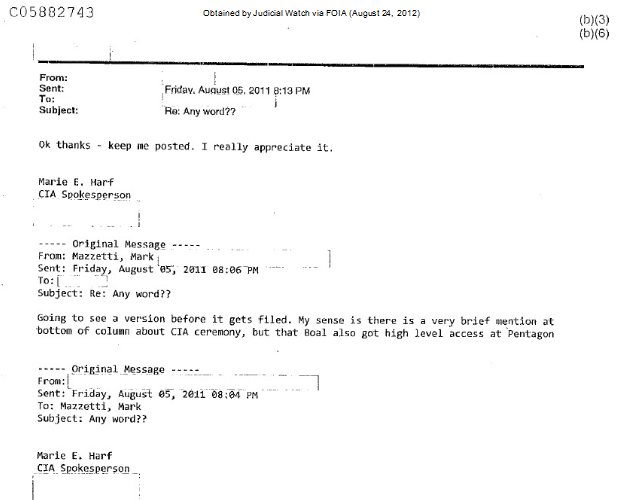
But what is news in this disclosure are the newly released emails between Mark Mazzetti, the New York Times‘s national security and intelligence reporter, and CIA spokeswoman Marie Harf. The CIA had evidently heard that Maureen Dowd was planning to write a column on the CIA’s role in pumping the film-makers with information about the Bin Laden raid in order to boost Obama’s re-election chances, and was apparently worried about how Dowd’s column would reflect on them. On 5 August 2011 (a Friday night), Harf wrote an email to Mazzetti with the subject line: “Any word??”, suggesting, obviously, that she and Mazzetti had already discussed Dowd’s impending column and she was expecting an update from the NYT reporter.

A mere two minutes after the CIA spokeswoman sent this Friday night inquiry, Mazzetti responded. He promised her that he was “going to see a version before it gets filed”, and assured her that there was likely nothing to worry about:

“My sense is there a very brief mention at bottom of column about CIA ceremony, but that [screenwriter Mark] Boal also got high level access at Pentagon.”

She then replied with this instruction to Mazzetti: “keep me posted”, adding that she “really appreciate[d] it”.

Mazzetti

Moments later, Mazzetti forwarded the draft of Dowd’s unpublished column to the CIA spokeswoman (it was published the following night online by the Times, and two days later in the print edition). At the top of that email, Mazzetti wrote: “this didn’t come from me … and please delete after you read.” [Continue reading…]

Mazzetti has told the Times’ public editor Arthur Bisbane, “I did make a bunch of calls and was doing this on deadline. As part of the process, I also did send the column [to the CIA]. It was definitely a mistake to do. I have never done it before and I will never do it again.”

Mazzetti was working on a deadline. So? He’s a reporter. That’s what reporters do.

Still, he’s acknowledged his mistake — but which one? Sending the column to the CIA? Or asking them to cover it up?

Then to cap the damage control he offers this assurance: he never did it before and will never do it again.

This is coming from a journalist who didn’t just get caught colluding with the CIA. He also got caught trying to cover up the evidence. And now he wants everyone to believe this was a one-time offense.

On the contrary, it sounds more like the kind of mea culpa one might expect from a serial liar. After all, he could merely have acknowledged this “mistake” without trying to portray himself as a choir boy.

Executive Editor Jill Abramson and Managing Editor Dean Baquet both went out of their way to minimize what Mazzetti did. If it turns out that he is really a serial offender, all three of them should get fired.

Facebooktwittermail

Syria: FSA captures missile storage base

A video posted on YouTube in the last few hours has this description:

The FSA captures a missile storage base near Damascus. Some of the missiles were being modified by the Assad regime so that chemically charged warheads could be fixed on them.

I can’t confirm any of that information or say anything about the Arabic text at the beginning. What seems evident, nevertheless, is that this video was indeed made in a missile storage facility which is no longer under the control of the Syrian military.

Watch the video at YouTube — embedding has been disable so I can’t post the video here.

Facebooktwittermail

Twitter — the new opium of the people?

At first glance, the statistics on Twitter use across the Arab world suggest that there is an inverse relationship between tweeting and revolution. With the exception of Bahrain, Twitter activity appears to be at its greatest among the unrevolutionary Gulf states.

The numbers used for this infographic come from the Dubai School of Government’s Arab Social Media Report and, as far as I can tell, their statistics are gathered simply on a country-by-country basis. For that reason, the numbers for the Gulf states need to be viewed with some caution since most of these countries have large and in some cases majority non-national populations. In other words a proportion of Gulf tweeters (who knows how large) are foreigners most of whom are likely to be politically disengaged by default — these are people who live in the Gulf to make money, not foment social change.

(Click on the image to enlarge.)

Twitter Active Users in Arab World - English

Browse more infographics.

Facebooktwittermail

Senior Israeli rabbi calls on Jews to pray for annihilation of Iran

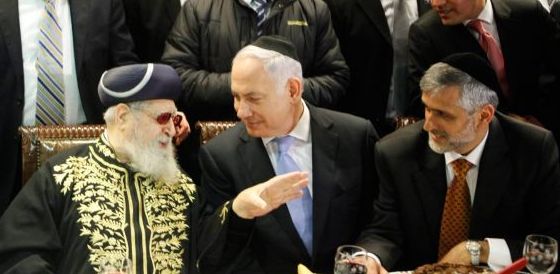
Rabbi Ovadia Yosef, Prime Minister Benjamin Netanyahu, and Interior Minister Eli Yishai.

Rabbi Ovadia Yosef, the ultra-Orthodox leader of the Shas party, does not speak for the Israeli government. Nevertheless, since Yosef’s advice has been sought by Israel’s political leaders on the issue of a possible attack on Iran, the comments from Yosef and those coming from Tehran deserve to be compared.

Nima Shirazi notes:

The rhetoric used in recent speeches by top Iranian officials has garnered much attention in the mainstream media. In addition to the outrage expressed over the statement that the Israeli governmental system and guiding Zionist ideology is an “insult to humanity,” comments that the “Zionist regime” is a “cancerous tumor” have also met fierce condemnation.

Here, as is typically the case, the target of Iranian political venom is not the Jewish people or the state of Israel but instead the political system, Zionism, through which Israel is governed. Naturally, many Jews inside and outside Israel find such strident and hateful language threatening, yet such attacks on Zionism are no more a threat to annihilate the Israeli population than were calls for the end of the Soviet Union the expression of a desire to wipe out Russians.

In contrast, when Rabbi Yosef calls for Iran’s destruction, as he did yesterday, he appears to be advocating genocide. He might be calling on God to destroy Israel’s enemies but many a war maker claims as his inspiration, divine guidance.

Haaretz reports: Rabbi Ovadia Yosef, who was updated last week on the Iranian nuclear project, called on Jews to pray for the destruction of Iran, this past Saturday.

During his weekly sermon, the ultra-Orthodox leader of the Shas party stated that his followers should pray for the annihilation of the enemies of the Jewish people during Rosh Hashana (Jewish New Year), with an emphasis on Iran and Hezbollah.

“When we say ‘may our enemies be struck down’ on Rosh Hashana, it shall be directed at Iran, the evil ones who threaten Israel. God shall strike them down and kill them,” said Yosef.”

The comments come in the wake of visits by senior defense officials, including National Security Council head Ya’akov Amidror and Interior Minister Eli Yishai, to Yosef to convince Yosef to support a possible Israeli attack on Iran.

It is not known whether Amidror or any of the others succeeded in persuading Yosef. However, during a sermon delivered the previous week, a day after his meeting with Amidror, Yosef said: “You know what situation we’re in, there are evil people, Iran, about to destroy us. … We must pray before [the almighty] with all our heart.”

Prime Minister Benjamin Netanyahu’s security cabinet, which Israeli officials have said is divided over the question of launching a go-it-alone attack on Iran, includes a Shas minister as one of its eight members. Iran says it is enriching uranium for peaceful purposes.

Yosef wields significant influence over Shas’s lawmakers, who seek his guidance on policy.

In the past, the Baghdad-born Yosef has stirred controversy by likening Palestinians to snakes, calling for Palestinian President Mahmoud Abbas to “perish from this world” and describing non-Jews as “born only to serve us”.

But he has also spoken out in favour of Israel ceding occupied land for peace with the Palestinians in order to end conflict and save Jewish lives.

Facebooktwittermail

How AIPAC corals American journalists into the pro-Israel camp

Journalists don’t quite maintain a code of silence when it comes to covering professional misconduct in their own business, but there’s clearly a general reluctance within the press to scrutinize itself. No one wants to look treacherous or close doors to their own career advancement. So, the following report from The Forward is unusual in shining a spotlight on willingness of American journalists to take guidance from the Israel lobby.

The report focuses on the operations of the American Israel Education Foundation (AIEF), an AIPAC offshoot which funds Congressional trips to Israel, but their propaganda efforts are not just directed at the so-called representatives of the American people; they also manipulate the so-called Fourth Estate:

AIEF takes more than just members of Congress on trips to Israel; it takes journalists, too, on a regular basis. Discussing the latest Sea of Galilee events, Chris Matthews host of MSNBC’s “Hardball,” said on August 20: “I’ve been there a number of times, a trip sponsored by a pro-Israel group, Jewish group, very educational trips. They show you a lot about the geography of the land and the situation they’re facing with the Palestinians.”

MSNBC did not return several calls requesting comment on Matthews’ participation in these trips and the network’s policy on joining press junkets.

A spokesman for AIEF would not provide details on the number of reporters hosted by the group in Israel, but there are estimates based on reports of participants indicating that dozens of journalists have participated in pro-Israel junkets throughout the years.

“It’s a super-effective strategy,” said David Plotz, editor-in-chief of the online magazine Slate. Plotz attended an AIEF trip in 2007. He noted that while the junket was “incredible fun,” with business class travel and fancy hotels, organizers packed the agenda with informative tours and “amazing interesting people,” including Israeli President Shimon Peres, top officers of the Israel Defense Forces and a senior Palestinian representative. Participants were free to quiz their hosts and to pose tough questions, but still, Plotz said he left Israel with the impression that “Gaza is a mess, the [security] wall is serving its purpose and that — oh, my God — Iran is six months away from nuclear weapons.” Slate does not have a policy prohibiting participation in junkets as long as reporters clearly state where the funding came from.

Many other American publications do not prohibit trips paid for by businesses or interest groups, though it is common to require full disclosure when reporting on topics relating to the tour. The New York Times, The Wall Street Journal, The Washington Post and all major TV networks insist on paying for their own expenses in all cases, as does the Forward.

“A responsible journalist has no business taking a free trip to Israel — or to any other country, or to a Hollywood film studio’s junket at a resort, or to any other destination that is involved in the subject matter that the journalist covers or is likely to cover in the future. Period,” said Samuel Freedman, a journalism professor at Columbia University’s Graduate School of Journalism and an expert on media ethics. Freedman stressed that even if the free trips do not create actual bias in the reporting, “they absolutely create the perception of bias, and that perception is just as corrosive to a journalist’s credibility.” Larry Lorenz, professor emeritus of journalism at Loyola University New Orleans, agreed that receiving free trips is wrong regardless of whether reporters write about the issue. “Journalism organizations should be concerned about giving the appearance of being bought,” Lorenz said.

Facebooktwittermail

If Breivik is sane, what is sanity?

Fittingly, a Norwegian court today pronounced its conclusion that Anders Behring Breivik is sane and thus has been given the maximum sentence for his crimes. As The Guardian notes, Norway demonstrated that terrorism can be faced without suspending the legal rights of the accused through ‘an open trial in an open society.’

But to say that Breivik is sane — even if we understand that to be nothing more than a determination of his legal responsibility for his own actions — begs the question of what we really mean by sanity.

We live in societies where it is generally assumed that, with a relatively small number of exceptions, everyone is sane. Sanity is normality, but what form of sanity functioned in Breivik’s mind?

To be sane is to be of sound mind and soundness of mind is a determination of mental coherence — that the mind is not broken. Whatever is sound is not about to fall apart.

This image of mind as an internal structure that may or may not rest on solid foundations, misses the fluid and dynamic relationship between cognition, awareness and the flood of sensory input out of which we can construct a constantly evolving understanding of the world.

If we are to view sanity as something with intrinsic value and not assume it to be commonplace, it actually has less to do with the internal structure that we designate as a sound mind than it has to do with the manner in which that mind engages with the world.

You can’t think straight unless there is a corresponding clarity in the way you see, hear, feel, and connect with your surroundings.

So many of the nominally sane are nothing more than sleepwalkers satisfied to engage with a crude representation of the world (“the world as I see it”) which becomes a filter that narrows and eventually replaces perceptions.

And nowhere is this filtering mechanism applied more extremely than in the mind of the ideologue. There, an infatuation with a representation not only means that filters are constructed in order to shut out anything that might challenge the ideology, but the ideologue then goes one radical step further by attempting to propagate his own conceptual framework inside the minds of others.

Breivik’s mind was consumed by a particularly destructive ideology; the fixations of others tend to be more benign, but what all hold in common is this inclination to shut out the world — a world that cannot be reduced to a collection of ideas; a world in which perceptions constantly touch the unknown; a world in which everyone’s vision springs from a vantage point.

Facebooktwittermail

Suicide attacks in Syria

John Rosenthal writes: There has recently been a small stir in the American media, as media organizations from the New York Times to the Wall Street Journal to the Associated Press have finally gotten around to acknowledging a “presence” of al-Qaeda and like-minded jihadist groups among the Syrian rebel forces seeking to topple the regime of Bashar al-Assad.

It is difficult to see what the cause of the excitement is. After all, such a presence has been blindingly obvious for many months: whether as a result of the dozens of suicide attacks that have plagued Syria or the numerous videos that have emerged showing rebel forces or supporters proudly displaying the distinctive black flag of al-Qaeda.

Dozens of suicide attacks? Is that an overstatement? The Long War Journal has compiled the statistics and the total currently stands at 25 such attacks. Two dozen is technically dozens because it’s more than one dozen but I think for most people the phrase “dozens” connotes a lot more.

For years, Bashar al Assad’s regime sponsored the flow of suicide bombers and foreign fighters into Iraq to fight Coalition forces. But suddenly, on Dec. 23, 2011, the regime’s own intelligence apparatus was struck by two suicide bombers in Damascus, leaving 44 dead and more than 160 wounded. The rebellion against Assad had begun nine months earlier, but no major suicide attacks, if any at all, were reported until that day in December.

The Syrian government blamed “terrorists.” The Syrian opposition blamed Assad, saying that the attacks were a false flag operation intended to undermine support for the rebels. But the opposition has clear incentives to write off the December 2011 suicide attacks as the work of the Assad regime. The rebellion had not been started by al Qaeda, and the group’s entry into the fight would only complicate international support for overthrowing the Syrian dictator.

There is a simple explanation for the suicide attacks in December and the others that would follow: blowback. Al Qaeda is staging a remarkable surge of its own in Syria.

Top US officials worried about just such a possibility well before the rebellion began. For example, a leaked State Department cable from July 2009 summarizes General David Petraeus’s view of the relationship between AQI and the Syrian regime. “In time,” the cable reads, “these fighters will turn on their Syrian hosts and begin conducting attacks against Bashar al Assad’s regime itself, Petraeus predicted.”

Relying on translations prepared by the SITE Intelligence Group and other publicly-available reports, The Long War Journal has found that approximately 25 suicide bombings have been executed in Syria since the end of last year. This includes the Dec. 23, 2011 attacks and 24 suicide bombings since the first of this year. That is, there have been about 25 suicide bombings in Syria in less than eight months.

A listing of these attacks, including links to sources when appropriate, is included below.

While this may not seem like an especially high number, it is a striking figure when compared to the global martyrdom campaign. For instance, according to the National Counterterrorism Center (NCTC), there were 279 suicide attacks in the world in 2011. 259 of these attacks were carried out by “Sunni extremists,” or jihadists. Only one of the 259 occurred in Syria. This suggests that the prolific use of suicide bombers in Syria that began late last year now represents a significant percentage of all such attacks carried out around the globe.

Based on the available information about the number of casualties from suicide attacks in Syria, the average number of deaths per day may be as few as one and perhaps as high as two. Given that the average number of deaths overall is now well over 100 per day, deaths from suicide attacks make up a tiny fraction.

Meanwhile in neighboring Iraq during 2012, deaths from suicide attacks have averaged seven per day. In other words, the risk of being killed by a suicide bomber is far greater in Iraq than it is in Syria even though the overall level of violence in Syria is vastly more than in Iraq.

In the Western media suicide attacks often seem to be portrayed as random acts of violence by Jihadist extremists who have a hunger for martyrdom, but in reality they are simply one of many gruesome forms of violence employed in a variety of situations for a variety of purposes.

Contrary to the state-driven propaganda which portrays Assad’s forces arraigned against hordes of foreign terrorists, there is currently no reason to suppose that such attacks are likely to become much more prevalent in Syria than they already are — which is to say, they are likely to remain a peripheral feature of the conflict.

Facebooktwittermail

Breivik’s sanity

To virtually any eye, it is a bizarre spectacle to witness the visible self-satisfaction radiating from the face of a man as he hears his sentence for mass murder. But since Anders Behring Breivik’s trial hinged on the question of his sanity — something about which he seemed to be in no doubt — his conviction is for him a perverse kind of vindication. It represents the failure of the prosecution’s effort to de-politicize Breivik’s crime.

Had the Norwegian been declared insane then his own explanation of the meaning and motivations for his actions would have been rendered meaningless. His theories about the effect of multiculturalism would simply be viewed as the products of a psychotic mind. His connection to polemicists, political activists, and bloggers who promote similar ideas would be treated as somewhat tenuous and their own disavowals would have been lent some extra strength.

But Breivik had an explicit and fully articulated political agenda. And his acts of terrorism were a means to an end: the promotion of his political views.

Paradoxically, counter-terrorism feeds terrorism through its effort to drain the political content from acts of violence.

Bombings and bloodbaths are the most extreme demand to be heard, yet those to whom such demands are directed often think that if the political content of terrorism is acknowledged then this would be a kind of capitulation. It would offer, so the argument goes, an incentive to others who thought that violence is an effective tool for making political demands.

The alternative is to open political debate and instead of trying to treat terrorists as purely criminal or insane, to show that their violence is not an extreme reaction to being silenced; their marginality is a product of their weak minds and the deficiency in their own powers of persuasion.

Breivik was not the victim of political oppression. The journey he traveled from an enthusiastic internet commenter to ruthless bomb-maker was not the result of being muzzled. It was a wild escalation in overstatement.

Facebooktwittermail

What Ryan represents

David Bromwich writes: On 11 August, Mitt Romney stirred excitement in a dull election by announcing that he would share the Republican ticket with Paul Ryan: a seven-term congressman, chairman of the House Budget Committee and intellectual guru of the congressional Tea Party. The choice was not altogether surprising. The moderate lawmakers whom Romney might have picked were without popular appeal, and it must have seemed possible that Ryan’s extreme proposals for federal budget-cutting and lowering taxes on the rich could be presented as evidence of a manly concern with principle which any impartial spectator ought to admire.

News presenters, keen on human interest, point out again and again that Ryan’s father died suddenly when he was 16. He learned independence the hard way, the story seems to say. In fact, Ryan grew up in Janesville, Wisconsin, close to grandparents and aunts and uncles who constituted an aristocracy in the town. The Ryans were numerous and they were rich. In time of trouble, Paul could always fall back on the network of a family that lived in concentric circles around him. His proposals to reduce the social ‘safety net’ for the unlucky may be seen as drawing a convenient but contortedly wrong lesson from his own life.

Ryan learned his anti-government ideology from an intoxicated early exposure to the writings of Ayn Rand.[*] It is now clear that Rand has been the most influential thinker in American politics of the last fifty years. Her novels The Fountainhead and Atlas Shrugged promote, as Rand put it, a ‘morality of rational self-interest – or of rational selfishness’. The central tenets of her politics, hatred of anything that could be construed as self-sacrifice and cruelty towards the helpless, are the exact inverse of the worship of collective sacrifice and blind solidarity that she detested in communism. For a lonely but well-fed achiever in Janesville, this doctrine was a gift – just as it had been once for Alan Greenspan, a young cultist before he became chairman of the Federal Reserve and presided over the bubble and collapse of the Clinton and Bush years.

What signal did Romney send by choosing Ryan? He is on the ticket to make sure that Romney will let Wall Street write its own rules. Free the dollar men, and free them not abashedly but proudly. The odd thing about the choice is that Ryan, though he is running for vice-president, was immediately taken to be the counter-Obama. At 42, he is young, as Obama was young in 2008. He, too, is an ‘idealist’. What the country has vaguely now been promised is an honourable contest of ideals. Yet it was natural for people to compare Ryan with Obama on other grounds. Both are handsome, athletic, comfortable with their early success, and irritating in no obvious way. Somewhere beneath the Obama presentation was always the message: ‘No one (ultimately) can resist my serious charm, and all problems (eventually) find solutions by listening to my voice.’ Ryan’s appeal is just as in-the-groove, but it takes the delivery to the edge of aggression: ‘I am clever and quick, I never lose my temper, and people can only pretend I didn’t win the argument if they ignore my facts and numbers.’

Where Obama projected the calm consciousness of a grave but unnamed mission, Ryan’s self-love is more recognisably American-boyish. He radiates ambition, healthy ambition, as if ambition were one of those permitted substances you could take at the gym to enhance performance. He has a lean and hungry look even when he smiles; and a relentless eagerness also, which will wear on people over time. His constant demeanour is cocksure; his face never registers reflection. Listening to other people is a formality, for Ryan, to be endured before he springs his answers. And how the answers pour out! There is an attractive, efficient speed in the way he works, but also a kind of deadness. And the deadness is there in his eyes – the hard eyes of the self-fulfilled and self-justified, clean of mind and clean of body, a whole mental mansion trip-wired against invasion by entities seeking pity and bearing excuses. [Continue reading…]

Since the beginning of the age of television, Americans have been deeply affected by the way candidates look and the deadness Bromwich rightly observes in Ryan’s eyes reminds me of my first response to the Romney-Ryan combination: these guys look like undertakers.

Romney offers the saccharin words of condolence, while Ryan gives a suitably concise presentation on the options for choosing a casket. And perhaps that’s fitting, now that the contrived hopes inspired during the last election have given way to a pervasive sense of cynicism and despair.

Facebooktwittermail

Congressional vacations-for-votes corruption exposed

Every once in a while most of us get offered a free vacation and most of us are smart enough to know that they are not free — there’s got to be some kind of quid pro quo. Corporate marketing departments simply don’t exist to give things away unless such “gifts” offer a reasonable rate of return.

When Rep. Kevin Yoder stripped off his clothes on the shores of the Sea of Galilee last summer, a few drinks might have helped him shed his inhibitions, or he might have momentarily forgotten he was a Republican, or he might have been thinking “Thank God I’m not in Kansas,” but whatever was going through his mind, it turns out that what got exposed wasn’t his genitals — let’s be honest, Yoder indiscretion hardly compares with Anthony Weiner’s — it was AIPAC: the night flower that thrives in darkness and can’t even tolerate moonlight.

The New York Times reports: The trip was much like any of the hundreds hosted in recent years by a nonprofit offshoot of the American Israel Public Affairs Committee, a powerful Washington lobby, and the purpose was much the same: to solidify the support of American lawmakers for Israel at a time of Middle East tumult.

For eight expense-paid days, House Republicans visited Israel’s holiest sites, talked foreign policy with its highest officials and dined at its most famous restaurants, including Decks, known for its grilled beef, stunning views of the Sea of Galilee, and now, for an impromptu swim party.

With hundreds of Washington lawmakers having gone to Israel courtesy of the program, the trips have a reputation as being the standard-bearer for foreign Congressional travel. “We call it the Jewish Disneyland trip,” said one pro-Israel advocate in Washington.

But for lawmakers, the attention surrounding last summer’s trip — thanks to reports of a skinny-dipping Kansas lawmaker who was part of the delegation — has cast an unwanted spotlight once again on the practice of private groups paying for foreign travel, a source of frequent criticism in the past.

One of the most famous travel boondoggles — a golf trip to Scotland for members of Congress and staff members, hosted by the lobbyist Jack Abramoff — led Congress in 2007 to tighten restrictions on who could sponsor trips and for how long. But despite the new restrictions, the number of Congressional trips paid for by outside groups has actually increased since 2007, to more than 1,600 from about 1,300, according to Legistorm, a research group that tracks Congressional data. To comply with the new restrictions, many political and lobbying groups have turned to nonprofit groups they set up and finance to host the Congressional trips.

Since 2000, the American Israel Education Foundation has been more prolific than any other in sponsoring overseas trips for members of Congress and their staffs, organizing 733 trips for both Republicans and Democrats at a cost of more than $7 million. Last year, it spent $2 million to sponsor 146 trips, far outpacing a Turkish coalition that ranked second, sponsoring 32 trips.

Last summer, there were so many members of Congress traveling — about 80 — that the education fund sponsored two separate trips. Israeli officials who met with the Congressional delegation that included the swim party said it seemed to include many first-time visitors, who knew little about Israel and appeared a bit naïve about its policies and traditions. Many of them were newcomers in Congress who were elected in 2010 with Tea Party support.

“What was remarkable about that group was most of them were freshmen; it was their first visit in Israel, and they did not know much, but they were very interested,” said one senior Israeli official who met with the delegation and spoke on the condition of anonymity. “I’m used to meeting members of Congress, and usually they’ve been here, we know them from the past.”

Among the donors who have helped to finance the trips is Sheldon Adelson, the casino magnate who is a strong Israel supporter and has pledged to spend as much as $100 million to defeat President Obama. A charitable trust operated by Mr. Adelson and his wife gave $1.2 million in 2006 to the American Israel Education Foundation, records show.

The mealy-mouthed New York Times might describe these trips as having the aim of solidifying support for Israel, but let’s be honest: we’re talking about bribery. It doesn’t involve unmarked bills in plain brown envelopes, but no one in Congress is in any doubt about how they are expected to show their thanks for a free vacation to Israel. Take vacations; pay with votes.

Facebooktwittermail

Life with Syria’s rebels in a ruthless war

C.J. Chivers reports: Abdul Hakim Yasin, the commander of a Syrian antigovernment fighting group, lurched his pickup truck to a stop inside the captured residential compound he uses as his guerrilla base.

His fighters had been waiting for orders for a predawn attack on an army checkpoint at the entrance to Aleppo, Syria’s largest city. The men had been issued ammunition and had said their prayers. Their truck bomb was almost prepared.

Now the commander had a surprise. Minutes earlier, his father, who had been arrested by the army at the same checkpoint in July, had called to say his jailers had released him. He needed a ride out of Aleppo, fast.

“God is great!” the men shouted. They climbed onto trucks, loaded weapons and accelerated away, barreling through darkness on nearly deserted roads toward a city under siege, to reclaim one of their own.

Mr. Yasin was pensive as he drove, worried that the call was a ploy to lure him and his fighters into a trap. “Often the government does this,” he said. “Usually it is an ambush.”

He had sent an empty freight truck ahead, he said, to check the way. But he never slowed down.

During five days last week, Mr. Yasin and his group, the Lions of Tawhid, allowed two journalists from The New York Times to live and travel beside them as they fought their part in the war to unseat President Bashar al-Assad.

This group falls under the command of Al Tawhid Brigade, a relatively new structure in Aleppo Province that has unified several groups and fights under the banner of the Free Syrian Army, the loose coalition of armed rebels.

While broad extrapolations are difficult to glean from one fighting group in a complex society, the activities and personal stories of these men, a mix of civilians who took up arms and dozens of army defectors who joined them, offers a fine-grained look of the uprising, and the momentum and guerrilla energy it has attained.

Mr. Yasin, 37, was a clean-shaven accountant before the war. He lived a quiet life with his wife and two young sons. Now thickly bearded and projecting a stoic calm under fire, he has been hardened by his war in ways he could not have foreseen. [Continue reading…]

And this is the point that everyone outside the war must remember, be they critics or supporters of the revolution: with our glib certainties we might imagine we know what course of action our political beliefs and moral values would dictate at a time of war, but we really don’t actually know what we would do if we found ourselves faced with the stark choices that now shape the lives of so many Syrians. Paradoxically, the ability to put ourselves in someone else’s shoes often depends on our ability to acknowledge how limited is the experience we share.

In this report and many others, the religiosity of the rebels is apparent and its mix with chilling violence will for many Western observers confirm their fears about the rise of Islamic extremism. But think about it. This doesn’t simply reflect the conservative religious trends that permeate the Middle East. Religiosity in this case is as much as anything reactive. It is in part a reaction to the fact that across the region, secularism, corruption, and dictatorship seem to have always ended up working together hand in hand. Thus those who are concerned that the fragile growth of democracy requires the protection that secularism might seem to offer must acknowledge that in the Middle East, secularism has too often been the vehicle of injustice. (I note this as an atheist.)

Facebooktwittermail

‘Samaritan attacks’ — the U.S. policy of killing people who help drone-strike victims

‘Samaritan attack’ is an expression unknown to most Americans. That’s hardly surprising given that the phrase has never appeared in U.S. media coverage of President Obama’s drone war in Pakistan, Yemen, and Somalia.

Rasul Mana, who comes from the village of Sirkut Burakhel Supulga in Waziristan, describes the experience of living under the constant threat of a drone strike and explains what ‘Samaritan attack’ means.

Every day we hear the voice of the drones at least six or seven times. We listen for the voice 24 hours a day. We are afraid at night as we lie in our beds.

The drones are going around and around over our heads. There may be four or five at any given time. They are normally very high, but sometimes they come down if there is a dust storm or it is cloudy. They also tend to come down lower to attack, which is when you get very scared.

When the missile is launched it makes a loud noise – zzhhooo – as it drops onto its target.

Many of the strikes are in the black of night. We run to where the attack has happened, we see people dead and crying in pain. No matter what time of night, the children will all be awake and crying. When we look for the injured, or pick up the pieces of the dead bodies, we know that the Americans may do another attack. It’s called a Good Samaritan attack, aimed at anyone who tries to help the injured, as they’re assumed to be friends of the original victims, who are themselves assumed to be militants.

Glenn Greenwald picks up the issue from his new perch at The Guardian.

The US government has long maintained, reasonably enough, that a defining tactic of terrorism is to launch a follow-up attack aimed at those who go to the scene of the original attack to rescue the wounded and remove the dead. Morally, such methods have also been widely condemned by the west as a hallmark of savagery. Yet, as was demonstrated yet again this weekend in Pakistan, this has become one of the favorite tactics of the very same US government.

A 2004 official alert from the FBI warned that “terrorists may use secondary explosive devices to kill and injure emergency personnel responding to an initial attack”; the bulletin advised that such terror devices “are generally detonated less than one hour after initial attack, targeting first responders as well as the general population”. Security experts have long noted that the evil of this tactic lies in its exploitation of the natural human tendency to go to the scene of an attack to provide aid to those who are injured, and is specifically potent for sowing terror by instilling in the population an expectation that attacks can, and likely will, occur again at any time and place:

“‘The problem is that once the initial explosion goes off, many people will believe that’s it, and will respond accordingly,’ [the Heritage Foundation’s Jack] Spencer said … The goal is to ‘incite more terror. If there’s an initial explosion and a second explosion, then we’re thinking about a third explosion,’ Spencer said.”

A 2007 report from the US department of homeland security christened the term “double tap” to refer to what it said was “a favorite tactic of Hamas: a device is set off, and when police and other first responders arrive, a second, larger device is set off to inflict more casualties and spread panic.” Similarly, the US justice department has highlighted this tactic in its prosecutions of some of the nation’s most notorious domestic terrorists. Eric Rudolph, convicted of bombing gay nightclubs and abortion clinics, was said to have “targeted federal agents by placing second bombs nearby set to detonate after police arrived to investigate the first explosion”.

In 2010, when WikiLeaks published a video of the incident in which an Apache helicopter in Baghdad killed two Reuters journalists, what sparked the greatest outrage was not the initial attack, which the US army claimed was aimed at armed insurgents, but rather the follow-up attack on those who arrived at the scene to rescue the wounded. [Continue reading…]

Facebooktwittermail