
Category Archives: ISIS

Islamic State of Iraq and Syria

ISIS — a faceless organization that stands for nothing

Icons are inescapable — even for those who make it their business to destroy them.

For Al Qaeda, Osama bin Laden was an iconic figure. The American effort to hunt him down had more to do with the need to destroy his image than to thwart a terrorist.

So who or what stands as the central symbol, the image around which ISIS gravitates?

In early July, ISIS released a short video showing the stone-faced Abu Bakr al-Baghdadi preaching in a mosque in Mosul. Even if this man happens to be a brilliant military strategist, he possesses no obvious charisma. He looks somewhat less personable than Adolf Hitler and Joseph Stalin.
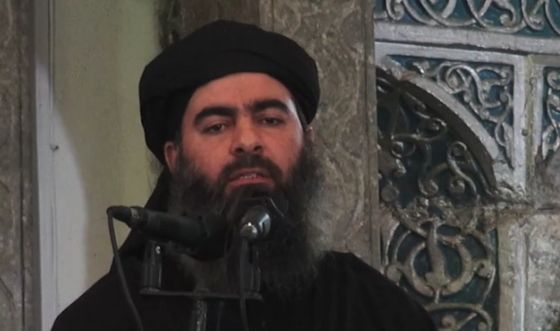
Caliph-Ibrahim

Badhdadi’s brief appearance carried much less significance than the arrival of a new caliph and seemed to have more to do with proving the existence of what was and remains a shadowy figure.

Based on the little he has revealed about himself, his followers have clearly committed themselves through acts of blind allegiance.

The head of ISIS is for all practical purposes invisible.

Moreover, in spite of the fact that ISIS has recruited fighters from dozens of countries, many from the West and many speaking English, from throughout its ranks it appears they have no one competent to serve as a spokesman. Instead they rely on the face and voice of their British hostage, John Cantlie, whose BBC-English offers them credibility they fear they would lack if they dared represent themselves.

ISIS has no face of its own.

Likewise, their media offerings unintentionally pay homage to American cable news and Hollywood, as though there could be no means of communication superior to the crude aesthetic conventions that have been globalized by CNN and Warner Brothers.

On the battlefield, nothing appears to have been a source of greater pride than ISIS’s ability to capture and use American-made military hardware.

ISIS is not American-made in the sense intended by conspiracy theorists, yet in ways its followers would be loath to acknowledge it is in large part an American product — first and foremost as a product of America’s misadventure in Iraq, but also in the multiple ways in which in leans upon American culture.

If there is one image that ISIS has made its own and that serves to symbolize everything ISIS stands for, it is that of grinning men holding aloft freshly severed human heads.

Thanks mostly to Twitter, these are the images we get confronted by with a frequency that would until recently have seemed unimaginable.

Ask anyone in the world about ISIS and the one thing everyone knows is that decapitation is the ISIS signature.

As a symbol of the enemy vanquished, the severed head represents a victory more absolute than unconditional surrender. As such, ISIS presumably engages in these acts of ritual slaughter in order to display its uncompromising, ruthless power.

But the symbolism also cuts another way: the organization with an invisible head and no public face of its own, through decapitation represents its own headlessness.

Furthermore, through its subjugation of women by slavery and rape, ISIS manifests its relationship with the powers of creation: its powers are solely destructive.

What does ISIS ultimately stand for? Death, and little else.

Facebooktwittermail

How the Left abandoned the Kurds by getting stuck up its anti-imperialist cul-de-sac

Yasin Sunca writes: One can simply put hundreds of reasons as to why the left has to oppose and react against the ISIS and what they have been doing to innocent people throughout last two years. However, those who are supposed to speak out against the ISIS, primarily the left wing parties and organisations, have simply failed to come up with a comprehensive approach, are even devoid of understanding what is going on exactly and, unfortunately for them, are stuck in the orthodox interpretation of socialism against imperialism. They have once again stuck to the marginal track to blame their respective governments as imperialist, which in fact, means almost nothing, either for the government or for the society.

In the specific case of the ongoing resistance of the Kurds in Rojava (Syrian Kurdistan) the Popular Protection Units (YPG) have been resisting against both the brutal attacks of the jihadists and the military aggressions of the Syrian regime. The Kurds have not opted for cooperation either with the regime or the mainstream opposition groups due to very convincing and understandable reasons. The regime has been oppressing the Kurds, among others, for a very long time and therefore, it was impossible for the Kurds to go along with the regime politically. However, facing political and military difficulties in the context of the ongoing war, the regime decided to focus on the strategic areas in their war with the opposition groups and intelligibly, have not carried out heavy military offensives against the Kurdish self-declared cantons, compared to other regions of the country. Furthermore, the declaration of the Kurdish cantons in Rojava would pose certain problems to Turkey which has been amongst the most vocally critical countries of the Syrian regime. Thus, we can talk about a political convergence between the regime and the Kurds rather than a strategically motivated agreement. Besides, the Kurds could not have cooperated with the mainline Syrian opposition because of two core issues. The first, the Arab opposition have not recognised any collective rights of the Kurds and postponed all Kurdish demands to a probable post-Assad period. The second, the Arab opposition did not have a clear agenda for the future of Syria. The question such as whether it would be a new dictatorship or a democracy has not a clear and convincing answer and the Kurds remained sceptical about the will of the opposition in relation to democratisation.

Taking all this background into account, the Kurds opted for a third line policy and started to build their cantons with a new democratic understanding, inclusive of all the different factions of the population. The Kurdish cantons have never carried out any offensives against any group unless a military attack was the case. The current resistance of the Kobane canton is due to the brutal attack of the jihadist ISIS and it is a war of self-defence. The Kurds are carrying out a socialist experiment in the Middle-East, one of the most challenging regions of the world, and the international left is equally responsible for the protection of this emerging socialist hope. This experiment needs the unconditional support of the socialists of the world and internationalist solidarity. (For those who are interested in the new model in Rojava here is an article, available online: http://roarmag.org/2014/07/rojava-autonomy-syrian-kurds/)

However, the left wing parties and groups in Europe are far from understanding what is going on exactly in Kurdistan and in Kobane, nor do they have any plans to understand the ideological background of the Rojava Cantons. They have to admit that they were unable to understand the third line policy and, just like the mainstream media have been doing, positioned the Kurds together with the Assad regime despite the fact that the Kurds clearly declaring and practically manifesting a billion times that they are an opposition group. They kept on blaming the Kurds to be the proxy of the regime. Besides, some other groups adopted a restrictive approach and claimed that if the Kurds are not with Bashar al-Assad then they have to be with the opposition. Yet one should remind people of the fact that being against the regime doesn’t automatically mean accepting all analyses and projections of the mainline opposition in Syria. Moreover, the mainline opposition in Syria is also supported by “imperialists” against the regime. So, the Kurds clearly understood the right place to stand was a third line. [Continue reading…]

Facebooktwittermail

‘Rehana is alive and well… ISIS fanatics have NOT beheaded her’

The Daily Mail reports: The female Kurdish fighter who became a poster girl for the Kobane resistance before allegedly being beheaded by Islamic State militants is actually alive and well, it was claimed today.

The woman, known by the pseudonym Rehana, was celebrated as a symbol of hope for the besieged Syrian border city after an image of her making a peace sign was retweeted over 5,000 times.

That picture was followed days later by a gruesome photograph of an ISIS terrorist holding the severed head of a young woman, sparking rumours that Rehana had been savagely murdered.

This is one of those moments when it remains to be seen whether the collective intelligence of the users of social media will be able to rise to the occasion.

That Rehana is alive — if this is true — is of course good news. But the photos of an ISIS fighter holding aloft the head of a Kurdish young woman fighter were most likely authentic — that young woman simply happened not to be one who had previously been turned into a “poster girl.”

Let’s not forget that the life as the unknown soldier is worth no less than that of the social-media celebrity.

Facebooktwittermail

Peshmerga on route to Kobane

Rudaw reports: Peshmerga from the Kurdistan Region of Iraq will arrive in Kobane in the early hours of Wednesday to help defenders of the Syrian border town fight off an Islamic State assault that has lasted more than 40 days, according to informed sources.

Part of the 150-strong Peshmerga artillery force were flying from Erbil to Turkey, from where they will cross to Kobane. Others will travel by road, accompanying trucks, guns, and other heavy weapons with which they hope to help defeat the ISIS siege.

The deployment of the Kurdish soldiers comes after being delayed for two days of negotiations with Turkey, through whose territory they must pass to reach Kobane, which lies just across the Turkish frontier.

Facebooktwittermail

The secret life of an ISIS warlord

The Daily Beast reports: The name that [ISIS commander] Abu Omar al-Shishani grew up with was Tarkhan. And because we are here in his hometown talking to the people who once loved him, and perhaps still do, we’ll use that name, too. Tarkhan’s father, Temur, a grizzled, eccentric, well-read old Christian with a bitter sense of self-irony, tells his sons’ story in an extensive — almost bizarre — interview with The Daily Beast at his small gray house in the village of Birkiani, where his boys grew up.

“I am like a hobo,” the old man declares. “My son is one of the founders of Islamic caliphate and I’m here, dying in poverty! Look! Look where I live!” According to Temur, his son even invited him to Syria. “He told me, ‘Dad, come with me. You’ll live like you are in paradise.’ I told him, ‘Save your paradise for yourself, I prefer my home here.’”

Despite Tarkhan’s fame as a holy warrior, the father doesn’t see him as particularly pious, his mother came from a Muslim family, but he didn’t show much interest. The old man claims that, in fact, before Tarkhan went to prison, he wasn’t religious at all. He supposedly warned his older brothers about the dangers of fanatical Islam, especially his brother Tamaz, who was fighting in Chechnya: “‘Be citizens of Georgia,’ Tarkhan would say to Tamaz, ‘You are in a war, you may fight there, but do not pick up their beliefs.’ And now look what happened! Do you see how a man can change?”

Like so many of the world’s most brutal dictators, military leaders, tyrants, and jihadists, it appears Tarkhan was trained by the very best: the United States government. [Continue reading…]

Facebooktwittermail

An army of child soldiers being raised by ISIS

Kate Brannen writes: They stand in the front row at public beheadings and crucifixions held in Raqqa, the Islamic State’s stronghold in Syria. They’re used for blood transfusions when Islamic State fighters are injured. They are paid to inform on people who are disloyal or speak out against the Islamic State. They are trained to become suicide bombers. They are children as young as 6 years old, and they are being transformed into the Islamic State’s soldiers of the future.

The Islamic State has put in place a far-reaching and well-organized system for recruiting children, indoctrinating them with the group’s extremist beliefs, and then teaching them rudimentary fighting skills. The militants are preparing for a long war against the West, and hope the young warriors being trained today will still be fighting years from now.

While there are no hard figures for how many children are involved, refugee stories and evidence collected by the United Nations, human rights groups, and journalists suggest that the indoctrination and military training of children is widespread.

Child soldiers aren’t new to war. Dozens of African armies and militias use young boys as fighters, in part because research has shown that children lack fully formed moral compasses and can easily be persuaded to commit acts of cruelty and violence.

The young fighters of the Islamic State could pose a particularly dangerous long-term threat because they’re being kept away from their normal schools and instead inculcated with a steady diet of Islamist propaganda designed to dehumanize others and persuade them of the nobility of fighting and dying for their faith. [Continue reading…]

Facebooktwittermail

ISIS promotes hostage John Cantlie as its embedded reporter in Kobane

The Washington Post reports: In a remarkable new video released by the Islamic State militants, British hostage John Cantlie gives a tour of the Syrian city of Kobane and denounces Western coverage of the fighting in the city.

(Note: Our video team believes the first segment of may have been doctored.)

Cantlie, a photographer and journalist who was taken hostage in late 2012, has appeared in a number of propaganda videos for the Islamic State in recent months, usually in an orange jumpsuit in front of a plain black screen. However, the new video, released Monday via social media accounts linked to the Islamic State, appears markedly more professional than the previous ones. Notably, it appears to show Cantlie walking outside and animatedly discussing recent events.

The video also takes aim at a different target: Although previous videos appeared designed to criticize Western military action against the Islamic State, this time the main target appears to be Western media and their coverage of the situation in Kobane, where the Islamic State has battled for control against Kurdish militias. [Continue reading…]

Facebooktwittermail

Inside Kobane

In this video, the squeaking in the background that sounds like birds chirping is actually coming from a rusty swing. The distant sounds of laughter and conversation from women — perhaps the same people on the swing, enjoying one of the recreations of childhood as daily life continues inside a war zone.


Facebooktwittermail

What ISIS hostages endured in Syria

The New York Times reports: The kidnappings, which were carried out by different groups of fighters jousting for influence and territory in Syria, became more frequent. In June 2013, four French journalists were abducted. In September, the militants grabbed three Spanish journalists.

Checkpoints became human nets, and last October, insurgents waited at one for Peter Kassig, 25, an emergency medical technician from Indianapolis who was delivering medical supplies. In December, Alan Henning, a British taxi driver, disappeared at another. Mr. Henning had cashed in his savings to buy a used ambulance, hoping to join an aid caravan to Syria. He was kidnapped 30 minutes after crossing into the country.

The last to vanish were five aid workers from Doctors Without Borders, who were plucked in January from the field hospital in rural Syria where they had been working.

At gunpoint, Mr. Sotloff and Mr. Abobaker were driven to a textile factory in a village outside Aleppo, Syria, where they were placed in separate cells. Mr. Abobaker, who was freed two weeks later, heard their captors take Mr. Sotloff into an adjoining room. Then he heard the Arabic-speaking interrogator say in English: “Password.”

It was a process to be repeated with several other hostages. The kidnappers seized their laptops, cellphones and cameras and demanded the passwords to their accounts. They scanned their Facebook timelines, their Skype chats, their image archives and their emails, looking for evidence of collusion with Western spy agencies and militaries.

“They took me to a building that was specifically for the interrogation,” said Marcin Suder, a 37-year-old Polish photojournalist kidnapped in July 2013 in Saraqib, Syria, where the jihadists were known to be operating. He was passed among several groups before managing to escape four months later.

“They checked my camera,” Mr. Suder said. “They checked my tablet. Then they undressed me completely. I was naked. They looked to see if there was a GPS chip under my skin or in my clothes. Then they started beating me. They Googled ‘Marcin Suder and C.I.A.,’ ‘Marcin Suder and K.G.B.’ They accused me of being a spy.”

Mr. Suder — who was never told the name of the group holding him, and who never met the other hostages because he escaped before they were transferred to the same location — remarked on the typically English vocabulary his interrogators had used.

During one session, they kept telling him he had been “naughty” — a word that hostages who were held with Mr. Foley also recalled their guards’ using during the most brutal torture.

It was in the course of these interrogations that the jihadists found images of American military personnel on Mr. Foley’s laptop, taken during his assignments in Afghanistan and Iraq.

“In the archive of photographs he had personally taken, there were images glorifying the American crusaders,” they wrote in an article published after Mr. Foley’s death. “Alas for James, this archive was with him at the time of his arrest.”

A British hostage, David Cawthorne Haines, was forced to acknowledge his military background: It was listed on his LinkedIn profile.

The militants also discovered that Mr. Kassig, the aid worker from Indiana, was a former Army Ranger and a veteran of the Iraq war. Both facts are easy to find online, because CNN featured Mr. Kassig’s humanitarian work prominently before his capture.

The punishment for any perceived offense was torture.

“You could see the scars on his ankles,” Jejoen Bontinck, 19, of Belgium, a teenage convert to Islam who spent three weeks in the summer of 2013 in the same cell as Mr. Foley, said of him. “He told me how they had chained his feet to a bar and then hung the bar so that he was upside down from the ceiling. Then they left him there.”

Mr. Bontinck, who was released late last year, spoke about his experiences for the first time for this article in his hometown, Antwerp, where he is one of 46 Belgian youths on trial on charges of belonging to a terrorist organization.

At first, the abuse did not appear to have a larger purpose. Nor did the jihadists seem to have a plan for their growing number of hostages.

Mr. Bontinck said Mr. Foley and Mr. Cantlie had first been held by the Nusra Front, a Qaeda affiliate. Their guards, an English-speaking trio whom they nicknamed “the Beatles,” seemed to take pleasure in brutalizing them.

Later, they were handed over to a group called the Mujahedeen Shura Council, led by French speakers. [Continue reading…]

Facebooktwittermail

How a Turkish leftist gave his life to save Kurdish Kobane

Al Jazeera: Suphi Nejat Agirnasli lived a scholar’s life on an island in the Sea of Marmara, a short ferry ride from the center of Istanbul. He was translating a multivolume encyclopedia of psychology from German into Turkish. He often worked in the living room, in sweatpants, looking out at the water.

“He told me that he didn’t want to grow up. He didn’t want to go to the adult world,” said his close friend Omer, a student who asked to be identified by only his first name.

But in August, Agirnasli cleaned out his room and vanished, leaving no indication of his destination. Two weeks ago, the news came that the 30-year-old died after joining Kurdish forces defending the besieged Syrian town of Kobane from Islamic State in Iraq and the Levant (ISIL).

Images from that brief final chapter of his life contrast with earlier photographs of the scholar hunched over his papers. In a portrait taken during his weeks with the Kurdish militia, Agirnasli stands straight, looking directly into the camera, a smile on his unshaven face. He is dressed in fatigues. In a video posted online, he states his name, birthdate and parents’ names. He holds a gun. Explosions can be heard in the background.

In the widening crisis emanating from Syria, Agirnasli’s profile stands out among the hundreds of men and women from Turkey — most of them ethnic Kurds — fighting in Kobane and the other parts of Syria.

Most of the estimated 15,000 volunteer foreign fighters who have been flooding into that theater of war are joining ISIL and other armed groups. But Agirnasli was fighting against them, making him one of the few non-Kurds, perhaps a few dozen men and women, who have taken up arms against ISIL.

“I think it will remain a small phenomenon in terms of fighters who are going across, but you’re seeing the fault lines played out inside Turkey coming from the Syrian conflict,” said Aaron Stein, a Geneva-based associate fellow with the defense think tank Royal United Services Institute. “It’s the militant left who are going to fight for the communist revolution and see the PYD as on the front lines against Islamism.” The PYD, or Democratic Union Party, is a Syrian Kurdish political party whose armed wing has been leading the battle against ISIL in Kobane. [Continue reading…]

Facebooktwittermail

ISIS threatens to kill British jihadis wanting to come home

The Observer reports: British jihadi fighters desperate to return home from Syria and Iraq are being issued with death threats by the leadership of Islamic State (Isis), the Observer has learned.

A source with extensive contacts among Syrian rebel groups said senior Isis figures were threatening Britons who were attempting to travel home. He said: “There are Britons who upon wanting to leave have been threatened with death, either directly or indirectly.”

The news comes after it was revealed that another young Muslim from Portsmouth had been killed on the frontline in Syria, the fourth to die from a group of six men known as the “Pompey lads” who travelled together to fight for Isis.

Meanwhile, the former Guantánamo Bay detainee Moazzam Begg confirmed that he was also aware of dozens of British men keen to return to the UK but who were trapped in Syria and Iraq, in effect held by a group they wanted to leave. Begg said he knew of more than 30 who wanted to come back. They had travelled to join rebels fighting the Syrian regime of President Bashar al-Assad but had subsequently become embroiled with Isis, some for language reasons – Isis had more English-speaking members. [Continue reading…]

Facebooktwittermail

West waging a ‘CNN war’ in Syria as ISIS makes gains in Iraq

The Telegraph reports: On the barren wastes of Mount Sinjar, the Yazidis are once more surrounded and fighting for their lives.

“We saw Isil, there are daily clashes with Isil. Today and yesterday there was heavy fighting,” said one stranded Yazidi man, Dre’i Shamo, last week. “The situation is very tragic and critical.”

Further south, the advance of the jihadists of Islamic State of Iraq and the Levant on Baghdad continues, slower than before but still with no sign of a reversal of fortune. Another district fell last week, after a major military base the week before, while scores more innocent civilians have died in a rise in bombings in the city itself.

The jihadists have also reached Ramadi, the capital of Anbar province and the last major city in western Iraq not in Isil’s hands.

The world’s attention has been focused on the medium-sized Kurdish town of Kobane, on the Syria-Turkey border, whose accessibility has provided countless opportunities for telegenic news coverage of American air strikes, which have multiplied in size and number. But Kobane is a secondary focus of the war that has been waging in Syria for more than three years; and that war is itself supposed to be secondary in strategic heft for America and its allies, including Britain.

They have deemed Iraq the first target of the fight against Isil. Yet the number of air strikes in supposedly less significant Syria has now reached double that in Iraq, as America and its allies seek to bolster Kobane’s defences.

Analysts and some Iraqis now wonder whether President Barack Obama’s declared strategy in the Middle East has been abandoned in favour of pursuing a short-term agenda dictated by the news agenda: that the “CNN factor was at play”, as Ben Barry, a former British Army brigadier, put it after compiling a detailed analysis of the military situation in Iraq.

Isil may even have drawn the West into a trap – pouring second-grade but eager foreign recruits into the battle for Kobane, while pursuing their more important goals next door, he said.

“Kobane is right against the border,” he told The Telegraph. “It may be that Isil deliberately took the decision to attack there to draw US air power away from Anbar.” [Continue reading…]

Facebooktwittermail

Kurds fear ISIS use of chemical weapon in Kobane

The Guardian reports: Kurds battling Islamic State militants for control of Kobani fear the extremist group may have used an unidentified chemical weapon, according to officials and one of the few doctors still working in the besieged Syrian town.

Patients with blisters, burning eyes and breathing difficulties turned up at a clinic after a blast was heard on Tuesday evening, Dr Walat Omar said. He described the symptoms as abnormal and said he could not identify their cause, but suspected a chemical weapon.

“After a loud explosion [on Tuesday night], we received some patients with abnormal symptoms. They reported a bad smell which produced some kind of allergic reaction,” Omar said in a telephone interview that was periodically disrupted by heavy explosions. [Continue reading…]

Facebooktwittermail

ISIS allegedly used chlorine gas against Iraqi security forces

The Washington Post reports: Dizzy, vomiting and struggling to breathe, 11 Iraqi police officers were rushed to a government hospital 50 miles north of the capital last month. The diagnosis: poisoning by chlorine gas. The perpetrators, according to the officers: Islamic State extremists.

The chlorine attack appears to be the first confirmed use of chemical weapons by the Islamic State on the battlefield. An Iraqi Defense Ministry official corroborated the events, and doctors said survivors’ symptoms were consistent with chlorine poisoning.

Iraqi forces say two other crude chlorine attacks have occurred since the extremists seized vast tracts of Iraqi territory this summer, but details on those incidents remain sketchy. The reported assaults all raise concerns that the militants are attempting to hone their chemical weapons capabilities as they push to control more ground.

The presence of a large former Iraqi chemical weapons production plant in territory seized by the Islamic State has compounded those fears, although officials and chemical weapons experts say the 2,500 degraded rockets filled with nerve agents that remain there are unlikely to be fit for use. Weapons inspectors sealed them off with concrete in a bunker more than 20 years ago.

The Islamic State’s reported chlorine attacks appear to have been largely ineffectual. The attack on the police officers last month is the only one officially documented.

Chlorine, a common component in industry, is sold legally, but its use as a weapon violates the Chemical Weapons Convention. It was widely employed in trench warfare during World War I, including infamously at Ypres in Belgium, where German forces dispersed more than 160 tons of chlorine into the breeze, killing thousands of French and Allied soldiers. [Continue reading…]

Facebooktwittermail

How America’s top military leader dragged Obama back into Iraq

Mark Perry writes: Apart from an occasional Thursday afternoon meeting between Barack Obama and Defense Secretary Chuck Hagel at the White House, Gen. Martin Dempsey — the chairman of the Joint Chiefs of Staff — rarely has opportunities to get face time with the president. So when he does, he presses his advantage. One of the few times this happened was during the early evening hours of Aug. 6, when Dempsey joined Obama in his limousine at the State Department, where the president had been attending a session of the U.S.-Africa Leaders Summit. The ride to the White House allowed Dempsey his first one-on-one with Obama in several weeks. As the two sat across from each other in the presidential limousine, Dempsey turned to his commander-in-chief.

“We have a crisis in Iraq, Mr. President,” Dempsey said, according to a senior Pentagon official who spoke with the chairman about his discussion with Obama that same day. “ISIS is a real threat,” he added, using an alternative acronym for the military group the Islamic State in Iraq and the Levant, or ISIL. The senior Pentagon official with whom I spoke, and who paraphrased the Obama-Dempsey exchange, added that “Dempsey really leaned into him” on the crisis, saying it demanded “immediate attention.”

By that point, ISIL had overrun Mosul, a city of one million people in northern Iraq, seized stockpiles of heavy weapons from the hapless Iraqi military and was attacking thousands of ethnic Yazidis who had fled the conflict. According to the senior Pentagon official, the president listened carefully as Dempsey outlined the militants’ rapid military gains in western Iraq and warned that ISIL fighters were threatening Baghdad. “It’s that bad?” Obama asked, according to this person’s account. Dempsey was blunt. “Yes, sir,” he said, “it is.” (The White House, asked to characterize the president’s reaction, declined to comment.) [Continue reading…]

Facebooktwittermail

ISIS keeps up Syrian oil flow despite U.S-led strikes

Reuters reports: Islamic State is still extracting and selling oil in Syria and has adapted its trading techniques despite a month of strikes by U.S.-led forces aimed at cutting off this major source of income for the group, residents, oil executives and traders say.

While the raids by U.S. and Arab forces have targeted some small makeshift oil refineries run by locals in eastern areas controlled by Islamic State, they have avoided the wells the group controls.

This has limited the effectiveness of the campaign and means the militants are able to profit from crude sales of up to $2 million a day, according to oil workers in Syria, former oil executives and energy experts.

Facebooktwittermail

Cutting off ISIS’ cash flow

Charles Lister writes: The Islamic State (or ISIS) is “the best-funded terrorist organization we’ve confronted,” but “we have no silver bullet, no secret weapon to empty ISIS’ coffers overnight.” These were the words of David Cohen, the undersecretary for Terrorism and Financial Intelligence at the U.S. Department of the Treasury in a speech yesterday, in which he outlined the U.S. government’s assessment of ISIS finance and a strategy to counter it.

According to Cohen, ISIS’ principal source of finance is still derived from its control and sale of oil, which he assessed was still bringing in $1 million a day. Additional funds come from kidnap for ransom, extortion networks, criminal activities, and donations from external individuals, the latter being of least significance in terms of scale. In order to counter this broad base of financial incomes, Cohen explained that U.S. strategy is focused on disrupting ISIS revenue streams, restricting ISIS access to the international financial system, and targeting ISIS leaders, facilitators and supporters with sanctions.

Despite vastly underestimating ISIS’ potential in the months and years leading up to the organization’s 2014 offensives in Syria and Iraq, the Treasury’s, and by extension the U.S. government’s assessment of ISIS finance and how to combat it does seem largely in tune. It is indeed right that external financial donations are of minimal significance to ISIS. Since as early as 2005, ISIS predecessor organizations Al-Qaeda in Iraq (AQI), Majlis Shura al-Mujahideen, and the Islamic State in Iraq (ISI) all consistently sought to develop internal structures dedicated to maintaining financial self-sufficiency and an independence from potentially vulnerable external donors. In the current climate, however, a diminished capacity to earn from the sale of oil may elevate the importance of external sources of funding for ISIS to sustain its internal durability. [Continue reading…]

Facebooktwittermail
