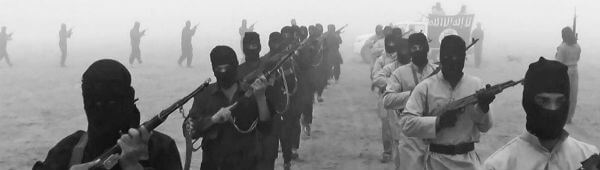
Category Archives: ISIS

Islamic State of Iraq and Syria

The rise and deadly fall of ISIS’s oil tycoon

The Wall Street Journal reports: Islamic State oil man Abu Sayyaf was riding high a year ago. With little industry experience, he had built a network of traders and wholesalers of Syrian oil that at one point helped triple energy revenues for his terrorist bosses.

His days carried challenges familiar to all oil executives—increasing production, improving client relations and dodging directives from headquarters. He also had duties unique to the extremist group, including approving expenses to cover the upkeep of slaves, rebuilding oil facilities damaged by U.S. airstrikes and counting towers of cash.

Last May, U.S. Special Forces killed Abu Sayyaf, a nom de guerre, at his compound in Syria’s Deir Ezzour province. The raid also captured a trove of proprietary data that explains how Islamic State became the world’s wealthiest terror group.

Documents reviewed by The Wall Street Journal describe the terror group’s construction of a multinational oil operation with help from officious terror-group executives obsessed with maximizing profits. They show how the organization deals with the Syrian regime, handles corruption allegations among top officials, and, most critically, how international coalition strikes have dented but not destroyed Islamic State’s income.

Defense Secretary Ash Carter called the May 16, 2015, raid a “significant blow” against Islamic State and heralded the death of Abu Sayyaf, the terror group’s No. 2 oil executive.

In the 11 months since, U.S. and allied forces have launched hundreds more strikes against terrorist-controlled oil facilities and killed dozens of militants working in Islamic State’s oil and finance business. U.S. officials estimate that at least 30% of the group’s oil infrastructure has been destroyed, and taxes have replaced oil as the group’s largest profit center. [Continue reading…]


Facebooktwittermail

Obama ramps up special forces mission in Syria against ISIS

Reuters reports: President Barack Obama announced on Monday the biggest expansion of U.S. ground troops in Syria since the civil war there began, saying he would dispatch 250 special forces soldiers to help local militia to build on successes against Islamic State.

The new deployment increases U.S. forces in Syria six-fold to about 300. While the total U.S. ground force is still small by comparison to other American deployments, defense experts said it could help shift the momentum in Syria by giving more Syrian fighters on the ground access to U.S. close air support.

Obama said the move followed victories that clawed back territory from Islamic State.

“Given the success, I’ve approved the deployment of up to 250 additional U.S. personnel in Syria, including special forces, to keep up this momentum,” Obama said in a speech in the German city of Hanover, the last stop on a foreign tour that has taken him to Saudi Arabia and Britain. [Continue reading…]

The New York Times reports: The United States has opened a new line of combat against the Islamic State, directing the military’s six-year-old Cyber Command for the first time to mount computer-network attacks that are now being used alongside more traditional weapons.

The effort reflects President Obama’s desire to bring many of the secret American cyberweapons that have been aimed elsewhere, notably at Iran, into the fight against the Islamic State — which has proved effective in using modern communications and encryption to recruit and carry out operations.

The National Security Agency, which specializes in electronic surveillance, has for years listened intensely to the militants of the Islamic State, and those reports are often part of the president’s daily intelligence briefing. But the N.S.A.’s military counterpart, Cyber Command, was focused largely on Russia, China, Iran and North Korea — where cyberattacks on the United States most frequently originate — and had run virtually no operations against what has become the most dangerous terrorist organization in the world. [Continue reading…]

Reuters reports: Towering over his Kurdish partner at a checkpoint in northern Iraq, U.S. volunteer John Cole cuts an unusual figure on the road to the newest front in the war against Islamic State.

Seven feet (2.1 metres) tall and holding his assault rifle upside down, Cole is among a relatively small band of Westerners who have made their own way to Iraq to take up arms against the militant group – even though Kurdish authorities say they need foreign money and weapons more than men.

Exactly how much fighting Cole has done is unclear, but the 23-year-old said that – unlike most regular U.S. soldiers stationed nearby – he has participated in offensives against Islamic State that involved artillery fire and airstrikes. [Continue reading…]

Al Jazeera reports: Iraq’s military has warned civilians against returning to Ramadi after dozens were killed by mines apparently planted by the Islamic State of Iraq and the Levant (ISIL, also known as ISIS) group in the city’s streets and buildings.

Iraqi forces reclaimed Ramadi from ISIL fighters in December and tens of thousands of residents have moved back to Ramadi, the provincial capital of Anbar, in the past two months.

Most of them have returned from camps east of the city where they took refuge prior to the army’s advance late last year. [Continue reading…]

Facebooktwittermail

An amateur vs. ISIS (and the FBI): A car salesman investigates and ends up in prison

The New York Times reports: By his own account, Toby Lopez was a supremely ordinary guy. He sold Toyotas and lived with his mother in a tidy rancher here with a cherry tree out front. He was proud that he could connect with customers — anyone from a Superior Court judge to, as he put it, “Redneck Bill from down on the farm.” What passed for excitement was the time his young niece won a beauty contest and he chauffeured her in a red Corvette in a local parade.

Then a high school friend was killed in Afghanistan, and the Islamic State began beheading American journalists. Horrified, Mr. Lopez heard on CNN one day in the fall of 2014 that the Islamic State was active on Twitter, and he went online to see what he could find. “I was intrigued,” said Mr. Lopez, 42. “What could they possibly be saying on Twitter?”

What followed was a radical break from his humdrum life. He was pulled into the murky world of Internet jihadists, sparring with them from his office at the car dealership and late into the night at home. Before long, he was talking for hours on Skype with a man who claimed — falsely, as it would turn out — to be a top ISIS military commander, trying to negotiate the release of hostages. Mr. Lopez contacted the F.B.I. and began a testy relationship with counterterrorism agents who came to believe he might pose a danger. In the end, he landed in federal prison, where he was held for nearly 14 months without trial.

The story of one man’s deepening obsession with a terrorist group is a reminder of how the Internet provides easy portals to distant, sometimes dangerous worlds. It shows the complications for law enforcement agents who confront an overeager amateur encroaching on their turf. [Continue reading…]

Facebooktwittermail

The Defense Department made a big gaffe that helps Putin and Assad in Syria

Business Insider reports: The spokesman for the US military operation against ISIS made a comment in a Wednesday press briefing in Baghdad that helps justify Russia’s continued attacks on Syria’s largest city in the midst of a truce.

US Army Col. Steve Warren, the spokesman for Operation Inherent Resolve in Iraq, was asked whether Russian airstrikes on Aleppo, the current epicenter of the war, meant that Moscow was preparing to end the cessation of hostilities (CoH) agreement between government forces and the opposition signed on February 29.

Warren responded that it was “complicated” because al-Nusra “holds Aleppo” and is not party to the agreement.

Warren said of Russia:

I’m not going to predict what their intentions are. What I do know is that we have seen, you know, regime forces with some Russian support as well begin to mass and concentrate combat power around Aleppo. … That said, it’s primarily al-Nusra who holds Aleppo, and of course, al-Nusra is not part of the cessation of hostilities. So it’s complicated.

As Middle East analyst Kyle Orton noted on Twitter, Warren came “pretty close” to saying that the coalition supports Russia’s airstrikes in the city. Those strikes, however, are aimed at degrading any and all opposition to Bashar Assad — the embattled Syrian president who the Obama administration has repeatedly insisted “has to go.” [Continue reading…]

Facebooktwittermail

The problem with rebuilding a Palmyra ruin destroyed by ISIS – does it simply help Assad?

Adam Taylor writes: London Mayor Boris Johnson unveiled a stunning site in his city’s historic Trafalgar Square on Tuesday: a replica of the 2,000-year-old Arch de Triumph from Palmyra, Syria.

The original arch, once part of the internationally famous UNESCO world heritage site in Palmyra, was destroyed in an explosion by the Islamic State after it took control of the city last year. This new 20-foot-tall re-creation of the monument was crafted by the Institute of Digital Archaeology, a joint venture among Harvard University, the University of Oxford and Dubai’s Museum of the Future, which used 3-D imaging technology to map the arch and digital tools to carve it out of Egyptian marble.

During the unveiling ceremony, Johnson told spectators that they were gathered “in defiance of the barbarians” who destroyed the arch, the BBC reports. But despite the triumphant nature of the day and the clear delight that many had in the rebuilding of the historic ruin, some were concerned about what, exactly, Palmyra had come to represent.

Although few would argue that the ancient sites of Palmyra shouldn’t be protected, there are concerns that the city’s ancient wonders could become a propaganda tool for the regime of Syrian President Bashar al-Assad. Annie Sartre-Fauriat, an expert on Syrian heritage who works with UNESCO, said the Palmyra site should be evaluated and perhaps restored once the conflict is over.

“For the moment, we should not be fooled of the manipulations of opinion by a bloody dictator,” Sartre-Fauriat said.

Syria’s government declared just last month that it had forced the Islamic State from Palmyra after a prolonged campaign. “The liberation of the historic city of Palmyra today is an important achievement and another indication of the success of the strategy pursued by the Syrian army and its allies in the war against terrorism,” Assad said at the time.

For Assad and the Syrian regime, the capture of Palmyra seems to have been not only a symbol of the newfound prowess the Syrian military had on the battlefield with Russian air support, but also a claim that Syrians were the only ones who could protect Syria’s heritage. Palmyra itself had relatively little strategic value for the Islamic State, Aymenn Jawad al-Tamimi, a fellow at the Middle East Forum think tank, told Al Jazeera as the city was liberated. “Palmyra is more important for the regime, symbolically, to present itself as the defender of civilisation against barbarism,” Tamimi said.

This message has an international audience, too. The Islamic State’s destruction of Palmyra had created a global outcry. Now the Syrian regime and its Russian backers were able to portray themselves as the protectors of the ancient cultural site. In the days after their troops took Palmyra, the Syrian regime quickly took Western journalists to the ancient city to show them what the Islamic State had destroyed and what, by extension, Syrian troops had saved.

In doing so, the Syrian regime was ignoring the damage it had caused to Palmyra, Sartre-Fauriat said. Assad’s troops had inflicted their own damage on the site, Sartre-Fauriat explained, firing shells and rockets into ancient sites and also looting graves. [Continue reading…]

Facebooktwittermail

ISIS’s reply to Sri Sri Ravi Shankar’s peace message — photo of beheaded man

The Times of India reports: piritual leader Sri Sri Ravi Shankar said on Thursday that he tried to open a dialogue with the Islamic State group but it rebuffed him by sending him a photograph of a beheaded man.

“I tried to initiate peace talks with the ISIS (Islamic State of Iraq and Syria) recently but they sent me a photograph of a beheaded body of a man. Thus, my effort for a peace dialogue with the ISIS ended,” he said.

“I think the ISIS does not want any peace talks,” he told the media in Agartala. “Hence, they should be dealt with militarily.” [Continue reading…]

Facebooktwittermail

Bangladeshi university professor hacked to death

BBC News reports: A university professor has been hacked to death in Bangladesh, in an attack police say is similar to killings of secular bloggers and atheists by suspected Islamist extremists.

AFM Rezaul Karim Siddique, 58, was a professor of English at Rajshahi University in the country’s north-west.
He was attacked with machetes as he left home to go to work.

So-called Islamic State militants say they killed him for “calling to atheism” in Bangladesh.

The claim was made by IS-linked Amaq Agency, cited by US-based SITE Intelligence Group which monitors jihadist groups.

However, Siddique’s colleagues earlier said that he had not written anything controversial and was not an atheist, unlike previous victims.

Police believe that he may have been targeted by suspected Islamist extremists because he was involved in cultural activities.

The BBC’s Dhaka correspondent Akbar Hossain says hardline Islamist groups dislike anyone involved in the cultural field. [Continue reading…]

Facebooktwittermail

Failed state: Can a unity government succeed in divided Libya?

Der Spiegel reports: This may be the only thing you need to know about the situation in Libya: For security reasons, the headquarters of the United Nations Special Representative for Libya is situated 500 kilometers (311 miles) away from Tripoli in the Tunisian capital of Tunis. Martin Kobler’s office is located in a non-descript building in the city’s Les Berges du Lac diplomatic quarter.

For trips to Libya, he has an 18-seat propeller plane at his disposal, parked at the nearby airport. He uses it to commute several times each month to Libya. But sometimes, he isn’t given permission to land, for no apparent reason. On such occasions, the plane remains grounded, along with Kobler, in Tunis.

On a recent Sunday in April, Kobler has invited us to a meal in the restaurant Au Bon Vieux Temps in a posh suburb of Tunis. The view of the Mediterranean is spectacular. A slight man with a warm glint in his eyes, Kobler, 63, was once chief of staff to former German Foreign Minister Joschka Fischer. He has also served as German ambassador to Cairo and Iraq and, most recently, as the UN special representative to the Democratic Republic of Congo.

Today he has one of the most difficult jobs in the world. His task is to help create a state out of Libya at the behest of the international community. The fact that Libya was never truly a state, even under dictator Muammar Gadhafi, who was toppled in 2011, doesn’t make things any easier. Considering what he’s up against, Kobler is pursuing his mission with astounding optimism.

The situation in Libya is important for Europe for two reasons. First, because Islamic State (IS) is continuing to spread unhindered in the civil war-torn country. Second, because one of the most important routes for migrants making their way to Europe runs through Libya. [Continue reading…]

The New York Times reports: The United States on Tuesday imposed sanctions on a prominent Libyan politician as part of a broader Western effort to force Libya’s warring factions to accept the authority of a unity government backed by the United Nations.

The Treasury Department said it was adding the politician, Khalifa al-Ghweil, the leader of a self-declared government in the capital, Tripoli, to its sanctions list and would freeze any assets he might have in the United States.

The sanctions are a boost to the new unity government, which was formed under the auspices of the United Nations in December, has strong support from Western countries that are desperate to end years of turmoil in Libya. It also enjoys the allegiance of Libya’s national oil company, the central bank and some of the militias that guard the country’s oil fields. [Continue reading…]

The Guardian reports: The United Nations envoy to Libya, Martin Kobler, has called for western forces to help combat Islamic State in partnership with the country’s new government.

With Barack Obama due to meet four European leaders in Germany on Monday for a summit that is likely to focus on Libya, Kobler said foreign powers should offer training and military support, combined with an end to the UN arms embargo.

“The Daesh [Isis] expansion can only be stopped militarily,” he said. “There is a consensus that a united Libyan army needs training; the lifting of the weapons embargo is very important. We need the most modern weapons to finish Daesh.”

Isis has been stepping up its offensive against Libya’s oilfields. An assessment circulating in foreign missions reports that in the last two weeks the group has broken out of its base in the coastal town of Sirte in three thrusts. [Continue reading…]

Facebooktwittermail

Think Merkel’s got problems now? Wait until she takes on Libya

Arne Delfs writes: Angela Merkel is pushing the boundaries of her realpolitik.

A leader whose pragmatism trumps ideology every time, the German chancellor faces international criticism, alienated voters and a rift in her coalition because of her choices in combating the refugee crisis.

That might just be the start of her difficulties. With the European Union deal she pushed with Turkey beginning to deter illegal migration, Merkel is shifting her focus to the surge in refugee flows across the central Mediterranean to Italy. And that means engaging with Libya and Egypt.

Merkel will host U.S. President Barack Obama and the leaders of the U.K., France and Italy in Hanover, western Germany, on Monday to discuss Libya and migration, Syria and Islamic State, along with what the White House described as additional steps NATO allies must take to address the “challenges on Europe’s eastern and southern periphery.”

German intelligence suggests some one million refugees are waiting in the Maghreb countries to cross to Europe, causing alarm in the Chancellery in Berlin, according to an official from Merkel’s party who asked not to be named discussing internal deliberations.

German foreign policy is now “driven by the domestic imperative to bring down the number of refugees: this is Merkel’s live-or-die issue,” said Josef Janning, head of the Berlin office of the European Council on Foreign Relations. Germany is set to become “much more active” in North Africa, and “for Merkel this is a challenge, because you have to be cautious about doing things that the public doesn’t understand.” [Continue reading…]

Facebooktwittermail

Well-known ISIS operative instructed Americans to kill Pamela Geller, prosecutors reveal

The Washington Post reports: The Justice Department on Thursday revealed that a well-known Islamic State operative instructed a Boston-area man to kill Pamela Geller, the organizer of a controversial Muhammad cartoon contest in Texas last year.

In court documents, prosecutors said that Junaid Hussain, a British militant, had been communicating with Usaamah Abdullah Rahim, 26, who along with two friends discussed beheading Geller.

Rahim, however, changed his mind and instead decided to target a police officer. He was shot and killed in June 2015 in Roslindale, Mass., after he attacked members of an FBI-led surveillance team while wielding a large knife, officials said. [Continue reading…]

Facebooktwittermail

On the front line against ISIS

ISIS-catwalk-bw

Scott Atran and ARTIS Research report: According to discussions with U.S. military commanders in Iraq, plans to retake Mosul call for eight to 12 combat brigades (up to 50,000 soldiers or so). These troops would outnumber the estimated ISIS force in Mosul by more than 5 to 1. But unless there is fighting spirit and coordination in the Iraqi Army from the squad level on up, the troops won’t be enough.

It may be wishful thinking to believe that U.S. advisors will make the “massive difference” that some “Iraq experts” suggest. As retired army Lt. Col. Daniel Davis writes in The National Interest: “It is clear that the problems with the Iraqi Army’s disintegration in 2014 when confronted with ISIS, and the conditions affecting the future battle for Mosul, go far deeper than anything a handful of U.S. military advisors are going to solve.”

From the road connecting Makhmour to Aliawa we can see the camp for the Iraqi Army’s 15th Division being set up for the advance on Mosul. Currently designed for 4,500 soldiers, it will likely grow.

ISIS targets the camp frequently. At dawn on March 15, ISIS took advantage of fog and rain to launch a suicide attack. Three ISIS inghamasi rushed the gate; two were killed before reaching it; a third blew himself up at the gate, wounding four soldiers.

At dawn on March 21, five inghamasi died on their way to the camp along with two Iraqi soldiers. General Najat Ali, the Peshmerga commander of the Makhmour front, said that he had warned about the camp’s unsafe location and vulnerability to ISIS attacks. And they keep coming without apparent regard for risk or cost. “They are brave and they fight without calculation,” said one Kurdish communist fighter who fought alongside Peshmerga at Kudilah, but who is usually with the PKK.

He told us that he often hears Shia songs at the camp. “That’s not a good sign of things to come,” he said, because there would be conflict between Shia and Sunni Arabs who some suspect of giving inside information to ISIS, although the few Shia and Sunni Arab soldiers our research team interviewed from the camp deny this is so. The PKK fighter also reminded us that the Sunni Arabs in Mosul initially supported al Qaeda against the Americans, and welcomed ISIS with open arms as a way of taking power back from the Shia, whose installation in power they still blame on the U.S. [Continue reading…]

Facebooktwittermail

‘Desperate’ Palestinian refugees starve as battle rages in Damascus

The Guardian reports: Thousands of civilians are trapped in “desperate” humanitarian conditions in a Palestinian refugee camp in Damascus where fighting has been raging for days between Islamic State fighters and other extremists, the UN has warned.

UNRWA, the UN relief agency for Palestinian refugees, said at the weekend that up to 10,000 residents of the Yarmouk camp in the south of the Syrian capital have gone without food or water for more than a week.

“Civilians in Yarmouk are facing starvation and dehydration alongside the heightened risks of serious injury and death from the armed conflict,” said Christopher Gunness, a UNRWA spokesman. People are trapped in their homes, hunkered down to avoid being hit by bullets and shrapnel, he added.

The camp, a sprawling urban neighbourhood that was once home to 150,000 people, has been ravaged by fighting between Isis and al-Qaida’s Syrian affiliate, al-Nusra Front, while government forces regularly shell it from outside. “Whatever supplies of food and water they had have long been exhausted,” Gunness said. [Continue reading…]

Facebooktwittermail

Everything we knew about this ISIS mastermind was wrong

Michael Weiss and Hassan Hassan writes: The Pentagon calls him Haji Imam. His other nicknames include Abu Ali al-Anbari, Abu Alaa al-Afri, Hajji Iman, or simply the Hajji, the Arabic word for “pilgrim” but one that is colloquially used to refer to a revered person or gray eminence. Iraqi and American security officials were so confused by his multiple noms de guerre that they identified him as two distinct high-level leaders of the so-called Islamic State; Wikipedia even has two biographies, and two photographs for the one jihadist whose obscurity was in direct proportion to his significance. For Abd al-Rahman Mustafa al-Shakhilar al-Qaduli — that’s his legal name — is known as a man of many talents. He’d have to be to attain the rank of second-most powerful figure in ISIS, next to the caliph himself.

The U.S. military announced that al-Qaduli—who oversaw ISIS’s intelligence operations — was killed in an airstrike in Deir Ezzor, in eastern Syria, on March 25. Although his death was proclaimed at least four times before by the Iraqi government and twice by the U.S.-led coalition, this time it might be real. Several ISIS supporters eulogized him on social media, and new details about his curriculum vitae and all-important role within the organization have been disclosed, possibly because operational security is no longer a priority.

That the No. 2 man in the world’s most dangerous terror organization may be dead matters almost as much as we’ve only been able to learn about him in death. Al-Qaduli’s biography has been cloaked in rumor, myth, and misinformation — or disinformation, given that much of what had been produced on his history came from disgruntled al Qaeda sources looking to ruin his reputation following the bin Ladenist’s split from ISIS in 2014. [Continue reading…]

Facebooktwittermail

Will Jabhat Al Nusra and ISIS join forces?

Hassan Hassan writes: In a two-part interview with Al Jazeera in May, Mohammed Al Jolani of Jabhat Al Nusra revealed that Al Qaeda’s central leadership had issued instructions against using Syria as a launch pad for attacks against the West. Although the anti-ISIL air campaign frequently struck his cells in northern Syria, Al Jolani said he was still committed to the strict orders.

Almost a year after the interview, much has changed in Syria and the wider neighbourhood. The organisation’s leadership continues to be pounded by the US-led campaign, which targeted operatives most qualified to plan and launch attacks against the West, loosely dubbed by the Americans as the “Khorassan Cell”. According to Hassan Abu Haniya, an observer of Islamist groups from Jordan, the cell’s commanders in Syria have been all but decapitated after a series of high-level killings. This has caused profound anger among Jabhat Al Nusra and Al Qaeda supporters, who started to question the current live-and-let-live strategy in Syria.

The continuing attacks against both ISIL and Al Qaeda, and their affiliates across the region, have led some sympathisers to wonder why the two jihadist groups do not collaborate. In addition to encouragement by ordinary extremist supporters, prominent jihadist ideologues offered help to narrow differences between the two groups. Abu Qatada Al Filistini from Jordan, for example, called for “management of differences” among warring jihadist and Islamist groups, while Abu Muhammed Al Maqdisi, also from Jordan, recently wrote on Twitter that he was willing to revise his position towards ISIL and join it “to spite the whole world” if it stopped labelling other jihadists as apostates. [Continue reading…]

Facebooktwittermail

U.S. ratchets up cyber attacks on ISIS

The Daily Beast reports: President Obama confirmed for the first time last week that the U.S. is conducting “cyber operations” against ISIS, in order to disrupt the group’s “command-and-control and communications.”

But the American military’s campaign of cyber attacks against ISIS is far more serious than what the president laid out in his bland description. Three U.S. officials told The Daily Beast that those operations have moved beyond mere disruption and are entering a new, more aggressive phase that is targeted at individuals and is gleaning intelligence that could help capture and kill more ISIS fighters.

As the U.S. ratchets up its online offensive against the terror group, U.S. military hackers are now breaking into the computers of individual ISIS fighters. Once inside the machines, these hackers are implanting viruses and malicious software that allow them to mine their devices for intelligence, such as names of members and their contacts, as well as insights into the group’s plans, the officials said, speaking on condition of anonymity to describe sensitive operations.

One U.S. official told The Daily Beast that intelligence gleaned from hacking ISIS members was an important source for identifying key figures in the organization. In remarks at CIA headquarters in Langley, Virginia this week, Obama confirmed that cyber operations were underway and noted that recently the U.S. has either captured or killed several key ISIS figures, including Sulayman Dawud al-Bakkar, a leader of its chemical weapons program, and “Haji Iman,” the man purported to be ISIS’s second in command. [Continue reading…]

Facebooktwittermail

ISIS revenue drops nearly a third after loss of territory shrinks tax base

AFP reports: Islamic State’s revenues have dropped about 30% since mid-2015, forcing the group to introduce a range of new taxes, a research group has said.

“In mid-2015, the Islamic State’s overall monthly revenue was around $80m,” said Ludovico Carlino, senior analyst at IHS, which issues regular reports on Isis-controlled territory.

“As of March 2016, the Islamic State’s monthly revenue dropped to $56m,” Carlino said.

An IHS report also said oil production in areas controlled by Isis jihadists was 21,000 barrels a day, down from 33,000 barrels a day.

This was due largely to airstrikes by the US-led coalition and Russia, although IHS warned the decline was only an “interruption of production” because jihadists were able to repair infrastructure quickly. [Continue reading…]

Facebooktwittermail

Half of all French soldiers are now deployed on streets at home

The Guardian reports: After last year’s terrorist attacks on Paris, the president, François Hollande, declared that France was at war and swiftly saturated the streets of main cities with soldiers standing guard in full military fatigues to make people feel more secure. The now permanent presence of thousands of soldiers in khaki across the capital and major cities has transformed the image and mood of France.

Operation Sentinelle, in which combat troops patrol streets and protect key sites – from synagogues to art galleries, nursery schools to mosques and Métro stations – is the army’s first wide-scale peacetime military operation on mainland France.

Sentinelle was launched after the massacre at Charlie Hebdo magazine and a kosher supermarket in Paris in January 2015. But after November’s attacks that killed 130 people, Hollande increased the presence to 10,000 troops across the nation, with about 6,500 of them in the Paris area.

But while 79% of French people approve of Sentinelle in a country with a very positive view of its army, political opposition on the right and left has begun to question not the soldiers themselves but the government’s use of the military. Political commentators and ex-military figures have started to query whether deploying soldiers in what one rightwing senator called a mere security guard role is an efficient use of a highly trained – and now highly stretched – army.

The constant presence of camouflage uniforms everywhere from quiet neighbourhood streets to Métro carriages, patrolling past schools at home-time or milling through markets, has transformed the cityscape – and the relationship of the French to their soldiers. People now bring hot drinks and food offerings to men in military fatigues at the end of their street. The elite troops of the foreign legion are invited into a barmitzvah in a street of synagogues that they normally guard. There are now military medals for serving on the streets of French towns and many more young people applying to join the army.

“It’s quite hard to know what to tell children already traumatised and confused by the terrorist attacks,” said the concierge at one central Paris building in a neighbourhood where soldiers are regularly posted. “My five-year-old daughter would shush me and try to hide whenever she saw a soldier. I asked her why. ‘They’re the killers!’ she said. I told her they weren’t at all, but she just replied: ‘But they’ve got guns!’” [Continue reading…]

Facebooktwittermail

David Cameron under pressure to come clean over plans to send British troops to Libya

The Guardian reports: The British government is facing new pressure to publish any plans it has for troop deployments to Libya after it was disclosed that five separate international security operations are being considered for the war-torn country.

EU ministers meet on Monday to discuss sending security units to Tripoli. Other missions in the works include bombing Islamic State fighters, training Libyan troops, combating people smugglers and disarming militias. Most are likely to involve British personnel.

Senior MPs are demanding a statement on what part British forces will play, after foreign secretary Philip Hammond insisted last week that no decisions had been made on any operations.

“Clarity is now overdue. We need transparency about the difficulties and the challenges,” Crispin Blunt, chairman of parliament’s foreign affairs committee, told the Observer. “Any deployment would need a parliamentary vote, as would airstrikes on Isis.” [Continue reading…]

Facebooktwittermail