Category Archives: ISIS

Islamic State of Iraq and Syria

Book review: Charles Lister’s The Syrian Jihad – a must read that untangles the web of militant groups

Robin Yassin-Kassab writes: Security discourse dominates the international chatter on Syria. Most Syrians see Bashar Al Assad as their chief enemy – he is, after all, responsible for the overwhelming proportion of the dead and displaced. But the Syrian people are not invited to the tables of powerful states, which are in agreement that their most pressing Syrian enemy is “terrorism”.

But there is disagreement on who exactly the terrorists are. Russian president Vladimir Putin shares Assad’s evaluation that everyone in armed opposition is an extremist, and at least 80 per cent of Russian bombs have therefore struck the communities opposing both the president and ISIL.

North of Aleppo, Russia has even struck the rebels while they were battling ISIL. This wave of the “war on terror” – now led, with plenty of historical irony, by Russia and Iran – uses anti-terror rhetoric to engineer colonial solutions, just as the last wave did, and ends up promoting terror like never before.

There is no question that the moderate Syrian opposition exists, in the form of hundreds of civilian councils – sometimes directly elected – and at least 70,000 democratic-nationalist fighters. In a recent blog for The Spectator, Charles Lister, one of the very few Syria commentators to deserve the label “expert”, explains exactly who they are.

Lister’s book-length study The Syrian Jihad: Al Qaeda, the Islamic State and the Evolution of an Insurgency, on the other hand, focuses on those militias, from the Syrian Salafist to the transnational jihadist, which cannot be considered moderate. It clarifies the factors behind the extremists’ rise to such strategic prominence, among them the West’s failure to properly engage with the defectors and armed civilians of the Free Syrian Army (FSA) in 2011 and 2012. [Continue reading…]

Facebooktwittermail

Raqqa tribes challenge Syria Kurds

NOW reports: A group of tribes in Syria’s Raqqa province have warned the Kurdish People’s Protection Units (YPG) against entering areas it controls, in the latest sign of simmering tensions between ethnic Arabs and Kurds in the province where ISIS maintains its de-facto capital.

“No one from the YPG may enter the Arab areas where are our fighters are present,” the Collective of Raqqa Tribes said in a statement issued Tuesday.

The group further called on the Kurdish militia to “hand over” the flashpoint Tal Abyad, a strategic Raqqa border area populated by ethnic Arabs and Turkmen that the Kurdish Democratic Union Party (PYD) has joined to its Democratic Self-Rule Administration. [Continue reading…]

Facebooktwittermail

As another activist is murdered, the least we owe ‘Raqqa is Being Slaughtered Silently’ is our attention

Kyle Orton writes: From the outset of the Syrian uprising, the regime of Bashar al-Assad and the Isis have been united on their strategic goal: eliminate the moderate opposition and make Syria a binary choice between themselves. This is why on the battlefield Assad and Isis largely leave one-another alone and the Assad regime’s propaganda—that the whole rebellion is composed of Islamist terrorists—reinforces Isis’s propaganda claim that it is the only effective protection for Sunnis against the regime. Both IS and the Assad regime are led by military and intelligence officers trained in the KGB and both rely on propaganda as a means of internal control, not only of controlling their international image, which is why both so virulently repress independent media that contradicts their officially sanctioned version. Last night, IS again struck down a member of an activist group that has tried to bring the truth about life under its rule to the outside world. [Continue reading…]

Facebooktwittermail

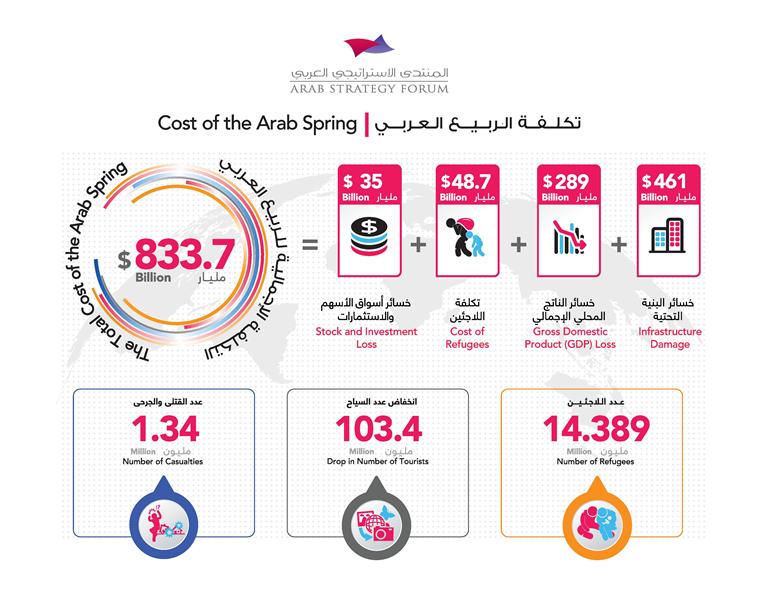
The cost of the suppression of the Arab Spring

How many mass movements in search of political rights would have been pronounced failures if success had to be established in just five years?

The quest for women’s rights has continued throughout human history and continues today.

Palestinians, Kurds, Tibetans, Kashmiris, and numerous other groups of indigenous peoples have for many decades campaigned and fought for their rights, often with very limited success.

But when it comes to the Arab Spring, those who stand to lose most from the expansion of political rights across the region, are now — not surprisingly — only too eager to pronounce it an expensive failure.

The idea that it might have been better to stay home and stay quiet, will all too easily resonate among the millions of people who have suffered the effects of the suppression of the Arab Spring.

As some of the region’s autocratic rulers and their advisers gathered in Dubai this week and soberly measured the “cost of the Arab Spring,” they should also — had they been honest — have been celebrating the rise of ISIS.

From Dubai to Tehran and from Riyadh to Cairo, it has been ISIS that has saved the day. The Arab Strategy Forum should have invited Abu Bakr al-Baghdadi as their guest of honor.

Don’t get me wrong. I’m not promoting any of the conspiracy theories about ISIS being the creation of a foreign government (be that the Saudis, the Turks, the Israelis, or the Americans — which of those being the culprit would depend merely on who the proponent such a theory sees as the worst enemy).

ISIS saved the day through its savagery by convincing nearly everyone else that political stability is worth more than any kind of political freedom.

Much as it will often be repeated that the need to destroy ISIS has never been more urgent, those whose rule is currently being legitimized by ISIS’s existence will be quite content for this war to be a valiant fight that sees no end.

And those blinkered by the conviction that the U.S. government is the architect of all the world’s afflictions, need to recognize that conflict in the Middle East is now being driven from many engine rooms — in Damascus, Moscow, Tehran, Jerusalem, Ankara, Riyadh, Cairo, Abu Dhabi, Doha, Beirut, Raqqa and elsewhere — in pursuit of incompatible agendas.

Among those costs, the greatest are not measured in dollars — the numbers of casualties and refugees. And these are not costs of the Arab Spring; they are, above all, the cost of the Assad regime’s refusal to respect the rights of the Syrian people.

Facebooktwittermail

On the need to listen to Arab public opinion

Commenting on the results of a recent Zogby poll of over 7,400 adults in six Arab countries (Egypt, Lebanon, Jordan, Iraq, Saudi Arabia, and the UAE), Turkey, and Iran, Rami G. Khouri writes: As expected, people in Iraqi are divided on their views of their own national institutions and regional players’ actions in their country. Sunnis mostly lack confidence in the Iraqi military, Iran’s involvement, or the Popular Mobilization Units that are fighting “Islamic State” (ISIS), while Iraqi Shiites support the actions of all these. The more significant finding, however, is the “remarkable consensus” on two important issues: that the cause of the conflict in Iraq is that, “the government in Baghdad does not represent all Iraqis,” and that, “the best way to ultimately resolve the conflict…is forming a more inclusive representative government” — and not partition, with the Kurds also supporting such a representative central government.

I would guess that this Iraqi desire for inclusive, representative governance within a unified national framework is mirrored in most Arab countries that are wracked by war and sectarian tensions, like Libya, Yemen, Bahrain, Lebanon, and Syria. Ordinary citizens probably hold much more rational and constructive views on how to resolve those conflicts than the warlords and officials, not to mention foreign powers that now mostly shape policy.

The poll found that ISIS was mentioned as the most serious extremist problem facing the region in every country except Jordan, where Al-Qaeda is ranked first. More interestingly — and significant for counter-terrorism purposes — is that in most countries polled citizens identified, “corrupt, repressive, and unrepresentative governments” and, “religious figures and groups promoting extremist ideas” as the most important causes of religious extremism. [Continue reading…]

Facebooktwittermail

Life in Raqqa: Bombed by the government during the day, then bombed by the coalition at night

A paediatric doctor describes his flight from the ISIS stronghold of Raqqa: One day ISIS came to me and put pressure on me to join the hospital that they controlled in the city. Most doctors had left Syria and they needed me. But I refused. As a result, I received threats. There was nowhere to hide from them – not in the small villages around Raqqa, nor in the city itself. I began to realise that my only way out was to leave Syria. I thought, ‘I’d prefer to go on one of the death boats than risk staying here’.

Life in Raqqa was terrifying. During the day we lived with the government’s airstrikes; at night there were coalition airstrikes. The sound of the jets was so loud it was like an earthquake. A close friend was killed by a government airstrike.

I realised that life had stopped for me, and the one thing I had to do was save my family. I worried that in Syria my children wouldn’t have a life or even get an education. I wanted to protect my life to save my children’s lives.

I started to plan my departure. I planned to travel to Turkey then take the boat to Europe, heading for Holland. My wife was in the final month of her pregnancy with our third child. She was so exhausted by the pregnancy that it was difficult for her to travel. So the idea was that I would go with a friend, and once I had immigration papers, my family would follow me.

I decided to sleep that last night with my children. Although they didn’t know I was leaving, they felt it somehow. I wish I could have brought them with me.

Leaving Raqqa was not easy, with fighting going on between ISIS, Kurdish fighters, Al Nusra and the FSA. I had to pass through three checkpoints between Raqqa and Efreen – it was like passing through three separate countries.

When I reached Turkey, I heard that the government was arresting people going to Izmir [a city on the coast]. Deep inside me, there was a voice hoping that this trip would fail and I’d have to return to Syria. [Continue reading…]

Facebooktwittermail

Libya’s rival governments reject delayed UN-brokered national unity deal

The Guardian reports: Libya’s future is on hold ahead of a national unity agreement brokered by the United Nations but rejected by the rival governments that have presided over months of chaos in a country witnessing the growing strength of Islamic State.

The UN said that the signing had been delayed for logistical reasons but would go ahead in Morocco on Thursday. Libya-watchers expressed doubts that it would happen, but warned that if it did it could mean the country had three governments instead of two.

Britain hopes that a unity government, to be run by a nine-strong presidency, will invite western powers to mount air strikes against Isis positions, allowing David Cameron to avoid another Commons vote before dispatching RAF jets. Agreement, hammered out in Rome last weekend, was hailed as “historic” by the US and Italy.

The long-awaited deal was supposed to have been signed on Wednesday after months of wrangling and opposition from hardliners in the opposing administrations that have claimed power since the overthrow of Muammar Gaddafi by Nato-backed rebels in 2011. [Continue reading…]

Facebooktwittermail

ISIS is a revolution

Scott Atran writes: As pundits and politicians stoked the recent shootings in California into an existential threat; as French troops were deployed in Paris; as Belgian police locked down Brussels, and US and Russian planes intensified air attacks in Syria following yet another slaughter perpetrated in the name of the so-called Islamic State, it was easy to lose sight of a central fact. Amid the bullets, bombs and bluster, we are not only failing to stop the spread of radical Islam, but our efforts often appear to contribute to it.

What accounts for the failure of ‘The War on Terror’ and associated efforts to counter the spread of violent extremism? The failure starts with reacting in anger and revenge, engendering more savagery without stopping to grasp the revolutionary character of radical Arab Sunni revivalism. This revival is a dynamic, countercultural movement of world-historic proportions spearheaded by ISIS, (the Islamic State of Iraq and Syria, also known as ISIL, or the Islamic State of Iraq and the Levant). In less than two years, it has created a dominion over hundreds of thousands of square kilometres and millions of people. And it possesses the largest and most diverse volunteer fighting force since the Second World War.

What the United Nations community regards as senseless acts of horrific violence are to ISIS’s acolytes part of an exalted campaign of purification through sacrificial killing and self-immolation: Know that Paradise lies under the shade of swords, says a hadith, or saying of the Prophet; this one comes from the Sahih al-Bukhari, a collection of the Prophet’s sayings considered second only to the Qu’ran in authenticity and is now a motto of ISIS fighters.

This is the purposeful plan of violence that Abu Bakr al-Baghdadi, the Islamic State’s self-anointed Caliph, outlined in his call for ‘volcanoes of jihad’: to create a globe-spanning jihadi archipelago that will eventually unite to destroy the present world and create a new-old world of universal justice and peace under the Prophet’s banner. A key tactic in this strategy is to inspire sympathisers abroad to violence: do what you can, with whatever you have, wherever you are, whenever possible.

To understand the revolution, my research team has conducted dozens of structured interviews and behavioural experiments with youth in Paris, London and Barcelona, as well as with captured ISIS fighters in Iraq and members of Jabhat al-Nusra (Al-Qaeda’s affiliate in Syria). We also focused on youth from distressed neighbourhoods previously associated with violence or jihadi support – for example, the Paris suburbs of Clichy-sous-Bois and Épinay-sur-Seine, the Moroccan neighbourhoods of Sidi Moumen in Casablanca and Jamaa Mezuak in Tetuán.

While many in the West dismiss radical Islam as simply nihilistic, our work suggests something far more menacing: a profoundly alluring mission to change and save the world. [Continue reading…]

Facebooktwittermail

Trump and Le Pen grow in strength with the help of ISIS

Roger Cohen writes: America, like Europe, is rattled by Islamic State terrorism and unsure how to respond to the black-flagged death merchants. Its polarized politics seem broken. The right of Donald Trump and the right of France’s Marine Le Pen overlap on terrorism and immigration. On the American left, Bernie Sanders sounds like nothing so much as a European social democrat. But that’s another story.

Le Pen is now a serious candidate for the French presidency in 2017. Her strong first-round performance in regional elections was not matched in the second round. She faded. But as with Trump, she answers the popular call for an end to business as usual after two Paris massacres this year in which the Islamic State had a role. The three jihadists who killed 90 Friday-night revelers in the Bataclan club were French citizens believed to have been trained in Syria.

“Islamist fundamentalism must be annihilated,” Le Pen says. People roar. “France must ban Islamist organizations,” she says. People roar. It must “expel foreigners who preach hatred in our country as well as illegal migrants who have nothing to do here.” People roar.

There is no question Le Pen is being taken seriously in France. Europe’s watchword is vigilance. Its entire postwar reconstruction has been premised on the conviction that peace, integration, economic union and the welfare state were the best insurance against the return to power of the fascist right.

That conviction is shaken. The rise of the Islamic State, and the Western inability to contain it, leads straight to the Islamophobia in which Trump and Le Pen traffic with success. It would be hard to imagine an atmosphere better suited to the politics of fear. Americans say they are more fearful of terrorism than at any time since 9/11.

“Every time things get worse, I do better,” Trump says. He does. They may get still worse. [Continue reading…]

Facebooktwittermail

Russia grapples with its own ‘Jihadi John’ as Moscow steps up role in Syria

The Wall Street Journal reports: For Russia, it was a shock: A blue-eyed Siberian with shaggy brown hair raged against his homeland in an Islamic State video before slicing the throat of a fellow Russian accused of being a spy.

The executioner, identified by Russian media and his friends as a 28-year-old named Anatoly Zemlyanka from the city of Noyabrsk, has risen to infamy in Russia since Islamic State released the undated video from Syria on Dec. 2.

Russian authorities, while not confirming his identity in the propaganda video, have put him on Interpol’s wanted list. Russian media have dubbed him Jihadi Tolik, based on the Russian nickname for Anatoly, in describing his apparent transformation from Siberian college student to the Slavic face of Islamic State brutality.

Mr. Zemlyanka’s image has spurred comparisons to Jihadi John, or Mohammed Emwazi—the British militant whose appearances in videos presiding over the beheadings of Western hostages while leveling demands at President Barack Obama made him a prime propaganda tool for Islamic State. But instead of speaking English and condemning Mr. Obama, Mr. Zemlyanka is speaking in Russian and berating Russian President Vladimir Putin.
“Listen to me, Putin, you dog, and let your henchmen hear me too!” Mr. Zemlyanka says in the video. “Before your arrival, the Assad regime bombed us, then America bombed us with its cowardly coalition, and now you’re bombing us. But nothing has come of it, apart from the fortitude and conviction that we’re on the side of truth.”

Islamic State is increasingly pointing its propaganda apparatus at Russia, as the Kremlin steps up its military support for Syrian leader Bashar al-Assad. The campaign appears aimed at raising Russian fears of possible further retribution from Islamic State, particularly after the suspected Oct. 31 bombing of a Russian charter flight traveling to St. Petersburg from Egypt’s Sharm El Sheikh. [Continue reading…]

Facebooktwittermail

Saudis ridiculed over ‘anti-terror’ coalition — new alliance likely to stir up sectarianism

By Brian Whitaker,

Amid widespread derision, Saudi Arabia has announced that it will lead a new military coalition to protect “the Islamic world” against terrorism.

Speaking at a news conference in Riyadh, deputy crown prince Mohammed bin Salman – the king’s favourite son and chief architect of the military disaster in Yemen – said the move stems from “the Islamic world’s vigilance in fighting this disease which has harmed the Islamic world first and is now harming the international community as a whole”.Saudi Arabia has put itself in charge of the coalition and, according to Prince Mohammed, “There will be an operations room in Riyadh for the coordination and support of efforts to fight terrorism in many parts of the Islamic world.”

More than 30 predominantly Muslim countries have allegedly signed up to join the coalition (full list here). They include the other Gulf monarchies, but with the notable exception of Oman which also previously declined to get involved in the war in Yemen.

The move seems partly intended as a response to complaints that Saudi Arabia is not doing enough to combat terrorism and that it is more interested in pursuing its quarrel with Iran than fighting ISIS. There has also been growing criticism of its efforts, over many years, to promote the intolerant religious ideology that now fuels ISIS and similar organisations elsewhere.

However, it looks as though the anti-terror coalition may nevertheless be designed to pursue a sectarian agenda. Judging by its reported membership, the “Islamic world” does not include Iran, the main representative of Shia Islam, or Iraq, Afghanistan or Syria – though it does reportedly include Lebanon which has a large Shia population along with large numbers of Sunni Muslims and Christians. Asked at the news conference if the coalition would only be targeting ISIS/Daesh, Prince Mohammed replied: “No. To any terrorist organisation that appears in front of us, we will take action to fight it.”

This is especially alarming because the Saudi regime has some very strange ideas about what constitutes terrorism and will presumably now be pressing other countries to accept them. Under a law introduced last year, virtually any criticism of the kingdom’s political system or its interpretation of Islam counts as terrorism:

Article 1: “Calling for atheist thought in any form, or calling into question the fundamentals of the Islamic religion on which this country is based.”

Article 2: “Anyone who throws away their loyalty to the country’s rulers, or who swears allegiance to any party, organization, current [of thought], group, or individual inside or outside [the kingdom].”

Article 4: “Anyone who aids [“terrorist”] organizations, groups, currents [of thought], associations, or parties, or demonstrates affiliation with them, or sympathy with them, or promotes them, or holds meetings under their umbrella, either inside or outside the kingdom; this includes participation in audio, written, or visual media; social media in its audio, written, or visual forms; internet websites; or circulating their contents in any form, or using slogans of these groups and currents [of thought], or any symbols which point to support or sympathy with them.”

Article 6: “Contact or correspondence with any groups, currents [of thought], or individuals hostile to the kingdom.”

Article 8: “Seeking to shake the social fabric or national cohesion, or calling, participating, promoting, or inciting sit-ins, protests, meetings, or group statements in any form, or anyone who harms the unity or stability of the kingdom by any means.”

Article 9: “Attending conferences, seminars, or meetings inside or outside [the kingdom] targeting the security of society, or sowing discord in society.”

Article 11: “Inciting or making countries, committees, or international organizations antagonistic to the kingdom.”Last December the cases of two women who defied the ban on driving cars were also referred to the special anti-terrorism court.

Facebooktwittermail

Torture by Iraqi militias: The report Washington did not want you to see

Reuters reports: It was one of the most shocking events in one of the most brutal periods in Iraq’s history. In late 2005, two years after the U.S.-led invasion toppled Saddam Hussein, U.S. soldiers raided a police building in Baghdad and found 168 prisoners in horrific conditions.

Many were malnourished. Some had been beaten.

The discovery of the secret prison exposed a world of kidnappings and assassinations. Behind these operations was an unofficial Interior Ministry organisation called the Special Investigations Directorate, according to U.S. and Iraqi security officials at the time.

The body was run by militia commanders from the Badr Organisation, a pro-Iran, Shi’ite political movement that today plays a major role in Baghdad’s war against Islamic State, the Sunni militant group.

Washington pressured the Iraqi government to investigate the prison. But the findings of Baghdad’s investigation – a probe derided by some of its own committee members at the time as a whitewash – were never released.

The U.S. military conducted its own investigation. But rather than publish its findings, it chose to lobby Iraqi officials in quiet for fear of damaging Iraq’s fragile political setup, according to several current and former U.S. military officials and diplomats.

Both reports remain unpublished. Reuters has reviewed them, as well as other U.S. documents from the past decade.

The documents show how Washington, seeking to defeat Sunni jihadists and stabilise Iraq, has consistently overlooked excesses by Shi’ite militias sponsored by the Iraqi government. The administrations of George W. Bush and Barack Obama have both worked with Badr and its powerful leader, Hadi al-Amiri, whom many Sunnis continue to accuse of human rights abuses.

Washington’s policy of expediency has achieved some of its short-term aims. But in allowing the Shi’ite militias to run amok against their Sunni foes, Washington has fueled the Shia-Sunni sectarian divide that is tearing Iraq apart.

The decade-old U.S. investigation of the secret prison implicates officials and political groups in a wave of sectarian killings that helped ignite a civil war. It also draws worrying parallels to the U.S. government’s muted response today to alleged abuses committed in the name of fighting Islamic State.

Those accused of running the secret prison or of helping cover up its existence include the current head of the Iraqi judiciary, Midhat Mahmoud, Transport Minister, Bayan Jabr, and a long revered Badr commander popularly referred to as Engineer Ahmed. [Continue reading…]

Facebooktwittermail

Turkish troops said to leave Iraqi camp after Baghdad orders them out

Reuters reports: Some Turkish troops started leaving their camp in Iraq and moving north on Monday, a Turkish military source and a senior official said, days after Baghdad protested to the United Nations and ordered them out.

Any move northwards would take them back closer to Iraq’s border with Turkey, but the officials did not say where they were going and it was unclear how far Ankara was bowing to pressure to bring its soldiers home.

Iraq said in early December hundreds of Turkish troops had arrived in its territory without its knowledge, calling it a hostile act.

Turkey said at the time the troops were meant to guard an international mission training and equipping Iraqi forces who are preparing for an offensive to retake the Iraqi city of Mosul, seized by Islamic State militants more than a year ago.

But the move was widely seen as a Turkish attempt to establish a greater foothold in the simmering conflicts across its border, which have already pulled in other regional and global powers. [Continue reading…]

Facebooktwittermail

Signs that ISIS’s propaganda machine is losing its edge

The Economist reports: although IS still churns out plenty of propaganda, both its quantity and reach are diminishing. Tabulating the number of pictures uploaded in media releases by the group, Aaron Zelin, a fellow at King’s College London, notes a marked decline since a peak in midsummer. Citing other researchers as well as his own observations, Mr Zelin also believes the quality of productions has fallen.

Perhaps more seriously for the group, it is having a harder time getting its message out, too. Aside from the restriction on personal internet use, which affects recruiting, Western governments have successfully prodded a growing number of social-media carriers to make much more serious efforts to weed out and block accounts sympathetic to IS. Twitter has shut thousands of suspect accounts in the past year; before that, there were reckoned to be over 20,000 IS Twitter accounts. YouTube is much quicker to take down ugly content than before. Telegram, an encrypted instant messaging service that had been increasingly adopted by IS as a main channel for its media output, has been blocking the group since mid-November.

As a sign of its growing isolation on the internet, IS announced shortly after the Paris attacks that it would shift its propaganda archive to the “dark web”, a hard-to-trace part of the internet largely inaccessible to ordinary web browsers.

As if this were not enough, IS is also suffering from media competition. Its biggest rival, al-Qaeda, has lately boosted both the quality and quantity of its own press releases. Perhaps more galling still, another, less radical Islamist fighting group in Syria, al-Jabha al-Shamiya, recently produced a video that deliberately mocked the style and content of IS’s notorious productions. It showed a group of orange-clad prisoners—actually captured IS fighters—being lined up and made to kneel before their executioners. But instead of pulling their triggers, the soldiers proceed to pocket their pistols, and the astonished prisoners are treated to a sermon about the Islamic duty of mercy, before being led back to jail. [Continue reading…]

Facebooktwittermail

ISIS was coming even without the invasion of Iraq

Kyle Orton writes: Yesterday, Reuters had an article by Isabel Coles and Ned Parker entitled, “How Saddam’s men help Islamic State rule.” The article had a number of interesting points, but in its presentation of the movement of former (Saddam) regime elements (FREs) into the leadership structure of the Islamic State (IS) as a phenomenon of the last few years, it was a step backward: the press had seemed to be recognizing that the Salafization of the FREs within IS dates back to the Islamization of Saddam Hussein’s regime in its last fifteen years, notably in the 1990s after the onset of the Faith Campaign.

The authors do note that when IS swept across Iraq in June 2014 and “absorbed thousands of [Ba’athist] followers,” these “new recruits joined Saddam-era officers who already held key posts in Islamic State” (italics added). But the Reuters piece then adds:

Most former Baathist officers have little in common with Islamic State. Saddam promoted Arab nationalism and secularism for most of his rule. But many of the ex-Baathists working with Islamic State are driven by self preservation and a shared hatred of the Shi’ite-led government in Baghdad. Others are true believers who became radicalised in the early years after Saddam’s ouster, converted on the battlefield or in U.S. military and Iraqi prisons.

The notion of a cleavage in IS between true believers and “Ba’athists” doesn’t stack up in the article’s own presentation. The notorious Camp Bucca where IS deliberately infiltrated men to gather recruits, some of whom were FREs, was important. But the very formulation begs the question. Why were insurgent leaders using Islam, not Ba’athism, as their rallying cry? Why was there “no secular Sunni resistance at all,” as Joel Rayburn, a former intelligence officer who worked with General David Petraeus from 2007 to 2010 and wrote one of the best histories of post-2003 Iraq, once put it? Because Ba’athism had been dead as an ideology for at least a decade — and it was Saddam who killed it. [Continue reading…]

Facebooktwittermail

This is how ISIS has spread beyond Syria and Iraq

Borzou Daragahi reports: His killers knew who he was and where he was going.

Hisham Barakat, Egypt’s top prosecutor, was driving away from his home in an upscale quarter of Cairo’s Heliopolis District. The force of the blast that struck the highest-ranking Egyptian official assassinated in decades shattered windows for blocks around. It was a clean hit. No one else was killed and no suspect was caught.

“The sound was horrible,” recalled Mona Murad, 58, the owner of a nearby women’s clothing store that was destroyed in the blast on June 29. “I was in the street. People were telling me, ‘Your shop is burning.’”

No one claimed responsibility for the attack, but it came amid a string of operations by ISIS’s branch in Egypt. ISIS thrives in collapsed states such as Syria, Iraq, Libya, and Yemen, where it seizes control of territory and resources and attempts to set up its 21st-century version of the medieval Islamic Caliphate. But ISIS’s operations in Egypt provide a blueprint of how it can absorb a knowledgeable local jihadi group — in this case the Sinai-based Ansar Beit al Maqdis — to make its presence felt in countries that are not war zones. The local groups give ISIS and its ideology global reach. ISIS supplies Ansar Beit al Maqdis with weapons through smuggling networks and inspiration to roil a flailing state.

“Like a multinational company, the jihadis merge with ISIS, mostly because of the media, finance, logistics, and manpower it can provide,” said retired Egyptian Interior Ministry Gen. Hussein Hamoudeh. “They take the trademark of ISIS in the terror war. But it’s not just a brand. You have to take up the Daesh thinking,” he said referring to the group by its Arabic acronym.

The Egyptian jihadi group Ansar Beit al-Maqdis announced its merger with ISIS in November 2014. The killing of Barakat last summer came days before a multipronged attack on security forces that was among the first warning signs that ISIS’s Egyptian branch, called Wilayat al-Sina, or Sinai Province, was gathering momentum. In recent weeks, ISIS in Egypt has killed four soldiers in western Cairo and bombed judges in a hotel often used by foreigners and dignitaries in the northeast Sinai town of Arish. That was in addition to one of its most spectacular claimed attacks: the downing of a Russian civilian plane that killed 224 passengers and crew.

Though attacks in Egypt are down numerically and armed forces say the number of militants killed has increased, the attacks by Sinai Province have become more effective, thanks in large part to the local political knowledge of the ISIS branch and Egyptian security forces’ over-reliance on airstrikes and conventional military means to eradicate the group. The group has badly damaged the country’s economy and the reputation of its security forces. Tourism has plummeted since the downing of the jet. The Egyptian pound is trading at a 25-year low and stock market has drooped. [Continue reading…]

Facebooktwittermail

Libya’s rival factions agree date to sign UN peace deal

Reuters reports: Libya’s rival factions on Friday agreed to Dec. 16 as a target date for signing a United Nations-backed national unity government agreement meant to end their conflict.

The U.N. has been negotiating for a year to get Libya’s two rival governments and armed factions to end their war that has plunged the North African state into chaos four years after rebellion ousted Muammar Gaddafi.

Successfully signing an agreement would open the way for the international community to support Libya in the fight against Islamic State, which has gained ground in the chaos and controls the western city of Sirte.

But hardliners in both camps have been resisting a deal. Several past deadlines to sign have fallen through after opponents balked at details or demanded more concessions from their rivals.

“There was a wide consensus that only through rapid signature of the Libyan political agreement the country can be brought back to unity,” U.N. Libya envoy Martin Kobler said in Tunisia after two days of talks. [Continue reading…]

Facebooktwittermail

Understanding ISIS through the insights of Eric Hoffer

David Brooks writes: After the terrorist attack in San Bernardino, some people’s minds flew to the materialistic element of the atrocity — the guns that were used in the killing. But the crucial issue, it seems to me, is what you might call the technology of persuasion — how is it that the Islamic State is able to radicalize a couple living in Redlands, Calif.? What psychological tools does it possess that enable it to wield this far-flung influence?

The best source of wisdom on this general subject is still “The True Believer,” by Eric Hoffer, which he wrote back in 1951. Hoffer distinguished between practical organizations and mass movements. The former, like a company or a school, offer opportunities for self-advancement. The central preoccupation of a mass movement, on the other hand, is self-sacrifice. The purpose of an organization like ISIS is to get people to negate themselves for a larger cause.

Mass movements, he argues, only arise in certain conditions, when a once sturdy social structure is in a state of decay or disintegration. This is a pretty good description of parts of the Arab world. To a lesser degree it is a good description of isolated pockets of our own segmenting, individualized society, where some people find themselves totally cut off.

The people who serve mass movements are not revolting against oppression. They are driven primarily by frustration. Their personal ambitions are unfulfilled. They have lost faith in their own abilities to realize their dreams. They sometimes live with an unrelieved boredom. Freedom aggravates their sense of frustration because they have no one to blame but themselves for their perceived mediocrity. Fanatics, the French philosopher Ernest Renan argued, fear liberty more than they fear persecution.

The successful mass movement tells such people that the cause of their frustration is outside themselves, and that the only way to alter their personal situation is to transform the world in some radical way. [Continue reading…]

Facebooktwittermail