Michael Weiss writes: Abu Khaled looked at me across the outdoor hookah café table in the touristy Laleli district of Istanbul. Across the street cars nearly careened into each other every other second in a busy interaction, semi-subterranean shops, their windows half-buried by the pavement, advertised everything from cellphones to toothpaste to the latest designer women’s fashions — or, at any rate, cheap knockoffs for those who didn’t know the difference or much care. Amid the din of an international city at rush hour was the scheduled call of the muezzin, leading the call to prayer, and an unremitting stream of awful European pop music being pumped through the café’s loudspeakers, which we’d asked in vain to have turned down.
Even though ISIS terror had struck inside Turkey the week before, the organization calling itself the Islamic State, al-Dawla al-Islamiya, felt very far away. Truly, Abu Khaled told me, the people who run it want their subjects to live as if in a world of their own, captive minds in a closed society. But the real world is a small place, and this defector from the ISIS intelligence services said he was not the only one who had grown restive.
“People started feeling bad about all the lying,” he said. “If you read the news…There’s no TV, just an ISIS newspaper, Akhbar Dawli Islamiya. It says we’re still in Kobani,” a Kurdish city retaken from ISIS with the help of U.S.-led bombing raids last year. [Continue reading…]
Category Archives: ISIS
U.S. investigators struggle to track homegrown ISIS suspects
The New York Times reports: At least three dozen people in the United States suspected of ties to the Islamic State were under heavy electronic or physical surveillance even before the Paris attacks, senior American officials say. But unlike the attackers in France, the officials say, the majority of those under investigation here never traveled to Syria to fight alongside the Islamic State or receive training from it.
In many ways, the officials say, that makes the American investigations even harder. Those under investigation typically have little terrorism expertise or support from a cell, which makes thwarting an Islamic State-inspired attack in the United States less like stopping a traditional terrorist plot and more like trying to prevent a school shooting.
Stopping a potential attack has taken on new urgency after Paris, which served as a reminder that even people who have already caught the eye of intelligence services can spring attacks on short notice. Although at this point American officials say there is no credible threat from the Islamic State inside the United States, they worry that Paris could provide the spark to inspire angry, troubled people to finally do something violent.
This year, American counterterrorism officials began focusing their resources on these Americans — known as homegrown violent extremists — after the Islamic State altered its tactics. After months of trying to persuade Americans to travel to join it in Syria and Iraq, the Islamic State, also known as ISIS or ISIL, began using social media to urge its sympathizers in the United States to stay put and plot violence here.
“They’re targeting the school-shooter types, the mentally ill, people with dysfunctional families and those struggling to cope with different issues,” said one senior law enforcement official who spoke on the condition of anonymity because he was not allowed to speak to reporters. “We have been pretty successful in disrupting these cases because they are not very sophisticated or smart.”
Despite the Islamic State’s urging of its followers to stay here, senior counterterrorism officials have so far identified roughly four dozen Americans who have evaded the authorities and traveled to Syria to join the Islamic State since the conflict began there in 2011, about twice the number that officials have said previously. Some of them are known to have died on the battlefield. A small number have returned to the United States but have lost interest in the cause, the officials say. [Continue reading…]
ISIS is losing ground. Will that mean more attacks overseas?
The Washington Post reports: Just hours after his men helped recapture the northern Iraqi town of Sinjar from Islamic State militants last week, Maj. Gen. Ali Ahmed, an officer with Kurdish security forces, watched another battle unfold on his television, this one some 2,500 miles away in Paris.
What had seemed a winning day in the war against the Islamic State had taken a horrific turn with attacks in the French capital that left 129 people dead.
The victory by Kurdish forces in Sinjar was just one in a string of losses for the militant group as it faces attacks on multiple fronts — from Ramadi in Iraq to Raqqa in Syria.
But the squeeze on Islamic State territory has coincided with an uptick in the group’s operations overseas. That’s no coincidence, according to some analysts, who expect the Islamic State to lash out with more attacks abroad to divert attention from its territorial losses.
“Their recruiting appeal is based on the appearance of strength, and that informs a lot of their strategy,” said J.M. Berger, co-author of “ISIS: The State of Terror” and a fellow at the Brookings Institution.
From the outset, the Islamic State has been acutely aware of its international image, with its slickly produced videos of beheadings and massacres a key part of attracting recruits.
“The brothers launched the attack in Paris to prove that we are a strong state and we can fight our enemies anywhere,” said one Islamic State sympathizer in Turkey, who declined to be named because of links to the terrorist group. “Since they are fighting us in our land, we are going to fight them in their lands.”
At its peak last year, the Islamic State had seized about a third of Iraqi territory, but it has lost about a third of that. After more than a year of bloody battles, pro-government forces wrested control of the oil refinery of Baiji in October.
In Ramadi, Iraqi security forces have steadily progressed in recent months and have encircled the city, according to Iraqi commanders.
“The city is besieged 360 degrees,” said Maj. Gen. Thamir Ismail, commander of SWAT forces in the province. “Daesh lost Baiji, and lost Sinjar, and now day by day they are losing Ramadi,” he said. He used an Arabic term for the Islamic State, which is also known as ISIS and ISIL.
“They attacked Paris in order to keep up the morale of their fighters and distract from their losses in Syria and Iraq,” he said. “I expect that when we liberate Ramadi, there will be more attacks in Europe.” [Continue reading…]
Belgium is a failed state
Tim King (editor of European Voice for The Economist) writes: [Molenbeek] is one of the most densely populated parts of Brussels, but its population is only 95,000. And it is not that the entire borough is a no-go zone. The lawlessness problems are concentrated in much smaller areas.
All of which raises the question of why Molenbeek’s problems have been allowed to persist for so long. This is not a task on the same scale as reviving the South Bronx or redressing the industrial blight of Glasgow. The nearest parallel I can think of is Brixton, a London suburb, three miles south of Westminster. Blighted by wartime bomb damage, then home to large contingents of West Indian immigrants in the 1950s and 1960s, it suffered race riots in the 1980s. But much of Brixton has been turned round, so why not Molenbeek?
The answers are an indictment of the Belgian political establishment and of successive reforms over the past 40 years.
Those failures are perhaps one part politics and government; one part police and justice; one part fiscal and economic. In combination they created the vacuum that is being exploited by jihadi terrorists.
Belgium has the trappings of western political structures, but in practice those structures are flawed and have long been so. The academics Kris Deschouwer and Lieven De Winter gave a succinct, authoritative account of the development of political corruption and clientelism in an essay published back in 1998 as part of the piquantly titled book “Où va la Belgique?” (Whither Belgium?)
Almost from the beginning, they explain, the state suffered problems of political legitimacy. [Continue reading…]
ISIS: The bridge between petty crime and mass murder
In the current debate about the effectiveness of military action against ISIS, one of the most commonly made assertions is that this is an ideological war — it requires victory on the battleground of ideas.
This view is not without merits and yet particularly when it comes to Western ISIS recruits, the stories we most often encounter depict individuals who, although they might be susceptible to brainwashing, have never been intellectually engaged. How do you win a debate with someone who has neither an interest nor an aptitude for engaging in debate?
The powers of persuasion at play here, seem to have much less to do with ideas than with identities and personal empowerment.
This is about a transformation in which someone goes from an aimless life in which they feel lost, to a purposeful life in which they have a sense of mission and their individual actions are consequential.
For those whose sense of alienation is rooted in their perception of the culture and state in which they were raised, it’s hard to imagine that they can be won back by those very institutions by which they felt they had already been discarded.
The Wall Street Journal reports: Two suspects in the Paris attacks sold the bar they owned in Brussels six weeks before the onslaught, according to public records seen by The Wall Street Journal, and it was shut down shortly after the sale over suspicion that drugs had been sold and consumed there.
Brahim Abdeslam, who authorities say blew himself up outside a restaurant during the attacks, and his brother Salah Abdeslam — who police suspect rented the car used in the attacks and is now the subject of a manhunt — sold their stakes in the Les Beguines bar on Sept. 30, according to public documents.
The records show the brothers transferred ownership of the bar to a person based in a Belgian town on the French border. The documents didn’t say how much it was sold for.
A neighbor described the place in the predominantly Muslim quarter of Molenbeek as a rough hangout with regular fights and frequent visits by police.
According to an official notice posted Nov. 2 and effective Nov. 5, authorities were shutting it down for five months because of a police report from August about the trafficking of “poisonous, narcotic and psychotropic substances” on the premises.
Molenbeek’s mayor, Françoise Schepmans, previously told The Wall Street Journal that two of the brothers were known to authorities, largely for drug violations.
The history of the two fits a pattern in which many Islamist terrorists in Europe have been radicalized from the ranks of petty criminals and drug users. [Continue reading…]
The ISIS poster boy for Paris attack is no ‘mastermind’
The Daily Beast reports: even as initial reports based on unofficial police sources claimed they were closing in on [Abdelhamid] Abaaoud in Saint-Denis, questions are being raised in intelligence circles about whether he is really so important to the ISIS terror networks as he’s sometimes been portrayed. [Abaaoud’ death has now been confirmed by French authorities.]
Probably not, says Wassim Nasr, the well-sourced terrorism analyst at the French international network France 24. Nasr, in his commentary, has carefully demoted Abaaoud from “mastermind” to “operational commander.” And that sentiment is shared by current and former U.S. intelligence officials.
Abaaoud clearly seems to have had personal connections to important ISIS figures as well as to men who acted as foot soldiers in Europe, including one who attacked a Jewish museum in Brussels, killing four.
But Abaaoud is now seen as a potentially important logistics coordinator or maybe even a top field operative, while the multiple, coordinated attacks in Paris bear the marks of an operation that was planned and ordered by men higher in the ISIS hierarchy.
“To call him a mastermind seems like saying a major or a lieutenant colonel was the mastermind of some battle plan,” a former senior U.S. intelligence official opined. “He seems more like the lead guy for the project, who more often than not is getting signoff from headquarters.”
One U.S. official, who asked not to be identified when discussing a sensitive ongoing investigation, said it would be misleading to suggest that Abaaoud thought up and then oversaw the attacks himself, because the operation was too sophisticated for one person.
For starters, the attackers were wearing suicide vests, which aren’t easy to make, Bruce Riedel, a former CIA intelligence officer and counterterrorism expert, told The Daily Beast.
“It’s also not easy to transport them from Syria to Paris,” Riedel said. “It’s more likely there is a bomb maker somewhere near Paris with some kind of workshop. It’s unlikely [ISIS] would use a bomb maker for a suicide mission, so he is probably still alive and very busy.” [Continue reading…]
New ISIS video threatening New York City uses stock images
The fact that a new ISIS video threatening New York City uses snippets from commercial videos available on YouTube, does not mean that the threat can be dismissed.
It does, nevertheless, indicate that the imagery in this video should not be taken at face value. This is not footage that was filmed on the ground by would-be attackers.
It’s reasonable to assume that ISIS produced the sections of the video showing a bomb being assembled, but they have then spliced these together with stock footage in a slick piece of editing that creates the appearance of a single production.
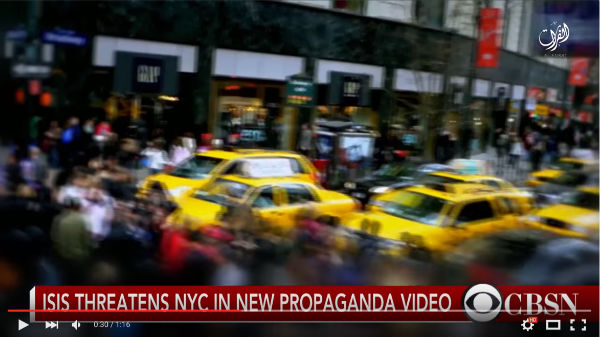
In one snippet of the ISIS video, we see a tracking shot showing taxis stopped at an intersection next to a Gap store:

This comes from a video made by StockFootage.com “Fast tracking shot of crowded street in nyc.“:

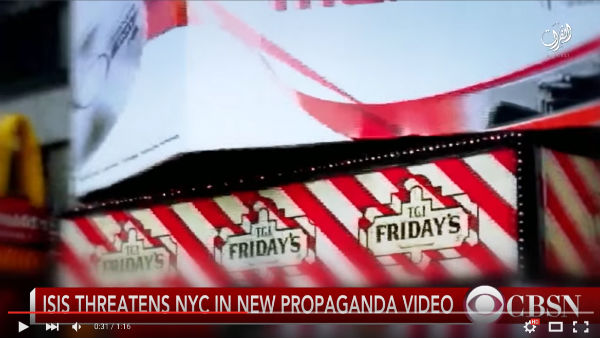
The ISIS video shows a TGI Friday’s:

This comes from another StockFootage.com video, “Panning shots of signs in Times Square New York City“:

Charlie Rose: Analysis of the Paris attacks — Michael Weiss, Bernard-Henri Lévy, et al
Now is the time to show solidarity with refugees fleeing from terrorism and tyranny
Ian Birrell writes: we share common cause with most refugees flooding to Europe from Iraq and Syria, who are driven by desire to share our freedoms after jihadis helped devastate their homelands. Those terrible events in France happen almost daily in Iraq and Syria, which is why families risk their lives to get on boats across the Mediterranean (although death is more likely to come from the Syrian regime some westerners suddenly seek to aid). The refugees I have met in Germany, Greece and Italy this year loathe Isis with bitter intensity – and the feeling is mutual, since the fanatics dislike those leaving their domain for undermining their proclamations of a paradisiacal caliphate.
There are justified, if regrettable, questions over the future of the Schengen area. But those calling for Europe to shut exterior borders and reject refugees should ask why people board lethal and overloaded boats. European Union borders are closed already, but desperate people resort to desperate measures. Shut off one route and another opens up; the only change is that those running from torture, war and repressionwill be fleeced still further by smugglers, and forced to take even more dangerous journeys. This can be seen already with the sinking of boats used to carry refugees; trafficking gangs simply switched to older, less seaworthy vessels and overcrowded inflatables.
Jean-Claude Juncker, the European commission president, is right to say that if one attacker arrived masquerading as an asylum seeker then he is “a criminal and not a refugee”. None of the 750,000 refugees admitted to the United States since 9/11 have been arrested on domestic terror charges. But isolationists and misanthropes in Europe and north America are using the Paris massacres to argue against offering sanctuary. Such is the Orwellian nature of debate, some say a British government that sought to end support for rescue missions to pull drowning people from the sea is more compassionate than a German government struggling to offer sanctuary to huge numbers of refugees. [Continue reading…]
Don’t ‘scapegoat’ Syrian refugees, Catholic bishops and evangelicals say
CNN reports: Two of the country’s largest and most influential religious groups, the U.S. Conference of Catholic Bishops and the National Association of Evangelicals, are urging the United States not to halt the resettlement of Syrian refugees after the deadly terrorist attack in Paris last Friday.
“Of course we want to keep terrorists out of our country, but let’s not punish the victims of ISIS for the sins of ISIS,” Leith Anderson, NAE president, said on Tuesday.
House Speaker Paul Ryan has called for a “pause” in the U.S. program accepting Syrian refugees and 27 governors have said they will not welcome them, though they have little legal authority to bar the federal government from settling refugees in their states. [Continue reading…]
Mosques vandalised as U.S. states reject Syria refugees
Al Jazeera reports: Several mosques have been vandalised and a number of suspected hate crimes targeting Muslims carried out after dozens of United States governors announced they would not accept Syrian refugees in their states.
The Council on American Islamic Relations (CAIR), a civil rights organisation, said on Monday that it has documented recent “vandalism, threats and hate [incidents]” in Massachusetts, Florida, Texas, Kentucky, Virginia, Nebraska, Tennessee, Ohio and New York, among other states.
The wave of incidents follows declarations by at least 27 state governors – 26 from the right-wing Republican party and a Democrat – saying they will block Syrian refugees, citing last Friday’s deadly attacks in Paris, claimed by the Islamic State of Iraq and the Levant (ISIL) group. [Continue reading…]
Does ISIS really have nothing to do with Islam? Islamic apologetics carry serious risks
Shadi Hamid writes: Every time the Islamic State commits yet another attack or atrocity, Muslims, particularly Western Muslims, shudder. Attacks like the ones in Paris mean another round of demands that Muslims condemn the acts, as if we should presume guilt, or perhaps some indirect taint.
The impulse to separate Islam from the sins and crimes of the Islamic State, also known as ISIS, is understandable, and it often includes statements such as ISIS has “nothing to do with Islam” or that ISIS is merely “using Islam” as a pretext. The sentiment is usually well-intentioned. We live in an age of growing anti-Muslim bigotry, where mainstream politicians now feel license to say things that might have once been unimaginable.
To protect Islam – and, by extension, Muslims – from any association with extremists and extremism is a worthy cause.
But saying something for the right reasons doesn’t necessarily make it right. An overwhelming majority of Muslims oppose ISIS and its ideology. But that’s not quite the same as saying that ISIS has nothing to do with Islam, when it very clearly has something to do with it.
If you actually look at ISIS’s approach to governance, it would be difficult – impossible, really – to conclude that it is just making things up as it goes along and then giving it an Islamic luster only after the fact. [Continue reading…]
Inside ISIS’s torture brigades
Michael Weiss writes: “They have a cage in this square,” Abu Khaled said, describing the place where ISIS justice is meted out in al-Bab, the Syrian town in which, until recently, he’d served with the state security apparatus of the so-called Islamic State. This is the same place where beheadings take place from time to time. But the cage is always there, and there’s almost always someone inside.
“They put people in it for three days. And they say why he is there,” the man we’ll call Abu Khaled told me at one of our meetings over three days in Istanbul last month. “One time, a man went to the court as a witness and he lied. They put him in the cage for three days. One guy was hanging out with girls; they weren’t his relatives and not married. He spent three days. For cigarettes, you spend like one day, two days, three days. It depends.”
Abu Khaled was describing a place I’d been. I was in al-Bab during Ramadan 2012, in the relatively early days of the revolt against the Assad regime, when the town was still controlled by local rebel forces, and I saw how that same square came alive at night when activists, rebels, or local civilians transformed themselves into ad hoc cleanup crews—the Free Syrian Street Sweepers—picking up detritus and rubble left over from regime shelling, or manning field hospitals in the basement of the local mosque, because the real hospital in al-Bab had been targeted and badly damaged by the Syrian military. [Continue reading…]
Kurds can’t be Syria’s saviors
Hassan Hassan writes: A senior commander of the Raqqa Revolutionaries’ Brigade, one of the SDF factions [in the newly-formed Syrian Democratic Forces], told the authors that uneven American support for the YPG enabled the Kurds to dictate terms to the rest of the factions. The main task of the new alliance “is to protect their areas only because the Kurds can’t cover all the region,” he said. “[The army] has only light weapons so it does not become too powerful.… The American support is what made [the Kurds] above the rest and impose their political goals.”
This reality was exemplified last month, when the Pentagon said that U.S. jets airdropped 50 tons of ammunition to Arab rebel forces in northern Raqqa. However, the Arab factions seemingly could not move the ammunition on their own, and it quickly ended up in Kurdish hands.
There are three reasons the subordinate role for Arab tribal fighters undercuts the alliance’s potential. First, the imbalance will undermine the military capabilities of the coalition to push against the Islamic State in Arab-dominated areas.
Second, the tribal fighters’ status as junior partners in the alliance will increasingly reduce their morale — as happened previously, when many U.S.-trained rebels abandoned the battlefield because they felt the program was aimless and disproportionally focused on counterterrorism. Tribal fighters say that U.S. support for the Kurds indicates it is less committed to tribes in the long term. They fear that nobody would come to their aid if the Islamic State returned to areas from which it had previously been expelled, as happened in Iraq over the years or in the eastern Syrian province of Deir Ezzor last year, when repeated appeals for help went unnoticed by the international community.
“Had it not been for the [international] coalition, ISIS would have reached Qamishli,” said a fighter from the Shammar tribe, which leads the Kurdish-Arab alliance’s al-Sanadid forces. “And the fact is that when ISIS wants, it could reach anywhere.”
Finally, there are widespread fears that as more areas are seized by the Kurdish-led alliance, incidents of ethnic cleansing will increase. Last month, Amnesty International released a report accusing the YPG of committing war crimes, including the forced displacement of Arab civilians and demolition of their houses. “Whenever the YPG enters an area, they displace its Arab residents,” the Shammari fighter said, referring to Arab towns in southern Hasakah. “Fifteen villages were leveled to the ground in Tal Hamees, Tel Brak, and Jazaa.” [Continue reading…]
Strikes on Raqqa in Syria lead to more questions than results
The New York Times reports: First France and then Russia answered Islamic State attacks on their citizens with a strategy of direct reprisal: intensified airstrike campaigns on Raqqa, the militants’ de facto capital within Syria, meant to eliminate the group’s leadership and resources.
But on Tuesday in the early hours of those new campaigns, there seemed to be more questions than decisive results. Chief among them: Why, if there were confirmed Islamic State targets that could be hit without killing civilians, were they not hit more heavily long ago? And what, in fact, was being hit?
More broadly, the Raqqa airstrikes are renewing a debate about how effective such attacks can be in defeating or containing the Islamic State, also known as ISIS or ISIL, without more commitment to measures like drying up its financial support, combating its ideology or — what outside forces on all sides so far appear to have ruled out — conducting a ground assault.
Several people in Lebanon, Syria and Turkey who have been able to make contact with relatives in Raqqa say the recent French airstrikes — a barrage of about 30 on Sunday night and seven more on Monday — did not kill any civilians. But neither did they inflict serious military damage, those people said, instead hitting empty areas or buildings, or parts of the territory of factory complexes or military bases used by the Islamic State. [Continue reading…]
ISIS says ‘Schweppes bomb’ used to bring down Russian plane
Reuters reports: Islamic State’s official magazine carried a photo on Wednesday of a Schweppes drink it said was used to make an improvised bomb that brought down a Russian airliner over Egypt’s Sinai Peninsula last month, killing all 224 people on board.
The photo showed a can of Schweppes Gold soft drink and what appeared to be a detonator and switch on a blue background, three simple components that if genuine are likely to cause concern for airline safety officials worldwide.
“The divided Crusaders of the East and West thought themselves safe in their jets as they cowardly bombarded the Muslims of the Caliphate,” the English language Dabiq magazine said in reference to Russia and the West. “And so revenge was exacted upon those who felt safe in the cockpits.”
Western governments have said the plane was likely brought down by a bomb and Moscow confirmed on Tuesday it had reached the same conclusion, but the Egyptian government says it has still not found evidence of criminal action. [Continue reading…]
Can a bunch of hackers really take on ISIS?
writes: For John Chase, the breaking point came on Jan. 7, when al Qaeda-linked militants gunned down 12 people at the Paris office of Charlie Hebdo. Subsequent attacks by a gunman affiliated with the Islamic State would take five more lives. Watching triumphant jihadi messages bounce across Twitter, the 25-year-old Boston native was incensed. They needed to be stopped.
Although Chase’s formal education ended with high school, computers were second nature to him. He had begun fiddling with code at the age of 7 and freelanced as a web designer and social media strategist. He now turned these skills to fighting the Islamic State, also known as ISIS. Centralizing other hacktivists’ efforts, he compiled a database of 26,000 Islamic State-linked Twitter accounts. He helped build a website to host the list in public view and took steps to immunize it against hacking counterattacks by Islamic State sympathizers. He even assumed an appropriately hacker-sounding nom de guerre, “XRSone,” and engaged any reporter who would listen. In doing so, Chase briefly became an unofficial spokesman for #OpISIS — and part of one of the strangest conflicts of the 21st century.
For more than a year, a ragtag collection of casual volunteers, seasoned coders, and professional trolls has waged an online war against the Islamic State and its virtual supporters. Many in this anti-Islamic State army identify with the infamous hacking collective Anonymous. They are based around the world and hail from every walk of life. They have virtually nothing in common except a passion for computers and a feeling that, with its torrent of viral-engineered propaganda and concerted online recruiting, the Islamic State has trespassed in their domain. The hacktivists have vowed to fight back.
The effort has ebbed and flowed, but the past nine months have seen a significant increase in both the frequency and visibility of online attacks against the Islamic State. To date, hacktivists claim to have dismantled some 149 Islamic State-linked websites and flagged roughly 101,000 Twitter accounts and 5,900 propaganda videos. At the same time, this casual association of volunteers has morphed into a new sort of organization, postured to combat the Islamic State in both the Twitter “town square” and the bowels of the deep web.
Chase, who has since shifted his focus to other pursuits, boasts a story typical of those volunteers who work to track and counteract the Islamic State’s online propaganda apparatus. Few of these hacktivists are hood-wearing, network-cracking, Internet savants. Instead, they are part-time hobbyists, possessed of a strong sense of justice and a disdain for fundamentalists of all stripes. Many, but not all, are young people — some are more seasoned, former military or security specialists pursuing a second calling. The oldest is 50. These hacktivists speak of a desire to “do something” in the fight against the Islamic State, even if that “something” may sometimes just amount to running suspicious Twitter accounts through Google Translate.
This is something new. Anonymous arose from the primordial, and often profane, underground web forums to cause mischief, not to take sides in real wars. The group gained notoriety for its random, militantly apolitical, increasingly organized hacking attacks during the mid-2000s. Its first “political” operation was an Internet crusade against the Church of Scientology following its suppression of a really embarrassing Tom Cruise video.
In time, however, Anonymous operations became less about laughs and more about causes, fighting the establishment and guaranteeing a free and open Internet. [Continue reading…]
The pot-smoking Paris suicide bomber
The Daily Mail reports: The former wife of Paris bomber Ibrahim Abdeslam has broken her silence to say he was a jobless layabout who smoked cannabis ‘all day every day’, never went to the mosque and had spent time in prison.
Ibrahim, 31, blew himself up outside the Comptoir Voltaire cafe during Friday’s terrorist massacre in Paris, injuring three people, but only killing himself.
In an exclusive interview his wife Niama told how during their ill-fated two-year marriage the trained electrician did just one day of work, often smoking three or four joints a day.
Speaking from her home in Moleenbeek, Brussels, Niama, 36, said: ‘His favourite activities were smoking weed and sleeping. He often slept during the day. The number of joints that he smoked was alarming.
‘Despite his diploma as an electrician, he found no job,’ she said. In those two years we were married, he worked a single day. It made him lazy.’
Ibrahim, also known as Brahim, was one of at least eight jihadis behind Friday’s atrocities, which left 129 dead and at least 352 injured, while striking fear and terror across Europe.
Security sources suggest he had accidentally detonated the bomb early, after fumbling with the device as he embarked on a religious ‘war’ against the west. [Continue reading…]