The Washington Post: Amid all the Islamic State’s atrocities — its massacres of civilians, its beheading of hostages, its pillaging of antiquities — the systematic violence the jihadists have carried out against countless enslaved women and girls never fails to shock. For months now, we’ve heard appalling testimony from women who escaped the Islamic State’s clutches, many of whom endured rape and other hideous acts of violence.
Zainab Bangura, the U.N.’s special representative on sexual violence in conflict, recently conducted a tour of refugee camps in the shadow of the conflicts in Syria and Iraq, war-ravaged countries where the Islamic State commands swaths of territory. She heard a host of horror stories from victims and their families and recounted them in an interview earlier this week with the Middle East Eye, an independent regional news site.
“They are institutionalizing sexual violence,” Bangura said of the Islamic State. “The brutalization of women and girls is central to their ideology.” [Continue reading…]
Category Archives: ISIS
ISIS and the new ‘Army of Conquest’ in Syria are headed for a showdown
The Daily Beast reports: Two successive months and two stunning battlefield reversals for the embattled Syrian President Bashar al-Assad — one dealt him in the east by the so-called Islamic State, the other in the north by a new coalition of rebel forces that includes an affiliate of al Qaeda in a leading role. Now, as the two armies look to expand their territorial gains at the Assad regime’s expense, they’re also converging on each other.
The clash between the terror state widely known as ISIS and the newly emerged Jaish al Fata, or Army of Conquest, is likely to come sooner than later. Most likely it will happen in the vicinity of Homs, referred to by many rebels as “the capital of the revolution.” Ironically (or maybe not), Homs stands on the ancient caravan route between the ISIS-overrun Palmyra and the Mediterranean.
U.S. officials have been arguing in recent weeks that the ISIS/Syria/Iraq war is destined to last a long time, saying there are no signs the parties are exhausted yet or that foreign backers are ready to call a halt to the carnage, as they eventually did with the long-running Lebanese civil war. “We remain in a period of dangerous military stalemate, and it is likely to continue for some time,” argues Randa Slim of the Middle East Institute, a think tank in Washington.
That may be so, but as Slim acknowledges, “the trend in Syria today is definitely not in favor of the regime.” That’s a point her colleague at the institute, former Ambassador Robert Ford, emphasized even before the fall of Palmyra, arguing, “Despite constant Western media assessments that Syrian President Bashar al-Assad’s situation is secure, the reality is that the Syrian war is one of attrition. And minority regimes usually do not fare well in prolonged wars of attrition.” [Continue reading…]
Where ISIS gets its bombs
The Daily Beast reports: Within sight of an unoccupied watchtower, and a couple of hundred meters from the border gate at Akcakale on the Syrian-Turkish border, two small girls are skipping on stacks of piping ready for shipment to the town of Tel Abyad, now controlled by the Islamic State, or ISIS, across what the Turks claim is a locked-down frontier.
It is the weekend and so in this slow-paced, dusty border town, decorated with multi-colored banners and pennants of Turkish political parties campaigning for next month’s parliamentary polls, no one is hurrying to transport the suspicious cargo. And so here the pipes, several meters long and three inches in diameter, remain.
Around the corner there are more pipes — larger ones, six inches in diameter. Smugglers say the piping can sustain high pressure and will be used by jihadists in Syria to manufacture pipe bombs, improvised explosive devices and launch-tubes for mortars. [Continue reading…]
ISIS claims responsibility for bombing at Saudi mosque
The New York Times reports: The Islamic State extremist group claimed responsibility Friday for a suicide bombing during midday prayer at a Shiite mosque in eastern Saudi Arabia. The Saudi Health Ministry said at least 21 people had been killed and more than 120 others injured.
It appeared to be the first official claim of an attack inside the kingdom by the Islamic State, which has seized control of much of Syria and Iraq.
The group attributed the attack to a new unit, the Najd Province, named for the central region of Saudi Arabia around Riyadh. But it was unclear whether the attack was planned by Islamic State leaders, initiated independently by a Saudi sympathizer, or merely claimed opportunistically after the fact.
The attack was a sign that Saudi Arabia’s intervention in the sectarian conflict in Yemen may be escalating tensions at home. Members of the Shiite minority in Saudi Arabia, who make up about 15 percent of the population and live mainly in the Eastern Province, have long complained of insults and discrimination by Saudi Arabia’s Sunni majority and its clerical establishment. [Continue reading…]
ISIS controls 50% of Syria after seizing historic city of Palmyra
The Guardian reports: Islamic State now holds sway over half of Syria’s landmass after its seizure of Palmyra, where it has begun massacring a rebellious tribe and faces no opposition to its entry and sacking of the historic city’s ancient ruins.
“There are no forces to stop them [entering the ruins],” Rami Abdul Rahman, director of the Syrian Observatory for Human Rights monitoring group, said. “But the important thing also is they now control 50% of Syria.”
Isis seized Palmyra on Wednesday night after a week-long siege that led to the collapse of forces loyal to Bashar al-Assad. The militants are drawing closer to his strongholds of Homs and Damascus and severing supply lines to Deir Ezzor in the east, which faces an overpowering Isis crackdown.
Local activists said Isis had imposed a curfew and was sweeping the city for remnants of Assad’s forces. Isis has also massacred members of the Shaitat tribe, which fought alongside the Assad regime in Palmyra and had railed against Isis in Deir Ezzor – a rebellion in which the militant group killed 800 members of the tribe.
Control of Palmyra leaves Isis with unopposed access to the city’s magnificent ruins, amid fears that they will destroy significant chunks of Syria’s heritage as they did in Iraq.
But more significantly, Isis controls vast swaths of Syria, from Palmyra to Raqqa and Deir Ezzor in the country’s west, a tract that the Syrian Observatory for Human Rights estimates to be 95,000 sq km, or more than half Syria’s landmass. With its seizure of the Arak and al-Hail gas fields near Palmyra, it also controls much of the country’s electricity supply – those two fields power much of the Syrian regime’s strongholds in the west. [Continue reading…]
The Daily Beast adds: According to Khaled Omran, a member of the Palmyra’s anti-Assad Coordinating Committee, the regime tried to reinforce its collapsing front lines Wednesday with detainees from the notorious Tadmour Prison. Most, however, ran away from the ISIS onslaught rather than stay and fight for their jailers. “I saw about 10 busloads of prisoners being driven to the front,” Omran said Wednesday evening via Skype. “Maybe 1,000 men.” They added to the regime’s “thousands” of soldiers and forcibly conscripted tribal militias who were used, in Omran’s words, as “cannon fodder.”
Assad’s military were stationed throughout the city and its outlying districts, which are home to several security installations, including an important airbase that Iran’s Revolutionary Guards Corps has used in the past to deliver resupplies to its overstretched and attrited ally, and the Syrian air force has used to wage sorties on mostly civilian and non-ISIS targets in the war-torn country. However, the use of prisoners to defend against ISIS stands as an interesting contrast to how the terror army did the jailbreaking in Ramadi earlier in the week in order to swell their own ranks.
“Four days ago, ISIS started their preparations to storm” Palmyra, Omran explained. “Regime forces called in reinforcements, mainly to the military security branch and the citadel, but relied heavily on their air force. The number of ISIS fighters was quite small—they were in the hundreds. They weren’t very heavily equipped, save for antiaircraft guns mounted on trucks in six positions around the city.” These rudimentary air defenses were enough to deter to the fighter planes and attack helicopters. “I didn’t see them down any jets, but the guns were enough to deter most of the aerial assaults.” [Continue reading…]
Oryx Blog says: With the strategically important town of al-Sukhna falling just over a week before, and the Iraqi city of Ramadi just days before Tadmur, it appears the Islamic State is far from being under control, and possibly attempting to revive the seemingly unstoppable upmarch of last summer.
Tadmur [Palmyra], which is also home to Tadmur airbase, is of high strategic importance due to its position at the base of the vital M20 highway, which leads through the recently fallen al-Sukhna to the regime’s last holdout in the East of the country: Deir ez-Zor. Without access to this highway and with little prospect of retaking both of the Islamic State’s newest gains, the Assad-regime will face extreme difficulty in keeping its troops in Deir ez-Zor supplied, and the fall of the city and associated airbase might soon become inevitable.
The town of Tadmur is best known for the ancient Roman monuments and ruins, which, given the Islamic State’s history with the destruction of historical sites, is now feared to be a target for vandalism. Although this aspect will likely incite a lot of coverage from Western media, it should not be forgotten that there are also thousands of lives at stake, with hundreds of casualties reported so far and many dead, despite earlier reporting from Syrian State Media that citizens were being evacuated. Of course, with mainstream media eager to find new stories that might interest a diverse public, events such as renewed poison gas attacks and the current offensive are less likely to be covered than a story on ancient Roman ruins in danger of destruction.
Also of great importance are the massive weapon depots located in Tadmur, one of the largest in Syria. While the exact contents of the depots remain unknown, there are reports of ballistic missiles being stored here. Should this be the case, it is likely images of such missiles in Islamic State’s hands will surface again soon, even though it is unlikely that they will get any to work. Perhaps more of interest is the fact that many other types of weaponry captured by the fighters of Islamic State as Ghaneema (spoils of war) will provide the means for future offensives, allowing the Islamic State to exert pressure on fronts throughout the region. [Continue reading…]
European nations unify laws to prevent foreign fighters
The Associated Press: European governments agreed Tuesday to synchronize their laws to bar citizens from going abroad to fight for the Islamic State group and other extremists.
A document signed by foreign ministers from the 47-nation Council of Europe requires countries to outlaw specific actions, including intentionally taking part in terrorist groups, receiving terrorist training or traveling abroad for the purpose of engaging in terrorism.
Analysts say European laws vary, with some countries like France charging people with crimes if they plan to leave to join a violent extremist group, and others, such as in Scandinavia, lacking a legal way to prevent their citizens from becoming foreign fighters.
Palmyra and its ancient ruins have fallen to ISIS
The New York Times reports: Islamic State militants swept into the desert city of Palmyra in central Syria on Wednesday, and by evening were in control of it, residents and Syrian state news media said, a victory that gives them another strategically important prize five days after the group seized the Iraqi city of Ramadi.
Palmyra has extra resonance, with its grand complex of 2,000-year-old colonnades and tombs, one of the world’s most magnificent remnants of antiquity, as well as the grimmer modern landmark of Tadmur Prison, where Syrian dissidents have languished over the decades.
But for the fighters on the ground, the city of 50,000 people is significant because it sits among gas fields and astride a network of roads across the country’s central desert. Palmyra’s vast unexcavated antiquities could also provide significant revenue through illegal trafficking.
Control of Palmyra gives the Islamic State command of roads leading from its strongholds in eastern Syria to Damascus and the other major cities of the populated west, as well as new links to western Iraq, the other half of its self-declared caliphate.
The advance, in which residents described soldiers and the police fleeing, wounded civilians unable to reach hospitals and museum workers hurrying to pack up antiquities, comes even as the United States is scrambling to come up with a response to the loss of Ramadi, the capital of Iraq’s Anbar Province.
The two successes, at opposite ends of a battlefield sprawling across two countries, showed the Islamic State’s ability to shake off setbacks and advance on multiple fronts, less than two months after it was driven from the Iraqi city of Tikrit — erasing any notion that the group had suffered a game-changing blow. [Continue reading…]
Prof Kevin Butcher writes: From modest beginnings in the 1st Century BC, Palmyra gradually rose to prominence under the aegis of Rome until, during the 3rd Century AD, the city’s rulers challenged Roman power and created an empire of their own that stretched from Turkey to Egypt.
The story of its Queen Zenobia, who fought against the Roman Emperor Aurelian, is well known; but it is less well-known that Palmyra also fought another empire: that of the Sasanian Persians.
In the middle of the third century, when the Sasanians invaded the Roman Empire and captured the Emperor Valerian, it was the Palmyrenes who defeated them and drove them back across the Euphrates.
For several decades Rome had to rely on Palmyrene power to prop up its declining influence in the east.
Palmyra was a great Middle Eastern achievement, and was unlike any other city of the Roman Empire.
It was quite unique, culturally and artistically. In other cities the landed elites normally controlled affairs, whereas in Palmyra a merchant class dominated the political life, and the Palmyrenes specialised in protecting merchant caravans crossing the desert. [Continue reading…]
Anyone telling you ISIS is in decline isn’t paying attention
Hassan Hassan writes: Once again, in less than a year, Iraqi soldiers abandoned their positions en masse and fled in the face of advancing Islamic State forces. The fall of the city of Ramadi, the provincial capital of Anbar province, leaves no doubt about the jihadi group’s capabilities: Despite U.S. attempts to paint it as a gravely weakened organization, the Islamic State remains a powerful force that is on the offensive in several key fronts across Syria and Iraq.
Ramadi is far from the only front on which the Islamic State is advancing. The group last week launched an offensive, supported by multiple suicide operations, in the eastern Syrian city of Deir Ezzor against President Bashar al-Assad regime’s holdouts in the military air base. In the central city of Palmyra, it attacked a regime base near the ancient Roman ruins. It also recently clashed with Syrian rebels and the regime in the eastern countryside of Aleppo, the provinces of Homs and Hama, and the southern city of Quneitra, near the border with Israel.
Nor are the Islamic State’s gains in Iraq confined to Ramadi. The group has advanced deep into the Baiji oil refinery, the largest in the country. And it has since pushed on from Ramadi, attacking the nearby town of Khalidiya; if the group is successful, that might provide it with the territorial depth to advance on Baghdad.
The Islamic State’s recent advance did not take the world by surprise, as it did when the group captured Mosul and other areas across Iraq last year. This time, the United States said it conducted seven airstrikes in Ramadi, in an effort to prevent its fall, in the 24 hours before the city was lost. Local officials in Ramadi, meanwhile, had repeatedly warned that the city would be overrun if they did not receive urgent reinforcements. But the international and Iraqi support that arrived was simply insufficient to hold the city.
Therefore, the prevalent narrative that the Islamic State is destined to decline appears to be false. Rather than suffering from resource and manpower shortages, the group is only increasing its grip on the local populations in its strongholds of Mosul and Raqqa, Syria; it is also attracting a considerable number of recruits, especially among teenagers. [Continue reading…]
Fall of Ramadi to ISIS weakens rule of Iraqi premier
The New York Times reports: As Shiite militiamen began streaming toward Ramadi on Monday to try to reverse the loss of the city to the Islamic State, the defeat has given new momentum to Prime Minister Haider al-Abadi’s rivals within his own Shiite political bloc.
At the urging of American officials who sought to sideline the militias, Mr. Abadi had, in effect, gambled that the combination of United States airstrikes and local Sunni tribal fighters would be able to drive Islamic State fighters out of the city as fighting intensified in recent weeks. The hope was that a victory in Ramadi could also serve as a push for a broader offensive to retake the Sunni heartland of Anbar Province.
But as the setback brought the Shiite militias, and their Iranian backers, back into the picture in Anbar, intensified Shiite infighting appeared to leave the prime minister more vulnerable than ever. And it presented a new example of how developments on the Iraqi battlefield have sometimes instantly shifted political currents in the country.
“Abadi does not have a strong challenge from Iraq’s Sunnis or Iraqi Kurds,” said Ahmed Ali, an Iraqi analyst in Washington with the Education for Peace in Iraq Center. “It’s from the Shia side.” [Continue reading…]
Fall of Ramadi reflects failure of Iraq’s strategy against ISIS, analysts say
The Washington Post reports: As Islamic State militants repeatedly attacked Ramadi this year, police solicited cash from local families and businessmen to buy weapons, one officer recalled. The Iraqi government didn’t pay the police for months, he said.
“We begged and begged for more support from the government, but nothing,” said Col. Eissa al-Alwani, a senior police officer in the city.
The fall of Ramadi amounts to more than the loss of a major city in Iraq’s largest province, analysts say. It could undermine Sunni support for Iraq’s broader effort to drive back the Islamic State, vastly complicating the war effort.
Prime Minister Haider al-Abadi on Tuesday reiterated a government pledge to train and arm Sunni fighters to rout the extremists from the predominantly Sunni province. The government had announced a military campaign that envisioned taking back Anbar province in the coming months and then moving on for a climactic battle with the extremists in Mosul, Iraq’s second-largest city.
But the plan to form an effective Sunni fighting force was slow to take shape, hobbled by government concerns that some of the Sunnis might be close to the Islamic State, analysts say. [Continue reading…]
Kurds advance against ISIS in northeastern Syria
Reuters: Kurdish forces backed by U.S.-led air strikes are pressing an attack on Islamic State in northeastern Syria that has killed at least 170 members of the jihadist group this week, a Kurdish official and a monitoring group said on Wednesday.
The official said Kurdish YPG fighters and allied militia have encircled Islamic State militants in a dozen villages near the town of Tel Tamr in Hasaka province. The region is important in the battle against Islamic State because it borders land controlled by the jihadists in Iraq.
The Kurdish YPG appear to be trying to drive Islamic State from a stronghold in the mountainous Jabal Abdul Aziz area to the southwest of Tel Tamr, said Rami Abdulrahman, who runs the Syrian Observatory for Human Rights monitoring group.
Government appears helpless as hundreds of young Britons click through to jihad
By Natasha Underhill, Nottingham Trent University
We have been hearing for some time now that hundreds of mainly young people have left the UK and found their way to Iraq and Syria to join the Islamic State. Headlines about young schoolgirls with excellent exam results and bright prospects sneaking across the border from Turkey, or the cold brutality of “Jihadi John” as a representative of Britain’s IS executioners have made for chilling reading.
While the media obsesses about the individual stories behind these defections, the UK government – like those in Australia, Germany, France, the United Kingdom, United States, Spain, as well as a number of northern African states – are desperately seeking a strategy to combat the lure of recruitment to jihad.
Overall, the police have noted that more than 700 potential terrorist suspects have travelled to Syria over the past year.
Meanwhile Scotland Yard reported recently that a record 338 people were arrested for terror-related activities in the UK in the year to march 2015 – almost one per day. This represents a dramatic increase of 33% on the 254 who were arrested in 2013/14 – a shocking statistic. Close analysis of those 338 arrests, shows that more than half were arrested in relation to their activities in Syria. Almost eight in ten of these suspects arrested were British nationals.
Defense Intelligence Agency report in 2012 warned about rise of ISIS in Iraq
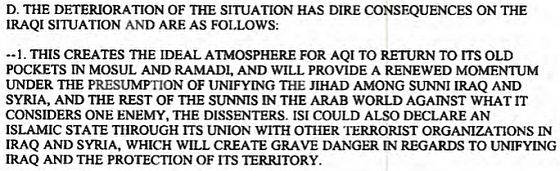
Fox News reports: Seventeen months before President Obama dismissed the Islamic State as a “JV team,” a Defense Intelligence Agency report predicted the rise of the terror group and likely establishment of a caliphate if its momentum was not reversed.
While the report was circulated to the CIA, State Department and senior military leaders, among others, it’s not known whether Obama was ever briefed on the document.
The DIA report, which was reviewed by Fox News, was obtained through a federal lawsuit by conservative watchdog Judicial Watch. Documents from the lawsuit also reveal a host of new details about events leading up to the 2012 Benghazi terror attack — and how the movement of weapons from Libya to Syria fueled the violence there. [Continue reading…]
Giving ISIS the battle they want in Iraq
Imran Khan writes: It was the worst defeat for Iraq’s elite security forces since the fall of Mosul just under year ago.
The images coming from Ramadi, the capital of Anbar province, looked more like a force in defeat rather than a tactical withdrawal.
They fled in the face of a campaign by the Islamic State of Iraq and the Levant (ISIL) group, which used firepower, car bombs and brute force for over a year to wear the Iraqi security forces down.
For ISIL it was a big victory.
Reports from Anbar suggest ISIL forces are now massing and gearing up for the next battle. A battle that they have wanted for a long time.
On Monday the Iraqi government announced that it had deployed at least ,3000 Shia militia members to Habbineyeh airbase in Anbar in preparation for an assault on ISIL fighters.
The Iranians have stepped up support for the militias and the US-led coalition has increased air strikes in the last 72 hours on ISIL targets in Ramadi.
A very loose coalition of Iraqi Shia forces, Iranian support and America and the West. It is the war that ISIL have always wanted.
Across ISIL messages boards and social media accounts, ISIL sympathisers have drawn parallels between this conflict and the Battle of Badr fought in 624 CE between the earliest followers of the Prophet Muhammad and the Quraish, the largest tribe in what is now Saudi Arabia. [Continue reading…]
To recapture Ramadi from Islamic State, Iraq must use this formula
Hayder al-Khoei writes: The fall of Ramadi, the capital of Iraq’s largest province, is a major defeat for the Iraqi security forces. It follows a period in which a number of strategic advances have been made by Iraqi forces elsewhere in the north and east of the war-torn country. Dreams of an offensive to defeat Islamic State in Mosul this year will now be crushed. Iraq will instead focus its resources and attention on liberating Ramadi, which lies just 60 miles to the west of Baghdad.
The complex realities on the ground will also lead to difficult choices being made on all sides of the conflict. Iraqi Prime Minister Haidar al-Abadi’s approval to send in the Shi’ite-dominated Hashid Shaabi paramilitary forces to the Sunni-dominated Anbar region will worry many, but it comes at the request of local Sunnis who are desperate to defend their areas against Islamic State. The Anbar governor, provincial council and local tribes have publically asked Baghdad to send in these paramilitary forces to support Iraq’s security forces and Sunni tribesmen.
Unlike in Tikrit, several Sunni tribes in Ramadi have already been resisting Islamic State for years now. As 3,000 Shi’ite fighters have deployed to the west of Ramadi following Abadi’s green light, 4,000 Sunni tribesmen have now been deployed in the west to prevent further Islamic State advances in Anbar. Sunni-Shi’ite military cooperation — aside from the official security forces that are themselves mixed — will be a crucial element in this campaign. Sunni tribal fighters are also officially part of the Hashid Shaabi in Anbar, so this paramilitary force is no longer exclusively Shi’ite. [Continue reading…]
ISIS solidifies foothold in Libya to expand reach
The Wall Street Journal reports: Islamic State leaders in Syria have sent money, trainers and fighters to Libya in increasing numbers, raising new concerns for the U.S. that the militant group is gaining traction in its attempts to broaden its reach and expand its influence.
In recent months, U.S. military officials said, Islamic State has solidified its foothold in Libya as it searches for ways to capitalize on rising popularity among extremist groups around the world.
“ISIL now has an operational presence in Libya, and they have aspirations to make Libya their African hub,” said one U.S. military official, using an acronym for the group. “Libya is part of their terror map now.”
Islamic State’s growth as a powerful anti-Western force has militant groups throughout the world trying to latch onto its notoriety. But until recently, affiliates have operated with a great degree of independence and there was little evidence they were taking orders from the group’s core leadership in Syria and Iraq, American officials said.
The core group benefited by pointing to the mushrooming number of affiliates to show its self-styled caliphate was expanding. But the gains in North Africa mark the first expansion of the group’s reach outside the Middle East beyond rebranding efforts by militants trying to secure direct support from the Syrian-based extremists, U.S. officials said. [Continue reading…]
ISIS is not as exceptional as it appears
Reyko Huang writes: The attention heaped on the Islamic State in Western media and public debate has centered primarily on two issues: its religion and its violence. On both fronts, the group has left observers aghast with its extremism. Those analysts focusing on the religion try to make sense of the group’s distinctive brand of Islamic ideology as well as the “psychopaths” who choose to become its followers. Those fixated on the group’s violence posit that its seemingly unlimited capacity to brutalize and terrorize has few parallels among violent organizations, so much so that “even al-Qaeda,” as is repeatedly pointed out, has disavowed the group.
Nevertheless, as Marc Lynch recently argued in the Monkey Cage, putting the Islamic State in a broader comparative perspective shows that the group is hardly unique among armed non-state organizations. This in turn points to ways scholars and observers might most productively study and write about the group.
Much of the media coverage and popular discussion of the Islamic State has focused on the group’s atrocious acts of violence. In their orchestrated murders and in the savvyness with which they broadcast them to the world’s horrified viewers, they are perhaps unmatched in the present age. And yet, to portray the Islamic State as uniquely brutal or unrivaled in its savagery is to forget our unfortunate history – even recent history – that is filled with episodes of extreme violence against civilians committed in the name of some political goal. One would be hard pressed to argue that the Islamic State’s actions are more unconscionable than those of the Khmer Rouge who created the killing fields of Cambodia, or Renamo of Mozambique whose fighters specialized in the kidnapping, rape and mutilation of women, men and children, or the systematic use of sexual violence as a weapon in the Bosnian war; or that the group’s staged beheadings are any more appalling than the thousands of “forced disappearances” conducted behind the scenes in the Salvadoran conflict. The only difference between cases such as these and the Islamic State when it comes to violence is that the latter operates in the age of social media and uses it to the fullest for shock-and-awe effects. [Continue reading…]
Who serves the best cappuccinos in the ISIS caliphate?
Channel 4 News reports: Abu Rumaysah al Britani, a man from Walthamstow in London who skipped bail to join the Islamic State group, has released a guide to the caliphate that ignores war-crimes and genocide, instead selling the Islamic State with the language of the west, of Costa coffee, of Cadbury’s chocolate, of holiday resort levels of comfort and climate.
The ‘Brief Guide to the Islamic State’ talks the about cosmopolitanism and ethnic diversity of the region that runs counter to the group’s medieval interpretation of Islam and the Islamic State militants’ destruction of ancient historical sites and images of mass killings it releases almost daily.
“If you were worried about leaving behind your local Costa coffee, then you will be happy to know that the Caliphate services some of the best lattes and cappuccinos around”, the guide reads. “The Caliphate offers an exquisite Mediterranean climate that has all the makings of a plush holiday resort.” [Continue reading…]