Nahrain Al-Mousawi writes: In the wake of the deadly attacks on the Paris satirical magazine Charlie Hebdo, some are portraying the current showdown as one between Western free speech versus an angry and intolerant Islamic world. In fact, it is the Islamic countries of the Middle East that have led the way in attacking the extremists of groups such as Islamic State using the instruments of satire. The use of mockery and caricature as a way of mocking Islamic extremism is, in fact, in some ways far more pronounced in the Middle Eastern media than it is in Europe.
Islamic State (also known as ISIS and ISIL) has slaughtered hundreds of Iraqi civilians and soldiers, raped and enslaved hundreds of women, held public crucifixions and stonings in Syria, and staged the executions of U.S. journalists and British aid workers. The group is revolting, abhorrent, and terrifying. But the region on which Islamic State has unleashed its sadistic campaign has responded producing a surprising volume of satire.
On Iraqi state TV, a satirical soap opera dedicated to mocking Islamic State, State of Myth, depicts the gruesome yet absurd “contributions” ISIS fighters and ideology unleash on a fictional town in Iraq, such as a green-energy car-bombing factory– cost-effective, reasonably priced, environment-friendly, and export-ready! All this information is provided by an IS engineer in a TV interview, where the female news announcer has resorted to wearing a sheet while asking questions.
While some claim humor is a way of taking back power – the power to name, to shame – on an uneven playing field, the show appears to be making fun of not only IS’s crude, fumbling, and sadistic methods to gain power, but also the strategic powerlessness of Iraqis trying to play along with, manipulate, and knowingly skirt the cruelty of that blundering power. [Continue reading…]
Category Archives: ISIS
ISIS launches dawn attack on Samarra
BBC News reports: Islamic State militants have attacked Iraqi security forces in the central city of Samarra, killing two people and injuring 28 others, officials say.
They reportedly carried out five suicide bomb attacks on checkpoints along a motorway west of Samarra.
The bombings were followed by mortar attacks on the city itself.
IS surrounded Samarra, a predominantly Sunni city that is home to one of Shia Islam’s holiest sites, after launching an offensive in northern Iraq in June.
Soldiers and allied Shia militiamen have managed to stop the jihadists overrunning the city, and have recently retaken towns and villages to the south with the help of US-led coalition air strikes.
The latest assault on Samarra by IS militants, who regard Shia as heretics who should be killed, began before sunrise on Thursday. [Continue reading…]
France to deploy aircraft carrier to fight ISIS, says report
AFP reports: The French aircraft carrier Charles de Gaulle and its fleet will be deployed to the Gulf to support operations against the Islamic State group, a military news site reported on Tuesday.
The deployment of the marine battle group is due to be announced by President Francois Hollande when he gives his annual new year’s speech to the armed forces onboard the Charles de Gaulle on January 14, according to the “Mer et Marine” news site.
The Elysee Palace confirmed to AFP that the carrier would travel to the Gulf on its way to India, where it is due to take part in exercises in mid-April.
“The Charles de Gaulle will be available to participate, if necessary, in all operational missions”, the Elysee spokesman said. [Continue reading…]
Who are the #CharlieHebdo killers?
One of the hallmarks of terrorism is that provokes its audience to prematurely assign meaning.
Today’s brutal attack on the offices of the French satirical magazine Charlie Hebdo has swiftly been taken to be an attack on free speech and this meaning seems so obvious, no one pauses to consider whether it is accurate.
The attackers identities remain unknown but there is little reason to doubt that they are Islamic extremists of some description. Exactly who is a detail that is probably of less concern to those whose first need is to condemn violence and to defend free speech.
I neither doubt the sincerity of these condemnations nor the need to defend free speech, but it’s important to try and understand exactly what happened.
A few hours before the attack, the magazine tweeted:
Meilleurs vœux, au fait. pic.twitter.com/a2JOhqJZJM
— Charlie Hebdo (@Charlie_Hebdo_) January 7, 2015
The caption says “Greetings from al-Baghdadi as well” and the ISIS leader is saying, “…and especially health.” The magazine adds, “Best wishes, by the way.”
But Kim Willsher at The Guardian notes this important detail about the timing of the attack:
#Charlie Hebdo. It was press day at the magazine so all important staff were there. Now 10 assassinated along with 2 police officers.
— Kim Willsher (@kimwillsher1) January 7, 2015
If the attackers had studied the work schedule of the journalists that carefully, it’s reasonable to infer that this operation was painstakingly planned and its occurrence right after the Baghdadi tweet was either pure coincidence or just a useful pretext.
It’s now reported that the gunmen told a bystander that the attack was carried out by Al-Qaeda in Yemen. The gunmen have been described as wearing military dress and armed with Kalashnikovs and a rocket launcher.
Witness to #CharlieHebdo attack claims gunmen told him it was “Al-Qaeda in Yemen” (i.e. AQAP): http://t.co/gGyLxyvSTw pic.twitter.com/3jcdj9dZcD
— Charles Lister (@Charles_Lister) January 7, 2015
Drawing a distinction between AQAP and ISIS may seem like a distinction without a difference. But the two jihadist groups have different objectives and competing interests.
In late November, NBC News reported:
Escalating a war of words between terrorism’s old and new schools, an Islamic scholar with al Qaeda’s Yemen-based offshoot on Friday accused ISIS of “planting … disunity” among the various Islamic extremist factions fighting to topple the Syrian government and rejcted the authority of the Iraq- and Syria-based group’s self-declared caliphate.
Harith Al-Nadhari, a spiritual leader and Shariah law scholar with the Yemen-based Al Qaeda in the Arabian Peninsula (AQAP), said in a videotape released on YouTube and other social media that the infighting among Syrian rebel groups was “the biggest disaster that hit the Ummah (Arabic for the Muslim community) at this stage.”
He blamed ISIS, also known as the Islamic State, for the divisions, saying that it had exported “infighting and fitna (Arabic for strife) to other fronts,” according to a translation of his comments by Flashpoint Partners, which monitors terrorist group’s online communications.
Al-Nadhari also criticized ISIS for what he described as an overreach by calling for Muslims everywhere to “pledge allegiance to the caliph.”
While AQAP acuses ISIS of sowing discord between Muslims, the Charlie Hebdo attack is clearly aimed at sharpening the divisions between Muslims and non-Muslims and between the East and the West.
To the extent that this message resonates with those whose support for ISIS has become shaky, the attack may serve a strategic goal: to present al Qaeda rather than ISIS as the preeminent defender of Muslims.
An ISIS critic, noting the difference in expressions of concern about deaths in Syria versus those in Paris, tweets:
hundreds of thousands of people butchered by Assad in #Syria but no one cares! for #CharlieHebdo everybody started to show up!
#hypocrites
— Truth Of ISIS (@Truth_ISIS) January 7, 2015
At the same time, there is also apparently an ongoing effort to use the attack to coral support for ISIS:
Top ISIS figures on social media pushing users to make a run on the #CharlieHebdo hashtag, posting older propaganda with it.
— J.M. Berger (@intelwire) January 7, 2015
Naturally, the conspiracy theorists — yet to agree on their narrative — are busy at work:
Two days before #CharlieHebdo shooting Hollande called Assad 'satan' – planned to attack #Syria. Now he has the perfect excuse!
— Partisangirl (@Partisangirl) January 7, 2015
yesterday #Holland declares he regret not intervening in #Syria
Today: #CharlieHebdo !
the smell of 11th.Sept. spreads from this!
— Truth Of ISIS (@Truth_ISIS) January 7, 2015
"Israel warned that the French parliament's vote in favor of recognizing Palestine will harm the peace process…"
#CharlieHebdo false flag
— i'm just a patsy! (@nine11inreverse) January 7, 2015
Meanwhile, Jeffrey Goldberg tweets:
The #CharlieHebdo attack represents possibly the most direct attack by Islamists on Western ideals to date.
— Jeffrey Goldberg (@JeffreyGoldberg) January 7, 2015
The gunmen's basic message: If you don't stop calling our religion intolerant and violent, we'll murder you.
— Jeffrey Goldberg (@JeffreyGoldberg) January 7, 2015
Many have retweeted a 2012 New Yorker cartoon which depicts the price of capitulating to the opponents of free speech.
New Yorker, September 2012 #CharlieHebdo pic.twitter.com/UgtnnyRGtX
— Davide Piacenza (@Davide) January 7, 2015
And in defense of the satirists, it’s worth noting that as much as they were criticized for being provocative, their sharp statements were not lacking in nuance:
Oct 1 cover #CharlieHebdo criticizing ISIS:'I am the prophet, idiot' beheader: 'STFU, infidel!' #freedomofexpression pic.twitter.com/fi6npEXNgd
— Özgür Karcıoğlu (@okarcioglu1) January 7, 2015
And neither was their critical focus reserved for Islam:
Jan 7 2015 #Paris #CharlieHebdo and #TheoVanGogh, criticized ALL #religions and people, not just #Islam and #Muslims! pic.twitter.com/gMdQeL76Wo
— Marius Ooms (@NESG2013) January 7, 2015
Before too many voices get raised in an unreflective and uninformed defense of Western ideals, let’s hope the gunmen are caught and they are carefully questioned.
An eyewitness description of the attack may turn out to be quite significant:
“Everything happened very calmly, without shouting, without insults.”
That the attackers operated with clinical efficiency suggests that their operation was not only planned meticulously but there was probably as much thought put into anticipating its effect.
That’s why I’m inclined to think that this was designed not simply to send a narrow message — this is the price for insulting Islam — but to have a much wider impact, deepening the divide between Muslims and non-Muslims.
It’s largely our choice whether the attack has this effect.

#CharlieHebdo French Islamic leaders at scene to condemn the attack. "They have hit us all. We are all victims. These people are a minority"
— Kim Willsher (@kimwillsher1) January 7, 2015
As a Muslim, killing innocent people in the name of Islam is much, much more offensive to me than any cartoon can ever be. #CharlieHebdo
— Iyad El-Baghdadi (@iyad_elbaghdadi) January 7, 2015
Saudi Arabia is right to be anxious over its ideological links with ISIS
Brian Whitaker writes: In a pre-dawn raid on Monday, militants attacked a Saudi border post from the Iraqi side of the frontier. The resulting clash left three soldiers and four militants dead, according to the Saudi government news agency.
It later emerged that one of the dead soldiers was no ordinary border guard but the commander of Saudi Arabia’s northern border forces, Brigadier General Awdah al-Balawi. This suggests that the attack, far from being random or opportunistic, had been carefully targeted and perhaps based on inside information regarding the general’s whereabouts.
The attack has been widely attributed to Islamic State, with some reports saying the rebel group has now claimed responsibility for it. This might be viewed simply as a reprisal for Saudi participation in the US-led bombing campaign against Isis, but Isis has also been seeking to extend the current conflict in Syria and Iraq into Saudi territory.
There is no doubt that Isis has both sympathisers and active supporters inside the kingdom – it claimed responsibility for shooting a Danish citizen in Riyadh last November, for example – but whether it will be able to establish a military foothold is another question. Isis tends to flourish militarily in places where central government is weak, but that is not the case in Saudi Arabia. [Continue reading…]
2014: A year of feminist insurrection against male violence
“We don’t see things as they are, we see things as we are.” [Source]
I have been waiting all my life for what 2014 has brought. It has been a year of feminist insurrection against male violence: a year of mounting refusal to be silent, refusal to let our lives and torments be erased or dismissed. It has not been a harmonious time, but harmony is often purchased by suppressing those with something to say. It was loud, discordant, and maybe transformative, because important things were said – not necessarily new, but said more emphatically, by more of us, and heard as never before.
It was a watershed year for women, and for feminism, as we refused to accept the pandemic of violence against women – the rape, the murder, the beatings, the harassment on the streets and the threats online.
Further into her essay, Solnit says:
Sometimes at big political demonstrations – against the war in Iraq in early 2003, for example – the thousands of placards with handwritten statements, jokes, and facts, for all their brevity, constitute a cumulative critique that covers a lot of angles. Social media can do the same, building arguments comment by comment, challenging, testing, reinforcing and circulating the longer arguments in blogs, essays and reports. It’s like a barn-building for ideas: innumerable people bring their experiences, insights, analysis, new terms and frameworks. These then become part of the fabric of everyday life, and when that happens, the world has changed. Then, down the road, what was once a radical idea becomes so woven into everyday life that people imagine that it is self-evident and what everyone always knew. But it’s not; it’s the result of a struggle – of ideas and voices, not of violence.
Strangely, in a piece that runs close to 5,000 words, the women who have been the targets of ISIS’s violence and the women who have been fighting against ISIS earned not a single mention.
Silence leaves a vacuum that can only be filled with speculation, but the reason for this omission seems to be spelt out in the terms by which Solnit describes effective political activism: it is defined by the absence of violence.
But did this Yazidi girl betray feminism by picking up an AK-47?
#Iraq, Becoming an almost iconic picture, #Yazidi girl with an #AK47 to protect her family against #ISIS. pic.twitter.com/CScIaBXAvM
— Danny Makki (@Dannymakkisyria) August 18, 2014
Since the battle for Kobane began and due to its convenient location right next to the Turkish border gained several weeks of intense international media attention — the battle continues but the media has mostly lost interest — the heroism of Kurdish women has been highlighted.
Zîlan Diyar, a Kurdish guerrilla fighter, wrote last month:
The whole world is talking about us, Kurdish women. It has become a common phenomenon to come across news about women fighters in magazines, papers, and news outlets. Televisions, news sites, and social media are filled with words of praise. They take photos of these women’s determined, hopeful, and radiant glances. To them, our rooted tradition is a reality that they only recently started to know. They are impressed with everything. The women’s laughter, naturalness, long braids, and the details of their young lives feel like hands extending to those struggling in the waters of despair. There are even some, who are so inspired by the clothes that the women are wearing, that they want to start a new fashion trend! They are amazed by these women, who fight against the men that want to paint the colors of the Middle East black, and wonder where they get their courage from, how they can laugh so sincerely. And I wonder about them. I am surprised at how they noticed us so late, at how they never knew about us. I wonder how they were so late to hear the voices of the many valiant women who expanded the borders of courage, belief, patience, hope, and beauty.
The fact that Solnit is not talking about Kurdish women, seems to imply that for her and perhaps many other activists in the West, the use of violence can never be defended.
If this interpretation is correct, this dedication to the principle of non-violence seems to me less a matter of principle than a luxury only available to those whose own lives are not under immediate threat.
I also have to wonder whether those who have chosen to ignore the Kurds, failed to notice that in Rojava — the Kurdish-controlled part of Syria — a political experiment has been underway for the last three years that deserves the interest and support of anyone who believes in the creation of an egalitarian and truly democratic society.
ISIS leader in Kobane apparently dished out cocaine to his fighters
With candor you’re unlikely to find from a traditional news outlet, Joakim Medin reports from Kobane: Streets and strategic buildings have been taken over by slow street fighting, which culminated in the important December 22 recapturing of Kobane’s Cultural Center. A few hours earlier, the happy fighters of this YPG unit had managed to make their own successful early morning attack against a house on the southern front, where an IS leader named Emir Abu Zahra was known to reside. They told me that in the firefight he was shot and killed.
“They also found a few things of his, which they took with them,” Dayan told me.
A slightly older fighter who speaks German came back into the room where we drank tea and perused the findings. Among them was a very thick, professional Dell laptop — one of those rugged, military-style Latitude XFRs, which has a ballistic armor protection system and is sold in stores for a few thousand dollars. They are meant to be used in demanding environments by oil workers, the police, and the army. It’s an expensive piece of equipment, but something you can probably easily pick up after having robbed the central bank of Mosul.
There’s also a traditional looking Middle Eastern dagger among the possessions they said they took from the now dead IS leader. Surprisingly, it’s not an authentic one, but a tacky copy with an Egyptian sphinx emblazoned on the case, and a horned goat head on the shaft. There are no blood traces on the blade.
And finally, sitting in front of me, is a large, transparent plastic bag filled with white powder. The YPG fighters told me they are not sure what this could be. So I dipped my index finger into it, and sure enough, it’s a big bag of cocaine. I must admit, I am familiar with the taste of the drug.
“Cocaine? What is that?” they ask.
The other guys have no knowledge of this drug, or how people use it. It’s nothing they have heard of or encountered before. But Dayan suggests that the powder is something Abu Zahra was distributing in smaller portions to his fighters.
There have been persistent rumors and accusations of drug use in the ranks of Islamic State fighters. Leaders in the group have been said to drug their militants to give them greater courage as they go into battle. This has led to both successful, but also reckless and ineffective suicide attacks by fighters who can easily be shot down. Certain IS militants have been described as “drug-crazed,” and Kurds report having found mysterious pills, capsules, and syringes on living and dead IS fighters. [Continue reading…]
Europe’s fear of Syria’s ‘ghost ships’
James Denselow writes: The story of the Ezadeen, the ship set on autopilot and set towards Europe with 450 fleeing Syrian refugees on board, could be a turning point in the European response to the crisis in Syria. With a conflict that has killed some 200,000 people burning brightly on its doorstep Europe’s prime focus to date has been on ensuring that it stays away from the flames. The emergence of “ghost ships”, the latest gruesome tactic to come out of a conflict that has also put the “barrel bomb” into the popular lexicon, may force a much needed revaluation on the strategy of Europe’s response.
The discovery of the Ezadeen is simply the latest in an increasing number of horror stories emerging from the Mediterranean Sea. The boat, aptly a former livestock carrier, was found in rough seas some 40 nautical miles off the Italian coast – the second vessel in four days to be found sailing abandoned by its crew.
The ghost ships represent both a new tactic – using large cargo ships to move people in winter across longer crossing – and a new trend – that of the refugees coming from Syria. Last year some 230,000 people arrived illegally across the Mediterranean into the EU with Italy receiving the lion’s share of 160,000 whilst 3,500 people died trying to make the crossing. The UNHCR explained that in 2014 for the first time, people mainly from Syria “have become a major component in this tragic flow, accounting for almost 50 per cent of the total”. [Continue reading…]
Foreigners fighting with Kurds against ISIS in Syria: who and why?
Reuters reports: While illegally crossing the Iraqi-Syrian border, Canadian Peter Douglas was adamant that his incursion was for humanitarian reasons – to help the people of Syria.
Douglas is one of a growing band of foreigners to dodge authorities and join the fight against Islamic State militants who have killed thousands and taken vast parts of Iraq and Syria, declaring a caliphate in territory under their control.
Many of these fighters argue they are there for humanitarian reasons but they say their decision to take up arms to fight for the Syrian people will not be viewed as such by some.
“I want to fight the Islamic State, although it might be the last thing I do,” said Douglas, 66, from Vancouver, as he prepared to board a boat crossing a remote stretch of the Tigris River .
“I know I have 10 years to live before I will start develop dementia or have a stroke so I wanted to do something good,” he added, although he acknowledged that taking up arms was new on the list of jobs and occupations he has previously pursued.
So far an estimated few dozen Westerners have joined Kurdish fighters battling Islamic State in northern Syria, including Americans, Canadians, Germans, and Britons. [Continue reading…]
Inside Kobane
Iraqi general warns of military woes in fighting ISIS
The Associated Press reports: Lt. Gen. Abdul-Wahab al-Saadi had 225 fighters, a single Abrams tank, a pair of mortars, two artillery pieces and about 40 armored Humvees when he set out to retake a strategic city in northern Iraq captured by Islamic State militants over the summer.
It took 30 days as his force made an agonizingly slow journey for 40 kilometers (25 miles) through roadside bombs and suicide car attacks, then successfully laid siege to the oil refinery city of Beiji. The campaign earned al-Saadi the biggest battlefield victory by Iraqi forces since Islamic State fighters swept over most of northern and western Iraq in a summer blitz, prompting the collapse of the military.
Yet al-Saadi is deeply pessimistic. In a two-hour interview with The Associated Press, he said Iraq’s military lacks weapons, equipment and battle-ready troops and complained that U.S. air support was erratic. Both the military and the government remain riddled with corruption, he said. Most of the senior generals serving when the military fell apart had skills “more suited to World War II,” he said.
“If things don’t get better,” warned the general, “the country could end up divided” between its Shiite, Sunni and Kurdish populations.
The extremists are beatable when confronted with a proper force, he said. But he worries that the military’s multiple woes prevent it from doing so. Already, there is a danger the jihadis could retake Beiji, he said. [Continue reading…]
The brothers who ambushed ISIS
Mohammed A. Salih reports: It was a sunny day in late November when Ahmed Ismael, 22, went with a group of seven other fighters to ambush militants from the self-proclaimed Islamic State, or ISIS, on the eastern flank of this besieged town.
Then the plan went terribly wrong. The would-be ambushers were themselves ambushed. Two car bombs exploded and a group of jihadists blocked their way from behind, cutting off their exit route. During the intense firefight that followed, four Kurdish fighters died, including three of Ahmed’s cousins.
“They had heavy weapons but we only had AK-47s,” says Ahmed, his voice still shaky as he recounts the details. “It was my first real fight. We stayed there for four hours. We ran out of ammunition. I was next to my cousins when they died.”
As the fight raged on, Ahmed and the three women fighters who were part of the mission, sent out calls for help. Finally, a squad of reinforcements arrived and they were able to retreat.
Since then, there have been many other skirmishes, so many that war has come to seem a ways of life for Ahmed and his older brother Nusin. But neither had ever thought before that they were destined to become fighters. They had led a quiet life in this otherwise rural and peripheral town in northern Syria that, until a few months ago, few people had ever heard of outside the region. They were carpenters making chairs, beds and other rudimentary pieces of furniture for the locals.
But when the jihadists from ISIS launched a large-scale assault on Kobani in September, the two brothers had to make a choice. “We wondered what to do,” says 24-year-old Nushin. “We sent our family to Turkey,” he says, “But this is our town. The two of us did not want to leave. Where could we go? We decided to stay here and defend our home.” [Continue reading…]
Syria year-end predictions and analysis by Joshua Landis
Joshua Landis writes: Syria will become increasingly fragmented in 2015. The Somalia-ization of the country is inevitable so long as the international community degrades all centers of power in Syria and the opposition fails to unite.
Who owns what?
The four strongest authorities in Syria are the Assad government, ISIS, Nusra, and the Kurds. They rule close to 95% of Syrian territory. The Assad government rules 45% of the land and perhaps 65% of the population, give or take. ISIS rules 35%, but controls less than 3 million people. Kurds may control about 8% or 9% of Syria and Nusra another 5%. This leaves the hundreds of additional militias controlling the remaining 5%, but in some areas “No FSA faction can operate without Nusra’s approval.” Jihadis prevailed in 2014.
Thanks to @deSyracuse for his maps. Click on it to go to his site and use interactive featuresAll authorities will become weaker, with the possible exception of the Kurds. The United States is at war with all important Arab factions. It is actively bombing ISIS and Nusra, while sanctioning Assad. Although Washington has been funding a “train and equip” project to the tune of half a billion dollars, it appears to have neither urgency nor teeth. Coalition forces are divided on objectives. This means that all centers of authority in Syria are being degraded while none are being built up. It means no one can win. The Assad regime, ISIS, and Nusra are all likely to see their power diminish over the coming year. The FSA militias have become practically irrelevant and must take orders from the radicals. The educated and worldly activists who played such a vital role in launching the revolution have been pushed aside and are today without influence. One can interpret this either as: a) Liberals and democrats in Syria were such a small elite that they were quickly swept aside by the tide of sectarians, fascists, and Islamists; or B) Assad intentionally destroyed the liberals and moderates so that he would face only extremists, leaving the world to face an either-or choice: Assad or al-Qaida. The reality is probably a measure of both.
The Assad government strengthened its control over major cities, while losing control over rural areas. It gained ground in the Damascus suburbs, Kalamoun, Homs and Aleppo, but it lost territory in others, such as Idlib, the Golan, Deraa and the Jazira. This strategy reveals Assad’s urban bias. He believes he can regain the support of the urban middle classes who fear the radicalized and poorer country-folk. The Baath originally relied on rural support against the cities. But as it went bankrupt and turned away from subsidies and socialism toward neo-liberal policies mixed with a heavy dose of corruption, it turned its back on the urban poor and struggling countryside. Today the regime is trying to turn the rich against the poor in an effort to convince them that the revolution was a pipe-dream and that they must fight “terrorism.” Collapsing oil revenues in Iran and Russia mean that Assad will have to suffer with less money in 2015. But so too will the rebels because they are as reliant on oil money as the regime. All incomes will take a nosedive. Ninety percent of Syrians live below the poverty line, according to the UN. But poverty can get worse. [Continue reading…]
Syria Kurds control 70 percent of besieged Kobane: monitor
Reuters reports: Kurdish forces have regained control of around 70 percent of the Syrian town of Kobani near the Turkish border after pushing back Islamic State fighters that have spent months besieging it, a group monitoring the war said on Wednesday.
Backed by U.S-led air strikes, Kurdish forces made significant advances overnight on Tuesday after violent clashes with Islamic State in the south of the town, the British-based Syrian Observatory for Human Rights said.
A war against childhood

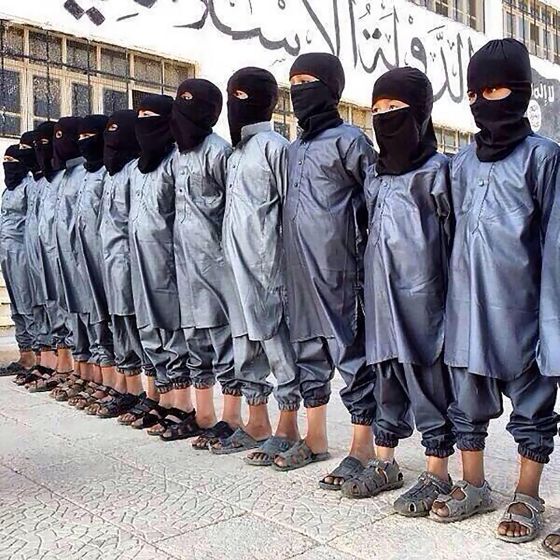
The Wall Street Journal reports: Jomah, a 17-year-old Syrian who joined Islamic State last year, sat in a circle of trainees for a lesson in beheading, a course taught to boys as young as 8.
Teachers brought in three frightened Syrian soldiers, who were jeered and forced to their knees. “It was like learning to chop an onion,” Jomah said. “You grab him by the forehead and then slowly slice across the neck.”
A teacher asked for volunteers and said, “Those who behead the infidels will receive gifts from God,” recalled Jomah, who didn’t want his full name revealed. The youngest boys shot up their hands and several were chosen to participate. Afterward, the teachers ordered the students to pass around the severed heads.
“I’d become desensitized by that time,” said Jomah, who has since defected to Turkey with his family. “The beheading videos they’d shown us helped.”
The enrollment of hundreds of boys in such militant training camps is another tragic facet of Syria’s nearly four-year-long civil war — and its impact could trouble the Middle East for years to come. Parents worry their boys will be forever lost to the indoctrination of Islamic State. [Continue reading…]
A TSG IntelBrief concludes:
• Through systemic indoctrination, intimidation, and extermination, violent extremist groups such as the Islamic State, Boko Haram, and both Afghan and Pakistan Taliban, are targeting children with unprecedented ferocity• Children are no longer accidental casualties in extremist conflicts but rather they are a primary target
• Extremists are trying to steal the future away from vulnerable regions by stealing the future generation through relentless messaging and violence that separates the youth from their society, government, and culture
• The damage already done by the Syrian civil war, the Islamic State, Boko Haram, and violent extremist groups in in Pakistan pales in comparison to what is yet to come if even a small percentage of their focus on youth pays off.
In the midst of pervasive war-weariness and deeply felt opposition to military intervention following the war in Iraq, social media has not only desensitized children living under ISIS’s rule, serving as a primer on brutality, but it has also desensitized opponents of war.
Images which provoke instinctive revulsion, trigger a desire not only to look away, but also turn away in every way possible, such that both ISIS and those who have become its victims can be cloaked in otherness.
When we see children in masks, it’s easier to see the masks than see the children.
Paradoxically, among the many who readily acknowledge that ISIS came into existence primarily as a result of the war in Iraq and that in this sense, ISIS is an American creation, far fewer are willing to admit that the U.S. has a huge responsibility in now trying to thwart the monster that it unwittingly released.
At the same time, even if we acknowledge that we are part-owners of the problem, no one will be served well by casting America in its traditional self-ascribed role as rescuer.
Now, as has long been the case, the U.S. needs to break out of its bipolar relationship with the rest of the world, neither seeking to dominate, nor retreat.
Backlash in Berlin over NSA spying recedes as threat from ISIS rises
The Washington Post reports: In a crescendo of anger over American espionage, Germany expelled the CIA’s top operative, launched an investigation of the vast U.S. surveillance programs exposed by Edward Snowden and extracted an apology from President Obama for the years that U.S. spies had reportedly spent monitoring German Chancellor Angela Merkel’s cellphone.
In an address to Parliament last year, Merkel warned that U.S.-German cooperation would be curtailed and declared that “trust needs to be rebuilt.”
But the cooperation never really stopped. The public backlash over Snowden often obscured a more complicated reality for Germany and other aggrieved U.S. allies. They may be dismayed by the omnivorous nature of the intelligence apparatus the United States has built since the Sept. 11, 2001, attacks, but they are also deeply dependent on it.
Over the past year, Germany has secretly provided detailed information to U.S. spy services on hundreds of German citizens and legal residents suspected of having joined insurgent groups in Syria and Iraq, U.S. and German officials said.
Germany has done so reluctantly to enlist U.S. help in tracking departed fighters, determining whether they have joined al-Qaeda or the Islamic State and, perhaps most importantly, whether they might seek to bring those groups’ violent agendas back to Germany.
The stream of information includes names, cellphone numbers, e-mail addresses and other sensitive data that German security services — ever mindful of the abuses by the Nazi and Stasi secret police — have been reluctant even to collect, let alone turn over to a suspect ally. [Continue reading…]
U.S. troops return to Iraq to train force to fight ISIS
The New York Times reports: The United States has begun training a first wave of Iraqi Army recruits, in recent days putting them through morning fitness exercises and instructing them in marksmanship and infantry tactics, in an effort to gather enough forces to mount a spring offensive against the extremists of the Islamic State.
Military officials here say the first of the American-trained recruits, who answered the call to arms by Iraqi religious leaders over the summer and have completed some basic training under the Iraqis, will be ready to join the fight against the Islamic State, also known as ISIS or ISIL, by mid-February. Pushing forward, officials say the goal is to train 5,000 new recruits every six weeks.
“These are new patriots of Iraq, that have actually signed up, have been through basic training and are now ready to go through some advanced training,” said Maj. Gen. Paul E. Funk II, the American commander who is overseeing the training program.
More than six months after the Islamic State’s lightning advance through northern Iraq forced a reluctant President Obama to order a new United States military mission here, an American training program for the Iraqi security forces has begun to take shape. In recent days, the first recruits, about 1,600 men in four battalions, have been received by American instructors at Camp Taji, a base north of Baghdad. Others have begun arriving at Al Asad Air Base in Anbar Province, joining roughly 200 American Marines and Special Forces soldiers.
The American presence in Iraq is expected to grow in the coming weeks, to more than 3,000 personnel from about 1,800. The American military already has a presence in Baghdad and Erbil, the Kurdish capital in the north, and has plans for two more training sites: one for Special Forces in Baghdad and another in Besmaya, south of the capital. [Continue reading…]
Shi’ite militias expand influence, redraw map in central Iraq
Reuters reports: Behind black gates and high walls, Iraqi national security agents watch 200 women and children.
Boys and girls play in the yard and then dart inside their trailers, located in a former U.S. military camp and onetime headquarters for Saddam Hussein’s officials in Babel province’s capital Hilla.
The women and children are unwilling guests, rounded up as they fled with their male relatives in October from Jurf al-Sakhr, a bastion of Islamic State, during a Shi’ite militia and military operation to clear the farming community.
Once they were arrested, security forces separated out the men, accusing them of being Islamic State fighters. They have not been heard from since.
Security forces say the women and children are being investigated, but have not been brought to court.
Their status shows how central Iraq’s mixed Shi’ite and Sunni regions are being altered.
As Shi’ite forces push into territories held by Islamic State, many Sunnis have fled for fear of both the Shi’ite-led government and the Sunni jihadists.
Shi’ite leaders insist Islamic State must never be allowed to strike them again, nor return to areas now abandoned.
Shi’ite groups now decide who can stay in a community and who should leave; whose houses should be destroyed and whose can stand. [Continue reading…]