Category Archives: Obama administration

How Obama killed diplomacy

Roger Cohen writes: “It is not going too far to say that American foreign policy has become completely subservient to tactical domestic political considerations.”

This stern verdict comes from Vali Nasr, who spent two years working for the Obama administration before becoming dean of the Johns Hopkins School of Advanced International Studies. In a book called “The Dispensable Nation,” to be published in April, Nasr delivers a devastating portrait of a first-term foreign policy that shunned the tough choices of real diplomacy, often descended into pettiness, and was controlled “by a small cabal of relatively inexperienced White House advisers.”

Nasr, one of the most respected American authorities on the Middle East, served as senior adviser to Richard Holbrooke, Obama’s special representative to Afghanistan and Pakistan until his death in December 2010. From that vantage point, and later as a close observer, Nasr was led to the reluctant conclusion that the principal aim of Obama’s policies “is not to make strategic decisions but to satisfy public opinion.”

In this sense the first-term Obama foreign policy was successful: He was re-elected. Americans wanted extrication from the big wars and a smaller global footprint: Obama, with some back and forth, delivered. But the price was high and opportunities lost.

“The Dispensable Nation” constitutes important reading as John Kerry moves into his new job as secretary of state. It nails the drift away from the art of diplomacy — with its painful give-and-take — toward a U.S. foreign policy driven by the Pentagon, intelligence agencies and short-term political calculus. It holds the president to account for his zigzags from Kabul to Jerusalem. [Continue reading…]

Facebooktwittermail

Obama: the president of perpetual war

Micah Zenko writes: During his second inaugural address, President Obama offered two aspirational statements that struck many observers as incongruous with administration policies: “A decade of war is now ending” and “We, the people, still believe that enduring security and lasting peace do not require perpetual war.” We should question these observations, not least because of the string of U.S. government plans and activities that increasingly blur the conventional definition of war.

My own list of war-like activities since Obama’s inaugural would include: four drone strikes that killed 16 people (all in Yemen); the acknowledgement by Secretary of Defense Leon Panetta regarding drones, "We’ve done that in Pakistan. We’re doing it in Yemen and elsewhere. I think the reality is its going to be a continuing tool of national defense in the future"; the announcement that the U.S. military would provide intelligence, transportation, and refueling support for the French intervention in Mali; the signing of a U.S.-Niger status of forces agreement that will likely include a drone base for surveillance missions, although U.S. officials "have not ruled out conducting
missile strikes
at some point"; the forthcoming expansion (perhaps quintupling) of U.S. Cyber Command, including "combat mission forces" for offensive cyberattacks; the executive branch’s secret legal review determining that Obama "has the broad power to order a pre-emptive strike if the United States detects credible evidence of a major digital attack looming from abroad"; the Marine commandant’s announcement of a new "crisis response unit" that would be "rapidly employable" to "address crises"; and the revelation that the United States is negotiating to purchase the Sheraton Hotel in Sanaa, the capital of Yemen, to house the growing number of embassy staff, troops, and contractors who implement U.S. security force assistance and counterterrorism operations in that country. (For other examples, see the interesting End of War Timeline that Jack Goldsmith and Lawfare created.)

Using lethal force against other countries — and developing and sustaining the capabilities to do so in perpetuity — are the distinguishing features of a country at war. As Vice Chairman of the Joint Chiefs of Staff Adm. James Winnefeld, Jr. remarked in November, "We remain a nation at war." In January, Gen. Martin Dempsey, chairman of the Joint Chiefs, told Ted Koppel that even after 2014, "Our war in Afghanistan will be complete, but no one has ever suggested that that will end the war." Last week, Secretary Panetta reminded policymakers and the press, as he often does: "We are in a war. We’re in a war on terrorism and we’ve been in that war since 9/11." Finally, during his grueling confirmation hearing to become the next secretary of defense, Chuck Hagel stated: "We’re at war in Afghanistan. We’re at war around the world….The fact is we’ve been at war for 12 years."

Most analysts and journalists have focused on President Obama’s expanded scope, intensity, and institutionalization of targeted killings against suspected terrorists and militants. However, perhaps the enduring legacy of the Obama administration will be its sustained, rigorous effort to shape and define-down the idea of war. [Continue reading…]

Facebooktwittermail

Obama allowed to keep his murder memos secret

Abdulrahman al-Aulaqi, a sixteen-year-old American citizen killed by a U.S. military strike in Yemen, October 14, 2011.

A federal court judge has ruled that President Obama does not need to reveal the legal grounds on which he claims he can make a unilateral and unreviewable decision to kill an American citizen.

Last year Attorney General Eric H. Holder Jr. contrived the notion that a citizen’s constitutional right to due process can be protected even in the absence of any judicial process.

In essence, the Obama adminstration’s answer to those who question its application of the law is: trust us, we abide by the law.

Yet if so much trust could be invested in a president’s legal authority, why bother with written laws? Why not simply say what in effect we are being told: the president’s word is law.

Conor Friedersdorf writes: To be clear, the legal fight isn’t about whether Obama can kill American citizens in secret without presenting any charges or evidence of guilt or conducting a trial. At issue is whether Americans are entitled to know what he regards as the legal justification for that power.

So far, President Obama has refused to release that legal reasoning, as prepared by the Office of Legal Counsel. He is effectively denying us the ability to know what laws we live under, and stifling an informed debate about whether the powers he is exercising are in fact proper.

Judge McMahon seems to think it is technically legal for Obama to keep mum. She nevertheless delivered a scathing rebuke. Characterizing his national security policy as an “ill-defined yet vast and seemingly ever-growing exercise,” she began by explaining that in this case he hasn’t actually run afoul of freedom of information laws, and thus cannot be compelled to explain why his controversial actions are permitted by the Constitution and do not violate the law.

But as Friedersdorf further notes, the judge’s own decision is wrapped in secrecy.

McMahon offers a stark reminder of how ruinous government secrets are to the normal functioning of the legal system. “This opinion will deal only with matters that have been disclosed on the public record,” she notes. “The Government has submitted material to the Court ex parte for an in camera review. Certain issues requiring discussion in order to make this opinion complete relate to this classified material. That discussion is the subject of a separate, classified appendix to this opinion, which is being filed under seal and is not available to Plaintiff’s counsel.” There’s a secret opinion explaining why the government’s secret argument for being able to keep secret the argument for why it can kill in secret is valid! This during the tenure of a man who pledged his administration would be the most transparent ever.

Facebooktwittermail

U.S. weapons global sales boom under Obama’s watch

Reuters reports: U.S. sales of warplanes, anti-missile systems and other costly weapons to China’s and North Korea’s neighbors appear set for significant growth amid regional security jitters.

Strengthening treaty allies and other security partners is central to the White House’s “pivot” toward a Pacific region jolted by maritime territorial disputes in China’s case, and missile and nuclear programs, in North Korea’s.

The pivot “will result in growing opportunities for our industry to help equip our friends,” said Fred Downey, vice president for national security at the Aerospace Industries Association, a trade group that includes top U.S. arms makers.

Demand for big-ticket U.S. weapons is expected to stay strong for at least the next few years, the trade group said in a 2012 year-end review and forecast released in December.

Fears resulting from China’s growing military spending should lead to enough U.S. sales in South and East Asia to more than offset a slowdown in European arms-buying, according to the forecast.

The trade group, whose members include Pentagon suppliers Lockheed Martin Corp, Boeing Co and Northrop Grumman Corp, did not put numbers to its 2013 forecast. Nor did the Pentagon’s Defense Security Cooperation Agency, which has overseen a boom in worldwide deals under President Barack Obama.

The security agency, in response to a Reuters request, said sales agreements with countries in the U.S. Pacific Command’s area of activity rose to $13.7 billion in fiscal 2012, up 5.4 percent from a year before. Such pacts represent orders for future delivery.

In 2012 there were about 65 notifications to Congress of proposed government-brokered foreign military sales with a combined potential value of more than $63 billion. In addition, the State Department office that regulates direct commercial sales was on track to receive more than 85,000 license requests in 2012, a new record.

Overall, the United States reached arms transfer agreements in 2011 totaling $66.3 billion, or nearly 78 percent of all such worldwide pacts, according to the nonpartisan Congressional Research Service. The 2011 total was swollen by a record $33.4 billion deal with Saudi Arabia. India ranked second with $6.9 billion in such agreements.

Facebooktwittermail

Obama Administration seeks to strengthen Rupert Murdoch

Matt Stoller writes: Earlier this year, Obama Federal Communications Commission Chairman Julius Genachowski proposed relaxing media ownership rules to allow Rupert Murdoch to buy the Los Angeles Times and Chicago Tribune. It’s not something you’ll see discussed much, because Republicans like the fact that Murdoch is going to get more power, while Democrats don’t want to admit that Obama is helping the person framed as their arch-nemesis. This is part of a larger pattern – media consolidation is one of the many structural problems that Obama promised to deal with. And indeed, this is the real arena where the battle over free speech is being fought. Corporate control over our communications infrastructure is the free speech question of our time.

Backed by tech billionaires and consumer advocates in 2008, Obama argued for a dramatic restructuring of communications policy (versus Hillary Clinton, whose advisors were traditional telecom lobbyists). Candidate Obama made the right noises, from a strong stance on net neutrality to opposition to media consolidation to expanded broadband access. In this case, there were billionaires who valued the right policies, not just do gooders. For instance, here’s a little noted part of Democratic Party platform from 2008.

We will encourage diversity in the ownership of broadcast media, promote the development of new media outlets for expression of diverse viewpoints, and clarify the public interest obligations of broadcasters who occupy the nation’s spectrum.

Of course, as is consistent with Obama’s main policy arc, after winning, Obama neutralized the reform groups and quickly reverted to a model of policymaking that is slightly more pro-corporate than Bush’s. He appointed Genachowski, a law school classmate known as an intellectual and moral lightweight, to run the FCC, and ensured that Larry Summers in the White House would sideline any attempts to fight against media and telecom barons. [Continue reading…]

Facebooktwittermail

Chuck Hagel and the trial-balloon method of a gutless president

David Bromwich writes: It looks as if Barack Obama is about to withdraw the idea of nominating Chuck Hagel as secretary of defense. To stick with Hagel against substantial (though at the beginning, surmountable) resistance would mean declaring one of his own apparent commitments to be unshakable. The pattern of Obama’s career and character, however, goes the other way. His preferred method has been (a) to give in silently and let the issue trail off; or (b) make an announcement of temporary surrender in the foreseeable future; or (c) string out negotiations until the farthest-out solution seems a possible but clearly dangerous option, and his own ratification of centrist conventional wisdom appears the result of profound reflection.

Of the three methods listed above, (a) was the protocol for announcing and a few months later scuttling the closure of Guantanamo, (b) was used to defer any action on global warming, and (c) for escalating the Afghanistan war after giving the generals the time and opportunity to leak their plans for a larger escalation. The apparent exception is the health care law whose passage lasted the long year between Obama’s inauguration and its signing in early 2010. But the exception proves the rule: after the signing, Obama said and did little to defend the Affordable Care Act, and according to his advisers he expected it to be declared unconstitutional by the Supreme Court. (That expectation was itself, of course, a reason for his silence. Obama does not like to be seen to struggle against “reality.”)

Chuck Hagel would have been a superb secretary of defense. There is not another American of high reputation in public life who has proved himself so free of the disastrous illusions that led to the Global War on Terror. Is there any consolation in the loss? Obama’s first choices for state and defense were Susan Rice and Hagel. The sickly trial-balloon method — so susceptible to the gradual buildup of an intimidating opposition — has ended by sinking them both. They were, however, contradictory choices in what they stood for: much harder to reconcile than, say, Robert Gates and Hillary Clinton. Rice is a careerist of the national security elite. Her only idiosyncrasy, if one can call it that, is excessive enthusiasm for “humanitarian intervention” and the remote-control wars that such enthusiasm breeds. Hagel, by contrast, is an independent thinker and a dissident, far more than the president himself — a man so alienated from the Republican war madness and other kinds of madness that he walked away from his party in 2008. A Kerry-Hagel team would have been interesting; but Obama’s original choice was the incoherent combination of Hagel and Rice. [Continue reading…]

Facebooktwittermail

Is Hagel too honest to serve in Obama’s cabinet?

Michael Hirsh reports: Besieged by criticism from right and left, and considerable skepticism from his former Senate colleagues, Chuck Hagel appears to be following the path of Susan Rice as a trial-balloon nominee who finds himself quickly losing altitude in Washington. And as happened with Rice, the White House is now signaling that it may soon puncture Hagel’s hopes.

Just as occurred with Rice, the U.N. ambassador whose prospective nomination as secretary of State — leaked to the media — flamed out in the face of widespread criticism of her, President Obama appears to be rethinking his choice for Defense secretary.

A senior administration official told National Journal on Sunday that it was “fair” to say Obama is considering candidates other than Hagel for Defense secretary, in particular Michele Flournoy, who was under secretary of Defense for policy in Obama’s first term, and Ashton Carter, the current deputy Defense secretary. Only a week ago, Bloomberg News reported that Hagel was Obama’s top choice.

The White House’s revised characterization of Hagel’s standing came after what was, for the former Republican senator, a particularly discouraging series of comments on the Sunday-morning talk shows. Outgoing Connecticut Sen. Joe Lieberman, an independent, told CNN’s “State of the Union” that it would be “a very tough confirmation process,” while on NBC’s “Meet the Press,” Hagel’s former fellow Republican in the Senate, Lindsey Graham, said Hagel’s would be “a challenging nomination.” Graham added: “I don’t think he’s going to get many Republican votes.”

While much of the criticism centers on questions of whether Hagel has been a strong enough supporter of Israel and tough enough on Iran — as well as past comments he made about gay people — he is also paying, in part, for his bluntness and bravery in advocating unpopular positions during his 12 years in the Senate. Hagel’s gutsy and prescient stand against his own party and President George W. Bush in the run-up to the Iraq invasion — and his criticism of the war’s management afterwards — all but cost him his political career, turning him from a possible GOP presidential contender into a pariah within his party. [Continue reading…]

Facebooktwittermail

Obama vows fast action in new push for gun control

The New York Times reports: President Obama declared on Wednesday that he would make gun control a “central issue” as he opens his second term, promising to submit broad new firearm proposals to Congress no later than January and to employ the full power of his office to overcome deep-seated political resistance.

Leading House Republicans responded to the president’s pledge in the aftermath of the Connecticut school massacre by restating their firm opposition to new limits on guns or ammunition, setting up the possibility of a bitter legislative battle and a philosophical clash over the Second Amendment soon after Mr. Obama’s inauguration.

Having avoided a politically difficult debate over guns for four years, Mr. Obama vowed to restart a national conversation about their role in American society, the need for better access to mental health services and the impact of exceedingly violent images in the nation’s culture.

He warned that the conversation — which has produced little serious change after previous mass shootings — will be a short one, followed by specific legislative proposals that he intends to campaign for, starting with his State of the Union address next month.

“This time, the words need to lead to action,” Mr. Obama said. “I will use all the powers of this office to help advance efforts aimed at preventing more tragedies like this.” [Continue reading…]

Facebooktwittermail

Petition: Immediately address the issue of gun control through the introduction of legislation in Congress

The goal of this petition is to force the Obama Administration to produce legislation that limits access to guns. While a national dialogue is critical, laws are the only means in which we can reduce the number of people murdered in gun related deaths.

Powerful lobbying groups allow the ownership of guns to reach beyond the Constitution’s intended purpose of the right to bear arms. Therefore, Congress must act on what is stated law, and face the reality that access to firearms reaches beyond what the Second Amendment intends to achieve.

The signatures on this petition represent a collective demand for a bipartisan discussion resulting in a set of laws that regulates how a citizen obtains a gun.

(A whitehouse.gov account is required to sign this petition.)

Facebooktwittermail

How Israel threw Barack Obama ‘under the bus’

Mark Perry writes: Remember Barack Obama’s “pivot to Asia”? Announced during his first term, then reinforced by Hillary Clinton’s detailed monograph on the subject one full year before his re-election, the “Pivot to Asia” was seen as Obama’s signature second term foreign policy initiative.

The pivot was not simply an acknowledgement of Asia’s growing economic power (it accounts for 25 percent of US exports and 35 percent of its imports – and supports 2.4 million jobs). It marked a break with the United States’ decade-long engagement in Iraq and Afghanistan – a hapless budget sapping adventure that yielded few benefits. So while Obama would never publicly say so, the message to the Arab world – and Israel – was clear: We have other priorities.

Or maybe not.

Just days before Obama embarked on a high profile trip to Thailand, Myanmar and Cambodia, which was intended to symbolise this “pivot”, Israel assassinated Ahmed Jabari, the head of Hamas’ military wing. The eight-day conflict that followed not only pushed Obama’s three-day Asia tour off the US’ front pages, it sent ripples of exasperation through the administration’s foreign policy establishment.
US President Obama visits Thailand

“Here we go again,” a senior State Department official told me just 24 hours after Israel’s attack. “The Middle East is like quicksand: The more you struggle to get loose, the more you get pulled back in.”

The statement is hardly an exaggeration. While Obama toured Thailand’s Wat Pho monastery, renowned for its giant reclining Buddha statue, his foreign policy staff was providing him hourly updates of the Gaza fighting – which continued even as the president met with Myanmar’s democracy icon, Aung San Suu Kyi.

By the time the president visited Cambodia to attend a summit organised by the Association of Southeast Asian Nations, the strain of focusing on the day-to-day requirements of his tour while handling a worsening Middle East crisis was beginning to take its toll. Obama’s irritability was undergirded by the barrage of questions he faced on the Gaza crisis, even as he attempted to refocus the press corps’ attention to the importance of his Asia tour.

But that proved nearly impossible. On the day before his arrival in Phnom Penh, Obama spent hours dealing with the crisis, making numerous calls to Israeli Prime Minister Binyamin Netanyahu and Egyptian President Muhammad Morsi.

Correspondents accompanying the President learned of the phone calls and pressed Obama’s staff: Was the Gaza crisis becoming too much of a diversion? Was Asia now “on the back burner”? Ben Rhodes, Obama’s deputy national security adviser, issued a testy response: “At the risk of having a double metaphor with a pivot,” he said, “We believe that the United States can walk and chew gum at the same time.” [Continue reading…]

Facebooktwittermail

Global opposition to drones and disappointment with Obama on climate change and Middle East

Pew Global Attitudes Project: Much of the world cheered the November 6 re-election of U.S. president Barack Obama. But the president’s honeymoon may be short lived. Disappointment with Obama’s first term foreign policy may challenge both his popularity and his ability to present a positive image of the United States around the globe.

Prior to the election, overwhelming majorities in Western Europe, Japan and Brazil supported Obama’s reelection. But they were upset with signature elements of his foreign policy. In particular, a survey conducted by the Pew Research Center’s Global Attitudes Project earlier this year found widespread opposition to drone strikes, a cornerstone of the Obama administration’s anti-terrorism policy, and many believe the president hasn’t sought international approval before using military force, as they expected he would when he first took office. In addition, publics around the globe say Obama failed to meet their expectations that he would tackle climate change and take an even-handed approach to the Israel-Palestinian conflict.

Four years ago, Obama came to office with the world behind him, reversing a decade-long trend of negative opinions of the U.S. Between 2008 and 2009, the percentage of Germans, French, Spanish and Indonesians expressing positive views of the U.S. increased by at least 25 percentage points, and double-digit increases were also evident in Mexico, Argentina, Brazil, Britain, India and Nigeria. Even in some Muslim countries, where Obama has never enjoyed broad popularity, the image of the U.S. saw modest improvements in Jordan, Egypt and Lebanon when Obama was first elected.

But clouds loom on the horizon, as overall approval of Obama’s international policies and confidence in the American president have declined around the globe since 2009. Among Obama’s biggest problems is his administration’s drone campaign against extremist leaders and organizations. Majorities in virtually every country surveyed in 2012 oppose this policy, which is a key component of American anti-terrorism efforts. Opposition is especially prevalent in Muslim countries – at least eight-in-ten in Egypt, Jordan and Turkey are against drone strikes – but about three-quarters in Spain, Japan, Mexico and Brazil are also against drones, as are 63% in France and 59% in Germany.

Obama is now confronted with a sense of disappointment over unmet expectations during his first term, especially when it comes to his handling of global climate change, and especially in Western Europe. In 2009, large majorities in France, Germany, Britain and Spain believed Obama would take significant measures to control climate change. By Spring 2012, however, fewer than three-in-ten in these countries said Obama had, in fact, done this. Significant gaps between expectations and evaluations of Obama’s performance on climate change were also evident in Poland, Russia, Turkey, Egypt, Jordan, Pakistan, China, Japan, and Mexico.

In Western Europe, Obama also failed to meet expectations on his handling of the Israeli-Palestinian conflict. Although 61% in Germany, 57% in France, and nearly half in Britain still believed Obama had been fair in dealing with both sides in the Spring 2012, as many as 79% in each of these three countries said they expected Obama to be even-handed on this issue at the beginning of this first term.

In most of the predominantly Muslim countries surveyed, where expectations that Obama would be fair in dealing with the Israeli-Palestinian conflict were already low in 2009, even fewer said the American president had handled the conflict fairly. For example, after Obama took office, about a quarter of Egyptians believed he would be fair, compared with 11% who said Obama had been fair in 2012. Double-digit gaps between expectations and evaluations were also evident in Turkey and Pakistan.

Facebooktwittermail

A global progressive agenda for Obama’s second term

Mark LeVine writes: Barack Obama’s re-election offers progressives a short window of opportunity to lay out a vision for his second term which, if deftly presented, could win broader public support, especially among the millions of young, women, and Latino voters who were crucial to his victory. Here are five issues that progressives, both in the United States and abroad, should push the President to address at the start of his second term in order to meet the so-far unfulfilled hopes for a transformative change in foreign and domestic policies that accompanied his historic political ascendance.

All five have the advantage of being issues which have the increasing attention and even support of important members of the Republican establishment in the US as well political leaders abroad and global civil society, increasing the possibility of their impacting administration policies if enough pressure can be deployed from a variety of angles in support of them.

1. Stop the drones. Drones have become Obama’s water boarding, only worse, and are the single biggest threat to US standing in the international community today. They have killed at least 176 children in Pakistan alone – that’s right, President Obama has killed sixteen times the number of children that Osama bin Laden killed on 9/11, including at least one American citizen. This number is a greater stain on the United States than the use of torture, secret renditions or Guantanamo. And the children represent only a small share of the many hundreds of civilians – perhaps as many as a thousand – who’ve been killed by US drones.

The President has directly supervised the programme, lauding its “surgical precision” even though a comprehensive report has revealed the number of high value al-Qaeda targets killed (the original purpose and still the primary justification for the programme) to be as low as two percent of the total killed. Moreover, the attacks have included patently illegal “double strikes” which have killed first responders who arrived to tend to the wounded only to themselves be blown to bits from the sky.

Even conservatives are worried about the legal and diplomatic ramifications of the drone programme, offering a unique opportunity to create a political and policy-making consensus drastically to curtail and perhaps even end their use. [Continue reading…]

Facebooktwittermail

Obama faces expanding conflicts across the Middle East

Patrick Cockburn writes: President Obama is lucky in his opponents, particularly when it comes to explaining why America’s influence is waning in the Middle East. The issue was hardly mentioned in the election, aside from a botched attempt by Mitt Romney to blame the administration for the death of Chris Stevens, the US ambassador to Libya, and for the burning of the US consulate in Benghazi.

Romney soon steered away from his initial posture of attacking Obama for “apologising for America” and failing to assert US power. He recognised that the one thing the US electorate does not want is another war in the Middle East. By beating the patriotic drum too hard, Romney risked voters remembering that it was the Republicans who, not so long ago, led them into failed wars in Iraq and Afghanistan. On a more prosaic level, Romney may have sensed he would be vulnerable on topics he knew nothing about.

This near immunity from effective criticism during the campaign does not mean that Obama is not facing dangers across the region with which he has previously failed to grapple successfully.

Afghanistan is a good example. The “surge”, which preoccupied the White House when Obama first took office in 2009, led to an extra 33,000 soldiers being sent to Afghanistan, where they wholly failed to eliminate the Taliban. The remaining 112,000 Nato troops will be withdrawn by the end of 2014, bringing to an end one of the more disastrously unproductive wars in American history. The US and its allies are supposedly training up Afghan security forces to take their place, but so many American and British soldiers have been killed by Afghan soldiers and police that the transition is turning into a debacle. [Continue reading…]

Facebooktwittermail

Middle East lost

Shadi Hamid writes: One of the great mysteries of the past four years is how Barack Obama — who rose to the presidency, in part, on his promises to fundamentally re-think and re-orient U.S. policy in the Middle East — has instead spent his term running away from the region.

It is difficult to remember it now, but the prospect of an Obama presidency was initially greeted in the Arab world with a mixture of relief and guarded optimism. His name and Muslim origins certainly helped. But there was something else: For the first time, here was an American president who seemed to have an intuitive grasp of Arab grievances. This grasp extended, perhaps most importantly, to the Arab-Israeli conflict. Israelis may have been victims, but so too were the Palestinians. In short, Obama seemed to “get” the Middle East. This didn’t sound like someone who wanted to spend three years “pivoting” to China.

To look back at Obama’s various statements before becoming president is somewhat jarring. At a 2003 farewell party for the scholar Rashid Khalidi, a fierce advocate for Palestinian rights, Obama told the audience that his conversations with Khalidi had been “consistent reminders to me of my own blind spots and my own biases … It’s for that reason that I’m hoping that, for many years to come, we continue that conversation.” Palestinian-American journalist Ali Abunimah recounted Obama telling him in 2004: “I’m sorry I haven’t said more about Palestine right now, but we are in a tough primary race. I’m hoping when things calm down I can be more up front.” (The campaign denied that Obama made such remarks.)

It is easy to make too much of these comments, as many already have. But there is little doubt that Obama stood apart from past presidents in the way he thought and spoke about the Arab-Israeli conflict. Moreover, he understood the conflict’s centrality in the broader Arab narrative. As he told the Atlantic’s Jeffrey Goldberg in 2008, “this constant wound…this constant sore, does infect all of our foreign policy.” Even after becoming president, Obama would go out of his way to acknowledge America’s checkered and sometimes tragic history in the region. In his 2009 Cairo address, he noted that tension between the West and the Muslim world “has been fed by colonialism that denied rights and opportunities to many Muslims, and a Cold War in which Muslim-majority countries were too often treated as proxies without regard to their own aspirations.”

The question isn’t whether such sentiments are good or bad. Whatever his prescriptions, Obama evidently believed in restoring American leadership in the Middle East and, by extension, that U.S. leadership mattered and could be used for good. In the subsequent years, however, Obama seems to have gradually lost faith in America’s ability to impact the course of events. [Continue reading…]

“American leadership” is a phrase and a concept that has passed its sell-by date. What it connotes is an ill-conceived duality: that the United States is either in control or disengaged; that the U.S. must always choose between dictating outcomes or declining to participate. This then leads to arguments about whether American power is declining and if it is, whether that power can be restored. Either we get what we want, or we won’t play. It’s a childish mentality.

The challenge that needs to be faced by the next president is that America’s effective engagement with the Middle East and the rest of the world can no longer be defined by such narrow expectations. The realists’ devotion to national interest needs to be replaced by a focus on collective interests. We no longer live in a world where narrow interests are sustainable.

Facebooktwittermail

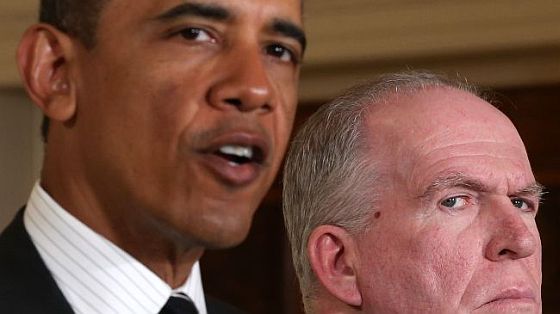
John O. Brennan: Architect of Obama’s plans for permanent war

The Washington Post reports: In his windowless White House office, presidential counterterrorism adviser John O. Brennan is compiling the rules for a war the Obama administration believes will far outlast its own time in office, whether that is just a few more months or four more years.

The “playbook,” as Brennan calls it, will lay out the administration’s evolving procedures for the targeted killings that have come to define its fight against al-Qaeda and its affiliates. It will cover the selection and approval of targets from the “disposition matrix,” the designation of who should pull the trigger when a killing is warranted, and the legal authorities the administration thinks sanction its actions in Pakistan, Yemen, Somalia and beyond.

“What we’re trying to do right now is to have a set of standards, a set of criteria, and have a decision-making process that will govern our counterterrorism actions — we’re talking about direct action, lethal action — so that irrespective of the venue where they’re taking place, we have a high confidence that they’re being done for the right reasons in the right way,” Brennan said in a lengthy interview at the end of August.

A burly 25-year CIA veteran with a stern public demeanor, Brennan is the principal architect of a policy that has transformed counterterrorism from a conventional fight centered in Afghanistan to a high-tech global effort to track down and eliminate perceived enemies one by one.

What was once a disparate collection of tactics — drone strikes by the CIA and the military, overhead surveillance, deployment of small Special Forces ground units at far-flung bases, and distribution of military and economic aid to threatened governments — has become a White House-centered strategy with Brennan at its core.

Four years ago, Brennan felt compelled to withdraw from consideration as President Obama’s first CIA director because of what he regarded as unfair criticism of his role in counterterrorism practices as an intelligence official during the George W. Bush administration. Instead, he stepped into a job in the Obama administration with greater responsibility and influence.

Brennan is leading efforts to curtail the CIA’s primary responsibility for targeted killings. Over opposition from the agency, he has argued that it should focus on intelligence activities and leave lethal action to its more traditional home in the military, where the law requires greater transparency. Still, during Brennan’s tenure, the CIA has carried out hundreds of drone strikes in Pakistan and opened a new base for armed drones in the Arabian Peninsula.

Although he insists that all agencies have the opportunity to weigh in on decisions, making differing perspectives available to the Oval Office, Brennan wields enormous power in shaping decisions on “kill” lists and the allocation of armed drones, the war’s signature weapon.

When operations are proposed in Yemen, Somalia or elsewhere, it is Brennan alone who takes the recommendations to Obama for a final sign-off.

As the war against al-Qaeda and related groups moves to new locations and new threats, Brennan and other senior officials describe the playbook as an effort to constrain the deployment of drones by future administrations as much as it provides a framework for their expanded use in what has become the United States’ permanent war. [Continue reading…]

Facebooktwittermail