Category Archives: Obama administration

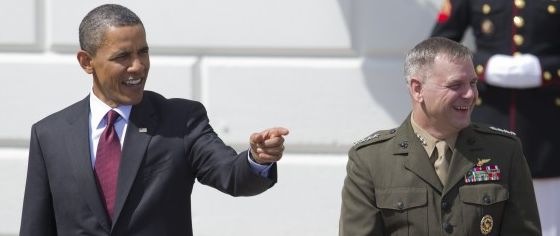
Obama’s ‘favorite general’ target of leak investigation

NBC News reports: Legal sources tell NBC News that the former second-highest-ranking officer in the U.S. military is now the target of a Justice Department investigation into an alleged leak of classified information about a covert U.S. cyberattack on Iran’s nuclear program.

According to legal sources, retired Marine Gen. James “Hoss” Cartwright, the former vice chairman of the Joint Chiefs of Staff, has been notified that he’s under investigation for allegedly leaking information about a massive attack using a computer virus named Stuxnet on Iran’s nuclear facilities. Gen. Cartwright, 63, becomes the latest alleged leaker targeted by the Obama administration, which has already prosecuted or charged eight individuals under the Espionage Act.

Last year, the New York Times reported that Cartwright, a four-star general who was vice chairman of the Joint Chiefs from 2007 to 2011, conceived and ran the cyber operation, called Olympic Games, under President Bush. President Obama ordered the cyberattacks sped up, and in 2010 an attack using the Stuxnet worm temporarily disabled 1,000 centrifuges that the Iranians were using to enrich uranium.

The Times story included details of the Olympic Games operation, including the cooperation of Israeli intelligence. The story said that President Barack Obama had ordered the attacks, which began during the Bush administration, to continue even after Stuxnet “escaped” from the Natanz nuclear plant in Iran and began to spread via the Internet. The virus was first publicly identified by a computer security company in June 2010.

The story described meetings in the White House Situation Room and was based on 18 months of interviews with “current and former American, European and Israeli officials involved in the program.” It credited Gen. Cartwright with presenting the original idea for Stuxnet to President Bush, said the NSA had developed the Stuxnet worm in tandem with the Israelis, and said thumb drives were first used to introduce the virus into the Natanz plant in 2008.

“This leak was very damaging,” said former California congresswoman Jane Harman, now a member of the Defense Policy Board. “Clearly what was going on here was a method and it should have been protected and I think it’s had devastating consequences.”

President Obama said in June 2012 that his attitude toward “these kinds of leaks” was “zero tolerance,” and that they were “criminal acts.”

According to legal sources, the original FBI probe into the Stuxnet leak focused on whether the information came from someone in the White House. By late last year, according to legal sources, FBI agents were zeroing in on Cartwright, who retired from the military in August 2011.

The Washington Post adds: Although Obama forged a quick rapport with Cartwright — White House officials referred to him as the president’s favorite general — the president chose not to promote him to chairman in 2011, in part because of concern that Cartwright had frayed his relationships with too many senior generals during the surge debate. Within the Pentagon, “he wasn’t seen as a team player,” said a senior military official who worked on the Joint Staff.

After retiring, Cartwright took a position at the Center for Strategic and International Studies and has spoken frequently on national security issues. He has emerged as a growing critic of the Obama administration’s expanded use of drones to counter the al-Qaeda threat.

At at event in Chicago in March, Cartwright said that the United States was beginning to see “blowback” from that targeted killing campaign. “If you’re trying to kill your way to a solution, no matter how precise you are, you’re going to upset people even if they’re not targeted.”


Facebooktwittermail

Obama as president reflects America’s role in the world

Gary Younge writes: Not long after the story into the National Security Administration’s spying programme broke, US president Barack Obama insisted the issues raised were worthy of discussion:

“I welcome this debate and I think it’s healthy for our democracy. I think it’s a sign of maturity because probably five years ago, six years ago we might not have been having this debate.”

In fairly short order, a YouTube compilation appeared, showing Obama debating with himself as he matured. Flitting back and forth between Obama the candidate and the Obama the president, we see the constitutional law professor of yore engage with the commander-in-chief of today. Referring to the Bush White House, candidate Obama says:

“This administration acts like violating civil liberties is the way to enhance our security. It is not.”

Referring to the NSA surveillance program, President Obama says:

“My assessment and my team’s assessment was that they help us prevent terrorist attacks.”

Candidate Obama says of the Bush years:

“This administration also puts forward a false choice between the liberties we cherish and the security we provide.”

President Obama retorts:

“You can’t have 100% security and also then have 100% privacy and zero inconvenience. We’re going to have to make some choices.”

The notion that a president’s record might contradict a presidential candidate’s promise is neither new nor particular to Obama. And we should hope that politicians evolve as their careers progress and new evidence and arguments come to light.

What makes these clips so compelling is that they show not evolution, but transformation. On this issue, at least, Obama has become the very thing he was against. They’re not gaffes. These are brazenly ostentatious flip-flops. And regardless of how much they cost him, Obama has clearly no intention of taking them back.

Given that he is not only defending but escalating the very things he criticised the Bush administration for, the accusation that many have made that he is “worse than Bush” on this issue, and others relating to privacy, security and drone attacks, is not unreasonable. Obama’s administration has denied more Freedom of Information Act requests than Bush did, and prosecuted more whistleblowers than all previous administrations combined.

But the charge also misses the point. [Continue reading…]

Facebooktwittermail

Obama’s neo-McCarthyist ‘Insider Threat Program’ promotes paranoia across government

McClatchy reports: Even before a former U.S. intelligence contractor exposed the secret collection of Americans’ phone records, the Obama administration was pressing a government-wide crackdown on security threats that requires federal employees to keep closer tabs on their co-workers and exhorts managers to punish those who fail to report their suspicions.

President Barack Obama’s unprecedented initiative, known as the Insider Threat Program, is sweeping in its reach. It has received scant public attention even though it extends beyond the U.S. national security bureaucracies to most federal departments and agencies nationwide, including the Peace Corps, the Social Security Administration and the Education and Agriculture departments. It emphasizes leaks of classified material, but catchall definitions of “insider threat” give agencies latitude to pursue and penalize a range of other conduct.

Government documents reviewed by McClatchy illustrate how some agencies are using that latitude to pursue unauthorized disclosures of any information, not just classified material. They also show how millions of federal employees and contractors must watch for “high-risk persons or behaviors” among co-workers and could face penalties, including criminal charges, for failing to report them. Leaks to the media are equated with espionage.

“Hammer this fact home . . . leaking is tantamount to aiding the enemies of the United States,” says a June 1, 2012, Defense Department strategy for the program that was obtained by McClatchy.

The Obama administration is expected to hasten the program’s implementation as the government grapples with the fallout from the leaks of top secret documents by Edward Snowden, the former National Security Agency contractor who revealed the agency’s secret telephone data collection program. The case is only the latest in a series of what the government condemns as betrayals by “trusted insiders” who have harmed national security.

“Leaks related to national security can put people at risk,” Obama said on May 16 in defending criminal investigations into leaks. “They can put men and women in uniform that I’ve sent into the battlefield at risk. They can put some of our intelligence officers, who are in various, dangerous situations that are easily compromised, at risk. . . . So I make no apologies, and I don’t think the American people would expect me as commander in chief not to be concerned about information that might compromise their missions or might get them killed.”

As part of the initiative, Obama ordered greater protection for whistleblowers who use the proper internal channels to report official waste, fraud and abuse, but that’s hardly comforting to some national security experts and current and former U.S. officials. They worry that the Insider Threat Program won’t just discourage whistleblowing but will have other grave consequences for the public’s right to know and national security.

The program could make it easier for the government to stifle the flow of unclassified and potentially vital information to the public, while creating toxic work environments poisoned by unfounded suspicions and spurious investigations of loyal Americans, according to these current and former officials and experts. Some non-intelligence agencies already are urging employees to watch their co-workers for “indicators” that include stress, divorce and financial problems.

“It was just a matter of time before the Department of Agriculture or the FDA (Food and Drug Administration) started implementing, ‘Hey, let’s get people to snitch on their friends.’ The only thing they haven’t done here is reward it,” said Kel McClanahan, a Washington lawyer who specializes in national security law. “I’m waiting for the time when you turn in a friend and you get a $50 reward.”

The Defense Department anti-leak strategy obtained by McClatchy spells out a zero-tolerance policy. Security managers, it says, “must” reprimand or revoke the security clearances – a career-killing penalty – of workers who commit a single severe infraction or multiple lesser breaches “as an unavoidable negative personnel action.”

Employees must turn themselves and others in for failing to report breaches. “Penalize clearly identifiable failures to report security infractions and violations, including any lack of self-reporting,” the strategic plan says.

The Obama administration already was pursuing an unprecedented number of leak prosecutions, and some in Congress – long one of the most prolific spillers of secrets – favor tightening restrictions on reporters’ access to federal agencies, making many U.S. officials reluctant to even disclose unclassified matters to the public.

The policy, which partly relies on behavior profiles, also could discourage creative thinking and fuel conformist “group think” of the kind that was blamed for the CIA’s erroneous assessment that Iraq was hiding weapons of mass destruction, a judgment that underpinned the 2003 U.S. invasion.

“The real danger is that you get a bland common denominator working in the government,” warned Ilana Greenstein, a former CIA case officer who says she quit the agency after being falsely accused of being a security risk. “You don’t get people speaking up when there’s wrongdoing. You don’t get people who look at things in a different way and who are willing to stand up for things. What you get are people who toe the party line, and that’s really dangerous for national security.” [Continue reading…]

Facebooktwittermail

Obama’s failure to defend the U.S. Constitution

Micah Zenko writes: When asked last September if he personally chose which individual terrorist suspects could be targeted with lethal force, President Barack Obama gave a response that would have astounded the founding fathers: “What is absolutely true is that my first job, my most sacred duty, as president and commander in chief, is to keep the American people safe.” This is false. As the presidential “Oath or Affirmation” in the Constitution reads: “I do solemnly swear (or affirm) that I will faithfully execute the Office of the President of the United States, and will to the best of my Ability, preserve, protect and defend the Constitution of the United States.”

It is troubling that someone who lectured on constitutional law for a dozen years at the University of Chicago Law School would misidentify the president’s primary pledge and obligation. To be fair, his predecessor was similarly guilty. George W. Bush told a cheering crowd at the 2004 Republican National Convention: “I believe the most solemn duty of the American president is to protect the American people.” This interpretation was supposed to be corrected with the 2008 presidential election; then-Senator Obama had declared during the campaign: “I was a constitutional law professor, which means, unlike the current president, I actually respect the Constitution.”

Now in his second term, President Obama insists that his counterterrorism policies differ markedly from Bush’s. However, there are far more similarities than differences with regards to: non-battlefield targeted killings (an estimated 50 under Bush, and 387 under Obama); indefinite detention of suspected terrorists (approved by both through executive orders); broad surveillance authorities (as former NSA and CIA director Michael Hayden admitted on Sunday, “NSA is actually empowered to do more things than I was empowered to do under President Bush’s special authorization”); and overclassification of government information (largely unchanged). Ari Fleischer, Bush’s former spokesperson and now public defender, recently tweeted: “Drone strikes. Wiretaps. Gitmo. O is carrying out Bush’s 4th term. Yet he attacked Bush 4 violating Constitution. #hypocrisy.”

The essential and enduring feature of both post-9/11 presidents has been their shared contention that their core objective — and by extension, that of the executive branch — is to protect U.S. citizens from one particular form of harm: terrorist violence. Both success and failure at achieving this objective have justified the expansion of additional authorities and tools. If there are no terrorist attacks, then all policies in place must remain, but when terrorist plots are revealed or the rare attack occurs, then additional tools and secrecy are mandated. Like a ratchet wrench, it only works in one direction. It does not matter if these presidential powers erode individual civil liberties or the ability of citizens to comprehend or evaluate the activities of the national security state. Again, the executive branch’s obligation is less to protect citizens’ constitutional rights than it is to protect citizens’ lives, but only from terrorists. [Continue reading…]

Facebooktwittermail

The biggest Obama scandals are proven and ignored

Conor Friedersdorf writes: Prompted by Peggy Noonan’s claim in The Wall Street Journal that “we are in the midst of the worst Washington scandal since Watergate,” Andrew Sullivan steps forward to defend Pres. Obama’s honor. “Can she actually believe this?,” he asks incredulously. “Has this president broken the law, lied under oath, or authorized war crimes? Has he traded arms for hostages with Iran? Has he knowingly sent his cabinet out to tell lies about his sex life? Has he sat by idly as an American city was destroyed by a hurricane? Has he started a war with no planning for an occupation? Has he started a war based on a lie, and destroyed the US’ credibility and moral standing while he was at it, leaving nothing but a smoldering and now rekindled civil sectarian war?”

An Obama critic, having overplayed her hand, gave Sullivan an opening to respond with what amounts to, “It isn’t as bad as Watergate, nor as bad as George W. Bush.” Let’s concede those points. I don’t much care what Obama’s Republican critics say about him. The scandals they’re presently touting, bad as two of them are, aren’t even the worst of Team Obama’s transgressions.

I have a stronger critique. Sullivan hasn’t internalized the worst of what Obama’s done, because his notion of scandal is implicitly constrained by whatever a president’s partisan opponents tout as scandalous. If they criticize Obama wrongly, he defends Obama proportionately.

To see what he’s forgotten as a result, let’s run once more through the first questions in Sullivan’s latest Obama apologia. [Continue reading…]

Facebooktwittermail

Is Obama already a lame duck president?

The Guardian reports: It is not a comparison that many people thought would ever get much traction.

But, assailed this week by multiple scandals and at the mercy of a furious press, President Obama has endured a legion of pundits wondering if he is the 21st-century Richard Nixon – and whether his second term is already a lame-duck disaster.

Certainly conservative writers have leapt at the idea that the now beleaguered Obama can be mentioned in the same breath as the shamed 37th president who left office early after the Watergate scandal.

They have looked at revelations that the Internal Revenue Service singled out conservative groups and that the Justice Department targeted AP journalists in a secret sweep of their phones as signs that Obama’s administration is paranoid and over-reaching its power. Then they have added a healthy dose of outrage over whether or not the White House manipulated reaction to the death of four Americans in an attack on the US diplomatic mission in Libya.

“Benghazi, IRS – son of Watergate?” wrote conservative writer Cal Thomas amid a plethora of similar headlines. But it was not just the right wing. Liberal Democrat congressman Michael Capuano reacted to the IRS reports by saying: “There’s no way in the world, I’m going to defend that. Hell, I spent my youth vilifying the Nixon administration for doing the same thing.”

Indeed, even Buzzfeed used an animation of Obama’s face morphing into Nixon’s.

Long-time Washington observers have been shocked at how rapidly it seems that Obama’s second term appears to have come off the rails. [Continue reading…]

Facebooktwittermail

Vali Nasr dissects Obama’s foreign policy failings

Robert E. Hunter writes: Publication this month of Vali Nasr’s The Dispensable Nation: American Foreign Policy in Retreat, could not have been better timed. The US and the NATO allies are in the process of disengaging from Afghanistan — however they choose to describe the process — without first developing clarity about what comes next and how to understand or secure the West’s continuing interests there or in the region. The Syrian civil war continues, seemingly without end and without success so far in the US government to develop a coherent policy or, apparently, efforts to fit that conflagration within developments in the region as a whole. President Obama has just visited the Near East, but there is as yet no promise that serious negotiations between Israelis and Palestinians will begin anytime soon. The standoff with Iran and its nuclear program continues. And there are widespread doubts about the staying-power of US commitments and policies throughout the Middle East and Southwest Asia. For some observers, including Nasr, all this leads to serious questioning about the overall conduct of American foreign policy, summarized in his judgment: “retreat.”

The author, now Dean of the School of Advanced International Studies at Johns Hopkins University in Washington, has had a special vantage point. From January 2009 until 2011 Nasr was special advisor to Ambassador Richard Holbrooke (who died in December 2010), who was the President’s (and Secretary of State Hillary Clinton’s) Special Representative for Afghanistan and Pakistan — shortened to the more digestible “AfPak.” It is not too much to say that Dr. Nasr’s brief but intense experience in the US government at a high level was both disappointing and disillusioning — and he was not alone. His principal conclusion, at least as inferred by this reviewer, is that the Obama White House failed to take seriously the diplomatic opportunities that were afforded the US, not just toward AfPak, but in the region overall; that it continued to tolerate an excessive militarization of US policies begun by earlier administrations at the expense of a more integrated approach where diplomatic instruments could play their proper role; that the president himself was long on language — eloquently so — but short on action and in the process failed to come to grips with a number of regional developments; that the best efforts by the State Department, including by Secretary Clinton, to intervene in critical policy-making were too often either rebuffed or ignored; and that the US has failed in its essential leadership role. Indeed, the title of Nasr’s book, Dispensable Nation, is a play on a term first coined by Secretary of State Madeleine Albright to the effect that the US in the post-Cold War world remains the “indispensable nation.” [Continue reading…]

Facebooktwittermail

Will Congress act to stop U.S. support for Honduras’ death squad regime?

Mark Weisbrot writes: The video (warning: contains graphic images of lethal violence), caught randomly on a warehouse security camera, is chilling.

Five young men walk down a quiet street in Tegucigalpa, Honduras. A big black SUV pulls up, followed by a second vehicle. Two masked men with bullet-proof vests jump out of the lead car, with AK-47s raised. The two youths closest to the vehicles see that they have no chance of running, so they freeze and put their hands in the air. The other three break into a sprint, with bullets chasing after them from the assassins’ guns. Miraculously, they escape, with one injured – but the two who surrendered are forced to lie face down on the ground. The two students, who were brothers 18- and 20-years-old, are murdered with a burst of bullets, in full view of the camera. Less than 40 seconds after their arrival, the assassins are driving away, never to be found.

The high level of professional training and modus operandi of the assassins have led many observers to conclude that this was a government operation. The video was posted by the newspaper El Heraldo last month; the murder took place in November of last year. There have been no arrests.

Now, the Obama administration is coming under fire for its role in arming and funding murderous Honduran police, in violation of US law. Under the Leahy Law, named after Vermont Senator Patrick Leahy, the US government is not allowed to fund foreign military units who have commit gross human rights violations with impunity. The director general of Honduras’ national police force, Juan Carlos Bonilla, has been investigated in connection with death squad killings; and members of the US Congress have been complaining about it since Bonilla was appointed last May. Thanks to some excellent investigative reporting by the Associated Press in the last couple of weeks – showing that all police units are, in fact, under Bonilla’s command – it has become clear that the US is illegally funding the Honduran police. [Continue reading…]

Facebooktwittermail

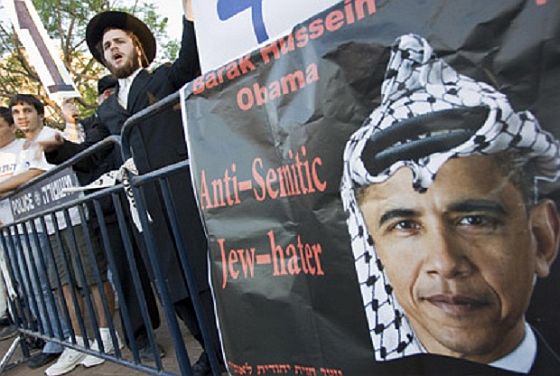
How Obama revealed himself to be an anti-Semite of the kind Zionists favor

David Bromwich writes: Compare what Barack Obama said in Jerusalem on March 21 with what he said in Cairo on June 4, 2009 and you find many similarities. Both were greetings by a recently-elected American president to a people who had come to doubt the worth of such a communication. In both cities, the improbable event was made credible by words expressing the most generous good intentions, and concluding with a proclamation of large hopes.

The Cairo speech carried two announcements with practical implications. First, “the United States does not accept the legitimacy of continued Israeli settlements.” Second, the president assured his Muslim audience that they would soon see evidence of his determination not to be at war with Islam. The first promise he failed to keep. On the second, the returns are not all in: the Iraq war is over but drone assassinations, favored by this president, have built up a new kind of war by the U.S. in the Arab world, and Obama’s presidency has done more to increase the likelihood of war than to improve the chances of negotiation with Iran.

Obama’s Middle East speeches of 2009 and 2013 were equally flattering to his audience on the chosen occasion. The ground of his respect for Muslims in Cairo was the authenticity of their religious faith and tribal roots. The ground of his respect for Israeli Jews was their religious and tribal roots and their national success. In the past, American presidents would have made this a secondary concern. The usual point of such a visiting speech is to admire the presence of liberty and basic political rights in the host nation (to the extent that these exist) and to ask the leaders and the people to advance the cause. Obama, in a cultural emphasis that was new, admired the Muslims in Cairo for being Muslim. Four years later, he admired the Israeli Jews in Jerusalem for being Jewish.

In fact, Obama went further in the case of Israel. He said in his speech of March 21: “while Jews achieved extraordinary success in many parts of the world, the dream of true freedom finally found its full expression in the Zionist idea.” Many apparently free but—-as our president has now judged—-actually not truly free American Jews will wonder what could have been in his mind when he committed himself to this straightforward endorsement of the Zionist idea. Can we imagine the president of the secular United States saying anything comparable about an Islamic nation? Pragmatic considerations aside, what prevents him from saying that “Shiite Islam found extraordinary success in many parts of the world but its dream of national realization has attained its full expression in Iran”? [Continue reading…]

Facebooktwittermail

Has Obama forgotten everything?

Gideon Levy writes: Barack Obama has decided to punish the Israelis: He is talking to them as if they were ignoramuses. The U.S. president has also decided to punish himself: He is betraying his principles, those that have won him international acclaim and the Nobel Peace Prize.

There’s no other way to understand what he said in his interview with Channel 2 on the eve of his visit here. The flattery he heaped on Israel’s leader considerably exceeded diplomatic protocol and even phony American manners. His denial of his values deviated even from the opportunism one might expect from a politician. Obama said he wants to “connect to the Israeli people.” This he actually did well; he told Israelis what they wanted to hear.

But from Obama we could have expected a lot more. When Obama said he admires Israel’s “core values,” which values was he talking about? The dehumanization of the Palestinians? The attitude toward African migrants? The arrogance, racism and nationalism? Is this what he admires? Don’t separate buses for Palestinians remind him of something? Doesn’t two communities living on the same land, one with full rights and the other with no rights, “ring a bell,” as they say in America?

To admire “core values” while knowing we’re talking about one of the most racist countries there is, with a separation wall and apartheid-like policies, means betraying the core values of the American civil rights movement that made the Obama miracle possible. Too bad he can’t fulfill his fantasy of wearing a fake mustache and wandering around to have conversations with Israelis; he would hear how they talk about blacks like him. Too bad he can’t sit in a cafe and “just hang out,” as he’d like. He’d hear which “core values” really move Israelis.

Obama wants to lower expectations of his visit. Well, they can’t get any lower. [Continue reading…]

Facebooktwittermail

Obama’s secrecy fixation

Glenn Greenwald writes: When Barack Obama ran for president in 2008, his pledges of openness and transparency were not ancillary to his campaign but central to it. He repeatedly denounced the Bush administration as “one of the most secretive administrations in our nation’s history”, saying that “it is no coincidence” that such a secrecy-obsessed presidency “has favored special interests and pursued policies that could not stand up to the sunlight.” He vowed: “as president, I’m going to change that.” In a widely heralded 2007 speech on transparency, he actually claimed that this value shaped his life purpose:

“The American people want to trust in our government again – we just need a government that will trust in us. And making government accountable to the people isn’t just a cause of this campaign – it’s been a cause of my life for two decades.”

His campaign specifically vowed to protect whistleblowers, hailing them as “the best source of information about waste, fraud, and abuse in government” and saying that “such acts of courage and patriotism. . . should be encouraged rather than stifled.” Transparency groups were completely mesmerized by these ringing commitments. “We have a president-elect that really gets it,” gushed Charles Davis, executive director of the National Freedom of Information Coalition, in late 2008; “the openness community will expect a complete repudiation of the Ashcroft doctrine.” Here’s just one of countless representative examples of Obama bashing Bush for excessive secrecy – including in the realm of national security and intelligence – and vowing a fundamentally different course:

Literally moments after he was inaugurated, the White House declared that “President Obama has committed to making his administration the most open and transparent in history”. [Continue reading…]

Facebooktwittermail

Federal judge finds national security letters unconstitutional, bans them

Wired: Ultra-secret national security letters that come with a gag order on the recipient are an unconstitutional impingement on free speech, a federal judge in California ruled in a decision released Friday.

U.S. District Judge Susan Illston ordered the government to stop issuing so-called NSLs across the board, in a stunning defeat for the Obama administration’s surveillance practices. She also ordered the government to cease enforcing the gag provision in any other cases. However, she stayed her order for 90 days to give the government a chance to appeal to the Ninth Circuit Court of Appeals.

“We are very pleased that the Court recognized the fatal constitutional shortcomings of the NSL statute,” said Matt Zimmerman, senior staff attorney for the Electronic Frontier Foundation, which filed a challenge to NSLs on behalf of an unknown telecom that received an NSL in 2011. “The government’s gags have truncated the public debate on these controversial surveillance tools. Our client looks forward to the day when it can publicly discuss its experience.”

The telecommunications company received the ultra-secret demand letter in 2011 from the FBI seeking information about a customer or customers. The company took the extraordinary and rare step of challenging the underlying authority of the National Security Letter, as well as the legitimacy of the gag order that came with it.

Facebooktwittermail

Obama helps promote myth of racially integrated Israel

I imagine the White House think it’s good to help promote the status of an African first — Israel’s first African-born Miss Israel. And no doubt Israeli leaders welcome a photo-op that is sure to be used to counter the charge that Israel functions as an apartheid state. Look! No apartheid here — as Benjamin Netanyahu and Shimon Peres sit with beaming smiles alongside Barack Obama and Yityish Aynaw. (Of course there won’t be any Palestinians at the table.)

The Guardian reports: It will be one of the hottest tickets in town. When the US president, Barack Obama, arrives in Israel on an official visit next week, one of the highlights for the country’s dignatries will be a dinner hosted at Israeli president Shimon Peres’s home. And among those set to dine with the two presidents is the first black Miss Israel, Yityish Aynaw.

When the president’s staff called to invite her to the dinnerAynaw, who was crowned just a few weeks ago, was understandably taken aback. “I didn’t believe this was happening,” she told the Jerusalem Post.

Aynaw arrived in Israel from Ethiopia when she was 12 years old. The beauty queen, who has worked as a sales assistant since leaving the army, has admitted that it was initially difficult for her to assimilate into Israeli society. Despite being 100,000 strong, the Ethiopian Jewish community is marginalised in Israel, where some rabbis have questioned the authenticity of their Jewish faith.

Meanwhile, in preparation for his Holy Land vacation, Obama has been busy playing the mood music: “In his interview Thursday on Channel 2, Obama made a supreme effort to let bygones be bygones and show friendship when he called Netanyahu ‘Bibi’ at least 10 times.”

Facebooktwittermail

Obama still prizes secrecy more than transparency

McClatchy reports: President Barack Obama has relied on state secrets and secret laws to make national security decisions with little congressional or public oversight much as his predecessor did, according to a report being released Sunday by a liberal government watchdog group.

The Center for Effective Government’s study on transparency finds that Obama has issued important open government policy reforms in his first term, but that implementation is inconsistent across federal agencies despite his claim of being the most open president in history.

“While the Obama administration deserves praise for the important work it has done to build a platform for open government in its first term, the job is unfinished,” according to the report.

The center, formerly called OMB Watch, issued the report at the start of Sunshine Week, an effort by civics groups, governments and newspapers to promote transparency in government across the nation. A copy was sent to the White House, but officials there did not respond to a request for comment.

The 50-page study says the area most in need of improvement is national security. The White House has withheld decisions and documents that have the force of law, labeled documents as classified even if they do not need to be and aggressively prosecuted whistleblowers, bringing six cases against employees for leaks compared to only three known previous cases since 1917. [Continue reading…]

Facebooktwittermail

Barack Obama’s 9/11

On September 11, when President Obama authorized a series of drone strikes over U.S. soil, only this much was clear: four passenger aircraft had been hijacked and were being piloted by the hijackers.

After the aircraft had each been shot down within the space of 30 minutes and 246 casualties been identified, President Obama said in an address to the nation: “No American president would want to have to make the decision I made today, but of this much we can be sure: the citizens of this country whose lives were sacrificed, did not die in vain. Thousand more lives were saved and for this we can be grateful.”

The nation could then let out a sigh of relief, realizing that an even greater catastrophe had been averted — or maybe not.

The problem is that whenever people take actions designed to change the future, they prove that the future is not inevitable.

What happens ultimately trumps what might have happened.

So on Obama’s 9/11, all we would end up being sure of was that the president had decided that it was imperative to kill 19 hijackers even if that meant 246 Americans would become collateral damage in the process.

We might never have discovered what the aims of the hijackers were and thus the threat they posed would be a matter of conjecture.

All that would be certain was that the president saw no limits whatsoever on the extent of executive power exercised in the name of national security.

In the aftermath, what would frighten Americans more? The threat from terrorism, or the powers of the president?

Facebooktwittermail

Obama’s indifference to the way Africa’s leaders treat their own people

Helen Epstein writes: America’s new drone base in the West African city of Niamey, Niger, announced by the White House on Friday, further expands our counter-terrorism activity in Africa. It’s also consistent with the militaristic emphasis of the Obama administration’s engagement with the continent. This may help contain the spread of jihadist violence in specific cases, but by failing to address persistent abuses of human rights by our African military allies, America is also undermining its own development investments that are intended to lift millions of people out of poverty and ensure the continent’s peace, stability, and economic growth.

The administration’s neglect of human rights in Africa is a great disappointment, since the president began his first term by laying out ambitious new goals for the continent. In July 2009, when his presidency was only six months old, Barack Obama delivered a powerful speech at Cape Coast Castle in Ghana, the point from which millions of African slaves were shipped across the Atlantic. He called on African countries to end the tyranny of corruption that affects so many of their populations, and to build strong institutions that serve the people and hold leaders accountable. The speech seemed to extend the message of his much-discussed Cairo address a month earlier, in which he called for a new beginning for Muslim relations with the West, based on non-violence and mutual respect. Many thought that the policies of the new president, himself of Kenyan descent, would depart from those of the Bush administration, which provided a great deal of development aid to Africa, but paid scant attention to human rights.

After more than four years in office, however, Obama has done little to advance the idealistic goals of his Ghana speech. The US finally suspended military aid to Rwanda last year, after it was forced to accept evidence of Rwandan support for the brutal Congolese rebel group M23, but has otherwise ignored the highly problematic human rights situation in that country. In Uganda, the US looked on for years as President Yoweri Museveni’s cabinet ministers gorged themselves on American and other foreign aid intended for impoverished farmers, war victims, roads, and health care. US diplomats have recently begun expressing support for Uganda’s many oppressed civil society groups, but one wonders what took them so long. Perhaps it has something to do with the fact that Uganda is a vital US military ally in Somalia, where Ugandan troops helped oust the Islamic militant group al-Shabbab from Mogadishu last year.

Meanwhile, Kenya, another important US ally in Somalia that is soon to be receiving drones from the Pentagon, is preparing for national elections on March 4. But some observers say the country is more violent now than it was in 2007, when post-election ethnic clashes left 1000 people dead and caused economic chaos across East Africa. Presidential candidate Uhuru Kenyatta and his running mate William Ruto have both been indicted by the International Criminal Court for crimes connected with those events. It’s not clear what the US will do if Kenyatta wins, but it often seems as if Obama will work with any African leader who furthers America’s military aims, regardless of how that leader treats his own people. [Continue reading…]

Facebooktwittermail