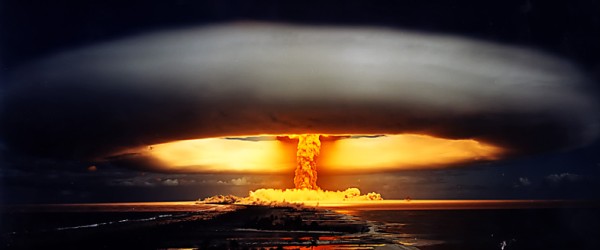
The Wall Street Journal reports: A proposal under consideration at the White House to reverse decades of U.S. nuclear policy by declaring a “No First Use” protocol for nuclear weapons has run into opposition from top cabinet officials and U.S. allies.
The opposition, from Secretary of State John Kerry, Secretary of Defense Ash Carter and Secretary of Energy Ernest Moniz, as well as allies in Europe and Asia, leaves President Barack Obama with few ambitious options to enhance his nuclear disarmament agenda before leaving office, unless he wants to override the dissent.
The possibility of a “No First Use” declaration—which would see the U.S. explicitly rule out a first strike with a nuclear weapon in any conflict—met resistance at a National Security Council meeting in July, where the Obama administration reviewed possible nuclear disarmament initiatives it could roll out before the end of the president’s term.
During the discussions, Mr. Kerry cited concerns raised by U.S. allies that rely on the American nuclear triad for their security, according to people familiar with the talks. The U.K., France, Japan and South Korea have expressed reservations about a “No First Use” declaration, people familiar with their positions said. Germany has also raised concerns, one of the people said.
Mr. Carter raised objections to the “No First Use” declaration on the grounds that it risked provoking insecurity about the U.S. deterrent among allies, some of which then could pursue their own nuclear programs in response, according to the people familiar with the discussions. North Korea’s nuclear ambitions and Russia’s actions in Europe have also complicated any change to the U.S. nuclear posture for the Pentagon.
Mr. Moniz, who weighs in on nuclear issues for the Department of Energy, also expressed opposition to a “No First Use” posture, according to a person familiar with the discussions.
Mr. Obama ultimately didn’t issue a decision on the “No First Use” proposal at the National Security Council meeting, but people familiar with the White House deliberations say opposition from the critical cabinet members and U.S. allies reduces the likelihood of the change. They say a decision by Mr. Obama to press ahead with the declaration appears unlikely in his remaining months, given the controversy it would stir in the midst of a presidential election, but it isn’t impossible. [Continue reading…]
Category Archives: Obama administration
Syrian doctors write letter to President Obama, urging him to act in Aleppo
ABC News reports: Some of the last doctors remaining in the besieged Syrian city of Aleppo have written a letter to President Obama, urging him to intervene to break the siege of the city and stop bombardments of hospitals. Their plea comes as fighting continues despite Russia’s announcement of a partial ceasefire.
“We have seen no effort on behalf of the United States to lift the siege or even use its influence to push the parties to protect civilians,” the doctors wrote in the letter obtained by ABC News. “Continued U.S. inaction to protect the civilians of Syria means that our plight is being willfully tolerated by those in the international corridors of power. The burden of responsibility for the crimes of the Syrian government and its Russian ally must therefore be shared by those, including the United States, who allow them to continue.”
The doctors said that last month alone Syria saw 42 attacks on medical facilities and that a medical facility in Syria is attacked every 17 hours. Two weeks ago, four newborn babies gasping for air suffocated to death after a blast cut the oxygen supply to their incubators, according to the doctors.
“At this rate, our medical services in Aleppo could be completely destroyed in a month, leaving 300,000 people to die,” the doctors wrote.
They explained that what pained them most was being forced to choose who will live and who will die.
“Young children are sometimes brought into our emergency rooms so badly injured that we have to prioritize those with better chances, or simply don’t have the equipment to help them,” they wrote. “We do not need tears or sympathy or even prayers, we need your action. Prove that you are the friend of Syrians, not the friend of our killers.” [Continue reading…]
U.S. considers sanctions against Russia in response to hacks of Democratic groups
The Wall Street Journal reports: U.S. officials are discussing whether to respond to computer breaches of Democratic Party organizations with economic sanctions against Russia, but they haven’t reached a decision about how to proceed, according to several people familiar with the matter.
Levying sanctions would require the White House to publicly accuse Russia, or Russian-backed hackers, of committing the breach and then leaking embarrassing information. The U.S. has frequently opted not to publicly release attribution for cyber-assaults, though Washington did openly accuse North Korea of carrying out an embarrassing breach of Sony Pictures Entertainment Inc. in 2014.
The Federal Bureau of Investigation and U.S. intelligence agencies have been studying the Democratic hacks, and several officials have signaled it was almost certainly carried out by Russian-affiliated hackers. Russia has denied any involvement, but several cybersecurity companies have also released reports tying the breach to Russian hackers.
On Thursday, House Minority Leader Nancy Pelosi (D., Calif.) told reporters, regarding a breach of the Democratic Congressional Campaign Committee, which spearheads the Democratic House campaigns: “I know for sure it is the Russians” and “we are assessing the damage.”
She added, “This is an electronic Watergate…The Russians broke in. Who did they give the information to? I don’t know. Who dumped it? I don’t know.” [Continue reading…]
Lopsided peace talks collapse, Saudis resume bombing Yemen and U.S. sells more weapons
The Intercept reports: The Pentagon announced an additional $1.15 billion in weapons sales to Saudi Arabia this week, even as a three-month cease-fire collapsed and the Saudi-led coalition resumed its brutal bombing campaign of the Yemen capital Sana.
The U.S. has already sold more than $20 billion in weapons to Saudi Arabia since the war began in March 2015, defying calls from Human Rights Watch and Amnesty International to cut off support. The Saudi-led coalition is responsible for the majority of the 7,000 deaths in the conflict, which has left more than 21 million people in need of urgent humanitarian assistance. Saudi Arabia has been accused of intentionally targeting homes, factories, schools, markets, and hospitals.
On Tuesday, the coalition targeted and destroyed a potato chip factory, killing 14 people. The Yemeni press has since reported that coalition has conducted hundreds more airstrikes across the country, killing dozens of people. [Continue reading…]
Battle for Aleppo may be the most crucial of the Syrian civil war
The Washington Post reports: A fast-moving cataclysm underway in and around Aleppo has brought together all the major actors in Syria’s civil war for what may be the most crucial battle of the five-year conflict, and it is testing whether U.S.-Russian cooperation to end it is a pipe dream.
North of the city — in which the government holds the western side and U.S.-backed moderate opposition forces have occupied the east since 2012 — the opposition has lost control of its only lifeline for resupply under relentless pummeling by Russian and Syrian aircraft and artillery.
The road to Turkey also provided the only path for humanitarian aid or an escape route for at least a quarter-million civilians trapped inside Aleppo, who the United Nations said this week have been left without food, medical supplies or running water.
So dire is their situation that talks initiated by the Obama administration with Russia this summer about coordinating their Syria counterterrorism efforts have been put on the back burner, superseded by urgent negotiations with Moscow over reopening the road to Turkey, according to U.S. officials. [Continue reading…]
In the video below, Charles Lister discusses the siege of Aleppo and the dynamics within Syrian opposition groups:
Obama’s worst mistake
Nicholas Kristof writes: A crazed gunman’s attack on an Orlando club in June, killing 49 people, resulted in blanket news coverage and national trauma.
Now imagine that such a massacre unfolds more than five times a day, seven days a week, unceasingly for five years, totaling perhaps 470,000 deaths. That is Syria. Yet even as the Syrian and Russian governments commit war crimes, bombing hospitals and starving civilians, President Obama and the world seem to shrug.
I admire Obama for expanding health care and averting a nuclear crisis with Iran, but allowing Syria’s civil war and suffering to drag on unchallenged has been his worst mistake, casting a shadow over his legacy. It is also a stain on all of us, analogous to the indifference toward Jewish refugees in the 1930s, to the eyes averted from Bosnia and Rwanda in the 1990s, to Darfur in the 2000s. [Continue reading…]
Putin, Obama and the battle for Aleppo
By Layla Saleh, Qatar University
The battle for Aleppo has the Arab world, Middle East observers and Western policymakers on edge.
In what is likely a turning point in the long Syrian civil war, a coalition of opposition fighters is attempting to break Bashar al-Assad regime’s siege of the country’s commercial capital. Meanwhile, the Syrian government – with Russian support – is bombing rebel strongholds in the city which is still home to 250,000 people, according to the BBC.
Thanks to recent U.S. diplomatic overtures to deepen cooperation with Russia against the Islamic State, or IS, and al-Qaida affiliate Al-Nusra Front, the U.S. could be considered a partner in those airstrikes. The U.S. overtures have been criticized as strategically inconsistent and Putin-pleasing.
As a student of American policy in the Middle East, I’d argue that American efforts are key to the tumultuous trajectory of Syria’s uprising-turned-war. What’s less clear to me is how much U.S. President Barack Obama’s approach prioritizes either the immediate needs of Syrians suffering from war and terrorism or their aspirations for self-liberation from authoritarian rule.
DNC hacking puts Obama in tough spot with Russia
The Hill reports: Pressure is growing on the White House to respond to Russia’s apparent hack of the Democratic National Committee (DNC), placing President Obama in a delicate political position.
Evidence has mounted that the Russian government was behind the theft of tens of thousands of damaging internal emails from the DNC, leading prominent lawmakers from both sides of aisle to call for some form of response.
The ranking members of the House and Senate Intelligence committees and the chairman and ranking member of the Senate Judiciary Committee have all issued calls for Obama to “seek justice” for the alleged attack.
But should Obama publicly point the finger at the Kremlin, it could expose covert intelligence capabilities and damage already touchy discussions over Russia’s behavior in Syria and Ukraine, experts say.
That dynamic reflects one the central challenges the White House faces in responding to cyberattacks. Without any international rules of engagement, officials must weigh a response to each attack individually.
The FBI has opened an investigation into the hack, but because of the risks, experts say, the public is unlikely to ever know the results, even if it is able to prove Russia’s guilt beyond a shadow of a doubt.
Obama has a slate of possible responses at his disposal, but each carries its own set of problems.
“They are really in between a rock and a hard place. Everything they do has a downside,” said Herb Lin, a senior research scholar who studies cyber policy and security at Stanford. [Continue reading…]
Obama releases drone strike ‘playbook’
Politico reports: President Barack Obama has to personally approve the killing of a U.S. citizen targeted for a lethal drone strike outside combat areas, according to a policy Obama adopted in 2013.
The president also is called upon to approve drone strikes against permanent residents of the U.S. and when “there is a lack of consensus” among agency chiefs about whom to target, but in other cases he is simply “apprised” of the targeting decision, the newly-disclosed document shows.
The presidential policy guidance on drone strikes, often called the drone “playbook,” was disclosed in an edited form Friday night in response to a Freedom of Information Act lawsuit brought by the American Civil Liberties Union.
When Obama approved the guidance in May 2013, the White House issued a fact sheet about the policy, but declined to release the document itself — even in a redacted form.
However, a series of decisions from a federal appeals court in New York and from lower court judges have made it more difficult for the government to withhold legal and policy documents when many of the details in them have been disclosed elsewhere, such as in speeches or press releases. [Continue reading…]
Why ‘launch under attack’ should not be a mainstay of U.S. nuclear policy

Jeffrey Lewis writes: Once a president gives the order to use nuclear weapons, there is no turning back. The system is designed to very quickly render the president’s will into death and destruction on the other side of the world. So maybe don’t elect the guy who melts down on Twitter every other day.
Trump’s temperament is pretty different from, say, that of Brzezinski, who tells the story about the 3 a.m. phone call as kind of a dark gag. I suppose Zbig got used to it. There was a series of false alarms in June 1980, usually described as having occurred because of the failure of a 46 cent computer chip. A few years later, the Center for Defense Information — the forerunner, in a roundabout way, to Global Zero — learned that between 1977 and 1984, there were 1,152 “moderately serious” false alarms. False alarms are so common that I actually suspect the system would fail to respond to a real Russian launch. I just can’t imagine Bushes, Clintons, or Barack Obama retaliating while there’s even a glimmer of doubt about an attack. My guess is that they would all decide to risk waiting to be sure an attack was underway, that it wasn’t a false alarm or cyberattack, instead of hastily opting for certain nuclear holocaust. Given what we know about human beings and confirmation bias, launch under attack is probably less dangerous than just pointless.
The problem, though, is what happens in a crisis. What happens when confirmation bias is pushing in the other direction? If we think Russia might launch such an attack, then it is easier to imagine a president making a hasty decision.
My advice to any future president would be to drop launch under attack as a mainstay of U.S. nuclear policy. Some systems might still be capable of launching quickly, but I would design the nuclear force around the assumption that the president plans to “ride out” a nuclear attack. This means having enough weapons at sea to do the job and relegating any land-based nuclear weapons to the role of warhead “sink,” drawing fire away from cities. The Obama administration has made some steps in this direction, instructing the military to plan for more realistic contingencies — but it has still elected to retain launch under attack as an option.
I am not much of a fan of launch under attack, and have said as much to policymakers in Washington, but I’ve long been resigned to no one listening to me. Defense experts have a fetish about giving the president options, and they are simply loath to abandon this one, no matter how unrealistic. It is U.S. policy now and for the foreseeable future. In fact, Washington has gone to great lengths to design its nuclear forces, as well as its command and control system, around the ability of the president to determine the fate of hundreds of millions of people in a matter of minutes. The upcoming deliberations about nuclear modernization, which will probably cost a trillion dollars over the next 30 years or so, will proceed on the same assumption. If we’re going to design the entire system in this way, to emphasize the speed and decisiveness of a single person, we should probably also pick that person carefully. [Continue reading…]
Obama prepares to boost U.S. cyberwarfare capabilities
Reuters reports: The Obama administration is preparing to elevate the stature of the Pentagon’s Cyber Command, signaling more emphasis on developing cyber weapons to deter attacks, punish intruders into U.S. networks and tackle adversaries such as Islamic State, current and former officials told Reuters.
Under the plan being considered at the White House, the officials said, U.S. Cyber Command would become what the military calls a “unified command” equal to combat branches of the military such as the Central and Pacific Commands.
Cyber Command would be separated from the National Security Agency, a spy agency responsible for electronic eavesdropping, the officials said. That would give Cyber Command leaders a larger voice in arguing for the use of both offensive and defensive cyber tools in future conflicts. [Continue reading…]
Middle East bishops say U.S. has ‘moral responsibility’ to help Christians
Crux reports: Catholic leaders in the Middle East say that the United Sates has the “moral responsibility” to help stop the savagery against Christians in the region, and to provide assistance to help them stay in the region, because it was the U.S. that unleashed the chaos in the first place.
“They were the ones who invaded [Iraq] in 2003 and changed the whole region, and they had the moral responsibility to fix the situation before leaving the country,” said the Chaldean Catholic Archbishop of Erbil, Iraq, Bashar Matti Warda.
Jean-Clément Jeanbart, Greek Melkite Archbishop of Aleppo, the “martyred city” of Syria, said that the U.S. has a two-fold responsibility. On the one hand, he asked the U.S. government to ensure that the aid being sent to the region is also distributed among Christians, which, he said, means entrusting a portion of it to the churches.
As the system is set up, he said, all the aid goes to the refugee camps. Yet Christians see their lives at risk there, so they generally choose to seek shelter at churches and convents instead.
“If the help went to the churches, it wouldn’t mean that they’re giving special rights to Christians, but that they’re actually helping everyone,”Jeanbart said at a press conference held on Wednesday during the Knights of Columbus’s 134th Supreme Convention, which took place in Toronto, Canada.
The many Christian churches in the region – in Syria, there are six different Catholic rites alone – fund schools, hospitals, and provide shelter to all refugees, without distinguishing between Muslims, Yazidis or Christians, he said. [Continue reading…]
In Aleppo, the West has once again failed to prevent what it vowed to stop
Julian Reichelt writes: Over the past four years, the Aleppo I fell in love with has ceased to exist, its slow and painful four-year-long death now dramatically accelerated by Russian smart bombs and Syrian regime dumb bombs.
If Aleppo were a person, this would be the point where we would pray for a swift end to their suffering. But Aleppo isn’t only one person, it’s a besieged town of 300,000, a disgrace to the conscience of the civilized world. Doctors are working in conditions resembling a slaughterhouse more than a hospital, but still saving lives. Children are burning tires to cloud the skies with smoke and obstruct the vision of Putin’s relentless jets and their soulless pilots. While they — eight-year-old kids — stand up to Putin’s air force and their crimes against humanity, the Western world — once again — has done nothing.
“We had gotten used to hell on earth,” one friend inside the city texted me two days ago. “Now they’re even bombing our hell to pieces.”
In the past days, while bombs were raining on the ruins of Aleppo, I have called, emailed or otherwise contacted every person in politics I know to voice not my concern, as our diplomats would say, but my outrage over what is happening — or, more accurately, what is not happening. [Continue reading…]
American trained and armed Syrian rebels find Russian offers of support enticing
Michael Weiss writes: The Russian government is trying to poach Syrian rebels trained and equipped by the United States for the war against ISIS, according to the political leader of a prominent Pentagon-backed brigade in Aleppo — and the rebels are strongly considering Russia’s offer.
In an exclusive interview with The Daily Beast, Mustafa Sejry of the Liwa al-Mu’tasim Brigade said that he met personally with a Moscow representative the Syrian-Turkish border 10 days ago and was offered “unlimited amounts of weaponry and close air support” to fight both ISIS and Jabhat Fatah al-Sham, the rebranded al-Qaeda affiliate in Syria, in exchange for the Mu’tasim Brigade’s transfer of loyalties from Washington to Moscow.
Sejry clearly wants to use the offer to leverage more and better support from the Americans if he can, but that may not be forthcoming. (The Pentagon and U.S. Central Command did not respond to requests for comment from The Daily Beast.) And the Russians, meanwhile, are whispering a lot of sweet nothings in the rebels’ ears. [Continue reading…]
Trump off base on Clinton and Iran payment
The Associated Press reports: The $400 million payment [to Iran reported by the Wall Street Journal on Wednesday] — plus $1.3 billion in interest to be paid later — is a separate issue from the Iran nuclear deal that Clinton initiated. The process that resulted in the payout started decades before she became secretary of state.
In the late 1970s the Iranian government, under the U.S.-backed shah, paid the United States $400 million for military equipment. The equipment was never delivered because in 1979, his government was overthrown, revolutionaries took American hostages at the U.S. Embassy in Tehran, and diplomatic relations between the United States and Iran were severed.
In 1981, the United States and Iran agreed to set up a commission at The Hague that would rule on claims by each country for property and assets held by the other. Iran’s claim for return of the equipment payment was among many that had been tied up in litigation before the Iran-U.S. Claims Tribunal, and interest the U.S. owed for holding the money for so long was growing.
Litigation over these claims has continued intermittently for 35 years, with some being settled and others going to the tribunal for judgment. All private U.S. claims before the tribunal have been resolved, with Iran paying more than $2.5 billion to American people and businesses. Some claims remain unresolved.
As secretary of state, Clinton did initiate secret talks with Iran over its nuclear program. After John Kerry succeeded her on Feb. 1, 2013, those secret contacts grew into 18 months of formal negotiations that culminated in the July 2015 nuclear deal.
U.S. officials had expected a ruling on the Iranian claim from the tribunal any time, and feared a ruling that would have made the interest payments much higher. As the nuclear talks progressed, the separate, intermittent talks on the military-equipment claim continued.
On Jan. 17, a day after the nuclear deal was implemented, the United States and Iran announced they had settled the claim, with the U.S. agreeing to pay the $400 million principal along with $1.3 billion in interest. Administration statements at the time made clear that the principal and the interest would be paid separately, but did not specify how the money would be delivered.
Trump is correct that the $400 million was paid in cash and flown to Tehran on a cargo plane. But litigation on the Iranian claim preceded Clinton’s tenure as secretary of state by decades and heated up only after she left the job. [Continue reading…]
Libya, U.S. face entrenched ISIS
The Wall Street Journal reports: Even with the U.S. launching airstrikes on an Islamic State stronghold in Libya, the battle to uproot the extremists from the oil-rich North African nation is expected to be long and difficult.
The U.S. began the attacks on Monday and struck again on Tuesday in support of a ground offensive to retake Sirte, a strategic port on the Mediterranean coast. But Islamic State is also entrenched in other pockets across the country, including parts of the eastern city of Benghazi, Libya’s second largest; Derna, another eastern city; and the western town of Sabratha, near the Tunisian border.
The competing militias and centers of power that have stoked Libya’s civil war complicate the fight against Islamic State. The chaos has given the group an opening to gain its first territorial foothold outside its self-declared caliphate in Iraq and Syria.
Libya has two rival governments — one that is internationally recognized in the capital, Tripoli, and another based in the east. The competing governments so far have refused to work together to defeat Islamic State or toward national unity, despite international efforts. [Continue reading…]
Obama says Republicans should withdraw support for Trump
The New York Times reports: In his strongest denunciation of Donald J. Trump so far, President Obama on Tuesday said Mr. Trump was “unfit to serve as president” and urged the leaders of the Republican Party to withdraw their backing for his candidacy.
Mr. Obama said the Republican criticisms of Mr. Trump “ring hollow” if the party’s leaders continue to support his bid for the presidency this fall, particularly in light of Republican criticisms of Mr. Trump for his attacks on the Muslim parents of an American soldier, Humayun Khan, who died in Iraq.
“The question they have to ask themselves is: If you are repeatedly having to say in very strong terms that what he has said is unacceptable, why are you still endorsing him?” Mr. Obama said at a news conference at the White House. [Continue reading…]
Libyan forces push into Sirte after U.S. air attacks
Middle East Eye reports: Forces loyal to Libya’s unity government have advanced inside the Islamic State group’s stronghold of Sirte following the first US air attacks on positions in the city.
Fighters seized the central district of al-Dollar after clashes that killed five of their members and wounded 17, they said on social media on Tuesday.
The Tripoli-based unity government launched an operation in May to retake Sirte, which the militants have controlled since June 2015.
The fall of the coastal city, 450km east of Tripoli, would be a major blow to IS, which has also faced a series of setbacks in Syria and Iraq.
The US air raids would continue as long as the unity government continued to request them, the US defence department said on Monday. [Continue reading…]
TSG IntelBrief says: The metastasizing nature of the so-called Islamic State has required the military effort to combat the group to grow alongside it. Though the U.S. has struck high-value targets in Libya before — most recently in February — it has not engaged in a sustained air campaign against the Islamic State in Libya. However, the announcement on August 1 of two airstrikes against Islamic State fighters in the coastal city of Sirte may be an indication that the operational tempo against the group in Libya is about to increase. The strikes came at the request of Libya’s Government of National Accord (GNA), which has been trying to battle the Islamic State while simultaneously attempting to navigate the numerous militias and armed rivals that make foreign intervention highly problematic.
For a time in late 2015, it appeared that the Islamic State was on the verge of making Sirte its de facto third capital after Mosul and Raqqa. Unlike Iraq and Syria, the environment in Libya has posed unique challenges for the Islamic State’s ‘fight everyone everywhere’ strategy; the lack of a sectarian wedge in Libya blunts the group’s appeal. Still, the Islamic State managed to take control of the important coastal city of Sirte in May 2015, and estimates of the group’s total strength in Libya ballooned to 4,000-6,000 fighters in April 2016.
To prevent another Raqqa or Mosul, the U.S., as well as France, the UK, and others, have spent months building liaison relationships with various militia and GNA forces. These relationships take time to build, as do intelligence gathering networks that can generate information accurate enough for targeting purposes. The August 1 strikes in Sirte indicate that cooperation and coordination has progressed to a level in which all parties are comfortable moving ahead. The scale and pace of any U.S. air campaign in Libya will not compare to those in Iraq or Syria, but comments made by U.S. officials indicate airstrikes will continue as the GNA seeks to gain footing in the fractured country. [Continue reading…]