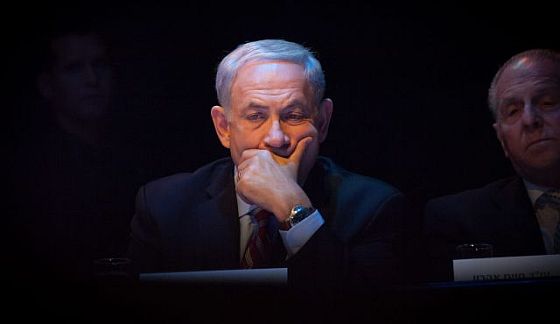
Jonathan Freedland writes: There was no hesitation in pointing out the obvious loser from last weekend’s breakthrough deal between the world’s leading powers and Iran – and it wasn’t the scriptwriters of Homeland. True, the US drama has taken a blow: the current storyline centres on Tehran and its runaway nuclear programme, depicting a regime utterly beyond the reach of conventional diplomacy. Yet while Carrie and Saul plot and scheme, there’s secretary of state John Kerry shaking hands with his Iranian counterpart in Geneva – the actuality once again outdoing the talents of fiction, to paraphrase the great Philip Roth.
No, the obvious loser is Binyamin “Bibi” Netanyahu. His driving mission, the raison d’être of this, his second spell as Israel’s prime minister, has been the total removal of what he sees as Iran’s nuclear threat. To Bibi, Iran is the existential issue to which all other questions – including Israel’s relationship with its neighbours, the Palestinians – are secondary. For two decades he has warned that Tehran is within touching distance of acquiring nuclear weapons – in 1992, he gave it five years, max, before Tehran had the bomb – and he has been bent ever since on the total eradication of that danger, almost certainly by force.
But the Geneva deal does not guarantee total Iranian disarmament. The pact struck last week is interim and incomplete: Iran retains some limited ability to enrich uranium and the like. It is not an Iranian surrender. Which is why Netanyahu denounced the agreement as a “historic mistake”, making him a lone public voice against the international chorus of celebration and relief. (As it happens, the Saudis and the Gulf states also oppose the deal, which they think lets Iran, their great regional rival, off the hook: but only Bibi said so out loud.)
Bibi-watchers are focused now on how the Israeli leader will play the next six months, in which the Geneva agreement will either blossom into a lasting accord or break apart. But it prompts another question: what will be the impact on Israel’s conflict closer to home? Could the breakthrough with Iran somehow presage a breakthrough between Israelis and Palestinians?
The wisest bet would be on no. Peace talks are officially under way, Kerry having pushed both sides to the table in late July. What got Bibi there was, chiefly, Iran: participation in Kerry’s talks was the quid, US support for Israel on Iran the expected quo. But now that leverage has gone. Bibi no longer needs to make nice to Kerry or Barack Obama: as far as he’s concerned, they’ve betrayed him and he owes them nothing. One western diplomat sympathetic to Israel explains that no leader of that country will ever dare move in peace talks unless reassured that “the US president has his back”. Bibi, he says, has lost that confidence.
A similar dynamic could operate in reverse. Obama knows he has angered his Israeli ally and that might make him reluctant to do so a second time. The US president already has a job on his hands winning congressional blessing for the Geneva pact. Given the wide support Bibi enjoys on Capitol Hill, Obama will only make his task harder by demanding Israel concede to the Palestinians.
Add that Kerry’s “bandwidth” for the next six months will be consumed by closing the Iran deal, and that Israeli-Palestinian talks are said to be stalled anyway, and you can see why few expect a Geneva bounce. The safest wager would be on Bibi “managing” whatever pressure comes from Obama, going through the motions with the Palestinians and waiting for the US president to be a certified lame duck. Meanwhile, he’ll do what he can to undermine the accord with Iran.
But there’s another, riskier bet to make. It says that Obama now has momentum in the Middle East, using diplomacy to solve problems previously deemed soluble only through military action. [Continue reading…]
Category Archives: Obama administration
Iran — the next stage
David Ignatius writes: Now that the Obama administration has won its breakthrough first-step nuclear deal with Iran, officials are planning strategy for the decisive second round that, over the next six months, will seek a broader and tougher comprehensive agreement.
This “end state” negotiation, as officials describe it, promises to be more difficult because the United States and its negotiating partners will seek to dismantle parts of the Iranian program, rather than simply freeze them. Another complication is that negotiators will be fending off even more brickbats from hard-liners in Israel, Congress and Tehran.
If the interim deal was reached largely in secret, through a back channel provided by Oman, this one will have to be negotiated in the diplomatic equivalent of a circus ring, with hoots and catcalls from bystanders.
As administration strategists seek a comprehensive deal, they have several priorities. All will be harder to negotiate than was the limited six-month freeze on the Iranian program agreed to last weekend. Given the arduous bargaining ahead, the United States will need the leverage of the sanctions still in place after the release of $7 billion in frozen Iranian assets — and the threat of more sanctions if negotiations break down.
The negotiators’ agenda: [Continue reading…]
How Congress could derail a nuclear deal with Iran
Cameron Abadi writes: When Secretary of State John Kerry joined the nuclear negotiations at the Intercontinental Hotel in Geneva last Saturday, he employed the oldest negotiating trick in the book, evoking Congress as the bad cop to the Obama administration’s good cop. Kerry told Iranian foreign minister Mohammad Javad Zarif that if they failed to reach an agreement that day, the Obama administration would be unable to prevent Congress from passing additional sanctions against Iran. Less than 24 hours later, Kerry and Zarif walked into the hotel lobby to announce that they had struck a deal to freeze Iran’s nuclear program temporarily.
In the face of criticism from members of Congress and U.S. allies in the Middle East, administration officials have insisted that the Geneva agreement is just the first step toward a more far-reaching disarmament deal. But such a deal will require that the Obama administration promise not just to forestall the imposition of new sanctions, but also to reduce dramatically the sanctions already in place. And that depends on the cooperation of a Congress that has been singularly uninterested in assuming the role of good cop in the showdown with Iran.
The White House has some discretion to rescind the Iran sanctions without Congress’s approval. The method for removing any given set of sanctions depends on how those sanctions were passed in the first place. If they’re the product of an executive order, as many of the existing sanctions against Iran are, removing them requires only that the White House decide to stop enforcing them. That’s exactly how Obama will be making good on its promise to Iran, as part of last week’s interim agreement, to restore access to $7 billion held in foreign bank accounts.
Removing sanctions that have been passed into law by Congress, however, is a much more difficult challenge. Despite the partisan gridlock in Washington over the past several years, bipartisan majorities have managed to cooperate on three separate rounds of sanctions since 2010, including measures targeting Iran’s central bank, which Iran will undoubtedly want rescinded. Removing those laws from the books will force the White House to go through Congress all over again. That will require overcoming the partisanship and procedural hurdles that have consumed Congress in recent years. [Continue reading…]
Iran allowed some construction at key nuclear site under interim deal, U.S. says
The Associated Press and JTA report: The U.S. said Wednesday that Iran can undertake some construction work at a key nuclear facility as long as fuel isn’t produced and advances aren’t made on a planned heavy water reactor.
The Arak site was among the thorniest issues negotiators sought to resolve in last weekend’s nuclear agreement in Geneva.
The White House said afterward Iran wouldn’t advance its “activities” at Arak or progress toward plutonium production. It spelled out several more constraints.
Iranian Foreign Minister Mohammad Javad Zarif said Wednesday while his country was honoring the deal, construction on building projects would continue.
Iran opens contacts with major Western oil companies (Financial Times)
U.S. nears decision to split leadership of NSA, Cyber Command
Reuters reports: The White House is nearing a decision on splitting up the eavesdropping National Security Agency and U.S. Cyber Command, which conducts cyber warfare, a proposed reform prompted in part by revelations of NSA’s widespread snooping, individuals briefed on the matter said on Wednesday.
As part of the emerging plan, the NSA likely would get a civilian director for the first time in its 61-year history, the individuals said.
Both agencies are now headed by the same person, Army General Keith Alexander, who is retiring in March as NSA’s longest-serving director.
While Alexander is highly regarded in the intelligence community, critics have questioned the current arrangement. They say it concentrates too much power in one individual and that the two agencies have different missions. [Continue reading…]
Iran deal exposes the limits of the Israel lobby’s power
Mohammed Ayoob writes: The impact of the Iran nuclear deal is unlikely to be limited to the nuclear proliferation arena. While the question whether the deal has prevented Iran from ever developing nuclear weapons capability or has merely postponed the inevitable by a few months or years will continue to be debated, one should not ignore the wider strategic consequences of the agreement for several reasons.
First, it has the potential of introducing a sea change in the relationship of the United States that could unfetter Iranian diplomatic capabilities that can be used in pursuit of its broader regional goals. This is the reason why Saudi Arabia and its Gulf allies have reacted so harshly and negatively to the agreement. If things proceed down the path of an Iranian-U.S. rapprochement in the context of a war weary American public opinion, Riyadh can no longer automatically depend upon U.S. diplomatic and military support against Iran in its competition for power and influence in the Persian Gulf.
Second, it has demonstrated unequivocally that on vital strategic issues in which U.S. and Israeli interests diverge Washington does possess the residual political will to make hard decisions in the teeth of Israeli opposition, something that analysts of all hues had doubted for a long time. This may signal the beginning of the unraveling of the prevailing myth that U.S. policy toward the Middle East is shaped in Tel Aviv and not in Washington. It also explodes the myth that the American Israel Public Affairs Committee (AIPAC) is an all-powerful force when it comes to fashioning U.S. policy toward the Middle East. Its consequences, therefore, go beyond the Iranian nuclear issue and are likely to impact public perceptions in the United States and abroad regarding the deadlock over the Palestinian issue and the likely direction of U.S. policy on the unending Israeli-Palestinian conflict. This explains Israeli Prime Minister Benjamin Netanyahu’s uncompromising hostility toward the Geneva agreement even at the expense of doing grave damage to Israeli-U.S. relations. [Continue reading…]
One of the paradoxes of the practice of railing against power — be that the power of the Israel lobby, or government, or corporations — is that those who persistently issue such warnings can be reluctant to acknowledge that such power has limits.
Thus in the current situation there are those who will insist that sooner or later Congress, on the command of AIPAC, will impose new sanctions and destroy the agreement Iran. Or, that due to pressure from Israel and Saudi Arabia the current agreement will expire without a permanent agreement being reached.
Both of those scenarios are certainly possibilities but my sense is that what this weekend’s agreement reveals is that the opponents of U.S.-Iranian rapprochement are manifestly swimming against the international tide.
The neocon trolls, beguiled by their own apocalyptic rhetoric, are convinced that the evil Islamic republic, hellbent on its pursuit of nuclear weapons, can pursue no other course. Yet what all the evidence makes clear is that Iran’s leaders — like those of any other state — are acting in accordance with what they perceive as their own interests and currently they see those interests best served by improved international relations.
The lesson here is about flexibility. Those with the skill to hold on to power are often more pragmatic than their opponents.
Iran deal could reconfigure the Mideast
Rami G. Khouri writes: The most striking implication of the agreement signed in Geneva last weekend to ensure that Iran’s nuclear industry does not develop nuclear weapons while gradually removing the sanctions on the country is more about Iran than it is about Iran’s nuclear industry. The important new dynamic that has been set in motion is likely to profoundly impact almost every significant political situation around the Middle East and the world, including both domestic conditions within countries and diplomatic relations among countries.This agreement breaks the long spell of estrangement and hostility between the U.S. and Iran, and signals important new diplomatic behavior by both countries, which augurs well for the entire region. It is also likely to trigger the resumption of the suspended domestic political and cultural evolution of Iran, which also will spur new developments across the Middle East.
Perhaps we can see the changes starting to occur in Iran as similar to the developments in Poland in the early 1980s, when the bold political thrust of the Solidarity movement that enjoyed popular support broke the Soviet Union’s hold on Polish political life, and a decade later led to the collapse of the entire Soviet Empire. The resumption of political evolution inside Iran will probably move rapidly in the years ahead, as renewed economic growth, more personal freedoms, and more satisfying interactions with the region and the world expand and strengthen the relatively “liberal” forces around Rouhani, Rafsanjani, Khatami and others; this should slowly temper, then redefine and reposition, the Islamic revolutionary autocrats who have controlled the power structure for decades but whose hard-line controls are increasingly alien to the sentiments of ordinary Iranians.
These domestic and regional reconfigurations will occur slowly, comprising the situations in Syria, Lebanon, Iraq and the Gulf Cooperation Council states led by Saudi Arabia. The critical link remains a healthy, normal, nonhostile relationship between Saudi Arabia and Iran, which I suspect will start to come about in the months ahead, as both grasp the exaggerated nature of their competition for influence in the region and learn to behave like normal countries. They will learn to compete on the basis of their soft power among a region of half a billion people who increasingly feel and behave like citizens who have the right to choose how they live, rather than to be dictated to and herded like cattle. [Continue reading…]
Americans back Iran deal by 2-to-1 margin
Reuters reports: Americans back a newly brokered nuclear deal with Iran by a 2-to-1 margin and are very wary of the United States resorting to military action against Tehran even if the historic diplomatic effort falls through, a Reuters/Ipsos poll showed on Tuesday.
The findings were rare good news in the polls for President Barack Obama, whose approval ratings have dropped in recent weeks because of the botched rollout of his signature healthcare reform law.
According to the Reuters/Ipsos survey, 44 percent of Americans support the interim deal reached between Iran and six world powers in Geneva last weekend, and 22 percent oppose it.
Obama’s overhaul of spy programs cloaked in more secrecy
McClatchy reports: President Barack Obama has faced withering criticism around the globe for his secret spying programs. How has he responded? With more secrecy.
Obama has been gradually tweaking his vast government surveillance policies. But he is not disclosing those changes to the public. Has he stopped spying on friendly world leaders? He won’t say. Has he stopped eavesdropping on the United Nations, the World Bank and the International Monetary Fund? He won’t say.
Even the report by the group Obama created to review and recommend changes to his surveillance programs has been kept secret.
Critics note that this comes after he famously promised the most open administration in history.
“They seem to have reverted to a much more traditional model of secrecy except when it’s politically advantageous,” said Steven Aftergood, who directs the Federation of American Scientists Project on Government Secrecy, and is an expert on – and prominent critic of – government secrecy. “That’s normal but not consistent with their pledge. [Continue reading…]
Nuclear deal a win-win for U.S., Iran and even Israel
Barbara Slavin writes: The ink was not dry on the historic Geneva nuclear accord with Iran before Israeli Prime Minister Benjamin Netanyahu denounced it as a “historic mistake” that would allow Iran to cheat and get closer to nuclear weapons.
Netanyahu may have been doing Iran a favor. By criticizing the deal so harshly, he will make it easier for Iranian officials to assert to their hardliners that the agreement, which pauses Iran’s nuclear advances and rolls back some of the program in return for modest sanctions relief, was a victory for the Islamic Republic.
In the zero-sum politics of the Middle East, what’s good for your enemy is invariably considered bad for you. Yet the deal announced early Sunday European time has much that is useful for Iran, the United States, the international community writ large and yes, Israel too. [Continue reading…]
Memo to Glenn Greenwald: Secrecy is not the root of all evil
AP & Al-Monitor learned about, but concealed, talks between US and Iran http://t.co/2wHU90Gj88
— Glenn Greenwald (@ggreenwald) November 25, 2013
AP and Al-Monitor concealed their knowledge of secret talks between the U.S. and Iran.
The mere fact that Glenn Greenwald regards this as Tweet-worthy seems to imply that he sees something nefarious in the Associated Press and Al-Monitor colluding with government officials by failing to disclose what they had learned at the time of discovery.
I guess for a transparency zealot this kind of collusion would have to be problematic, but let’s get real.
Wherein lies the greater public service: making all information public at the earliest opportunity even if that disclosure might sabotage diplomacy? Or, in recognizing that there are times when forging an agreement absolutely depends on confidentiality so that negotiations can proceed without interference from parties that oppose the existence of such negotiations?
All I can say is: thank goodness AP and Al-Monitor kept quiet. They did the right thing.
Moreover, let’s be honest. Greenwald himself has been sitting on stories for months for reasons that I doubt will ever be made public. The process through which the Snowden revelations have trickled out has not been a model of transparency.
The last thing the world needs is Congress thwarting historic U.S.-Iran nuclear deal
Lawrence Wilkerson and Kate Gould write: The nuclear deal that the US just struck with Iran is nothing short of historic. This agreement is a victory for everyone who wants to prevent a nuclear-armed Iran and a catastrophic war.
The deal is one of the many triumphs that have resulted from the great American tradition of negotiating with adversaries to advance US interests. President Kennedy’s talks with Premier Khrushchev delivered the world from the brink of nuclear war. Ten years later, President Nixon’s visit to Mao’s China revolutionized the US role in Asia, and the world. A decade later, President Reagan’s diplomatic engagement of President Gorbachev achieved historic nuclear arms reductions.
UN weapons inspectors are now on track to peacefully disarm Syria of its chemical weapons because Washington was willing to engage the Syrian regime through diplomacy with Moscow, rather than through Tomahawk cruise missiles. And under the deal reached in Geneva this weekend, Iran will stop advancing its nuclear program for the first time in nearly a decade.
Iran’s nuclear program will now be under an expanded inspections regime to help ensure that Iran’s nuclear program is used for purely peaceful purposes. In exchange, Iran will receive modest sanctions relief.
Make no mistake: this is a good deal, and it should be protected so that our diplomats have the space to negotiate a final agreement to prevent war and a nuclear-armed Iran once and for all.
That is why former secretary of state Madeleine Albright and former national security advisors Zbigniew Brzezinski and Brent Scowcroft have already endorsed the deal. These three most pre-eminent national security officials have cautioned Congress against pushing for new sanctions that could sabotage the tremendous progress that our diplomats have achieved. [Continue reading…]
Why the agreement with Iran is a good deal
Jeffrey Lewis writes: Seven thoughts about the Iran deal, in no particular order.
First, let’s be clear that the package agreed to in Geneva is an interim deal — a six-month slowdown in Iran’s nuclear programs in exchange for a largely temporary easing of sanctions. The Geneva agreement will ultimately be judged on whether the parties can agree to something more comprehensive before it’s all said and done. The document does outline some of the parameters of a final deal, but they are general in nature.
Rouhani wanted some early sanctions relief to show that he could bring home the bacon — I know, that’s a terrible analogy for a Muslim country — to a populace that is economically hurting. The West didn’t want to negotiate with the Iranians while they were installing more centrifuges, new centrifuges, and equipment at the Arak nuclear reactor. The deal largely accomplishes both tasks.
Second, the Iranians gave the West pretty much everything one might have asked for — the Iranians will continue to enrich to less than 5 percent using only existing IR-1 centrifuges and limit manufacturing to replace damaged machines. Iran was never going to make a prostration before the Great Satan like Libya did in 2003, when Qaddafi agreed to give up all his weapons of mass destruction — especially having seen how that worked out for old Muammar. The restrictions on the Iranian program are, frankly, more than could have been hoped for. Thank you, France. If we can’t ease sanctions in exchange for these sorts of concessions, one really must ask what the point of pressuring Iran is.
Third, the usual suspects will complain that we’ve given away too much in terms of sanctions relief, but there are three things to keep in mind. (1) Much of the sanctions relief is temporary. If the Iranians collapse the deal, there will be plenty of takers for imposing tougher sanctions. (2) It isn’t clear to me that the sanctions regime is indefinitely sustainable. The Iranians have had quite a bit of luck challenging sanctions in European courts, and Washington doesn’t have quite the same pull in Moscow and Beijing these days. Sanctions have always been a wasting asset. It makes sense to get something for them now. (3) Moreover, if the Iranian economy starts to recover, that might be a good thing. There is a whole field of research into something called “prospect theory” that more or less boils down to a profound insight into the irrationality of human beings: we tend to fear losses more than we value gains, even if they are numerically the same. This is why your favorite basketball team waits too long to trade that promising draft pick who’ll never be more than a rotation player. If the Iranian economy starts to recover, that will probably increase the pressure on Rouhani to make a deal, not decrease it. [Continue reading…]
After rapid release of hot air, Israeli leaders may soon run out of cliches

The New York Times reports: Israeli leaders denounced the agreement reached Sunday in Geneva, saying they were not bound by it and reiterating the principle that Israel would be ready to defend itself without assistance against any threat.
After weeks of intense lobbying against any deal between the world powers and Iran that does not ensure the dismantling of Iran’s nuclear program, Prime Minister Benjamin Netanyahu of Israel called the agreement “a historic mistake,” saying in remarks that were broadcast from the start of his weekly cabinet meeting, “Today the world has become a much more dangerous place because the most dangerous regime in the world has taken a significant step toward attaining the most dangerous weapon in the world.”
Mr. Netanyahu excoriated the world’s leading powers for agreeing to Iranian uranium enrichment for the first time and for relenting on sanctions “in exchange for cosmetic Iranian concessions that can be canceled in weeks.”
“Israel is not bound by this agreement,” he said. “As prime minister of Israel, I would like to make it clear: Israel will not allow Iran to develop a military nuclear capability.”
The foreign minister of Israel, Avidgor Lieberman, told Israel Radio that “Israel will have to make a reassessment” and that “all the options are on the table.”
“We are talking about the greatest diplomatic achievement for the Iranians,” he said. “We have to take our decision in a cleareyed, independent manner, and we have to be serious enough to be responsible for our fate. Responsibility for the fate of the Jewish people and for the state of Israel lies with the Israeli government alone.” [Continue reading…]
Yada, yada, yada. What options on which table?
Jeffrey Goldberg is in no doubt that Israel no longer has any military options:
[Obama] boxed-in Israeli Prime Minister Benjamin Netanyahu so comprehensively that it’s unimaginable Israel will strike Iran in the foreseeable future. Netanyahu had his best chance to attack in 2010 and 2011, and he missed it. He came close but was swayed by Obama’s demand that he keep his planes parked. It would be a foolhardy act — one that could turn Israel into a true pariah state, and bring about the collapse of sanctions and possible war in the Middle East — if Israel were to attack Iran now, in the middle of negotiations.
Secret U.S.-Iran talks set stage for nuke deal
The Associated Press reports: The United States and Iran secretly engaged in a series of high-level, face-to-face talks over the past year, in a high-stakes diplomatic gamble by the Obama administration that paved the way for the historic deal sealed early Sunday in Geneva aimed at slowing Tehran’s nuclear program, The Associated Press has learned.
The discussions were kept hidden even from America’s closest friends, including its negotiating partners and Israel, until two months ago, and that may explain how the nuclear accord appeared to come together so quickly after years of stalemate and fierce hostility between Iran and the West.
But the secrecy of the talks may also explain some of the tensions between the U.S. and France, which earlier this month balked at a proposed deal, and with Israel, which is furious about the agreement and has angrily denounced the diplomatic outreach to Tehran. [Continue reading…]
Haaretz reports: Israel found out about the existence of secret talks between the United States and Iran months before they were officially informed of the negotiations by the U.S. government, a senior Israeli official told Haaretz. The Israeli government learned of the secret negotiations sometime near the beginning of the summer through intelligence it managed to obtain.
Managed to obtain how? Through surveillance on U.S. diplomatic communications? Or, more likely, through leaks from an Israel-friendly Washington insider.
Obama has leeway on Iran, despite U.S. lawmakers’ concerns
Reuters reports: Republican and Democratic U.S. senators on Sunday voiced skepticism about an interim nuclear deal reached with Iran but Congress looked likely to give President Barack Obama room to see if the agreement works.
The deal does not need to be ratified by Congress and Obama is using his executive power to temporarily suspend some existing U.S. sanctions on Iran.
Senators have been discussing for months imposing even tighter sanctions, which could anger Tehran and put Sunday’s deal reached in Geneva in jeopardy.
But influential Democrats – who control the Senate – made clear that any new sanctions against Iran would include a six-month window before they took effect.
That would allow time to see if Iran is sticking by the pact, worked out between Tehran, the United States and other world powers.
“It is a choice between a pause or imminent war. I choose a verifiable pause,” Senator Bill Nelson, a Democrat from Florida said.
Influential Democratic Senator Robert Menendez, who is known as a hawk on Iran, said forthcoming legislation would “provide for a six-month window to reach a final agreement before imposing new sanctions on Iran.” [Continue reading…]
A nuclear deal to which no one can reasonably object
Fred Kaplan writes: The Iranian nuclear deal struck Saturday night is a triumph. It contains nothing that any American, Israeli, or Arab skeptic could reasonably protest. Had George W. Bush negotiated this deal, Republicans would be hailing his diplomatic prowess, and rightly so.
A few weeks ago, a “senior administration official” outlined the agreement that President Obama hoped to achieve in Geneva. Some reporters who heard the briefing (including me) thought that the terms were way too one-sided, that the Iranians would never accept them. Here’s the thing: The deal just signed by Iran and the P5+1 nations (the United States, Britain, France, Russia, and China plus Germany) is precisely the hoped-for deal laid out at that briefing.
It is an interim agreement, not a treaty (which means, among other things, that it doesn’t require Senate ratification). It is meant as a first step toward a comprehensive treaty to be negotiated in the next six months. More than that, it expires in six months. In other words, if Iran and the other powers can’t agree on a follow-on accord in six months, nobody is stuck with a deal that was never meant to be permanent. There is no opportunity for traps and trickery.
Meanwhile, Iran has to do the following things: halt the enrichment of all uranium above 5 percent and freeze the stockpile of uranium enriched to 3.5 percent; neutralize its stockpile of uranium that’s been enriched to 20 percent (either by diluting it to 5 percent purity or converting it to a form that cannot be used to make a weapon); stop producing, installing, or modernizing centrifuges; stop constructing more enrichment facilities; halt all activities at the Arak nuclear reactor (which has the potential to produce nuclear weapons made of plutonium); permit much wider and more intrusive measures of verification by the International Atomic Energy Agency, including daily inspections of all facilities.
Without going into a lot of technical detail (which can be read here), the point is this: The agreement makes it impossible for the Iranians to make any further progress toward making a nuclear weapon in the next six months—and, if the talks break down after that, and the Iranians decide at that point to start building a nuclear arsenal, it will take them much longer to do so. [Continue reading…]
New U.S. sanctions would spell ‘end of deal’ to limit nuclear program
NBC News reports: Iran will not honor the nuclear agreement it just signed with the United States and other world powers if Congress imposes new sanctions, Iran’s foreign minister told NBC News after the deal was announced.
“If there are new sanctions, then there is no deal. It’s very clear. End of the deal. Because of the inability of one party to maintain their side of the bargain,” Foreign Minister Javad Zarif said during an exclusive interview with NBC News.
After four days of marathon bargaining, on Sunday the United States and its allies agreed to offer Iran “modest relief” from harsh economic sanctions and access to a portion of the revenue that the country has been denied through these sanctions. In exchange, Iran will give inspectors broader access to nuclear sites and allow spontaneous inspections.
If NBC News actually read the text of the agreement, they would not be reporting “Iran’s foreign minister told NBC News.” They would have seen it in black and white:
The U.S. Administration, acting consistent with the respective roles of the President and the Congress, will refrain from imposing new nuclear-related sanctions.
Can the crazy people on Capitol Hill exercise some restraint over the coming months? We’ll see.