Category Archives: Obama administration

Officials’ defenses of NSA phone program may be unraveling

The Washington Post reports: From the moment the government’s massive database of citizens’ call records was exposed this year, U.S. officials have clung to two main lines of defense: The secret surveillance program was constitutional and critical to keeping the nation safe.

But six months into the controversy triggered by former NSA contractor Edward Snowden, the viability of those claims is no longer clear.

In a three-day span, those rationales were upended by a federal judge who declared that the program was probably unconstitutional and the release of a report by a White House panel utterly unconvinced that stockpiling such data had played any meaningful role in preventing terrorist attacks.

Either of those developments would have been enough to ratchet up the pressure on President Obama, who must decide whether to stand behind the sweeping collection or dismantle it and risk blame if there is a terrorist attack.

Beyond that dilemma for the president, the decision by U.S. District Judge Richard J. Leon and the recommendations from the review panel shifted the footing of almost every major player in the surveillance debate.

NSA officials, who rarely miss a chance to cite Snowden’s status as a fugitive from the law, now stand accused of presiding over a program whose capabilities were deemed by the judge to be “Orwellian” and likely illegal. Snowden’s defenders, on the other hand, have new ammunition to argue that he is more whistleblower than traitor.

Similarly, U.S. officials who have dismissed NSA critics as naive about the true nature of the terrorist threat now face the findings of a panel handpicked by Obama and with access to classified files. Among its members were former deputy CIA director Michael J. Morrell and former White House counterterrorism adviser Richard A. Clarke, both of whom spent years immersed in intelligence reports on al-Qaeda. [Continue reading…]


Facebooktwittermail

Obama and climate change: The real story

Bill McKibben writes: Two years ago, on a gorgeous November day, 12,000 activists surrounded the White House to protest the proposed Keystone XL pipeline. Signs we carried featured quotes from Barack Obama in 2008: “Time to end the tyranny of oil”; “In my administration, the rise of the oceans will begin to slow.”

Our hope was that we could inspire him to keep those promises. Even then, there were plenty of cynics who said Obama and his insiders were too closely tied to the fossil-fuel industry to take climate change seriously. But in the two years since, it’s looked more and more like they were right – that in our hope for action we were willing ourselves to overlook the black-and-white proof of how he really feels.

If you want to understand how people will remember the Obama climate legacy, a few facts tell the tale: By the time Obama leaves office, the U.S. will pass Saudi Arabia as the planet’s biggest oil producer and Russia as the world’s biggest producer of oil and gas combined. In the same years, even as we’ve begun to burn less coal at home, our coal exports have climbed to record highs. We are, despite slight declines in our domestic emissions, a global-warming machine: At the moment when physics tell us we should be jamming on the carbon brakes, America is revving the engine.

You could argue that private industry, not the White House, has driven that boom, and in part you’d be right. But that’s not what Obama himself would say. Here’s Obama speaking in Cushing, Oklahoma, last year, in a speech that historians will quote many generations hence. It is to energy what Mitt Romney’s secretly taped talk about the 47 percent was to inequality. Except that Obama was out in public, boasting for all the world to hear:

“Over the last three years, I’ve directed my administration to open up millions of acres for gas and oil exploration across 23 different states. We’re opening up more than 75 percent of our potential oil resources offshore. We’ve quad­rupled the number of operating rigs to a record high. We’ve added enough new oil and gas pipeline to encircle the Earth, and then some. . . . In fact, the problem . . . is that we’re actually producing so much oil and gas . . . that we don’t have enough pipeline capacity to transport all of it where it needs to go.” [Continue reading…]

Facebooktwittermail

Top Senate Democrats break with White House and circulate new Iran sanctions bill

Ali Gharib reports: Three top senators, including two Democrats, have begun circulating a draft of a new Iran sanctions bill that critics say could violate the terms of an agreement struck between Iran and the United States in Geneva last month. The bill, set for introduction by the Democratic chairman of the Foreign Affairs Committee, Robert Menendez of New Jersey, along with top sanctions hawks Chuck Schumer (D-N.Y.) and Mark Kirk (R-Ill.), defies the Obama administration’s repeated requests for Congress to hold off on any new legislation that could imperil last month’s interim nuclear pact with Iran while talks continue toward a comprehensive final deal.

A copy of the bill, dubbed the Nuclear Weapon Free Iran Act of 2013*, was obtained by Foreign Policy. The new sanctions are unlikely to come to a vote in the Senate this week in the final days of the 2013 session.* Instead, the Senate would likely consider the measure after it returns on Jan. 6.

The legislation would broaden the scope of the sanctions already imposed against Iran, expanding the restrictions on Iran’s energy sector to include all aspects of its petroleum trade and putting in place measures targeting Iran’s shipping and mining sectors. The bill allows Obama to waive the new sanctions during the current talks by certifying every 30 days that Iran is complying with the Geneva deal and negotiating in good faith on a final agreement, as well as meeting other conditions such as not sponsoring or carrying out acts of terrorism against U.S. targets.

In accordance with goals laid out frequently by hard-liners in Congress and the influential lobbying group the American Israel Public Affairs Committee, the bill sets tough conditions for a final deal, should one be reached with Iranian negotiators. Among those conditions is a provision that only allows Obama to waive new sanctions, even after a final deal has been struck, if that deal bars Iran from enriching any new uranium whatsoever. The bill states Obama may not waive sanctions unless the United States and its allies “reached a final and verifiable agreement or arrangement with Iran that will … dismantle Iran’s illicit nuclear infrastructure, including enrichment and reprocessing capabilities and facilities.” (Congress could also block Obama’s waivers by passing a “joint resolution of disapproval” against a final deal.) [Continue reading…]

Facebooktwittermail

Which Iran will we choose?

Trita Parsi, Bijan Khajehpour and Reza Marashi write: The historic interim agreement between the permanent members of the UN Security Council plus Germany (P5+1) and Iran over its nuclear dispute is not just about enrichment, centrifuges and breakout capabilities. Ultimately, it will help determine who and what will define Iran’s foreign and domestic policies for decades to come. Will it be the security-oriented, confrontational and internally repressive orientation preferred by the Iranian hardliners? Or will the more cooperative, moderate and win-win approach favored by President Hassan Rouhani and the majority of the population take root and prevail?

In a new report published today (“Extending Hands and Unclenching Fists“) — which relies on in-depth interviews with senior Iranian political officials, intellectuals and members of business community — we show that the West can weaken the hardline Iranian narrative of confrontation and resistance and facilitate a comprehensive nuclear deal by collaborating with Iran on scientific projects that carry no proliferation risk.

For the U.S. and Europe, this means augmenting a successful nuclear deal through other areas of mutual interest can help usher in a more cooperative and less threatening Iran whose domestic political liberalization positively impacts the Middle East as a whole. In the past, we have seen Iran take important steps in this direction, but without reaching the desired results.

The 2013 presidential election unexpectedly catapulted centrist leaders into power that have sought an opening to the West on numerous occasions. Such efforts include the 2001 collaboration with the U.S. in Afghanistan, the 2003 Grand Bargain offer, and the 2005 offer to limit Iran’s enrichment program to 3,000 centrifuges (Iran currently has 19,000). These offers were all made prior to the West imposing crippling sanctions. By rejecting this outreach, Washington strengthened the hand of Iranian hardliners who believe the only way to compel the U.S. to deal with Iran is not by sending peace offers, but rather by resisting American power. [Continue reading…]

Facebooktwittermail

The many enemies of a deal with Iran

Christopher Dickey writes: “Black swans” are the unlikely and unforeseen events that change the world. Mathematical probability cannot predict them and conventional wisdom is blind to them, as Nassim Nicholas Taleb, wrote six years ago when he coined the term. They seem to come out of nowhere, like the airliners of 9/11. But anyone who has a feel for the ever-deceptive volatility of the Middle East can see that right now the black swans are circling like vultures.

Their dark wings can be glimpsed in random headlines: a mysterious American disappears during on an off-the-books mission for the CIA. Members of a cult-like Iranian opposition group are slaughtered in Iraq even as their leaders forge close ties to famous American politicians. The worsening U.S. relationship with its old ally Saudi Arabia is threatened by renewed questions about the complicity of Saudi officials in the 9/11 attacks. Those are just a few of the sinister bits of information floating around the chaotic region these days.

None of these developments are certain to provoke cataclysmic change and, probability-wise, they probably won’t. But the region is so on edge, with Libya crumbling, Egypt in turmoil, and Syria tearing itself apart, that, like the act of a single assassin in Sarajevo in 1914, one unforeseen incident can bring on a cascade of catastrophes.

Let’s set the scene by looking at the Iran talks: The Obama administration has made those negotiations, to stop the mullahs from acquiring atomic weapons, a top priority. But last month’s breakthrough accords between Iran and the United States (plus France, Britain, Germany, Russia and China) are “just interim,” as French Foreign Minister Laurent Fabius reminded the World Policy Conference in Monaco on Saturday. A final deal isn’t due for six months, if then.

The Iranians now have most of the know-how and most of the radioactive stuff they need to build a bomb. Will they truly and definitively step back from that threshold? Fabius, whose skepticism stalled the Geneva accords for a time, says he is skeptical still.

If the talks fail, the chances increase dramatically that the United States will get dragged into a new war in the Middle East, most likely alongside Israel. The objective of the surgical attacks that have been talked about would be to stall the Iranian program for just a few years—perhaps a very few years. But in response to such an action, it’s likely the Iranians would pursue a much more secretive effort without any United Nations inspectors to track it, and they’d eventually wind up with the bomb.

The only way to be 100 percent sure they won’t go down that path would be to change the regime. That was the logic behind the 2003 invasion of Iraq, and we know how that went. [Continue reading…]

Facebooktwittermail

What NSA reforms would mean for Americans (and everyone else)

Joshua Brustein writes: The White House just released the report from an advisory panel (PDF) suggesting changes to intelligence gathering surrounding communication technologies. The Obama administration doesn’t have to accept any of the 46 recommendations, of course, but if it does, it would mean some major shifts in the government’s approach to privacy, and critics of the National Security Agency are taking the proposals seriously. “We view it as a blueprint for restoring privacy protection in post-9/11 America,” says Marc Rotenberg, the president of the Electronic Privacy Information Center.

Here’s what the policy recommendations would mean for three key groups.

American Citizens: The panel essentially calls for an end to fishing expeditions where the government collects a lot of information and holds on to it in case it becomes useful at some point. The report calls for an end to the collection and storage of metadata about phone communications, and the panel would prevent “mass, undigested, non-public personal information about individuals to enable future queries and data-mining for foreign intelligence purposes.” It also suggests tighter restrictions on specific requests for information.

This doesn’t mean loads of personal information shouldn’t be collected and stored. Instead, the panel suggests having private companies or a third party hold on to the information. If the government wants to get it, it would have to ask. This could provide a level of safety, since the private groups would presumably push back against such requests (although it seems telephone companies haven’t done much of that so far). But not everyone likes the idea. “What we’re concerned about is this is opening the door for mandatory data retention, meaning there is a massive database about everything you do,” says Kurt Opsahl, a senior staff attorney with the Electronic Frontier Foundation.

The panel also wants to break up the duties of the NSA so that the military-related aspects of its work are separate from its defensive duties. Perhaps a civilian would be in charge. There are also various suggestions for tightening control of classified information to prevent the next coming of Edward Snowden. [Continue reading…]

Facebooktwittermail

U.S. open to engaging with the Islamic Front in Syria

The Cable reports: As the moderate faction of the Syrian rebellion implodes under the strain of vicious infighting and diminished resources, the United States is increasingly looking to hardline Islamists in its efforts to gain leverage in Syria’s civil war. The development has alarmed U.S. observers concerned that the radical Salafists do not share U.S. values and has dismayed supporters of the Free Syrian Army who believe the moderates were set up to fail.

On Monday, the State Department confirmed its openness to engaging with the Islamic Front following the group’s seizure of a Free Syrian Army headquarters last week containing U.S.-supplied small arms and food. “We wouldn’t rule out the possibility of meeting with the Islamic Front,” State Department spokeswoman Marie Harf said Monday. “We can engage with the Islamic Front, of course, because they’re not designated terrorists … We’re always open to meeting with a wide range of opposition groups. Obviously, it may make sense to do so at some point soon, and if we have something to announce, we will.”

On Saturday Reuters reported that Syrian rebel commanders in the Islamic Front were due to meet U.S. officials in Turkey in the coming days to discuss U.S. support for the group. A Syrian opposition source speaking with The Cable said that efforts were in place to unite the Western-backed Free Syrian Army and the Islamic Front under the same coalition. “There are negotiations planned for very soon between the [Free Syrian Army’s] SMC and the Islamic Front to determine what the relationship will be,” said the source. America’s role in coordinating the talks remains unclear.

Though the Islamic Front is not a U.S.-designated terrorist group, many of its members hold intensely anti-American beliefs and have no intention of establishing a secular democracy in Syria. U.S. interest in the group reflects the bedraggled state of the Supreme Military Council and the desire to keep military pressure on President Bashar al-Assad ahead of next month’s planned peace conference in Geneva. “The SMC is being reduced to an exile group and the jihadists are taking over,” said a senior congressional aide.

The creation of the Islamic Front was announced on Nov. 22 with the purpose of uniting the strength of prominent Islamist militias across the country. Seven Islamist groups, with a total estimated strength of 45,000 to 60,000 fighters, signed on to the merger. [Continue reading…]

Before the anti-interventionists start squawking about the perils of engaging with extremists, don’t forget that the same argument has been used to support of policy of non-communication with Iran, Hezbollah, and Hamas. The only predictable outcome of refusing to talk to any group or any nation is that you will understand less about what they think than you would, had you been willing to talk. Talking is good for everyone.

Facebooktwittermail

Three months in Rouhani’s Iran

Farideh Farhi writes: I have recently returned from a three-month trip to Iran. I arrived in Tehran in early September before the famous Rouhani/Obama phone call and departed last week as the mood was turning more skeptical regarding the potential for some sort of final nuclear deal, which, in the words of Foreign Minister Javad Zarif, would “normalize” the status of Iran’s nuclear program if it were to happen.

Frankly, sitting in Tehran, it was hard to listen to various Obama administration officials’ frenzied explanations to the US Congress and Israeli government regarding how, even with the first-step agreement, Iran will remain in dire straits. It was hard to listen without becoming skeptical about the US political environment allowing an agreement that would also be acceptable to Iran. From the receiving end of all the nuclear chatter, the whole American demeanor on Iran appears imperious, even outright uncivilized; like people speaking calmly about the taking of others’ lives and imposing further economic misery on them as options that are still very much on the table.

As I write this, news has broken that the Iranian experts engaged in talks in Vienna over the first phase of the “Joint Plan” were abruptly recalled to Tehran in reaction to the blacklisting of 19 Iranian companies by the US Treasury Department — a move that both Iran and Russia said violated the “spirit” of the Geneva accord. The spokesperson of Iran’s Foreign Ministry, Marzieh Afkham, in describing the “unconstructive moves” by the Obama Administration, regretted “serious confusion in the approach, decisions, and statements of US officials.”

When I was in Tehran, Iranian officials of various political persuasions were rather soft in their reaction to all the hard talk coming out of Washington. Several officials, including key members of the Parliament, expressed their understanding of the Obama administration’s predicament in trying to sell the Geneva agreement to the US Congress. Talk about continuing pressure on Iran did provide ammunition to folks like Hossein Shariatmadari, the hawkish chief editor of the well-known Iranian daily, Kayhan, but Washington’s verbal assaults were mostly tolerated, even if Foreign Minister Zarif acknowledged that they were making his efforts to maintain support for the agreement difficult. But it appears that the latest Treasury Department move, which followed a rather harsh op-ed in the Wall Street Journal by David Cohen, the Undersecretary for Terrorism and Financial Intelligence, made looking the other way difficult. Lest we forget: Iran also has domestic politics. Unlike its reception in Washington, the Iranian nuclear agreement was mostly greeted positively in Tehran given the general consensus that it’s time to resolve the nuclear imbroglio. But there are limits to what Tehran can ignore.

I am inclined to view this event as an “enough is enough” public statement directed at Congress and aimed at limiting further moves by the Treasury Department. Both the Obama and Rouhani administrations have raised the stakes in the talks high enough to prevent unraveling at this early stage. Nevertheless, the chances of this are quite high, particularly if the Iranian context for the decision to engage in talks in the current manner is misunderstood or willfully misconstrued. [Continue reading…]

Facebooktwittermail

NSA review to leave spying programs largely unchanged, reports say

The Guardian reports: A participant in a White House-sponsored review of surveillance activities described as “shameful” an apparent decision to leave most of the National Security Agency’s controversial bulk spying intact.

Sascha Meinrath, director of the Open Technology Institute, said Friday that the review panel he advised is at risk of missing an opportunity to restore confidence in US surveillance practices.

“The review group was searching for ways to make the most modest pivot necessary to continue business as usual,” Meinrath said.

Headed by the CIA’s former deputy director, Michael Morrell, the review is expected to deliver its report to President Barack Obama on Sunday, the White House confirmed, although it is less clear when and how substantially its report will be available to the public.

National security council spokeswoman Caitlin Hayden said she would have no further comment “on a report that is not yet final and hasn’t yet been submitted to the White House”.

Should the review group’s report resemble descriptions that leaked late Thursday, the report “does nothing to alter the lack of trust the global populace has for what the US is doing, and nothing to restore our reputation as an ethical internet steward,” said Meinrath, who met with the advisory panel and White House officials twice to discuss the bulk surveillance programs that have sparked international outrage.

Leaks about the review group’s expected recommendations to the New York Times and Wall Street Journal strengthened Meinrath and other participants’ long-standing suspicions that much of the NSA’s sweeping spy powers would survive. [Continue reading…]

Facebooktwittermail

Iran nuclear talks hit snag after U.S. expands commercial ‘blacklists’

Reuters reports: A breakthrough agreement to end a standoff over Iran’s nuclear program appeared to face its first major difficulty on Friday with Russia warning that a U.S. sanctions move could “seriously” complicate its implementation.

Russia, which along with the United States is among the six world powers which negotiated the November 24 interim accord with Tehran, echoed Iran’s criticism by saying Washington’s sanctions decision violated the spirit of the deal.

Moscow’s statement came after diplomats said Iran had interrupted technical talks with the six nations in Vienna over how to implement the agreement, under which Tehran is to cap its nuclear program in return for limited sanctions easing.

The developments highlighted potential obstacles negotiators face in pressing ahead with efforts to resolve a decade-old dispute between the Islamic Republic and the West that has stirred fears of a new Middle East war.

Several Western diplomats insisted the inconclusive outcome of the December 9-12 expert-level discussions in Vienna should not be seen as a sign that the political deal hammered out nearly three weeks ago was in serious trouble.

But Russia made its concerns clear a day after the United States blacklisted additional companies and people under existing sanctions intended to prevent Iran from obtaining the capability to make nuclear weapons. Iran denies any such aims.

“The U.S. administration’s decision goes against the spirit of this document,” said Foreign Ministry spokeswoman Maria Zakharova, referring to the Geneva agreement between Iran and the United States, Russia, China, France, Britain and Germany.

“Widening American ‘blacklists’ could seriously complicate the fulfillment of the Geneva agreement, which proposes easing sanctions pressure.” [Continue reading…]

Facebooktwittermail

Iran’s FM says sanctions would kill nuclear deal

Time magazine: In a wide-ranging interview with TIME in Tehran on Dec. 7, Iran’s Foreign Minister Mohammed Javad Zarif spoke to writer and Iran expert Robin Wright about how the Geneva nuclear deal came together, how the government has to appeal to Iran’s own parliament not to undermine the interim pact, and how any new sanctions passed by the United States Congress would kill the deal. The agreement, reached between Iran and six world powers in November, calls for a freeze on parts of Iran’s nuclear program in exchange for an easing of sanctions. It is meant to pave the way for a final settlement between Iran and the international community on Iran’s nuclear program. Iran says the program is for civilian purposes only; world powers fear that it has a military component. Speaking in the ornate Foreign Ministry building, Zarif also indicated that Iran might not be wedded to Syria’s President Bashar Assad, a long-time ally, and he said that Iran hoped for a “duly monitored” democratic election in Syria. Iran’s most high-profile cabinet official warned that the deepening sectarianism playing out in Syria does not recognize borders and has implications “on the streets of Europe and America.” [Continue reading…]

Facebooktwittermail

Israel lobby changes tactics on Iran deal

JTA reports: When it comes to the deal between Iran and major powers, Israel and the pro-Israel community are retreating from a strategy of confrontation and working instead to influence the contours of a final agreement.

In a conference call last week, Howard Kohr, the American Israel Public Affairs Committee’s executive director, advised pro-Israel activists and leaders not to confront the Obama administration directly over the “difference of strategy” between the United States and Israel on Iran. Instead, Kohr said to focus on passing new sanctions as a means of shaping a final deal.

AIPAC would not comment on the call, which was first revealed Dec. 3 in a Zionist Organization of America news release criticizing AIPAC’s approach. But Kohr’s advice comports with a recent rhetorical pivot by Israeli Prime Minister Benjamin Netanyahu, who initially excoriated the interim deal with Iran reached last month in Geneva as a “historic mistake.”

This week, meeting with US Secretary of State John Kerry in Jerusalem, Netanyahu significantly downplayed his unhappiness with the interim deal and said he was focused instead on the outcome of the six-month period established to reach a final accord over Iran’s nuclear program. Netanyahu is sending a team to Washington in the coming days to consult with US officials on how best to influence a final deal.

“We believe that in a final deal, unlike the interim deal, it’s crucial to bring about a final agreement about determination of Iran’s military and nuclear capability,” Netanyahu said. [Continue reading…]

Facebooktwittermail

Why won’t the President rein in the intelligence community?

Ryan Lizza writes: On March 12, 2013, James R. Clapper appeared before the Senate Select Committee on Intelligence to discuss the threats facing America. Clapper, who is seventy-two, is a retired Air Force general and Barack Obama’s director of National Intelligence, in charge of overseeing the National Security Agency, the Central Intelligence Agency, and fourteen other U.S. spy agencies. Clapper is bald, with a gray goatee and rimless spectacles, and his affect is intimidatingly bureaucratic. The fifteen-member Intelligence Committee was created in the nineteen-seventies, after a series of investigations revealed that the N.S.A. and the C.I.A. had, for years, been illegally spying on Americans. The panel’s mission is to conduct “vigilant legislative oversight” of the intelligence community, but more often it treats senior intelligence officials like matinée idols. As the senators took turns at the microphone, greeting Clapper with anodyne statements and inquiries, he obligingly led them on a tour of the dangers posed by homegrown extremists, far-flung terrorist groups, and emerging nuclear powers.

“This hearing is really a unique opportunity to inform the American public to the extent we can about the threats we face as a nation, and worldwide,” Dianne Feinstein, a California Democrat and the committee’s chairman, said at one point. She asked committee members to “refrain from asking questions here that have classified answers.” Saxby Chambliss, a Georgia Republican, asked about the lessons of the terrorist attack in Benghazi. Marco Rubio, a Florida Republican, asked about the dangers of Egypt’s Muslim Brotherhood.

Toward the end of the hearing, Feinstein turned to Senator Ron Wyden, of Oregon, also a Democrat, who had a final question. The two senators have been friends. Feinstein held a baby shower for Wyden and his wife, Nancy Bass, before the birth of twins, in 2007. But, since then, their increasingly divergent views on intelligence policy have strained the relationship. “This is an issue where we just have a difference of opinion,” Wyden told me. Feinstein often uses the committee to bolster the tools that spy agencies say they need to protect the country, and Wyden has been increasingly concerned about privacy rights. For almost a decade, he has been trying to force intelligence officials like Clapper to be more forthcoming about spy programs that gather information about Americans who have no connection to terrorism.

Wyden had an uneasy kind of vindication in June, three months after Clapper’s appearance, when Edward Snowden, a former contractor at the N.S.A., leaked pages and pages of classified N.S.A. documents. They showed that, for the past twelve years, the agency has been running programs that secretly collect detailed information about the phone and Internet usage of Americans. The programs have been plagued by compliance issues, and the legal arguments justifying the surveillance regime have been kept from view. Wyden has long been aware of the programs and of the agency’s appalling compliance record, and has tried everything short of disclosing classified information to warn the public. At the March panel, he looked down at Clapper as if he were about to eat a long-delayed meal. [Continue reading…]

Facebooktwittermail

With Iran, Obama can end America’s long war for the Middle East

Andrew J. Bacevich writes: What Jimmy Carter began, Barack Obama is ending. Washington is bringing down the curtain on its 30-plus-year military effort to pull the Islamic world into conformity with American interests and expectations. It’s about time.

Back in 1980, when his promulgation of the Carter Doctrine launched that effort, Carter acted with only a vague understanding of what might follow. Yet circumstance — the overthrow of the shah in Iran, the Soviet invasion of Afghanistan — compelled him to act. Or more accurately, the domestic political uproar triggered by those events compelled the president, facing a tough reelection campaign, to make a show of doing something. What ensued was the long-term militarization of U.S. policy throughout the region.

Now, without fanfare, President Obama is effectively revoking Carter’s doctrine. The U.S. military presence in the region is receding. When Obama posited in his second inaugural address that “enduring security and lasting peace do not require perpetual war,” he was not only recycling a platitude; he was also acknowledging the folly and futility of the enterprise in which U.S. forces had been engaged. Having consumed vast quantities of blood and treasure while giving Americans little to show in return, that enterprise is now ending.

Like Carter in 1980, Obama finds himself with few alternatives. At home, widespread anger, angst and mortification obliged Carter to begin girding the nation to fight for the greater Middle East. To his successors, Carter bequeathed a Pentagon preoccupied with ramping up its ability to flex its muscles anywhere from Egypt to Pakistan. The bequest proved a mixed blessing, fostering the illusion that military muscle, dexterously employed, might put things right. Today, widespread disenchantment with the resulting wars and quasi-wars prohibits Obama from starting new ones.

Successive military disappointments, not all of Obama’s making, have curbed his prerogatives as commander in chief. Rather than being the decider, he ratifies decisions effectively made elsewhere. In calling off a threatened U.S. attack on Syria, for example, the president was acknowledging what opinion polls and Congress (not to mention the British Parliament) had already made plain: Support for any further military adventures to liberate or pacify Muslims has evaporated. Americans still profess to love the troops. But they’ve lost their appetite for war. [Continue reading…]

Facebooktwittermail

The best and the brightest: More members with PhDs from U.S. universities in Rouhani’s cabinet than in Obama’s

Moisés Naím writes: Hassan Rouhani, Iran’s president, has more cabinet members with Ph.D. degrees from U.S. universities than Barack Obama does. In fact, Iran has more holders of American Ph.D.s in its presidential cabinet than France, Germany, Italy, Japan, Russia, or Spain — combined.

Take, for example, Rouhani’s chief of staff, Mohammad Nahavandian. He spent many years in the United States and has a Ph.D. in economics from George Washington University. Or Javad Zarif, the foreign affairs minister and chief negotiator in the recent nuclear deal between Iran and six global powers. He studied at the University of San Francisco and completed his doctorate at the University of Denver. For five years, he lived in New York and was Iran’s ambassador to the United Nations. Ali Akbar Salehi, head of Iran’s Atomic Energy Organization, has a Ph.D. in nuclear engineering from MIT. Mahmoud Vaezi, the communication minister, studied electrical engineering at Sacramento and San Jose State Universities and was enrolled in the Ph.D. program at Louisiana State University (he ultimately earned a doctorate in international relations at Warsaw University). Other cabinet members have advanced degrees from universities in Europe and Iran. Abbas Ahmad Akhoundi, the transportation minister, has a Ph.D. from the University of London, while President Rouhani got his from Glasgow Caledonian University in Scotland. The new government in Tehran, in other words, might well be one of the most technocratic in the world.

Does this matter? On the surface, perhaps not much. We all know how often the governments of the “best and the brightest” disappoint. And it’s important to keep in mind that many of these highly credentialed cabinet members were also active participants in former Iranian administrations and backed policies that earned Iran’s theocracy its bad name. [Continue reading…]

Facebooktwittermail

Iran nuclear deal respects Netanyahu’s red line

red-line

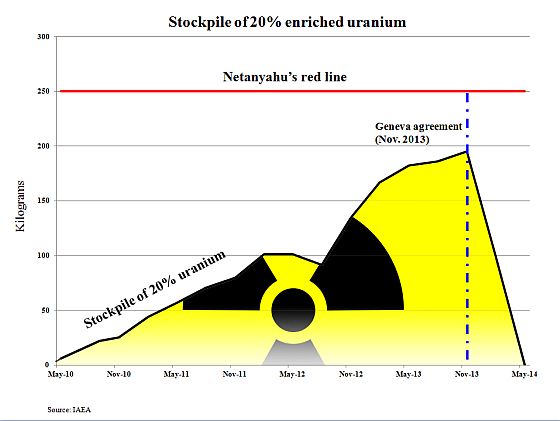
Graham Allison writes: Amidst the weeping and gnashing of teeth from the Prime Minister’s office after the interim agreement on Iran reached in Geneva, it is appropriate to pause to ask how President Obama’s interim agreement actually measures up on Israeli Prime Minister Netanyahu’s chosen yardstick.

Who can forget Netanyahu’s UN presentation last year where he made his best case to the world about the threat Iran’s nuclear program poses to international security. To vivify this danger, Bibi unveiled a graphic sketch of a bomb on which he demonstrably drew a red line.

As he explained in his UN speech then: “In the case of Iran’s nuclear plans to build a bomb, this bomb has to be filled with enough enriched uranium. And Iran has to go through three stages. The first stage: they have to enrich enough of low enriched uranium. The second stage: they have to enrich enough medium enriched uranium. And the third stage and final stage: They have to enrich enough high enriched uranium for the first bomb.”

Having set the stage, he then asked, “Where’s Iran?” As he answered: “Iran’s completed the first stage. It took them many years, but they completed it and they’re 70% of the way there. Now they are well into the second stage.” He then vowed that Iran would never be allowed to cross his red line to the third stage. “The red line must be drawn on Iran’s nuclear enrichment program,” he argued, “because these enrichment facilities are the only nuclear installations that we can definitely see and credibly target. I believe that faced with a clear red line, Iran will back down.” [Continue reading…]

Facebooktwittermail

What lessons do the success of Camp David and the failure of Oslo hold for America’s nuclear deal with Iran?

Marc Lynch writes: The Geneva P5+1 interim agreement with Iran is already the most important Middle Eastern diplomatic gambit since the Camp David Accords between Egypt and Israel and the Oslo Accords between the PLO and Israel. The “Joint Plan of Action” produced a monumental, symbolic breakthrough after years of frustrating diplomatic gridlock, and laid out a tantalizing glimpse of a very different Middle East. It has rapidly normalized relationships and practices which had very recently seemed unthinkable. A successful final status agreement on the Iranian nuclear program would be a monumental diplomatic accomplishment. But like Camp David and Oslo, Geneva is only an interim agreement which leaves a vast array of core issues unresolved — and offers a million opportunities for failure.

Camp David is the best-case analogy for Geneva, Oslo the worst-case analogy (and Munich is, of course, the black hole of analogies, a billion bad ideas gone supernova and sucking in everything that comes within its malevolent gravitational pull). Camp David suggests that implementation can be achieved against considerable odds, and in doing so galvanize radical strategic change in unpredictable directions. But Oslo suggests how easily Geneva can fail, given the opportunities it creates for spoilers to intervene and for implementation problems to sap its transformative power. That’s especially troubling since Geneva’s bargaining framework resembles Oslo’s more than anything else.

But it is a measure of Camp David’s success that few now recall that Egypt was for decades Israel’s most militarily dangerous foe and the strategic linchpin of a pan-Arab order. Most policy analysts in the mid-1960s (and, most likely, in the mid-1970s) would have considered the idea of an enduring, decades-long Egyptian-Israeli security partnership to be outrageously implausible. Camp David shows that a seemingly unthinkable strategic reorientation of leading rivals is entirely possible, if not likely, and that once achieved can be normalized remarkably quickly. [Continue reading…]

Facebooktwittermail

U.S. plan for new, Western-trained Libyan force faces obstacles

The Washington Post reports: Deepening divisions among Libya’s myriad armed groups are increasingly stirring conflict in the North African state. Now the United States and its allies are prepared to add a new force to the toxic mix.

U.S. officials say the hope is that the General Purpose Force — a trained Libyan military organization — will start to fill the country’s festering security vacuum, initially by protecting vital government installations and the individuals struggling to make this country run. The Obama administration hopes the force eventually will form the core of a new national army.

The first steps are small. At the request of Prime Minister Ali Zeidan, the United States, Britain and Italy have agreed to train 5,000 to 8,000 troops, many of whom will be drawn from existing militias. The recruits will be taken outside of Libya for military instruction and what a senior U.S. defense official described as an attempt to “shift attitudes and create new allegiances” to the central government.

But it remains unclear whether more men in arms can make a difference in an atmosphere flush with hundreds of powerful armed groups — many of them already on the government payroll — and competing political agendas.

Some in Libya, along with a number of outside experts, worry that the new force — whose recruits will be selected by the Libyan defense minister and vetted by the country that trains them — could ultimately become a tool for competing groups to advance their agendas, or simply one more armed faction in a dangerous sea of firepower. [Continue reading…]

Facebooktwittermail