Barbara Slavin reports: Bargaining into the early hours of Sunday morning in Geneva, the representatives of the world’s major powers and Iran reached a milestone on what remains a long road to resolving the decade-old nuclear crisis, and potentially also marking a turning point in three decades of hostility between Tehran and Washington.
Under the deal hammered out between Iran and the U.S., France, Britain, Germany, China and Russia, Tehran agreed to what President Barack Obama called “substantial limitations” on its nuclear program in return for “modest relief” of sanctions that have harshly impacted the Iranian economy. The agreement covers a six-month period, during which the parties hope to establish momentum for a more far-reaching deal.
While skeptics on all sides are expected to try and pick apart the agreement, few can doubt its historical significance. Had the parties failed again this weekend – only two weeks after Secretary of State John Kerry and his counterparts last rushed to Geneva but came up short – it would have been extremely difficult to maintain the momentum of negotiations in the face of mounting pressure from more hawkish voices on all sides. President Obama’s efforts to restrain Congress from an escalation of U.S. sanctions in order to give diplomacy a chance would have been dealt a severe blow. While some in Congress will almost certainly still try to pass further sanctions, the deal reached in Geneva will have helped the White House make its case.
Indeed, Obama, speaking from the Oval Office late Saturday in Washington, said “now is not the time to move forward on new sanctions” and the agreement promises no new nuclear-related sanctions for six months if Iran abides by its commitments. [Continue reading…]
Category Archives: Obama administration
As Syrian chemical attack loomed, missteps doomed civilians
The Wall Street Journal reports: As Syrian troops battled rebel forces in the Damascus suburbs Aug. 18, U.S. eavesdropping equipment began picking up ominous signals.
A special Syrian unit that handles chemical weapons was ordered closer to the front lines, officials briefed on the intelligence say, and started mixing poisons. For two days, warning signs mounted until coded messages went out for the elite team to bring in the “big ones” and put on gas masks.
U.S. intelligence agencies didn’t translate the intercepts into English right away, so White House officials didn’t know what the Syrian regime was planning until the assault began. Just before 2:30 a.m. on Aug. 21, the first salvo of poison-filled rockets streaked through the clear night sky and crashed into rebel strongholds.
Sarin gas, which kills almost instantly by attacking the nervous system, spread across sleeping farms. Pushed down by falling temperatures, the poison settled in low-lying areas and penetrated homes.
Men, women and children began coughing and gagging, with little more than wet handkerchiefs and T-shirts to hold over their mouths. Neighborhood doctors quickly ran out of antitoxins, and, in a desperate effort to wash away the poison, flooded clinic floors and dragged unconscious victims through the water. More than 1,400 people died, according to U.S. estimates, making it the worst chemical-weapons strike in a quarter century.
A final report is due soon from the United Nations. The Wall Street Journal has pieced together a reconstruction of that fateful day from battlefield reports and dozens of interviews with eyewitnesses, rebels, medics, activists and Western intelligence officials. It reveals both the horror of the attack and the months of miscalculations by the Syrian regime, opposition groups and U.S. government that left them all unprepared for what happened.
U.S. and Israeli communications intercepts reveal chaos inside the Syrian regime that night. When the reports of mass casualties filtered back from the field, according to the officials briefed on the intelligence, panicked Syrian commanders shot messages to the front line: Stop using the chemicals!
Calls came in to the presidential palace from Syrian allies Russia and Iran, as well as from Hezbollah, the Lebanese militant group whose fighters were inadvertently caught up in the gassing, according to previously undisclosed intelligence gathered by U.S., European and Middle Eastern spy agencies. The callers told the Syrians that the attack was a blunder that could have profound international repercussions, U.S. officials say.
The Obama administration had been closely monitoring Syria’s chemical-weapons stockpile since the conflict began in 2011, and had watched the regime carry out about a dozen small-scale chemical attacks before the big one, U.S. officials say. Even if they had translated the intercepts before the Aug. 21 strike, these officials say, they likely wouldn’t have acted because there were no indications it would be out of the ordinary.
Top policy makers had little appetite for getting more deeply involved in the conflict, and questions loomed large about the legality of providing support to the rebels and the best strategy for managing the chemical-weapons threat, these officials say. Rebel leaders and their allies in the U.S. government say the White House failed to act on requests for gas masks, antidote injectors and other protective gear until it was too late.
All told, the events of Aug. 21 changed the Middle East and U.S. policy in ways likely to reverberate for years. It prompted the U.S. to consider and then pull back from military action. The eventual deal to avert a strike, in which Syria agreed to destroy its chemical-weapons stockpiles, elevated Russia, for now, to a leadership position in the region.
President Bashar al-Assad has tightened his hold on power. His regime has denied using chemical weapons, blaming the attacks on the rebels. In exchange for giving up his chemical arsenal, he avoided an American military intervention and likely will get even more support from Russia and Iran. Mr. Assad has pressed ahead with his offensive using conventional arms. U.S. intercepts show a Russian official later boasting to a Syrian counterpart about how easy it had been to get the U.S. to back off strike plans, officials briefed on the intelligence say.
Syrian opposition leaders made their first formal appeal to the U.S. for protection from chemical weapons back in June 2012. At a meeting in Washington, opposition representatives handed administration officials a request for various nonlethal supplies, including 2,500 gas masks, say people who attended.
Samantha Power, then the White House’s top human-rights official and now U.S. ambassador to the United Nations, was receptive, these people say. But other White House advisers, they say, questioned whether the masks would make much of a difference. Some worried that if Islamic extremists in the opposition got their hands on them they might try to seize poison gas from the regime. Administrative lawyers worried about potentially running afoul of domestic and international law.
“It was never ‘no.'” says one opposition representative about what would become a series of requests. “But it would never happen.”
A senior administration official says, “Decisions that were made on assistance to the opposition were made in consultation with them as to what their priorities were.”
That July, American and Israeli spy agencies for the first time intercepted fragmentary intelligence about regime forces using chemical weapons on a small scale. The evidence wasn’t conclusive—there were no physical traces—but some top military officials say they found it persuasive and wanted to make it clear right away to Syria the U.S. wouldn’t tolerate even small attacks.
Then-White House Deputy National Security Adviser Denis McDonough and other officials told their agency counterparts that the top-secret information shouldn’t be made public, but congressional committees were briefed, according to officials. Mr. McDonough also decided to restrict the distribution of such “raw” intelligence inside the government because of its sensitivity, these people say. White House officials didn’t want to set off a chain reaction that would restrict their ability to decide how active a role to play, senior U.S. officials say.
The following month, on Aug. 20, President Barack Obama said the regime would cross the U.S.’s “red line” if it started moving or using “a whole bunch of chemical weapons.”
Last December, the U.S. intercepted an unusually complete communication in which Syrian officials spoke about a potentially larger-scale chemical attack involving aircraft. The White House sent private messages to the Russian government, which in turn asked Iran to lean on the Syrians to scrap the plan, according to current and former U.S. officials involved in the matter. Iran did just that, the officials say. A spokesperson for Iran’s U.N. mission said Iran had made it clear it opposed the use of chemical weapons. [Continue reading…]

Destruction of Syria’s chemical weapons may be outsourced to private contractors
The Associated Press reports: The global chemical weapons watchdog is inviting private companies to bid to get involved in destroying Syria’s stockpile of toxic agents and precursor chemicals.
The Organization for the Prohibition of Chemical Weapons is posting a request for “expressions of interest” from companies who want a role in “the treatment and disposal of hazardous and non-hazardous organic and inorganic chemicals.”
Saudi prince frets about ‘this perception that America is going down.’
The Wall Street Journal reports: ‘The U.S. has to have a foreign policy. Well-defined, well-structured. You don’t have it right now, unfortunately. It’s just complete chaos. Confusion. No policy. I mean, we feel it. We sense it, you know.”
Members of the Saudi royal family have voiced their displeasure with the Obama administration’s approach to the Middle East through private channels and recently in public as well. None of them puts it quite like HRH Prince Alwaleed bin Talal bin Abdulaziz Alsaud.
One of some three-dozen living grandsons of the first Saudi King Abdulaziz, this prince is a prominent but atypical royal. His investment company made him the Arab world’s richest businessman. He strikes a modern image for a Saudi, employing female aides and jet-setting on a private Boeing. He’s at ease with Western media.
Passing through New York earlier this week, Mr. Alwaleed, who is 58, sits down with the Journal editorial board between a couple of television appearances. He wears a blue suit, shirt and tie. These days, his bouffant widow’s peak has more salt than pepper. The prince holds no important government post in Saudi Arabia, but it’s hard to shake the impression that here is the uncensored id of the reserved House of Saud.
“America is shooting itself in the foot,” he says. “Saudi Arabia and me, myself, we love the United States. But what’s happening right now here, from Republicans and Democrats, is just not helping the image of the United States and is making this perception that America is going down a reality.” [Continue reading…]
Iran nuclear deal appears imminent
The Los Angeles Times reports: A deal to limit Iran’s nuclear program appeared close to completion Friday as negotiators from six world powers and Tehran smoothed remaining conflicts and top diplomats began arriving to join the talks.
After a rocky day Thursday, negotiators appeared for now to have overcome their differences on Iran’s entitlement to enrich uranium and on how to curb progress on a partially built nuclear research reactor that Western powers view as a particular threat.
U.S. Secretary of State John F. Kerry left late Friday for Geneva to help “narrow the differences and move closer to an agreement,” the State Department said. Sergei Lavrov, Russia’s foreign minister, arrived from Moscow early Friday evening, making him the first of the six nations’ ministers to show up for a possible signing ceremony that would end a decade of usually stalemated negotiations.
“Negotiations are moving on a positive track,” Iranian Deputy Foreign Minister Takht Ravanchi said.
A deal would be a first-stage agreement that would give Iran temporary relief from the crushing Western sanctions on its economy in exchange for temporary limits on its nuclear program. Many nations fear that Iran, despite its insistence that its program is for peaceful purposes only, is seeking weapons capability with its huge nuclear infrastructure.
This deal would open the way for tough bargaining on a final, comprehensive agreement that would take six months or longer to be reached.
A preliminary agreement would be a major step and could reduce the threat of another war in the Middle East. But as soon as it is signed it is likely to come under attack by Republican and Democratic lawmakers and U.S. allies such as Israel and Saudi Arabia, who fear that it will be too lenient. [Continue reading…]
White House: Israel’s all-or-nothing proposal on Iran would lead to war
JTA reports: Israel’s proposal that Iran totally dismantle its nuclear capacity in exchange for sanctions relief would likely lead to war, a top White House official said.
The official, in a conference call on Wednesday with think tanks and advocacy groups sympathetic to the Obama administration’s Iran strategy, outlined the proposal that the major powers will put forward at a third round of negotiations in Geneva beginning Thursday.
JTA obtained a recording of the call on condition that it not name the participants or fully quote them.
A think tank participant on the call said Israel’s posture — demanding a total halt to enrichment and the dismantling of all of Iran’s centrifuges — was a path to war. [Continue reading…]
Sen. Mark Kirk’s unshakable loyalty to Israel
Eli Clifton and Ali Gharib report: During an invitation-only phone briefing for supporters, one of the Senate’s top Iran hawks relished his battle with the Obama administration over the imposition of more sanctions against Iran amid the latest round of diplomatic negotiations underway in Geneva. During the call, Sen. Mark Kirk, R-Ill., reserved special attacks for Secretary of State John Kerry and lead U.S. negotiator Under Secretary of State Wendy Sherman.
“It’s the reason why I ran for the Senate, [it] is all wrapped up in this battle. I am totally dedicated to the survival of the state of Israel in the 21st century,” said Kirk, whose office framed the call as an update on Iran’s nuclear program and Kirk’s efforts to pass additional sanctions. “This has been very much a one-senator show, unfortunately,” he said of his confrontational, public approach.
Kirk is leading the Republican effort to introduce new sanctions in the Senate. Along with six co-sponsors, Kirk on Tuesday announced his intention to introduce amendments to the National Defense Authorization Act, the annual bill that budgets for the military, that would increase sanctions on Iran and impose restrictions on any possible interim nuclear deal with Iran. The effort is currently being held up by the upper chamber’s Democratic leadership.
The 28-minute phone call with Kirk, which occurred on Monday afternoon, was by invitation only, but Salon reporters obtained an invitation and RSVPed by name to Kirk for Senate finance director Barret Kedzior. [Continue reading…]
Working around Keystone XL, Suncor Energy steps up oil production in Canada
The New York Times reports: Suncor Energy, Canada’s top petroleum producer, announced on Thursday that it would expand its oil production in 2014 by 10 percent in another sign that the Obama administration’s delay in approving the Keystone XL pipeline extension is not holding back growth in the western Canadian oil sands fields.
“We’re set for a strong year of continued production,” Suncor’s chief executive, Steven W. Williams, said. The company announced a capital spending program of $7.45 billion for 2014, $477 million more than it had forecast earlier this year.
Suncor, which is based in Calgary, produces oil and gas around Canada, and has operations in North Africa and the North Sea. But its oil sands operations are the main driver for the company. In the most recent quarter, its oil sands output rose 16 percent from the year before for a record of 396,000 barrels a day, nearly 20 percent of the country’s total oil sands production.
The company said it expected its oil sands production to increase again next year to 430,000 barrels a day.
Reports of increased production are coming even as Canadian oil executives are privately questioning whether the Obama administration will ever approve the Keystone XL pipeline, which it has been considering for more than two years.
The extension is intended to transport more than 800,000 barrels a day of oil sands output to refineries on the Gulf of Mexico coast, but environmentalists have made stopping the pipeline their top priority since emissions from oil sands production are higher than for most crude oils consumed in the United States.
But over the last several months, oil companies have sought to go around the dispute by announcing plans for three large rail loading terminals with the combined capacity of transporting 350,000 barrels a day.
The companies are poised to quadruple rail-loading capacity over the next few years to as many as 900,000 barrels a day, whether or not the Keystone pipeline is built. [Continue reading…]
It’s long been reported that rail transportation of oil was already making the construction of Keystone XL an issue of questionable relevance in relation to the environmental consequences of oil sands production, which makes me wonder why so much activist energy was focused on the pipeline. Was it simply because “stop the pipeline” is such an easy rallying-cry?
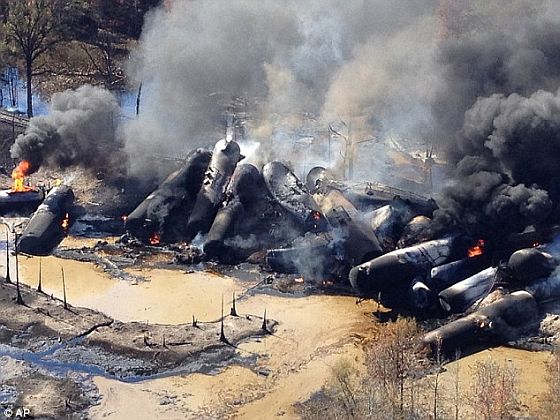
Ironically, the dangers posed by rail delivery of oil are probably far greater than those posed by Keystone XL as an accident in Alabama earlier this month made all too clear:

Why the Obama administration is giving a free pass to Egypt’s military regime
Marc Lynch writes: Secretary of State John Kerry can’t seem to find enough ways these days to express his acceptance of Egypt’s military coup regime. In a visit to Cairo, he waved away the hard-fought suspension of some U.S. aid as “not a punishment” and declined to raise the issue of the trial of former President Mohamed Morsy. He seems keen to pretend that Egypt is on the road to democracy, and even appears to believe that the fiercely anti-democratic United Arab Emirates is going to support a democratic transition. Most recently, he endorsed the regime’s narrative by claiming that the Muslim Brotherhood “stole” the revolution — by winning free and fair elections, which Washington strongly supported.
Why is Kerry making such a production of supporting Egypt’s military regime? Most likely, President Barack Obama’s administration simply has much bigger regional issues with which to grapple, and has decided that it can accomplish little in a hopelessly fractured Egypt. It (correctly) calculates that there is little it can do to influence the course of events in Cairo due to the pervasive hostility to Washington across the Egyptian political spectrum and the willingness of Gulf states to offset any American attempts to exercise leverage.
It may be galling to many Egypt watchers and Egyptians who consider Cairo the center of the Middle East universe, but right now events there are barely a sideshow for Washington. Cairo has made it quite clear that it has little interest in American advice, and Washington has far more important issues on its plate.
Both Iran’s nuclear program and the horrific war in Syria continue to take priority over Egypt on America’s regional agenda. Closing a deal with Iran would arguably be the single most impressive and important geostrategic accomplishment in the Middle East since the Camp David Accords. Meanwhile, Syria’s civil war continues to inflict crushing human costs and has reverberated around the region, and few of the external players are keen on U.S.-orchestrated attempts to organize a peace conference.
Given those momentous challenges, the Obama administration is likely calculating that if happy talk on Egypt can slightly appease America’s anxious Gulf allies as Washington pushes policies in Iran and Syria that they dislike, then so be it.
That may be dispiriting, but at least it makes sense — as long as nobody is really fooled that Egypt is actually on a path toward a democratic future. But I doubt anyone in the administration is buying their own rhetoric. It may seem strange now, but there was once a controversy over whether Egypt’s July 3 coup should be called a coup. Even though it met the textbook definition of a coup — the military stepping in, suspending the constitution, and arresting the elected political leadership — many Egyptians protested that the masses in the streets demanding change and the perfidy of the Brotherhood leadership made it something different. It didn’t, of course.
Lest we forget, everything that has happened since July 3, without exception, has confirmed the coupness of Egypt’s coup. Army chief Abdel Fattah al-Sisi’s military regime has done everything by the book — rounding up and brutalizing supporters of the old regime, cultivating a cult of personality around the coup leader, tightly controlling the media, stage-managing a constitutional process designed to protect the military’s power and privileges, and even promising an eventual return to democracy.
The more obvious the nature of Egypt’s coup has become, the faster Washington has tried to run away from the legal and political implications of acknowledging it. [Continue reading…]
Friedman on the Israel lobby’s effort to block a deal with Iran
Thomas Friedman writes: Never have I seen Israel and America’s core Arab allies working more in concert to stymie a major foreign policy initiative of a sitting U.S. president, and never have I seen more lawmakers — Democrats and Republicans — more willing to take Israel’s side against their own president’s. I’m certain this comes less from any careful consideration of the facts and more from a growing tendency by many American lawmakers to do whatever the Israel lobby asks them to do in order to garner Jewish votes and campaign donations.
That said, I don’t mind Prime Minister Bibi Netanyahu of Israel and King Abdullah of Saudi Arabia going ballistic — in stereo — over this proposed deal. It gives Kerry more leverage. Kerry can tell the Iranians: “Look, our friends are craaaaaazzzy. And one of them has a big air force. You better sign quick.”
No, I don’t begrudge Israel and the Arabs their skepticism, but we still should not let them stop a deal. If you’re not skeptical about Iran, you’re not paying attention. Iran has lied and cheated its way to the precipice of building a bomb, and without tough economic sanctions — sanctions that President Obama engineered but which Netanyahu and the Arab states played a key role in driving — Iran would not be at the negotiating table.
It’s good to see Friedman again acknowledging the influence of the Israel lobby and not surprising that like so many others he repeats the trope that sanctions forced Iran to negotiate, but as Hossein Mousavian points out, the actual effect of sanctions has been the opposite of their intended effect:
Contrary to the claims of some US lawmakers and Israeli officials, sanctions only caused a dramatic rise in nuclear capability, as Tehran sought to show it would not respond to pressure. Before, Iran was enriching uranium to below 5 per cent at one site with 3,000 centrifuges and possessed a minute stockpile of enriched uranium. Today, it is enriching to 20 per cent at two sites with 19,000 centrifuges. It has a stockpile of 8,000kg of enriched uranium and more sophisticated centrifuges.
America’s ‘army of lawyers’ is almost as deadly as its drones
Dawood Ahmed writes: “If you tell a lie big enough and keep repeating it, people will eventually come to believe it.” Some ascribe this quote to Nazi propagandist Joseph Goebbels; others say Hitler authored the idea. In Mein Kampf he did speak of the invention of a lie so “colossal” that few would believe that someone “could have the impudence to distort the truth so infamously”.
Whoever coined the idea, the point is this: controlling the narrative matters immensely.
Military prowess is not enough in this age. And the United States knows it. America’s “other army” – its less visible but equally potent cadre of skillful lawyers (in government and even in private institutions) – dutifully got busy crafting appropriate international law narratives for the War on Terror. They realized that winning the battle for defining “legality” on the world stage was critical.
This is something states in the developing world would do well to understand. And particularly, governments of countries that bear the brunt of US military interventions touted as “self-defense” and “counter-terrorism” – Pakistan, Yemen, Somalia, Afghanistan and Iraq. Such states need to build intellectual-professional capacity to counter precedent-setting international legal arguments strategically employed (or better said: deployed) against them.
No contemporary political discourse provides us with a clearer illustration of this than the heated debate about the (ill)legality of drones and targeted killings. [Continue reading…]
Video: Leaked memo reveals U.S. plan to oppose helping poor nations adapt to climate change
New Iran sanctions not likely while nuclear talks still in progress, key senators say
The Washington Post reports: Lawmakers acknowledged Tuesday that they were unlikely to impose new economic sanctions on Iran while sensitive nuclear talks are underway, removing a potential obstacle to a diplomatic settlement that U.S. officials say could come within days.
The decision to delay action on new sanctions came as a new Washington Post-ABC News poll showed widespread approval for a deal with Iran, even if that deal means lifting some of the economic restrictions that have helped force Iran to the negotiating table.
A bipartisan group of senators emerged from a two-hour White House meeting saying there would likely be no vote this week on proposed new sanctions targeting Iran’s oil industry. Still, some lawmakers continue to push to ratchet up the pressure on Iran, despite warnings that such a move could prompt the country’s representatives to abandon international negotiations scheduled to resume Wednesday in Geneva.
“People are concerned that we’re giving up some leverage,” Sen. Bob Corker (Tenn.), the ranking Republican on the Senate Foreign Relations Committee, told reporters after the White House meeting.
The agreement to delay a sanctions vote came as diplomats from the United States, Iran and five other countries arrived in Geneva for the start of potentially decisive negotiations on the future of Iran’s nuclear program. Diplomats — after coming close to a deal two weeks ago — are seeking to finalize what U.S. officials describe as a first step in a comprehensive agreement on permanent limits to Iran’s nuclear capabilities. [Continue reading…]
U.S. considers destroying Syria’s chemical weapons on a barge in international waters
The New York Times reports: Unable to find a country willing to dispose of Syria’s chemical weapons, the United States is considering plans to place the chemical components of the weapons on an barge where they would be dissolved or incinerated, according to senior American officials.
The two systems under review are intended to destroy the precursor materials that are designed to be combined to form chemical munitions. Syria’s smaller arsenal of operational chemical weapons would be destroyed separately, officials said.
Officials from the Organization for the Prohibition of Chemical Weapons, which is operating in Syria to locate and identify the weapons, would monitor the destruction, which would be carried out following safety standards set by legislation in the United States and the European Union, according to officials familiar with the proposal. Officials did not say whether any chemical residue would be dumped in the ocean.
The system could be operational in 75 days.
The seaborne options have received more serious consideration after Albania on Friday turned down an appeal by the United States to destroy the weapons on its territory; the decision followed street protests by thousands of Albanians. Norway rejected an earlier request, saying it did not have the expertise or the facilities to destroy the weapons. The issue caused a major political dispute there as well. [Continue reading…]
Strains with Israel over Iran snarl U.S. goals in Mideast
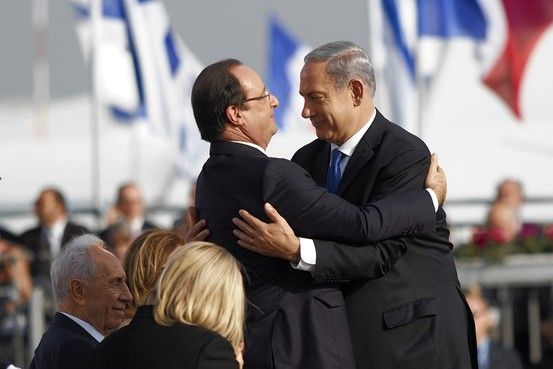
The Wall Street Journal reports: The Obama administration’s overtures to Iran are straining the U.S. alliance with Israel in ways not seen in decades, compounding concerns about the White House’s ability to manage the Middle East’s proliferating security crises, said current and former American diplomats.Hollande recoils slightly from Netanyahu's suffocating embrace.
In a sign of Israel’s growing disaffection with Washington, French President François Hollande was given a hero’s welcome when he arrived in Tel Aviv on Sunday for a three-day visit that would showcase Paris’s hard line against Iran’s nuclear program ahead of international talks in Geneva this week.
Mr. Netanyahu reiterated his criticism that the U.S.-backed compromise was a “very bad deal” while hailing Mr. Hollande for his opposition to the agreement at a joint news conference Sunday evening in Jerusalem.
“Your support and your friendship is real. It’s sincere. You were one out of six,” he said, referring to the six world powers participating in talks with Iran.
Both the U.S. and Israel insist the relationship is strong enough to sustain even a pronounced disagreement. But the State Department said on Sunday that it was considering sending Secretary of State John Kerry back to Jerusalem for the second time this month to try and repair the breach with Israeli Prime Minister Benjamin Netanyahu. [Continue reading…]
Negotiating with Iran for an imperfect peace
Laura Secor writes: A week ago, negotiations in Geneva between Iran and six world powers adjourned without a deal. At issue was an interim agreement that would have frozen Iran’s nuclear program while the group worked out a broader, long-term settlement. By most accounts, the negotiations foundered over the late introduction of more stringent language about one of Iran’s facilities—a heavy-water reactor near Arak—and the removal of an explicit allowance for low-level uranium enrichment on Iranian soil. But meetings were set to resume this week, and, last Thursday, the International Atomic Energy Agency announced that Iran has not expanded its nuclear program since August, when President Hassan Rouhani took office. Just six months ago, productive talks with Iran—the kind that hold out the possibility of a historic breakthrough—were unthinkable. Now, for the first time in thirty-four years, Iran and the United States are speaking. Yet many in the West remain wary of a diplomatic solution. The nature of diplomacy, after all, is compromise, which means that an agreement with Iran will bring an end to the fantasy of total victory for either side.
Rouhani has committed himself to finding a quick resolution to the impasse, and the cumbersome, fractious machinery of the Iranian state has backed him with an unusual unity of purpose. The tone of the Iranian negotiating team is businesslike and frankly urgent. Gone are the grandiose diatribes and the repetitive talking points of the Ahmadinejad years. In their place is what the Iranian President, sounding like a member of the Council on Foreign Relations, calls “constructive engagement,” and the Supreme Leader, Ayatollah Ali Khamenei, sounding more like a member of a yoga collective, calls “heroic flexibility.”
Rouhani is a pragmatist who came to power, in part, on the strength of disaffection, both popular and élite, with the confrontational foreign policy of his predecessor. Surely his first priority is relief from the international sanctions, tied to the nuclear issue, on financial transactions and oil exports, which have caused hardship for the Iranian people. But it’s not difficult to imagine that, with Sunni extremism rising, particularly in Iraq and Syria, Rouhani and his team are also making long-term calculations about Iran’s strategic interests. So far, his foreign-policy agenda has not encountered the predicted hard-line obstruction in Tehran. On the contrary, during the Geneva talks the Supreme Leader tweeted, “Our #negotiators are children of the #Revolution. We strongly support those in charge of our diplomacy.”
On domestic matters, however, Rouhani’s support is less certain. He has fashioned a government of national unity at a time of profound political polarization. The President is a trusted member of the clerical élite, who also carries a mandate from reform-minded voters. They are waiting, with increasing impatience and skepticism, for him to make good on promises to relax censorship and to release more political prisoners. Meeting those demands will require Rouhani to persuade the conservative members of his coalition that liberalization will not threaten them or the system they uphold. He may hope to conclude the nuclear talks before addressing such delicate matters at home. But the longer Rouhani takes to satisfy reform-minded voters the more likely it is that his coalition will fracture. The Geneva talks look straightforward by comparison. [Continue reading…]
The Democrats marching to war with Iran
James Traub writes: If you squeeze a bully’s b — sorry, fingers — really hard, and he buckles, then you keep squeezing until you bring him to his knees, right? That, in any case, is the logic which lies behind the bipartisan revolt against President Barack Obama’s diplomacy with Iran. In an op-ed in USA Today, Democratic Senator Robert Menendez, the chairman of the Senate Foreign Relations Committee, explained why he had defied the administration’s urgent request that Congress hang fire on further sanctions: “Iran is on the ropes because of its intransigent policies and our collective will…. Tougher sanctions will serve as an incentive for Iran to verifiably dismantle its nuclear weapons program.”
It’s hardly an absurd proposition. Menendez, one of the leading Democratic Iran hawks, also recently told an AIPAC meeting that when he began his drive to impose sanctions — a drive for which the White House might want to claim a little bit of credit as well — he was told that force would never bring the Iranians to the table. I’m not sure who, besides Flynt Leverett, argued against coercion, but it’s an unarguable fact that sanctions on Iran’s oil sales and financial system, imposed by the European Union as well as Congress, have forced the Iranians to take the nuclear negotiations more seriously than they have in the past, and may even have helped elect the moderate president Hassan Rouhani.
So why is the White House insisting that Menendez and his colleagues on the left and right are provoking “a march to war”? The obvious answer, furnished by Secretary of State John Kerry, among others, is that Iran would view additional sanctions imposed in the middle of the most delicate negotiations as a sign of bad faith. More to the point, a punitive response by the West would undermine the moderates on Rouhani’s team, and prove to Iranian hard-liners — including the supreme leader, Ayatollah Khamenei — that the United States and its allies are an intransigent adversary intent on humiliating Iran and ultimately overthrowing its Islamic regime.
Obama’s critics have a riposte to this claim: new sanctions won’t kick in for another three to six months, and thus will function as an effective Sword of Damocles while talks continue. That’s a pretty risky gamble, especially because anything that prolongs the negotiations gives Iran more time to enrich uranium and reach a point of no return at which it could produce enough fuel to fill a bomb.
But that’s not the biggest problem with the squeeze-’em-till-they-drop crowd. The reason why Menendez and others really are marching on a path to war is that they are demanding an outcome which Iran manifestly will not accept: zero enrichment. As Daryl Kimball, director of the Arms Control Association, puts it, “This is a strategy based upon hope that is not supported by the evidence of Iranian actions over the past decade, its past statements, or common sense.” [Continue reading…]
WikiLeaks publishes secret trade text to rewrite copyright laws, limit internet freedom
Wikileaks: On November 13, 2013, WikiLeaks released the secret negotiated draft text for the entire TPP (Trans-Pacific Partnership) Intellectual Property Rights Chapter. The TPP is the largest-ever economic treaty, encompassing nations representing more than 40 per cent of the world’s GDP. The WikiLeaks release of the text comes ahead of the decisive TPP Chief Negotiators summit in Salt Lake City, Utah, on 19-24 November 2013. The chapter published by WikiLeaks is perhaps the most controversial chapter of the TPP due to its wide-ranging effects on medicines, publishers, internet services, civil liberties and biological patents. Significantly, the released text includes the negotiation positions and disagreements between all 12 prospective member states.
The TPP is the forerunner to the equally secret US-EU pact TTIP (Transatlantic Trade and Investment Partnership), for which President Obama initiated US-EU negotiations in January 2013. Together, the TPP and TTIP will cover more than 60 per cent of global GDP. Both pacts exclude China.
Since the beginning of the TPP negotiations, the process of drafting and negotiating the treaty’s chapters has been shrouded in an unprecedented level of secrecy. Access to drafts of the TPP chapters is shielded from the general public. Members of the US Congress are only able to view selected portions of treaty-related documents in highly restrictive conditions and under strict supervision. It has been previously revealed that only three individuals in each TPP nation have access to the full text of the agreement, while 600 ‘trade advisers’ – lobbyists guarding the interests of large US corporations such as Chevron, Halliburton, Monsanto and Walmart – are granted privileged access to crucial sections of the treaty text. [Continue reading…]