Category Archives: Entities

Is Julian Assange an idiot who has outlived his usefulness?

Michael Weiss writes: There is no one more zealous than a convert.

CIA Director Mike Pompeo previously welcomed WikiLeaks’ disclosures about Hillary Clinton and the Democratic National Committee when these proved helpful to the Republican nominee. Now he has experienced a road-to-Damascus moment.

“WikiLeaks,” Pompeo said at a think tank event last week, “walks like a hostile intelligence service and talks like a hostile intelligence service.” Pompeo also regards Julian Assange, the publisher of WikiLeaks and the lonely maintainer of its hyper-active Twitter account, as a “fraud.”

In a rather folksy fly-over metaphor, the former Kansas representative likened the albinoid antipodean anarchist to the Wizard of Oz, perhaps forgetting that the man behind the curtain turned out to be an all-right guy in the end rather than a helpmeet of European dictatorship and a purveyor of conspiracy theories about the Rothschilds.

Pompeo isn’t the only one who’s changed his mind about the man holed up for five long years at the Ecuador embassy in London. The U.S. Justice Department, headed by Jeff Sessions—a man who conveniently forgot while testifying before Congress that he twice met with the Russian ambassador to the United States—now considers arresting Assange a “priority.” [Continue reading…]

Arresting Assange is a “priority” of an undisclosed magnitude — I’m doubtful that it can be particularly high.

No doubt at a time when this administration is going out of its way to create the appearance that it has no ties to Russia, a tough-on-Wikileaks stance might seem desirable.

But let’s not forget that Assange himself has repeatedly claimed that he is willing to accept extradition to the United States.

So is it just a matter of time before the cable news networks will be able to feast on 24/7 coverage of the trial of the century?

Probably not.

Ignoring the question of whether the Justice Department can actually construct a legal case against Assange, I seriously doubt that the White House would welcome seeing him testifying in court. Indeed he might not even make it to his own trial if he sought and received immunity as an FBI witness.

The message that the U.S. wants to get its hands on Assange may have had less to do with challenging his ability to remain in refuge than it has with making sure he remains where he is. Likewise, he will probably remain a problem Moscow doesn’t need to solve so long as he stays put.

The irony is that if Assange had complied with Sweden’s request to question him in 2010, whatever the outcome of that interrogation, it is quite likely that by now he would be a free man. Instead he endures a self-imposed prison sentence for which there is no end in sight.


Facebooktwittermail

UN documents Syrian war crimes, but prosecution moves slowly

The New York Times reports: The chairman of a United Nations commission investigating possible war crimes in Syria has met that country’s ambassador only once, he said. It happened during a chance encounter in a hallway after he had given a briefing to the General Assembly in New York.

“Then for 15 minutes, he gave me a lecture,” the commission chairman, Paulo Sérgio Pinheiro, said of his exchange with the Syrian envoy, Bashar al-Jaafari. “We don’t have any hope that the Syrians will cooperate with us.”

Members of the commission, created by the United Nations Human Rights Council in August 2011, have never been permitted to visit Syria by the government of President Bashar al-Assad, which appears to view them as accomplices of Mr. Assad’s enemies.

The commission, with a support staff of about 25 people, has collected an enormous volume of material, which could be used in courts, about the atrocities committed in the six-year-old civil war by both Mr. Assad’s side and the groups arrayed against him. [Continue reading…]

Facebooktwittermail

Entire U.S. Senate to go to White House for North Korea briefing

Reuters reports: Top Trump administration officials will hold a rare briefing on Wednesday at the White House for the entire U.S. Senate on the situation in North Korea, senior Senate aides said on Monday.

All 100 senators have been asked to the White House for the briefing by Secretary of State Rex Tillerson, Secretary of Defense Jim Mattis, Director of National Intelligence Dan Coats and General Joseph Dunford, chairman of the Joint Chiefs of Staff, the aides said.

While top administration officials routinely travel to Capitol Hill to address members of Congress on foreign policy and national security matters, it is unusual for the entire 100-member Senate to go to such an event at the White House, and for those four top officials to be involved. [Continue reading…]

Facebooktwittermail

The French elections showed the strength of the European far-right — and its limits

Zack Beauchamp writes: To understand what France’s election means, and what it tells us about the rise of far-right movements around Europe, you need to understand two fundamental truths about the results.

The first is that it’s a historic victory for the far-right Marine Le Pen and her Front National party. Le Pen was one of two candidates who qualified for the second round, soundly beating the standard-bearers both of France’s traditional establishment parties — the center-right Republicans and center-left Socialists. The once-reviled Front has clearly entered the mainstream of French politics.

At the same time, the election seemed to demonstrate the very clear limits of Le Pen’s popularity — and, potentially, European far-right politics more broadly.

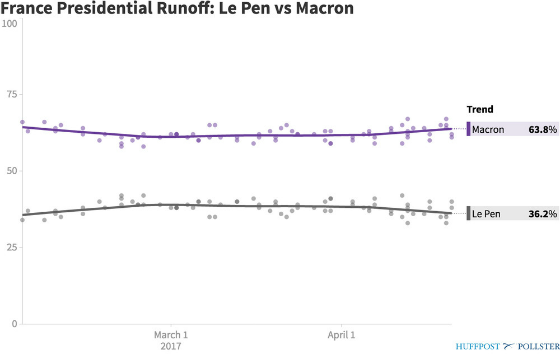
Le Pen came in second in Sunday’s election, with 21.7 percent of the vote. The plurality winner, upstart centrist Emmanuel Macron, won with 23.9 percent. He’s her polar opposite in virtually every respect. She wants to restrict immigration to France and pull France out of the EU; he supports keeping the borders open and proudly waved the EU flag at his final campaign rally. And when these two face each other one-on-one in a runoff in two weeks, he’s very likely to win — every poll that’s been taken so far has him up by massive margins:


The tolerant center, in France, appears likely to hold.

What we’re seeing in France mirrors what’s happening in much of Europe. After the twin shocks of Brexit and Trump, the far-right has seen a series of setbacks. From elections in Austria and the Netherlands to polls in all-important Germany, the far-right is performing far less well than many have expected.

What these numbers suggest is that the far-right has a political ceiling: That while its supporters may be hard-core, the majority of Europeans still recoil from its vision — at least for now. [Continue reading…]

Facebooktwittermail

Senate Trump-Russia probe has no full-time staff, no key witnesses

The Daily Beast reports: The Senate Intelligence Committee’s probe into Russia’s election interference is supposedly the best hope for getting the public credible answers about whether there was any coordination between the Kremlin and Trump Tower.

But there are serious reasons to doubt that it can accomplish this task, as currently configured.

More than three months after the committee announced that it had agreed on the scope of the investigation, the panel has not begun substantially investigating possible ties between the Trump campaign and Russia, three individuals with ties to the committee told The Daily Beast.

The investigation does not have a single staffer dedicated to it full-time, and those staff members working on it part-time do not have significant investigative experience. The probe currently appears to be moving at a pace slower than prior Senate Intelligence Committee investigations, such as the CIA torture inquiry, which took years to accomplish.

No interviews have been conducted with key individuals suspected of being in the Trump-Russia orbit: not Michael Flynn, not Roger Stone, not Carter Page, not Paul Manafort, and not Jared Kushner, according to two sources familiar with the committee’s procedures. [Continue reading…]

Facebooktwittermail

China’s leader urges restraint on North Korea in call with Trump

The New York Times reports: China’s president, Xi Jinping, has urged President Trump to show restraint toward North Korea despite signs that the North may be preparing a nuclear test. Mr. Xi made the appeal in a phone call with Mr. Trump on Monday that reflected growing alarm over North Korea’s plans, which could tip the region into crisis.

The phone conversation, on Monday morning in Beijing, came after Mr. Trump had already used a meeting with Mr. Xi in Florida, a follow-up phone call, interviews and Twitter messages to press Mr. Xi to do more to deter North Korea from holding additional nuclear and missile tests. The United States and its allies have been on alert for another atomic test by the North.

In the latest call, the third between the two leaders, Mr. Xi indicated to Mr. Trump that China opposed any such test by North Korea, but he also nudged Mr. Trump to avoid a tit-for-tat response to the North’s fiery threats, according to a report on Chinese television.

“China adamantly opposes any actions in contravention of the United Nations Security Council resolutions,” Mr. Xi said, according to the report, evidently referring to a series of decisions by the council to punish North Korea for its nuclear and missile programs.

“At the same time, it is hoped that all sides exercise restraint and avoid doing things that exacerbate tensions on the peninsula,” Mr. Xi said, referring to the Korean Peninsula. “Only if all sides live up to their responsibilities and come together from different directions can the nuclear issue on the peninsula be resolved as quickly as possible.”

The comments reflected growing Chinese fears that the tensions between North Korea and the United States and its Asian allies could spiral into outright military conflict. That widening rift is presenting China with confounding choices between its longstanding ties to North Korea and its hopes for steady relations with the United States. [Continue reading…]

Facebooktwittermail

Instead of threatening North Korea, Trump should try this instead

John Delury writes: President Trump’s missile strike on Syria won plaudits from commentators on the left and right, with some of the enthusiasm spilling over into the debate about a “military solution” when it comes to North Korea. The comparison, like much of the administration’s rhetoric about Korea, is dangerously misleading. There is no way to hit North Korea without being hit back harder. There is no military means to “preempt” its capabilities — nuclear and otherwise — with a “surgical” strike. Any use of force to degrade its weapons program would start a war, the costs of which would be staggering.

Maybe in the era of America First, we don’t care about death and destruction being visited on the 10 million people who live in Seoul, within North Korean artillery and short-range missile range. Do we care about some 140,000 U.S. citizens residing in South Korea — including soldiers and military families at bases here, plus more in nearby Japan? Or South Korea’s globally integrated $1.4 trillion economy, including the United States’ $145 billion two-way trade with the country? Do we care about North Korean missiles raining down on Incheon International Airport, one of Asia’s busiest airports, or Busan, the sixth-largest container port in the world? What happens to the global economy when a conflagration erupts on China’s doorstep and engulfs Japan?

Surely the American public and Congress, regardless of party, can agree that these costs are unbearable and unthinkable. Given the presence of many sober-minded strategists and policymakers in the administration, it seems reasonable to conclude the military taunts are a bluff. If so, they are a distraction from the real, pressing question: How much longer should they wait on economic pressure generated by Chinese sanctions, rather than pursue diplomatic options opened up by direct dialogue and engagement? [Continue reading…]

Facebooktwittermail

Marine Le Pen to face off against ‘France’s Justin Trudeau,’ Emmanuel Macron

Christopher Dickey writes: Two days after Donald Trump declared that anti-immigrant, anti-European Union, anti-NATO, pro-Russian, anti-American, pro-Steve-Bannon Marine Le Pen was the “strongest on borders, and she’s the strongest on what’s been going on in France,” she has made it through the first round of the country’s presidential elections and into the sudden-death runoff that will take place on May 7.

If she manages to win, her election will have stunning consequences domestically and internationally, multiplying the shocks that have followed on the Brexit vote and Trump’s ascent in the United States.

A Le Pen victory would also be welcomed by Russia’s Vladimir Putin, who recently received her at the Kremlin as if she already were a head of state.

Right now, however, it looks like Le Pen doesn’t have much of a prayer, and France may well position itself as a new bulwark against Trump-style xenophobia and populism.

Her second-round rival is 39-year-old former banker and economy minister Emmanuel Macron, who is pretty much in favor of everything that Le Pen opposes. He was the only one of the four leading candidates who did not speak warmly of Putin. He embraces globalism; he has even waved the European Union flag at his election rallies. And while Trump rooted for Le Pen, former President Barack Obama called Macron to give him encouragement. [Continue reading…]

An editorial in The Guardian says: The contest on 7 May is a contest between openness and bigotry, internationalism and nationalism, optimism and hatred, reaction and reform, hope and fear. The fact that Ms Le Pen has reached the second round should not be underplayed simply because it was predicted for so long, or because, if the exit polling is confirmed, she finished second behind Mr Macron, not first. She took almost a quarter of French votes. Her projected 21.9% is significantly larger than her father’s 16.9% in 2002. Even if she loses in round two, the FN may still stand on the verge of a historic advance in June’s parliamentary elections.

It is tempting to see Ms Le Pen’s result as a defeat alongside that of Geert Wilders in the Netherlands, and to conclude that European liberal values have successfully rallied to stop another lurch to the racist right. Some of that is true, and it is a cause for immense relief. France stood up and was counted on Sunday. But the threat from the French extreme right is not over. Nor is the threat from kindred extreme-right parties in Europe. Both the AfD in Germany and Ukip in Britain have moved further to the right in the past week. The Front National remains a party of bigotry, hatred and nationalism of the worst kind.

Now France must stand up again in two weeks’ time and complete the job by electing Mr Macron. [Continue reading…]

Sonia Delesalle-Stolper writes: France had a choice. To be more or less open; more or less democratic; more or less European. With Emmanuel Macron, it has chosen openess, democracy and Europe.

The real work, the real battle begins in June, with the parliamentary elections. Macron will need to gather a big enough majority to be able to govern – and this with a political movement that did not even exist one year ago. He has promised to field candidates in all 577 constituencies, with at least half of them new recruits to politics. It will be difficult, but on the evening of the first round, nothing looks impossible for this extraordinary candidate. [Continue reading…]

Facebooktwittermail

Trump puts on a big show of assaulting his ‘opposition’ in the media. Inside the White House, it’s a different story

Politico reports: Seven days before Donald Trump took office, the inauguration festivities got off to a low-key start inside a modest conference room at the Capitol Hill offices of the American Trucking Association. There, a hundred-odd familiar faces from the Washington set gathered to fête one of their own, incoming White House press secretary Sean Spicer.

The party spilled out into the hallway as entrepreneur Susanna Quinn, ubiquitous Republican consultant Ron Bonjean and Spicer’s wife, Rebecca, a staffer at the National Beer Wholesalers Association, rubbed shoulders with CBS’ White House correspondent Major Garrett and its political editor Steve Chaggaris, Time’s Zeke Miller and several journalists from CNN, including Washington bureau chief Sam Feist. Spicer arrived late, but in good spirits, and after 20 minutes of schmoozing he strode to the front of the room to deliver brief remarks.

In public, Trump’s team and the press had been engaged in bitter clashes for months. Just two days earlier, during a contentious transition-team news conference, Spicer had threatened to eject CNN’s Jim Acosta from Trump Tower. But in the end, ratings were up and Trump was president-elect.

The overlit conference room was a safe space, not a war zone. Spicer made light of the Acosta incident, jokingly threatening to eject Feist from the room. Feist took Spicer’s teasing in stride, briefly turning as if to make for the exit, and the room laughed along. Spicer cracked that he looked forward to serving in his new post for “eight years,” an unheard-of tenure in the notoriously trying job of White House press secretary. This prompted more knowing laughter. One heckler shouted, “Tell the truth!”—an arch reference to the angry chant Trump supporters had been raining down on reporters at campaign rallies.

Then, a week later, a grim-faced Spicer took to the podium in the White House briefing room for the first time and angrily denounced the news media’s reporting of Trump’s inauguration crowd, uttering several easily debunked falsehoods. “This was the largest audience to ever witness an inauguration. Period,” he said, flanked by twin monitors displaying a deceptively flattering overhead photo of the crowd on the National Mall—instantly becoming a national punchline on Twitter and late-night television. He did not take questions, let alone make jokes.

“It was a bit of a shocker,” said one veteran Washington journalist who had attended Spicer’s party. “Especially given what had happened that night at the get-together.” [Continue reading…]

Facebooktwittermail

‘Everyone tunes in’: Inside Trump’s obsession with cable TV

The Washington Post reports: During a small working lunch at the White House last month, the question of job security in President Trump’s tumultuous White House came up, and one of the attendees wondered whether press secretary Sean Spicer might be the first to go.

The president’s response was swift and unequivocal. “I’m not firing Sean Spicer,” he said, according to someone familiar with the encounter. “That guy gets great ratings. Everyone tunes in.”

Trump even likened Spicer’s daily news briefings to a daytime soap opera, noting proudly that his press secretary attracted nearly as many viewers.

For Trump — a reality TV star who parlayed his blustery-yet-knowing on-air persona into a winning political brand — television is often the guiding force of his day, both weapon and scalpel, megaphone and news feed. And the president’s obsession with the tube — as a governing tool, a metric for staff evaluation, and a two-way conduit with lawmakers and aides — has upended the traditional rhythms of the White House, influencing many spheres, including policy, his burgeoning relationship with Congress, and whether he taps out a late-night or early-morning tweet. [Continue reading…]

Facebooktwittermail

When Nigel Farage met Julian Assange

Carole Cadwalladr writes: On 9 March 2017, an ordinary Thursday morning, Ian Stubbings, a 35-year-old Londoner, was walking down the street near his office in South Kensington when he spotted a familiar face. He turned and saw a man entering the redbrick terrace which houses the Ecuadorian embassy, where the WikiLeaks founder Julian Assange has been holed up since 2012. And the familiar face? It was Nigel Farage, the man who spearheaded Britain’s exit from the European Union.

“I thought ‘hang on a moment’,” Stubbings says. “‘That looks a bit dodgy.’ I knew the building was the embassy because I often see camera crews outside. But there was no one else around. I was the only person who’d seen him. And I didn’t know what the significance was – and I still don’t actually – but I thought: that’s got to be worth telling and I was the only person who’d witnessed it.”

So, at 11.22am, he tweeted it. His handle is @custardgannet and he wrote: “Genuine scoop: just saw Nigel Farage enter the Ecuadorian embassy.” Moments later, a reporter from BuzzFeed, who happened to follow him on Twitter, picked it up and tweeted him back, and Stubbings told her: “No press or cameras around.”

No press or cameras around, that is, until BuzzFeed turned up just in time to catch Farage leaving, 40 minutes later. “Nigel Farage Just Visited the Ecuadorian Embassy in London,” the headline said. “Asked by BuzzFeed News if he’d been visiting Julian Assange, the former Ukip leader said he could not remember what he had been doing in the building.”

And that was how the world found out, by accident, that the founder of WikiLeaks, the organisation which published Hillary Clinton’s leaked emails – a decisive advantage for Donald Trump’s campaign – and Farage, a friend of Donald Trump, were mutually acquainted. [Continue reading…]

Facebooktwittermail

How the March for Science finally found its voice

Ed Yong writes: They marched for science, and at first, they did so quietly. On Saturday, as thousands of people started streaming eastward from the Washington Monument, in a river of ponchos and umbrellas, the usual raucous chats that accompany such protests were rarely heard and even more rarely continued. “Knowledge is power; it’s our final hour,” said six enthusiastic people—to little response. “What do we want? Science! When do we want it? After peer review!” shouted another pocket of marchers—for about five rounds.

Scientists are not a group to whom activism comes easily or familiarly. Most have traditionally stayed out of the political sphere, preferring to stick to their research. But for many, this historical detachment ended with the election of Donald Trump.

His administration has denied the reality of climate change, courted anti-vaccine campaigners, repeatedly stated easily disproven falsehoods, attempted to gag government scientists, proposed enormous budget cuts that would “set off a lost generation of American science,” and pushed for legislation that would roll back environmental and public health protections, pave the way for genetic discrimination, and displace scientific evidence from the policy-making process. Sensing an assault on many fronts—to their jobs, funds, and to the value of empiricism itself—scientists are grappling with politics to an unprecedented extent. “You know something is wrong when people around the world must protest for science,” said Erich Jarvis, a neuroscientist at Rockefeller University, to the assembled crowds. [Continue reading…]

Facebooktwittermail

The planet can’t stand this presidency

Bill McKibben writes: President Trump’s environmental onslaught will have immediate, dangerous effects. He has vowed to reopen coal mines and moved to keep the dirtiest power plants open for many years into the future. Dirty air, the kind you get around coal-fired power plants, kills people.

It’s much the same as his policies on health care or refugees: Real people (the poorest and most vulnerable people) will be hurt in real time. That’s why the resistance has been so fierce.

But there’s an extra dimension to the environmental damage. What Mr. Trump is trying to do to the planet’s climate will play out over geologic time as well. In fact, it’s time itself that he’s stealing from us.

What I mean is, we have only a short window to deal with the climate crisis or else we forever lose the chance to thwart truly catastrophic heating.

In Paris in 2015, the world’s nations pledged to do all they could to hold the rise of the planet’s temperature to 1.5 degrees Celsius (2.7 degrees Fahrenheit). It was a good idea since, though we’re still half a degree short of that number, we’re already seeing disastrous ice melt at the poles, the loss of coral reefs and the inexorable rise of the oceans. But at current rates of burning coal, gas and oil, we could put enough carbon in the atmosphere in the next four years to eventually push us past that temperature limit.

The planet’s hope, coming out of those Paris talks, was that we’d see such growth in renewable energy that we’d begin to close the gap between what physics demands and what our political systems have so far allowed in terms of action.

But everything Mr. Trump is doing should slow that momentum. He’s trying to give gas-guzzlers new life and slashing the money to help poor nations move toward clean energy; he and his advisers are even talking about pulling out of the Paris accords. He won’t be able to stop solar and wind power in their tracks, but his policies will slow the pace at which they would otherwise grow. Other presidents and other nations will have spewed more carbon into the atmosphere, but none will have insured, at such a critical moment, that carbon’s reign is extended.

The effects will be felt not immediately but over decades and centuries and millenniums. More ice will melt, and that will cut the planet’s reflectivity, amplifying the warming; more permafrost will thaw, and that will push more methane into the atmosphere, trapping yet more heat. The species that go extinct as a result of the warming won’t mostly die in the next four years, but they will die. The nations that will be submerged won’t sink beneath the waves on his watch, but they will sink. No president will be able to claw back this time — crucial time, since we’re right now breaking the back of the climate system. [Continue reading…]

On this Earth Day, Trump issued a statement that made no reference to climate change, nor even an acknowledgement that we all live on the same planet!

On Earth Day, Trump’s focus was on America’s “abundant natural resources” and its need for “economic growth” and the reduction of “unnecessary burdens on American workers and American companies” — oh, and by the way, we need to protect the environment.

Facebooktwittermail

On rampage inside military base, Taliban slaughter at least 140 Afghan army soldiers

The New York Times reports: They looked like Afghan Army soldiers returning from the front lines, carrying the bodies of wounded comrades as part of the ruse.

Dressed in military uniforms, a squad of 10 Taliban militants drove in two army Ford Ranger trucks past seven checkpoints. They arrived inside northern Afghanistan’s largest military installation just as hundreds, perhaps thousands, of unarmed soldiers were emerging from Friday Prayers and preparing for lunch.

For the next five hours, the militants went on a rampage, killing at least 140 soldiers and officers in what is emerging as the single deadliest known attack on an Afghan military base in the country’s 16-year war. Some assailants blew themselves up among the soldiers fleeing for their lives, according to survivors, witnesses and officials.

“Today, there was even a shortage of coffins,” said Ibrahim Khairandish, a member of the provincial council in Balkh Province, where the attack took place. Other officials feared that the death toll could exceed 200.

The attack punctuated the dismal outlook for Afghanistan, where much of the population of 34 million has known only war.

Over the last two years, Taliban fighters have gained more territory in the countryside and now threaten several cities. Afghanistan’s forces, suffering enormous casualties and grappling with a leadership marred by indecision and corruption, have struggled to put up a defense.

More than 6,700 members of the Afghan security forces lost their lives in 2016, a record high that is nearly three times the total American casualties for the war. [Continue reading…]

Facebooktwittermail

Trump reaches beyond West Wing for counsel

The New York Times reports: Relationships have always been President Trump’s currency and comfort, helping him talk his way into real estate deals over three decades in New York. Those who know him best say that his outer confidence has always belied an inner uncertainty, and that he needs to test ideas with a wide range of people.

As Mr. Trump’s White House advisers jostle for position, the president has turned to another group of advisers — from family, real estate, media, finance and politics, and all outside the White House gates — many of whom he consults at least once a week.

The media mogul Rupert Murdoch is on the phone every week, encouraging Mr. Trump when he’s low and arguing that he focus on the economy rather than detouring to other issues. The developer Richard LeFrak is a soothing voice who listens to Mr. Trump’s complaints that cost estimates for the border wall with Mexico are too high. Sean Hannity tells the president that keeping promises on core Republican issues is crucial.

Mr. Trump’s West Wing aides, like President Bill Clinton’s staff two decades before, say they sometimes cringe at the input from people they can’t control, with consequences they can’t predict. Knowing these advisers — who are mostly white, male and older — is a key to figuring out the words coming from Mr. Trump’s mouth and his Twitter feed. [Continue reading…]

Facebooktwittermail

Comey tried to shield the FBI from politics. Then he shaped an election

The New York Times reports: The day before he upended the 2016 election, James B. Comey, the director of the Federal Bureau of Investigation, summoned agents and lawyers to his conference room. They had been debating all day, and it was time for a decision.

Mr. Comey’s plan was to tell Congress that the F.B.I. had received new evidence and was reopening its investigation into Hillary Clinton, the presidential front-runner. The move would violate the policies of an agency that does not reveal its investigations or do anything that may influence an election. But Mr. Comey had declared the case closed, and he believed he was obligated to tell Congress that had changed.

“Should you consider what you’re about to do may help elect Donald Trump president?” an adviser asked him, Mr. Comey recalled recently at a closed meeting with F.B.I. agents.

He could not let politics affect his decision, he replied. “If we ever start considering who might be affected, and in what way, by what we do, we’re done,” he told the agents.

But with polls showing Mrs. Clinton holding a comfortable lead, Mr. Comey ended up plunging the F.B.I. into the molten center of a bitter election. Fearing the backlash that would come if it were revealed after the election that the F.B.I. had been investigating the next president and had kept it a secret, Mr. Comey sent a letter informing Congress that the case was reopened.

What he did not say was that the F.B.I. was also investigating the campaign of Donald J. Trump. Just weeks before, Mr. Comey had declined to answer a question from Congress about whether there was such an investigation. Only in March, long after the election, did Mr. Comey confirm that there was one. [Continue reading…]

Facebooktwittermail

France’s identity crisis: ‘People just don’t know what to think any more’

Natalie Nougayrède writes: The quiet, lovely medieval towns and soft, rolling hills covered with orchards and vineyards of south-west France are an unlikely setting for a citizens’ uprising. Yet just days before the presidential election, conversations with the inhabitants of this once leftwing region, stretching from the city of Toulouse to the rural settings of the Tarn-et-Garonne, offer a glimpse into France’s mood of rage and confusion. Popular resentment, fears and frustrations set the stage for a major political upheaval, almost 60 years after De Gaulle founded the country’s Fifth Republic.

France is a republican quasi-monarchy. Its institutions are centred on the president. But what is at stake in this vote isn’t just the choice of a personality, nor only an economic or political programme. The very essence of France’s democracy hangs in the balance, as well as the survival of the 60-year-old European project. Much of what is at work resembles the trends that produced Brexit in Britain and Trump in the US – not least the disgruntlement of those who feel they have lost out to globalisation. But there are also specific, distinct elements of a collective French identity crisis.

In the town of Moissac, a doctor in her 50s describes the mood this way: “We are experiencing a huge evolution, and it might well become a revolution. It would only take a spark.” “People are fed up and disorientated,” says a shopkeeper in Montauban, a town 30 miles north of Toulouse. “Many don’t yet know how they’ll vote, but be sure they will want to kick some bums. Things can’t go on like this”.

The French are notorious for complaining, and for their divisiveness. “How is it possible to govern a country that produces 246 varieties of cheese?” De Gaulle once asked. Brooding is a national sport. Surveys have shown the French are more pessimistic than Iraqis or Afghans . It’s hard to square this with the living standards of the world’s fifth largest economy, a country of high social protection and well-developed infrastructure, which has known 70 years of peace. But these are difficult, mind-boggling times. If comments from people in France’s south-west are anything to go by, then populist, extremist and even conspiratorial views are likely to define much of what will happen on Sunday and beyond. [Continue reading…]

Facebooktwittermail

Champs-Elysées gunman: An unstable criminal who ‘hated French police’

AFP reports: The Champs Elysees shooter fits a pattern of many extremists inspired by Islamic State in France in recent years: a violent, unstable criminal not known for any religious conviction.

Karim Cheurfi, 39, was described as an oddball by his neighbours in the multi-ethnic suburb of Chelles east of Paris, about a 30-minute train ride from the centre of the City of Light.

“Everyone knew him here,” said one resident in the quiet area where Cheurfi lived with his mother. “It was someone who had lost all reason, who was psychologically very damaged,” said the resident, asking not to be named.

Another local man, Salim, described him as “nuts” and someone never seen at the local mosque, while fellow resident Abdel said Cheurfi had been influenced by his repeated experiences in prison.

“He hated the police and France,” 23-year-old Abdel said, yet he found it hard to believe he was linked to the Islamic State group, which claimed the attack a few hours after the shooting on Thursday evening.

Salim, who said he knew Cheurfi’s cousin, said the gunman “could hardly use a remote controller for the television. Go on the internet and contact esh (Islamic State)? I can’t see it.”

After shooting a policeman dead with an automatic weapon and injuring two others on Thursday night, Cheurfi was killed in return fire. A hand-written note praising IS was found near his body.

Cheurfi had a long criminal record that dates back to at least 2001 when he was involved in an accident southeast of Paris while driving a stolen car.

After being pursued by a police officer and his brother, he seriously wounded the two men after shooting with a revolver he was carrying.

Two days later, after being arrested, he grabbed the gun of a policeman while in custody and tried to kill him.

He received a 20-year jail term on three counts of attempted murder, reduced to 15 years on appeal in February 2005, but was released early from prison in 2013.

Three months later, he committed a violent robbery which culminated in another car chase with police.

In July 2014, he was sentenced to four years in prison, but the last two years were suspended. He was released in 2015.

“At the time there was no sign he had been radicalised,” his lawyer, Jean-Laurent Panier, said. “It was someone very solitary and introverted. He talked very little, didn’t even defend himself.” [Continue reading…]

Facebooktwittermail