David Frum writes: From the start of the Trump-Russia story, there have been many secrets, but no mysteries.
Russia interfered in the 2016 presidential election to help Donald Trump. Donald Trump publicly welcomed that help, and integrated the fruits of Russian intervention into his closing campaign argument. (“I love WikiLeaks!”) Since being elected he has attempted to tilt American policy toward Russia, above all by his persistent and repeated attempts to lift the sanctions imposed by President Obama to punish Russia for its invasion of Crimea in 2014 and for its election-meddling in 2016.
Uncertainties remain: Did the Trump campaign actively coordinate its messaging with Russia? Were any U.S. laws violated along the way? What exactly are Trump’s motives? What are Russia’s? And Sunday’s latest revelations added one more: Was Donald Trump Jr.’s meeting with a shady Russian lawyer who offered dirt on Hillary Clinton in any way connected to the WikiLeaks drop a few days later?
But the basic story line is clear. It was clear in real time—and it’s clearer than ever after the Hamburg summit. Whatever exactly happened at the meeting between Trump and Putin, the president’s Sunday morning Twitter storm confirms: Trump has accepted Putin’s denials as the final word on the matter.
Why would not Trump accept it? He has insisted that the accounts of Russian interference in the US election are a “made-up story,” a hoax by sore-loser Democrats. Putin told Trump nothing that Trump did not already believe—or anyway, that Trump wanted everyone else to believe. If there was any question before Hamburg, that question was settled at Hamburg: There will be no consequences for Russia. They attacked American electoral processes and succeeded. The president Russia helped to install will not punish Russia for helping to install him. [Continue reading…]
Category Archives: Trump administration
Trump’s son met with Russian lawyer after being promised damaging information on Clinton
The New York Times reports: President Trump’s eldest son, Donald Trump Jr., was promised damaging information about Hillary Clinton before agreeing to meet with a Kremlin-connected Russian lawyer during the 2016 campaign, according to three advisers to the White House briefed on the meeting and two others with knowledge of it.
The meeting was also attended by his campaign chairman at the time, Paul J. Manafort, and his son-in-law, Jared Kushner. Mr. Manafort and Mr. Kushner only recently disclosed the meeting, though not its content, in confidential government documents described to The New York Times.
The Times reported the existence of the meeting on Saturday. But in subsequent interviews, the advisers and others revealed the motivation behind it.
The meeting — at Trump Tower on June 9, 2016, two weeks after Donald J. Trump clinched the Republican nomination — points to the central question in federal investigations of the Kremlin’s meddling in the presidential election: whether the Trump campaign colluded with the Russians. The accounts of the meeting represent the first public indication that at least some in the campaign were willing to accept Russian help. [Continue reading…]
Trump’s plan to work with Putin on cybersecurity makes no sense. Here’s why
Henry Farrell writes: During the Obama administration, the United States and China reached an agreement on how to deal with contentious issues in cybersecurity. Both the United States and China hack into each other’s systems on a regular basis. The agreement was not intended to stop this but to prevent it from getting out of control in ways that might damage bilateral arrangements. Thus, the agreement created a kind of hotline for communication and information sharing about potentially problematic behavior, as well as a continuing dialogue on cyber issues. It also ruled out efforts by state actors to steal intellectual property (the United States had persistently complained that Chinese state hackers stole U.S. companies’ secrets and passed them on to Chinese competitor firms). To the surprise of many in the United States, the agreement seems to have helped moderate Chinese efforts to steal commercial secrets, although there is disagreement over whether this was because China was shamed and wanted to preserve honor, or alternatively used the agreement to impose control over unruly hackers.
Either way, this deal worked — to the extent it did work — because both states had roughly convergent interests over a very limited set of issues. It did not involve the exchange of truly sensitive information — China does not trust the United States with details of its defenses against cyberattacks, and the United States does not trust China. Instead, the two sides have looked to manage their disagreement, rather than engage in deep and extensive cooperation.
That doesn’t appear to be what Trump wants
As Trump has described his discussions with Putin, both want something much more far-reaching than the deal that Obama reached with China. Instead of setting up dialogue, Trump wants to engage in true cooperation. He wants to set up a joint “unit” that would handle election security issues so as to prevent hacking. This unit would, furthermore, be “impenetrable.”
Critics in the United States have unsurprisingly interpreted this proposal as a transparent ploy by Trump to sideline accusations that Russian hackers helped him win the presidential election. However, even if Trump’s proposal is taken at face value, it doesn’t make much sense.
U.S. officials don’t trust the Russians
If the proposed cybersecurity unit were to work effectively, the United States would need to share extensive information with Russia on how U.S. officials defend elections against foreign tampering. The problem is, however, that information that is valuable for defending U.S. systems is, almost by definition, information that is valuable for attacking them, too. This is one reason U.S. officials have not previously proposed any far-reaching arrangement with Russia on cybersecurity. Providing such information would almost certainly give the Russians a map of vulnerabilities and insecurities in the system that they could then exploit for their own purposes.
It would not only provide the fox with a map of the henhouse, but give him the security code, the backdoor key, and a wheelbarrow to make off with the carcasses. [Continue reading…]
‘Trump has pressed fast-forward on the decline of the United States as a global leader’
Chris Uhlmann, reporting for the Australian Broadcasting Corporation from Hamburg on the G-20 summit:
A leading PR firm in the U.S. is working directly for one of Egypt’s top spy services
The Atlantic reports: On a Tuesday night in early May, all the big players in the public relations industry gathered at Cipriani 42nd Street, a lavish restaurant in Manhattan, for the annual “Superior Achievement in Branding Reputation & Engagement” awards. The event, where winners were selected by a panel of industry insiders, was billed by its organizers as a “showcase for the best that public relations has to offer”—it was like the Oscars, but for the titans of PR. #CupFusion, a hashtag designed to build buzz around a new Reese’s Peanut Butter Cup, won a best in show award for Ketchum. Edelman took home a trophy for a Starbucks video campaign focusing on “normal” people doing “extraordinary” things.
The New York-based Weber Shandwick was also a big winner, taking home three trophies: one for North American agency of the year, another for a social-media campaign celebrating a body-positive Barbie Doll, and one more for a science-education program sponsored by Lockheed Martin. One of its campaigns, however, did not attract much notice: a $1.2 million-a-year deal with Egypt’s General Intelligence Service (GIS). The agency, roughly the country’s equivalent of the CIA, is part of a constellation of infamous intelligence services known as the mukhabarat. Perhaps most notorious in the United States for collaborating with the CIA in the torture of suspected al-Qaeda members after 9/11, GIS has been accused of working in secret with Egypt’s domestic intelligence to manipulate elections and suppress internal dissent since the coup that installed Abdel Fattah el-Sisi as president in 2013.
Weber’s contract with the Egyptians is not, in itself, unconventional. But the firm’s decision to do business with a foreign-intelligence service known for torture and repression, one that has been instrumental to Sisi’s crackdown on the Muslim Brotherhood and other groups, is unorthodox. And it comes at a key moment. Four years after Sisi toppled Egypt’s elected government, he’s eager to cement ties with a new U.S. administration that’s willing to overlook his authoritarianism, and at the same time win friends in Congress who oversee Egypt’s massive aid package. In Weber Shandwick, it would appear that the Sisi regime has found a PR firm willing to apply its considerable messaging prowess to the cause of funneling U.S. taxpayer money and goodwill towards the increasingly brutal leadership of the world’s largest Arab country.
Weber and the lobbying firm Cassidy & Associates—a “specialty” firm that’s part of Weber (both are owned by InterPublic Group, a public company)—signed deals with Egypt in late January, eight days after Donald Trump’s inauguration. According to paperwork filed with the Department of Justice, the firms would be reporting directly to General Naser Fahmy of the GIS. They would be promoting Egypt’s “strategic partnership with the United States,” and emphasizing its “leading role in managing regional risks.” The firm, in other words, would be amplifying the Egyptian government’s own message: that arming and backing up an increasingly authoritarian Egypt state is necessary to keep the peace. [Continue reading…]
Trump gave Putin exactly what he wanted
Masha Gessen writes: While American news media offered differing interpretations of the meeting between President Trump and President Vladimir V. Putin of Russia, debating whether Mr. Trump had shown resolve or had fallen into a trap set by Mr. Putin, the Russian press disagreed on only one thing: the proper translation of the word “tremendous,” which Mr. Trump used to describe the meeting. Headlines in state-owned media, state-dominated media, and the lone independent Web-based TV channel offered translations that hewed closer to “grand,” “outstanding,” or “amazing.” Those distinctions aside, all agreed: The meeting was a triumph.
Mr. Putin has for years — 17 years, to be exact, for this is how long he has been in power — been clear about what he wanted from his relationship with the United States president: He wants to be treated as an equal partner on the world stage and not to be questioned about or pressed on the Russian government’s actions inside Russia or in what he considers his sphere of influence. Despite the friendly tenor of Mr. Putin’s relationship with George W. Bush and the offer of a “reset” made by Barack Obama’s administration, Mr. Putin never achieved his objective — until now. His fourth American president has given him exactly what he wanted: respect, camaraderie and freedom from criticism.
The one accomplishment of the meeting — a limited cease-fire in Syria — is exactly what Mr. Putin wanted. Not the cease-fire, that is: He wanted an acknowledgment that the United States and Russia are equal negotiating parties in the Syrian conflict. He spent years cajoling and then blackmailing the Obama administration into accepting Russia’s decisive role in the Middle East. Now, Mr. Trump has handed him much more than that. He has demonstrated that Russia and the United States can negotiate Syrian life and death without involving any Syrians. [Continue reading…]
Trump team met with lawyer linked to Kremlin during campaign
The New York Times reports: Two weeks after Donald J. Trump clinched the Republican presidential nomination last year, his eldest son arranged a meeting at Trump Tower in Manhattan with a Russian lawyer who has connections to the Kremlin, according to confidential government records described to The New York Times.
The previously unreported meeting was also attended by Mr. Trump’s campaign chairman at the time, Paul J. Manafort, as well as the president’s son-in-law, Jared Kushner, according to interviews and the documents, which were outlined by people familiar with them.
While President Trump has been dogged by revelations of undisclosed meetings between his associates and Russians, this episode at Trump Tower on June 9, 2016, is the first confirmed private meeting between a Russian national and members of Mr. Trump’s inner circle during the campaign. It is also the first time that his son Donald J. Trump Jr. is known to have been involved in such a meeting.
Representatives of Donald J. Trump Jr. and Mr. Kushner confirmed the meeting after The Times approached them with information about it. In a statement, Donald Jr. described the meeting as primarily about an adoption program. The statement did not address whether the presidential campaign was discussed. [Continue reading…]
‘Our world has never been so divided,’ says French President Macron at close of G-20 summit at which U.S. isolated itself
The Washington Post reports: President Trump and other world leaders on Saturday emerged from two days of talks unable to resolve key differences on core issues such as climate change and globalization, slapping an exclamation point on a divisive summit that left other nations fearing for the future of global alliances in the Trump era.
The scale of disharmony was remarkable for the annual Group of 20 meeting of world economic powers, a venue better known for sleepy bromides about easy-to-agree-on issues. Even as negotiators made a good-faith effort to bargain toward consensus, European leaders said that a chasm has opened between the United States and the rest of the world.
“Our world has never been so divided,” French President Emmanuel Macron said as the talks broke up. “Centrifugal forces have never been so powerful. Our common goods have never been so threatened.”
The divisions were most bitter on climate change, where 19 leaders formed a unified front against Trump. But even in areas of nominal compromise, such as trade, top European leaders said they have little faith that an agreement forged today could hold tomorrow.
Macron said world leaders found common ground on terrorism but were otherwise split on numerous important topics. He also said there were rising concerns about “authoritarian regimes, and even within the Western world, there are real divisions and uncertainties that didn’t exist just a few short years ago.”
“I will not concede anything in the direction of those who are pushing against multilateralism,” Macron said, without directly referring to Trump. “We need better coordination, more coordination. We need those organizations that were created out of the Second World War. Otherwise, we will be moving back toward narrow-minded nationalism.” [Continue reading…]
G-20 leaders’ statement on climate change highlights rift with U.S.
The Guardian reports: World leaders have made clear the US’s isolated stance on climate change, with 19 of the G20 countries affirming their commitment to the “irreversible” Paris climate agreement.
After lengthy negotiations that stretched well into Saturday, the final joint statement from the meeting in Hamburg notes Donald Trump’s withdrawal from the Paris deal while stating that the world’s other major economies all still support the international effort to slow dangerous global warming.
The German chancellor, Angela Merkel, said on Saturday she “deplored” the US exit from the agreement and added that she did not share the view of Theresa May, the British prime minister, that Washington could decide to rejoin the pact.
“I think it’s very clear that we could not reach consensus, but the differences were not papered over, they were clearly stated,” Merkel told reporters at the end of the two-day meeting. “It’s absolutely clear it is not a common position.”
The communique reads: “We take note of the decision of the United States of America to withdraw from the Paris agreement,” adding: “The leaders of the other G20 members state that the Paris agreement is irreversible” and “we reaffirm our strong commitment to the Paris agreement”. [Continue reading…]
Other world leaders held full press conferences at G-20, but not Trump
The Hill reports: President Trump was one of the only world leaders to leave the G-20 summit without holding a full press conference.
Trump on Saturday departed Hamburg, Germany, for Washington after the close of the three-day summit of the world’s top political leaders.
As first noted by CNN, Trump did not hold a full news conference at the end of the event, while other top world leaders did.
Russian President Vladimir Putin said at his Saturday press conference that he thinks Trump believed his assurances that Russia did not interfere in last year’s U.S. election. [Continue reading…]
When Putin met Trump, he inquired whether the press in attendance were “the ones who insulted you?” Trump responded: “These are the ones, you’re right about that,” to which Putin laughed, signaling perhaps that a strong leader would not tolerate such criticism.
Nothing would appear to satisfy the Russian president more than the opportunity to shake the American president’s hand while also laughing at him.
The bipartisan fight for quieter oceans
Ed Yong writes: Last night, to celebrate the fourth of July, the air over the U.S. filled with fireworks. The noise they created was extremely loud and, mercifully, brief. But imagine having to listen to even louder explosions once every ten seconds, for days or weeks on end. Starting this fall, that may be the new reality for whales, fish, and other marine life off the eastern seaboard, if the Trump administration’s plans go ahead.
Following the president’s executive order to open the Atlantic to offshore drilling, the National Marine Fisheries Service (NMFS) is set to permit five companies to begin seismic airgun blasting—an old but controversial technique for detecting reserves of oil and gas. Ships will tow an array of 24 to 36 cannons behind them along with streamers of underwater microphones. The cannons create explosions by releasing pressurized gas, while the microphones detect the echoes of these detonations to pinpoint petroleum deposits beneath the ocean floor.
Each airgun produces up to 180 decibels of noise, making them around 1,000 times louder than nearby fireworks. And each will go off five or six times a minute, for months at a time, from the back of slow-moving ships that crisscross 90,000 kilometres of Atlantic waters from New Jersey to Florida. There is clear evidence that noise of this magnitude kills or perturbs marine life at every scale—from titanic whales to tiny plankton. It “poses an unacceptable risk of serious harm to marine life… the full extent of which will not be understood until long after the harm occurs,” said a group of 75 marine scientists in 2015. [Continue reading…]
Trump handed Putin a stunning victory
Molly K McKew writes: President Donald Trump needed to accomplish two things this week during his visits to Poland and the G-20 Summit in Hamburg. First, he needed to reassure America’s allies that he was committed to collective defense and the core set of values and principles that bind us together. Second, he needed to demonstrate that he understands that the greatest threat to that alliance, those values, and our security is the Kremlin.
Trump delivered neither of these. In very concrete terms, through speech and action, the president signaled a willingness to align the United States with Vladimir Putin’s worldview, and took steps to advance this realignment. He endorsed, nearly in its totality, the narrative the Russian leader has worked so meticulously to construct.
The readout of Trump’s lengthy meeting with Putin included several key points. First, the United States will “move on” from election hacking issues with no accountability or consequences for Russia; in fact, the U.S. will form a “framework” with Russia to cooperate on cybersecurity issues, evaluating weaknesses and assessing potential responses jointly. Second, the two presidents agreed not to meddle in “each other’s” domestic affairs—equating American activities to promote democracy with Russian aggression aimed at undermining it, in an incalculable PR victory for the Kremlin. Third, the announced, limited cease-fire in Syria will be a new basis for cooperation between the U.S. and Russia; Secretary of State Rex Tillerson went so far as to say that the Russian approach in Syria—yielding mass civilian casualties, catastrophic displacement, untold destruction and erased borders—may be “more right” than that of the United States.
Each of these points represents a significant victory for Putin. Each of them will weaken U.S. tools for defending its interests and security from the country that defines itself as America’s “primary adversary.” Trump has ceded the battle space—physical, virtual, moral—to the Kremlin. And the president is going to tell us this is a “win.” [Continue reading…]
The white nationalist roots of Donald Trump’s Warsaw speech
Jamelle Bouie writes: “The fundamental question of our time is whether the West has the will to survive,” said the president, before posing a series of questions: “Do we have the confidence in our values to defend them at any cost? Do we have enough respect for our citizens to protect our borders? Do we have the desire and the courage to preserve our civilization in the face of those who would subvert and destroy it?”
In the context of terrorism specifically, a deadly threat but not an existential one, this is overheated. But it’s clear Trump has something else in mind: immigration. He’s analogizing Muslim migration to a superpower-directed struggle for ideological conquest. It’s why he mentions “borders,” why he speaks of threats from “the South”—the origin point of Hispanic immigrants to the United States and Muslim refugees to Europe—and why he warns of internal danger.
This isn’t a casual turn. In these lines, you hear the influence of [Steve] Bannon and [Stephen] Miller. The repeated references to Western civilization, defined in cultural and religious terms, recall Bannon’s 2014 presentation to a Vatican conference, in which he praised the “forefathers” of the West for keeping “Islam out of the world.” Likewise, the prosaic warning that unnamed “forces” will sap the West of its will to defend itself recalls Bannon’s frequent references to the Camp of the Saints, an obscure French novel from 1973 that depicts a weak and tolerant Europe unable to defend itself from a flotilla of impoverished Indians depicted as grotesque savages and led by a man who eats human feces.
For as much as parts of Trump’s speech fit comfortably in a larger tradition of presidential rhetoric, these passages are clear allusions to ideas and ideologies with wide currency on the white nationalist right.
Defenders of the Warsaw speech call this reading “hysterical,” denying any ties between Trump’s rhetoric in Poland and white nationalism. But to deny this interpretation of the speech, one has to ignore the substance of Trump’s campaign, the beliefs of his key advisers, and the context of Poland itself and its anti-immigrant, ultranationalist leadership. One has to ignore the ties between Bannon, Miller, and actual white nationalists, and disregard the active circulation of those ideas within the administration. And one has to pretend that there isn’t a larger intellectual heritage that stretches back to the early 20th century, the peak of American nativism, when white supremacist thinkers like Madison Grant and Lothrop Stoddard penned works with language that wouldn’t feel out of place in Trump’s address. [Continue reading…]
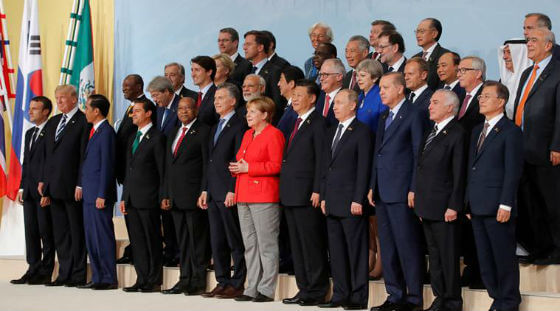
Once dominant, the United States finds itself isolated at G-20

Trump was shunted to the far left and placed under Emmanuel Macron’s close supervision.
The New York Times reports: For years the United States was the dominant force and set the agenda at the annual gathering of the leaders of the world’s largest economies.
But on Friday, when President Trump met with 19 other leaders at the Group of 20 conference, he found the United States isolated on everything from trade to climate change, and faced with the prospect of the group’s issuing a statement on Saturday that lays bare how the United States stands alone.
Chancellor Angela Merkel of Germany, the host of the meeting, opened it by acknowledging the differences between the United States and the rest of the countries. While “compromise can only be found if we accommodate each other’s views,” she said, “we can also say, we differ.”
Ms. Merkel also pointed out that most of the countries supported the Paris accord on climate change, while Mr. Trump has abandoned it. “It will be very interesting to see how we formulate the communiqué tomorrow and make clear that, of course, there are different opinions in this area because the United States of America regrettably” wants to withdraw from the pact, she said.
Mr. Trump seemed to relish his isolation. For him, the critical moment of Friday was his long meeting with the Russian president, Vladimir V. Putin, which seemed to mark the reset in relations that Mr. Trump has been desiring for some time. It also provided Mr. Putin the respect and importance he has long demanded as a global partner to Washington.
Where previous American leaders saw their power as a benevolent force, and were intent on spreading prosperity through open markets and multilateral cooperation, Mr. Trump has portrayed himself as a nationalist, a unilateralist and a protectionist, eager to save American jobs.
What recent events have underscored, though — and especially at the G-20 — is that no nation is today large or powerful enough to impose rules on everyone else. In advancing his views, Mr. Trump has alienated allies and made the United States seem like its own private island. [Continue reading…]
225 years ago Alexander Hamilton anticipated the rise of Trump and the subversion of American democracy
On August 18, 1792, Alexander Hamilton wrote: The truth unquestionably is, that the only path to a subversion of the republican system of the Country is, by flattering the prejudices of the people, and exciting their jealousies and apprehensions, to throw affairs into confusion, and bring on civil commotion….
When a man unprincipled in private life desperate in his fortune, bold in his temper, possessed of considerable talents, having the advantage of military habits—despotic in his ordinary demeanour—known to have scoffed in private at the principles of liberty—when such a man is seen to mount the hobby horse of popularity—to join in the cry of danger to liberty—to take every opportunity of embarrassing the General Government & bringing it under suspicion—to flatter and fall in with all the non sense of the zealots of the day—It may justly be suspected that his object is to throw things into confusion that he may “ride the storm and direct the whirlwind.” [Continue reading…]
Trump accepts Putin’s word that Russia didn’t hack the U.S. election, says Lavrov
Lavrov: Trump said he heard Putin's statements that Russia didn't hack election and accepts them.
— Lucian Kim (@Lucian_Kim) July 7, 2017
The Washington Post reports: Eight months after an unprecedented U.S election — one that U.S. intelligence agencies say the Russian government tried to sway — President Trump and President Vladimir Putin sat for their first meeting on Friday, a friendly encounter that ended in confusion over whether Trump accepted assurances that the Kremlin was innocent of any wrongdoing during the campaign.
Trump, believed to be the intended beneficiary of the Russian meddling, emerged from the extraordinary meeting — which dragged so long that Trump’s wife tried once to break it up — with a deal including Russia and Jordan on a partial Syrian ceasefire. The agremeent would mark the first time Washington and Moscow had operated together in Syria to try to reduce the violence.
But there were no grand bargains on U.S. sanctions on Russia, the Ukraine crisis or the other issues that have divided the nations for years.
The meeting, on the sidelines of the Group of 20 summit, opened with Trump telling Putin it was an “honor to be with you.” In the closed-door discussion, Trump pressed Putin “on more than one occasion” on Russia’s interference in the 2016 presidential elections, Secretary of State Rex Tillerson, who attended the two-hour-and-16-minute meeting, told reporters.
Tillerson said “President Putin denied such involvement” but agreed to organize talks “regarding commitments of noninterference in the affairs of the United States and our democratic process.”
But Tillerson’s counterpart, Russian Foreign Minster Sergei Lavrov, said that Trump had heard out Putin’s assurances that Moscow did not run a hacking and disinformation effort, and dismissed the entire investigation into the Russian role.
“President Trump said that this campaign has taken on a rather strange character, because after many months, whenever these accusations are made, no facts are brought,” Lavrov told Russian reporters. “The U.S. president said that he heard clear statements from President Putin about this being untrue, and that he accepted these statements.”
The two presidents, he said, are “looking for mutually beneficial agreements and not trying to act out some confrontation scenarios, not trying to create problems out of nothing.” [Continue reading…]
The remaking of Donald Trump
Joshua Green writes: Well into its run, The Apprentice was viewed by corporate America as the epitome of the forward-thinking, multicultural programming that all advertisers were increasingly seeking, especially after the election in 2008 of a biracial president. Just as Barack Obama symbolized the country’s uplifting racial progress, advertisers were “also tapping into that same yearning, particularly among younger Americans, to put racial divisions behind us and move forward in a more unified way,” Danny Allen, a top executive at the multicultural-focused ad agency Sensis, declared in 2009. As unlikely as it sounds from the vantage point of today, Trump and The Apprentice, up through the end of the decade, were considered by advertisers and audiences alike to be a triumph of American multiculturalism.
As a celebrity and a pop-culture icon, Trump was riding higher than ever. But privately he was obsessing over politics. Nobody knew it yet, but soon enough they would—because Trump was about to do something that any ordinary Republican with an eye on the White House would consider reckless to the point of insanity: He was about to torch his relationship with minority voters.
Trump had achieved by 2010 what Republican politicians had struggled, without success, to accomplish for the better part of 50 years. He had made himself genuinely popular with a broad segment of blacks and Hispanics. This audience didn’t think of him as a politician, of course. Not yet. But as a starting point in a bid for higher office, Trump was already out on the far horizon of where the Republican Party one day hoped to be.Truth be told, the party was moving in entirely the wrong direction. Ever since 1964, when Barry Goldwater championed “states’ rights”—understood to signify his opposition to the civil rights movement—minority voters had turned their backs on the Republican Party. Richard Nixon’s “Southern strategy”—stoking white racism for electoral gain—had only cemented this state of affairs. In the 11 presidential elections that followed Goldwater’s thumping loss, no Republican had won more than 15 percent of the black vote. And in the most recent election, in 2008, exit polls showed that John McCain had pulled a meager 4 percent of them. Republicans fared slightly better among the fast-growing population of Hispanic voters, with George W. Bush hitting a high point of 44 percent in 2004. But here, too, the GOP was backsliding: McCain had carried just 31 percent of Hispanics. Republican strategists looking toward the future were already growing nervous because the changing demography of the U.S. made perfectly clear that minorities would steadily increase as a share of the eligible electorate. Republicans needed to win more of them.
Trump was the furthest thing from a racial innocent. In 1989, after five black and Hispanic male teenagers from Harlem were accused of raping a white female jogger in Central Park, he had felt it necessary to spend $85,000 running full-page ads in the New York daily newspapers calling for the return of the death penalty. “Muggers and murderers,” he wrote, “should be forced to suffer and, when they kill, they should be executed for their crimes.” (Even after DNA evidence exonerated the Central Park Five, Trump refused to apologize and held fast to his insistence that they were guilty.) And yet, however improbable, he had managed to win the good favor of millions of minority voters.
What was it, then, that impelled Trump to suddenly start questioning Barack Obama’s citizenship and implying that he wouldn’t produce a birth certificate because he hadn’t really been born in the U.S.? And not just air his suspicion that Obama was born in Kenya but conduct a full-scale media blitzkrieg that took him from Fox News to ABC’s The View to drive home this fantastical narrative?
Trump himself would never say. But knowing now that his presidential ambitions were serious—and not simply a ratings stunt, as we assumed at the time—it seems clear that he was considering challenging Obama in 2012 and had an inkling of the power he could marshal by highlighting the president’s otherness to appeal to anti-Obama voters. The birther charge had been circulating for some time in the darker corners of the internet, on right-wing conspiracy sites, and in email chains. As someone possessing perhaps the best raw political instincts of any Republican in his generation, Trump had intuited, correctly, that a racist attack targeting a black president was the surest way to ingratiate himself with grass-roots Republican voters. [Continue reading…]

Most Americans disagree with Trump admin’s enforcing travel ban against grandparents
Ryan Goodman writes: One of the hotly contested questions in the Travel Ban litigation is the definition of “close family relationships.” The Supreme Court told the administration that it cannot enforce the ban against any foreign national who has a “close familial relationship” with a person in the United States. The plaintiffs including the state of Hawaii have argued that the Supreme Court’s order should be understood to protect grandparents. The Justice Department told the federal court in Hawaii that the plaintiffs’ views of close family relationships “lack any universal or cohesive support.” That is the question the Hawaii federal court refused to decide on Thursday, and tried to kick the issue up to the Supreme Court. So, what to make of the competing views of family structure and where grandparents fit in?
A poll out this week suggests most Americans fundamentally disagree with the administration’s position. The Politico/Morning Consult survey asked the following question and got these results:
“Do you believe each of the following should qualify as a close family relationship for visa applicants from six predominately Muslim countries wishing to enter the United States? Grandparent”
Yes, this should qualify: 67%
No, this should not qualify: 20%That is not only a huge margin in general. It also holds true across different groups of people who were asked the question. More specifically, the margin held strong such that at least 60% of Americans agreed that grandparents should qualify as a “close family relationship” for the purpose of receiving visas from the six predominately Muslim countries regardless of the respondent’s party identification, religion, gender, age, income, education, or region of the country. Even among people who voted for Donald Trump for president, 61% agreed that grandparents should qualify and 29% thought they should not. [Continue reading…]