The Daily Beast reports: The Obama administration may soon release 28 classified pages from a congressional investigation that allegedly links Saudis in the United States to the 9/11 attackers. A former Republican member of the 9/11 Commission alleged Thursday that there was “clear evidence” of support for the hijackers from Saudi officials.
But in Florida, a federal judge is weighing whether to declassify portions of some 80,000 classified pages that could reveal far more about the hijackers’ Saudis connections and their activities in the weeks preceding the worst attack on U.S. soil.
The still-secret files speak to one of the strangest and most enduring mysteries of the 9/11 attacks. Why did the Saudi occupants of a posh house in gated community in Sarasota, Florida, suddenly vanish in the two weeks prior to the attacks? And had they been in touch with the leader of the operation, Mohamed Atta, and two of his co-conspirators?
No way, the FBI says, even though the bureau’s own agents did initially suspect the family was linked to some of the hijackers. On further scrutiny, those connections proved unfounded, officials now say.
But a team of lawyers and investigative journalists has found what they say is hard evidence pointing in the other direction. Atta did visit the family before he led 18 men to their deaths and murdered 3,000 people, they say, and phone records connect the house to members of the 9/11 conspiracy. [Continue reading…]
Category Archives: Congress
Bob Graham: Release the uncensored truth about 9/11
Former senator Bob Graham writes: Nearly 15 years after the horrific events of 9/11, President Obama must decide whether to release 28 pages of information withheld as classified from the publicly released report of the congressional inquiry into the terrorist attacks that killed thousands of Americans.
On April 10, the CBS program “60 Minutes” aired a story about the missing 28 pages. I was one of several former public officials — including former House Intelligence Committee chairman and CIA director Porter Goss (R-Fla.) ; Medal of Honor recipient and former senator Bob Kerrey (D-Neb.); former Navy secretary John Lehman; and former ambassador and representative Tim Roemer (D-Ind.) — who called on the White House to declassify and release the documents.
Two days after that broadcast, I received a call from a White House staff member who told me that the president would make a decision about the 28 pages no later than June. While that official made no promises as to what Obama would do, I viewed the news as a step in the right direction. [Continue reading…]
A soldier’s challenge to the president
In an editorial, the New York Times says: Capt. Nathan Michael Smith, who is 28, is helping wage war on the Islamic State as an Army intelligence officer deployed in Kuwait. He is no conscientious objector. Yet he sued President Obama last week, making a persuasive case that the military campaign is illegal unless Congress explicitly authorizes it.
“When President Obama ordered airstrikes in Iraq in August 2014 and in Syria in September 2014, I was ready for action,” he wrote in a statement attached to the lawsuit. “In my opinion, the operation is justified both militarily and morally.” But as his suit makes clear, that does not make it legal.
Constitutional experts and some members of Congress have also challenged the Obama administration’s thin legal rationale for using military force in Iraq and Syria. The Federal District Court for the District of Columbia should allow the suit to move forward to force the White House and Congress to confront an important question both have irresponsibly skirted.
The 1973 War Powers Resolution requires that the president obtain “specific statutory authorization” soon after sending troops to war. Mr. Obama’s war against the Islamic State, also known as ISIS and ISIL, was billed as a short-term humanitarian intervention when it began in August 2014. The president and senior administration officials repeatedly asserted that the United States would not be dragged back into a Middle East quagmire. The mission, they vowed, would not involve “troops on the ground.” Yet the Pentagon now has more than 4,000 troops in Iraq and 300 in Syria. Last week’s combat death of a member of the Navy SEALs, Special Warfare Operator First Class Charles Keating IV, underscored that the conflict has escalated, drawing American troops to the front lines.
“We keep saying it’s supposed to be advising that we’re doing, and yet we’re losing one kid at a time,” Phyllis Holmes, Petty Officer Keating’s grandmother, told The Times.
Asked on Thursday about the lawsuit, the White House press secretary, Josh Earnest, said it raised “legitimate questions for every American to be asking.” The administration has repeatedly urged Congress to pass a war authorization for the war against the Islamic State. It currently relies on the authorization for the use of military force passed in 2001 for the explicit purpose of targeting the perpetrators of the Sept. 11 attacks, which paved the way for the invasion of Afghanistan.
“One thing is abundantly clear: Our men and women in uniform and our coalition partners are on the front lines of our war against ISIL, while Congress has remained on the sidelines,” the White House spokesman Ned Price said in an email.
Yet, the White House has enabled Congress to shirk its responsibility by arguing that a new war authorization would be ideal but not necessary. Administration officials could have forced Congress to act by declaring that it could not rely indefinitely on the Afghanistan war authorization and giving lawmakers a deadline to pass a new law.
By failing to pass a new one, Congress and the administration are setting a dangerous precedent that the next president may be tempted to abuse. That is particularly worrisome given the bellicose temperament of Donald Trump, the likely Republican nominee.
It is not too late to act before the presidential election in November. The Senate majority leader, Mitch McConnell, and House Speaker Paul Ryan have shown little interest in passing an authorization. They should feel compelled to heed the call of a young deployed soldier who is asking them to do their job.
An army captain takes Obama to court over war on ISIS
The New York Times reports: A 28-year-old Army officer on Wednesday sued President Obama over the legality of the war against the Islamic State, setting up a test of Mr. Obama’s disputed claim that he needs no new legal authority from Congress to order the military to wage that deepening mission.
The plaintiff, Capt. Nathan Michael Smith, an intelligence officer stationed in Kuwait, voiced strong support for fighting the Islamic State but, citing his “conscience” and his vow to uphold the Constitution, he said he believed that the mission lacked proper authorization from Congress.
“To honor my oath, I am asking the court to tell the president that he must get proper authority from Congress, under the War Powers Resolution, to wage the war against ISIS in Iraq and Syria,” he wrote.
The legal challenge comes after the death of the third American service member fighting the Islamic State and as Mr. Obama has decided to significantly expand the number of Special Operations ground troops he has deployed to Syria aid rebels there. [Continue reading…]
Don’t abandon America’s Afghan helpers
An editorial in the New York Times says: The House Armed Services Committee approved a version of the 2017 defense spending bill on Thursday that would leave thousands of Afghan interpreters who worked for the American government in Afghanistan in the lurch.
More than 10,000 applicants, many of whom submitted petitions years ago and are now under threat in their country, are waiting for visas to get to the United States. However, the State Department can approve only about 4,000 applications, given the number of visas currently authorized by Congress.
The committee’s bill provides no additional visas and imposes unreasonable eligibility criteria for applications made after next month. Under the bill, only interpreters who worked with military personnel in the field would be eligible for resettlement. That is senseless, since many interpreters who worked on military bases or in government offices are in similar danger. [Continue reading…]
Obama’s last chance to end the ‘forever war’
Jennifer Daskal writes: The United States is fighting an unauthorized war. Over the past 19 months, American forces have launched more than 8,800 strikes against the Islamic State in Iraq and Syria and hit the group’s affiliate in Libya. The United States continues aerial assaults against Al Qaeda in the Arabian Peninsula in Yemen, is going after militants in Afghanistan and Pakistan, and killed more than 150 suspected Shabab fighters in Somalia just last month.
This war isn’t limited to drone strikes or aerial bombings. It includes Special Operations forces in Iraq, Syria and Afghanistan — and possibly elsewhere. This past weekend, President Obama announced that he would send an additional 250 such troops to Syria.
The primary legal authority for these strikes and deployments comes from the 60-word Authorization for Use of Military Force, passed almost a decade and a half ago. In the days after Sept. 11, 2001, President George W. Bush asked for an open-ended authorization to fight all future acts of terrorism. Wisely, Congress rejected that request, though it did give the president authority to use force against those responsible for the Sept. 11 attacks, Al Qaeda, and those that harbored them, the Taliban.
Today, the Taliban no longer rules Afghanistan, Osama bin Laden has been killed and the other key participants in the Sept. 11 attacks are either locked up or dead. But the old authorization lives on. [Continue reading…]
House advances Email Privacy Act, setting the stage for vital privacy reform
Electronic Frontier Foundation: The U.S. House of Representatives passed the Email Privacy Act (H.R. 699) yesterday, which would require the government to get a probable cause warrant from a judge before obtaining private communications and documents stored online with companies such as Google, Facebook, and Dropbox.
The bill provides a long-overdue update to the Electronic Communications Privacy Act (ECPA), first passed in 1986. The bill also codifies the Sixth Circuit’s ruling in U.S. v. Warshak, which held that the Fourth Amendment demands that the government first obtain a warrant before accessing emails stored with cloud service providers.
The House vote is historic, given that H.R. 699 has an amazing 315 cosponsors, almost three quarters of the entire House. The House voted unanimously, following a unanimous vote by the House Judiciary Committee earlier this month. [Continue reading…]
Senator says he may back bill exposing Saudis to 9/11 lawsuits
The New York Times reports: A bill opposed by the Obama administration that would expose Saudi Arabia to legal jeopardy for any role in the Sept. 11 attacks appeared to gain momentum on Tuesday when the senator holding it up said he would be open to supporting it.
Senator Lindsey Graham, Republican of South Carolina, said in an interview on Tuesday that he would drop his opposition to the bill — predicting it could pass the Senate next week — if the sponsors of the legislation agreed to changes that he believed were important to protect American interests abroad. He did not specify what changes he was requesting.
“The goal is to bring people to justice who have been involved in terrorism,” Mr. Graham said. But he added, “I don’t want Americans to be held liable because of one bad actor in some embassy somewhere.” [Continue reading…]
The Daily Beast reports: There’s a major push in Congress right now for a bill that could hold the government of Saudi Arabia legally responsible for the 9/11 attacks. U.S. military and counterterrorism officials now leading the fights against al Qaeda and ISIS think that bill is a terrible idea.
“We don’t need this debate right now,” one defense official said, like others speaking on condition of anonymity because they’re not authorized publicly to criticize the bill, known as the Justice Against Sponsors of Terrorism Act. Saudi officials have lobbied hard against the bill, telling members of the Obama administration, lawmakers, and journalists that the Saudi government has been a stalwart ally with the U.S. and was fighting al Qaeda years before it ever attacked American soil.
That message is resonating inside the Pentagon and in U.S. national security circles. Two former officials, who likewise declined to comment on the record about the bill, said it represented a troubling insertion of politics at a key point in the war against ISIS and would distract from a shared goal of combatting Islamic extremism. [Continue reading…]
Saudi Arabia threatens economic fallout if Congress passes 9/11 bill
The New York Times reports: Saudi Arabia has told the Obama administration and members of Congress that it will sell off hundreds of billions of dollars’ worth of American assets held by the kingdom if Congress passes a bill that would allow the Saudi government to be held responsible in American courts for any role in the Sept. 11, 2001, attacks.
The Obama administration has lobbied Congress to block the bill’s passage, according to administration officials and congressional aides from both parties, and the Saudi threats have been the subject of intense discussions in recent weeks between lawmakers and officials from the State Department and the Pentagon. The officials have warned senators of diplomatic and economic fallout from the legislation.
Adel al-Jubeir, the Saudi foreign minister, delivered the kingdom’s message personally last month during a trip to Washington, telling lawmakers that Saudi Arabia would be forced to sell up to $750 billion in treasury securities and other assets in the United States before they could be in danger of being frozen by American courts. [Continue reading…]
Does it take 8 years to decide whether to declassify 28-pages of 9/11 report?
The Daily Beast reports: By the end of President Obama’s term in office, the administration hopes to decide whether to declassify a controversial portion of Congress’ investigation into the 9/11 attacks, the White House said Tuesday. The so-called “28 pages,” which have never been publicly released, are said to implicate Saudi government officials and civilians in the deadliest act of terrorism on U.S. soil.
The administration had directed a “declassification review” of the material from the Joint Congressional Inquiry into the terrorist attacks in 2014. Former lawmakers who have read the classified pages say they describe a financial and logistical support network for the 19 hijackers, most of them Saudi citizens, while they were in the U.S. The report was released in December 2002.
“That review process remains underway, but every effort is being taken to complete it before the end of the Administration,” Ned Price, the spokesperson for the National Security Council, told The Daily Beast in a statement. [Continue reading…]
Andrew Bacevich: Presidential wars
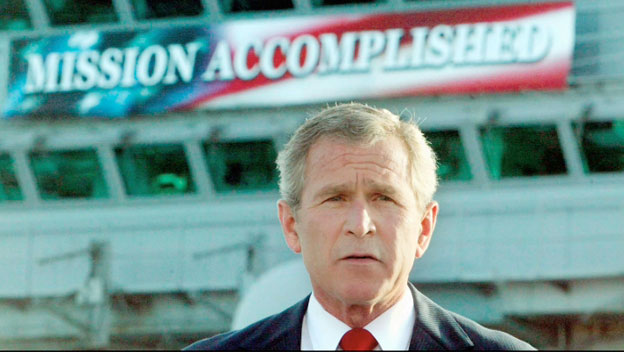
It was a large banner and its message was clear. It read: “Mission Accomplished,” and no, I don’t mean the classic “mission accomplished” banner on the USS Abraham Lincoln under which, on May 1, 2003, President George W. Bush proudly proclaimed (to the derision of critics ever since) that “major combat operations in Iraq have ended.” I’m actually referring to a September 1982 banner with those same two words (and an added “farewell” below them) displayed on a landing craft picking up the last Marines sent ashore in Beirut, Lebanon, to be, as President Ronald Reagan put it when they arrived the previous August, “what Marines have been for more than 200 years — peace-makers.” Of course, when Bush co-piloted an S-3B Viking sub reconnaissance Naval jet onto the deck of the Abraham Lincoln and made his now-classic statement, major combat had barely begun in Iraq (and it has yet to end) — nor was it peace that came to Beirut in September 1982: infamously, the following year 241 Marines would die there in a single day, thanks to a suicide bomber.
“Not for the last time,” writes Andrew Bacevich in his monumental new work, America’s War for the Greater Middle East: A Military History, “the claim proved to be illusory.” Indeed, one of the grim and eerie wonders of his book is the way in which just about every wrongheaded thing Washington did in that region in the 14-plus years since 9/11 had its surprising precursor in the two decades of American war there before the World Trade Center towers came down. U.S. military trainers and advisers, for example, failed (as they later would in Iraq and Afghanistan) to successfully build armies, starting with the Lebanese one; Bush’s “preventive war” had its predecessor in a Reagan directive called (ominously enough given what was to come) “combating terrorism”; Washington’s obsessive belief of recent years that problems in the region could be solved by what Andrew Cockburn has called the “kingpin strategy” — the urge to dismantle terror organizations by taking out their leadership via drones or special operations raids — had its precursor in “decapitation” operations against Muammar Gaddafi, Saddam Hussein, and Somali warlord Mohamed Farrah Aidid with similar resulting mayhem. The belief that “an additional increment of combat power might turn around a failing endeavor” — call it a “surge,” if you will — had its Iraq and Afghan pretrial run in Somalia in 1993. And above all, of course, there was Washington’s unquenchable post-1980 urge to intervene, military first, in a decisive way throughout the region, which, as Bacevich writes, only “produced conditions conducive to further violence and further disorder,” and if that isn’t the repetitive history of America’s failed post-2001 wars in a nutshell, what is?
As it happened, the effects of such actions from 1980 on were felt not just in the Greater Middle East and Africa, but in the United States, too. There, as Bacevich writes today, war became a blank-check activity for a White House no longer either checked (in any sense) or balanced by Congress. Think of it as another sad tale of a surge (or do I mean a decapitation?) that went wrong. Tom Engelhardt
Writing a blank check on war for the president
How the United States became a prisoner of war and Congress went MIA
By Andrew J. BacevichLet’s face it: in times of war, the Constitution tends to take a beating. With the safety or survival of the nation said to be at risk, the basic law of the land — otherwise considered sacrosanct — becomes nonbinding, subject to being waived at the whim of government authorities who are impatient, scared, panicky, or just plain pissed off.
The examples are legion. During the Civil War, Abraham Lincoln arbitrarily suspended the writ of habeas corpus and ignored court orders that took issue with his authority to do so. After U.S. entry into World War I, the administration of Woodrow Wilson mounted a comprehensive effort to crush dissent, shutting down anti-war publications in complete disregard of the First Amendment. Amid the hysteria triggered by Pearl Harbor, Franklin Roosevelt issued an executive order consigning to concentration camps more than 100,000 Japanese-Americans, many of them native-born citizens. Asked in 1944 to review this gross violation of due process, the Supreme Court endorsed the government’s action by a 6-3 vote.
More often than not, the passing of the emergency induces second thoughts and even remorse. The further into the past a particular war recedes, the more dubious the wartime arguments for violating the Constitution appear. Americans thereby take comfort in the “lessons learned” that will presumably prohibit any future recurrence of such folly.
Leahy asked State Dept. to investigate Israel and Egypt’s human rights ‘violations’
Politico reports: Sen. Patrick Leahy (D-Vt.) and 10 House members have asked the Obama administration to investigate claims that the Israeli and Egyptian security forces have committed “gross violations of human rights” — allegations that if proven truei could affect U.S. military aid to the countries.
In a letter to Secretary of State John Kerry dated Feb. 17, the lawmakers list several examples of suspected human rights abuses, including reports of extrajudicial killings by Israeli and Egyptian military forces, as well as forced disappearances in Egypt. The letter also points to the 2013 massacre in Egypt’s Rab’aa Square, which left nearly 1,000 people dead as the military cracked down on protesters, as worthy of examination.
Leahy’s signature is particularly noteworthy because his name is on a law that conditions U.S. military aid to countries on whether their security forces are committing abuses. [Continue reading…]
Lawmakers warn of ‘radical’ move by NSA to share information

The Hill reports: A bipartisan pair of lawmakers is expressing alarm at reported changes at the National Security Agency that would allow the intelligence service’s information to be used for policing efforts in the United States.
“If media accounts are true, this radical policy shift by the NSA would be unconstitutional, and dangerous,” Reps. Ted Lieu (D-Calif.) and Blake Farenthold (R-Texas) wrote in a letter to the spy agency this week. “The proposed shift in the relationship between our intelligence agencies and the American people should not be done in secret.
“NSA’s mission has never been, and should never be, domestic policing or domestic spying.” [Continue reading…]
Citing atrocities, John Kerry calls ISIS actions genocide
The New York Times reports: Secretary of State John Kerry declared on Thursday that the Islamic State is committing genocide against Christians, Yazidis and Shiite Muslims who have fallen under its control in Syria and Iraq.
The militants, who have also targeted Kurds and other Sunni Muslims, have tried to slaughter whole communities, enslaved captive women and girls for sex, and sought to erase thousands of years of cultural heritage by destroying churches, monasteries and ancient monuments, Mr. Kerry said.
The Islamic State’s “entire worldview is based on eliminating those who do not subscribe to its perverse ideology,” he said.
The statement by Mr. Kerry, made in response to a deadline set last year by Congress for the Obama administration to determine whether the targeting of minority religious and ethnic groups by the Islamic State could be defined as genocide, is unlikely to change American policy. The United States is already leading a coalition that is fighting the militants, and American aircraft have been bombing Islamic State leaders and fighters, its oil-smuggling operations and even warehouses where the group has stockpiled millions of dollars in cash. [Continue reading…]
Apple and FBI look to Congress to settle battle over iPhone encryption
The Guardian reports: The war of words between Apple and US law enforcement escalated again on Monday as their fight over personal versus national security prepared to move beyond the courthouse and into the halls of Congress.
In testimony released ahead of a hotly anticipated congressional hearing, Apple’s chief attorney argued that helping unlock an iPhone used by a terrorist in San Bernardino will ultimately create more crime. New York’s chief prosecutor said the company’s devices were beyond the law and urged Congress to pass new legislation keeping encryption keys to user data in the hands of the tech giants.
Both sides have called on Congress to settle the dispute, although lawmakers and the Obama administration have thus far balked at either setting encryption standards by legislation or permanently ceding the territory to mathematicians. Technologists and privacy advocates spent much of 2015 in a highly visible public push to prevent Congress from mandating so-called backdoors into company-held data. [Continue reading…]
Senator calls on Obama administration to stop UN from letting Assad regime censor aid plans
BuzzFeed reports: Sen. Bob Casey has told the Obama administration he is “appalled” that the United Nations allowed the regime of Syrian President Bashar al-Assad to censor parts of a humanitarian aid plan, in a letter being sent to the State Department on Thursday and obtained in advance by BuzzFeed News.
The letter follows reporting by BuzzFeed News last week that the U.N. had changed parts of a humanitarian aid plan for Syria after consulting with the Assad regime, removing the words “besieged” and “sieged,” references to a de-mining program, and references to violations of international law.
The censorship came to light after revelations of extreme starvation in the Syrian town of Madaya, which has been besieged by regime forces.
Casey, a Democrat from Pennsylvania, is urging the State Department to “insist that UN-produced assessments and humanitarian aid plans accurately reflect conditions on the ground, not the political concerns of the Assad regime.” Casey’s letter, addressed to Secretary of State John Kerry and U.S. Ambassador to the U.N. Samantha Power, states that he is “appalled” by the reports that the Assad regime was allowed to censor parts of the document, which lays out a $3.1 billion aid plan. [Continue reading…]
SEC is criticized for lax enforcement of climate risk disclosure
The New York Times reports: As recently as 2011, shares in Peabody Energy, the world’s biggest private sector coal company, traded at the equivalent of $1,000. Today, they hover around $4 each. Over that time, investors who held the stock lost millions.
Peabody, like other coal companies, has been hammered as cheap natural gas erodes the demand for coal. But concerns about climate change are also an issue for the company as customers and investors turn away from fossil fuels.
Peabody saw this coming. Even as the company privately projected that coal demand would slump and prices would fall, it withheld this information from investors. Instead, Peabody said in filings with the Securities and Exchange Commission that it was not possible to know how changing attitudes toward climate change would affect its business.
Peabody’s double talk was revealed as part of a two-year investigation by the New York attorney general. In a settlement in November, Peabody agreed that it would disclose more about climate change risks in its regular filings with the S.E.C.
In theory, however, Peabody should have been making such disclosures all along. [Continue reading…]
A nation of field mice where fear runs rampant
In an article titled, “One Nation Under Fear,” Mark Edmundson writes:
How did a people who settled a continent, created enormous wealth, and fought and (mostly) won war after war devolve into a nation of such tremulous souls? And how did it happen so quickly? Where once there was the generation of the Second World War, ready to leave home and fight fascists on the far sides of the world, we now have a nation that at times seems composed largely of field mice, prone to quiver when they detect an unfriendly shadow.
In the latest wave of mass hysteria, the barriers of entry to the United States imposed on people with darker skins will once again be raised higher.
The Visa Waiver Program Improvement and Terrorist Travel Prevention Act of 2015 does not make any mention of skin color, yet the officials who are responsible for enforcing this law will inevitably notice skin color when determining if it needs to be applied. Since the law will apply, for instance, to British citizens who are also Iranian nationals simply by virtue of having an Iranian father — such an individual might have been born in the UK, have never visited Iran and not possess an Iranian passport — the way in which they will get flagged for questioning will most likely be because they are Middle Eastern in appearance.
Ostensibly, the law was designed to block U.S. entry to Europeans who have joined ISIS.
Let’s imagine how that would work: A British citizen who fought with ISIS in Syria has now returned home and then decides to fly to New York. He shows up at the airline check-in desk, presents his passport and the clerk, seeing the stamp entered when he visited Syria, says: “Sorry mate, no trip to America for you!” The thwarted traveler responds: “Damn that Terrorist Travel Prevention Act!” … except, of course, such an individual would in reality neither declare nor present any evidence that they had been in Syria or belonged to ISIS. The terrorist would — surprise, surprise — break the rules.
In truth, this isn’t a serious piece of legislation. Those who drafted and passed this law were engaged in a piece of political theater. Indeed, anyone who can coin a phrase like “terrorist travel prevention” would be better employed at The Onion than in the U.S. Congress.
The only people who will be reliably prevented from travel are those innocently trying to do what most travelers do — visit relatives and friends; engage in tourism or business.
The terrorists are not so dumb that they would run afoul of such restrictions — just as no terrorist would subvert his own objectives by tangling himself in the vetting process imposed on asylum seekers. Continue reading