Category Archives: Congress

Snowden calls Russian-spy story ‘absurd’

Jane Mayer reports: Edward J. Snowden, the former National Security Agency contractor turned whistleblower, strongly denies allegations made by members of Congress that he was acting as a spy, perhaps for a foreign power, when he took hundreds of thousands of classified U.S. government documents. Speaking from Moscow, where he is a fugitive from American justice, Snowden told The New Yorker, “This ‘Russian spy’ push is absurd.”

On NBC’s “Meet The Press,” Mike Rogers, a Republican congressman from Michigan who is the chairman of the House Intelligence Committee, described Snowden as a “thief, who we believe had some help.” The show’s host, David Gregory, interjected, “You think the Russians helped Ed Snowden?” Rogers replied that he believed it was neither “coincidence” nor “a gee-whiz luck event that he ended up in Moscow under the handling of the F.S.B.”

Snowden, in a rare interview that he conducted by encrypted means from Moscow, denied the allegations outright, stressing that he “clearly and unambiguously acted alone, with no assistance from anyone, much less a government.” He added, “It won’t stick…. Because it’s clearly false, and the American people are smarter than politicians think they are.”

If he was a Russian spy, Snowden asked, “Why Hong Kong?” And why, then, was he “stuck in the airport forever” when he reached Moscow? (He spent forty days in the transit zone of Sheremetyevo International Airport.) “Spies get treated better than that.” [Continue reading…]

Facebooktwittermail

How the U.S. turned the world into a war zone

Gregory D Johnsen writes: Sunrise was still nearly an hour off when Nazih al-Ruqai climbed into his black Hyundai SUV outside a mosque in northern Tripoli and turned the key. The lanky 49-year-old had left the house barely 30 minutes earlier for a quick trip to the mosque on a Saturday. It was Oct. 5, 2013, and after more than two decades in exile, he had settled into a predictable existence of prayer and worship.

The homecoming hadn’t always been so smooth. Ruqai, who is better known in the jihadi world as Abu Anas al-Libi, was still feeling the effects of the hepatitis C he had contracted years earlier during a stint in an underground prison in Iran. Following overtures from Muammar al-Qaddafi’s government, his wife and children had returned to Libya in 2010. But Libi stayed away, wary of the man he had once plotted to kill. Only when the Libyan uprisings started in early 2011 did he follow his family back to Libya. But by then it was already too late. His oldest son, Abd al-Rahman, the only one of his five children who had been born in Libya, was dead, shot while fighting for the capital.

After that, things moved in fits and starts. Qaddafi was killed weeks later in October 2011, and Libi eventually settled in Nufalayn, a leafy middle-class neighborhood in northeast Tripoli, alongside several members of his extended family. Life after Qaddafi was chaotic and messy — nothing really worked as the new government struggled to reboot after 42 years of dictatorship, often finding itself at the mercy of the heavily armed militias and tribes that had contributed to Qaddafi’s downfall.

Libi knew he was a wanted man. He had been on the FBI’s most wanted list for more than a decade, following an indictment in 2000 for his alleged role in al-Qaeda’s attacks on U.S. embassies in Kenya and Tanzania two years earlier. Along with Libi the indictment named 20 other individuals, including Osama bin Laden and Ayman al-Zawahiri, as defendants.

“He suspected that at any moment he would be killed,” his son later told The New York Times. Still, on that Saturday morning in early October, much of the danger seemed to have passed. Libi had been living in the open for nearly a year, attending prayers and settling local disputes, where his history as a fighter and knowledge of the Qur’an made him a respected arbiter. Neighbors called him simply “the shaykh,” a sign of respect in the conservative circles in which Libi still moved.

He had also taken steps to address his past. Three weeks earlier, on Sept. 15, Libi had sat down with Libya’s attorney general to discuss his indictment, according to one report. (The Libyan Embassy in Washington did not respond to repeated requests to confirm Libi’s meeting.) But mostly he just wanted to move on with his life. He had applied for his old job at the Ministry of Oil and Gas and he couldn’t stop talking about how much he was looking forward to becoming a grandfather for the first time.

A trio of cars around 6 a.m. ended all of that.

Inside the family’s apartment, Libi’s wife heard the commotion. From a window she looked out over the beige wall that surrounded their building and into the street where several men had surrounded her husband, who was still in the driver’s seat of his black Hyundai.

“Get out,” the men shouted in Arabic. “Get out.” Then they smashed the window. Most of the men were masked, but she could see a few faces, she said later in Arabic interviews. They looked Libyan; they sounded Libyan. Some of them had guns; some didn’t, but they all moved quickly.

By the time the rest of the family made it to the street, all that was left was a single sandal and a few drops of blood.

Early that same morning, nearly 3,000 miles away in the seaside city of Baraawe on Somalia’s eastern coast, U.S. Navy SEALs crept through the darkness toward their target, which a local resident later described to me as a walled compound more than 100 yards inland. The Americans had been here before. Four years earlier, in September 2009, a contingent of Navy SEALs had ambushed a two-car convoy just outside of town. Flying low in helicopter gunships, the SEALs quickly disabled the cars and then touched down to collect the bodies.

This time the target — Abd al-Qadir Muhammad Abd al-Qadir, a young Kenyan of Somali descent better known as Ikrima — was stationary. The SEALs would have to go in and get him. Pre-raid intelligence suggested that the compound housed mostly fighters with few or no civilians present. Only 130 miles south of Mogadishu and what passed for the Somali government, Baraawe had been under the control of al-Shabaab, a fragmentary militant group, since 2009. Fighters came and went freely, as al-Shabaab implemented its own narrow version of Islamic law in the city.

Moving up the beach and into enemy territory, the SEALs needed the element of surprise. Through the trees and scrub brush ahead of them, most of the city was dark. Baraawe had only a few hours of electricity each day, usually from evening prayers until midnight. But al-Shabaab’s members lived separately and, along with some of the city’s wealthier residents, got around the shortages by running private generators. The plan that night took this into account, calling for the SEALs to jam internet signals, apparently in an attempt to cut off communication once the raid began. That would prove to be a mistake.

Inside the compound, some of the al-Shabaab fighters were up late and online. And, according to a report in the Toronto Star, when the internet suddenly went out in the middle of the night, they went to look for the source of the problem. At least one fighter stepped outside, and as he moved around in the darkness he spotted some of the SEALs.

The plan to knock the internet offline and isolate the fighters in the villa had backfired, effectively giving al-Shabaab an early warning that the SEALs were on their way. (In the days after the raid, al-Shabaab would arrest a handful of local men who were known to visit Western websites, accusing them of spying and aiding U.S. efforts.)

The firefight lasted several minutes, although residents reported hearing gunfire throughout the night as members of al-Shabaab discharged their weapons into the dark for hours after the Americans had withdrawn, empty-handed.

In the span of a few hours, the U.S. had launched a pair of raids — one successful and one not — 3,000 miles apart, in countries with which the nation was not at war. Hardly anyone noticed.

More than a dozen years after the Sept. 11 attacks, this is what America’s war looks like, silent strikes and shadowy raids. The Congressional Research Service, an analytical branch of the Library of Congress, recently said that it had located at least 30 similar occurrences, although the number of covert actions is likely many times higher with drones strikes and other secret operations. The remarkable has become regular.

The White House said that the operations in both Libya and Somalia drew their authority from the Authorization for the Use of Military Force, a 12-year-old piece of legislation that was drafted in the hours after the Sept. 11 attacks. At the heart of the AUMF is a single 60-word sentence, which has formed the legal foundation for nearly every counterterrorism operation the U.S. has conducted since Sept. 11, from Guantanamo Bay and drone strikes to secret renditions and SEAL raids. Everything rests on those 60 words. [Continue reading…]

Facebooktwittermail

What happened to AIPAC’s seventy senators?

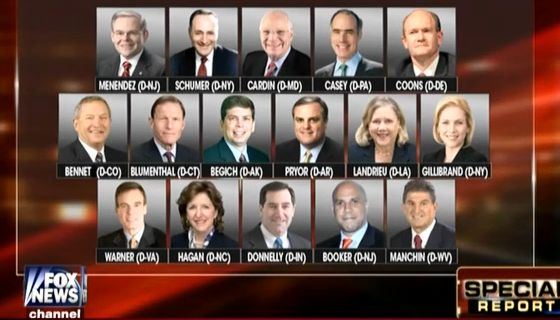
AIPAC-senators

In 2005, AIPAC’s Steven Rosen when prompted by Jeffrey Goldberg to assess the level of the lobby’s influence famously said: “In twenty-four hours, we could have the signatures of seventy senators on this napkin.”

The “Nuclear Weapon Free Iran Act of 2013” sponsored by Democratic Senator Robert Menedez has the support of fifty-nine senators. That’s a dangerously large majority but just short of a veto-proof sixty-seven votes and well short of Rosen’s seventy.

Does that mean that AIPAC is refraining from pulling its weight or is it just not as powerful as Rosen declared?

I called my Democratic Senator Kay Hagan, one of the co-sponsors of the bill, to tell her that if she follows through and casts a vote in favor, she won’t have my vote in November. Interestingly, her staffer was at pains to underline the fact that this is still in process and hasn’t gone to a vote. I got a strong sense that Hagan, perhaps like many other senators both Democratic and Republican, would be content demonstrating her loyalty to AIPAC without actually casting a vote.

In the report below, Republican Senator Roy Blunt essentially says that every senator’s hands have been tied by Senate leader Harry Reid and far from striking a defiant tone, Blunt seems content to be rendered powerless.

If the bill got just one more supporter, would Reid bow to pressure and let it go to a vote? And can’t AIPAC with all its influence turn just one more senator in its favor?

I get the sense that for everyone involved — including AIPAC — this is all political theater. They want to act tough, but at the end of the day, they probably don’t want to be held responsible for sabotaging the most significant diplomatic opening in a decade.

National Journal reports: Senate Iran hawks have lots of votes to back their sanctions legislation. What they lack is a plan to get the bill to the floor.

Fifty-nine senators — including 16 Democrats — have signed onto sanctions legislation from Democratic Sen. Robert Menendez and Republican Sen. Mark Kirk. The measure would punish Iran with sanctions if it reneges on an interim nuclear agreement or if that agreement does not ultimately abolish any nuclear-weapons capabilities for Iran.

That count has climbed rapidly since the bipartisan pair introduced their legislation in late December. But now it’s unclear whether that support will be enough to clear the bill’s next major hurdle: Senate Majority Leader Harry Reid.

Reid is siding with the White House, which has put intense pressure on lawmakers not to act on sanctions, arguing it could result in both a nuclear-armed and hostile Iranian state. And without Reid’s backing, supporters of the Menendez-Kirk bill are unsure how to move the measure to the floor.

“I assume that if the Democrat senators put enough pressure on Senator Reid he might bring it to the floor,” said Missouri Republican Sen. Roy Blunt. “But, you know, we are at a moment in the Senate where nothing happens that Senator Reid doesn’t want to happen; and this is something at this moment that Senator Reid doesn’t want to happen.”

And for now, sanctions supporters are still mulling their strategy.

“We are talking amongst ourselves. There is a very active debate and discussion ongoing about how best to move forward,” said Democratic Sen. Richard Blumenthal of Connecticut, a cosponsor of the bill. “There are a number of alternative strategies, but we’re deliberating them.”

While Reid has, at least for now, foiled their policy plans, sanctions supporters are still scoring the desired political points on the issue. They can report their efforts to their constituents while blaming Reid for the inaction.

Jon Stewart, comparing these senators to egg-throwing Justin Bieber, is perfectly clear about which “constituents” they are trying to represent: AIPAC and Israel. (It’s a shame that Daily Show writers, having crafted a strong piece then felt compelled to add some “balance” by treating Rouhani’s tweet with scorn: “World powers surrendered to Iran’s national will.” If he can placate his hawkish critics just with a tweet, I’m sure Obama is envious.)

Facebooktwittermail

An Iran hawk’s case against new Iran sanctions

Jeffrey Goldberg is arguably the most influential liberal Zionist in America, so it’s worth taking note when he speaks out against the efforts of the Israel lobby and its lackeys inside the U.S. Senate.

For years, Iran hawks have argued that only punishing sanctions, combined with the threat of military force, would bring Tehran to the nuclear negotiating table. Finally, Iran is at the table. And for reasons that are alternately inexplicable, presumptuous and bellicose, Iran hawks have decided that now is the moment to slap additional sanctions on the Iranian regime.

The bill before the U.S. Senate, which has 59 co-sponsors at last count, will not achieve the denuclearization of Iran. It will not lead to the defunding of Hezbollah by Iran or to the withdrawal of Iranian support for Syrian president Bashar al-Assad. What it could do is move the U.S. closer to war with Iran and, crucially, make Iran appear — even to many of the U.S.’s allies — to be the victim of American intransigence, even aggression. It would be quite an achievement to allow Iran, the world’s foremost state sponsor of terrorism, to play the role of injured party in this drama. But the Senate is poised to do just that.

Facebooktwittermail

Washington ready to send $1.5 billion aid to Egypt’s military rulers

The Daily Beast reports: Congress is preparing to allow the Obama administration to give more than $1 billion dollars to the Egyptian government and military, despite the fact the generals perpetrated a coup last summer and are suppressing opposition ahead of a nation-wide constitutional referendum.

The House and Senate are set to unveil a year-long spending bill that will loosen restrictions on U.S. aid to Egypt and negate the law that prevents the U.S. from funding a foreign military that has conducted a coup against a democratically elected government. The Obama administration has been lobbying Congress for permission to give the aid to the Egyptian government. Several senior senators had been working to make sure that aid was conditioned on the Egyptian government pursing a path toward democracy and respect for the rule of law.

But now, with the Egyptians speeding toward a Constitutional referendum that will cement the rule of the military-led regime and with the Egyptian government’s crackdown on the opposition ongoing, most of those conditions could be lifted by Congress or waived by the Obama administration.

For experts and congressional officials who have followed the Obama administration’s clumsy and often incoherent policy on Egypt, the potential easing of restrictions on aid represents only the latest unfortunate twist in a failed effort to preserve U.S. influence in the Arab world’s most populous country.

“When the omnibus bill is passed, there’s going to be legislation in it that in effect is going to give the administration a waiver from the coup provisions and allow them to restore aid to Egypt,” said Michele Dunne, senior associate at the Carnegie Endowment for International Peace.

Ever since the Egyptian military ousted and jailed ex-president Mohamed Morsi last July and began its campaign of arresting opposition leaders and protesters, the Obama administration and Congress have been withholding most of the $1.5 billion in annual aid the U.S. gives Egypt, most of which goes directly to the country’s army.

“I think there’s a sense of giving up on Egypt [inside of the Obama administration], on the Hill as well,” said Dunne. “There’s a sense that ‘Oh well they tried a democratic transition, it didn’t work, but we don’t want to cut ourselves off from Egypt as a security ally, so let’s just forget about the whole democracy and human rights thing except for giving it some lip service from time to time.’” [Continue reading…]

Facebooktwittermail

Invading Iraq was dumb enough. Now Congress wants to derail the Iran deal

Stephen Kinzer writes: The diplomatic bargain struck by the United States and Iran this week is the Obama administration’s greatest diplomatic triumph. Efforts by the US Congress to derail it would, if successful, constitute a self-inflicted strategic wound even more myopic than its vote to endorse the 2003 invasion of Iraq. That vote, after all, was only endorsing a mistaken policy set in the White House. This one would be a rebellion against a White House decision that promises great benefits to the United States.

Congress, it turns out, is filled with Republicans and Democrats eager to act as enablers for the most repressive forces in Iran. It is an astonishing spectacle: an alliance between brutal Iranian institutions, principally the Revolutionary Guard, and elected representatives of the American people. Both are deeply invested in the paradigm of hostility, and both are in a state of near-panic at the prospect of reconciliation between Tehran and Washington.

Hostility toward Iran may not be the silliest of all American foreign policies –that would probably be the continuing trade embargo of Cuba – but it is undoubtedly the most self-defeating. No step the United States could take anywhere in the world would bring strategic benefits as great as détente with Iran. It has tantalizing potential. Iran’s interest in stabilizing the violence-torn countries on its eastern and western borders, Iraq and Afghanistan, closely parallels that of the United States. [Continue reading…]

Facebooktwittermail

Senators led by AIPAC on a ‘march towards war’

The New York Times reports: With the United States and Iran about to embark on a critical phase of nuclear talks, President Obama is waging an intense rear-guard action to prevent Senate Democrats from supporting strict new sanctions that could upend his diplomatic efforts.

Sponsors of the bill, which would aim to drive Iran’s oil exports down to zero, have secured the backing of 59 senators, putting them within striking distance of a two-thirds majority that could override Mr. Obama’s threatened veto. Republicans overwhelmingly support the bill. So far 16 Democrats have broken with the president, and the bill’s sponsors hope to get more.

The struggle is casting a long shadow over the talks, which administration officials say will be even harder than those that resulted in the six-month interim agreement, signed Sunday, that will temporarily freeze Iran’s nuclear program in return for limited sanctions relief.

Iranian officials have threatened to leave the bargaining table if the United States enacts any new sanctions during the negotiations.

The White House has cast the issue in stark terms, saying that a vote for new sanctions would be, in effect, a “march toward war” and challenging those lawmakers who support the bill to acknowledge publicly that they favor military action against Iran.

“It just stands to reason if you close the diplomatic option, you’re left with a difficult choice of waiting to see if sanctions cause Iran to capitulate, which we don’t think will happen, or considering military action,” said Benjamin J. Rhodes, a deputy national security adviser. [Continue reading…]

Facebooktwittermail

47 senators take AIPAC’s word over U.S. intel community

Jim Lobe writes: The American Israel Public Affairs Committee (AIPAC) has published the list of senators who so far have agreed to co-sponsor the Nuclear Weapon Free Iran Act of 2013, aka the Wag the Dog Act of 2014. You’ll recall that the initial list, which was introduced by its principal engineers, Sens. Mark Kirk and Robert Menendez, Dec 19, included 26 co-sponsors equally divided between Democrats and Republicans, to which newly elected New Jersey Sen. Cory Booker quickly added his name. Since then, 20 other senators — all Republicans, unsurprisingly — have added their names, for a grand total of 47 — still short of a majority, let alone one that could survive an Obama veto that the White House has already committed the president to cast if the bill is passed in its present form.

According to the AIPAC list, which is reproduced below, 53 senators, including 36 Democrats and the two independents who normally vote with the Democratic caucus, have not agreed to co-sponsor the bill, or, in the dreaded moniker used by AIPAC to score lawmakers’ voting records (presumably for the benefit of the “pro-Israel” PACs that decide how to dole out campaign cash), are labeled “DNC.” They will undoubtedly be the top targets for AIPAC’s legendary powers of persuasion when the Senate reconvenes early next week.

What is remarkable about this list, however, is that very few of the 47 co-sponsors have chosen to publicize their support for the bill to their constituents through local media or other means. [Continue reading…]

Facebooktwittermail

The danger of new Iran sanctions

Colin H. Kahl writes: The Geneva “interim” agreement reached in November between Iran and the so-called P5+1 (the United States, Britain, China, France, Germany, and Russia) freezes Tehran’s nuclear program in exchange for modest sanctions relief, with the goal of enabling further talks to comprehensively resolve one of the world’s thorniest challenges. Yet despite the landmark accord, more than two dozen Senators introduced legislation on December 19 to impose new oil and financial sanctions on Iran. The Senate could vote on the measure soon after it returns from recess in January. Powerful lobby organizations are mobilized in support of the bill, and it could certainly pass.

The legislation defies a request by the Obama administration and ten Senate committee chairs to stand down on sanctions while negotiations continue. It also flies in the face of an unclassified intelligence assessment that new sanctions “would undermine the prospects for a successful comprehensive nuclear agreement with Iran.” Proponents of the bill note that the proposed sanctions would only come into force if Iran violates the Geneva agreement or fails to move toward a final deal, and would not kick in for months. But the White House warns that enshrining new economic threats in law now runs counter to the spirit of the Geneva pledge of no new sanctions during negotiations, and risks empowering Iranian forces hoping to scuttle nuclear talks. The legislation also defines congressionally acceptable parameters for a final deal that Iran experts almost universally believe are unachievable, namely the requirement that Iran completely dismantle its uranium enrichment program. For these reasons, the administration believes the bill represents a poison pill that could kill diplomacy, making a nuclear-armed Iran or war more likely.

Sanctions hawks disagree, arguing that the legislation will enable, not thwart, diplomatic progress. “Current sanctions brought Iran to the negotiating table,” Senator Robert Menendez, the bill’s leading champion, contends, “and a credible threat of future sanctions will require Iran to cooperate and act in good faith at the negotiating table.”

But this logic badly misreads the historical effect of sanctions on Iranian behavior and under-appreciates the role played by Iran’s fractious domestic politics. A careful look at Iranian actions over the past decade suggests that economic pressure has sometimes been effective, but only when it aligns with particular Iranian political dynamics and policy preferences. And once domestic Iranian politics are factored in, the lesson for today’s sanctions debate is clear: the threat of additional sanctions, at this critical juncture, could derail negotiations toward a peaceful solution. [Continue reading…]

Facebooktwittermail

Don’t let Israel declare war for America

Sheldon Richman writes: The American people should know that pending right now in Congress is a bipartisan bill that would virtually commit the United States to go to war against Iran if Israel attacks the Islamic Republic. “The bill outsources any decision about resort to military action to the government of Israel,” Columbia University Iran expert Gary Sick wrote to Sen. Chuck Schumer (D-NY) in protest, one of the bill’s principal sponsors.

The mind boggles at the thought that Congress would let a foreign government decide when America goes to war, so here is the language (PDF):

If the government of Israel is compelled to take military action in legitimate self-defense against Iran’s nuclear weapon program, the United States Government should stand with Israel and provide, in accordance with the law of the United States and the constitutional responsibility of Congress to authorize the use of military force, diplomatic, military and economic support to the Government of Israel in its defense of its territory, people and existence.

This section is legally nonbinding, but given the clout of the bill’s chief supporter outside of Congress — the American-Israel Public Affairs Committee (AIPAC [PDF]), leader of the pro-Israel lobby — that is a mere formality. [Continue reading…]

Facebooktwittermail

The Democratic senators willing to risk a war with Iran

The Huffington Post reports: As the United States finally puts a decade of war behind it, a group of senators, including 15 Democrats, is defying the White House and threatening to push the country into a fresh war with Iran.

Sen. Bob Menendez (D-N.J.) is leading the charge to pass legislation in January that would impose tougher sanctions on Iran, despite dire warnings from the White House, Iranian leaders, 10 Democratic committee chairs and a host of liberal groups that such an effort could sink a delicate nuclear agreement already in place. Under that Nov. 24 deal, Tehran would curb its nuclear program in exchange for some relief from economic sanctions for a period of six months.

The Senate bill, which has 19 Republican cosponsors, takes a hard line, levying new sanctions on Iran unless the country’s leaders agree to abandon all uranium enrichment — what some have called an “absurd” stance. In the past, both John Kerry, then a U.S. senator, and Mohamed ElBaradei, former head of the International Atomic Energy Agency, have said that Iran has the right to enrich uranium for peaceful purposes.

Iranian Foreign Minister Javad Zarif said earlier this month that if the Senate moved forward with its bill, the current nuclear deal would be dead. A senior Obama administration official went further, telling The Huffington Post that Senate action makes it “far more likely that we’ll be left only with a military option” regarding Iran. [Continue reading…]

Facebooktwittermail

Top Senate Democrats break with White House and circulate new Iran sanctions bill

Ali Gharib reports: Three top senators, including two Democrats, have begun circulating a draft of a new Iran sanctions bill that critics say could violate the terms of an agreement struck between Iran and the United States in Geneva last month. The bill, set for introduction by the Democratic chairman of the Foreign Affairs Committee, Robert Menendez of New Jersey, along with top sanctions hawks Chuck Schumer (D-N.Y.) and Mark Kirk (R-Ill.), defies the Obama administration’s repeated requests for Congress to hold off on any new legislation that could imperil last month’s interim nuclear pact with Iran while talks continue toward a comprehensive final deal.

A copy of the bill, dubbed the Nuclear Weapon Free Iran Act of 2013*, was obtained by Foreign Policy. The new sanctions are unlikely to come to a vote in the Senate this week in the final days of the 2013 session.* Instead, the Senate would likely consider the measure after it returns on Jan. 6.

The legislation would broaden the scope of the sanctions already imposed against Iran, expanding the restrictions on Iran’s energy sector to include all aspects of its petroleum trade and putting in place measures targeting Iran’s shipping and mining sectors. The bill allows Obama to waive the new sanctions during the current talks by certifying every 30 days that Iran is complying with the Geneva deal and negotiating in good faith on a final agreement, as well as meeting other conditions such as not sponsoring or carrying out acts of terrorism against U.S. targets.

In accordance with goals laid out frequently by hard-liners in Congress and the influential lobbying group the American Israel Public Affairs Committee, the bill sets tough conditions for a final deal, should one be reached with Iranian negotiators. Among those conditions is a provision that only allows Obama to waive new sanctions, even after a final deal has been struck, if that deal bars Iran from enriching any new uranium whatsoever. The bill states Obama may not waive sanctions unless the United States and its allies “reached a final and verifiable agreement or arrangement with Iran that will … dismantle Iran’s illicit nuclear infrastructure, including enrichment and reprocessing capabilities and facilities.” (Congress could also block Obama’s waivers by passing a “joint resolution of disapproval” against a final deal.) [Continue reading…]

Facebooktwittermail

Which Iran will we choose?

Trita Parsi, Bijan Khajehpour and Reza Marashi write: The historic interim agreement between the permanent members of the UN Security Council plus Germany (P5+1) and Iran over its nuclear dispute is not just about enrichment, centrifuges and breakout capabilities. Ultimately, it will help determine who and what will define Iran’s foreign and domestic policies for decades to come. Will it be the security-oriented, confrontational and internally repressive orientation preferred by the Iranian hardliners? Or will the more cooperative, moderate and win-win approach favored by President Hassan Rouhani and the majority of the population take root and prevail?

In a new report published today (“Extending Hands and Unclenching Fists“) — which relies on in-depth interviews with senior Iranian political officials, intellectuals and members of business community — we show that the West can weaken the hardline Iranian narrative of confrontation and resistance and facilitate a comprehensive nuclear deal by collaborating with Iran on scientific projects that carry no proliferation risk.

For the U.S. and Europe, this means augmenting a successful nuclear deal through other areas of mutual interest can help usher in a more cooperative and less threatening Iran whose domestic political liberalization positively impacts the Middle East as a whole. In the past, we have seen Iran take important steps in this direction, but without reaching the desired results.

The 2013 presidential election unexpectedly catapulted centrist leaders into power that have sought an opening to the West on numerous occasions. Such efforts include the 2001 collaboration with the U.S. in Afghanistan, the 2003 Grand Bargain offer, and the 2005 offer to limit Iran’s enrichment program to 3,000 centrifuges (Iran currently has 19,000). These offers were all made prior to the West imposing crippling sanctions. By rejecting this outreach, Washington strengthened the hand of Iranian hardliners who believe the only way to compel the U.S. to deal with Iran is not by sending peace offers, but rather by resisting American power. [Continue reading…]

Facebooktwittermail

Three months in Rouhani’s Iran

Farideh Farhi writes: I have recently returned from a three-month trip to Iran. I arrived in Tehran in early September before the famous Rouhani/Obama phone call and departed last week as the mood was turning more skeptical regarding the potential for some sort of final nuclear deal, which, in the words of Foreign Minister Javad Zarif, would “normalize” the status of Iran’s nuclear program if it were to happen.

Frankly, sitting in Tehran, it was hard to listen to various Obama administration officials’ frenzied explanations to the US Congress and Israeli government regarding how, even with the first-step agreement, Iran will remain in dire straits. It was hard to listen without becoming skeptical about the US political environment allowing an agreement that would also be acceptable to Iran. From the receiving end of all the nuclear chatter, the whole American demeanor on Iran appears imperious, even outright uncivilized; like people speaking calmly about the taking of others’ lives and imposing further economic misery on them as options that are still very much on the table.

As I write this, news has broken that the Iranian experts engaged in talks in Vienna over the first phase of the “Joint Plan” were abruptly recalled to Tehran in reaction to the blacklisting of 19 Iranian companies by the US Treasury Department — a move that both Iran and Russia said violated the “spirit” of the Geneva accord. The spokesperson of Iran’s Foreign Ministry, Marzieh Afkham, in describing the “unconstructive moves” by the Obama Administration, regretted “serious confusion in the approach, decisions, and statements of US officials.”

When I was in Tehran, Iranian officials of various political persuasions were rather soft in their reaction to all the hard talk coming out of Washington. Several officials, including key members of the Parliament, expressed their understanding of the Obama administration’s predicament in trying to sell the Geneva agreement to the US Congress. Talk about continuing pressure on Iran did provide ammunition to folks like Hossein Shariatmadari, the hawkish chief editor of the well-known Iranian daily, Kayhan, but Washington’s verbal assaults were mostly tolerated, even if Foreign Minister Zarif acknowledged that they were making his efforts to maintain support for the agreement difficult. But it appears that the latest Treasury Department move, which followed a rather harsh op-ed in the Wall Street Journal by David Cohen, the Undersecretary for Terrorism and Financial Intelligence, made looking the other way difficult. Lest we forget: Iran also has domestic politics. Unlike its reception in Washington, the Iranian nuclear agreement was mostly greeted positively in Tehran given the general consensus that it’s time to resolve the nuclear imbroglio. But there are limits to what Tehran can ignore.

I am inclined to view this event as an “enough is enough” public statement directed at Congress and aimed at limiting further moves by the Treasury Department. Both the Obama and Rouhani administrations have raised the stakes in the talks high enough to prevent unraveling at this early stage. Nevertheless, the chances of this are quite high, particularly if the Iranian context for the decision to engage in talks in the current manner is misunderstood or willfully misconstrued. [Continue reading…]

Facebooktwittermail

NYT and Washington Post provide cover for Israel lobby’s efforts to obstruct Iran deal

Philip Weiss writes: The lobby is doing its utmost to sandbag the breakthrough agreement between the U.S. and Iran. The Congress is now readying yet more sanctions bills; the Forward says Democrats are backing the legislation or doing nothing to oppose it because “These are the men and the women, after all, who are on a first-name basis with most of the board of AIPAC.” MJ Rosenberg says the Israel lobby is the reason Sens. Tim Kaine, Sherrod Brown and — conspicuously — progressive Elizabeth Warren have been silent on the diplomatic breakthrough.

One reason that supposed liberals can get away with this is that the New York Times and the Washington Post give them no heat. In reporting on the sanctions effort, our leading papers leave out the lobby’s role, allowing the nightflower to remain a nightflower. [Continue reading…]

Facebooktwittermail

Iran’s FM says sanctions would kill nuclear deal

Time magazine: In a wide-ranging interview with TIME in Tehran on Dec. 7, Iran’s Foreign Minister Mohammed Javad Zarif spoke to writer and Iran expert Robin Wright about how the Geneva nuclear deal came together, how the government has to appeal to Iran’s own parliament not to undermine the interim pact, and how any new sanctions passed by the United States Congress would kill the deal. The agreement, reached between Iran and six world powers in November, calls for a freeze on parts of Iran’s nuclear program in exchange for an easing of sanctions. It is meant to pave the way for a final settlement between Iran and the international community on Iran’s nuclear program. Iran says the program is for civilian purposes only; world powers fear that it has a military component. Speaking in the ornate Foreign Ministry building, Zarif also indicated that Iran might not be wedded to Syria’s President Bashar Assad, a long-time ally, and he said that Iran hoped for a “duly monitored” democratic election in Syria. Iran’s most high-profile cabinet official warned that the deepening sectarianism playing out in Syria does not recognize borders and has implications “on the streets of Europe and America.” [Continue reading…]

Facebooktwittermail

Why won’t the President rein in the intelligence community?

Ryan Lizza writes: On March 12, 2013, James R. Clapper appeared before the Senate Select Committee on Intelligence to discuss the threats facing America. Clapper, who is seventy-two, is a retired Air Force general and Barack Obama’s director of National Intelligence, in charge of overseeing the National Security Agency, the Central Intelligence Agency, and fourteen other U.S. spy agencies. Clapper is bald, with a gray goatee and rimless spectacles, and his affect is intimidatingly bureaucratic. The fifteen-member Intelligence Committee was created in the nineteen-seventies, after a series of investigations revealed that the N.S.A. and the C.I.A. had, for years, been illegally spying on Americans. The panel’s mission is to conduct “vigilant legislative oversight” of the intelligence community, but more often it treats senior intelligence officials like matinée idols. As the senators took turns at the microphone, greeting Clapper with anodyne statements and inquiries, he obligingly led them on a tour of the dangers posed by homegrown extremists, far-flung terrorist groups, and emerging nuclear powers.

“This hearing is really a unique opportunity to inform the American public to the extent we can about the threats we face as a nation, and worldwide,” Dianne Feinstein, a California Democrat and the committee’s chairman, said at one point. She asked committee members to “refrain from asking questions here that have classified answers.” Saxby Chambliss, a Georgia Republican, asked about the lessons of the terrorist attack in Benghazi. Marco Rubio, a Florida Republican, asked about the dangers of Egypt’s Muslim Brotherhood.

Toward the end of the hearing, Feinstein turned to Senator Ron Wyden, of Oregon, also a Democrat, who had a final question. The two senators have been friends. Feinstein held a baby shower for Wyden and his wife, Nancy Bass, before the birth of twins, in 2007. But, since then, their increasingly divergent views on intelligence policy have strained the relationship. “This is an issue where we just have a difference of opinion,” Wyden told me. Feinstein often uses the committee to bolster the tools that spy agencies say they need to protect the country, and Wyden has been increasingly concerned about privacy rights. For almost a decade, he has been trying to force intelligence officials like Clapper to be more forthcoming about spy programs that gather information about Americans who have no connection to terrorism.

Wyden had an uneasy kind of vindication in June, three months after Clapper’s appearance, when Edward Snowden, a former contractor at the N.S.A., leaked pages and pages of classified N.S.A. documents. They showed that, for the past twelve years, the agency has been running programs that secretly collect detailed information about the phone and Internet usage of Americans. The programs have been plagued by compliance issues, and the legal arguments justifying the surveillance regime have been kept from view. Wyden has long been aware of the programs and of the agency’s appalling compliance record, and has tried everything short of disclosing classified information to warn the public. At the March panel, he looked down at Clapper as if he were about to eat a long-delayed meal. [Continue reading…]

Facebooktwittermail