Category Archives: US government

Several ISIS leaders have been killed in Iraq, U.S. says

The Wall Street Journal reports: U.S. airstrikes have killed three military leaders of the extremist group Islamic State in Iraq in recent weeks, the Pentagon’s top uniformed officer said Thursday.

The action came as U.S. and Iraqi forces step up operations in Iraq, officials said, part of an expanding coalition effort ahead of an expected offensive next year to try to retake key cities seized by the militant group.

Gen. Martin Dempsey, chairman of the Joint Chiefs of Staff, told The Wall Street Journal in an interview that the strikes that killed the military leaders were designed to hamper Islamic State’s ability to conduct attacks, supply fighters and finance operations. [Continue reading…]

Facebooktwittermail

Meet Alfreda Bikowsky, the senior officer at the center of the CIA’s torture scandals

Glenn Greenwald and Peter Maass report: NBC News yesterday called her a “key apologist” for the CIA’s torture program. A follow-up New Yorker article dubbed her “The Unidentified Queen of Torture” and in part “the model for the lead character in ‘Zero Dark Thirty.’” Yet in both articles she was anonymous.

The person described by both NBC and The New Yorker is senior CIA officer Alfreda Frances Bikowsky. Multiple news outlets have reported that as the result of a long string of significant errors and malfeasance, her competence and integrity are doubted — even by some within the agency.

The Intercept is naming Bikowsky over CIA objections because of her key role in misleading Congress about the agency’s use of torture, and her active participation in the torture program (including playing a direct part in the torture of at least one innocent detainee). Moreover, Bikowsky has already been publicly identified by news organizations as the CIA officer responsible for many of these acts. [Continue reading…]

Facebooktwittermail

CIA analysis: ‘high-value targeting’ had limited effect against Taliban

The Washington Post reports: Raids, drone strikes and other military operations designed to capture or kill “high-value targets” in the Taliban have had little overall effect in part because of the militant group’s ability to replace leaders, according to a 2009 CIA analysis newly released by WikiLeaks.

The document, titled “Making High-Value Targeting Operations an Effective Counterinsurgency Tool,” is dated July 7, 2009, and was produced as the Obama administration grappled with whether to send additional U.S. troops into Afghanistan to launch widespread counterinsurgency operations and train the Afghan police and military. In December 2009, President Obama sent an additional 30,000 U.S. troops in to do just that, expanding the American military presence to more than 100,000 service members.

The CIA analysis released Thursday provides a new snapshot into the intelligence the White House and Pentagon were working with at the time. It acknowledges that “high-value targeting” had been conducted against the Taliban only on an intermittent basis at that point, with limited effect. Counterinsurgency operations conducted against the Taliban to that point had moderate effect, according to the report. The report also examined how the issue of targeting high-value enemy figures played out in other conflicts, including in Northern Ireland and Algeria. [Continue reading…]

Facebooktwittermail

A contrivance of an alliance against ISIS

Time reports: The U.S. is largely flying solo when it comes to attacking ISIS

The U.S.-led bombing campaign against Islamic State of Iraq and Greater Syria (ISIS) is complex. A coalition made up of the U.S. and seven allies began bombing ISIS targets in Iraq in August. A month later, the U.S. began bombing targets belonging to the militant group in Syria, along with four allies.

Should the civilized world care that none of the seven U.S. allies bombing ISIS targets in Iraq (Australia, Belgium, Canada, Denmark, France, Netherlands and the United Kingdom) are bombing ISIS in Syria? And that, ipso facto, none of the four U.S. allies bombing targets in Syria (Bahrain, Jordan, Saudi Arabia and the United Arab Emirates) are bombing ISIS targets in Iraq?

Does it matter that the U.S. stands alone when it comes to bombing both?

Perhaps more important is the lopsided nature of the air strikes: since Sept. 23, the allies have accounted for nearly 40% of close air support, interdiction and escort sorties, and 25% of total missions flown. “Many of those sorties that conduct dynamic targeting in support of ground forces require specialized capability, and frequently they do not result in a necessary strike on [ISIS] forces, equipment or facilities,” Gary Boucher, spokesman for the campaign, dubbed Operation Inherent Resolve, said Tuesday. [Continue reading…]

Facebooktwittermail

Republicans strongly pro-torture, Democrats divided

Pew Research Center reports: Following the Senate Intelligence Committee’s report on CIA interrogation practices in the period following the Sept. 11, 2001 terrorist attacks, 51% of the public says they think the CIA methods were justified, compared with just 29% who say they were not justified; 20% do not express an opinion.

The new national survey by the Pew Research Center, conducted Dec. 11-14 among 1,001 adults, finds that amid competing claims over the effectiveness of CIA interrogation methods, 56% believe they provided intelligence that helped prevent terrorist attacks, while just half as many (28%) say they did not provide this type of intelligence.

Partisan divides on these questions are wide. A large majority of Republicans (76%) say the interrogation methods used by the CIA after 9/11 were justified. Democrats are divided – 37% say the methods were justified, while 46% disagree. About twice as many liberal Democrats (65%) as conservative and moderate Democrats (32%) say the CIA’s interrogation techniques were not justified. [Continue reading…]

Facebooktwittermail

Torture, Inc.

The New York Times reports on the two psychologists, James Mitchell and Bruce Jessen, who designed and ran the CIA’s torture program: Mr. Mitchell suggested that the C.I.A. also hire Mr. Jessen, a friend and former colleague. In the Air Force, Mr. Jessen had helped screen the instructors who posed as interrogators. Occasionally, he played the interrogator himself, and was once called out by colleagues for being too aggressive. Mr. Jessen did not respond to repeated interview requests.

In Thailand, only Mr. Mitchell and Mr. Jessen were allowed to use the new tactics. For nearly a month, they interrogated Abu Zubaydah, at one point waterboarding him until he lost consciousness. Some C.I.A. officials said they were repulsed by the brutal methods, according to the Senate report, and cables showed that some wanted out of the program. Some officials, in fact, grew to resent the contractors, complaining that they refused to listen to alternatives, the report says. “I would sometimes feel it,” Mr. Mitchell said. “It was nothing ever said to me, but I could feel it sometimes.”

Yet the Senate report shows that Mr. Mitchell and Mr. Jessen prevailed, backed by allies at C.I.A. headquarters, including on the agency’s Bin Laden team and at the Counterterrorism Center, who believed that Abu Zubaydah — and later others — were holding back information. It eventually became difficult to distinguish between the C.I.A. and Mitchell and Jessen Associates, the Spokane, Wash.-based company they formed, according to the Senate report.

In 2005, the C.I.A. awarded the company a contract to provide interrogation services. Mr. Mitchell and Mr. Jessen hired psychologists, interrogators and security personnel as the program spread to secret prisons in Afghanistan, Romania, Poland and Lithuania.

By 2006, contractors made up 73 percent of the people at the C.I.A.’s Renditions and Detention Group, the office in charge of interrogations. The majority were from Mitchell and Jessen Associates, according to the report. Mr. Mitchell said the C.I.A. made it clear that they wanted him to form the company as a way to combat the high turnover. “They wanted to have people who had retired who knew the skills,” he said. In one example, the chief of the C.I.A. division that supervised the interrogation program became the firm’s chief operating officer when he retired.

Mitchell and Jessen Associates had one central purpose, and when President Obama shut down the interrogation program in 2009, it was over. “The company didn’t last after they shut down the program,” Mr. Mitchell said.

The C.I.A. terminated the contract after paying the company $81 million of a contract that could have been worth twice that much. That does not include the money Mr. Mitchell and Mr. Jessen made before 2005, when the C.I.A. paid them a daily rate.

Both men are now retired — Mr. Mitchell to Florida and Mr. Jessen to Spokane, Wash. But both have faced continuing problems from their role in the torture program, and the C.I.A. is obligated to keep paying the legal expenses of Mitchell and Jessen Associates through 2021. [Continue reading…]

Facebooktwittermail

What the Vietcong learned and the CIA failed to learn about torture

Jeff Stein reports: The CIA is hardly the only spy service to grapple with blowback from making prisoners scream. Even leaders of Communist Vietnam’s wartime intelligence agency, notorious for torturing American POWs, privately knew that “enhanced interrogation techniques,” as the CIA calls them, could create more problems than solutions, according to internal Vietnamese documents reviewed by Newsweek.

In many cases, torturing people wrongly suspected of being enemy spies caused “extremely regrettable losses and damage,” says one of the documents, released to little notice in 1993 by Hanoi’s all-powerful Public Security Service (PSS). But unlike the CIA, Vietnam’s security service constantly engaged in Marxist-style “self-criticism” to review its mistakes, particularly those caused by relying on confessions extracted by torture, the recently translated Communist documents show.

The documents were obtained and translated by Christopher E. Goscha, a history professor at the University of Montreal and one of the leading international scholars on Indochina during the French colonial period. He included them in his book, Historical Dictionary of the Indochina War (1945-1954): An International and Interdisciplinary Approach, which was published to little notice in Denmark in 2011. “Torture and intelligence gathering in a time of war are a tricky combination,” he told Newsweek, “and the [Communists’] policing and military intelligence services were no exception to the rule.”

Some of the papers Goscha found delve into intelligence errors dating back to the late 1940s, when Ho Chi Minh — prime minister of the nascent Democratic Republic of Vietnam — and his fellow revolutionaries were in a life-and-death struggle to oust French colonial forces from the country. One document recounts how, in early July 1949, agents from the PSS gathered secretly in an underground three-day conference outside of Saigon and “analyzed the service’s organizational and professional weaknesses, especially those involving the work of arresting and interrogating suspects.”

The main topic: a successful operation by French intelligence that planted a false document inside the organization, which suggested that some of the PSS cadres were double agents.

Four decades later, the Vietnamese agency’s review of the affair, obtained by Goscha, concluded that its counterespionage wing had overreacted and forced false confessions from many innocent people. It describes “waves of arrests…that caused us extremely regrettable losses and damage,” which were the result of “physical violence and torture, forcing people to make statements, putting words in their mouths, and then arresting everyone implicated by the suspects during torture.”

The PSS blamed the excesses on “professional immaturity,” according to the documents. Interrogators were driven by desperation to get quick results and to get ahead. “In almost every case,” the papers said, “there was…a personal motivating factor, because in all cases the erring cadre wanted to achieve a success for his own personal benefit.” [Continue reading…]

Facebooktwittermail

The questions about torture that don’t need to be asked

What is torture?

Torture is like rape and pornography. Even though lawyers might argue over the definition, everyone knows what it is.

The timidity of American journalists around using the term torture has little to do with the mystery of how it’s defined and everything to do with their obsequious deference to political power.

Imagine if Bill Cosby was to respond to the allegations swirling around him and said: “Sure, I drugged several women and then had sex with them, but I didn’t rape them,” would he then have interviewers asking him how he defined rape?

Of course not. Likewise, it’s irrelevant how Dick Cheney defines torture.

Cheney can hide behind definitions conjured up by the Office of Legal Counsel no more legitimately than Adolf Eichmann could use his “just following orders” defense for his role in the Holocaust.

Did the CIA engage in torture?

Suppose there was no evidence — nothing more than unsubstantiated allegations that the CIA had engaged in torture — then it would be reasonable to ask whether these allegations had any basis. But the evidence is abundant and comes from official records.

The fact that this question is still even being raised shows the extent to which the CIA and its defenders have successfully manipulated political discourse around this issue.

Does torture work?

Torture defenders, recognizing that despite the efforts of Cheney and others to deny that torture was used by the CIA, have mostly moved on to their second line of defense: it saved lives. For legal reasons they will not explicitly confirm that torture was used, but they do so implicitly by asserting this justification, that it “saved lives.”

The media and many in Congress have bitten the hook in this argument by legitimizing the question: does torture work?

If torture can be shown to “work,” its alleged efficacy reinforces the claim that its use is imperative.

This then becomes an emotive argument of necessity. It suspends any serious analysis of the morality of torture by appealing to the simplistic, populist rationale that desperate times call for desperate measures.

Torture’s an ugly thing, but when the future of America was at stake, sacrifices had to be made — so the argument goes.

In an interview broadcast this weekend, former CIA director Michael Hayden said: “This was done out of duty. I mean, it’s hard to suppress your humanity.”

In other words, those who engaged in torture had such a deep sense of duty to their country that they were indeed able to suppress their humanity.

Aside from the question as to whether it’s ever a virtue for patriotism to trump a sense of humanity, the purported sense of necessity which legitimized torture apparently never actually rose to the level that anyone was willing to knowingly break the law. In other words, no one came to this conclusion: We have no choice but to break the law and engage in torture because we put the interests of our nation above our own.

On the contrary, the apparent necessity of using torture was made contingent on guarantees that those who authorized its use and those who engaged in it, would not place themselves in legal jeopardy.

So those who now trumpet their patriotism by declaring that they did what they had to do in order to save lives, should really be saying, we were willing to do whatever we could to save lives without risking losing our jobs.

For American torturers and their overseers, job security and legal impunity were more important than national security.

And let’s be clear: President Obama understands that this was the deal and he is glad to keep his end of the unspoken bargain not only to honor the expectations of those who tortured in the line of duty, but also because he expects for himself similar protection in the future. That is to say, Obama currently shields torturers from prosecution, so that a decade from now he will not be charged with murder — having ordered hundreds of summary executions through drone strikes, this being Obama’s alternative to the legally messy problem of handling suspected terrorists.

Did the CIA’s use of torture prevent future attacks?

Cheney says that the fact that the U.S. has not faced another large-scale attack since 9/11 is proof that the program “worked.”

Anyone with half a brain should be able to see that this is a bogus line of reasoning. The absence of such an attack can be attributed to multiple causes, such as improved airline security, improved surveillance, and the diminished abilities of al Qaeda to organize such an attack. Yet the fact that there hasn’t been another 9/11 for thirteen years doesn’t preclude there being another surprise attack tomorrow. If that happens, then the alleged success of Cheney’s program will instantly be exposed as a delusion.

The only way in which future attacks can be shown to have been foiled is by plans and planners being intercepted. In and of itself, the absence of another 9/11 proves nothing.

Were innocent people tortured?

Paradoxically, this is a question that perhaps more than any other legitimizes torture since it implies that the greatest injustice in torture is for it be applied unfairly — to the innocent. Thus, those who were not innocent could, it seems, perhaps justifiably have been tortured.

The insidious effect of this question is evident in the fact that in the midst of a massive amount of media attention on the subject of CIA torture, the focus of that attention has been on the perpetrators rather than the victims of America’s torture programs.

Torture is in the spotlight and yet somehow the victims remain in the shadows.

Facebooktwittermail

The torture photos Obama didn’t want revealed

The Daily Beast reports: The Obama administration is withholding hundreds, perhaps even thousands of photographs showing the U.S. government’s brutal treatment of detainees, meaning that revelations about detainee abuse could well continue, possibly compounding the outrage generated by the Senate “torture report” now in the public eye.

Some photos show American troops posing with corpses; others depict U.S. forces holding guns to people’s heads or simulating forced sodomization. All of them could be released to the public, depending on how a federal judge in New York rules—and how hard the government fights to appeal. The government has a Friday deadline to submit to that judge its evidence for why it thinks each individual photograph should continue to be kept hidden away.

The photographs are part of a collection of thousands of images from 203 investigations into detainee abuse in Iraq and Afghanistan and represent one of the last known secret troves of evidence of detainee abuse. While the photos show disturbing images from the Bush administration’s watch, it is the Obama administration that has allowed them to remain buried — all with the help of a willing Congress. [Continue reading…]

Facebooktwittermail

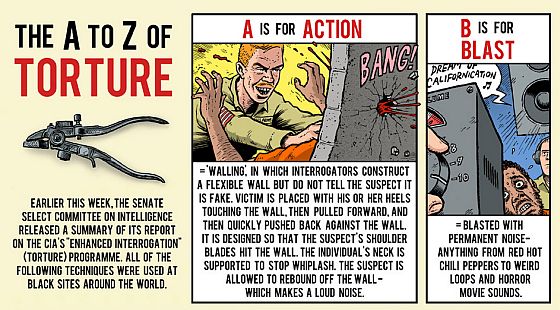
Rebecca Gordon: The torture wars

It came from the top and that’s never been a secret.  The president authorized the building of those CIA “black sites” and the use of what came to be known as “enhanced interrogation techniques” and has spoken of this with a certain pride. The president’s top officials essentially put in an order at the Department of Justice for “legal” justifications that would, miraculously, transform those “techniques” into something other than torture.  Its lawyers then pulled out their dictionaries and gave new meaning to tortured definitions of torture that could have come directly from the fused pens of Franz Kafka and George Orwell.  In the process, they even managed to leave the definition of torture to the torturer.  It was a performance for the ages.

Last week, former Vice President Dick Cheney, who only days after 9/11 claimed that the Bush administration was going to “work the dark side,” once again championed those techniques and the CIA agents who used them.  It was a handy reminder of just what a would-be crew of tough-guy torture instigators he and his cohorts were. The legal veneer spread thinly over the program they set in motion was meant to provide only the faintest legal cover for the “gloves” they bragged about taking off, while obscuring the issue for the American public.  After all, few in the rest of the world were likely to accept the idea that interrogation methods like waterboarding, or “the water torture” as it had once been known, were anything but torture.  Even in this country, it had been accepted as just that.  The Bush administration was, of course, helped in those years by a media that, when not cheerleading for torture, or actually lending the CIA a helpful hand, essentially banished the word from its vocabulary, unless it referred to heinously similar acts committed by countries we disliked.

All in all, it was an exercise in what the “last superpower,” the world’s “policeman,” could get away with in the backrooms of its police stations being jerry-built around the world.  And some of the techniques used with a particular brutality were evidently first demonstrated to top officials in the White House itself.

Then, of course, the CIA went out and applied those “enhanced techniques” to actual human beings with abandon, as the newly released (and somewhat redacted) executive summary of the Senate Intelligence Committee’s “torture report” indicates.  This was done even more severely than ordered (not that Cheney & Co. cared), including to a surprising number of captives that the CIA later decided were innocent of anything having to do with terror or al-Qaeda.  All of this happened, despite a law this country signed onto prohibiting the use of torture abroad.

Although what I’ve just described is now generally considered The Torture Story here, it really was only part of it.  The other part, also a CIA operation authorized at the highest levels, was “rendition” or “extraordinary rendition” as it was sometimes known.  This was a global campaign of kidnappings, aided and abetted by 54 other countries, in which “terror suspects” (again often enough innocent people) were swept off the streets of major cities as well as the backlands of the planet and “rendered” to other countries, ranging from Libya and Syria to Egypt and Uzbekistan, places with their own handy torture chambers and interrogators already much practiced in “enhanced” techniques of one sort or another.

Moreover, those techniques migrated like a virus from the CIA and its “black sites” elsewhere in the U.S. imperium, most notoriously via Guantanamo to Abu Ghraib, the American-run prison in Iraq, where images of torture and abuse of a distinctly enhanced variety then migrated home as screensavers.  What was done couldn’t have been more criminal in nature, whether judged by U.S. or international law.  In its wake, its perpetrators, both the torturers and the kidnappers, were protected in a major way.  Except for a few low-level figures at Abu Ghraib and one non-torturing CIA whistleblower who went to prison for releasing to a journalist the name of someone involved in the torture program, no American figure, not even those responsible for deaths at the Agency’s black sites, would be brought to court.  And of course, the men (and woman) most responsible would leave the government to write their memoirs for millions of dollars and defend what they did to the death (of others).

It’s one for the history books and, though it’s a good thing to have the Senate report made public, it wasn’t needed to know that, in the years after 9/11, when the U.S. government created an offshore Bermuda Triangle of injustice, it also essentially became a criminal enterprise.  Recently, Republican hawks in Washington protested loudly against the release of that Senate report, suggesting that it should be suppressed lest it “inflame” our enemies.  The real question isn’t, however, about them at all, it’s about us. Why won’t the release of this report inflame Americans, given what their government has done in their names?

And in case you think it’s all over but for the shouting, think again, as Rebecca Gordon, TomDispatch regular and author of Mainstreaming Torture: Ethical Approaches in the Post-9/11 United States writes today. Tom Engelhardt

American torture — past, present, and… future?
Beyond the Senate torture report
By Rebecca Gordon

It’s the political story of the week in Washington. At long last, after the endless stalling and foot-shuffling, the arguments about redaction and CIA computer hacking, the claims that its release might stoke others out there in the Muslim world to violence and “throw the C.I.A. to the wolves,” the report — you know which one — is out.  Or at least, the redacted executive summary of it is available to be read and, as Senator Mark Udall said before its release, “When this report is declassified, people will abhor what they read. They’re gonna be disgusted. They’re gonna be appalled. They’re gonna be shocked at what we did.”

So now we can finally consider the partial release of the long-awaited report from the Senate Select Committee on Intelligence about the gruesome CIA interrogation methods used during the Bush administration’s “Global War on Terror.” But here’s one important thing to keep in mind: this report addresses only the past practices of a single agency. Its narrow focus encourages us to believe that, whatever the CIA may have once done, that whole sorry torture chapter is now behind us.

Continue reading

Facebooktwittermail

U.S. policies in the Arab world must be seen to resonate with its values

Nussaibah Younis writes: Secretary of state John Kerry tried to suppress publication of the CIA torture report, citing fears of a blowback against US targets in the Middle East. But the truth is that the region barely flinched in response to the publication of the 528-page document.

Almost all state-run media in the region ignored the report entirely, keen to play down their complicity in rendition programmes and their own rampant use of torture in domestic prisons. And the public in Arab countries took the revelations simply as confirmation of facts that they had long believed to be true. That the report has prompted such uproar in the US is comic to a region that expects dastardly behaviour from the US. If anything, many in the Arab world suspect that these admissions are just a small part of a much wider set of abuses yet to be exposed.

Despite the muted reaction, the revelations of the CIA’s extensive use of torture are extremely damaging to the US and to the west in general. The details are already being used as ammunition by Islamic State (Isis) to discredit the coalition intervention in Syria and Iraq, and will also severely undermine US efforts to prevent the use of torture in the Middle East.

The fact remains, however, that for those in the Middle East, the US lost its moral authority long before the publication of this report, largely because of its interventions in the Arab-Israeli conflict and its support of authoritarian governments. US partiality on the Israel-Palestine conflict has been shown to undercut its moral legitimacy in the region, with more than 80% of Jordanians, Moroccans, Saudis and Lebanese believing that the US has not been even-handed in its efforts to negotiate a solution.

Continued US support for repressive governments has also undermined confidence in the country. In September, President Obama gave a speech at the Clinton Global Initiative declaring: “Partnering and protecting civil society groups around the world is now a mission across the US government.” At the same time, his administration has fought to bypass pro-democracy conditions on military aid to Egypt, and last week achieved its goal by inserting a “national security” waiver into the spending bill expected to be passed by Congress soon. This is despite the fact that the government of President Abdel Fatah al-Sisi has mounted a fierce attack against civil society organisations in Egypt, forcing many of them to suspend their operations or leave the country. [Continue reading…]

Facebooktwittermail

Come clean on British links to CIA torture, MPs tell U.S. Senate

The Guardian reports: The head of the powerful Commons intelligence and security committee is demanding that the US hand over its archive of material documenting Britain’s role in the CIA’s abduction and torture programme developed in the wake of the 9/11 attack.

Sir Malcolm Rifkind, chair of the parliamentary inquiry into the complicity of British intelligence agencies in the US programme, has told the Observer that British MPs would seek the intelligence relating to the UK that was redacted from last week’s explosive Senate report, which concluded that the CIA repeatedly lied over its brutal but ineffective interrogation techniques.

The move comes amid escalating pressure on the government not to extend an agreement allowing the US to use the British Overseas Territory of Diego Garcia as a military base until its true role in the CIA’s extraordinary rendition has been established. [Continue reading…]

Facebooktwittermail

Syrian rebels see U.S. abandoning them

Josh Rogin writes: As Congress struggles to pass a bill to fund the government for the rest of the year, one curious and significant item was left on the cutting room floor: a request from the Barack Obama administration for $300 million to expand the secret CIA program to arm the “moderate” Syrian rebels.

The request, which administration officials had been lobbying for in recent weeks, was held up by the House Intelligence Committee, which has serious doubts about the Free Syrian Army and other rebel groups that for years have been receiving arms secretly from the U.S. and its allies, two administration officials told me. Without the money, Syrian opposition leaders say, the FSA will struggle to hold its remaining positions in northern Syria, much less make progress against Islamic State and the Bashar al-Assad regime.

“The requested funds are a crucial indication of the partnership between the United States and Syrian freedom fighters. This comes at a particularly important time,” said Oubai Shahbandar, a senior adviser for the Syrian National Coalition.

Nonetheless, not everyone in the White House will lament the decision to drop it from the spending bill: Congress’s disenchantment with the Syrian rebels is shared by many officials inside the administration, following the rebels’ losses to Assad, IS and the al-Nusra Front in northern Syrian cities such as Idlib. There is particular frustration that these setbacks resulted in some advanced American weaponry falling into extremist hands.

Reflecting that dissatisfaction, the Obama administration has taken a series of steps in recent weeks to distance the U.S. from the moderate rebels in the north, by cutting off their weapons flow and refusing to allow them to meet with U.S. military officials, right at the time they are struggling to survive in and around Aleppo, Syria’s largest city. [Continue reading…]

Facebooktwittermail

U.S.-led warplanes hit militants in Syria and Iraq 27 times this week

The Los Angeles Times reports: U.S.-led warplanes launched 27 airstrikes against Islamic State militants in Iraq and Syria this week, officials said Friday.

The three-day attack by jets and drones was focused on militants in Syria’s second-largest city, Aleppo; the embattled Syrian city of Kobani and several cities in Iraq: Ramadi and Rutba to the west; Samarra and Mosul to the north.

In Aleppo and Kobani, U.S. officials claim to have destroyed Islamic State bunkers and fortified structures. In Iraq, the airstrikes destroyed armored vehicles as well as bulldozers and an excavator, they said.

President Obama has described the airstrike campaign as an effort to “degrade and ultimately destroy” Islamic State, which rose to prominence during the summer when its fighters crossed the border from Syria into Iraq and conquered large swaths of territory, including Mosul, one of Iraq’s largest cities. [Continue reading…]

Facebooktwittermail

State Dept: Rebels are never going to defeat Assad militarily

Foreign Policy reports: In a grim assessment of the U.S.-backed Syrian rebels, a senior State Department official said on Wednesday that the country’s armed opposition will not be able to topple the regime of Syrian President Bashar al-Assad now or in the foreseeable future, despite the existence of a Pentagon program to train and equip 5,000 rebels per year.

“We do not see a situation in which the rebels are able to remove him from power,” Brett McGurk, one of the State Department’s point men in managing the ad hoc international coalition battling the Islamic State, told the House Foreign Affairs Committee. “It will have to be a diplomatic process.”

In recent weeks, the situation for Syria’s beleaguered moderate opposition has gone from bad to worse, as they continue to lose ground in the crucial northern provinces of Idlib and Aleppo. The near-extinction of many moderate rebel groups has coincided with increasing gains by Salafist groups tied to al Qaeda or the Islamic State. For the remaining “moderates,” aligning with Washington poses a deadly risk, as U.S. airstrikes against al Qaeda-aligned militant groups in Syria fuel conspiracies that Washington tacitly supports Assad.

That’s a problem for the Obama administration’s Syria policy, which relies in part on recruiting and training moderate rebels to combat Islamic State militants before taking the fight to the Syrian government. [Continue reading…]

Facebooktwittermail

CIA director: U.S. spies raised questions about 9/11 intelligence ahead of Iraq War

The Washington Post reports: CIA officials questioned in the run-up to the Iraq War in 2003 whether key intelligence cited by President George W. Bush’s administration as a reason for a military invasion was faulty, according to a newly declassified CIA letter released Thursday by the chairman of the Senate Armed Services Committee.

The letter was sent March 13 of this year from CIA Director John Brennan to Sen. Carl Levin, the outgoing committee chairman, and introduced on the Senate floor on Thursday. Brennan confirmed that CIA field operatives “expressed significant concern” whether Muhammad Atta, one of the airliner hijackers in the Sept. 11, 2001, terrorist attacks, could have met with a former Iraqi intelligence officer, Ahmad Khalil Ibrahim Samir al-Ani, in Prague about five months earlier.

The so-called “Prague connection” was used by the Bush administration as a way of tying the 9/11 attacks to Iraqi President Saddam Hussein. The intelligence has been questioned for years, but the new CIA letter raises anew questions about why the Bush administration took the United States into the Iraq War despite concerns repeatedly being raised by U.S. intelligence officers about whether there was a tie between 9/11 and the Iraqi government. [Continue reading…]

Facebooktwittermail

I interrogated the top terrorist in U.S. custody. Then the CIA came to town

Ali Soufan writes: In the middle of my interrogation of the high-ranking terrorist Abu Zubaydah at a black-site prison 12 years ago, my intelligence work wasn’t just cut short for so-called enhanced interrogation techniques to begin. After I left the black site, those who took over left, too – for 47 days. For personal time and to “confer with headquarters”.

For nearly the entire summer of 2002, Abu Zubaydah was kept in isolation. That was valuable lost time, and that doesn’t square with claims about the “ticking bomb scenarios” that were the basis for America’s enhanced interrogation program, or with the commitment to getting life-saving, actionable intelligence from valuable detainees. The techniques were justified by those who said Zubaydah “stopped all cooperation” around the time my fellow FBI agent and I left. If Zubaydah was in isolation the whole time, that’s not really a surprise.

One of the hardest things we struggled to make sense of, back then, was why US officials were authorizing harsh techniques when our interrogations were working and their harsh techniques weren’t. The answer, as the long-awaited Senate Intelligence Committee report now makes clear, is that the architects of the program were taking credit for our success, from the unmasking of Khalid Sheikh Mohammed as the mastermind of 9/11 to the uncovering of the “dirty bomber” Jose Padilla. The claims made by government officials for years about the efficacy of “enhanced interrogation”, in secret memos and in public, are false. “Enhanced interrogation” doesn’t work. [Continue reading…]

Facebooktwittermail