Susan Zalkind writes: It’s nearly midnight in a nondescript condo complex a few blocks from Universal Studios in Orlando, and Tatiana Gruzdeva has been crying all day. Though neither of us knows it yet, as she sits on the corner of her bed and sobs in tiny convulsions, the fact that she’s talking to me will lead to her being arrested by federal agents, placed in solitary confinement, and deported back to Russia.
Next to us on the bed are nine teddy bears. Eight of them came with her from Tiraspol, Moldova. The ninth was a gift from her boyfriend, Ibragim Todashev. Today would have been Ibragim’s 28th birthday, but he is not here to see it, because in the early hours of May 22, 2013, a Boston FBI agent shot and killed him in this very apartment, under circumstances so strange that a Florida state prosecutor has opened an independent investigation. According to the FBI, just before Ibragim was shot—seven times, in two bursts, including once in the top of the head—he was about to write a confession implicating himself and alleged Boston Marathon bomber Tamerlan Tsarnaev in a brutal triple homicide that took place in Waltham, Massachusetts, in September 2011.
I’m sitting awkwardly at one end of the twin bed. She’s crying quietly, cross-legged at the other end, wearing shorts and a white shirt with sequins. Most of her outfits have sequins or rhinestones. She’s 19. I’m 26. We both have long blond hair. We’ve both been close to men who were in trouble with the law, and lost them violently. We’ve been talking for about an hour, mostly about men, and parties, and moving forward after a tragedy. Ibragim was a good man, she says. He could never have committed a murder.
“I’m here alone,” she cries. “I hope it never can be worse than this.”
I try to comfort her, but it’s complicated. We both want to know why Ibragim Todashev was killed. She wants to clear his name. For me, and for the families of the Waltham murder victims, Ibragim’s shooting may have snuffed out the last chance at finding out what really happened that night. In the back of my mind is this question: Did her dead boyfriend kill my friend Erik? [Continue reading…]
Category Archives: US government
Mole who met Bin Laden killed by Al Qaeda in Bosnia
NBC News reports: An FBI mole who provided valuable intelligence on al Qaeda and met with Osama bin Laden was lured away from the FBI to work for the CIA, but was killed by al Qaeda operatives in Bosnia who suspected he was an informant, NBC News has learned exclusively.
The informant, a Sudan-born driver and confidante to “Blind Sheikh” Omar Abdel-Rahman, the radical Muslim cleric who allegedly masterminded the first attempt to take down the World Trade Center, had been the sole human asset providing first-person information about al Qaeda in the mid-1990s as the terror group gained strength around the globe.
According to sources familiar with the management of the mole, the FBI recruited him in 1993 because he was a known associate of the Blind Sheikh. [Continue reading…]
White House considers four options for modifying NSA mass phone surveillance
The Wall Street Journal reports that administration lawyers have presented the White House with four options for reforming the NSA’s mass phone-surveillance program the first of which would require phone companies to store such data and deliver specific search requests.
A second option presented to the White House would have a government agency other than the NSA hold the data, according to a U.S. official. Candidates for this option could include the Federal Bureau of Investigation, which some current and former intelligence officials have recommended.
Another possibility floated in policy circles was turning the program over to the custody of the Foreign Intelligence Surveillance Court, which oversees the phone-data and other NSA surveillance programs, but judges have balked at an expanded role for the court.
A third option would be for an entity outside the phone companies or the government to hold the data, officials said. This approach has been criticized by privacy groups who say such a third party would just become an extension of the NSA and would provide no additional privacy benefit.
A final alternative would be to scrap the phone-data program and instead bolster investigative efforts under current authorities to obtain the information about possible terrorist connections some other way, an official said. Mr. Obama acknowledged this approach in his January speech, but said “more work needs to be done to determine exactly how this system might work.”
FBI had human source in contact with bin Laden as far back as 1993
The Washington Times reports: In a revelation missing from the official investigations of the Sept. 11, 2001, terrorist attacks, the FBI placed a human source in direct contact with Osama bin Laden in 1993 and ascertained that the al Qaeda leader was looking to finance terrorist attacks in the United States, according to court testimony in a little-noticed employment dispute case.
The information the FBI gleaned back then was so specific that it helped thwart a terrorist plot against a Masonic lodge in Los Angeles, the court records reviewed by The Washington Times show.
“It was the only source I know in the bureau where we had a source right in al Qaeda, directly involved,” Edward J. Curran, a former top official in the FBI’s Los Angeles office, told the court in support of a discrimination lawsuit filed against the bureau by his former agent Bassem Youssef.
Mr. Curran gave the testimony in 2010 to an essentially empty courtroom, and thus it escaped notice from the media or terrorism specialists. The Times was recently alerted to the existence of the testimony while working on a broader report about al Qaeda’s origins.
Members of the Sept. 11 commission, congressional intelligence committees and terrorism analysts told The Times they are floored that the information is just now emerging publicly and that it raises questions about what else Americans might not have been told about the origins of al Qaeda and its early interest in attacking the United States.
“I think it raises a lot of questions about why that information didn’t become public and why the 9/11 Commission or the congressional intelligence committees weren’t told about it,” said former Rep. Peter Hoekstra, Michigan Republican, who chaired the House Permanent Select Committee on Intelligence from 2004 through 2007 when lawmakers dealt with the fallout from the 9/11 Commission’s official report.
“This is just one more of these examples that will go into the conspiracy theorists’ notebooks, who say the authorities are not telling us everything,” Mr. Hoekstra told The Times in an interview last week. “That’s bad for the intelligence community. It’s bad for law enforcement and it’s bad for government.”
Former Rep. Lee Hamilton, an Indiana Democrat who co-chaired the 9/11 Commission with former New Jersey Gov. Thomas Kean, said that as far as he can remember, the FBI never told the commission that it had been working a source so close to bin Laden that many years before 9/11.
“I do not recall the FBI advising us of a direct contact with Osama bin Laden,” Mr. Hamilton told The Times in a recent interview. [Continue reading…]
Lawyers, judge hold secret Guantánamo hearing on CIA black sites
Carol Rosenberg reports: A military judge held a secret war court session Saturday on defense lawyers’ efforts to uncover evidence of what the CIA did to the alleged USS Cole bomber across years in the agency’s clandestine overseas prison network.
Both the public and the alleged terrorist were excluded from the 111-minute hearing in the case that seeks the execution of Abd al Rahim al Nashiri as mastermind of the Oct. 12, 2000 terror attack that killed 17 U.S. sailors off Aden, Yemen.
Only prosecutors and defense lawyers attended the hearing with the judge, Army Col. James L. Pohl, and a court recorder creating a classified transcript of the proceedings.
Nashiri, 49, spent four years in secret CIA prisons where, according to declassified reports, agents waterboarded him and interrogated him nude with a hood on his head and handcuffs on his wrists. One U.S. agent threatened to kill the Saudi with a power drill and handgun, and threatened to have his mother raped. [Continue reading…]
Meanwhile, AFP reports: Five former Guantanamo detainees are seeking damages for what they say were years of sexual, mental and physical abuse at the US detention center, where they were held without charge or trial.
The men from Turkey, Uzbekistan and Algeria, who are now settled in other countries, alleged Friday at a US appeals court that they were subjected to torture that included forced nudity, sexual harassment and beatings, first in Afghanistan and then at the military jail in Cuba.
Justices will make their ruling in several weeks, but one of them, Judge David Tatel, said military and civilian officials at the Pentagon had failed in their duty.
“Their job is to protect the detainees from abuse, they failed to do so,” he said.
Anatomy of the Deep State
Rome lived upon its principal till ruin stared it in the face. Industry is the only true source of wealth, and there was no industry in Rome. By day the Ostia road was crowded with carts and muleteers, carrying to the great city the silks and spices of the East, the marble of Asia Minor, the timber of the Atlas, the grain of Africa and Egypt; and the carts brought out nothing but loads of dung. That was their return cargo.
– The Martyrdom of Man by Winwood Reade (1871)
Mike Lofgren writes: There is the visible government situated around the Mall in Washington, and then there is another, more shadowy, more indefinable government that is not explained in Civics 101 or observable to tourists at the White House or the Capitol. The former is traditional Washington partisan politics: the tip of the iceberg that a public watching C-SPAN sees daily and which is theoretically controllable via elections. The subsurface part of the iceberg I shall call the Deep State, which operates according to its own compass heading regardless of who is formally in power.
During the last five years, the news media has been flooded with pundits decrying the broken politics of Washington. The conventional wisdom has it that partisan gridlock and dysfunction have become the new normal. That is certainly the case, and I have been among the harshest critics of this development. But it is also imperative to acknowledge the limits of this critique as it applies to the American governmental system. On one level, the critique is self-evident: In the domain that the public can see, Congress is hopelessly deadlocked in the worst manner since the 1850s, the violently rancorous decade preceding the Civil War.
As I wrote in The Party is Over, the present objective of congressional Republicans is to render the executive branch powerless, at least until a Republican president is elected (a goal that voter suppression laws in GOP-controlled states are clearly intended to accomplish). President Obama cannot enact his domestic policies and budgets: Because of incessant GOP filibustering, not only could he not fill the large number of vacancies in the federal judiciary, he could not even get his most innocuous presidential appointees into office. Democrats controlling the Senate have responded by weakening the filibuster of nominations, but Republicans are sure to react with other parliamentary delaying tactics. This strategy amounts to congressional nullification of executive branch powers by a party that controls a majority in only one house of Congress.
Despite this apparent impotence, President Obama can liquidate American citizens without due processes, detain prisoners indefinitely without charge, conduct dragnet surveillance on the American people without judicial warrant and engage in unprecedented — at least since the McCarthy era — witch hunts against federal employees (the so-called “Insider Threat Program”). Within the United States, this power is characterized by massive displays of intimidating force by militarized federal, state and local law enforcement. Abroad, President Obama can start wars at will and engage in virtually any other activity whatsoever without so much as a by-your-leave from Congress, such as arranging the forced landing of a plane carrying a sovereign head of state over foreign territory. Despite the habitual cant of congressional Republicans about executive overreach by Obama, the would-be dictator, we have until recently heard very little from them about these actions — with the minor exception of comments from gadfly Senator Rand Paul of Kentucky. Democrats, save a few mavericks such as Ron Wyden of Oregon, are not unduly troubled, either — even to the extent of permitting seemingly perjured congressional testimony under oath by executive branch officials on the subject of illegal surveillance. [Continue reading…]
Attorney General signs new rules to limit access to journalists’ records
The New York Times reports: Attorney General Eric H. Holder Jr., who drew fire last spring over the Justice Department’s aggressive tactics for secretly obtaining reporters’ phone logs and emails as part of leak investigations, on Friday signed new guidelines narrowing the circumstances in which law enforcement officials may obtain journalists’ records.
The rules, which will be published in the Federal Register next week, carry out a set of changes that Mr. Holder announced last July and described in a six-page report at the time. A preamble described the revisions as intended to ensure that the department “strikes the proper balance among several vital interests,” like protecting national security and “safeguarding the essential role of the free press in fostering government accountability and an open society.”
Among other things, the rules create a presumption that prosecutors generally will provide advance notice to the news media when seeking to obtain their communications records. [Continue reading…]
Tom Engelhardt: Thug state U.S.A.
Documenting darkness
By Tom Engelhardt
Here, at least, is a place to start: intelligence officials have weighed in with an estimate of just how many secret files National Security Agency contractor Edward Snowden took with him when he headed for Hong Kong last June. Brace yourself: 1.7 million. At least they claim that as the number he or his web crawler accessed before he left town. Let’s assume for a moment that it’s accurate and add a caveat. Whatever he had with him on those thumb drives when he left the agency, Edward Snowden did not take all the NSA’s classified documents. Not by a long shot. He only downloaded a portion of them. We don’t have any idea what percentage, but assumedly millions of NSA secret documents did not get the Snowden treatment.
Such figures should stagger us and what he did take will undoubtedly occupy journalists for months or years more (and historians long after that). Keep this in mind, however: the NSA is only one of 17 intelligence outfits in what is called the U.S. Intelligence Community. Some of the others are as large and well funded, and all of them generate their own troves of secret documents, undoubtedly stretching into the many millions.
And keep something else in mind: that’s just intelligence agencies. If you’re thinking about the full sweep of our national security state (NSS), you also have to include places like the Department of Homeland Security, the Energy Department (responsible for the U.S. nuclear arsenal), and the Pentagon. In other words, we’re talking about the kind of secret documentation that an army of journalists, researchers, and historians wouldn’t have a hope of getting through, not in a century.
We do know that, in 2011, the whole government reportedly classified 92,064,862 documents. If accurate and reasonably typical, that means, in the twenty-first century, the NSS has already generated hundreds of millions of documents that could not be read by an American without a security clearance. Of those, thanks to one man (via various journalists), we have had access to a tiny percentage of perhaps 1.7 million of them. Or put another way, you, the voter, the taxpayer, the citizen — in what we still like to think of as a democracy — are automatically excluded from knowing or learning about most of what the national security state does in your name. That’s unless, of course, its officials decide to selectively cherry-pick information they feel you are capable of safely and securely absorbing, or an Edward Snowden releases documents to the world over the bitter protests, death threats, and teeth gnashing of Washington officialdom and retired versions of the same.
Israelis caught by U.S. trying to sell arms to Iran
Kathimerini reports: Israeli arms dealers tried to send spare parts for F-4 Phantom aircraft via Greece to Iran in violation of an arms embargo, according to a secret probe by the US government agency Homeland Security Investigations (HSI) carried out in cooperation with the drugs and weapons unit of Greece’s Financial Crimes Squad (SDOE).
According to the probe, which Kathimerini has had access to, the operation was carried out in two phases – one in December 2012 and the second in April 2013. In both cases, officials traced containers packed with the F-4 parts on Greek territory. The cargo had been sent by courier from the Israeli town of Binyamina-Giv’at Ada and had been destined for Iran, which has a large fleet of F-4 aircraft, via a Greek company registered under the name Tassos Karras SA in Votanikos, near central Athens. SDOE officials established that the firm was a ghost company, while the company’s contact number was found to belong to a British national residing in Thessaloniki who could not be located.
According to HSI memos, the cargo appears to have been sent by arms dealers based in Israel, seeking to supply Iran in contravention of an arms embargo, and using Greece as a transit nation. [Continue reading…]
The Iran I saw — in 781 days in Evin Prison
Josh Fattal, who along with his friends Shane Bauer and Sarah Shourd, was imprisoned in Evin Prison alongside Iranian political prisoners, writes: Nine months into my detention, my interrogators led me blindfolded out of my cell to meet a man they described mysteriously as a “foreign diplomat from this region.” Awaiting Shane, Sarah and me in a prison office was Salem Ismaeli, an Omani businessman and envoy of Sultan Qaboos bin Said. He enveloped us in his flowing robes as he introduced himself, and I still remember how sweetly he smelled of sandalwood. He gave us expensive watches and told us his mission was to get the United States and Iran to talk to each other about our release.
It took more than a year for Salem to deliver us to freedom and the waiting arms of our families on the tarmac in Muscat. The Associated Press has since reported that Oman’s mediation led to direct talks between U.S. and Iranian officials that paved the way for last November’s interim accord to freeze parts of Iran’s nuclear program in exchange for relief from some economic sanctions.
With talks between Iran and six world powers on a permanent accord resuming this week, some voices in Congress and some supporters of Israel continue to warn against engagement with Iran and to press for even tougher sanctions. The Iran that I glimpsed under my blindfold, heard in the supportive whispers on my prison hallway and tasted in the sweet candies provided by my hall mates convinces me this stance is misguided.
It is time to end the mutual hostility for good. A permanent accord that limits Iran’s nuclear capabilities in exchange for a lifting of sanctions would make my relatives in Israel safer. It would make my family in the United States safer. And it would strengthen the hand of the brave Iranians I met in the dark corridors of Evin Prison in their continuing struggle for democracy.
NSA and DHS grant permission to be mocked
The Wall Street Journal reports: The National Security Agency and the Department of Homeland Security acknowledged in a settlement made public Tuesday that they were wrong to ban a leading custom-merchandise retailer from selling t-shirts, mugs, and posters that poked fun at the agencies.
The agreement puts to rest a First Amendment lawsuit against the federal government brought last year by a t-shirt designer, Dan McCall, who hawked merchandise on Zazzle.com that parodied the official seal of the NSA with jokes referencing the spy program disclosures. Another design imprinted on mugs featured a look-alike Homeland Security logo for a “Department of Homeland Stupidity.”
Mr. McCall’s lawsuit, which Law Blog wrote about earlier, came in response to cease-and-desist letters that the NSA and Homeland Security sent to Zazzle in 2011, ordering the retailer to remove the parody products from its site or face legal action.
How a careerist culture leads to military scandals
Kelley Vlahos writes: Popular culture reveres the U.S. military as an institution of pride and strength, as keeper of the American moral center. But a recent series of scandals suggests that, instead, ethical corrosion may be eating away at its very core.
Sarah Palin was in top rhetorical form when she told an assembled crowd of thousands on the National Mall in 2010 that soldiers were “a force for good in this country, and that is nothing to apologize for … for these men and women, honor was never lost.” But behind the partisan politics in which Democrats and Republicans have used the military as props, padded its budgets, and publicly deferred to its leadership in myriad ways over 12 years of war, there lies a complicated breakdown in its culture, military experts tell TAC. Without reform, they believe institution is headed for more embarrassment and transgression.
“I’m not surprised at all—one [scandal] relates to the other,” charges Donald Vandergriff, a retired Army officer who often lectures on leadership and reform, including in the service academies. A West Point grad and former deputy director of Army ROTC at Georgetown University, he wrote The Path to Victory: America’s Army and the Revolution in Human Affairs, in 2002.
“The [military] system that’s evolved over the last 100 years does not test moral courage, it does not test strength of character, or the ability to tell the truth regardless of harm to one’s career,” Vandergriff added. “We don’t do things like that. We are looking at people who follow the process, fall in line, don’t cause waves, aren’t open to innovation, and these personality traits leave them open to scandal.” [Continue reading…]
Nick Turse: The Pentagon makes history the first casualty
Call me human. It turns out that I’m no better at predicting the future than the rest of humanity. If as a species we were any good at it, right now I would undoubtedly be zipping through the gloriously spired skies over my hometown, New York City, my jet pack strapped to my back, just as I was promised by those imagining the future in my youth. I’ve been an editor in the book business for almost four decades and I still wouldn’t put a buck at decent odds on my predictions about which books will make it. When it came to Kill Anything That Moves: The Real American War in Vietnam, whose focus is American war crimes in Vietnam, I spent years assuring its author, Nick Turse, that in the America we both knew, the odds were it would promptly fall into the abyss where unnoticed books go to die. Mind you, I never had a second’s doubt that it would be a great book — but a great, ignored book was my best guess. Of course, as most readers of TomDispatch know, it hit the New York Times bestseller list.
It was published in January 2013 and it’s fair to say that my predictive inadequacies have been brought home to me in the most literal way every single day since. I’ve never had an experience like it. Because Nick is the managing editor of TomDispatch.com and, as today, often publishes his work at this site, it’s natural that people would often write him about his book care of TomDispatch. Nonetheless, in the last year plus I doubt a single day has passed without at least one such email, and often a slew of them, arriving at the site. Thirteen months and still going.
Sometimes book editors work their whole lives on manuscripts they think the universe needs to read and never quite see how the books they’ve shepherded into existence settle into our world, how reading them touches, affects, changes lives. It’s been a rare honor to be a sideline witness to exactly that through those emails. My role since publication has fallen somewhere between messenger boy and peeping Tom. I always at least glance at them, since from the subject lines it’s seldom initially clear what they are, and I have to say that they have been eye-opening. Many come from Vietnam vets, who want to thank Nick for documenting their war, for confirming their own experiences or those of their buddies. Some want to tell him stories — horrors, really — they witnessed, experienced, or committed more than 40 years ago as exceedingly young men in “Nam” and have been living with ever since. Often, by their own accounts, until writing Nick they have been incapable of confiding in a soul, including their own wives and children. There were also letters from those children, letting Nick know that, thanks to his book, they finally understood what their silent, unnerved, disturbed dads had gone through in lives shadowed by, or even cut short by, the pain of memories that remained unbearable and acts, witnessed or committed, that were worse.
If I didn’t admit that these have been moving private accounts to read, I’d be a liar. I’ve never quite seen anything like them, nor while working on the book did it ever cross my mind that such a thing might happen. The new afterword to the just published paperback of Kill Anything That Moves focuses on the emails, letters, and encounters that followed publication of the hardcover. Nick writes: “I had spent years painstakingly tracking down witnesses, victims, and perpetrators. Now, people with stories to tell were finding me.”
In his book, Nick has created a one-man Grand Guignol of the real American war in Vietnam. Admittedly, it’s not the sort of thing that countries like to commemorate when they hand out medals, pump up their populaces, or “remember” their wars. A series of visits Nick paid to a website billed by the Pentagon as a 50th anniversary commemoration of Vietnam makes the point well. (And by the way, 1962, the year chosen for the beginning of that commemoration, ludicrously enough, was the anniversary of nothing, neither of the end of the war and a staggering defeat nor of its beginning and the sad path ahead.) Tom Engelhardt
Misremembering America’s wars, 2003-2053
The Pentagon’s latest “mission accomplished” moment
By Nick TurseIt’s 2053 — 20 years since you needed a computer, tablet, or smart phone to go online. At least, that’s true in the developed world: you know, China, India, Brazil, and even some parts of the United States. Cybernetic eye implants allow you to see everything with a digital overlay. And once facial recognition software was linked to high-speed records searches, you had the lowdown on every person standing around you. Of course, in polite society you still introduce yourself as if you don’t instantly know another person’s net worth, arrest record, and Amazooglebook search history. (Yes, the fading old-tech firms Amazon, Google, and Facebook merged in 2033.) You also get a tax break these days if you log into one of the government’s immersive propaganda portals. (Nope, “propaganda” doesn’t have negative connotations anymore.) So you choose the Iraq War 50th Anniversary Commemoration Experience and take a stroll through the virtual interactive timeline.
Look to your right, and you see happy Iraqis pulling down Saddam’s statue and showering U.S. Marines with flowers and candy. Was that exactly how it happened? Who really remembers? Now, you’re walking on the flight deck of what they used to call an aircraft carrier behind a flight-suit-clad President George W. Bush. He turns and shoots you a thumbs-up under a “mission accomplished” banner. A voice beamed into your head says that Bush proclaimed victory that day, but that for years afterward, valiant U.S. troops would have to re-win the war again and again. Sounds a little strange, but okay.
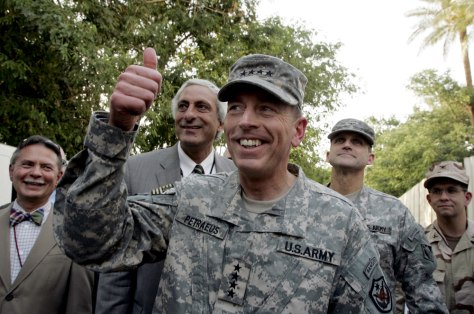
A few more paces down the digital road and you encounter a sullen looking woman holding a dog leash, the collar attached to a man lying nude on the floor of a prison. Your digital tour guide explains: “An unfortunate picture was taken. Luckily, the bad apple was punished and military honor was restored.” Fair enough. Soon, a digital General David Petraeus strides forward and shoots you another thumbs-up. (It looks as if they just put a new cyber-skin over the President Bush avatar to save money.) “He surged his way to victory and the mission was accomplished again,” you hear over strains of the National Anthem and a chorus of “hooahs.”
Rand Paul sues Obama administration over NSA surveillance
The Associated Press reports: Sen. Rand Paul, a possible Republican presidential candidate, sued the Obama administration Wednesday over the National Security Agency’s mass collection of millions of Americans’ phone records.
The Kentucky senator said he and the conservative activist group FreedomWorks filed the suit for themselves and on behalf of “everyone in America that has a phone.”
The lawsuit argues that the bulk collection program that’s been in existence since 2006 violates the Fourth Amendment right against unreasonable searches. It calls for an end to the program, which was revealed by former National Security Agency analyst Edward Snowden. [Continue reading…]
Sen. Levin’s bid to boost drone oversight falters in Congress
The Los Angeles Times reports: An effort by a powerful U.S. senator to broaden congressional oversight of lethal drone strikes overseas fell apart last week after the White House refused to expand the number of lawmakers briefed on covert CIA operations, according to senior U.S. officials.
Sen. Carl Levin (D-Mich.), who chairs the Armed Services Committee, held a joint classified hearing Thursday with the Senate Intelligence Committee on CIA and military drone strikes against suspected terrorists.
But the White House did not allow CIA officials to attend, so military counter-terrorism commanders testified on their own.
Levin’s plan ran aground on the Washington shoals of secrecy and turf, according to congressional aides and other U.S. officials, none of whom would be quoted by name discussing classified oversight matters. [Continue reading…]
Judge orders Pakistani intelligence services to produce missing drone victim
Reprieve: A Pakistani judge today ordered the country’s intelligence services to produce a victim of CIA drone strikes who has been missing since being seized from his Rawalpindi home a week ago.
Kareem Khan, who lost his son and brother to a 2009 CIA drone strike in North Waziristan, had been due to travel to Europe to discuss his experience with parliamentarians in a number of countries later this month. However, he has not been heard from since being detained by a group of men in police uniforms and plain clothes in the early hours of February 5.
The Rawalpindi Bench of the Lahore High Court was today hearing a Habeas petition brought by Mr Khan’s lawyer and Reprieve fellow, Shahzad Akbar. Mr Akbar argued that the intelligence services must have been responsible for Mr Khan’s arrest, as responses filed by the police indicated that they were unaware of the incident. As a result, the judge ordered the various intelligence services overseen by Pakistan’s Ministry of the Interior to produce Mr Khan by Thursday February 20.
Mr. Khan was due to travel to Europe this Saturday (February 15), where he was scheduled to speak with German, Dutch and British parliamentarians about his personal experience with drone strikes and and his work as a freelance journalist investigating other strikes in the region. [Continue reading…]
What the CIA learned from the Nazis
Annie Jacobsen writes: It was 1946 and World War II had ended less than one year before. In Top Secret memos being circulated in the elite ‘E’ ring of the Pentagon, the Joint Chiefs of Staff were preparing for ‘total war’ with the Soviets—to include atomic, chemical, and biological warfare. They even set an estimated start date of 1952. The Joint Chiefs believed that the U.S. could win this future war, but not for reasons that the general public knew about. Since war’s end, across the ruins of the Third Reich, U.S. military officers had been capturing and then hiring Hitler’s weapons makers, in a Top Secret program that would become known as Operation Paperclip. Soon, more than 1,600 of these men and their families would be living the American dream, right here in the United States. From these Nazi scientists, U.S. military and intelligence organizations culled knowledge of Hitler’s most menacing weapons including sarin gas and weaponized bubonic plague.
As the Cold War progressed, the program expanded and got stranger still. In 1948, Operation Paperclip’s Brigadier General Charles E. Loucks, Chief of U.S. Chemical Warfare Plans in Europe, was working with Hitler’s former chemists when one of the scientists, Nobel Prize winner Richard Kuhn, shared with General Loucks information about a drug with military potential being developed by Swiss chemists. This drug, a hallucinogen, had astounding potential properties if successfully weaponized. In documents recently discovered at the U.S. Army Heritage Center in Pennsylvania, Loucks quickly became enamored with the idea that this drug could be used on the battlefield to “incapacitate not kill.” The drug was Lysergic acid diethylamide, or LSD.
It did not take long for the CIA to become interested and involved. Perhaps LSD could also be used for off-the-battlefield purposes, a means through which human behavior could be manipulated and controlled. In an offshoot of Operation Paperclip, the CIA teamed up with Army, Air Force and Naval Intelligence to run one of the most nefarious, classified, enhanced interrogation programs of the Cold War. The work took place inside a clandestine facility in the American zone of occupied Germany, called Camp King. The facility’s chief medical doctor was Operation Paperclip’s Dr. Walter Schreiber, the former Surgeon General of the Third Reich. When Dr. Schreiber was secretly brought to America—to work for the U.S. Air Force in Texas—his position was filled with another Paperclip asset, Dr. Kurt Blome, the former Deputy Surgeon General of the Third Reich and the man in charge of the Nazi’s program to weaponize bubonic plague. The activities that went on at Camp King between 1946 and the late 1950s have never been fully accounted for by either the Department of Defense or the CIA.
Camp King was strategically located in the village of Oberursel, eleven miles northwest of the United States European Command (EUCOM) headquarters in Frankfurt. Officially the facility had three names: the U.S. Military Intelligence Service Center at Oberursel, the 7707th European Command Intelligence Center, and Camp King. In 1945, the place housed captured Nazis but by 1948 most of its prisoners were Soviet bloc spies. For more than a decade Camp King would function as a Cold War black site long before black sites were known as such—an ideal facility to develop enhanced interrogation techniques in part because it was “off-site” but mainly because of its access to Soviet prisoners. [Continue reading…]
Annie Jacobsen’s new book, Operation Paperclip, is published this week.
Bin Laden death images subject to purge, emails reveal
The Associated Press reports: Eleven days after the killing of Osama bin Laden in 2011, the US military’s top special operations officer ordered subordinates to destroy any photographs of the al-Qaida founder’s corpse or turn them over to the CIA, according to a newly released email.
The email was obtained under a freedom of information request by the conservative legal group Judicial Watch. The document, released on Monday by the group, shows that Admiral William McRaven, who heads the US Special Operations Command, told military officers on 13 May 2011 that photos of Bin Laden’s remains should have been sent to the CIA or already destroyed. Bin Laden was killed by a special ops team in Pakistan on 2 May 2011.
McRaven’s order to purge the bin Laden material came 10 days after the Associated Press asked for the photos and other documents under the US Freedom of Information Act. Typically, when a freedom of information request is filed to a government agency under the Federal Records Act, the agency is obliged to preserve the material sought – even if the agency later denies the request. [Continue reading…]