Category Archives: US government

What’s behind the “Iranian plot”?

Laura Secor writes: The weirdness of the Arbabsiar case has, unfortunately, fed a mill that already loves to churn up conspiracies. Who benefits? Blowing up a Washington, D.C., restaurant to kill a Saudi ambassador: exactly what would Iran stand to gain? Is that particular Saudi ambassador really in the way of any Iranian political objective? It doesn’t take a foreign-policy mastermind or an evil genius to see that assassinating him could only result in increased hostilities between Iran and the United States, Saudi Arabia, and Israel. At worst, it could furnish the perfect pretext for a military attack on Iran. At best, it might provoke Saudi Arabia to harass Iran with all the means at its disposal: driving down the price of oil, suppressing Bahraini Shiites, stirring up sectarian trouble in Iraq, and encouraging the Syrian opposition, to name a few.

I’ve long believed that the Iranian regime stands to gain from provoking external antagonism— up to a point. Not war, but rumors of war: the Iranian regime excels in dancing up to the line, then drawing back. (Here again the current plot looks out of character: too brash, too clumsy, too direct.) From its very inception, the Islamic Republic defined and strengthened itself by promoting an atmosphere of siege, whether the external enemy was Iraq, the United States, or the West more generally. That the Islamic Republic is an affront to America, and that America presents a military threat and a cultural onslaught, is practically a raison d’être. After 1989, with the end of the Iran-Iraq war and the petering out of the Cold War, sustaining this atmosphere became more difficult. Fortunately for the Supreme Leader, Ali Khamenei, it got a lot easier during the Bush years, with the Axis of Evil and with U.S. troops in two neighboring countries.

The Obama Administration, however, confounded all that. It came in with a rhetoric of engagement and dialogue. And yet it took less than two years for parties on all sides to once again sound the alarm about a coming U.S. war with Iran.

I’m skeptical. Part of that is experience: the alarm has been sounding for decades, and the war never comes. Part is the creeping suspicion that too many people have too much invested in stoking hysteria. The Iranian regime wants its people to believe the Americans will attack, because it believes this will help it hang on to power. The U.S. government wants the Iranians to believe it just might attack, because otherwise the United States has very little leverage in nuclear negotiations. The Israelis want the Iranians to fear an American attack, because they believe this will deter Iranian moves against Israeli interests. The Saudis, too, would like to use a bellicose American ally as leverage against Iran, their regional rival. Then, there’s American domestic politics. The Republicans bluster against Iran to prove that they are tough and that the Democrats are appeasers; the Democrats bluster against Iran to prove that they are no such thing. The neoconservative right encourages the conclusion that the only solution is military; the anti-imperialist left forever argues that the neoconservatives are secretly steering America toward war. It could be my sheer perversity that prevents me from believing what everyone wants me to believe. Or it could be that none of these parties have satisfactorily proved that anyone actually in power believes an attack on Iran would advance American interests more than it would set them back.

Gareth Porter writes: On May 24, when Arbabsiar first met with the DEA informant he thought was part of a Mexican drug cartel, it was not to hire a hit squad to kill the ambassador. Rather, there is reason to believe that the main purpose was to arrange a deal to sell large amounts of opium from Afghanistan.

In the complaint, the closest to a semblance of evidence that Arbabsiar sought help during that first meeting to assassinate the Saudi ambassador is the allegation, attributed to the DEA informant, that Arbabsiar said he was “interested in, among other things, attacking an embassy of Saudi Arabia”.

Among the “other things” was almost certainly a deal on heroin controlled by officers in the Islamic Revolutionary Guard Corps (IRGC). Three Bloomberg reporters, citing a “federal law enforcement official”, wrote that Arbabsiar told the DEA informant he represented Iranians who “controlled drug smuggling and could provide tons of opium”.

Because of opium entering Iran from Afghanistan, Iranian authorities hold 85 percent of the world’s opium seizures, according to Iran’s Fars News Agency. Iranian security personnel, including those in the IRGC and its Quds Force, then have the opportunity to sell the opium to traffickers in the Middle East, Europe and now Mexico.

Mexican drug cartels have begun connecting with Middle Eastern drug traffickers, in many cases stationing operatives in Middle East locations to facilitate heroin production and sales, according to a report last January in Borderland Beat.

But the FBI account of the contacts between Arbabsiar and the DEA informant does not reference any discussions of drugs.

Interview with Gareth Porter — Part One:

Interview with Gareth Porter — Part Two:

Facebooktwittermail

American teenager killed in drone strike

An American teenager gets blown up in a US drone strike and the only explanation provided for why he was killed is that his father was alleged to be a terrorist. And given the small amount of reporting on yesterday’s killings it appears that having covered the Obama-kills-an-American story last month, Obama-kills-another-American is a story of no great interest. But this isn’t just a story about the abuse of executive power. It would now appear that individuals can be snuffed out just because the US government objects to what they are saying.

The New York Times reports: Airstrikes, believed to have been carried out by American drones, killed at least nine people in southern Yemen, including a senior official of the regional branch of Al Qaeda and an American, the 17-year-old son of a Qaeda official killed by the United States last month, according to the government and local reports on Saturday.

Fighting also escalated in the capital, Sana, where at least 12 antigovernment protesters were killed by security forces near the Foreign Ministry and at least four civilians were killed in a battle near the airport, opposition officials said.

The fighting in Sana was the deadliest since President Ali Abdullah Saleh returned to the country last month, and coincided with rising political tensions as all sides await a statement by the United Nations Security Council expected in weeks.

Yemen has been in turmoil for months, as protesters demanding the ouster of Mr. Saleh, who has ruled for 33 years, have filled the streets, and rival political factions have fought for power. Despite tremendous domestic opposition, international pressure and an assassination attempt that severely wounded him in June, Mr. Saleh has refused to step down.

Islamic militant groups, including Al Qaeda in the Arabian Peninsula, the Yemeni branch of the terrorist organization, have exploited the chaos, taking over large regions in Shabwa and Abyan Provinces in the south.

The American drone strike last month that killed the Qaeda official, Anwar al-Awlaki, has been particularly controversial in the United States. Despite being an American citizen, Mr. Awlaki, a Qaeda propagandist, was killed without a trial. The United States has argued that he had taken on an operational role in the organization, plotting attacks against Americans, which made him a legitimate target.

The killing of his son in a drone attack on Friday night, if confirmed, would be the third time an American was killed by such a United States attack in Yemen, although it was not clear if the son was an intended target. A second American, Samir Khan, the editor of Al Qaeda’s online magazine, was killed in the attack on Mr. Awlaki, which was launched from a new secret C.I.A. base on the Arabian Peninsula.

Facebooktwittermail

Get hacked, don’t tell: drone base didn’t report virus

Danger Room reports: Officials at Creech Air Force Base in Nevada knew for two weeks about a virus infecting the drone “cockpits” there. But they kept the information about the infection to themselves — leaving the unit that’s supposed to serve as the Air Force’s cybersecurity specialists in the dark. The network defenders at the 24th Air Force learned of the virus by reading about it in Danger Room.

The virus, which records the keystrokes of remote pilots as their drones fly over places like Afghanistan, is now receiving attention at the highest levels; the four-star general who oversees the Air Force’s networks was briefed on the infection this morning. But for weeks, it stayed (you will pardon the expression) below the radar: a local problem that local network administrators were determined to fix on their own.

“It was not highlighted to us,” says a source involved with Air Force network operations. “When your article came out, it was like, ‘What is this?’”

The drones are still flying over warzones from Afghanistan to Pakistan to Yemen. There’s no sign, yet, that the virus either damaged any of the systems associated with the remotely piloted aircraft or transmitted sensitive information outside the military chain of command — although three military insiders caution that a full-blown, high-level investigation into the virus is only now getting underway.

Facebooktwittermail

The Obama administration’s fast and furious response to the Iranian bomb plot

The GOP is clearly eager to use whatever weapons it can grab in its campaign to ensure that Obama is a one-term president. Still, it’s hard not to wonder whether there might be a connection between the fact that yesterday, Attorney General Holder leaped into the media spotlight to draw attention to an alleged assassination and bombing plot, and today he has been subpoenaed by a Congressional committee chairman. Both cases involve US surveillance of Mexican drug cartels.

Rep. Darrell Issa (R-Calif.) subpoenaed Attorney General Eric Holder on Wednesday for documents related to the “Fast and Furious” gun tracking operation.

Issa, the chairman of the House Oversight and Government Reform Committee, contends Holder knew more about the botched operation than he has told Congress. His subpoenas are directed to Holder and other senior officials at the Department of Justice.

“Top Justice Department officials, including Attorney General Holder, know more about Operation Fast and Furious than they have publicly acknowledged,” Issa said in a statement announcing the subpoenas.

“The documents this subpoena demands will provide answers to questions that Justice officials have tried to avoid since this investigation began eight months ago. It’s time we know the whole truth.”

The 22-item subpoena seeks documents and communication records between Holder, Deputy Attorney General James Cole, Assistant Attorney General Lanny Breuer, the U.S. Attorney’s office in Arizona, the Executive Office of the President employees — including the White House’s associate communications director Eric Schultz — and nearly 20 other high-ranking officials within the DOJ.

Rep. Elijah Cummings (D-Md.), the ranking Democrat on Issa’s committee, called the subpoena a “deep-sea fishing expedition” and a “political stunt.”

“This subpoena is a deep-sea fishing expedition and a gross abuse of the Committee’s authority,” said Cummings in a statement. “It demands tens of thousands of pages of highly sensitive law enforcement and national security materials that have never been requested before and are completely unrelated to Operation Fast and Furious. Rather than legitimate fact-gathering, this looks more like a political stunt.”

Under Operation Fast and Furious, the Bureau of Alcohol, Tobacco, Firearms, and Explosives (ATF) oversaw the sale of thousands of firearms to known or suspected straw buyers for Mexican drug cartels with the hope of dismantling their gun trafficking routes. But the guns weren’t given proper supervision and most of them disappeared. Two of the guns sold under the operation were found at Border Patrol Agent Brian Terry’s murder scene in Arizona last year.

On Tuesday, Holder said: “[W]hat I want the American people to understand is that in complying with those subpoenas and dealing with that inquiry, that will not detract us from the important business that we here to do at the Justice Department, including matters like the one that we have announced today.”

Meanwhile, CBS News reports:

The Obama administration was taking its case against Iran to the world Wednesday, trying to stir up an international response to charges that the Islamic republic plotted to assassinate the Saudi Arabian ambassador to the U.S.

“It’s critically important that we unite the world in the isolation of and dealing with the Iranians,” Vice President Joe Biden said on “The Early Show” Wednesday. “That’s the surest way to be able to get results.”

Mr. Obama’s top national security aides have said the administration will lobby for the imposition of new international sanctions as well as for individual nations to expand their own penalties against Iran.

The State Department sent a cable to all American embassies and consulates around the world telling them to put the Iran case before their host governments. The officials said the cable, sent late Tuesday by Deputy Secretary of State William Burns and classified secret, tells them to detail the evidence against Iran as presented by federal prosecutors.

Reza Marashi and Trita Parsi warn:

U.S.-Iran tensions have long been a powder keg, overflowing with nuclear programs, human rights abuses, Stuxnet and secret assassinations. And the alleged terror plot against the Saudi Ambassador shows how easily a single incident can spark a wider conflict. Without serious efforts to defuse a crisis that is steadily spiraling out of control, we are on the precipice of a major war in the region.

This is why a containment policy can turn into a self-fulfilling prophecy. Short of a government collapse in Tehran or strategic shift in Washington — both unlikely in the short to medium term — containment has created an environment in which adversaries repeatedly provoke one another, without having the ability to reverse any escalation.

The Obama administration must avoid falling further into this trap — particularly if there are Iranian hardliners trying to bait the U.S. into a conflict.

Even so, as Reuters reports, the administration is showing little hesitation in escalating the emerging crisis:

U.S. officials said on Wednesday it was “more than likely” that Iran’s supreme leader and the head of its Quds force knew of the alleged plot to kill the Saudi ambassador to Washington, but acknowledged the claim was based on analysis rather than hard evidence.

Muhammad Sahimi, at Tehran Bureau, points out:

[D]espite its repressive domestic policy, when it comes to dealing with the outside world, the Islamic Republic of Iran (IRI) has followed a pragmatic approach, based first and foremost on protecting itself from external physical attacks, and then on expanding its influence when and where possible. We can see this from how it dealt with and received weapons from Israel in the 1980s during the notorious Iran-Contra affair, from the pragmatic way it sat out the conflict when the U.S. and its allies attacked Iraq to expel it from Kuwait in 1990 (despite many internal voices demanding that Iran assist Saddam Hussein’s regime against the Western forces), from its arming of the Bosnian Muslims with U.S. consent during the war with the Serbs, and from the significant assistance it provided to the U.S. invasion of Afghanistan in 2001. Based on a purely cost-benefit analysis, it is extremely difficult, if not impossible, to imagine that the IRI could have benefited from such a plot as is alleged. At a time when (a) international pressure on Iran is mounting in response to its gross human rights violations, (b) the sanctions that have been imposed on Iran are showing signs of working, (c) the IRI is deeply worried about the fate of its strategic partner in Syria, the government of Bashar al-Assad, (d) tensions with Turkey are increasing over its hostile policy toward the Assad regime, and (e) a fierce power struggle is underway within Iran between the supporters of Ayatollah Ali Khamenei and President Mahmoud Ahmadinejad, it is essentially impossible to believe that the IRI would act in such a way as to open a major new front against itself.

Moreover, although the IRI has carried out assassination operations beyond Iranian borders, some of which I have described here and here, they targeted Iranian dissidents, not foreign diplomats. Even at the height of the assassination wave, the IRI did not go after non-Iranians. It is keenly aware that it is under the American microscope. It is thus hard to believe that the IRI would actually embark on such a useless assassination involving a low-level, non-player individual, dealing with people that they do not know.

Furthermore, the IRI ended its foreign assassinations in the mid-1990s. And, with a single exception more than 30 years ago, the IRI avoided carrying out any such plots on U.S. soil. The first and last such act occurred in July 1980, when Ali Tabatabaei was murdered at his home in Bethesda, Maryland, by Dawud Salahuddin, an American sympathetic to the 1979 Revolution. Tabatabaei, press attaché in the Iranian Embassy in the United States under the Shah, had joined the opposition after the Revolution. Salahuddin, who was paid $5,000 to kill Tabatabaei, currently lives in Iran.

One may argue that the targets of the operation were Saudi Arabia and Israel. But this seems even more absurd. If the IRI really intends to harm Saudi Arabia, due to the increasing tension with the Riyadh government, why should it try to do it here in the United States and in Washington? Why not attack the Saudis embassies in, for example, chaotic locations in the Middle East, such as Afghanistan, Iraq, and Yemen? Why not carry out a sabotage operation against Saudi Arabia’s oil fields in the eastern part of the country, where the Shia population is centered? That would increase the price of oil dramatically, which would benefit the IRI and hurt the fragile economies of the West.

Facebooktwittermail

The “very scary” Iranian terror plot

Glenn Greenwald writes: The most difficult challenge in writing about the Iranian Terror Plot unveiled yesterday is to take it seriously enough to analyze it. Iranian Muslims in the Quds forces sending maurading bands of Mexican drug cartel assassins onto sacred American soil to commit Terrorism — against Saudi Arabia and possibly Israel — is what Bill Kristol and John Bolton would feverishly dream up while dropping acid and madly cackling at the possibility that they could get someone to believe it. But since the U.S. Government rolled out its Most Serious Officials with Very Serious Faces to make these accusations, many people (therefore) do believe it; after all, U.S. government accusations = Truth. All Serious people know that. And in the ensuing discussion one finds virtually every dynamic typically shaping discussions of Terrorism and U.S. foreign policy.

Facebooktwittermail

Americans warned about global threat posed by used-car salesmen

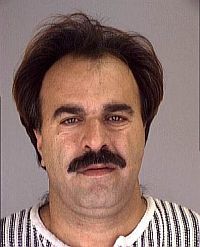
Manssor Arbabsiar — used-car salesman cum terrorist-mastermind — is in detention and no longer poses a threat to the world, but the State Department wants Americans to take care when traveling overseas: there could be other dumb hustlers out there hatching dastardly plots, so the US government urges all Americans to exercise caution when traveling anywhere or even thinking about it.
The warning contains two anomalies, however:

1. It expires on January 11, 2012, just three months away. Surely the danger will persist right up until November 6, 2012. It seems imprudent to let our guard down before we’ve chosen the next president.

2. Arbabsiar is a US citizen. Don’t we need to be exercising as much if not more caution inside America. After all, who buys a used-car when overseas?

MSNBC reports: The State Department issued a worldwide travel alert late Tuesday for American citizens after the United States accused Iran of backing a plot to kill Saudi Arabia’s ambassador to Washington.

“The U.S. government assesses that this Iranian-backed plan to assassinate the Saudi ambassador may indicate a more aggressive focus by the Iranian government on terrorist activity against diplomats from certain countries, to include possible attacks in the United States,” it said in a statement on its website.

The alert, which expires January 11, 2012, urged Americans living and traveling abroad to be wary.

“U.S. citizens residing and traveling abroad should review the Department’s Worldwide Caution and other travel information when making decisions concerning their travel plans and activities while abroad,” it added.

U.S. authorities said earlier on Tuesday that they had broken up a plot by two men linked to Iran’s security agencies to assassinate Saudi Ambassador Adel al-Jubeir. One, a former Texas used-car dealer named Manssor Arbabsiar, was arrested last month while the other was believed to be in Iran.

However a friend and one-time business partner of Arbabsiar, David Tomscha, said Arbabsiar, known as Jack to his friends, made an unlikely secret agent.

Tomscha said Arbabsiar, 56, a naturalized U.S. citizen who holds an Iranian passport, was likeable, a bit lazy and “no mastermind.”

“I can’t imagine him thinking up a plan like that. I mean, he didn’t seem all that political. He was more of a businessman … He was sort of a hustler,” he said.

Meanwhile, following Attorney General Eric Holder’s dramatic announcement about the plot, a US official has provided the New York Times with additional details:

The alleged plot also included plans to pay the cartel, Los Zetas, to bomb the Israeli Embassy in Washington and the Saudi and Israeli Embassies in Argentina, according to a law enforcement official.

The plotters also discussed a side deal between the Quds Force, part of Iran’s Islamic Revolutionary Guards Corps, and Los Zetas to funnel tons of opium from the Middle East to Mexico, the official said. The plans never progressed, though, because the two suspects — the Iranian-American and an Iranian Quds Force officer — unwittingly were dealing with an informant for the Drug Enforcement Administration, officials said.

It’s quite baffling that Arbabsiar and Shakuri’s plans should have been so limited in their scope — but what a stroke of luck that the feds managed to get on to the case and play such a creative role in allowing it to unfold!

Facebooktwittermail

Obama’s October surprise?

I know an October surprise is meant to happen weeks — not a full year — before a presidential election, but if one considers the different players affected by the alleged Iranian assassination and bombing plot, President Obama is the only who comes out with a clear advantage.

Today’s news might not herald another war, but a year of increasing tension between the US and Iran could serve the interests of a president whose strongest card has turned out to be national security. With no relief in sight on the economic front, the campaign may end up turning on who we are supposed to be more comfortable with in handling an international crisis — the seasoned incumbent or a novice? At least, that’s a scenario that might look appealing to the Obama 2012 campaign right now.

“We see this as a chance to go out to capitals around the world and talk to allies and partners about what the Iranians tried to do,” a White House official tells David Ignatius. “We’re not going to tolerate targeting a diplomat in Washington. We’re going to try to use this to isolate them to the maximum extent possible.”

Meanwhile, James Traub describes how far removed such issues are from the GOP primary campaign:

The world beyond America’s borders just doesn’t figure in the 2012 campaign. In the 2008 Republican debates, candidates regularly crossed swords on the war in Iraq, the nuclear showdown with Iran, and the proper conduct of the war on terror. At this year’s first real debate, held in Manchester, New Hampshire, the rest of the world wasn’t even mentioned until more than 90 minutes into the two-hour event. “Given the focus on economic issues, it’s difficult to get the candidates interested in foreign policy,” laments Jamie Fly, head of the Foreign Policy Initiative, which acts as a transmission belt between conservative intellectuals and politicians. Audiences seem similarly apathetic. The heartiest applause often goes to libertarian Rep. Ron Paul when he calls for as little foreign policy as possible, as he did recently in Iowa during a discussion of the Middle East. His prescription: “Stay out of their internal business. Don’t get involved in these wars. And just bring our troops home.”

To the extent that the Republicans cleave to this domestic-issues-only line, an international crisis in the run up to 2012 could clearly assist Obama.

Whatever Messrs Arbabsiar and Shakuri were up to, one element has become surprisingly predictable in this type of story: each time the Justice Department announces a stunning breakthrough in preventing an act of terrorism, it turns out that federal agents were involved in the plot from early in its conception. In these undercover operations the line between investigation and instigation gets repeatedly blurred.

If the Iranian government had the serious intent to assassinate the Saudi ambassador to the United States and to do so by bombing a restaurant in Washington DC, one wonders why the breaking news was not about a plot being stymied and not instead about a horrific explosion.

The idea that Iran would outsource such an operation to a Mexican drug cartel is being viewed with appropriate skepticism.

Tim Padgett writes:

If Iranian government operatives really did try to contract a Mexican drug cartel to assassinate the Saudi ambassador to the U.S., as the Obama Administration alleges today, then they weren’t just being diabolical. They were being fairly stupid.

Granted, the Zetas – the drug mafia that Iranian-American Manssor Arbabsiar allegedly thought he was dealing with on behalf of Tehran – is certainly Mexico’s most bloodthirsty: they are the narcos that brought beheadings and wholesale massacres of innocent civilians to the nightmarish drug war scene south of the border. But even the Zetas, founded more than a decade ago by former Mexican army commandos, know better than to venture north of the border and invite the kind of U.S. law enforcement heat that a political assassination of this magnitude would have brought on them. They’re more than willing to murder high and low inside Mexico – the Zetas are the chief suspects, for example, in last year’s assassination of Tamaulipas state gubernatorial candidate Rodolfo Torre – but they’ve rarely if ever directed that kind of mayhem inside the U.S.

And for good reason: they’ve experienced the vast difference between cops, prosecutors and judges in Mexico, whom they can buy off or kill with impunity, and the U.S. judicial system. In 2005 and 2006, for example, Zetas murdered at least five rival gangsters in Laredo, Texas, just across the border from one of their strongholds, Nuevo Laredo, Mexico. A number of Zetas were arrested and prosecuted as a result and sent away to U.S. prisons – which are a lot harder to break out of than Mexican penitentiaries are, and where you can’t live the comfortable life that drug lords make for themselves inside Mexican lockups. Zeta leaders like Heriberto Lazcano, aka El Verdugo, or The Executioner, learned fairly quickly that the world across the Rio Grande was a different ballgame – and that if they didn’t want to jeopardize their lucrative drug distribution networks in the U.S., it was best to avoid bloodshed there as well.

And then there is the most basic question: how could Iran possibly benefit if this plot had been carried out?

Max Fisher writes:

What would it really mean for Iran if the Saudi ambassador to the U.S. were killed in a terrorist attack in Washington? The U.S.-Saudi relationship has been bad and getting worse since the start of the Arab Spring, with the Saudi monarchy working increasingly against the democratic movements that the U.S. supports. A senior member of the royal family even threatened to cut off the close U.S.-Saudi relationship if Obama opposed the Palestinian statehood bid, which he did. If the U.S. and Saudi Arabia really broke off their seven-decade, oil-soaked romance, it would be terrific news for Iran. Saudi Arabia depends on the U.S. selling it arms, helping it with intelligence, and overlooking its domestic and regional (see: Bahrain) abuses.

If the U.S.-Saudi alliance fell apart, the Shia-majority Islamic Republic of Iran would have an easier time pushing its regional influence against Saudi Arabia, especially in some of the crucial states between the two: Iraq, Bahrain, and the United Arab Emirates. Iran would be able to reverse its increasing regional isolation and perhaps flip some Arab leaders from the U.S.-Saudi sphere toward its own. The best part of this, for Iran, is that it probably wouldn’t even have to do anything: the U.S.-Saudi special relationship, if it collapses, would do so without Iran having to lift a finger. The dumbest thing that Iran could possibly do, then, would be stop the collapse, to find some way to bring the U.S. and Saudi Arabia back together. For example, by attempting to blow up the Saudi ambassador to the U.S. on American
soil.

The Iranian leadership, for all their twisted human rights abuses and policies that often serve the regime at the cost of actual Iranians, are not idiots.

Facebooktwittermail

Scientists’ analysis disputes FBI closing of anthrax case

The New York Times reports: A decade after wisps of anthrax sent through the mail killed 5 people, sickened 17 others and terrorized the nation, biologists and chemists still disagree on whether federal investigators got the right man and whether the F.B.I.’s long inquiry brushed aside important clues.

Now, three scientists argue that distinctive chemicals found in the dried anthrax spores — including the unexpected presence of tin — point to a high degree of manufacturing skill, contrary to federal reassurances that the attack germs were unsophisticated. The scientists make their case in a coming issue of the Journal of Bioterrorism & Biodefense.

F.B.I. documents reviewed by The New York Times show that bureau scientists focused on tin early in their eight-year investigation, calling it an “element of interest” and a potentially critical clue to the criminal case. They later dropped their lengthy inquiry, never mentioned tin publicly and never offered any detailed account of how they thought the powder had been made.

The new paper raises the prospect — for the first time in a serious scientific forum — that the Army biodefense expert identified by the F.B.I. as the perpetrator, Bruce E. Ivins, had help in obtaining his germ weapons or conceivably was innocent of the crime.

Both the chairwoman of a National Academy of Science panel that spent a year and a half reviewing the F.B.I.’s scientific work and the director of a new review by the Government Accountability Office said the paper raised important questions that should be addressed.

Alice P. Gast, president of Lehigh University and the head of the academy panel, said that the paper “points out connections that deserve further consideration.”

Dr. Gast, a chemical engineer, said the “chemical signatures” in the mailed anthrax and their potential value to the criminal investigation had not been fully explored. “It just wasn’t pursued as vigorously as the microbiology,” she said, alluding to the analysis of micro-organisms. She also noted that the academy panel suggested a full review of classified government research on anthrax, which her panel never saw.

In interviews, the three authors said their analysis suggested that the F.B.I. might have pursued the wrong suspect and that the case should be reopened. Their position may embolden calls for a national commission to investigate the first major bioterrorist attack in American history.

Facebooktwittermail

White House clarifies when it’s OK for Obama to kill Americans

A week after the assassination of Anwar al-Awlaki — “a great day for America,” as one senior Obama administration official put it — and then a flurry of headlines about Obama killing US citizens, the White House clearly sees the need to change the narrative. Although it had already been stated that the president was exerting powers in accordance with legal advice, the administration wants to assure everyone that this was sound advice — the kind that would require the thoroughness of a 50-page memo drafted by a team of lawyers.

In other words, to those who are concerned about the suspension of the rule of law, the consolation is rule by procedure. It’s not due process, but it involved meetings, legal opinions, documentation, signatures — all the essential ingredients to ensure that those involved can later point to the ways in which they diligently followed procedures and ultimately no one can be held responsible. The buck stops nowhere.

Even so, since this is a presidency where secrecy often appears to be cherished more than anything else, we don’t get to actually read the Justice Department’s memorandum describing the circumstances in which Obama has the discretion to suspend the constitution. Instead, the contents of the memo get selectively revealed to a reporter.

It’s not exactly a leak — more like a drip.

The New York Times reports: The Obama administration’s secret legal memorandum that opened the door to the killing of Anwar al-Awlaki, the American-born radical Muslim cleric hiding in Yemen, found that it would be lawful only if it were not feasible to take him alive, according to people who have read the document.

The memo, written last year, followed months of extensive interagency deliberations and offers a glimpse into the legal debate that led to one of the most significant decisions made by President Obama — to move ahead with the killing of an American citizen without a trial.

The secret document provided the justification for acting despite an executive order banning assassinations, a federal law against murder, protections in the Bill of Rights and various strictures of the international laws of war, according to people familiar with the analysis. The memo, however, was narrowly drawn to the specifics of Mr. Awlaki’s case and did not establish a broad new legal doctrine to permit the targeted killing of any Americans believed to pose a terrorist threat.

The Obama administration has refused to acknowledge or discuss its role in the drone strike that killed Mr. Awlaki last month and that technically remains a covert operation. The government has also resisted growing calls that it provide a detailed public explanation of why officials deemed it lawful to kill an American citizen, setting a precedent that scholars, rights activists and others say has raised concerns about the rule of law and civil liberties.

But the document that laid out the administration’s justification — a roughly 50-page memorandum by the Justice Department’s Office of Legal Counsel, completed around June 2010 — was described on the condition of anonymity by people who have read it.

The legal analysis, in essence, concluded that Mr. Awlaki could be legally killed, if it was not feasible to capture him, because intelligence agencies said he was taking part in the war between the United States and Al Qaeda and posed a significant threat to Americans, as well as because Yemeni authorities were unable or unwilling to stop him.

The memorandum, which was written more than a year before Mr. Awlaki was killed, does not independently analyze the quality of the evidence against him.

The administration did not respond to requests for comment on this article.

Facebooktwittermail

U.S. had ‘frighteningly simplistic’ view of Afghanistan, says McChrystal

The Guardian reports: One of America’s most celebrated generals has issued a harsh indictment of his country’s campaign in Afghanistan on the 10th anniversary of the invasion to topple the Taliban.

The US began the war with a “frighteningly simplistic” view of Afghanistan, the retired general Stanley McChrystal said, and even now the military lacks sufficient local knowledge to bring the conflict to an end.

The US and Nato are only “50% of the way” towards achieving their goals in Afghanistan, he told the Council on Foreign Relations.

“We didn’t know enough and we still don’t know enough. Most of us, me included, had a very superficial understanding of the situation and history, and we had a frighteningly simplistic view of recent history, the last 50 years.”

Facebooktwittermail

9/11: the tapping point

David Rose writes: One morning in June 2001, three months before the 9/11 attacks on the United States, I happened to be interviewing a senior official from the British Secret Intelligence Service, M.I.6. His current focus was the war on drugs, not international terrorism, but he shared a piece of information that united the two subjects.

A short time earlier, the official told me, the U.S. National Security Agency had intercepted a call between two satellite-telephone users in Afghanistan—the al-Qaeda leader Osama bin Laden and the Taliban leader Mullah Mohammed Omar. They had been discussing the Taliban’s ban on growing opium poppies, imposed the previous summer—a remarkably effective edict that had shrunk production in areas they controlled almost to zero.

According to the M.I.6 official, bin Laden sounded unhappy. “Why stop growing opium?” he asked. “Heroin only weakens our enemies.” There was no need to worry, Mullah Omar replied. The ban was merely a tactic. “There has been a glut, and the price is too low. Once the world price has risen, the farmers can start growing it again.”

The real lesson of this overheard conversation was not its specific content but the fact that it could be heard at all. Electronic eavesdropping clearly had potential in Taliban-controlled Afghanistan. But in the years before 9/11, when bin Laden’s terror plot was first being discussed, that potential remained limited. The reason was simple: Afghanistan had no cell phones, no Internet, and only a rudimentary landline network, which did not work at all outside the country’s largest cities. This could be remedied, however. Indeed, by the end of 1999, the Taliban government had embraced a full-fledged American scheme to install a modern cell-phone-and-Internet system in Afghanistan. It could have been up and running within months. The Taliban had already granted an exclusive license to a U.S.-owned firm, the Afghan Wireless Communications Company.

More to the point, electronic modifications concealed within the circuitry would have allowed every call and every e-mail emanating from Afghanistan to be relayed without interference to N.S.A. headquarters in Fort Meade, Maryland. “This project was a dream,” says one former senior F.B.I. counterterrorism specialist who knew about the scheme at the time. “To be able to wire up a country from ground level up—you don’t get too many opportunities like that.” No, you don’t. But at the critical moment, the Clinton administration put the project on hold, while rival U.S. agencies—the F.B.I., the N.S.A., and the C.I.A.—bickered over who should control it.

In the decade since 9/11, investigations by journalists and government commissions have explored the many missed opportunities to prevent bin Laden’s attacks. Overall, it is the story of a catastrophic failure to connect the dots. One can argue—and many have—that the connections emerge more visibly in retrospect than they ever did as events themselves unfolded. But the affair of the Afghan cell-phone network—put on hold until time ran out—falls into a category by itself. It was a course of action whose value and urgency were acknowledged by everyone, but it was impeded nonetheless. The cell-phone plan “was one tool we could have put in Afghanistan that could have made a difference,” a former C.I.A. official says. “Why didn’t we put it in? Because we couldn’t fucking agree.”

Facebooktwittermail

CIA: Detainee’s torture drawings, writings, “should they exist,” to remain Top Secret

Jason Leopold reports: In 2002, not long after he was subjected to so-called “enhanced interrogation techniques” by Bruce Jessen and James Mitchell, psychologists under contract to the CIA, high-value detainee Abu Zubaydah made about ten drawings depicting the torture he endured while in custody of the agency.

One of the drawings Zubaydah had sketched captured in incredible detail the waterboarding sessions he underwent. Another drawing showed him being chained by his wrists to the ceiling of a CIA black site prison where he was held and another showed him strapped to a chair and being doused with water as part of a sleep deprivation program, according to two counterterrorism officials who have seen Zubaydah’s drawings.

Zubaydah drew the pictures of the torture techniques he was subjected to on a sheet of paper measuring about 8 x 11 inches and on pieces of paper about the size of an index card. In some instances, Zubaydah drew several of the torture techniques on a single piece of paper.

Zubaydah’s “artwork is very detailed right down to the straps that were used when he was on the waterboard and almost looks like a photograph,” said one of the counterterrorism officials, who requested anonymity in order to discuss classified material.

Brent Mickum, Zubaydah’s attorney, previously told Truthout that in the absence of the 92 interrogation videotapes, which the agency destroyed, the drawings Zubaydah made contain the best description of the torture techniques used against him while he was being held at the agency’s black site prison facilities.

“These are a good group of drawings and he is a pretty good artist,” Mickum told Truthout last year. Mickum said he is prohibited from discussing the contents of Zubaydah’s drawings because it remains classified. However, he said, “the depictions would be of interest” and agreed that Zubaydah “can draw and with great detail.”

Additionally, Zubaydah wrote poetry, short stories, and articles while in CIA custody. The content of his writing, however, is not known.

But the CIA refuses to release any of his drawings or writings and won’t even acknowledge that those materials actually exist. If Zubaydah’s drawings and writings do exist, the CIA said, it would be part of the agency’s “operational files,” which means “records and files detailing the actual conduct of [CIA’s] intelligence activities.”

Facebooktwittermail

Secret memo on Obama’s right to kill Americans

David Shipler writes:

The Obama administration should release the secret Justice Department memo justifying the placement of an American citizen, Anwar al-Awlaki, on the CIA’s kill list. The legal questions are far from clearcut, and the country needs to have this difficult discussion. A good many Obama supporters thought that secret legal opinions by the Justice Department—rationalizing torture and domestic military arrests, for example—had gone out the door along with the Bush administration.

But now comes a momentous change in policy with serious implications for the Constitution’s restraint on executive power, and Obama refuses to allow his lawyers’ arguments to be laid out on the table for the American public to examine. Shakespeare’s line in Hamlet on the “insolence of office” comes to mind.

The questions are legion. If U.S. government officials are being accurate and truthful in both their attributed and anonymous statements, Awlaki was placed on the list only in April 2010, after he had “gone operational” and had crossed the line between speech and action. Did the lawyers think that the First Amendment protected even his fiery rhetoric, easily available to potential jihadists by Internet, which had inflamed a few wannabe terrorists? Did they require that he actually take a hand in some planning before he could be considered worthy of the drone strike that killed him in Yemen? Hours after his death, President Obama awarded him a posthumous promotion, calling him for the first time “the leader of external operations for al-Qaeda in the Arabian Peninsula.”

What is the basis for this grand title? There is no doubt about his words—anybody can still hear and read them—but the picture of his actions is sketchy, derived from unverified intelligence. Given how wrong the CIA was about weapons of mass destruction in Iraq, is it really sufficient to base a death warrant on intelligence operatives’ untested assertions? How can their accuracy be checked? Does the Fifth Amendment’s right to due process extend to Americans overseas? Due process, after all, was the Framers’ effort to enhance the accuracy of the criminal justice system. Is there another way that an independent review can be done before a missile is sent in the direction of some named person who is not on a battlefield? Isn’t it strange that under Obama’s reasoning, the president can’t order torture but can order death, that he needs a judge’s authorization to listen to an American’s phone overseas but needs no such judicial approval to end the citizen’s life?

Facebooktwittermail

Congress blocking aid to the Palestinians: the facts and what they mean

Lara Friedman from Americans for Peace Now writes:

This past weekend there were press reports (original story in the Independent, with further reporting in the Israeli press) that Congress was blocking $200 million in aid to the Palestinian Authority (PA). As is often the case when it comes to the rather arcane world of Congress and appropriations, the press reports were partly correct and partly incorrect, and also missed some rather important points.

The Facts

  • U.S. direct assistance to the PA for FY2011, which amounted to $200 million, is already out the door. Congress can’t do anything to block funding that has already been spent, although some members of Congress are threatening to cut off this funding in 2012 to punish the Palestinian Authority for going to the UN.
  • Congress is blocking $192 million in funds for U.S. humanitarian programs for Palestinian residents of the West Bank and Gaza. This funding is being blocked by Republicans on two House committees: the House Foreign Affairs Committee and the House Appropriations Committee’s Foreign Operations Subcommittee. These funds are for programs funded through USAID and carried out by non-governmental organizations. It should be emphasized that the West Bank/Gaza assistance program is completely distinct from U.S. aid to the PA. U.S. humanitarian assistance to the Palestinian people has long been kept hermetically sealed off from PA aid – specifically to enable it to continue, even, for example, when concerns over corruption led Congress to prohibit all aid to the PA (a prohibition that still is law today, but a law that the President has the authority to waive, with conditions), and even after Hamas won the 2006 Palestinian legislative elections. The U.S. program for the West Bank and Gaza, it should be emphasized, is probably the most congressionally restricted, conditioned, vetted and overseen U.S. assistance program in the world – all to ensure that not a dollar benefits the PA and that not a dollar serves any purpose but to address humanitarian concerns and promote U.S. policy objectives.
  • Congress is also blocking $150 million in funding for security assistance to the PA (aid that comes under the title of “international narcotics control and law enforcement programs – INCLE”). This block – which so far has not been reported in the media – does target the PA and will be very problematic for the PA. These funds are being blocked by Republicans on the Senate Foreign Relations Committee and possibly also by the House Foreign Affairs Committee (this could not be confirmed as of this writing). Some members of Congress have also threatened to cut these funds in 2012 to punish the Palestinian Authority for going to the UN.

The press has not been clear on how Congress is blocking funds that have been previously approved, so to clarify: Congress keeps a very tight hold on the purse strings when it comes to foreign aid in general, and assistance for the Palestinians and the PA in particular. One way it does this is by (as part of the law providing the funds) requiring the Administration to notify/consult with relevant committees (House and Senate) before actually spending money. The relevant committees are the committees with jurisdiction over foreign assistance – the House Foreign Affairs Committee and Senate Foreign Relations Committee and the Foreign Operations Subcommittees of the House and Senate Appropriations Committees. As part of this notification process, a committee member or members can place a hold on a given expenditure – in theory in order to get more information/justification from the Administration.

That is what is happening here with the holds on the $192 million for USAID funding for the Palestinians, and the hold on the $150 million for security assistance – although of course while some members might legitimately want more information (including information about how USAID might be adapting to new circumstances that could be relevant to a these aid programs), for others this could easily be a handy pretext for just blocking the funding for political reasons. [Continue reading…]

Facebooktwittermail

U.S. Congress inflicting ‘collective punishment’ on Palestinians

The Independent reports:

The Palestinian leadership yesterday accused the US Congress of inflicting “collective punishment” upon its people by holding up almost $200m in aid earmarked for the West Bank and Gaza by the Obama administration.

The freeze on funds earlier allocated for the financial year which ends today is the first concrete Congressional reprisal against Palestinian President Mahmoud Abbas to come to light since he angered US legislators by pursuing his application for full UN membership last week.

The unpublicised block has been in force since August and was imposed in response to the then planned UN recognition bid and to earlier – so far fruitless – efforts to effect reconciliation between Mr Abbas’s own Fatah faction and Hamas.

USAID has been unable to allocate the funds, designated for a wide range of humanitarian, educational and state capacity building projects, pending negotiations between the US government and Congressional leaders aimed at lifting the freeze. Ghassan Khatib, chief spokesman for the Palestinian Authority, said yesterday: “This is not constructive at all. Such moves are unjustified. These are mainly humanitarian and development projects-it is another kind of collective punishment which is going to harm the needs of the public without making any positive contribution.”

Facebooktwittermail

Does Obama believe he has the right to kill anyone, anywhere, anytime?

This is a great day for America,” says a senior Obama administration official, but not such a great day for the people of Yemen.

Fayza Sulieman, a protest leader fighting for democracy in Yemen told The Guardian:

We always question the timing of these announcements from our government, [Yemen’s recently returned President] Saleh is on the backfoot and on the verge of stepping down and suddenly Anwar Awlaki is killed. We all know that Saleh’s ‘fight’ against Al-Qaida is the only thread of support keeping him in office. We pray that this news does not distract the world from our struggle against this tyrannical regime.

Mary Ellen O’Connell, vice chair of the prestigious American Society of International Law, as well as a professor at the University of Notre Dame, tells Danger Room why President Obama had no legal authority to order the assassination of Awlaki.

“The United States is not involved in any armed conflict in Yemen,” O’Connell tells Danger Room, “so to use military force to carry out these killings violates international law.”

O’Connell’s argument turns on the question of whether the U.S. is legally at war in Yemen. And for the administration, that’s a dicey proposition. The Obama administration relies on the vague Authorization to Use Military Force, passed in the days after 9/11, to justify its Shadow Wars against terrorists. Under its broad definition, the Authorization’s writ makes Planet Earth a battlefield, legally speaking.

But the Authorization authorizes war against “nations, organizations, or persons [the president] determines planned, authorized, committed, or aided the terrorist attacks that occurred on September 11, 2001.” It’s a stretch to apply that to al-Qaida’s Yemen affiliate, which didn’t exist on 9/11. But when House Republicans tried to re-up the Authorization to explicitly bless the new contours of the war against al-Qaida, the Obama administration balked, fearing the GOP was actually tying its hands on the separate question of terrorist detentions.

“It is only during the intense fighting of an armed conflict that international law permits the taking of human life on a basis other than the immediate need to save life,” O’Connell continues. “In armed conflict, a privileged belligerent may use lethal force on the basis of reasonable necessity. Outside armed conflict, the relevant standard is absolute necessity.”

So did al-Awlaki represent an “absolute” danger to the United States? President Obama, in acknowledging Awlaki’s death on Friday morning, didn’t present any evidence that he did.

As NPR reported, at a moment when few politicians are willing to question anything that is done in the name of national security, GOP presidential candidate Ron Paul had some tough words for Obama

“I don’t think that’s a good way to deal with our problems,” Paul told reporters. “Al-Awlaki was born here; he is an American citizen. He was never tried or charged for any crimes. No one knows if he killed anybody. We know he might have been associated with the underwear bomber. But if the American people accept this blindly and casually that we now have an accepted practice of the president assassinating people who he thinks are bad guys, I think it’s sad.

“I think what would people have said about Timothy McVeigh? We didn’t assassinate him, who we were pretty certain that he had done it. Went and put through the courts then executed him. To start assassinating American citizens without charges, we should think very seriously about this.”

And if Obama thinks his much trumpeted overseas successes are going to help him get re-elected, as MSNBC points out, the failing economy is really the only issue that preoccupies American voters.

No president since George H.W. Bush has had more foreign-policy successes happen under his watch than President Obama. The death of bin Laden. The dismantling of al Qaeda. The ouster of Khaddafy. And the end of combat operations in Iraq. Yet when you look at polls and Obama’s approval rating, he’s getting almost no credit from the American public, a la Bush 41.

When you ask the public about Obama and foreign policy, he gets good marks. But it’s not front of voters’ minds. In a bad economy, as Bush 41 learned, what happens overseas doesn’t matter.

Facebooktwittermail

Our man in Kandahar

Afghan General Abdul Raziq

Matthieu Aikins writes:

Shyly, at times smiling with weak adolescent bravado, the two young men recounted to me how they were beaten and tortured. It was July, and we were sitting at a table in the cavernous restaurant where they both work, in the stupefying summer heat. They slouched forward with their arms on their knees, frequently glancing down toward their open sandals, at toes where livid burns from the electrical wires were still visible.

I will call them Najib and Ahmad, though their names, like others in this article, have been changed to protect their safety. Both 23 years old, they looked like gangly young men who should be playing basketball on the street outside their house, or perhaps video games inside. But here in Kandahar City, the linchpin of the U.S. military’s campaign against the Taliban in southern Afghanistan, they had found themselves the victims of America’s Afghan allies.

One afternoon in June, two younger boys who worked at the restaurant, ages 12 and 14, had been stopped by the Afghan National Police while carrying home leftovers from an afternoon wedding. The boys, who were each paid about $60 a month, explained that they always took home leftover meals for their families. But this time they were arrested and accused of bringing food to insurgent fighters hiding outside the city.

Around 11 o’clock that night, police showed up at the restaurant and arrested Najib and Ahmad as well, accusing them of having sent the younger boys out to feed the Taliban. They were taken to police headquarters, where they were handed over to men wearing the mottled gray-green uniforms of the Border Police.

“They said, ‘We are going to beat you,’” Ahmad recalled.

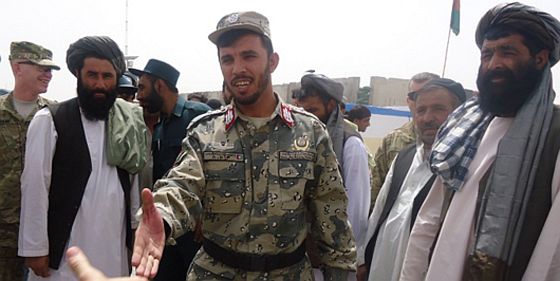
The Border Police were a new sight in the city: rough-looking types with wraparound shades and bandoliers of grenades, who could be seen lounging at checkpoints throughout the city and guarding installations such as the governor’s palace. Though restricted by Afghan law to operate only in international airports or within 50 kilometers of the border, they’d entered the city on May 29 when their boss, Brigadier General Abdul Raziq, was appointed acting chief of police in Kandahar province, following the assassination of his predecessor. Raziq was well known as a warlord and suspected drug trafficker who had waged a brutal campaign against the Taliban. He was also a close ally of both President Hamid Karzai and the U.S. military.

Inside the station, the policemen tied a scarf to Najib’s handcuffs and hung him from the ceiling until he felt as if his arms were being pulled from their sockets. Then two men—one in uniform and holding a black metal baton, the other in plain clothes and wielding a length of cable—began beating him across his hips and thighs. A third man, also in plain clothes, questioned Najib: “What was the name of the commander you were bringing food to? How often do you bring food to the enemy?” Sobbing, Najib pleaded his innocence. In a nearby room, Ahmad could hear his friend’s screams, though he was spared for the time being.

When the beating was over, Najib and Ahmad were taken outside and thrown into the back of an armored Humvee, where they lay all night with their wrists still tightly cuffed, suffocating in the stiflingly hot, enclosed interior.

Early the next morning, they were taken to the governor’s palace, a long, low white compound fronted by a series of arches, jointly guarded by American soldiers and Border Police, where U.S. and Afghan officials meet on a daily basis. The police brought them around the back, to a filthy room that smelled of human waste, where they were shackled to the wall next to two other prisoners. Then, one at a time, they were taken to a second room, empty except for a gas-powered generator.

Najib went first. He was forced to lie on his back, and wires leading to the generator were attached to toes on both his feet. A group of Border Police crowded around him, jeering and spitting snuff on his face. “Tell us the truth,” they commanded. Then they switched on the power. “It felt,” Najib told me, “like my whole body was filled with moving knives.”

After he passed out from the pain, it was Ahmad’s turn to be tortured. When the two awoke from the ordeal, they were placed in separate rooms. In the evening, they were taken to police headquarters to see Abdul Raziq himself.

Raziq is just 33 years old, slender and boyish-looking, with a square jaw and a widow’s peak that tufts up beneath the embroidered pillbox cap he favors when he’s not in uniform. Uneducated but clever and charismatic, he is, despite his youth, one of the most powerful warlords in southern Afghanistan. He controls a militia of several thousand men, as well as the lucrative drug-smuggling routes that pass through his territory, which includes a key trading town called Spin Boldak, near the border with Pakistan.

That June evening, Najib and Ahmad were seated facing Raziq, who asked them to explain why they had been arrested. They told him about the younger boys who would take leftover food home to their families, and whether it was because they had not confessed, or because their stories had checked out, Raziq ordered them released.

Najib and Ahmad complained to me of suffering nerve damage in their wrists from being cuffed for two days, and both said they’d had problems with their kidneys since the electrocutions: Ahmad, who had the more-severe burns, urinated blood for three days afterward. I examined the wounds on Ahmad’s and Najib’s toes—distinct circular burn marks that were still raw and unhealed—and I spoke with a number of their co-workers, who corroborated their claims. I was also given photos of their injuries taken immediately after they were released, and was told their story independently by a source inside the Kandahar police department unhappy with the abuses taking place under Raziq. “That’s what happened to them, when they were innocent,” this official said. “Think of what they do to the guilty.”

What happened to Ahmad and Najib is not an isolated incident, but part of a larger pattern of abuse that has occurred wherever Raziq has been in power, first in his outpost of Spin Boldak and now in Kandahar City. Raziq has long been publicly suspected of drug trafficking and corruption; allegations that he and his men have been involved in extrajudicial killings, torture, and illegal imprisonment have been trickling out for years. Raziq categorically denies all such charges, telling The Atlantic, “When someone works well, then he finds a lot of enemies who try to ruin his name.”

Last fall, Raziq and his militia were given a starring role in the U.S.-led military offensive into Taliban-controlled areas west of Kandahar City, a campaign that boosted his prestige immensely. Mentored by an American Special Forces team, Raziq’s fighters won public praise from U.S. officers for their combat prowess. After the offensive, Raziq was promoted to brigadier general—a rank requiring a direct order from President Karzai—in a January ceremony at the governor’s mansion. As Ben Moeling, who was until July the State Department’s senior official in Kandahar province, explained to me at the time, the promotion was “an explicit recognition of his importance.”

Facebooktwittermail