Category Archives: US government

CIA reportedly ordered Blackwater to murder 9/11 suspect

CIA reportedly ordered Blackwater to murder 9/11 suspect

In 2004, the CIA sent a team from the private security firm Blackwater, now Xe, to Hamburg to kill an alleged al Qaeda financier who was investigated for years by German authorities on suspicion of links to al Qaeda, according to a little-highlighted element in a Vanity Fair article to be published this month.

The report cited a source familiar with the program as saying the mission had been kept secret from the German government.

“Among the team’s targets, according to a source familiar with the program, was Mamoun Darkazanli, an al Qaeda financier living in Hamburg who had been on the agency’s radar for years because of his ties to three of the 9/11 hijackers and to operatives convicted of the 1998 bombings of U.S. embassies in East Africa,” writes Vanity Fair’s Adam Ciralsky. [continued…]

Germany knows nothing of alleged CIA murder plot

The German government said on Monday it knew nothing about a magazine report that the CIA had planned a secret operation to kill a German-Syrian in Hamburg linked to the September 11 attacks on U.S. targets.

The U.S. magazine Vanity Fair had reported that the CIA had in 2004 sent a team from the private security firm Blackwater, now Xe, to Hamburg to kill Mamoun Darkazanli, who was investigated for years by German authorities on suspicion of links to al Qaeda. [continued…]

Facebooktwittermail

UPDATED – Jordan emerges as key CIA counterterrorism ally

UPDATED with NBC report on the identity of the man who attacked the CIA last week:

Visit msnbc.com for breaking news, world news, and news about the economy

Jordan emerges as key CIA counterterrorism ally

Hours after last week’s deadly attack on a CIA base in Afghanistan, a revision was made in official accounts of the number of intelligence operatives killed in the suicide bombing. Instead of eight deaths, as initially reported, the CIA acknowledged only seven.

The eighth victim resurfaced over the weekend when his flag-draped coffin arrived in his native country, Jordan. The man, a captain in the Jordanian intelligence service, was given full military honors at a ceremony that referred only to his “humanitarian work” in war-torn Afghanistan.

In fact, the man’s death offered a rare window into a partnership that U.S. officials describe as crucial to their counterterrorism strategy. Although its participation is rarely acknowledged publicly, Jordan is playing an increasingly vital role in the fight against al-Qaeda and other terrorist groups, sometimes in countries far beyond the Middle East, according to current and former government officials from both countries.

Traditionally close ties between the CIA and the Jordanian spy agency — known as the General Intelligence Department — strengthened after the Sept. 11, 2001, attacks, occasionally prompting allegations by human rights groups that Jordan was serving as a surrogate jailer and interrogator for the U.S. intelligence agency. In the past two years, in the face of new threats in Afghanistan and Yemen, the United States has again called on its ally for help, current and former officials from both countries said. [continued…]

Editor’s Comment — When the war on terrorism began, George Bush spoke in a language that ten-year olds would understand: America had been attacked by some bad guys and we would now hunt them down.

Those ten-year olds are now entering adulthood yet government officials and journalists still insist in talking like children.

In describing the reason a Jordanian intelligence officer was working alongside CIA officers in Afghanistan as all fell victim to a suicide attack last week, Jamie Smith, a former CIA officer who worked in the border region in the years immediately after the US-led invasion, told The Washington Post: “They know the bad guy’s . . . culture, his associates, and more [than anyone] about the network to which he belongs.”

In this narrative, there’s reason to be unsure about the status of the Jordanians. Are they “good guys” like us? They’ve shown themselves as being indispensable to the United States — as sources of intelligence (who sometimes were not listened to when they should have been, such as when they forewarned the US about 9/11) and as interrogators, which is to say, torturers.

Of course, good guys don’t torture — they have someone else do it for them. And good guys don’t suppress democracy, but the Jordanians are loyal friends to America so I guess in this instance we shouldn’t be too particular about how we assign moral status.

Meanwhile, in the real world, the most striking thing about the attack on Forward Operating Base Chapman was not that it was a devastating event for the CIA — it was the inescapable degree of equivalence in the conflict.

Two groups of combatants, neither of whom wear uniforms are slugging it out on the Afghan-Pakistan border. Each group has identified what it regards as high-value targets and each are using their own available means to hit these targets. The Taliban/Qaeda are using suicide bombers while the CIA is using Hellfire missiles.

When the Taliban struck last week, as far as the reports indicate, there doesn’t appear to have been a single civilian casualty. According to Pakistani reports, on the other hand, Predator strikes have so far resulted in 140 innocent civilians killed for each al Qaeda or Taliban target hit.

So, on the basis of considering who’s killing who, there seems to be sufficient reason to set aside the term “bad guys” and the implied “good guys”. The crucial difference between the two sides does not hinge on who can make the more credible claim of virtue. It comes from the contest between the indigenous and the foreign — a contest in which the advantage of the indigenous is inherent and insurmountable.

However long Americans reside in Afghanistan, it will never become home; their departure is inevitable. All that remains unknown is when we will leave.

Suspected U.S. drone kills 2 in Pakistan

A teacher and his 9-year-old son were killed Sunday night by a suspected U.S. drone, a Pakistani administration official and an intelligence official told CNN.

The incident occurred in the village of Musaki in the North Waziristan district. The suspected U.S. drone fired two guided missiles at the compound of local resident Sadiq Noor, the officials said. There were reports Noor’s home was used by local and foreign militants. [continued…]

US drone attack kills five in Pakistan: officials

U.S. missiles flattened an extremist hideout in Pakistan’s lawless tribal belt Sunday, killing five militants in the latest strike in a recent spike in drone attacks, Pakistani officials said.

The attack targeted a house in Mosakki village, about 25 kilometres (16 miles) east of Miranshah, the main town in North Waziristan, and was the third suspected US missile attack in the tribal district in less than a week. [continued…]

Facebooktwittermail

An American world of war

An American world of war

… let’s pause a moment as the New Year begins and take stock of ourselves as what we truly are: the preeminent war-making machine on planet Earth. Let’s peer into the future, and consider just what the American way of war might have in store for us in 2010. Here are 10 questions, the answers to which might offer reasonable hints as to just how much U.S. war efforts are likely to intensify in the Greater Middle East, as well as Central and South Asia, in the year to come.

1. How busted will the largest defense budget in history be in 2010?

Strange, isn’t it, that the debate about hundreds of billions of dollars in health-care costs in Congress can last almost a year, filled with turmoil and daily headlines, while a $636 billion defense budget can pass in a few days, as it did in late December, essentially without discussion and with nary a headline in sight? And in case you think that $636 billion is an honest figure, think again — and not just because funding for the U.S. nuclear arsenal and actual “homeland defense,” among other things most countries would chalk up as military costs, wasn’t included.

If you want to put a finger to the winds of war in 2010, keep your eye on something else not included in that budget: the Obama administration’s upcoming supplemental funding request for the Afghan surge. In his West Point speech announcing his surge decision, the president spoke of sending 30,000 new troops to Afghanistan in 2010 at a cost of $30 billion. In news reports, that figure quickly morphed into “$30-$40 billion,” none of it in the just-passed Pentagon budget. To fund his widening war, sometime in the first months of the New Year, the president will have to submit a supplemental budget to Congress — something the Bush administration did repeatedly to pay for George W.’s wars, and something this president, while still a candidate, swore he wouldn’t do. Nonetheless, it will happen. So keep your eye on that $30 billion figure. Even that distinctly low-ball number is going to cause discomfort and opposition in the president’s party — and yet there’s no way it will fully fund this year’s striking escalation of the war. The question is: How high will it go or, if the president doesn’t dare ask this Congress for more all at once, how will the extra funds be found? Keep your eye out, then, for hints of future supplemental budgets, because fighting the Afghan War (forget Iraq) over the next decade could prove a near trillion-dollar prospect. [continued…]

Facebooktwittermail

Over 700 killed in 44 drone strikes in 2009

Over 700 killed in 44 drone strikes in 2009

Of the 44 predator strikes carried out by US drones in the tribal areas of Pakistan over the past 12 months, only five were able to hit their actual targets, killing five key Al-Qaeda and Taliban leaders, but at the cost of over 700 innocent civilians.

According to the statistics compiled by Pakistani authorities, the Afghanistan-based US drones killed 708 people in 44 predator attacks targeting the tribal areas between January 1 and December 31, 2009.

For each Al Qaeda and Taliban terrorist killed by US drones, 140 innocent Pakistanis also had to die. Over 90 per cent of those killed in the deadly missile strikes were civilians, claim authorities. [continued…]

Taliban: CIA attack was retaliation for drone strikes

A senior commander connected to the Afghan Taliban and involved with the attack against the CIA that left eight people dead said Saturday that the bombing was retaliation for U.S. drone strikes in the Afghan-Pakistan border region.

“We attacked this base because the team there was organizing drone strikes in Loya Paktia and surrounding area,” the commander said, referring to the area around Khost, the city where the U.S. facility was attacked. The commander, a prominent member of the Afghan insurgency, spoke on the condition of anonymity.

The suicide attack, which dealt the biggest loss to the agency in more than 25 years, killed a woman who was the station chief along with six other CIA officers and one private security contractor. [continued…]

CIA attacker driven in from Pakistan

The suicide bomber who killed at least six Central Intelligence Agency officers in a base along the Afghan-Pakistan border on Wednesday was a regular CIA informant who had visited the same base multiple times in the past, according to someone close to the base’s security director.

The informant was a Pakistani and a member of the Wazir tribe from the Pakistani tribal area North Waziristan, according to the same source. The base security director, an Afghan named Arghawan, would pick up the informant at the Ghulam Khan border crossing and drive him about two hours into Forward Operating Base Chapman, from where the CIA operates. [continued…]

Facebooktwittermail

Different Taliban groups claim role in Afghanistan bombing

Different Taliban groups claim role in Afghanistan bombing

Both Afghan and Pakistani Taliban groups claimed responsibility for the suicide bombing this week that killed eight Americans — seven of them C.I.A. officers — suggesting that the attack was viewed as a success and could be used to gain recruits and financial support.

The competing claims, made Thursday and Friday, did little to clarify the circumstances of the attack, as each group offered a different account of how the C.I.A. base in Khost Province, in southeastern Afghanistan, had been infiltrated on Wednesday.

The Afghan Taliban said the suicide bomber was a disillusioned Afghan National Army soldier, supporting accounts from NATO officials that the attacker was wearing a uniform over his suicide vest.

The Pakistani Taliban said the attacker was someone the C.I.A. had recruited to work with them, who then offered the militants his services as a double agent. [continued…]

Intel officer: CIA officers’ deaths will be avenged

An American intelligence official vowed Thursday that the United States would avenge a suspected terrorist attack on a U.S. base in Afghanistan that resulted in the deaths of seven CIA officers.

Two of those killed were contractors with private security firm Xe, formerly known as Blackwater, a former intelligence official told CNN. The CIA considers contractors to be officers. [continued…]

CIA caught in dirty and secretive war against al-Qaeda on Afghan border

It was an operation by what are euphemistically called “other government agencies” that was alleged to have killed a number of students in Kunar province on Saturday, causing widespread anger in Afghanistan.

CIA-led night raids such as this have proved controversial before. A UN-commissioned report last year from Philip Alston, director of the New York Centre for Human Rights, claimed that such raids raised issues under humanitarian and international law.

The report criticised the “opaque” use of ultra-secretive CIA units operating alongside irregular Afghan militias such as the Pashai.

Professor Alston complained that many raids were “composed of Afghans but with a handful, at most, of international people directing it” and were “not accountable to any international military authority”.

Such units answer directly to the Pentagon rather than to the Nato command structure, and their operations are often so secretive that even other US forces operating nearby are sometimesmay be unaware of them. [continued…]

Facebooktwittermail

Afghanistan suicide bombing kills 8 CIA officers

Afghanistan suicide bombing kills 8 CIA officers

A bomber slipped into a U.S. base in eastern Afghanistan on Wednesday and detonated a suicide vest, killing eight CIA officers in one of the deadliest days in the agency’s history, current and former U.S. officials said.

The attack took place at Forward Operating Base Chapman in Khowst province, an area near the border with Pakistan that is a hotbed of insurgent activity. An undisclosed number of civilians were wounded, the officials said. No military personnel with the U.S. or North Atlantic Treaty Organization forces were killed or injured, they said.

A U.S. official who spoke on condition of anonymity said the CIA had a major presence at the base, in part because of its strategic location. [continued…]

In year-end message, Taliban calls 2009 ‘successful’

In a written statement, the Taliban calls 2009 “a successful year for mujahedeen” and says it is determined to drive coalition forces out of Afghanistan in 2010.

“Last year the guerrilla warfare, frontline war, attacks and road mines against the invaders increased as the enemy began to cry out for reconciliation,” said the statement, obtained by CNN on Wednesday.

“The enemy does not have a constant policy,” the unsigned statement said. “Sometimes they talk about sending more soldiers and other times they speak of an early withdrawal. Their thinking is irrational.” [continued…]

Facebooktwittermail

Craving terrorist melodrama

Craving terrorist melodrama

The fact that Obama doesn’t hysterically run around like some sort of frightened chicken with his head cut off every time Al Qaeda sneezes — or swagger to the nearest camera to beat his chest and play the role of protective daddy-cowboy — is one of the things I like best about him. As for Armao’s “point” about how Janet Napolitano probably took it easy because the “boss was away” — and her belief that Terrorists will strike more on holidays if Obama isn’t affixed to his chair in the Oval Office, as though he’s the Supreme Airport Screener: those are so self-evidently dumb it’s hard to believe they found their way even into something written by one of Fred Hiatt’s editorial writers.

What this actually illustrates is that many people are addicted to the excitement and fear of Terrorist melodramas. They crave some of that awesome 9/12 energy, where we overnight became The Greatest Generation and — unified and resolute — rose to the challenge of a Towering, Evil Enemy. Armao is angry and upset because the leader didn’t oblige her need to re-create that high drama by flamboyantly flying back to Washington to create a tense storyline, pick up a bullhorn, stand on some rubble, and personally make her feel “safe.” Maureen Dowd similarly complained today that Obama “appeared chilly in his response to the chilling episode on Flight 253.”

That’s because Obama reacted as though this is exactly what it actually is: a lame, failed attempt to kill people by a fractured band of criminals. It’s not the Cuban Missile Crisis or the attack on Pearl Harbor, as disappointing and unfulfilling as it is to accept that. It merits analysis, investigation and possibly policy changes by the responsible government agencies — not a bright-red-alert, bell-ringing, siren-sounding government-wide emergency that venerates Al Qaeda into a threat so profound that the President can’t even be away from Washington lest they get us all. As always, Al Qaeda’s greatest allies are the ones in the U.S. who tremble with the most fear at the very mention of their name and who quite obviously crave a return of that stimulating, all-consuming, elevating 9/12 glory. [continued…]

Facebooktwittermail

President Obama takes the heat President Bush did not

President Obama takes the heat President Bush did not

Eight years ago, a terrorist bomber’s attempt to blow up a transatlantic airliner was thwarted by a group of passengers, an incident that revealed some gaping holes in airline security just a few months after the attacks of Sept. 11. But it was six days before President George W. Bush, then on vacation, made any public remarks about the so-called “shoe bomber,” Richard Reid, and there were virtually no complaints from the press or any opposition Democrats that his response was sluggish or inadequate.

That stands in sharp contrast to the withering criticism President Barack Obama has received from Republicans and some in the press for his reaction to Friday’s incident on a Northwest Airlines flight heading for Detroit. [continued…]

U.S. intel lapses helped Abdulmutallab

CBS News has learned that as early as August of 2009 the Central Intelligence Agency was picking up information on a person of interest dubbed “The Nigerian,” suspected of meeting with “terrorist elements” in Yemen.

Sources tell CBS News “The Nigerian” has now turned out to be Umar Farouk Abdulmutallab. But that connection was not made when Abudulmutallab’s father went to the U.S. Embassy in Nigeria three months later, on November 19, 2009. It was then he expressed deep concerns to a CIA officer about his son’s ties to extremists in Yemen, a hotbed of al Qaeda activity.

In fact, CBS News has learned this information was not connected until after the attempted Christmas Day bombing. [continued…]

Al-Qaeda ‘groomed Abdulmutallab in London’

The Christmas Day airline bomb plot suspect organised a conference under the banner “War on Terror Week” as he immersed himself in radical politics while a student in London, The Times has learnt.

Umar Farouk Abdulmutallab, 23, a former president of the Islamic Society at University College London, advertised speakers including political figures, human rights lawyers and former Guantánamo detainees.

One lecture, Jihad v Terrorism, was billed as “a lecture on the Islamic position with respect to jihad”.

Security sources are concerned that the picture emerging of his undergraduate years suggests that he was recruited by al-Qaeda in London. Security sources said that Islamist radicalisation was rife on university campuses, especially in London, and that college authorities had “a patchy record in facing up to the problem”. Previous anti-terrorist inquiries have uncovered evidence of extremists using political meetings and religious study circles to identify potential recruits. [continued…]

Facebooktwittermail

Watching government cure incompetence with idiocy

The trouser bomber effect: watching government cure incompetence with idiocy

The tragedy in the midst of this farce was that it was all so much easier. And the problem had nothing to do with any of the myriad of shinplaster grotesqueries we have come to expect from the Department of Homeland Security. Obama’s statement “that all appropriate measures be taken to increase security for air travel” is totally beside the point.

It is really simple, the American Embassy in Lagos, Nigeria screwed up bigtime. Even a minor consular officer like a grade 6 Foreign Service Officer can understand that, even if no one in the press or the Obama Administration seems to. Unfortunately it appears no minor consular officer ever got their hands on this in Lagos. This screw up was handled by the big guys at the Embassy.

Once a credible person of the stature of Abdulmutullab’s father, multimillionaire Umaru Mutullab, one of the most important figures in banking in all of Africa, contacted the Embassy and said he feared his son had been “radicalized,” the Embassy should have immediately reviewed the young man’s American multiple entry visa granted to him by the American Embassy in London in 2008 and placed a hold on it pending a hearing. But that’s not what happened. According to the Department of State, Umaru had a face to face meeting at the request of high officials in Nigerian Security with top American embassy officials on November 19th. And the records at State show what did happen. [continued…]

Facebooktwittermail

US forces mounted secret Pakistan raids in hunt for al-Qaida

US forces mounted secret Pakistan raids in hunt for al-Qaida

American special forces have conducted multiple clandestine raids into Pakistan’s tribal areas as part of a secret war in the border region where Washington is pressing to expand its drone assassination programme.

A former Nato officer said the incursions, only one of which has been previously reported, occurred between 2003 and 2008, involved helicopter-borne elite soldiers stealing across the border at night, and were never declared to the Pakistani government.

“The Pakistanis were kept entirely in the dark about it. It was one of those things we wouldn’t confirm officially with them,” said the source, who had detailed knowledge of the operations. [continued…]

Welcome to Pashtunistan: the aim of America’s secret war?

Few people by now can be unaware of Blackwater, later known as Blackwater Worldwide and now as Xe. The private security agency formed in 1997 and based in North Carolina is owned by Erik Prince, a former member of the US Navy Seal special forces, and has long-standing links with both the CIA and the FBI.

Its presence in Pakistan has been an open secret for some years. The investigative journalist and writer Jeremy Scahill, an authority on Blackwater and author of the bestselling Blackwater: the Rise of the World’s Most Powerful Mercenary Army, revealed last month that it has been there since 2006. He says Blackwater is being employed for covert ops, essentially intended to target high-value al Qa’eda leaders, including Osama bin Laden, but it has also assisted in providing information for drone attacks and has kidnapped suspects and transported them covertly to the US for interrogation.

In other words, it is an American agency with a licence to kill or kidnap, thus exonerating official American agencies that might one day be held accountable. (Although personally I doubt if the CIA will ever be held accountable. I continue to aver that it is the only real rogue intelligence agency in the world. Mossad might enjoy liberty of action for any operation, but it cannot undertake one without the approval of the Israeli prime minister: no such restriction applies to the CIA.) [continued…]

Facebooktwittermail

Stunning statistics about the war every American should know

Stunning statistics about the war every American should know

A hearing in Sen. Claire McCaskill’s Contract Oversight subcommittee on contracting in Afghanistan has highlighted some important statistics that provide a window into the extent to which the Obama administration has picked up the Bush-era war privatization baton and sprinted with it. Overall, contractors now comprise a whopping 69% of the Department of Defense’s total workforce, “the highest ratio of contractors to military personnel in US history.” That’s not in one war zone — that’s the Pentagon in its entirety.

In Afghanistan, the Obama administration blows the Bush administration out of the privatized water. According to a memo [PDF] released by McCaskill’s staff, “From June 2009 to September 2009, there was a 40% increase in Defense Department contractors in Afghanistan. During the same period, the number of armed private security contractors working for the Defense Department in Afghanistan doubled, increasing from approximately 5,000 to more than 10,000. [continued…]

Facebooktwittermail

U.S.-Israeli arms cooperation quietly growing

U.S.-Israeli arms cooperation quietly growing

Leaders in Washington and Jerusalem have publicly locked horns over the issue of West Bank settlements. And Israeli public opinion has largely viewed America’s new administration as unfriendly. But behind the scenes, strategic security relations between the two countries are flourishing.

Israeli officials have been singing the praises of President Obama for his willingness to address their defense concerns and for actions taken by his administration to bolster Israel’s qualitative military edge — an edge eroded, according to Israel, during the final year of the George W. Bush presidency.

Among the new initiatives taken by the administration, the Forward has learned, are adjustments in a massive arms deal the Bush administration made with Arab Gulf states in response to Israeli concerns. There have also been upgrades in U.S.-Israeli military cooperation on missile defense. And a deal is expected next year that will see one of the United States’ most advanced fighter jets go to Israel with some of America’s most sensitive new technology.

Amid the cacophony of U.S.-Israel clashes on the diplomatic front, public attention given to this intensified strategic cooperation has been scant. But in a rare public comment in October, Israeli Ambassador Michael Oren praised the Obama administration’s response to complaints about lost ground during the close of the Bush years as “warm and immediate.” [continued…]

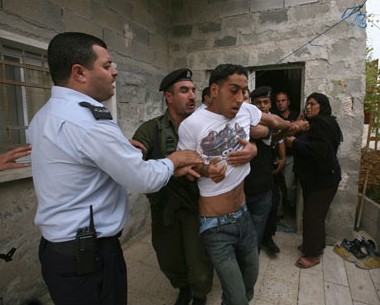
CIA working with Palestinian security agents

Palestinian security agents who have been detaining and allegedly torturing supporters of the Islamist organisation Hamas in the West Bank have been working closely with the CIA, the Guardian has learned.

Less than a year after Barack Obama signed an executive order that prohibited torture and provided for the lawful interrogation of detainees in US custody, evidence is emerging the CIA is co-operating with security agents whose continuing use of torture has been widely documented by human rights groups.

The relationship between the CIA and the two Palestinian agencies involved – Preventive Security Organisation (PSO) and General Intelligence Service (GI) – is said by some western diplomats and other officials in the region to be so close that the American agency appears to be supervising the Palestinians’ work.

One senior western official said: “The [Central Intelligence] Agency consider them as their property, those two Palestinian services.” A diplomatic source added that US influence over the agencies was so great they could be considered “an advanced arm of the war on terror”. [continued…]

Obama told China: I can’t stop Israel strike on Iran indefinitely

President Barack Obama has warned his Chinese counterpart that the United States would not be able to keep Israel from attacking Iranian nuclear installations for much longer, senior officials in Jerusalem told Haaretz.

They said Obama warned President Hu Jintao during the American’s visit to Beijing a month ago as part of the U.S. attempt to convince the Chinese to support strict sanctions on Tehran if it does not accept Western proposals for its nuclear program.

The Israeli officials, who asked to remain anonymous due to the sensitivity of the matter, said the United States had informed Israel on Obama’s meetings in Beijing on Iran. They said Obama made it clear to Hu that at some point the United States would no longer be able to prevent Israel from acting as it saw fit in response to the perceived Iranian threat. Continue reading

Facebooktwittermail

Muslims say FBI tactics sow anger and fear

Muslims say FBI tactics sow anger and fear

The anxiety and anger have been building all year. In March, a national coalition of Islamic organizations warned that it would cease cooperating with the F.B.I. unless the agency stopped infiltrating mosques and using “agents provocateurs to trap unsuspecting Muslim youth.”

In September, a cleric in Bay Ridge, Brooklyn, sued the government, claiming that the F.B.I. had threatened to scuttle his application for a green card unless he agreed to spy on relatives overseas — echoing similar claims made in recent court cases in California, Florida and Massachusetts.

And last month, after an imam in Queens was charged with aiding what the authorities called a bomb-making plot, a group of South Asian Muslims there began compiling a database of complaints about their brushes with counterterrorism investigators.

Since the terror attacks of 2001, the F.B.I. and Muslim and Arab-American leaders across the country have worked to build a relationship of trust, sharing information both to fight terrorism and to protect the interests of mosques and communities.

But those relations have reached a low point in recent months, many Muslim leaders say. Several high-profile cases in which informers have infiltrated mosques and helped promote plots, they say, have sown a corrosive fear among their people that F.B.I. informers are everywhere, listening. [continued…]

Facebooktwittermail

Documents show DHS improperly spied on National of Islam in 2007

Documents show DHS improperly spied on National of Islam in 2007

The Department of Homeland Security improperly gathered intelligence on the Nation of Islam for eight months in 2007 when the leader of the black Muslim group, Louis Farrakhan, was in poor health and appeared to be yielding power, according to government documents released Wednesday.

The intelligence gathering violated domestic spying rules because analysts took longer than 180 days to determine whether the U.S-based group or its American members posed a terrorist threat. Analysts also disseminated their report too broadly, according to documents obtained under the Freedom of Information Act (FOIA) by the Electronic Frontier Foundation, a civil liberties group.

The disclosure was included in hundreds of heavily redacted pages released by the Justice Department as part of long-standing FOIA lawsuits about the government’s policies on terrorist surveillance, detention and treatment since the Sept. 11, 2001, attacks. It marks the latest case of inappropriate domestic spying under rules that were expanded after the terror attacks to give intelligence agencies more latitude. [continued…]

Facebooktwittermail

Drone attacks may be expanded in Pakistan

Drone attacks may be expanded in Pakistan

Senior U.S. officials are pushing to expand CIA drone strikes beyond Pakistan’s tribal region and into a major city in an attempt to pressure the Pakistani government to pursue Taliban leaders based in Quetta.

The proposal has opened a contentious new front in the clandestine war. The prospect of Predator aircraft strikes in Quetta, a sprawling city, signals a new U.S. resolve to decapitate the Taliban. But it also risks rupturing Washington’s relationship with Islamabad.

The concern has created tension among Obama administration officials over whether unmanned aircraft strikes in a city of 850,000 are a realistic option. Proponents, including some military leaders, argue that attacking the Taliban in Quetta — or at least threatening to do so — is crucial to the success of the revised war strategy President Obama unveiled last week.

“If we don’t do this — at least have a real discussion of it — Pakistan might not think we are serious,” said a senior U.S. official involved in war planning. “What the Pakistanis have to do is tell the Taliban that there is too much pressure from the U.S.; we can’t allow you to have sanctuary inside Pakistan anymore.”

But others, including high-ranking U.S. intelligence officials, have been more skeptical of employing drone attacks in a place that Pakistanis see as part of their country’s core. Pakistani officials have warned that the fallout would be severe.

“We are not a banana republic,” said a senior Pakistani official involved in discussions of security issues with the Obama administration. If the United States follows through, the official said, “this might be the end of the road.” [continued…]

Pakistan rebuffs U.S. on Taliban crackdown

Demands by the United States for Pakistan to crack down on the strongest Taliban warrior in Afghanistan, Siraj Haqqani, whose fighters pose the biggest threat to American forces, have been rebuffed by the Pakistani military, according to Pakistani military officials and diplomats.

The Obama administration wants Pakistan to turn on Mr. Haqqani, a longtime asset of Pakistan’s spy agency who uses the tribal area of North Waziristan as his sanctuary. But, the officials said, Pakistan views the entreaties as contrary to its interests in Afghanistan beyond the timetable of President Obama’s surge, which envisions drawing down American forces beginning in mid-2011.

The demands, first made by senior American officials before President Obama’s Afghanistan speech and repeated many times since, were renewed in a written demarche delivered in recent days by the United States Embassy to the head of the Pakistani military, Gen. Ashfaq Parvez Kayani, according to American officials. Gen. David Petraeus followed up on Monday during a visit to Islamabad.

The demands have been accompanied by strong suggestions that if the Pakistanis cannot take care of the problem, including dismantling the Taliban leadership based in Quetta, Pakistan, then the Americans will by resorting to broader and more frequent drone strikes in Pakistan.

But the Pakistanis have greeted the refrain with official public silence and private anger, illustrating the widening gulf between the allies over the Afghan war.

Former Pakistani military officers voice irritation with the American insistence daily on television, part of a mounting grievance in Pakistan that the alliance with the United States is too costly to bear.

“It is really beginning to irk and anger us,” said a security official familiar with the deliberations at the senior levels of the Pakistani leadership.

The core reason for Pakistan’s imperviousness is its scant faith in the Obama surge, and what Pakistan sees as the need to position itself for a major regional realignment in Afghanistan once American forces begin to leave. [continued…]

Facebooktwittermail

Blackwater guards tied to secret CIA raids

Blackwater guards tied to secret CIA raids

Private security guards from Blackwater Worldwide participated in some of the C.I.A.’s most sensitive activities — clandestine raids with agency officers against people suspected of being insurgents in Iraq and Afghanistan and the transporting of detainees, according to former company employees and intelligence officials.

The raids against suspects occurred on an almost nightly basis during the height of the Iraqi insurgency from 2004 to 2006, with Blackwater personnel playing central roles in what company insiders called “snatch and grab” operations, the former employees and current and former intelligence officers said.

Several former Blackwater guards said that their involvement in the operations became so routine that the lines supposedly dividing the Central Intelligence Agency, the military and Blackwater became blurred. Instead of simply providing security for C.I.A. officers, they say, Blackwater personnel at times became partners in missions to capture or kill militants in Iraq and Afghanistan, a practice that raises questions about the use of guns for hire on the battlefield.

Separately, former Blackwater employees said they helped provide security on some C.I.A. flights transporting detainees in the years after the 2001 terror attacks in the United States.

The secret missions illuminate a far deeper relationship between the spy agency and the private security company than government officials had acknowledged. Blackwater’s partnership with the C.I.A. has been enormously profitable for the North Carolina-based company, and became even closer after several top agency officials joined Blackwater. [continued…]

When did the CIA become a Blackwater subsidiary?

Today’s Times disclosures can be seen as an extension of the claims made by Erik Prince in his curious Vanity Fair interview that he was a proud but informal operative of the CIA, notwithstanding his unsuccessful attempts to sign up through the front door. In a discussion with Jeremy Scahill at The Nation, I noted that the interview appeared to be carefully laying the foundations for a “graymail” defense for Prince, should federal prosecutors move against him. One common form of “graymail” for a figure who has a relationship with the U.S. intelligence community is to warn that, if prosecuted, he will have to spill the beans on his covert activities in order to defend himself. The tactic has proven widely effective. [continued…]

Facebooktwittermail

McChrystal’s stovepipe operation

McChrystal’s stovepipe operation

President Barack Obama’s national address last Tuesday not only detailed the United States’ strategy on Afghanistan, it laid bare his new administration’s strengths and weaknesses – and confirmed the growing suspicion that, eight years after September 11, 2001, meeting America’s global challenges with a military response remains the default position of the Washington policymaking establishment.

“Don’t underestimate the impact that eight years of the [George W] Bush administration has had in Washington,” a senior State Department official explained this last summer. “The Bush people set out the language of the war on terrorism, invented the vocabulary, defined the terms. People talk about the importance of ‘doing’ diplomacy, but no one really knows what that means or how tough it can really be.”

At least initially, this assessment seemed contradicted by the administration’s flurry of diplomatic activity. Its first months were taken up by Secretary of State Hillary Clinton’s globetrotting, special envoy George Mitchell’s high-profile Jerusalem meetings, AfPak specialist Richard Holbrooke’s repeated initiatives with Pakistan’s President Asif Ali Zardari – and Obama’s decision to engage Iran in direct talks about its nuclear program.

Suddenly, surprisingly, the military seemed relegated to playing a minor role in Washington: Bush’s hero David Petraeus, the US commander for the greater Middle East, was no longer in the headlines, the war in Iraq seemed well in hand and Defense Secretary Robert Gates was nowhere to be seen.

All of this changed in May, when a series of well-timed Taliban offensives led to a spike in US casualties and Gates decided to replace the US Afghan commander, David McKiernan, with Lieutenant General Stanley McChrystal. The change did not come as a surprise to Pentagon officers, who had watched Petraeus and McKiernan struggle through a difficult relationship: “The two couldn’t be in the same room together,” a McKiernan aide says. “We knew there’d be a fist fight if we left them alone.” The disagreement was personal: McKiernan resented answering to an officer whom he had once commanded and viewed as politically ambitious.

But the relationship was also scarred by a subtle disagreement over how to meet the Taliban challenge. Both McKiernan and Petraeus agreed that the Taliban posed a security challenge to the Afghan government, but McKiernan focused first on development – on building what he called “human capital”. Petraeus disagreed: you can’t build “human capital” without security, he argued, and the security situation in the country was deteriorating. Then too, Petraeus thought, what was needed in Afghanistan was an officer who could respond creatively to what Petraeus believed was turning into an asymmetric fight – and McKiernan was an officer with a deep background in running conventional wars.

McChrystal, a former Green Beret and a celebrated special operations commander, was the answer. Petraeus recommended a change to Gates, and Gates agreed. Within days of his May 11 appointment, McChrystal showed up in the Afghan capital, Kabul, with a team of counter-insurgency experts who commandeered McKiernan’s headquarters and fanned out throughout the country.

McChrystal’s teams were told to identify the problem and find a solution. “They absolutely flooded the zone,” a US development officer says. “There must have been hundreds of them. They were in every province, every village, talking to everyone. There were 10 of them for every one of us.” Not surprisingly, within weeks of their deployment, McChrystal’s team leaders had concluded that the US was facing was an escalating insurgency that could only be checked with an increase in US troops. In-country State Department officials rolled their eyes: “What a shock. If you deploy a gang squad, they’re going to find a gang,” a senior State Department official says with a tinge of bitterness. “They were looking for an insurgency and they found one.”

“From the minute that McChrystal showed up in Kabul, he drove the debate,” a White House official confirms. “You’ll notice – from May on it was no longer a question of whether we should follow a military strategy or deploy additional troops. It was always, ‘should we do 20,000 or 30,000 or 40,000, or even 80,000’? We weren’t searching for the right strategy; we were searching for the right number.”

A senior State Department official, watching McChrystal from her State Department perch in Washington, remembers the frustration among the department’s top policymakers: “We kept saying ‘we need to open up to the other side, like we did in Iraq with the Anbar insurgency,’ and the military kept saying, ‘well this isn’t Iraq.’ And so we’d answer: ‘fine, so if Afghanistan isn’t Iraq, then why do you keep talking about a surge?’ And we never got an answer.”

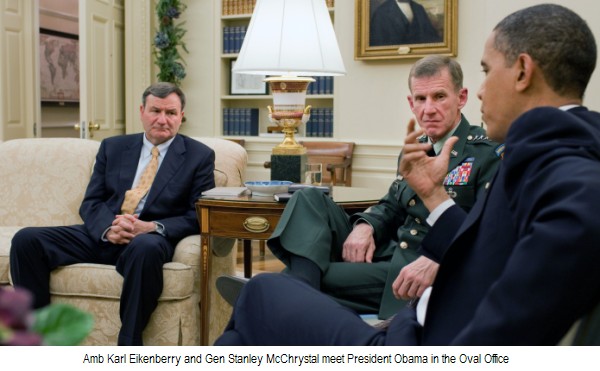
The State Department’s frustration extended into the embassy in Kabul, where the US ambassador, Karl Eikenberry, was having his own problems with McChrystal. The appointment of Eikenberry in March of 2009 had been greeted with skepticism in the State Department because of his background as a West Pointer, a retired lieutenant general and a US security coordinator in the country. But if anyone would be sympathetic to McChrystal, it was now thought, it would be Eikenberry.

But that’s not what happened: Eikenberry won friends among professional diplomats for his easygoing manner and quick understanding of their problems – and for his open irritation at McChrystal’s imperious manner. “McChrystal came in and he just thought he was some kind of Roman proconsul, a [Douglas] MacArthur,” an Eikenberry colleague notes. “He was going to run the whole thing. He didn’t need to consult with the State Department or civilians, let alone the ambassador. This was not only the military’s show, it was his show.”

But McChrystal was not only able to “flood the zone” in Afghanistan, he was able to do so in Washington. As the director of the Joint Staff, a position he held just prior to arriving in Kabul, McChrystal established the Pakistan-Afghanistan Coordinating Cell (PACC), a 70-person military-civilian operations group housed in the Pentagon’s National Command Center, one of the most secure offices in the world. “This isn’t a place you just wander in and out of,” a senior Pentagon official says. The “PACC” bypassed the normal command structure – and the State Department. It reported to McChrystal, who rotated its officers in and out of Kabul every three to four months.

The PACC is “a stovepipe operation”, this senior Pentagon official notes. “It’s beautiful. It’s headed up by McChrystal acolytes, former special operations officers who view him [McChrystal] as their patron. So they follow his lead. And there is no requirement for them to share any of the information they get from Kabul with the State Department or anyone else – let alone with Eikenberry. This is McChrystal’s game. The PACC people in Washington pass information to McChrystal without going through any channels and they take the best information from Kabul and they brief [JCS chairman Admiral Mike] Mullen – and he briefs the president. So during the run-up to the Afghanistan decision, the military always looked current. They had the best information. Everyone else looked like a bunch of amateurs. Eikenberry was out of the loop. He had no chop [influence] on any of it. They just ran circles around him.” [continued…]

Facebooktwittermail

Obama wanted a surge, he’s getting a surge, and it feels good

Obama wanted a surge, he’s getting a surge, and it feels good

Mine might not be a headline the New York Times would choose, but that’s the story they tell under their flatly descriptive: “How Obama Came to Plan for ‘Surge’ in Afghanistan.”

The narrative reads like a script for NBC’s “West Wing” as it dramatises Obama’s deliberative process and that seems to have been the object of the exercise for this stellar team of reporters: paint a picture of presidential solemnity that will inspire confidence in how Obama makes decisions and thereby drum up a bit of good old-fashioned blind-faith in the presidency.

If there is no inescapable logic to the idea that a faster surge will enable a swifter withdrawal, then — the Times would have its readers believe — we shouldn’t worry our little heads about that because our fabulously diligent president has performed an operation of executive intelligence that renders all further consideration superfluous.

In a similar vein I’ll spare readers here the tedium of wading through a 4,660-word article and pick out some of the highlights. Actually, to my eye there is really only one point of substance:

Mr. Obama and his advisers … considered options for stepping up the pursuit of extremists in Pakistan’s border areas. He eventually approved a C.I.A. request to expand the areas where remotely piloted aircraft could strike, and other covert action. The trick would be getting Pakistani consent, which still has not been granted.

For “expand the areas” read: Baluchistan.

If getting Pakistani consent to open a new front in the war simply comes down to diplomatic finesse, then yes, you could call it a “trick” managing to get those instransigent Pakistanis to do the right thing.

In reality, it is merely the imperatives of fluent story-telling that compels the Times to glide over this important detail in the much larger and grimmer story of the war. Understanding why Baluchistan represents a red line that Pakistan refuses to abandon is something that Washington might grasp only when it’s too late.

The matter of most importance both for this administration and for the New York Times has less to do with people, places, history and geography, than it does with high-value words. Words like “surge”.

Obama wants to push in hard so he can pull out fast.

A three-month strategic review thus produced a choreographic solution:

The plan, called Option 2A, was presented to the president on Nov. 11. Mr. Obama complained that the bell curve would take 18 months to get all the troops in place.

He turned to General Petraeus and asked him how long it took to get the so-called surge troops he commanded in Iraq in 2007. That was six months.

“What I’m looking for is a surge,” Mr. Obama said. “This has to be a surge.”

That represented a contrast from when Mr. Obama, as a presidential candidate, staunchly opposed President Bush’s buildup in Iraq. But unlike Mr. Bush, Mr. Obama wanted from the start to speed up a withdrawal as well. The military was told to come up with a plan to send troops quickly and then begin bringing them home quickly.

On November 29, after winning the approval of all his immediate advisers, the president moved into action:

Mr. Obama then went to the Situation Room to call General McChrystal and Ambassador Eikenberry. The president made it clear that in the next assessment in December 2010 he would not contemplate more troops. “It will only be about the flexibility in how we draw down, not if we draw down,” he said.

Two days later, Mr. Obama flew to West Point to give his speech. After three months of agonizing review, he seemed surprisingly serene. “He was,” said one adviser, “totally at peace.”

Obama wanted a surge, he’s getting a surge, and it feels good — at least for now.

Facebooktwittermail