Category Archives: US government

Afghan spy agency arms villagers to hold off ISIS

The Wall Street Journal reports: n Afghan spy agency is recruiting villagers for militias to hold back Islamic State fighters seeking to expand their foothold in this opium heartland in eastern Afghanistan.

The program, which one top official says the government hopes to roll out across the country and may later use against the Taliban, is President Ashraf Ghani ’s riskiest attempt to defend rural villages—and also a part of his much larger counterinsurgency strategy.

The government has closely guarded the program, and news of it essentially hasn’t been reported since its establishment in August 2015. Details of the program came from Afghan government officials, local village leaders and Western officials who have been monitoring its progress.

The militia groups that are part of the pilot project, known as the People’s Uprising Program, are being called on to hold territory the army has recaptured from Islamic State in three districts.

More than a thousand men, mostly village farmers who turned against the extremist group’s harsh rule in areas it seized in the past year, are on the payroll of the spy agency, the National Directorate of Security, which receives funding from the U.S. Central Intelligence Agency. So far, the militias in Kot, with the backing of the army and police, have repelled six Islamic State attacks. [Continue reading…]

Facebooktwittermail

Intelligence community olive branch on data sharing greeted with skepticism

The Intercept reports: Top intelligence community lawyer Robert Litt has offered a rare olive branch to privacy advocates, in the form of information.

In a post on one of the intelligence community’s favorite blogs on Wednesday, Litt, general counsel for the Office of the Director of National Intelligence, outlined new intelligence data-sharing guidelines that he said will be released soon.

The post, on Just Security, was essentially a response to reporting last month from the New York Times’s Charlie Savage that the NSA would soon be sharing with other government agencies the raw, unfiltered intelligence from the depths of its massive overseas spying programs.

“There has been a lot of speculation about the content of proposed procedures that are being drafted to authorize the sharing of unevaluated signals intelligence,” Litt wrote.

The New York Times story raised concerns that the data, which inevitably includes information about Americans, would become too easily accessible by intelligence agencies including the FBI, potentially leading to fishing expeditions. [Continue reading…]

BuzzFeed reports: Just days after breaking into a terrorist’s iPhone using a mysterious third-party technique, FBI officials on Friday told local law enforcement agencies it will assist them with unlocking phones and other electronic devices.

The advisory, obtained by BuzzFeed News, was sent in response to law enforcement inquiries about its new method of unlocking devices — a technique the FBI said was successful at gaining access to the iPhone 5C belonging to one of the shooters in the deadly San Bernardino, California, attack.

“In mid-March, an outside party demonstrated to the FBI a possible method for unlocking the iPhone,” the message said. “That method for unlocking that specific iPhone proved successful.” [Continue reading…]

Facebooktwittermail

America’s asylum policy is broken

Elizabeth Rubin writes: I recently received a phone call from Alabama. It was Samey Honaryar, an Afghan who had worked as an interpreter with the United States military and had fled Taliban persecution hoping to find asylum here. Samey is not accused of committing any crime. Yet for nearly a year, he’s been locked up in Etowah County Detention Center, among the worst and most remote of immigration detention centers, with little access to lawyers or medical attention.

“I cannot take it anymore,” said Samey, who was planning a hunger strike. “I served this country. I risked my life for this country, and this is how I’m repaid.”

I have reported from Afghanistan frequently since 2001, and I know that interpreters are an essential conduit into a culture easily misread by foreigners. Nearly every translator I’ve worked with has saved my life. But once they choose to work for the military, their job becomes a political act, making them marked men and women for the Taliban.

At a time when Europeans and Canadians are sheltering over a million asylum seekers, many from conflicts created by United States policies, Samey’s treatment demands attention. Documents and witnesses show that Samey risked his life for American soldiers. But he has been cast into immigration purgatory nonetheless, his troubles caused by a toxic mix of bureaucracy, fear, prejudice and, most poignantly, his naïve faith in American honor. [Continue reading…]

Facebooktwittermail

Mixed reactions from Iraqis as American troops enter the ground war against ISIS

Mustafa Habib writes: Iraqis found out that just about a week ago at dawn, the US military had entered the “war” against the extremist group known as the Islamic State, for real. In the northern province of Ninawa, near the extremist-held city of Mosul, US ground troops – a group of 200 soldiers from the 26th Marine Expeditionary Unit, according to the US Secretary of Defence, Ashton Carter – used their artillery against the Islamic State, or IS, group’s fighters in the area.

Speaking at a press briefing last Friday, Carter told reporters that the US troops had set up base at an outpost to be named Firebase Bell – as the LA Times newspaper reported, “this would be the first American combat base since the US returned to Iraq in 2014”.

So how did Iraqis feel about the apparent return of US boots to their ground?

“The US troops have finally decided to join in properly,” says Qais al-Saadi, a colonel in the Iraqi army. “Previously they were limited to air raids. I think now they have discovered that these air raids did not affect the Islamic State as much as they hoped and they have become convinced that ground troops are also important.”

Al-Saadi was happy about this, noting that the US was paving the way for the Iraqi army, especially with their recent success in eliminating two senior members of the IS group in quick succession.

Social media lit up with debate on the subject. Some welcomed the US troops, believing they were necessary in order to defeat the IS group. Often Iraqi commentators said that this move by the US was too late and that they should have helped from the beginning. Others were not so happy, saying it was a new occupation. [Continue reading…]

Facebooktwittermail

A CIA grunt’s tale of the fog of secret war

The New York Times reports: In Douglas Laux’s final days as a C.I.A. officer, the futility of his mission prompted him to quote George Orwell to his boss.

Mr. Laux had spent months in 2012 working with various Middle Eastern nations that were trying to ship arms to Syria to help disparate rebel groups there. But it had become clear to him that the C.I.A had little ability to control the squabbling and backstabbing among the Saudis, Qataris and other Arabs.

He told a senior C.I.A. officer he felt like Winston Smith, the character in “1984” known for his fatalism, because he was carrying out his work without comprehending the politics and competing agendas thwarting progress in aiding the rebellion. “I understand the how,” Mr. Laux said, paraphrasing one of Smith’s famous lines. “I do not understand the why.”

It is a sentiment that might sum up much of Mr. Laux’s career at the C.I.A., an organization he served for eight years as an undercover case officer and soldier in the agency’s shadowy conflicts overseas. His career at the agency began with a tour at a remote firebase in southern Afghanistan and ended with a spot on the agency’s Syria Task Force — a life in war zones that is emblematic of the lives of a large cadre of American spies who joined the C.I.A. after the Sept. 11 terrorist attacks. He left the agency three years ago, but is speaking publicly about his experiences there for the first time in conjunction with the release of a memoir. [Continue reading…]

Facebooktwittermail

U.S. and Russia reach ‘agreement’ that some day Assad will leave Syria

Middle East Eye reports: The US and Russia have reached an understanding that Syrian President Bashar Assad will leave to another country as part of the future peace process, according to the Lebanese Al-Hayat newspaper.

A diplomatic source on the Security Council told al-Hayat in reports published on Thursday that US Secretary of State John Kerry had “informed concerned Arab countries that the US and Russia have reached an agreement on the future of the political process in Syria, including the transfer of President Bashar al-Assad to another country.”

The source said the US-Russian agreement was “clear” in diplomatic back channels, though he said that “the timing and context of that in the political process remains unclear to everyone at the moment”. [Continue reading…]

Facebooktwittermail

In Iraq 21 generals lead 5,000 U.S. troops — about what a colonel usually commands

Nancy Youssef reports: In the war against the self-proclaimed Islamic State, the U.S. military is notably short on soldiers, but apparently not on generals.

There are at least 12 U.S. generals in Iraq, a stunningly high number for a war that, if you believe the White House talking points, doesn’t involve American troops in combat. And that number is, if anything, a conservative estimate, not taking into account the flag officers running the U.S. air war, the admirals helping wage the war from the sea, or their superiors back at the Pentagon.

At U.S. headquarters inside Baghdad’s fortified Green Zone, even majors and colonels frequently find themselves saluting superiors at a pace that outranks the Pentagon and certainly any normal military installation. With about 5,000 troops deployed to Iraq and Syria ISIS war, that means there’s a general for every 416 troops, give or take. To compare, there are some captains in the U.S. Army in charge of that many people.

Moreover, many of those generals come with staffs and bureaucracy that some argue slows decision-making against an agile terror group.

The Obama administration has frequently argued that the U.S. maintains a so-called light footprint in Iraq to reassure the American public that its military is not back in Iraq. Indeed, at times, the United States has not acknowledged where it has deployed troops until one of them died.

But if the U.S. footprint is so small, why does the war demand so many generals? [Continue reading…]

In an editorial, the New York Times says: With the military campaign against the Islamic State making some progress, American officials have begun to sharpen plans to expel the terrorist organization from two major cities it still controls.

Recapturing Raqqa, in northern Syria, and Mosul, in northern Iraq, from the Islamic State is critical. But President Obama has not made the case for expanding America’s role in the fighting, nor has he given a forthright assessment of the resources that would be required.

Since Mr. Obama authorized the first airstrikes in Iraq and Syria in 2014 to curb the rise of the Islamic State, administration officials have been vague and at times disingenuous about the evolution of a military campaign that has escalated sharply. [Continue reading…]

Facebooktwittermail

Washington’s nuclear strategy doesn’t keep Europe safe — it puts everyone at risk of apocalyptic terrorism

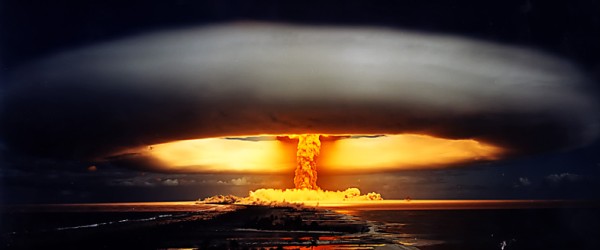
French nuclear test "Licorne", French Polynesia, July, 1970

Jeffrey Lewis writes: In an earlier job, I ran a project that tried to outline options for what would become the 2009 Nuclear Posture Review. One of the better parts was the travel. I made a lovely visit to Brussels, where my team had a series of very high-level meetings at the European Union and NATO headquarters. There were some steak frites, a little lambic beer, and a lot of talk about nuclear weapons. And at the time, senior U.S. military officers made one thing very clear to us: The security at the bases stunk. One commander noted that the upgrades necessary to meet security requirements would run into the hundreds of millions of dollars. Another said his worst fear was that a group of activists would be able to get inside the shelters where the nuclear weapons are stored and use a cell phone to publish a picture of the vaults.

And then it happened. In January 2010, a group of protesters who call themselves “Bombspotters” entered Kleine Brogel.

Apparently the plan was to hang around on the tarmac of the runway and get arrested. But no one came to arrest them. So they wandered around — for either 40 minutes or an hour, the accounts differ — before walking through an open gate into an area with hardened aircraft shelters for the base’s F-16s. Eventually, as the hippies continued to wander around the shelters, security arrived.

The “security force” was one moderately annoyed-looking Belgian guy with a rifle — an unloaded rifle. The effect would only have been more comedic if he had some powdered sugar on his face and maybe a little bit of waffle stuck to his uniform.

The protestors were briefly detained but not for long. There was no panic. The mood in Belgium seemed to be something like “you crazy kids.” Not to worry, the Belgians assured their American partners, the activists weren’t anywhere near the shelters with nuclear weapons.

So, a few months later, the activists entered the base again. They helpfully sent me a little note. This time, they not only got inside the proper area, but they also got inside one of the shelters.

Security never showed up. Apparently, the base commander found out about the incursion when the rest of us did — when the activists posted a video on YouTube a day or so later. This was literally the scenario the U.S. military officer had warned us about — hippies inside a shelter with a cell phone, security nowhere to be found.

Yet still no panic.

One way to look at this is to say that the multiple and redundant security features worked. Sure, the Belgians should have caught the activists at the fence. And, sure, the hippies got inside the inner perimeter. And, sure, the shelter shouldn’t have been unlocked. But the nuclear weapons inside the shelter were still secure in a vault in the floor. A terrorist would have needed the code or a jackhammer to access the bomb itself. Even if it was only the last, or next to last, line of defense, it still worked. Another day without a nuclear holocaust. Who’s complaining?

The other way to look at it is to see that the security failures were not independent. The base had a lax security culture that makes anything possible. There were no dogs because the Belgians were too cheap to hire a dog-master. Who is to say what other security breaches might be possible? Who is to say the same people who didn’t bother to lock the gates or the shelters wouldn’t also leave a vault open? Or wouldn’t say something indiscreet, allowing a group of armed men to show up as a bomb is being moved for servicing? According to this view, you either take security seriously, or you don’t. If you don’t, you are vulnerable to systematic breakdowns that allow the seemingly impossible to happen. [Continue reading…]

Facebooktwittermail

FBI backs off from its day in court with Apple this time – but there will be others

By Martin Kleppmann, University of Cambridge

After a very public stand-off over an encrypted terrorist’s smartphone, the FBI has backed down in its court case against Apple, stating that an “outside party” – rumoured to be an Israeli mobile forensics company – has found a way of accessing the data on the phone.

The exact method is not known. Forensics experts have speculated that it involves tricking the hardware into not recording how many passcode combinations have been tried, which would allow all 10,000 possible four-digit passcodes to be tried within a fairly short time. This technique would apply to the iPhone 5C in question, but not newer models, which have stronger hardware protection through the so-called secure enclave, a chip that performs security-critical operations in hardware. The FBI has denied that the technique involves copying storage chips.

So while the details of the technique remain classified, it’s reasonable to assume that any security technology can be broken given sufficient resources. In fact, the technology industry’s dirty secret is that most products are frighteningly insecure.

Continue reading

Facebooktwittermail

FBI signed $15 million contract with Apple vendor, Cellebrite; parent company’s stock soars

Fortune reports: The U.S. government’s announcement Monday that it hacked into the San Bernardino terrorist’s iPhone ended the FBI’s legal feud with Apple. But while many observers thought the incident left both the FBI and Apple looking foolish, there does appear to be a winner emerging from the case.

Shares of Suncorp, a Japanese technology company traded on the Tokyo stock exchange (ticker: 6736), soared 17% on Tuesday following the government’s court declaration that it “successfully accessed the data stored on [Syed] Farook’s iPhone.” In all, Suncorp’s shares have more than doubled in the six weeks since February 16, when Apple published its letter refusing to help the FBI.

Suncorp, which specializes in mobile data transfer as well as equipment for a popular Japanese pinball-like game called pachinko, owns Cellebrite, the Israel-based company that reportedly helped the FBI crack the iPhone.

Apple’s stock, meanwhile, was up just about 2% Tuesday afternoon, despite the fact that it is now free of legal expenses relating to the FBI case as well as the technological burden the government tried to impose.

Suncorp’s shares started rising last month, and really took off after the government said last Wednesday that an “outside party” had demonstrated “a possible method for unlocking” the iPhone. An Israeli newspaper quickly identified the unnamed company as Cellebrite, a government contractor that makes a mobile forensic device for extracting and decoding data from smartphones and tablets. Since then, Suncorp’s stock has risen nearly 40%, while Japan’s Nikkei 225 stock market index has been basically flat, and fell slightly on Tuesday.

The odd thing about the company’s dramatic stock rise is that neither the FBI nor Suncorp has confirmed the company was involved in unlocking the phone. In fact, the FBI has said very little so far about how it might have cracked the iPhone. [Continue reading…]

The Daily Beast reports: The FBI has said practically nothing about the “tool” that helped the FBI get inside the phone, as a U.S. law enforcement official called it in a hastily arranged press conference on Monday evening. Nor would the official say whether investigators might use it again on the dozen or so other iPhones the FBI is reportedly trying to gain access to, or whether the bureau would share the tool with local law enforcement agencies, who are believed to have hundreds of phones just waiting to be cracked.

“I think the best answer I can give you is it’s premature to say anything about our ability to access other phones,” said the official, who discussed the case with reporters on condition of anonymity and said almost nothing about where the FBI will go from here.

But he didn’t have to. Comey’s earlier remarks, coupled with the government’s decision to drop the warrant request, sent a message to other tech companies: Work with us, or don’t. We’ll get what we need without you.

Notably, the U.S. official didn’t say whether the FBI would disclose its newfound technique to Apple, which has a vested interest in protecting the security and privacy of its customers. But Cellebrite, an Israeli company, has been identified in some news accounts as the company that came to the FBI’s rescue. It signed a contract with the bureau worth more than $15 million last week.

In other words: The American government may have used foreign hackers to crack the signature product of America’s top technology company.

But it’s hard to imagine Apple didn’t have some idea what was coming. One of Cellebrite’s other clients is Apple itself. [Continue reading…]

Facebooktwittermail

Leahy asked State Dept. to investigate Israel and Egypt’s human rights ‘violations’

Politico reports: Sen. Patrick Leahy (D-Vt.) and 10 House members have asked the Obama administration to investigate claims that the Israeli and Egyptian security forces have committed “gross violations of human rights” — allegations that if proven truei could affect U.S. military aid to the countries.

In a letter to Secretary of State John Kerry dated Feb. 17, the lawmakers list several examples of suspected human rights abuses, including reports of extrajudicial killings by Israeli and Egyptian military forces, as well as forced disappearances in Egypt. The letter also points to the 2013 massacre in Egypt’s Rab’aa Square, which left nearly 1,000 people dead as the military cracked down on protesters, as worthy of examination.

Leahy’s signature is particularly noteworthy because his name is on a law that conditions U.S. military aid to countries on whether their security forces are committing abuses. [Continue reading…]

Facebooktwittermail

U.S. sold $33 billion of weapons to Gulf states in 11 months

Defense News reports: The US State Department has facilitated $33 billion worth of weapons sales to its Arab Gulf allies since May 2015, according to department figures.

The six Gulf Cooperation Council (GCC) countries have received weapons including ballistic missile defense capabilities, attack helicopters, advanced frigates and anti-armor missiles, according to David McKeeby, a spokesman the State Department’s Bureau of Political-Military Affairs.

“Consistent with the commitments we made to our Gulf partners at the Camp David summit last May, we have made every effort to expedite sales. Since then, the State and Defense departments have authorized more than $33 billion in defense sales to the 6 Gulf Coordination Council countries,” McKeeby told Defense News. [Continue reading…]

Facebooktwittermail

Pentagon reaches out to U.S. weapons manufacturers to find new ways to threaten Russia and China

Reuters reports: The Pentagon’s Strategic Capabilities Office plans to reach out to U.S. industry in about a month for ways to put existing weapons technologies to new uses as the department scrambles to maintain its competitive edge over Russia and China.

“We’re looking for things we can put our hands on today, go test today,” said Will Roper, director of the SCO, or what he called the Pentagon’s “take risk” office, said.

This is the first time the office is broadly going out to industry for specific ideas on how to repurpose existing weapons, which could result in lucrative new contracts.

The secretive Pentagon office was set up in August 2012 at the behest of Defense Secretary Ash Carter, then the deputy defense secretary, who worried that the U.S. military was not ready for a return to great power competition after years of fighting extremist groups in Iraq and Afghanistan.

The office is now managing a nearly $1 billion dollar annual budget that is aimed at upsetting assumptions made by China and Russia about U.S. military capabilities. [Continue reading…]

Facebooktwittermail

Lockheed ‘very excited’ to be boosting bomb production for an era of conflict with no end in sight

Defense One reports: Lockheed Martin is expanding various munition factories to meet rising demand from the U.S. and its partners fighting the Islamic State — and to start equipping American warplanes for great-power wars at sea.

“We are seeing a lot of international demand for our product set,” Frank St. John, Lockheed’s vice president of tactical missiles, said Tuesday. “That’s causing us to do a lot of work in international partnerships and co-production and we’re very excited about those opportunities.”

In particular, U.S. and allies are burning through their stocks of Lockheed’s Hellfire missile, the signature weapon of Predator and Reaper drones. Helicopters and fixed-wing planes also carry the versatile laser-guided weapon.

“It requires a little bit of investment on our part to expand the factories, but the demand is there and we’re keeping up with it [and] we’re staying ahead of it,” St. John said.

It also requires Pentagon funding. Last June, the U.S. Army gave Lockheed $18 million to boost Hellfire production from 500 to 650 missiles per month. St. John said the company has added tools, test equipment, and floor space to its Hellfire production line.

Lockheed has also “quadrupled our production capacity” at the Archbald, Pennsylvania, factory to meet demand from the U.S. and its allies for Paveway II laser-guided bombs.

With top military officials predicting that the ISIS campaign will run for years, demand for missiles and bombs is expected to remain high. [Continue reading…]

Facebooktwittermail

CIA-armed militias are shooting at Pentagon-armed ones in Syria

The Los Angeles Times reports: Syrian militias armed by different parts of the U.S. war machine have begun to fight each other on the plains between the besieged city of Aleppo and the Turkish border, highlighting how little control U.S. intelligence officers and military planners have over the groups they have financed and trained in the bitter 5-year-old civil war.

The fighting has intensified over the past two months, as CIA-armed units and Pentagon-armed ones have repeatedly shot at each other as they have maneuvered through contested territory on the northern outskirts of Aleppo, U.S. officials and rebel leaders have confirmed.

In mid-February, a CIA-armed militia called Fursan al Haq, or Knights of Righteousness, was run out of the town of Marea, about 20 miles north of Aleppo, by Pentagon-backed Syrian Democratic Forces moving in from Kurdish-controlled areas to the east.

“Any faction that attacks us, regardless from where it gets its support, we will fight it,” said Maj. Fares Bayoush, a leader of Fursan al Haq.

Rebel fighters described similar clashes in the town of Azaz, a key transit point for fighters and supplies between Aleppo and the Turkish border, and March 3 in the Aleppo neighborhood of Sheikh Maqsud. [Continue reading…]

Facebooktwittermail

In Syria and Iraq, ISIS is in retreat on multiple fronts

The Washington Post reports: As European governments scramble to contain the expanding terrorist threat posed by the Islamic State, on the battlefield in Iraq and Syria the group is a rapidly diminishing force.

In the latest setbacks for the militants on Thursday, Syrian government troops entered the outskirts of the historic town of Palmyra after a weeks-old offensive aided by Russian airstrikes, and U.S. airstrikes helped Iraqi forces overrun a string of Islamic State villages in northern Iraq that had been threatening a U.S. base nearby.

These are just two of the many fronts in both countries where the militants are being squeezed, stretched and pushed back. ­Nowhere are they on the attack. They have not embarked on a successful offensive in nearly nine months. Their leaders are dying in U.S. strikes at the rate of one every three days, inhibiting their ability to launch attacks, according to U.S. military officials.

Front-line commanders no longer speak of a scarily formidable foe but of Islamic State defenses that crumble within days and fighters who flee at the first sign they are under attack. [Continue reading…]

Facebooktwittermail