Category Archives: US government

Does it take 8 years to decide whether to declassify 28-pages of 9/11 report?

The Daily Beast reports: By the end of President Obama’s term in office, the administration hopes to decide whether to declassify a controversial portion of Congress’ investigation into the 9/11 attacks, the White House said Tuesday. The so-called “28 pages,” which have never been publicly released, are said to implicate Saudi government officials and civilians in the deadliest act of terrorism on U.S. soil.

The administration had directed a “declassification review” of the material from the Joint Congressional Inquiry into the terrorist attacks in 2014. Former lawmakers who have read the classified pages say they describe a financial and logistical support network for the 19 hijackers, most of them Saudi citizens, while they were in the U.S. The report was released in December 2002.

“That review process remains underway, but every effort is being taken to complete it before the end of the Administration,” Ned Price, the spokesperson for the National Security Council, told The Daily Beast in a statement. [Continue reading…]

Facebooktwittermail

FBI used hacking software decade before iPhone fight

The New York Times reports: In early 2003, F.B.I. agents hit a roadblock in a secret investigation, called Operation Trail Mix. For months, agents had been intercepting phone calls and emails belonging to members of an animal welfare group that was believed to be sabotaging operations of a company that was using animals to test drugs. But encryption software had made the emails unreadable.

So investigators tried something new. They persuaded a judge to let them remotely, and secretly, install software on the group’s computers to help get around the encryption.

That effort, revealed in newly declassified and released records, shows in new detail how F.B.I. hackers worked to defeat encryption more than a decade before the agency’s recent fight with Apple over access to a locked iPhone. The Trail Mix case was, in some ways, a precursor to the Apple dispute. In both cases, the agents could not decode the data themselves, but found a clever workaround.

The Trail Mix records also reveal what is believed to be the first example of the F.B.I. remotely installing surveillance software, known as spyware or malware, as part of a criminal wiretap.

“This was the first time that the Department of Justice had ever approved such an intercept of this type,” an F.B.I. agent wrote in a 2005 document summing up the case.

The next year, six activists were convicted of conspiracy to violate the Animal Enterprise Protection Act in the case. An appeals court upheld the convictions in 2009, and said that the use of encryption, among other things, was “circumstantial evidence of their agreement to participate in illegal activity.”

Ryan Shapiro, a national security researcher and animal welfare advocate, provided the documents in the case to The New York Times after obtaining them in a Freedom of Information Act lawsuit. Several important details remain secret, including whether the tactic worked. The wiretap was disclosed at trial but the software hacking was not, said Lauren Gazzola, one of the defendants, who now works for the Center for Constitutional Rights. [Continue reading…]

Facebooktwittermail

Apple iPhone unlocking manoeuvre likely to remain secret

Reuters reports: The company that helped the FBI unlock a San Bernardino shooter’s iPhone to get data has sole legal ownership of the method, making it highly unlikely the technique will be disclosed by the government to Apple or any other entity, Obama administration sources said this week.

The White House has a procedure for reviewing technology security flaws and deciding which ones should be made public. But it is not set up to handle or reveal flaws that are discovered and owned by private companies, the sources said, raising questions about the effectiveness of the so-called Vulnerabilities Equities Process.

The secretive process was created to let various government interests debate about what should be done with a given technology flaw, rather than leaving it to agencies like the National Security Agency, which generally prefers to keep vulnerabilities secret so they can use them. [Continue reading…]

Facebooktwittermail

U.S. readies ‘Plan B’ to arm Syria rebels

The Wall Street Journal reports: The Central Intelligence Agency and its regional partners have drawn up plans to supply more-powerful weapons to moderate rebels in Syria fighting the Russia-backed regime in the event the country’s six-week-old truce collapses, according to U.S. and other officials.

The preparations for a so-called Plan B center on providing vetted rebel units with weapons systems that would help them in directing attacks against Syrian regime aircraft and artillery positions, the officials said.

The Wall Street Journal first reported in February that President Barack Obama’s top military and intelligence advisers were pressing the White House to come up with a Plan B to counter Russia in Syria. Since then, fresh details have emerged on the nature of the new weaponry that could be deployed under the covert program.

The preparations were discussed at a secret meeting of spy chiefs in the Middle East just before the cease-fire took effect on Feb. 27 and in follow-on exchanges between intelligence services.

In those meetings, officials briefed on the deliberations said, coalition members received provisional assurances from the CIA that they would be given approval to expand support to Syria’s moderate opposition. Coalition members have agreed on the outlines of Plan B, but the White House must still approve the list of specific Plan B weapons systems before they can be introduced to the battlefield. [Continue reading…]

Facebooktwittermail

FBI paid professional hackers one-time fee to crack San Bernardino iPhone

The Washington Post reports: The FBI cracked a San Bernardino terrorist’s phone with the help of professional hackers who discovered and brought to the bureau at least one previously unknown software flaw, according to people familiar with the matter.

The new information was then used to create a piece of hardware that helped the FBI to crack the iPhone’s four-digit personal identification number without triggering a security feature that would have erased all the data, the individuals said.

The researchers, who typically keep a low profile, specialize in hunting for vulnerabilities in software and then in some cases selling them to the U.S. government. They were paid a one-time flat fee for the solution. [Continue reading…]

Facebooktwittermail

As ISIS is pushed back in Iraq, worries about what’s next

Reuters reports: As U.S.-led offensives drive back Islamic State in Iraq, concern is growing among U.S. and U.N. officials that efforts to stabilize liberated areas are lagging, creating conditions that could help the militants endure as an underground network.

One major worry: not enough money is being committed to rebuild the devastated provincial capital of Ramadi and other towns, let alone Islamic State-held Mosul, the ultimate target in Iraq of the U.S.-led campaign.

Lise Grande, the No. 2 U.N. official in Iraq, told Reuters that the United Nations is urgently seeking $400 million from Washington and its allies for a new fund to bolster reconstruction in cities like Ramadi, which suffered vast damage when U.S.-backed Iraqi forces recaptured it in December.

“We worry that if we don’t move in this direction, and move quickly, the progress being made against ISIL may be undermined or lost,” Grande said, using an acronym for Islamic State.

Adding to the difficulty of stabilizing freed areas are Iraq’s unrelenting political infighting, corruption, a growing fiscal crisis and the Shiite Muslim-led government’s fitful efforts to reconcile with aggrieved minority Sunnis, the bedrock of Islamic State support. [Continue reading…]

Facebooktwittermail

How the expanding U.S. role in Iraq is kept quiet by pretending it’s not expanding

The New York Times reports: There are roughly 5,000 American service members in Iraq according to current Pentagon estimates, but the number often varies, sometimes daily, by hundreds. That number is higher than the cap the White House set last year, which limited the number of troops to be deployed to Iraq to 3,870. But under policies created by the military after the attacks of Sept. 11, 2001, service members who are planning to spend less than four months in a war zone are not counted.

Sergeant Cardin [who was killed on March 19] and the Marines [with him at Fire Base Bell, south of Mosul] were scheduled to be deployed in Iraq temporarily, so they did not count against the cap.

At the height of the war in 2007, the United States had roughly 165,000 troops deployed in 500 bases and outposts across Iraq. Mr. Obama, who ran for president in 2008 vowing to end the United States’ involvement, fulfilled his pledge when he pulled all American troops out of the country in 2011. But as the Islamic State has strengthened its hold in the region in the past two years, Mr. Obama has sent thousands of American service members back in. [Continue reading…]

Facebooktwittermail

Two ways the war in Yemen is turning into a disaster for the U.S.

Ishaan Tharoor writes: Two significant reports last week illustrated the awkward role of the United States in the ongoing conflict in Yemen, which has claimed thousands of lives, seen the virtual collapse of the fragile Yemeni state, and sparked a grim humanitarian crisis in what was already the Middle East’s most impoverished nation.

An investigation by Human Rights Watch published on Wednesday alleged that at least two deadly airstrikes by the Saudi-led coalition last month used munitions supplied by the United States. The attack, which hit a town in northwestern Yemen, killed at least 97 civilians, including 25 children.

Last month also marked the anniversary of Saudi Arabia’s entrance into the civil war on its southern border — an intervention that has seen Riyadh and its allies get bogged down in a difficult battle with the country’s Houthi rebels, who still control the capital Sanaa and much of northern Yemen.

Separately, a Reuters special report raised the possibility that al-Qaeda in the Arabian Peninsula, the terror group’s influential Yemeni wing — long the target of U.S. counterterror operations — has gained ground in the shadow of the Saudi-led war, exploiting Yemen’s security vacuum to consolidate its position in a string of coastal cities while building up an impressive treasury of plundered wealth. [Continue reading…]

Facebooktwittermail

Kerry encourages Obama to visit Hiroshima

The New York Times reports: Secretary of State John Kerry attended a memorial ceremony in Hiroshima on Monday for victims of the American atomic bombing 71 years ago, becoming the highest-ranking United States administration official to visit the site of one of the most destructive acts of World War II.

The visit is likely to intensify speculation about whether President Obama will go to Hiroshima during a planned trip to Japan next month. Mr. Obama would be the first sitting American president to visit the city, a decision that would resonate deeply in Japan but would be controversial at home.

“Everyone should visit Hiroshima, and everyone means everyone,” Mr. Kerry said at a news conference on Monday in response to a question about whether Mr. Obama would go. He said that the president had been invited by Japanese officials and that he would like to visit someday, but Mr. Kerry added: “Whether or not he can come as president, I don’t know.”

Mr. Kerry spoke after he and other leading diplomats from the Group of 7 industrialized countries toured Hiroshima’s atomic bomb museum, laid flowers at a cenotaph in its Peace Memorial Park and examined the former exhibition hall that stood directly under the atomic blast and has been preserved as a skeletal monument. He called the experience “stunning” and “gut-wrenching.”

Mr. Kerry and the other officials were in the city for talks ahead of the annual Group of 7 summit meeting next month, to be hosted by Japan.

The question of how to acknowledge the nuclear attack on Hiroshima, and another on the city of Nagasaki three days later, has long troubled American diplomats. The bombings ultimately killed more than 200,000 people, most of them civilians, in a country that after the war was transformed from an enemy of the United States into one of its closest allies.

But a majority of Americans have long believed that the bombings were necessary to force Japan’s surrender and to spare American lives. [Continue reading…]

An article by Ward Wilson, published in Foreign Policy in 2013, argues, however, that Japan’s decision to surrender probably had much less to do with the effect of nuclear weapons, than with Stalin’s decision to invade.

Facebooktwittermail

FBI’s ‘shared responsibility committees’ to identify ‘radicalized’ Muslims raise alarms

The Intercept reports: The FBI’s plan to enlist community leaders in “Shared Responsibility Committees” all across the country with the goal of identifying “radicalized” individuals is raising alarm among civil rights activists.

The Shared Responsibility Committees, known as SRCs, “are expanding the informant program under the guise of an intervention program, which it is not,” said Abed Ayoub, legal director of the American-Arab Anti-Discrimination Committee (ADC).

The FBI’s ideas is to have social service workers, teachers, mental health professionals, religious figures, and others interdict young people they believe are on a path towards radicalization. The program was first revealed last November, and while details remain scant, it is widely believed to have been developed along the lines of similar “anti-radicalization” programs in the United Kingdom.

The FBI did not respond to multiple requests for comment.

Experts acknowledge the need to have options beyond sending young people to jail for making threatening statements. The committees purport to offer such an option, by allowing members to offer non-binding recommendations to law enforcement about whether certain individuals should be arrested or offered rehabilitation for their alleged radicalization.

But critics say that despite the FBI’s benign characterization of the SRCs, the proposal amounts to nothing more than an expansion of already existing FBI informant programs. The committees “would be doing the work of the FBI, gathering information. This initiative failed in the U.K., it’s not like this is a new idea,” said Ayoub.

The U.K. program called “Channel” has been widely blamed for alienating the communities it targeted while inflaming attitudes towards authorities. Arun Kundnani, an adjunct professor at New York University and expert on U.K. counterterrorism policy, said he worries that the U.S. program would “suffer from the same problems, such as drawing non-policing professionals into becoming the eyes and ears of counter-terrorism surveillance, and thereby undermining professional norms and relationships of trust among educators, health workers and others.” [Continue reading…]

Facebooktwittermail

Obama’s counterterrorism strategy ‘an abject failure,’ says former official

decay9

The New York Times reports: The banging on the door jolted Sal Shafi awake. F.B.I. agents were looking for his son. “Where’s Adam?” they yelled. “Where’s Adam?”

Terrified, Mr. Shafi led the agents, guns drawn, up the stairs toward his son’s bedroom. He watched as they led his 22-year-old son away in handcuffs, backed by evidence of Adam Shafi’s terrorist ambitions.

He had come to the attention of officials not by a well-placed informant or a sting operation. His father, concerned and looking for help, had simply picked up the phone and led the government right to his son. For months, over the objections of his lawyer, Mr. Shafi had been talking to the F.B.I., believing he was doing the right thing.

“My God,” he thought, soon after the arrest in July. “I just destroyed Adam.”

Had things been different, Mr. Shafi, 62, a Silicon Valley executive, might have become a much-needed spokesman for the Obama administration’s counterradicalization campaign. Who better to talk to other parents about the seductive pull of terror organizations? Trust the government, he would tell them. They do not want to take away your children.

Despite nascent efforts to steer young people away from terrorism, the government’s strategy remains largely built on persuading people to call the F.B.I. when they first suspect a problem. [Continue reading…]

Facebooktwittermail

The covert roots of the Panama Papers

Steven Cohen writes: It should come as no surprise that the CIA’s finances are a secret. One of the rare glimpses into the agency’s funding came when Edward Snowden leaked a copy of the intelligence “black budget” to The Washington Post in 2013. But if history is any indication, the CIA may well have resources that don’t appear on any congressional document, highly classified or otherwise. Covert operations, by their very nature, often require access to off-the-books funding. The CIA’s first operation was paid for with funds seized from the Nazis, and in the years since, the agency has been notoriously creative about how it obtains its money.

Adnan Khashoggi would know. A “principal foreign agent” of the United States, as one Senate report referred to him, the billionaire playboy made a fortune (more than $100 million between 1970 and 1975 alone) from commissions negotiating arms deals with his native Saudi Arabia. He used these windfalls, in turn, to cultivate political clout—including, allegedly, with President Richard Nixon. In the aftermath of Watergate, when Congress began reining in the CIA, Khashoggi helped establish the supranational intelligence partnership known as the Safari Club. Soon after, he aided the CIA in circumventing another congressional impediment. With money borrowed from the Saudi and U.S. intelligence-linked Bank of Credit and Commerce International, he financed the illegal arms sales that set off the Iran-Contra scandal.

One way Khashoggi structured his shadowy holdings during his heyday was through the specialized services of Mossack Fonseca, the law firm that is in the news for having helped global luminaries like Vladimir Putin hide their money. Thanks to a recent report from the International Consortium of Investigative Journalists, we now know Khashoggi to be among a number of former spies and CIA associates implicated by the 2.6 terabytes of offshore financial documents provided to the German newspaper Süddeutsche Zeitung last summer.

That his name should appear in an international dark money scandal suggests something about the nature of tax havens that much of the media’s coverage has thus far avoided grappling with. The Panama Papers have largely been presented as an unprecedented insight into how global elites hide their fortunes from tax collectors and other regulators. But they also underscore how tax havens are used by covert agencies and other shadowy players to launder dirty money, a practice that has a long history in which Panama, in particular, has played a notable part. [Continue reading…]

Facebooktwittermail

Syria releases American freelance photographer Kevin Patrick Dawes

The Washington Post reports: The Syrian government has freed an American freelance photographer who was abducted after traveling to the country in 2012, according to two U.S. officials.

Kevin Patrick Dawes, 33, from San Diego, was released following many months of negotiations, said the officials, who spoke on the condition of anonymity because the details of Dawes’s release have not yet been made public.

Dawes had been allowed in recent months to call his family and receive care packages, a signal to officials that the Syrian government was moving toward releasing him, officials said. The U.S. State Department had taken the lead on winning Dawes’s release. [Continue reading…]

Facebooktwittermail

U.S., Russia said to team up to draft new Syria constitution

Bloomberg reports: Russia and the U.S are working on drafting a new constitution for Syria, according to three Western and Russian diplomats, in the clearest sign yet of the two powers’ determination to broker a solution to a five-year civil war that has sent a wave of refugees toward Europe.

The joint efforts are at an early stage, and Russia’s current proposals are closer to the Syrian government’s position, said one Western diplomat. The two countries are continuing to exchange ideas, a Russian diplomat said. All three envoys spoke on condition of anonymity because the discussions are confidential.

The U.S agreed with Russia on a target of August to create a framework for a political transition and a draft constitution for Syria, Secretary of State John Kerry said after talks in the Kremlin on March 24. The United Nations is leading peace talks in Geneva where the government and opposition are negotiating a settlement. [Continue reading…]

Facebooktwittermail

Rory Fanning: Talking to the young in a world that will never truly be ‘postwar’

The third time around, the Pentagon evidently wants to do it right — truly right — this time.  What other explanation could there be for dispatching 12 generals to Iraq (one for every 416 American troops estimated to be on the ground in that country, according to Nancy Youssef of the Daily Beast).  And keep in mind that those 12 don’t include the generals and admirals overseeing the air war, naval support, or other aspects of the campaign against the Islamic State from elsewhere in the Middle East or back in the U.S., nor do they include generals from allied forces like those of Australia and Great Britain also in Iraq.  Youssef offers a “conservative” count of 21 “flag officers,” including allies, now in that country to oversee the war there. Among other things, they are undoubtedly responsible for ensuring the success of the major goal proclaimed by both Washington and Baghdad for 2016: an offensive to retake the country’s second largest city, Mosul. Only weeks ago, it got off to a rousing start when the Iraqi army recaptured a few obscure villages on the road to that city.  Soon after, however, the offensive reportedly ground to a dispiriting halt when parts of the American-retrained and rearmed Iraqi Army (which had collapsed in June 2014 in the face of far smaller numbers of far more determined Islamic State militants) began to crumble again, amid mass desertions.

In the meantime, in both Iraq and Syria, U.S. operations seem to be on an inexorable mission-creep upward, with ever more new troops and special ops types heading for those countries in a generally under-the-radar manner, assumedly with the objective of someday justifying the number of generals awaiting them there. Somewhere in a top-heavy Pentagon, there surely must be an office of déjà vu all over again, mustn’t there?  (And talking about déjà vu, last week the U.S. launched yet another air strike in Somalia, supposedly knocking off yet another leader of al-Shabab, the indigenous terror movement. If you could win a war by repeatedly knocking off the leaders of such movements, the U.S. would by now be the greatest victor in the history of warfare.)

Meanwhile in Afghanistan… but do I really have to tell you about the ground taken by the resurgent Taliban in the last year, the arrival of ISIS in that country, the halting (yet again) of withdrawal plans for U.S. forces almost 15 years into the second American war there, or other tales from the crypt of this country’s never-ending wars?  I think not.  Even if you haven’t read the latest news, you can guess, can’t you?

And this, of course, is exactly the repetitive world of war (and failure) into which the young, especially in America’s poorest high schools, are being recruited, even if they don’t know it, via JROTC.  It’s a Pentagon-funded program that promises to pave the way for your future college education, give meaning to your life, and send you to exotic lands, while ensuring that the country’s all-volunteer military never lacks for new troops to dispatch to old (verging on ancient) conflicts. As Ann Jones has written, “It should be no secret that the United States has the biggest, most efficiently organized, most effective system for recruiting child soldiers in the world. With uncharacteristic modesty, however, the Pentagon doesn’t call it that. Its term is ‘youth development program.’” So let’s offer thanks for small favors when someone — in this case, ex-Army Ranger and TomDispatch regular Rory Fanning (author of Worth Fighting For: An Army Ranger’s Journey Out of the Military and Across America) — feels the urge to do something about that massive, militarized propaganda effort in our schools.  In my book, Fanning is the equivalent of any 12 of our generals and we need more like him both in those schools and in our country. Tom Engelhardt   

The wars in our schools
An ex-Army Ranger finds a new mission
By Rory Fanning

Early each New Year’s Day I head for Lake Michigan with a handful of friends. We look for a quiet stretch of what, only six months earlier, was warm Chicago beach. Then we trudge through knee-deep snow in bathing suits and boots, fighting wind gusts and hangovers. Sooner or later, we arrive where the snowpack meets the shore and boot through a thick crust of lake ice, yelling and swearing as we dive into near-freezing water.

It took me a while to begin to understand why I do this every year, or for that matter why for the last decade since I left the military I’ve continued to inflict other types of pain on myself with such unnerving regularity. Most days, for instance, I lift weights at the gym to the point of crippling exhaustion. On summer nights, I sometimes swim out alone as far as I can through mats of hairy algae into the black water of Lake Michigan in search of what I can only describe as a feeling of falling.

Continue reading

Facebooktwittermail

Andrew Bacevich: Presidential wars

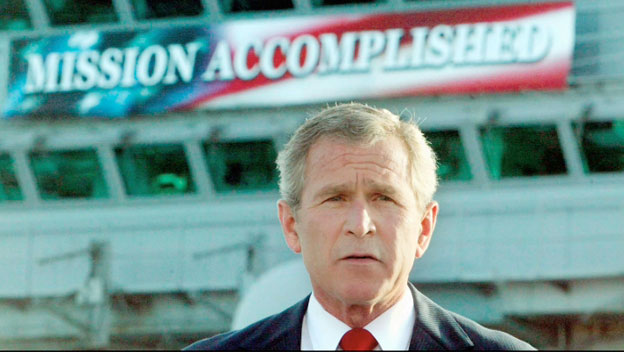
It was a large banner and its message was clear.  It read: “Mission Accomplished,” and no, I don’t mean the classic “mission accomplished” banner on the USS Abraham Lincoln under which, on May 1, 2003, President George W. Bush proudly proclaimed (to the derision of critics ever since) that “major combat operations in Iraq have ended.”  I’m actually referring to a September 1982 banner with those same two words (and an added “farewell” below them) displayed on a landing craft picking up the last Marines sent ashore in Beirut, Lebanon, to be, as President Ronald Reagan put it when they arrived the previous August, “what Marines have been for more than 200 years — peace-makers.”  Of course, when Bush co-piloted an S-3B Viking sub reconnaissance Naval jet onto the deck of the Abraham Lincoln and made his now-classic statement, major combat had barely begun in Iraq (and it has yet to end) — nor was it peace that came to Beirut in September 1982: infamously, the following year 241 Marines would die there in a single day, thanks to a suicide bomber.

“Not for the last time,” writes Andrew Bacevich in his monumental new work, America’s War for the Greater Middle East: A Military History, “the claim proved to be illusory.”  Indeed, one of the grim and eerie wonders of his book is the way in which just about every wrongheaded thing Washington did in that region in the 14-plus years since 9/11 had its surprising precursor in the two decades of American war there before the World Trade Center towers came down.  U.S. military trainers and advisers, for example, failed (as they later would in Iraq and Afghanistan) to successfully build armies, starting with the Lebanese one; Bush’s “preventive war” had its predecessor in a Reagan directive called (ominously enough given what was to come) “combating terrorism”; Washington’s obsessive belief of recent years that problems in the region could be solved by what Andrew Cockburn has called the “kingpin strategy” — the urge to dismantle terror organizations by taking out their leadership via drones or special operations raids — had its precursor in “decapitation” operations against Muammar Gaddafi, Saddam Hussein, and Somali warlord Mohamed Farrah Aidid with similar resulting mayhem.  The belief that “an additional increment of combat power might turn around a failing endeavor” — call it a “surge,” if you will — had its Iraq and Afghan pretrial run in Somalia in 1993.  And above all, of course, there was Washington’s unquenchable post-1980 urge to intervene, military first, in a decisive way throughout the region, which, as Bacevich writes, only “produced conditions conducive to further violence and further disorder,” and if that isn’t the repetitive history of America’s failed post-2001 wars in a nutshell, what is?

As it happened, the effects of such actions from 1980 on were felt not just in the Greater Middle East and Africa, but in the United States, too.  There, as Bacevich writes today, war became a blank-check activity for a White House no longer either checked (in any sense) or balanced by Congress.  Think of it as another sad tale of a surge (or do I mean a decapitation?) that went wrong. Tom Engelhardt

Writing a blank check on war for the president
How the United States became a prisoner of war and Congress went MIA
By Andrew J. Bacevich

Let’s face it: in times of war, the Constitution tends to take a beating. With the safety or survival of the nation said to be at risk, the basic law of the land — otherwise considered sacrosanct — becomes nonbinding, subject to being waived at the whim of government authorities who are impatient, scared, panicky, or just plain pissed off.

The examples are legion.  During the Civil War, Abraham Lincoln arbitrarily suspended the writ of habeas corpus and ignored court orders that took issue with his authority to do so. After U.S. entry into World War I, the administration of Woodrow Wilson mounted a comprehensive effort to crush dissent, shutting down anti-war publications in complete disregard of the First Amendment. Amid the hysteria triggered by Pearl Harbor, Franklin Roosevelt issued an executive order consigning to concentration camps more than 100,000 Japanese-Americans, many of them native-born citizens. Asked in 1944 to review this gross violation of due process, the Supreme Court endorsed the government’s action by a 6-3 vote. 

More often than not, the passing of the emergency induces second thoughts and even remorse. The further into the past a particular war recedes, the more dubious the wartime arguments for violating the Constitution appear. Americans thereby take comfort in the “lessons learned” that will presumably prohibit any future recurrence of such folly.

Continue reading

Facebooktwittermail

Saudi Arabia passes Russia as world’s third biggest military spender

The Washington Post reports: Global military spending reached almost $1.7 trillion in 2015, marking a year-on-year increase for the first time since 2011, according to the Stockholm International Peace Research Institute, which tracks arms expenditure around the world.

The United States remained far and away the top spender, which despite a dip from 2014, accounted for more than a third of total global spending. It was followed by China and then, perhaps surprisingly, Saudi Arabia, which supplanted Russia in third place. [Continue reading…]

Facebooktwittermail

One of Libya’s rival governments steps down as new UN-brokered unity government is installed

The Associated Press reports: One of Libya’s rival governments has resigned, a step that helps efforts by a new, UN-brokered unity government to assert itself in the capital Tripoli despite opposition from some local militias.

In a statement, the Tripoli-based National Salvation government said it would “cease duties” as executive authority, and therefore absolve itself of responsibility for the country’s fate.

“We put the interests of the nation above anything else, and stress that the bloodshed stop and the nation be saved from division and fragmentation,” the statement read.

Western nations view the new unity government as the best hope for ending Libya’s chaos and uniting all factions against an increasingly powerful Islamic State affiliate, which has seized the central city of Sirte. Another government, based in the eastern city of Tobruk, still opposes the UN-backed body. [Continue reading…]

The Washington Post reports: The United States and European allies, including Italy, France and Britain, have made the unity government’s establishment a key precondition for launching twin missions to begin an international stabilization effort and help combat a growing Islamic State affiliate there.

Each of those tasks will be strained by tensions among militia factions that Western nations hope will form a unified front against terrorist groups and by strong reluctance among European nations to wade into Libya’s chaos — even among those countries most threatened by the Islamic State’s growth across the Mediterranean.

The tentative political progress comes as the United States moves forward with plans to launch intensified attacks against the Islamic State’s Libyan branch, which has up to 8,000 fighters and is the group’s strongest affiliate outside Iraq and Syria. [Continue reading…]

Facebooktwittermail