Category Archives: 2016 President Election

How to make racist comments without being a racist

The New York Times reports: Speaker Paul D. Ryan, the nation’s highest-ranking Republican, on Tuesday called Donald J. Trump’s remarks about a Latino judge “racist,” an extraordinary indictment that generated a fresh wave of criticism and panic from other Republicans. By the end of the day, Mr. Trump was forced into a rare moment of damage control and said that his words had been “misconstrued.”

Mr. Trump, who said last week that a Mexican-American judge in a case involving Trump University was biased against him because of his heritage, issued a statement Tuesday saying, “I do not feel that one’s heritage makes them incapable of being impartial.” He added that he was simply questioning whether he was receiving a fair trial, but he did not apologize for his remarks, something many Republicans had urged him to do.

Mr. Ryan said Mr. Trump’s criticism of the judge, Gonzalo P. Curiel of United States District Court, was “the textbook definition of a racist comment.” But Mr. Ryan also reiterated his support for Mr. Trump, the presumptive Republican presidential nominee. [Continue reading…]

The Republicans, such as Ryan, who are disavowing Trump’s racist comments yet reiterating their support for him, are less concerned that Trump is indeed a racist than they insist he must stop sounding like a racist.

Paradoxically, on the one hand they acknowledge that racism is manifest in behavior — such as the comments someone makes — and yet they also seem to be saying that someone can engage in racist behavior without being a racist.

It’s either that, or what Ryan et al are really saying is this: We know Trump’s a racist but we wish he’d stop making it so obvious.

Trump’s statement that from now on he’ll stop talking about the Trump University court case, suggests he got the message. The question now is not whether he’s a racist but whether he can keep his mouth shut. That seems about as likely as it is for his hair to stay in place.

Facebooktwittermail

With Trump’s racism out in the open, how does he ‘come around’?

To say that Donald Trump has become an embarrassment to Republicans is an understatement. Yet with Trump’s racism now on open display when it comes to his criteria for suspecting judicial bias, the Republican establishment has yet to truly disown him.

For instance, Trump supporter, Newt Gingrich, says Trump’s remarks about American-born District Judge Gonzalo Curiel were “inexcusable.”

The implication being made by most of these critics is that using skills which have thus far not been evident, Trump might somehow be able to maneuver his way out of this situation. What’s he going to say that can undo what he’s done?

He’s already used all those gambits about how much he loves Mexicans and Muslims, but with his racism so far out in the open, the question isn’t about how he can make amends; it’s about the racism that permeates the Republican Party.

Disavowals of racism coming from individuals who are nevertheless willing to see their party led by a racist, make it all the more evident that it is the GOP’s long-standing toleration of thinly veiled racism that provided one of the central driving forces behind the Trump campaign.

What Trump has done is made it virtually impossible for anyone to plausibly pretend that he is not a racist. And as much as Trump imagines he’s cast aside the shackles of political correctness, the appearance of racism in contemporary America is indeed inexcusable. There’s no way to complete the sentence: Trump’s a racist, but…

Facebooktwittermail

How Republicans swallowed Donald Trump’s political poison

Rick Wilson, a national Republican political strategist, in an open letter to fellow Republicans, writes: Imagine it’s the Fall of this year and you’re a U.S. House or Senate candidate in a swing district or state. Your Democratic opponent is running a low-risk campaign, having pivoted to the slightly-center-left with aplomb. Regardless of their actual beliefs, they’ve got their masks bolted on tight, staying relentlessly on message as technocratic middle-of-the-lane moderates. Barack Obama’s approval numbers keep creeping higher and higher as a kind of “at least he’s not crazy or obviously corrupt” vibe sets in with the public. It makes your “Obamacare, Benghazi, tranny bathrooms” message cluster feel less promising than it did last year when you were planning this run, doesn’t it?

Your pollsters and strategists are hunting for a message and a tone where you can capture the anger and unrest of the Trump voters without becoming Trump-like, because no matter who you are, you’re not Donald Trump. You don’t have the built-in pad of celebrity and reality-television brand image. You don’t have the weird media dynamic where the spectacle of Trump’s shitshow du jour seems to erase yesterday’s insanity with a new hot mess. To your credit, you’re also not utterly insane and suffering from political Tourtte’s syndrome. I hate to tell you this, but it’s not working.

When you endorsed him, you bought all the problems Trump has with the voters and none of the assets. That’s why you’re awake at night, staring at the ceiling wondering what the madman will tweet next. You’ve had a tough summer, with endless questions from the press in your not-too-conservative state. Every time he opens his mouth, you’re flooded with questions. You wake up every day trying to stay on your message, but each morning your guts get watery when the Google alert with “your name + Donald Trump” pops on your iPhone. It’s why you can’t go on your Twitter or Facebook or do town hall meetings; because the whole election is about Trump, not you.

The resources you need from the donor community are a bright spot, because they’re certainly not giving the money to Mr. Self Funder Billionaire, but you’re having to spend it basically as it comes in to defend yourself. Your opponent and their allied SuperPACs are pounding you with media linking you at the hip with Trump. The themes are easy to predict; “Donald Trump says Mexicans are rapists…and Candidate X still backs him…100%” is the core script. Some of the connections are tenuous, but it doesn’t matter. All because you said the fateful words, “I support Donald Trump.”

I get it. You were terrified of his online horde of low-information whackjobs, neo-Nazi trolls, red-hat jackasses and their endless, febrile demands that you worship at the foot of Agent Orange. Hell, you’re a politician. You want to be loved. He was beating all the people you liked and respected, one after another. The media kept making him the spotlight, the hot focus of attention and you wanted some of that mojo, didn’t you? Bad call.

You see it in your polling, every day. Trump’s poison brand has splashed over on you, like the reek of some political sewage you can’t wash off. [Continue reading…]

Facebooktwittermail

Muhammad Ali knocked Trump’s Muslim ban before he died

Marlow Stern writes: The late Muhammad Ali, who passed away Friday evening at the age of 74, was proudly, unapologetically black. He fought for the civil rights of African Americans, and famously refused to serve in the Vietnam War with the following ardent proclamation: “I ain’t got nothing against no Viet Cong; no Viet Cong never called me nigger.”

He was also a devout Muslim and dedicated member of the Nation of Islam, having fallen under the tutelage of Malcolm X in 1962. When rumors began circulating that year that he’d joined the Nation of Islam, one of his bouts was nearly canceled, and when he officially joined in 1964, he had his boxing titles stripped from two organizations, including the WBA. Shortly thereafter, Nation of Islam leader Elijah Muhammad—who became a surrogate father to Ali—announced that the man formerly known as Cassius Clay would henceforth be “Muhammad Ali,” with “Muhammad” meaning “one who is worthy of praise” and Ali the cousin and son-in-law of the Prophet Muhammad, as well as the fourth caliph. He later left the NOI after experiencing a falling out when Elijah Muhammad stepped down and, in 1975, converted to Sunni Islam (he later embraced Sufism).

In the wake of the deadly mass shooting in San Bernardino, California, by two ISIS-affiliated terrorists, presidential candidate Donald Trump called for a ban on all Muslims entering the United States.

“Donald J. Trump is calling for a total and complete shutdown of Muslims entering the United States until our country’s representatives can figure out what is going on,” he announced in a campaign press release.

This was, of course, after a rash of other anti-Muslim comments Trump had made, including that he wanted American mosques to be surveilled, considered establishing a database monitoring all Muslims in the U.S., and his bogus claim that he saw “thousands” of Muslims in New Jersey celebrating as the Twin Towers fell on 9/11 (then again, Trump also claimed he saw people jump from the Towers on 9/11 from a “view in my apartment that was specifically aimed at the World Trade Center,” even though he lives in midtown Manhattan, more than four miles from Ground Zero).

Ali, who was cordial with Trump in years past, and even gave him the Muhammad Ali award at his Celebrity Fight Night XIII in 2007, had strong words for the reality star turned politician’s proposed Muslim ban. [Continue reading…]

Facebooktwittermail

Trump and the fear of sinister forces inside America

Theo Anderson writes: Donald Trump is deeply divisive among the Republican base of white evangelical Christians in the U.S. In a recent story on NPR, one evangelical called the billionaire New Yorker a “reprehensible” and “wicked” man. A popular evangelical novelist, Joel Rosenberg, has said Trump “would be an absolute catastrophe as president.” Even so, Trump has done well enough among conservative Christians to become the GOP’s presumptive nominee. In May’s decisive primary in Indiana, where about half of Republican voters were white evangelicals, exit polls showed Trump winning their votes by a margin of six points over Texas Senator Ted Cruz. They preferred a man who has been married three times, and who has been pro-choice much of his life, to the most outspoken evangelical Republican in the race. Why?

Trump has promised to seal off the nation’s borders from perceived “outside” threats, namely Mexicans and Muslims. His signature policy proposal is to build a wall along the entire southern border, and he has called for a moratorium on allowing Muslims into the U.S. These proposals, and his habit of stirring up fears related to nationality and religion, no doubt speak powerfully to many his supporters. But that animus isn’t the primary source of Trump’s appeal among white conservative Christians.

For more than a century, white evangelicals have been unsettled and infuriated by what they view as the nation’s subversion — not by forces outside the nation’s borders, but those within its most powerful institutions. These actors have corrupted and secularized one sector after another, evangelicals argue, especially universities, public schools, and the federal government. [Continue reading…]

Facebooktwittermail

Donald Trump could threaten U.S. rule of law, scholars say

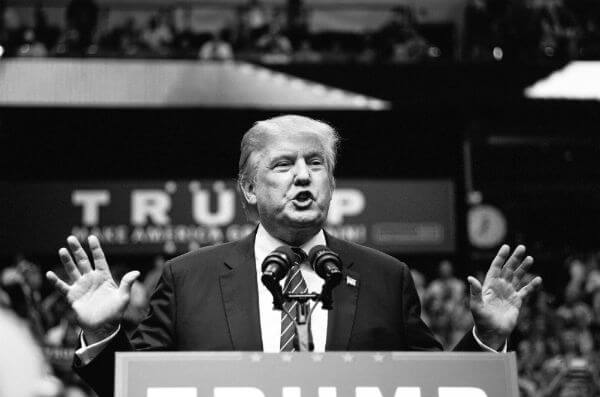
trump-bw

The New York Times reports: Donald J. Trump’s blustery attacks on the press, complaints about the judicial system and bold claims of presidential power collectively sketch out a constitutional worldview that shows contempt for the First Amendment, the separation of powers and the rule of law, legal experts across the political spectrum say.

Even as much of the Republican political establishment lines up behind its presumptive nominee, many conservative and libertarian legal scholars warn that electing Mr. Trump is a recipe for a constitutional crisis.

“Who knows what Donald Trump with a pen and phone would do?” asked Ilya Shapiro, a lawyer with the libertarian Cato Institute.

With five months to go before Election Day, Mr. Trump has already said he would “loosen” libel laws to make it easier to sue news organizations. He has threatened to sic federal regulators on his critics. He has encouraged rough treatment of demonstrators.

His proposal to bar Muslims from entry into the country tests the Constitution’s guarantees of religious freedom, due process and equal protection.

And, in what was a tipping point for some, he attacked Judge Gonzalo P. Curiel of the Federal District Court in San Diego, who is overseeing two class actions against Trump University. [Continue reading…]

Facebooktwittermail

Once threatened by Mexican drug cartels, judge now faces attacks from Trump

The New York Times reports: For much of a year, Gonzalo P. Curiel, then a federal prosecutor in California, lived officially in hiding.

He hunkered down for a while on a naval base and in other closely guarded locations under the protection of United States marshals. Even his siblings did not know exactly where he was at times.

The reason: In a secretly taped conversation inside a San Diego prison, a man accused of being a gunman for a Mexican drug cartel said that he had received permission from his superiors to have Mr. Curiel assassinated.

“It was kind of scary,” said Mr. Curiel’s brother Raul. “He had to be protected. He always had one or two bodyguards with him.”

Nearly 20 years later, Gonzalo Curiel, now a federal judge, is being targeted in a very different way.

The presiding judge in a lawsuit filed by former students of Trump University, he has been called a “hater” of Mr. Trump by the presumptive Republican presidential nominee himself. At a rally last week, Mr. Trump said the judge “happens to be, we believe, Mexican,” suggesting that he was biased because of Mr. Trump’s calls to build a wall along the border to prevent illegal immigration. Angry supporters have been calling the judge’s chambers. [Continue reading…]

Facebooktwittermail

Trump University: It’s worse than you think

John Cassidy writes: Following the release, earlier this week, of testimony filed in a federal lawsuit against Trump University, the United States is facing a high-stakes social-science experiment. Will one of the world’s leading democracies elect as its President a businessman who founded and operated a for-profit learning annex that some of its own employees regarded as a giant rip-off, and that the highest legal officer in New York State has described as a classic bait-and-switch scheme?

If anyone still has any doubt about the troubling nature of Donald Trump’s record, he or she should be obliged to read the affidavit of Ronald Schnackenberg, a former salesman for Trump University. Schnackenberg’s testimony was one of the documents unsealed by a judge in the class-action suit, which was brought in California by some of Trump University’s disgruntled former attendees.

Schnackenberg, who worked in Trump’s office at 40 Wall Street, testified that “while Trump University claimed it wanted to help consumers make money in real estate, in fact Trump University was only interested in selling every person the most expensive seminars they possibly could.” The affidavit concludes, “Based upon my personal experience and employment, I believe that Trump University was a fraudulent scheme, and that it preyed upon the elderly and uneducated to separate them from their money.” [Continue reading…]

Facebooktwittermail

Can Trump sustain his success story?

trump

Michael Wolff writes: One thing to understand about Trump is that, rather unexpectedly, he’s neither angry nor combative. He may be the most threatening and frightening and menacing presidential candidate in modern life, and yet, in person he’s almost soothing. His extreme self-satisfaction rubs off. He’s a New Yorker who actually might be more at home in California (in fact, he says he usually comes to his home here — two buildings on Rodeo Drive [in Beverly Hills] — only once a year). Life is sunny. Trump is an optimist — at least about himself. He’s in easy and relaxed form campaigning here in these final days before the June 7 California primary, even with Hillary Clinton’s biggest backers and a city that is about half Latino surrounding him.

Earlier in the day, I’d met with Trump at a taping of ABC’s Jimmy Kimmel Live! at the El Capitan Theatre on Hollywood Boulevard, where he was the single guest for the evening (musicians The Weeknd and Belly canceled upon learning of his appearance). “Have you ever seen anything like this?” he asked. He meant this, the Trump phenomenon. Circumventing any chance that I might dampen the sentiment, he quickly answered his own question: “No one ever has.”

His son-in-law, New York Observer owner Jared Kushner, married to his daughter Ivanka and also a real estate scion — but clearly a more modest and tempered fellow, a wisp next to his beefsteak father-in-law — offered that they may have reached 100 percent name recognition. In other words, Trump could be the most famous man in the world right now. “I may be,” says Trump, almost philosophically, and referencing the many people who have told him they’ve never seen anything like this. “Bill O’Reilly said in his lifetime this is the greatest phenomenon he’s ever seen.”

That notion is what’s at the center of this improbable campaign, its own brilliant success. It’s its main subject — the one you can’t argue with. You can argue about issues, but you can’t argue with success. Hence, to Trump, you’re really foolish to argue with the Trump campaign. “I’ve spent $50 million of my own money to go through the primaries. Other people spent $230 million and they came in last. You know what I’m saying?” And this provides him the reason to talk endlessly and repetitively about the phenomenon of the campaign. [Continue reading…]

Trump doesn’t have to make serious campaign promises or coherently articulate his vision for how exactly he intends to make America great again. Instead, he’s offering himself as the embodiment of success.

The long calendar of the primaries and the large number of GOP contestants have served the Trump campaign well by sustaining a rolling narrative of perpetual and rising success.

The question is, once Trump has had his official coronation at the Republican National Convention in Cleveland next month, how will he sustain his success narrative for three more months with little else to point at than polling numbers?

Of course, if he soars ahead in the polls, then Trump America is just around the corner. But if he doesn’t pull away, his message of success may start to lose a lot of its power.

The Democrats might try to build solidarity around fear of Trump with the unintended effect of magnifying both negative and positive perceptions of his strength, but perhaps instead they need to focus their attack on the Trump brand of success. Once Trump loses a firm grip on his success story, he has nothing.

Facebooktwittermail

Why Trump University got chased out of Texas

USA Today reports: The Texas Attorney General’s Office opened a deceptive trade practices investigation of Trump University in 2010 and chased the business out of the state, saying the promises made to students were “virtually impossible to achieve,” according to documents unearthed by a Democratic super PAC.

Assistant Attorney General Rick Berlin wrote to Donald Trump’s lawyers in June 2010 that Trump University seminars – for which students paid thousands of dollars – were targeted at real estate novices and promised “to teach these novices everything they need to know to be a successful residential real estate broker — in 3 days.”

But in Texas, “to become licensed as a real estate broker you must have 900 hours of classroom instruction and 2 years selling experience,” Berlin said, in the memo the Democratic super PAC American Bridge 21st Century uncovered through a public records request and provided to USA TODAY. The information given to students by Trump University “is essentially unusable,” and students “will be unable to recoup their investment in the course, much less make a profit, as promised by Trump U,” Berlin wrote. [Continue reading…]

Facebooktwittermail

The easiest way to guess if someone supports Trump? Ask if Obama is a Muslim

Philip Klinkner writes: You can ask just one simple question to find out whether someone likes Donald Trump more than Hillary Clinton: Is Barack Obama a Muslim? If the answer is yes, 89 percent of the time that person will have a higher opinion of Trump than Clinton.

That’s more accurate than asking people if it’s harder to move up the income ladder than it was for their parents (54 percent), whether they oppose trade deals (66 percent), or if they think the economy is worse now than last year (81 percent). It’s even more accurate than asking them if they are Republican (87 percent).

Those results come from the 2016 American National Election Study (ANES) pilot survey. My analysis indicates that economic status and attitudes do little to explain support for Donald Trump. [Continue reading…]

Facebooktwittermail

In America, domestic extremists are a bigger risk than foreign terrorism

By David Alpher, George Mason University

Take America back from those who have stolen it.
Protect America from those who want to destroy it.
Restore the principles that these usurpers betrayed.

These are the messages that have defined the GOP presidential race. They have been used for the past eight years to justify obstruction of the Obama administration, and are now being used to paint the Democratic candidates as dangerous. In the late stages of the GOP primary as the rhetoric became increasingly xenophobic, they were applied to increasingly broad swaths of the American population as well.

Years of constant repetition by members of the GOP have given them an appearance of legitimacy, now strengthened by Donald Trump’s victory in the GOP primary contest and the party’s growing embrace of him as their standard-bearer.

Unfortunately, the Republican Party isn’t alone in using these messages.

Right-wing extremist groups use them as well, and to very specific ends: to define the conditions under which antigovernment violence becomes legitimate in their worldview.

I have spent nearly 15 years studying how the risk of violence grows within societies around the world, and running programs designed to stem the tide. I have seen rhetoric like this used to mobilize violence in countries like Iraq and Kenya.

This same dynamic, I argue, is taking shape within American society now. If it continues, it represents a greater threat than anything we face from terrorist groups outside our own borders.

Continue reading

Facebooktwittermail

Whither Jerry Brown goes, so will many Democrats

trump-bw

Todd S. Purdum writes: When an endorsement is as tepid as Jerry Brown’s — call it a non-endorsement endorsement — does it really make any difference at all? Perhaps not — except as a bellwether. The California governor’s eleventh-hour announcement on Tuesday that he’s supporting Hillary Clinton over Bernie Sanders, only a week before the biggest primary election in the presidential race, is emblematic of the months-long head-heart dilemma that has plagued the many Democrats who have a complicated history with the Clintons.

No one embodies this ambivalence, in fact, more than Jerry Brown himself, who a generation ago was seen more or less as the Bernie Sanders of his time. After all, it was Brown who, in the heat of his insurgent 1992 primary campaign for president against Bill Clinton, denounced him as “the prince of sleaze,” and described the work for the Arkansas state government of Hillary Clinton’s law firm as “a conflict of interest” and “a scandal of major proportion,” while carrying his candidacy to the bitter end at the Democratic National Convention in New York.

“I don’t care what you say about me, but you ought to be ashamed of yourself for jumping on my wife,” Bill Clinton told Brown in an angry Chicago debate in which the rivals pointed fingers in each other’s faces. “You’re not worth being on the same platform with my wife. I never funneled any money to my wife’s law firm. Never.”

Twenty-four years later, politics has once again made strange bedfellows — and Brown’s accommodation points to where many other progressive Democrats will likely end up, whether or not they are directly influenced by his action. It’s not that they like Hillary any better now than they did before, but much as the prospect of hanging concentrates the mind, the looming nomination of Donald Trump appears to supply the necessary nudge. If Hillary Clinton wins, it will be as part of a “Stop Trump” movement by many Democrats, nothing more. [Continue reading…]

Facebooktwittermail

Trump’s big tent for bigotry

Jonathan Weisman writes: A Jewish 17-year-old, inflamed by the Black Lives Matter movement and the cause of L.G.B.T. rights, told me recently there is no anti-Semitism, certainly nothing compared with the prejudices that afflict other minorities. I surprised myself when I recoiled from her words and argued passionately that Jews must never think anti-Semitism has been eradicated. I sounded like my mother.

Just weeks later, I found myself staring down a social-media timeline filled with the raw hate and anti-Semitic tropes that for centuries fueled expulsion, persecution, pogroms and finally genocide.

“I found the Menorah you were looking for,” one correspondent offered with a Trump-triumphant backdrop on his Twitter profile; it was a candelabrum made of the number six million. Old Grand Dad cheerfully offered up a patriotic image of Donald Trump in colonial garb holding up the Liberty Bell and fighting “against the foreign hordes,” with caricatures of the Jew, the American Indian, the Mexican, the Chinese and the Irish cowering at his feet.

I am not the first Jewish journalist to experience the onslaught. Julia Ioffe was served up on social media in concentration camp garb and worse after Trump supporters took umbrage with her profile of Melania Trump in GQ magazine. The would-be first lady later told an interviewer that Ms. Ioffe had provoked it. The anti-Semitic hate hurled at the conservative commentator Bethany Mandel prompted her to buy a gun.

Beyond journalism, stories of Muslims assaulted by Trump supporters are piling up. Hispanic immigrants are lining up for citizenship, eager to vote. Groups that have been maligned over centuries at different times in different regions now share a common tormentor, the alt-right, a militant agglomeration of white nationalists, racists, anti-Semites and America Firsters that have been waging war on the Republican establishment for some time. Their goals: Close the borders, deport illegal immigrants, pull out of international entanglements and pull up the drawbridge. [Continue reading…]

The middle way here requires neither minimizing anti-Semitism nor granting it special status among the array of bigotries that are being fomented by Trump.

The struggle now is between the politics of inclusion and those of exclusion.

There’s never been a time of greater need for a show of solidarity between Jews, Muslims, blacks, immigrants and all Americans who recognize that shared human values matter more than the identities we use to set ourselves apart.

Facebooktwittermail

Trump’s rise part of global trend

The New York Times reports: Mr. Trump’s campaign has engendered impassioned debate about the nature of his appeal and warnings from critics on the left and the right about the potential rise of fascism in the United States. More strident opponents have likened Mr. Trump to Adolf Hitler and Benito Mussolini.

To supporters, such comparisons are deeply unfair smear tactics used to tar conservatives and scare voters. For a bipartisan establishment whose foundation has been shaken by Mr. Trump’s ascendance, these backers say, it is easier to delegitimize his support than to acknowledge widespread popular anger at the failure of both parties to confront the nation’s challenges.

But the discussion comes as questions are surfacing around the globe about a revival of fascism, generally defined as a governmental system that asserts complete power and emphasizes aggressive nationalism and often racism. In places like Russia and Turkey, leaders like Vladimir V. Putin and Recep Tayyip Erdogan employ strongman tactics. In Austria, a nationalist candidate came within three-tenths of a percentage point of becoming the first far-right head of state elected in Europe since World War II.

In Hungary, an authoritarian government has clamped down on the news media and erected razor wire fences to keep out migrants. There are worries that Poland may follow suit. Traditional parties in France, Germany, Greece and elsewhere have been challenged by nationalist movements amid an economic crisis and waves of migrants. In Israel, fascism analogies by a former prime minister and a top general have again inflamed the long-running debate about the occupation of Palestinian territories.

“The crash of 2008 showed how globalization creates losers as well as winners,” said Mark Leonard, the director of the European Council on Foreign Relations. “In many countries, middle-class wages are stagnant and politics has become a battle over a shrinking pie. Populists have replaced contests between left and right with a struggle between cosmopolitan elites and angry nativists.” [Continue reading…]

Facebooktwittermail

How would Trump ‘take the oil’?

Zack Beauchamp writes: In the past five years, Trump has consistently pushed one big foreign policy idea: America should steal other countries’ oil.

He first debuted this plan in an April 2011 television appearance, amid speculation that he might run for the GOP nomination. In the interview, Trump seemed to suggest the US should seize Iraqi oil fields and just operate them on its own.

“In the old days when you won a war, you won a war. You kept the country,” Trump said. “We go fight a war for 10 years, 12 years, lose thousands of people, spend $1.5 trillion, and then we hand the keys over to people that hate us on some council.” He has repeated this idea for years, saying during one 2013 Fox News appearance, “I’ve said it a thousand times.”

Trump sees this as just compensation for invading Iraq in the first place. “I say we should take it [Iraq’s oil] and pay ourselves back,” he said in one 2013 speech.

During the 2016 campaign, Trump has gotten more specific about how exactly he’d “take” Iraq’s oil. In a March interview with the Washington Post, he said he would “circle” the areas of Iraq that contain oil and defend them with American ground troops:

POST: How do you keep it without troops, how do you defend the oil?

TRUMP: You would… You would, well for that— for that, I would circle it. I would defend those areas.

POST: With U.S. troops?

TRUMP: Yeah, I would defend the areas with the oil.

After US troops seize the oil, Trump suggests, American companies would go in and rebuild the oil infrastructure damaged by bombing and then start pumping it on their own. “You’ll get Exxon to come in there … they’ll rebuild that sucker brand new. And I’ll take the oil,” Trump said in a December stump speech.

Trump loves this idea so much that he’d apply it to Libya as well, telling Bill O’Reilly in April that he’d even send in US ground troops (“as few as possible”) to fight off ISIS and secure the country’s oil deposits.

To be clear: Trump’s plan is to use American ground troops to forcibly seize the most valuable resource in two different sovereign countries. The word for that is colonialism.

Trump wants to wage war in the name of explicitly ransacking poorer countries for their natural resources — something that’s far more militarily aggressive than anything Clinton has suggested.

This doesn’t really track as “hawkishness” for most people, mostly because it’s so outlandish. A policy of naked colonialism has been completely unacceptable in American public discourse for decades, so it seems hard to take Trump’s proposals as seriously as, say, Clinton’s support for intervening more forcefully in Syria.

Yet this is what Trump has been consistently advocating for for years. His position hasn’t budged an inch, and he in fact appears to have doubled down on it during this campaign. This seems to be his sincere belief, inasmuch as we can tell when a politician is being sincere. [Continue reading…]

Ignoring the issue of whether this policy might be widely supported in the U.S. (I fear that large numbers of Americans, like Trump, may actually feel the U.S. is entitled to lay claim to Iraq’s oil), and ignoring the fact that Iraqis themselves would object to the theft of their resources, a problem that Trump seems to overlook is the reaction of the rest of the Gulf’s oil producing countries.

Rather than succeeding in taking the oil, what Trump would more likely accomplish is something that currently looks improbable: the formation of an alliance between Iran, Saudi Arabia and the other Gulf states, all of whom would feel threatened by Trump’s move. Not only would they feel threatened but they would also have the means to apply a stranglehold on the global oil supply by shutting down the Straits of Hormuz until Washington’s Pirate-in-Chief stepped back in line by respecting Iraq’s sovereignty.

What’s scarier than any of Trump’s outlandish proposals, is the fact that millions of Americans take him seriously.

Facebooktwittermail