Category Archives: 2016 President Election

Israel/Palestine in the coming realignment of American politics

Following Bernie Sanders’ selection of Cornel West, Keith Ellison, James Zogby, Deborah Parker, and Bill McKibben to sit on the 15-member Democratic Party platform-writing committee, Corey Robin writes: However insignificant, power-wise, Sanders’s choices may be — his people will constitute about a third of the total committee — they are highly significant in terms of the discussion in this country around Israel/Palestine, as Haaretz rightly pointed out.

Because so much of Israel/Palestine politics in this country depends upon keeping certain voices and arguments out of the mainstream, the very fact that Sanders has chosen Cornel West — who in addition to self-identifying as a socialist, is also a long-standing critic of Israel and firm supporter of the boycott, divestment, and sanctions movement (BDS) — as well as Zogby and even Ellison, as his representative on the platform committee, is a big deal.

West, Zogby, and Ellison are now the voices of not only Sanders but also of the not-insignificant sector of Sanders voters within the Democratic Party.

Israel/Palestine has always been a curious issue in American politics: on the one hand, it’s one tiny piece of the world; on the other hand, it plays an outsized role in US foreign policy and political culture, for all sides of the debate.

That Sanders has chosen to make that one issue a kind of line in the sand of his particular brand of politics — when so many of us had thought he’d simply the ignore the issue altogether — suggests to me that it will play a large role in the coming realignment of American politics. [Continue reading…]


Facebooktwittermail

Unhappiness in white America

Carol Graham writes: Everyone is struggling to understand why so many whites — including many who are not suffering economically — are rallying to the angry words and fearful music of Donald Trump’s presidential campaign. Meanwhile, blacks and other minorities are sticking with the status-quo incrementalism of Hillary Clinton. It’s an odd juxtaposition, but there’s an explanation, one with far-reaching ramifications. A wide and growing optimism gap has opened between poor and middle-class whites and their counterparts of other races — and the former are the congenital pessimists.

My research finds deep divisions in our country – not just in terms of income and opportunity, but in terms of hopes and dreams. The highest costs of being poor in the U.S. are not in the form of material goods or basic services, as in developing countries, but in the form of unhappiness, stress, and lack of hope. What is most surprising, though, is that the most desperate groups are not minorities who have traditionally been discriminated against, but poor and near-poor whites. And of all racial groups in poverty, blacks are the most optimistic about their futures.

Based on a question in a Gallup survey asking respondents where they expected their life satisfaction to be in five years (on a 0-10 point scale), I find that among the poor, the group that scores the highest is poor blacks. The least optimistic group by far is poor whites. The average score of poor blacks is large enough to eliminate the difference in optimism about the future between being poor and being middle class (e.g. removing the large negative effect of poverty), and they are almost three times more likely to be higher up on the optimism scale than are poor whites. Poor Hispanics are also more optimistic than poor whites, but the gaps between their scores are not as large as those between blacks and whites.

In terms of stress — a marker of ill-being — there are, again, large differences across races. Poor whites are the most stressed group and are 17.8 percent more likely to experience stress in the previous day than middle-class whites. In contrast, middle-class blacks are 49 percent less likely to experience stress than middle-class whites, and poor blacks are 52 percent less likely to experience stress than poor whites (e.g. their odds of experiencing stress are roughly half those of poor whites.

Why does this matter? Individuals with high levels of well-being have better outcomes; they believe in their futures and invest in them. In contrast, those without hope for their futures typically do not make such investments. Remarkably, the poor in the U.S. (on average) are less likely to believe that hard work will get them ahead than are the poor in Latin America. [Continue reading…]

Facebooktwittermail

Donald Trump would allow Keystone XL pipeline and end Paris climate deal

The Guardian reports: Donald Trump pledged to cancel the Paris climate agreement, endorsed drilling off the Atlantic coast and said he would allow the Keystone XL pipeline to be built in return for “a big piece of the profits” for the American people.

At an oil and natural gas conference in North Dakota on Thursday, just minutes after he had celebrated hitting the 1,237 delegate mark needed to formally clinch the party’s nomination, Trump gave a speech on energy policy that was largely shaped by advice from Kevin Cramer, a US representative from the state.

In a press conference before the event, Trump praised the advice of oil tycoon Harold Hamm. Hamm and Cramer then introduced him onstage.

Michael Brune, executive director of the Sierra Club environmentalist group, was taken aback by Trump’s address.

“I have never heard more contradiction in one hour than I heard in the speech,” he told the Guardian. [Continue reading…]

Facebooktwittermail

Trump’s people: Among the fans in Florida, New Hampshire, and Iowa

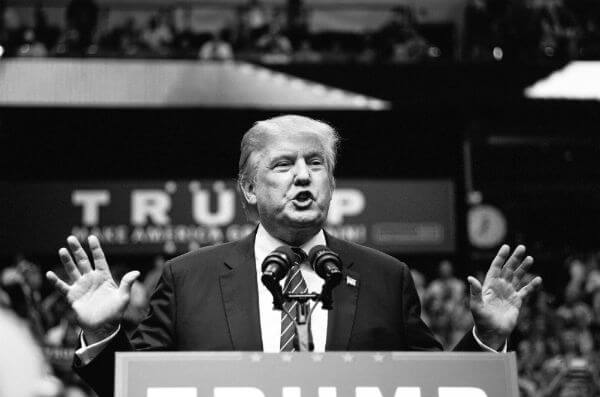
trump-bw

Paul Wood writes: Trump’s supporters believe that he is the only one “out there telling the real story” about the Islamic State, as a Florida man named Richard Sherman told me. He was retired, in his sixties, wearing white shorts and a white cutoff T-shirt that called for jihadists to be fed to pigs. “I designed it myself,” he said. “Every time we kill a jihadist, we should chop him up on the White House lawn, on worldwide television, and have pigs eat him. They like to chop off heads. You have to treat terror with terror. That’s the only thing they understand. The Koran tells them to kill Jews, kill Christians, to die in the process, and they will get seventy-two virgins. Okay, we can say: ‘You’re going to be eaten and excreted by pigs. Do you want that?’ If you can get the seventy-two virgins after that, God bless you.”

Of the race for the Republican nomination, he said, “We’re tired of the people who say they’re against Obama and then they do everything Obama wants. The Muslims are slaughtering us — in San Bernardino, in Boston, in Chattanooga. They’re coming to this country and slaughtering us. The immigration people are not keeping them out. All you’re finding is dead Americans all over America. We want somebody who’s going to stop that.” [Continue reading…]

Facebooktwittermail

Trump’s plan to renegotiate the climate deal would require the agreement of 195 countries

Reuters reports: Donald Trump would be “highly unlikely” to be able to renegotiate the global accord on climate change if elected U.S. president, the U.N.’s climate chief said on Wednesday, as doing so would require the agreement of 195 countries.

Trump, the presumptive Republican presidential nominee, told Reuters earlier this month he was “not a big fan” of the climate accord and would seek to renegotiate elements of the deal.

“As we all know, Donald Trump relishes making very dramatic statements on many issues, so it is not surprising, but it is highly unlikely that that would be possible,” Christiana Figueres, executive secretary of the United Nations Framework Convention on Climate Change, told journalists at the Carbon Expo event in Cologne.

The accord, struck in Paris last December, saw countries agree to cut greenhouse gas emissions from 2020 with the aim of limiting the rise in the global average temperature to less than 2 degrees Celsius.

“An agreement that has been adopted by 195 countries would require 195 countries to agree to any new negotiation,” she said.

She added the current U.S. administration was a strong supporter of the deal because it benefits the country. [Continue reading…]

Facebooktwittermail

5 ways Bernie Sanders may impact the Democratic Party platform

Jason Linkins writes: Every four years, as Democrats and Republicans plan for their national conventions, party leaders come together to decide on how to best dust off and shine up their respective parties’ platform — that catch-all proclamation that signals their political priorities and policy goals. Typically, the publication of these platforms results in a couple days of news stories, in which noteworthy alterations are documented and the other side levies partisan objections.

But this year, there’s an interesting twist: Bernie Sanders — the presumptive second-place finisher in the Democratic primary — has been granted the opportunity to play a role on the platform committee. Which means that the Democratic Party’s platform document may receive up to four days of coverage. Perhaps even five.

If this seems like a cynical way of viewing what is ostensibly an important party document, I invite you to muddle through the last Democratic party platform, authored in President Barack Obama’s re-election year. A red-hot manifesto it is not. Over the course of some 25,000-or-so words, the party outlines, in the safest possible terms, what it stands for. Everything is poll-tested to within an inch of its literary life.

Along the way, the platform is salted with marketing bromides and vague political platitudes. Credit is given to Obama for many accomplishments which need to, in the eyes of the party, continue being accomplished. And, in keeping with recent Democratic Party election-year strategies, much effort is undertaken to cast the GOP in a bad light (“The other guys are crazy!”). It’s a tradition that will no doubt continue now that the presumptive Republican Party nominee is reality TV personality and North Pacific Subtropical Gyre garbage patch Donald Trump.

The objectionable nature of Trump’s candidacy may be one thing on which this year’s platform committee might be able to quickly agree. In an unusual move, Democratic National Committee Chairwoman Debbie Wasserman-Schultz is allowing Sanders to name five appointees to the 15-member committee, instead of reserving the right to name the entire committee for herself. Under this arrangement, presidential rival Hillary Clinton‘s campaign will get to pick six members and Wasserman-Schultz will name four, including the committee chair, Rep. Elijah Cummings (D-Md.).

As Mother Jones’ Kevin Drum points out, the buried news may be that Sanders is signaling that he understands he won’t win this nomination. Whether or not this is true, the independent Vermont senator is hailing this as a major, substantive concession. And he’s named a quintet of unconventional-by-party-insider standards as his emissaries: Rep. Keith Ellison (D-Minn.), environmental campaigner Bill McKibben, Native American activist Deborah Parker, racial justice advocate (and Obama critic) Cornel West and DNC member James Zogby.

Clinton’s picks are decidedly more in keeping with her “barrier-breakers” theme: American Federation of State, County and Municipal Employees union leader Paul Booth, former EPA head Carol Browner, Rep. Luis Gutiérrez (D-Ill.), Ohio state Rep. Alicia Reece, former State Department official Wendy Sherman and Center for American Progress head Neera Tanden.

So, one way in which this arrangement will generate more news than is typically created by the platform committee will be watching West and Tanden co-author a document. But beyond the soap opera aspect of this collaboration, there are several areas in which Sanders’ representatives could alter what’s traditionally a very staid and cautious party declaration in significant ways. [Continue reading…]

Facebooktwittermail

Why pro-Israel Democrats Bernie Sanders and Hillary Clinton could have a fight about Israel

The Washington Post reports: The only Jewish candidate in the 2016 presidential race, who calls himself “100 percent pro-Israel,” and one of Israel’s strongest U.S. defenders are nearing a fight over what being a pro-Israel Democrat means.

Sen. Bernie Sanders of Vermont plans to push for revisions in the Democratic Party position about relations with Israel, with a focus on elevating Palestinian rights as a U.S. priority, people involved in discussions over potential changes to the Democratic Party’s platform said.

Sanders wants revisions in wording about U.S. relations with Israel and commitment to seeking peace between the U.S. ally and the Palestinians while preserving the commitment to Israel’s security, those people said. They requested anonymity to discuss ideas for the platform that are still being developed. The platform is drafted by a Democratic National Committee panel and presented at the party convention in July.

The proposed new language on Israel is expected to seek what Sanders has elsewhere called a more even-handed U.S. approach to Israeli occupation of land Palestinians claim for a future state. [Continue reading…]

Facebooktwittermail

Defending the status quo helps the populists thrive

Natalie Nougayrède writes: his is the age of the disgruntled – in domestic politics and foreign affairs alike. Anti-establishment sentiment within countries is somehow echoed by the way the rule book of international relations is being torn up. These dynamics feed on each other. They are at play in America (the rise of Donald Trump), Europe (growing populism) and Asia (nationalism and an arms race). Finding a way to address them will be crucial if democracies are to have any hope of resisting instability.

I recently attended the Lennart Meri conference in Estonia – a transatlantic gathering where much of the talk focused on how the “dream of a Europe whole and free” might be fading, and how that is affecting security and stability. And this week in London, at a meeting on global governance, and what needs to be done to improve it, a key focus of British and other European participants was: how do we restore the legitimacy of international institutions?

In democracies it is only natural that public opinion influences actions taken by governments on the international stage. But the way that pressure is exerted has changed. The Dutch government would never have sought a review of an association agreement between the EU and Ukraine if a referendum in the Netherlands – with a turnout of only 32%, triggered by a petition that had just over 300,000 signatures – hadn’t signalled a rejection of that treaty. [Continue reading…]

Facebooktwittermail

Many of GOP’s wealthiest donors don’t like Trump

The New York Times reports: A powerful array of the Republican Party’s largest financial backers remains deeply resistant to Donald J. Trump’s presidential candidacy, forming a wall of opposition that could make it exceedingly difficult for him to meet his goal of raising $1 billion before the November election.

Interviews and emails with more than 50 of the Republican Party’s largest donors, or their representatives, revealed a measure of contempt and distrust toward their own party’s nominee that is unheard of in modern presidential politics.

More than a dozen of the party’s most reliable individual contributors and wealthy families indicated that they would not give to or raise money for Mr. Trump. This group has contributed a combined $90 million to conservative candidates and causes in the last three federal elections, mainly to “super PACs” dedicated to electing Republican candidates.

Up to this point, Mr. Trump has embraced the hostility of the Republican establishment, goading the party’s angry base with diatribes against wealthy donors who he claimed controlled politicians. And he has succeeded while defying conventions of presidential campaigning, relying on media attention and large rallies to fire up supporters, and funding his operation with a mix of his own money and small-dollar contributions.

But that formula will be tested as he presents himself to a far larger audience of voters. Mr. Trump has turned to the task of winning over elites he once attacked, with some initial success. And he has said he hopes to raise $1 billion, an enormous task given that he named a finance chairman and started scheduling fund-raisers only this month. [Continue reading…]

Facebooktwittermail

America feels like it’s in decline again — and Trump is just a symptom

By Liam Kennedy, University College Dublin

A visceral sense of domestic decline is coursing through contemporary American culture and politics – and it’s become one of the central themes of this year’s presidential campaign. Donald Trump in particular has used it to stoke the inchoate anger of his supporters, telling them: “Our country is falling apart. Our infrastructure is falling apart … Our airports are, like, third world.”

And paradoxically, even as Trump laments the US’s decline, leading pundits are pointing to his remarkably successful insurgency as evidence of the same phenomenon. Andrew Sullivan, describing the election campaign as “dystopian”, argued that “America has never been so ripe for tyranny.“ He concluded: “In terms of our liberal democracy and constitutional order, Trump is an extinction-level event.”

But while they certainly have a deep resonance today, dramatic lamentations of American decline have a long history. Ever since the founding of the nation, Americans have gone through bouts of self-doubt, struggling to come to terms with national and global crises both real and perceived. American political culture is shot through with the theme of decline followed by regeneration, a distinctive pattern that helps frame the idea of American exceptionalism.

Political leaders frequently invoke this dynamic in their rhetoric, although usually to paint a picture of regeneration. Pessimism is not often rewarded. Jimmy Carter’s notorious “crisis of confidence” speech in 1979 may have been meant as a bold admonition to the nation to pick up its spirits, but its dour attempt at straight talk was no match for Carter’s sunnier successor, Ronald Reagan, who was re-elected by a landslide in 1984 as he declared it “morning again in America”.

Continue reading

Facebooktwittermail

Clinton vs Sanders: Peace is still possible

John Cassidy writes: In many hard-fought political races, there comes a time when tempers fray and emotion takes over. Right now, the Democratic Presidential primary appears to have reached such a point, with people on both sides going at each other with gusto, and some of the media getting swept up, too.

The front page of Thursday’s Times featured this headline: “Sanders Willing to Harm Hillary in Home Stretch.” Did Sanders really say that? No, he didn’t. The only quote in the Times story from anyone in the Sanders campaign came from his senior adviser, Tad Devine, who said that he didn’t think his boss’s criticisms of Clinton on the stump would hurt her in a general-election campaign against Donald Trump. The senator’s team, Devine said, was “not thinking about” the possibility that they might prevent Clinton from becoming the first woman to be elected President. Then came a long statement by Devine to the Times:

The only thing that matters is what happens between now and June 14th … We have to put the blinders on and focus on the best case to make in the upcoming states. If we do that, we can be in a strong position to make the best closing argument before the convention. If not, everyone will know in mid-June, and we’ll have to take a hard look at the way things stand.

One way to interpret this story comes from the headline, which implies that Sanders is callously ignoring the danger that he will damage Clinton’s chances in the fall and hand the Oval Office keys to Trump. Paul Krugman tweeted a photo showing a Web version of the headline, “Sanders Willing to Harm Clinton in Homestretch.” To that, he added, “Of course he is. Fwiw, I don’t think Sanders has gone off the rails; I think this is who he always was.” Linking to the Times story on her Facebook feed, the writer and editor Anna Holmes wrote, “Seriously. Fuck this guy.”

Another possible interpretation is that the headline was inflammatory, and the story contained little that was new. After all, Sanders has been saying for weeks that he intends to campaign aggressively until the end of the primaries, in mid-June, and that he is hoping to defeat Clinton in California, on June 7th. To this end, he has continued to depict his opponent as the candidate of élites and big money, as he has been doing for many months.

Devine’s focus on the here and now was what you would expect from a campaign operative. If you read his statement carefully, it actually contradicts the notion that Sanders’s campaign is conducting a battle to the death, oblivious to the implications for the general election. [Continue reading…]

Facebooktwittermail

This is how fascism comes to America

Robert Kagan writes: We’re supposed to believe that Trump’s support stems from economic stagnation or dislocation. Maybe some of it does. But what Trump offers his followers are not economic remedies — his proposals change daily. What he offers is an attitude, an aura of crude strength and machismo, a boasting disrespect for the niceties of the democratic culture that he claims, and his followers believe, has produced national weakness and incompetence. His incoherent and contradictory utterances have one thing in common: They provoke and play on feelings of resentment and disdain, intermingled with bits of fear, hatred and anger. His public discourse consists of attacking or ridiculing a wide range of “others” — Muslims, Hispanics, women, Chinese, Mexicans, Europeans, Arabs, immigrants, refugees — whom he depicts either as threats or as objects of derision. His program, such as it is, consists chiefly of promises to get tough with foreigners and people of nonwhite complexion. He will deport them, bar them, get them to knuckle under, make them pay up or make them shut up.

That this tough-guy, get-mad-and-get-even approach has gained him an increasingly large and enthusiastic following has probably surprised Trump as much as it has everyone else. Trump himself is simply and quite literally an egomaniac. But the phenomenon he has created and now leads has become something larger than him, and something far more dangerous.

Republican politicians marvel at how he has “tapped into” a hitherto unknown swath of the voting public. But what he has tapped into is what the founders most feared when they established the democratic republic: the popular passions unleashed, the “mobocracy.” Conservatives have been warning for decades about government suffocating liberty. But here is the other threat to liberty that Alexis de Tocqueville and the ancient philosophers warned about: that the people in a democracy, excited, angry and unconstrained, might run roughshod over even the institutions created to preserve their freedoms. As Alexander Hamilton watched the French Revolution unfold, he feared in America what he saw play out in France — that the unleashing of popular passions would lead not to greater democracy but to the arrival of a tyrant, riding to power on the shoulders of the people. [Continue reading…]

Unfortunately, some people, lacking the confidence to think for themselves, are instead inclined to mirror the opinions of their ideological mentors, in which case it often seems to matter more who is speaking than what they are saying.

In this case, for those for whom the label neocon provokes disgust, the warnings from a leading neoconservative (Robert Kagan) might easily be dismissed — even though they are well-grounded. My advice: Ignore the byline and simply consider what he is saying. And remember that tyrants aren’t born — they emerge in a suitable set of conditions and those conditions themselves give birth to tyranny.

Facebooktwittermail

Austria’s election is a warning to the West

Sylvie Kauffmann writes: On Monday, the Western world may well wake up to the news that, for the first time since the defeat of Nazism, a European country has democratically elected a far-right head of state. Norbert Hofer, of the Austrian Freedom Party, claimed 35 percent of the vote in the first round of the presidential election on April 24. Now he is heading into the second round on Sunday with the two mainstream parties having been eliminated from the runoff and the Social Democratic chancellor, Werner Faymann, having resigned.

One month later, Europeans may wake up to the news that British voters have decided, in their June 23 referendum, that their country should become the first member state to leave the European Union. Many observers fear that would be fatal to the European project itself.

And on April 24, 2017, exactly a year after Mr. Hofer’s first-round victory, the French may well wake up to the news that Marine Le Pen, leader of the far-right National Front, has come out on top in the first round of France’s presidential election. That is what polls say we could expect if the election were held today.

In the meantime, it is not impossible that Donald J. Trump, however low his odds seem now, will have moved into the White House.

These are not Orwellian scenarios. Signs of defiance toward the old democratic order are so numerous that the news of Mr. Hofer’s first-round victory hardly reached the front pages of European newspapers. Remember when the election of President Kurt Waldheim in the 1980s, or the antics by the Freedom Party leader Jörg Haider in the 1990s were considered deeply disturbing? That was last century. Today, Austria’s weird politics are no longer isolated. They are part of a solid trend across Europe.

And not just Europe. The trend reaches across the Atlantic, too, with Trumpism threatening to split or take over the Republican Party. [Continue reading…]

Facebooktwittermail

Dying GOP senator apologizes to Muslims for Donald Trump

The Daily Beast reports: Former GOP senator Bob Bennett lay partially paralyzed in his bed on the fourth floor of the George Washington University Hospital. He was dying.

Not 48 hours had passed since a stroke had complicated his yearlong fight against pancreatic cancer. The cancer had begun to spread again, necessitating further chemotherapy. The stroke had dealt a further blow that threatened to finish him off.

Between the hectic helter-skelter of nurses, doctors, and well wishes from a long-cultivated community of friends and former aides, Bennett faced a quiet moment with his son Jim and his wife Joyce.
It was not a moment for self-pity.

Instead, with a slight slurring in his words, Bennett drew them close to express a dying wish: “Are there any Muslims in the hospital?” he asked.

“I’d love to go up to every single one of them to thank them for being in this country, and apologize to them on behalf of the Republican Party for Donald Trump,” Bennett told his wife and son, both of whom relayed this story to The Daily Beast. [Continue reading…]

Facebooktwittermail

Donald Trump’s war on the media threatens fundamental American principles

Peter Beinart writes: On Saturday, Donald Trump ally and confidante Roger Stone declared that CNN “is not a news organization but an advocacy group” and that “when Donald Trump is president, he should turn off their FCC license.” (Full disclosure: I’m a CNN contributor.)

In any other election year, that would be news. But this cycle, Trump and his campaign have threatened the press in so many unprecedented ways that they’ve overloaded the system. The press itself can’t keep up. The day before Stone’s comments, Trump implied that he’d retaliate against The Washington Post’s critical coverage of him by going after its owner, Amazon CEO Jeff Bezos, who has been “getting away with murder, tax-wise” and has a “huge antitrust problem.” In March, Trump campaign manager Corey Lewandowski was arrested on misdemeanor battery charges for grabbing Breitbart reporter Michelle Fields at a campaign rally. (The charges were later dropped.) In February, Trump declared, “If I win … I’m going to open up our libel laws so when they [journalists] write purposely negative and horrible and false articles, we can sue them and win lots of money.” In January, the Trump campaign barred New York Times reporters from covering campaign events after the Times published an unflattering story about his ground operation. (At various times, Team Trump has also barred reporters from National Review, The Des Moines Register, Univision, BuzzFeed, The Daily Beast, Fusion, The Huffington Post, Mother Jones, and Politico, sometimes in explicit retaliation for negative coverage.)

There’s more. Trump has publicly called the journalists who cover him “scum” on at least two occasions. Last July, when The Daily Beast ran a piece about sexual-assault accusations by Trump’s ex-wife, Michael Cohen — executive vice-president at the Trump Organization — told the reporters who wrote it that “what I’m going to do to you is going to be fucking disgusting … I’m going to mess your life up.” As Vice’s Olivia Becker has noted, “Trump is the only presidential candidate whose rallies feature a specific area in the back where journalists are corralled and not permitted to leave. Other candidates have areas designated for the media, but reporters are free to mingle in the crowd to interview people. Leaving the press pen at a Trump rally [by contrast] comes with its own risk.” In February, when a Time magazine journalist tried to leave the pen to photograph protesters being ejected, a secret-service agent grabbed him by the neck and slammed him to the ground. [Continue reading…]

Facebooktwittermail

Donald Trump is about to start getting intelligence briefings — ‘it could be a disaster’

NPR reports: Harry Truman had been vice president for only 82 days when Franklin Roosevelt died, so there was quite a lot he needed to learn when he became president in 1945.

“He didn’t even know the atomic bomb existed,” historian David Priess said. “He didn’t know about the Manhattan Project.”

Priess, a former CIA officer and author of The President’s Book of Secrets, a history of the president’s daily brief, said that experience made Truman resolve that no future president should come into office unprepared.

So in 1952, as the world grew accustomed to nuclear peril and other threats in the unfolding Cold War, Truman offered classified briefings about the global security situation to each of the major-party nominees running to replace him. That tradition has held up ever since.

Traditionally, the White House waits until Republicans and Democrats have formally nominated their candidates at their party conventions, Priess said, but not always. Georgia Gov. Jimmy Carter had no experience with foreign intelligence, so he asked President Gerald Ford for his briefings before he was nominated — and got them.

“Ultimately, it’s the president’s call,” Priess said, about who is briefed and when.

Although presidents typically try to accommodate candidates, even ones in the opposite party, they do not share everything. So, as the White House prepares to arrange briefings by the intelligence community, officials will likely hold back sensitive details about covert operations, secret nuclear and other defense programs, and other such details.

In fact, intelligence briefers this year may need to be more careful than ever, said former CIA analyst Aki Peritz. The de facto Republican nominee, Donald Trump, is “a man famously with no filter,” Peritz said of Trump, who has built his campaign upon what he calls straight talk.

“He’s never held public office before,” Peritz said. “He’s a business developer and a reality TV star. So if the United States starts giving Donald Trump classified briefings” with certain kinds of sensitive information, “it could be a disaster.” [Continue reading…]

Facebooktwittermail

Countering American anti-intellectualism involves more than challenging ignorance

The Washington Post reports on President Obama’s commencement address at Rutgers University on Sunday: The president throughout his speech decried a strain of anti-intellectualism in American politics that he said rejects science, reason and debate. “These are things you want in people making policy,” Obama said to laughter. “That might seem obvious.”

At one point, clearly referring to Trump and congressional Republicans who have decried efforts to combat global warming, Obama warned that “in politics and in life, ignorance is not a virtue.”

“It’s not cool to not know what you are talking about,” he said. “That’s not keeping it real or telling it like it is. That’s not challenging political correctness. That’s just not knowing what you are talking about.”

Throughout the year, Obama has turned again and again in speeches to the obligations that come with citizenship and the need for a more reasoned and respectful political debate at a moment when the country’s politics have never seemed more vulgar and poisonous. [Continue reading…]

Given Obama’s youthful audience, it’s hardly surprising that he would appeal to their desire to be cool, but that itself strikes me as being part of the problem.

Intellectual development hinges less on knowing what you are talking about, than it requires the cultivation of curiosity.

It’s got more to do with asking the right questions, than knowing the right answers.

To be cool, on the other hand, suggests never being caught by surprise — as though to be surprised (which means to encounter the unexpected) must be a bad thing.

But no one can become so seasoned in life that they actually never encounter anything new. On the contrary, where the sense of surprise has been lost, nothing more is being learned. The process of digesting new information and new perceptions that modify ones understanding of the world, has atrophied. Thought, once malleable, has become fixed.

Those who claim they’ve seen it all before, have more likely just stopped looking.

The rancor in political debate which Obama criticizes, is itself not simply representative of a fractious political environment. It isn’t just that discourse is lacking in civility; it’s a reflection of the fears that inhibit creative political thinking.

When politics is strictly factionalized, orthodoxies rule. No one wants to challenge the conventional wisdom inside the camp to which they are aligned. Politics is then simply a power struggle between competing camps.

The intransigence we project onto our opponents is mirrored by the inflexibility on our side.

Facebooktwittermail

GOP leaders: ‘People don’t care’ about Trump’s woman problem

The Guardian reports: After a week of make-up meetings with Donald Trump, Republican party leaders have arrived at a new strategy to accommodate their presumptive presidential nominee: ignore his problematic attitude to women, his tax issues and his fluctuating positions on trade, immigration, foreign relations and a host of other topics, and instead embrace the will of Republican voters.

The switch was illuminated on Sunday, a day after the New York Times published a lengthy investigation into Trump’s alleged mistreatment and objectification of women in his personal life.

Reince Priebus, chair of the Republican National Committee, told Fox News Sunday that if voters have shown they are prepared to ride over issues surrounding the nominee’s behavior, so should the party.

“We’ve been working on this primary for over a year,” he said. “People don’t care. The question is, who is going to bring an earthquake to Washington DC?”

Trump, Priebus added, “represents something much different from the analysis of traditional candidates. Donald Trump is going to have to answer the question, but we’re in a year where nothing applies.

“It’s down to the bigger question: Who is going to blow up the system? That’s what this election is coming down to.” [Continue reading…]

Facebooktwittermail