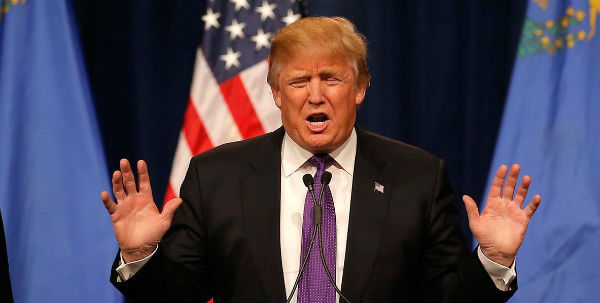
Politico reports: Donald Trump finally shared the name of someone he consults on foreign policy: himself.
Asked on MSNBC’s “Morning Joe” who he talks with consistently about foreign policy, Trump responded, “I’m speaking with myself, number one, because I have a very good brain and I’ve said a lot of things.”
“I know what I’m doing and I listen to a lot of people, I talk to a lot of people and at the appropriate time I’ll tell you who the people are,” Trump said. “But my primary consultant is myself and I have a good instinct for this stuff.” [Continue reading…]
Category Archives: 2016 President Election
Two-thirds GOP voters from Tuesday’s primaries support ban on Muslims entering the U.S.
2/3 GOP primary voters in Illinois, North Carolina, Ohio, & Florida support banning Muslims from entering the U.S. pic.twitter.com/OhXclfkeEJ
— Nathan Lean (@nathanlean) March 16, 2016
I cheered as Trump supporters clashed with protesters. Then I felt shame
Matt Laslo writes: I was in Philadelphia for a funeral on Friday when Chicago friends started blowing up my phone after Donald Trump’s rally was canceled. The situation in Chicago devolved into chaos, with people on both sides wildly swinging at each other, others storming the stage, vitriolic barbs being lobbed by both Trump fans and enemies alike. I should have been mourning, but I was cheering.
Chicago is the city I grew up in. I cheer for its sports teams and rappers alike (though I’m never voting Kanye for president. Sorry, bruh). That’s partially why I was initially elated that my hometown – black, brown and white alike; male and female – finally stood up to Trump and what he represents to many: outright xenophobia and thinly veiled support of racists and bigots.
My initial reaction was wrong. I’ve allowed myself to be debased by Trumpian politics, and for that I’m ashamed. American politics should be about ideas, not about who can land a more ferocious uppercut. [Continue reading…]
Trump’s long romance with Russia
Josh Rogin writes: When Donald Trump talks about his desire to have good relations between the U.S. and Russia, it’s not a recent attraction. Trump’s attempts to expand his business and his brand there date back decades, and this history casts a shadow over his pro-Russian foreign policy. As a presidential candidate, he courts Putin’s favor, extending the charm offensive intended to build the Trump real-estate empire.
“Wouldn’t it be nice if actually we could get along with Russia?” Trump asked at a recent Republican presidential debate. It’s a line he’s used in rallies as well. Trump and Russian President Vladimir Putin have exchanged praise and Trump said he “would probably get along with him very well.”
Trump’s attraction to Russia seems to be mutual. There is a Russian-language website that collects Trump news and offers sales of Trump books and products. There’s even a Trump 2016 Russian language mock campaign site. [Continue reading…]
White voters hope Trump will restore the racial hierarchy upended by Barack Obama
Jamelle Bouie writes: In a nation shaped and defined by a rigid racial hierarchy, [Barack Obama’] election was very much a radical event, in which a man from one of the nation’s lowest castes ascended to the summit of its political landscape. And he did so with heavy support from minorities: Asian Americans and Latinos were an important part of Obama’s coalition, and black Americans turned out at their highest numbers ever in 2008.
For liberal observers, this heralded a new, rising electorate, and — in theory — a durable majority. “The future in American politics belongs to the party that can win a more racially diverse, better educated, more metropolitan electorate,” wrote Harold Meyerson in the Washington Post after the 2008 election. “It belongs to Barack Obama’s Democrats.”
For millions of white Americans who weren’t attuned to growing diversity and cosmopolitanism, however, Obama was a shock, a figure who appeared out of nowhere to dominate the country’s political life. And with talk of an “emerging Democratic majority,” he presaged a time when their votes—which had elected George W. Bush, George H.W. Bush, and Ronald Reagan—would no longer matter. More than simply “change,” Obama’s election felt like an inversion. When coupled with the broad decline in incomes and living standards caused by the Great Recession, it seemed to signal the end of a hierarchy that had always placed white Americans at the top, delivering status even when it couldn’t give material benefits.
In a 2011 paper, Robin DiAngelo — a professor of multicultural education at Westfield State University — described a phenomenon she called “white fragility.” “White Fragility is a state in which even a minimum amount of racial stress becomes intolerable, triggering a range of defensive moves,” she writes. “These moves include the outward display of emotions such as anger, fear, and guilt, and behaviors such as argumentation, silence, and leaving the stress-inducing situation. These behaviors, in turn, function to reinstate white racial equilibrium.”
DiAngelo was describing private behavior in the context of workplace diversity training, but her diagnosis holds insight for politics. You can read the rise of Obama and the projected future of a majority nonwhite America as a racial stress that produced a reaction from a number of white Americans — and forced them into a defensive crouch. You can see the maneuvering DiAngelo describes in the persistent belief that Obama is a Muslim — as recently as last fall, 29 percent of Americans held this view, against all evidence. It is a way to mark Obama as “other” in a society where explicit anti-black prejudice is publicly unacceptable. Consistent with this racialized fear and anxiety is the degree to which white Americans now see “reverse discrimination” as a serious problem in national life. For its American Values Survey, the Public Religion Research Institute asks respondents whether “discrimination against whites is a significant problem.” In last year’s survey, 43 percent of Americans — including 60 percent of working-class whites — said discrimination against whites had become as big a problem as discrimination against blacks and other minorities.
The anxieties DiAngelo describes, and the fears cataloged by the American Values Survey, have real political impact. In a 2014 study, political scientists Maureen Craig and Jennifer Richeson tried to measure “perceived status threat” from a shift in racial demographics, surveying how people responded when informed that California is now home to more blacks, Hispanics, and Asians than non-Hispanic whites. In other words, how do white Americans react to unrelated political questions when exposed to news of a “majority-minority” future? The results were clear. “Making the majority-minority shift in California salient led politically unaffiliated white Americans to lean more toward the Republican Party,” wrote Craig and Richeson. Likewise, “making the changing national racial demographics salient led white Americans (regardless of political party affiliation) to endorse both race-related and relatively race-neutral conservative policy positions more strongly.”
The Obama era didn’t herald a post-racial America as much as it did a racialized one, where millions of whites were hyperaware of and newly anxious about their racial status. [Continue reading…]
The Intercept, busy denouncing critics of Trump, now says media hasn’t done enough to denounce Trump

Glenn Greenwald writes:
As Donald Trump’s campaign predictably moves from toxic rhetoric targeting the most marginalized minorities to threats and use of violence, there is a growing sense that American institutions have been too lax about resisting it. Political scientist Brendan Nyhan on Sunday posted a widely cited Twitter essay voicing this concern, arguing that “Trump’s rise represents a failure in American parties, media, and civic institutions — and they’re continuing to fail right now.” He added, “Someone could capture a major party [nomination] who endorses violence [and] few seem alarmed.”
Actually, many people are alarmed, but it is difficult to know that by observing media coverage, where little journalistic alarm over Trump is expressed.
Really? Everywhere I look there has been no shortage of voices of alarm — everywhere other than, perhaps, The Intercept.
Greenwald and his colleagues have too often seemed more concerned about the hypocrisy of Trump’s critics than about Trump.
On March 4, for instance, Greenwald wrote:
in many cases, probably most, the flamboyant denunciations of Trump by establishment figures make no sense except as self-aggrandizing pretense, because those condemning him have long tolerated if not outright advocated very similar ideas, albeit with less rhetorical candor.
The same day, The Intercept’s Jon Schwarz wrote:
Over 90 “members of the Republican national security community” have now signed an open letter to express their united opposition to a Donald Trump presidency. The letter makes many reasonable criticisms of Trump for his “military adventurism,” “embrace of the expansive use of torture,” and “admiration for foreign dictators such as Vladimir Putin.”
But some of Trump’s critics have no standing here, given that they’ve publicly supported or even directly participated in the same kinds of things for which they are now criticizing him.
At the end of February, The Intercept’s Zaid Jilani saw “Trump moving the GOP to a more dovish direction” — the context of that dubious prediction being the fact that Trump’s success “is setting off alarm bells among neoconservatives who are worried he will not pursue the same bellicose foreign policy that has dominated Republican thinking for decades.”
One gets the sense that at The Intercept, a resurgence of the neocons strikes louder alarm bells than Trump’s rising power.
But today Greenwald writes:
Imagine calling yourself a journalist, and then — as you watch an authoritarian politician get closer to power by threatening and unleashing violence and stoking the ugliest impulses — denouncing not that politician, but, rather, other journalists who warn of the dangers.
Except that seems to be pretty much what Greenwald himself and his colleagues have been doing.
Sounding the alarm about Trump has been the mainstay of the mainstream media for months — even though that alarm has often been diluted by the false expectation that Trump would cause his own campaign to implode.
The problem for those whose own overriding preoccupation is criticism of the establishment/government/media has been a reluctance to echo a mainstream critique of Trump and thereby risk appearing to be in alignment with the forces one rigidly opposes.
Those who pound too hard on the anti-establishment drum are opening up a real danger in November.
If, as seems likely, it comes down to a choice between Donald Trump and Hillary Clinton, a significant number of Bernie Sanders’ current supporters may decide not to vote for the establishment candidate, Clinton, and some may even opt for Trump, not because they agree with him but because they see intrinsic value in shaking up the system.
If, for the sake of his readers, Glenn Greenwald wants to unequivocally register the degree to which he is indeed alarmed by Trump, maybe he can say right away that in a Clinton vs. Trump general election, in spite of the mountain of misgivings he has about Clinton, he will nevertheless vote for her. But maybe he won’t.
(And just in case anyone is wondering: In my state’s primary, I just voted for Bernie Sanders. If the general election turns out to be Clinton vs. Trump, I’ll vote for Clinton.)
Trump takes cue from Assad by casting critics as terrorists
A couple of days ago, a Syrian-American tweeted:
Assad on the phone with Trump right now giving him advice on how best to deal with protesters #TrumpShabeeha
— Omar (@Homsae) March 12, 2016
Even though Trump didn’t make the call, he clearly has no shame in following Assad’s example by accusing a protester of having ties to ISIS after rushing the stage at a Dayton rally.
USSS did an excellent job stopping the maniac running to the stage. He has ties to ISIS. Should be in jail! https://t.co/tkzbHg7wyD?ssr=true
— Donald J. Trump (@realDonaldTrump) March 12, 2016
Needless to say, Trump’s accusation is baseless, as Heavy.com reports:
Tommy Dimassimo, a student at Wright State University in Dayton, has been an avid supporter of the Black Lives Matter movement and Vermont Senator and presidential candidate Bernie Sanders on social media.
The video [which Trump tweeted] seems to have been created by a troll, the same person who started a Facebook page called “Tommy dimassimo wasn’t hugged enough as a kid.”
The Arabic caption on the original video appears to be a joke, including a phrase that roughly translates to saying Dimassimo thought he’d be a big man by standing on the American flag, but really has a small penis.
When George Bush launched the war on terrorism, his rhetoric was a bountiful gift to tyrants around the world. In its response to 9/11, the U.S. had effectively issued a free license for global political oppression which could henceforth all be conducted in the name of fighting terrorism.
Donald Trump has brought that gift back home and anyone who wonders how he would operate as president, merely needs to see how he now demonizes his adversaries.
Yet among some reactionary anti-imperialists, there is a notion that, bad as Trump might be, Hillary Clinton would be worse. Clinton is supposedly the ultimate war-maker whereas Trump strangely gets cast as some sort of man of peace.
For instance, at Counterpunch, William Blum says of Trump:
He speaks of Russia and Vladimir Putin as positive forces and allies, and would be much less likely to go to war against Moscow than Clinton would.
On the Syrian dictator, Trump said last September: “Assad, to me, looks better than the other side,” and in January he claimed that Clinton and Obama “created ISIS.”
Those who want to see Trump as an anti-interventionist should note that in the same speech in Biloxi, Mississippi, he proudly asserted in front of a crowd of thousands of supporters, “I am the most militaristic person in this room.”
On the nuclear deal that Obama struck with Iran, Trump warns: “I will police that [deal], to a level that they [Iran] will not believe even exists.”
Anyone who thinks that a president Trump who has vowed to expand America’s military strength would turn out to be a stabilizing influence in the world, seems to be indulging in wishful thinking.
But let’s suppose that Trump did indeed turn out not to start any wars overseas, there isn’t a shred of evidence that he has the capacity to be the “great unifier” at home that he claims to be.
Trump builds unity in the same way that every tyrant employs: by fomenting hatred of the enemy.
The enemy is a revolving target. It alternates between immigrants, Muslims, the media, China, and now, disruptive protesters.
The result of this approach is always the same: division.
Although he keeps on winning primary after primary, Trump is viewed across America more unfavorably than any other major candidate — and yet he’s likely to become the Republican nominee.
He may even become president. As he correctly says, Clinton’s supporters lack “fervor,” while Bernie Sanders faces a struggle in the Democrat delegate count.
The risk is that out of cynicism about the political process, or out of a sense perhaps that America might be getting what it deserves, Trump’s half-hearted critics may hand him power — power gained not because of the breadth of his support but because too many people underestimated the threat he poses to this country.

Why Trump’s endorsements should scare your pants off
Matt Taibbi writes: Earlier this week, an African-American protester was sucker-punched by a 78-year-old man in a cowboy hat at a Trump rally in North Carolina. The video went viral, and reporters later tracked down John McGraw, the red-faced Trumpthusiast who’d thrown the punch. McGraw explained why he’d belted Rakeem Jones:
“Number one, we don’t know if he’s ISIS,” McGraw said.
One has to commend the Inside Edition reporter doing the interview for not bursting out laughing, or dropping to the ground in shock, at this moment. McGraw went on:
“The next time we see him, we might have to kill him,” he said. “We don’t know who he is. He might be with a terrorist organization.”
That same night, Trump told Anderson Cooper he wasn’t backing down from his plan to bar all Muslims from entering the country. “I think Islam hates us,” he said, adding, “It’s very hard to separate because you don’t know who is who. We have to be very vigilant.”
These episodes are like a child’s game of “telephone,” only played with bone-ignorant adults. The game starts when Trump personifies “Islam” under one label, apparently not realizing that this represents an awesomely diverse collection of people who collectively represent about a quarter of the world’s population. [Continue reading…]
The Bernie Sanders voters who would vote for Trump over Clinton
The Guardian reports: n this most bizarre of presidential election cycles, every day seems to bring another jaw-dropping development. Donald Trump on the size of his genitals, Ben Carson and the Egyptian pyramids, Bernie Sanders’ socialist revolution, Hillary Clinton and the cloth she used to wipe her private email server clean.
But it’s not just the candidates who have raised eyebrows in 2016.
The latest startling phenomenon is the voter who is feeling the Bern, but also has eyes for the Donald.
This week the Guardian sought out Sanders fans who are contemplating switching their allegiance to Trump if Hillary Clinton secures the Democratic nomination.
Almost 700 people replied to the call-out, and some 500 of them said they were thinking the unthinkable: a Sanders-Trump switch.
They explained their unconventional position by expressing a variety of passionately held views on their shared commitment for protecting workers and against new wars, on their zeal for an alternative to the establishment, and on their desire to support anyone but Hillary Clinton.
As one respondent, a 34-year-old male IT technician, put it: “Bernie and Trump agree a lot on healthcare, Iraq war, campaign finance and trade. I really want to move on to something new, new ideas from outside the box. Maybe Donald Trump can provide that.”
The Guardian call-out was not a poll, but controlled surveys by polling companies have identified this small but not insignificant slice of the Sanders crowd who would consider backing Trump.
In an NBC News/Wall Street Journal survey conducted by Hart Research Associates this month, 7% of Sanders voters said they could see themselves supporting Trump. Some 66% said the same for Clinton. [Continue reading…]
To many in the Middle East, Trump looks like their own rulers: heavy-handed, vain, and rich

Joyce Karam writes: When Donald Trump announced his candidacy on June 16, 2015, my editors at the London-based pan-Arab newspaper Al-Hayat, like most Americans, shrugged it off. “This is not serious; send something very small to page eight,” I was told.
Nine months later, Trump’s rise is the story in the Middle East when it comes to the American presidential race. My work as a journalist for Al-Hayat sends me traveling frequently in the region, and when people hear I cover US politics, their first instinct has often been to ask me about Donald Trump: “Is Trump for real?” “Why is he winning?” “Is he going to be president?” and “What will happen to us if he does?”
As Trump attracts more support in America, he gets more attention in the Middle East. And there are a few reactions to Trump that I hear over and over. Almost all are negative, some are as much about the US as they are about Trump himself, and all are a revealing look at how the Middle East perceives and thinks about American politics.
Some see in Trump a reflection of their own political figures, from dictators to buffoonish and controversial entertainers. Some take him more seriously and see him, should he become president, as a nightmare for the Middle East. [Continue reading…]
Sarah Palin knows more than Trump
James Fallows quotes a reader of his “who for professional reasons has carefully studied a very large number of [Donald Trump’s] “newsmaker” interviews in recent years”: I have now been through dozens of interviews with Trump with a variety of interviewers, and I have never once—not once—heard him discuss anything, any subject of any kind, with any evidence of knowledge, never mind thought. None. Zero. He’s like a skipping stone over a pond. He doesn’t even come close to the level of dilettante.
You’d think at some point, something, anything would have engaged his interest enough to read up on it and think about it, but as far as I can tell, nothing has. Much more so even than George W., he appears to lack anything resembling intellectual curiosity. Maybe he’s faking it, but while understanding can sometimes be faked, you can’t fake ignorance convincingly. [Continue reading…]
Germany’s Trump-like problem: Right-wing, anti-foreigner movement poised for big election win
The Los Angeles Times reports: A populist far-right German party that has fiercely attacked the government for letting in more than a million refugees in the last year is expected to be the big winner in three important state elections Sunday that will serve as a referendum on Chancellor Angela Merkel’s controversial open-door policies.
The party has aimed its appeal to German voters with a shrill anti-foreigner bent that has some similarities to Donald Trump’s bid to win the Republican nomination for U.S. president.
The Alternative for Germany party, or AfD, has campaigned hard against refugees streaming into the country, mostly from Syria and Iraq, and it has surged in public opinion polls from about 3% last summer to as high as 20% ahead of elections in three of Germany’s 16 states. That is far above the 4.7% the AfD won in the 2013 federal election just half a year after it was formed mainly to oppose Europe’s single currency, the euro, and the expensive European Union financial bailouts to Greece. [Continue reading…]
It’s not just Trump. Authoritarian populism is rising across the West. Here’s why.
Pippa Norris writes: Many American commentators have had trouble understanding the rise of Donald Trump. How could such a figure surge to become the most likely standard-bearer for the GOP – much less have any chance of entering the White House?
But Trump is far from unique. As many commentators have noted, he fits the wave of authoritarian populists whose support has swelled in many Western democracies.
The graph below from ParlGov data illustrates the surge in the share of the vote for populist authoritarian parliamentary parties (defined as rated 8.0 or above by experts on left-right scales) across 34 OECD countries. [Continue reading…]
Will Trump’s campaign manager face criminal charges?
David A Graham reports: Since his campaign manager was accused of assaulting a Breitbart reporter, Donald Trump has taken his case to the court of public opinion. Now, Corey Lewandowski, the accused staffer, may have to take his case to criminal court as well. Michelle Fields has filed a police report about the incident in Jupiter, Florida, the town’s police department confirmed in a statement. The news was first reported by the Independent Journal Review.
Fields says she was grabbed and yanked out of Trump’s way Tuesday night as she tried to ask him a question at a post-election press conference. Washington Post reporter Ben Terris witnessed the incident. But the Trump campaign suggested Fields was lying and had fabricated in the incident. The Brietbart reporter, upset by the denials, then tweeted a picture of her bruises.
Trump again escalated his game of brinksmanship Thursday night after the Republican debate. “Perhaps she made the story up. I think that’s what happened,” he said. Lewandowski, meanwhile, tweeted, “You are totally delusional. I never touched you. As a matter of fact, I have never even met you.”
Lewandowski’s alleged rough handling of Fields is one of two disturbing incidents of violence at Trump events in the last week. On Wednesday in Fayetteville, N.C., an attendee sucker-punched a protestor who was being removed by police and later told Inside Edition, “Next time, we might have to kill him.” There was near-violence outside that rally as well, as I reported. [Continue reading…]
Trump’s is the ugly face of a political insurgency that spans the Atlantic

Philip Stephens writes: The terms of politics in many of the world’s advanced democracies had changed well before [Donald Trump] joined the Republican primary contest. If the party of Lincoln now risks being devoured by its own terrible creation, the European model of consensual centrism has been under threat for some time. Mr Trump’s flair, if you can call it that, has been in riding the wave.
Populists in Europe fume against the same supposed conspiracy of the elites that Mr Trump claims is doing down America’s middle classes. The binding threads of the shared populism are angry nationalism and state intervention. Europeans used to call it national socialism. Mr Trump wants to expel Mexicans and bar Muslims. In France, the National Front’s Marine Le Pen is bidding for the presidency on a platform of Islamophobia and state capitalism. Both are unabashed admirers of Russian president Vladimir Putin.
The other day a proudly neo-Nazi party — complete with sinister black uniforms and lightning flashes — won seats in the Slovakian parliament. In neighbouring Hungary, prime minister Viktor Orban presides over an authoritarian regime that is hostile to Muslims, permissive of anti-Semitism and blames foreign capital for the country’s economic ills. Poland’s politics have swung towards the xenophobic right. Nationalists are on the march in Scandinavia and Italy. And while populists on the far right rail against migrants, their cousins on the extreme left join them in blaming globalisation for economic ills.
Germany, hitherto a linchpin of the continent’s political stability, faces the beginnings of its own insurgency in the rise of the Eurosceptic and anti-migrant Alternative für Deutschland party. In Britain, the movement to take Britain out of the EU has its own populist hue. Mr Trump promises to make America great again by throwing up the barricades. Boris Johnson, the ambitious mayor of London, pledges that Brexit would see Britons “take back control” of the nation’s borders. [Continue reading…]
Former DIA director, now Trump adviser, sees Muslims as dangerous and Putin as great ally
The Daily Beast reports: As Donald Trump inches closer to the Republican nomination for president, he has faced repeated calls from rival candidates and the press to name the national security and foreign policy experts who advise him and who are helping to shape his views on critical questions that he would confront as commander-in-chief.
Last week, Trump — who has called for banning foreign Muslims from entering the U.S., killing the families of terrorists, and using torture — said in an interview with MSNBC’s Morning Joe that he would identify the members of “the team” he consults “very shortly,” and that, “I don’t think there’s any rush… I just don’t want to do it now.”
But in interviews with current and former U.S. defense and intelligence officials, one name continues to surface as a trusted Trump adviser and go-to man on intelligence and national security: Retired Army Lt. Gen. Michael Flynn, a well-known and outspoken critic of the Obama administration’s campaign against ISIS and its foreign policy.
In Trump, Flynn may have found a kindred spirit—a brash, candid provocateur who seems more interested in upending whole systems than in fine-tuning them. He is also the most prominent name to emerge of those who could help shape the nascent Trump doctrine. And that has made some current and former officials who know Flynn nervous.
They question why the retired general, who has earned criticism for his leadership style but has generally been regarded as a well-intentioned professional, would assist a candidate who has called for military actions that would constitute war crimes.
“I think Flynn and Trump are two peas in a pod,” one former senior U.S. intelligence official who knows Flynn told The Daily Beast. “They have this naive notion that yelling at people will just solve problems.”
Flynn, who was forced out of his post as director of the Defense Intelligence Agency in August 2014 after clashing with other senior officials, has said that “political correctness” has prevented the U.S. from confronting violent extremism, which he sees as a “cancerous idea that exists inside of the Islamic religion.” Flynn has authored a forthcoming book that argues the U.S. government “has concealed the actions of terrorists like [Osama] bin Laden and groups like ISIS, and the role of Iran in the rise of radical Islam…” His co-author, Michael Ledeen, is a neoconservative author and policy analyst who was involved in the Iran-Contra Affair. [Continue reading…]
Millions of ordinary Americans support Donald Trump. Here’s why
Thomas Frank writes: Trade is an issue that polarizes Americans by socio-economic status. To the professional class, which encompasses the vast majority of our media figures, economists, Washington officials and Democratic power brokers, what they call “free trade” is something so obviously good and noble it doesn’t require explanation or inquiry or even thought. Republican and Democratic leaders alike agree on this, and no amount of facts can move them from their Econ 101 dream.
To the remaining 80 or 90% of America, trade means something very different. There’s a video going around on the internet these days that shows a room full of workers at a Carrier air conditioning plant in Indiana being told by an officer of the company that the factory is being moved to Monterrey, Mexico and that they’re all going to lose their jobs.
As I watched it, I thought of all the arguments over trade that we’ve had in this country since the early 1990s, all the sweet words from our economists about the scientifically proven benevolence of free trade, all the ways in which our newspapers mock people who say that treaties like the North Atlantic Free Trade Agreement allow companies to move jobs to Mexico.
Well, here is a video of a company moving its jobs to Mexico, courtesy of Nafta. This is what it looks like. The Carrier executive talks in that familiar and highly professional HR language about the need to “stay competitive” and “the extremely price-sensitive marketplace.” A worker shouts “Fuck you!” at the executive. The executive asks people to please be quiet so he can “share” his “information”. His information about all of them losing their jobs.
Now, I have no special reason to doubt the suspicion that Donald Trump is a racist. Either he is one, or (as the comedian John Oliver puts it) he is pretending to be one, which amounts to the same thing.
But there is another way to interpret the Trump phenomenon. A map of his support may coordinate with racist Google searches, but it coordinates even better with deindustrialization and despair, with the zones of economic misery that 30 years of Washington’s free-market consensus have brought the rest of America. [Continue reading…]
‘The military is not his palace guards,’ retired three-star general says of Donald Trump
The Washington Post reports: Retired Army Lt. Gen. Mark Hertling says he had “a visceral response” to some of the rhetoric Donald Trump unleashed during the most recent Republican debate.
But the statement that really concerned him, Hertling told CNN’s Chris Cuomo on Monday, came when Trump told debate moderator Bret Baier that there’s no way U.S. service members would refuse to follow his orders.
“They won’t refuse,” Trump said during Thursday’s debate on Fox News. “They’re not going to refuse me, believe me. If I say do it, they’re going to do it. That’s what leadership is all about.”
Hertling forcefully disagreed, calling the Republican front-runner’s management style “toxic leadership.” [Continue reading…]