Category Archives: Arab Spring

Assad rebuffs Turkish envoy’s plea to end crackdown

The New York Times reports:

President Bashar al-Assad of Syria rebuffed an appeal from Turkey on Tuesday to end the Syrian crackdown that has emerged as one of the bloodiest chapters in the Arab uprising and has plunged his country into its deepest isolation in years.

Mr. Assad said in a statement after a six-hour meeting with Turkey’s foreign minister, Ahmet Davutoglu, that his government would press ahead with its fight against militant Islamists, the term the government has often used to describe the instigators of an uprising that began in March and has posed the gravest challenge to Mr. Assad’s rule.

Sana, Syria’s state news agency, quoted Mr. Assad as telling Mr. Davutoglu that Damascus “will not relent in pursuing the terrorist groups in order to protect the stability of the country and the security of the citizens.”

“But it is also determined to continue reforms. And is open to any help offered by friendly and brotherly states,” the statement published by Sana said.

The Turkish foreign minister arrived in Syria on Tuesday morning to deliver a message that Prime Minister Recep Tayyip Erdogan has summarized as Ankara’s having “run out of patience” with a crackdown that has killed, by the count of some Syrian opposition groups, more than 2,000 people.

The Associated Press reports:

The Obama administration is preparing to explicitly demand the departure of Syrian President Bashar Assad and hit his regime with tough new sanctions, U.S. officials said Tuesday as the State Department signaled for the first time that American efforts to engage the government are finally over.

The White House is expected to lay out the tougher line by the end of this week, possibly on Thursday, according to officials who said the move will be a direct response to Assad’s decision to step up the ruthlessness of the crackdown against pro-reform demonstrators by sending tanks into opposition hotbeds. The officials spoke on condition of anonymity to discuss internal administration deliberations.

President Barack Obama and other top U.S. officials previously had said Assad has “lost legitimacy” as a leader and that he either had to spearhead a transition to democracy or get out of the way. They had not specifically demanded that he step down. The new formulation will make it clear that Assad can no longer be a credible reformist and should leave power, the officials said.

Rana Kabbani writes:

One of two eye doctors are determining the future of Syria. The first is alive and kicking: son of a brutal military dictator; heir to a corrupt family junta that has ruled the country for 41 years. The second is a long-dead private citizen, buried at the bottom of his family’s modest garden.

Dr Hikmat Khani was head of Hama’s national hospital when, in 1982, his city was besieged and bombarded on the orders of Bashar Assad’s father Hafiz and his uncle Rif’at. To rout 1,500 armed Islamists there, the Assads killed 25,000 innocent civilians. Tens of thousands were rounded up and tortured. Young girls were gang-raped and women had their hands chopped off so their bracelets could be stolen more quickly after their men had been murdered.

The maimed lay on the streets of the half-flattened city, crying out in agony, as many eyewitnesses have recounted since. Dr Khani sought to help what wounded he could treat. For this, he was taken to the state porcelain factory, which had been turned into a detention centre. There, this renowned specialist was made an example of in front of the other prisoners. He had his right eye gouged out, then was left to bleed for three hours before being beaten to death. His broken mess of a body was sent to his pregnant wife, with his identity card nailed to his naked chest.

Today Hama is being bombarded in much the same way by Bashar and Maher, with weaponry paid for by an impoverished Syrian people through the stiff “defence tax”. It is thus that Deraa, Deir Ezzor, Qamishli, Homs, Hama, Latakia, Maarat al-Numan, Idlib, Jisr al-Shughour, Muadhamiya, Zabadani, Midan and all our other towns and cities and quarters have been made to subsidise the murder of their own sons and daughters.

Though all the undemocratic regimes of the Arab world are unremittingly cruel, Assad’s must stand out as the most inventively macabre. Its brutish, uncouth, illiterate and famously greedy Shabbiha death squads are being bussed around the country, with orders to rape, loot, burn, and kill. It is they who pull out the fingernails of young boys, they who torture them to death, castrate their bodies, only to force their grief-crazed parents to recant their accusations on the state’s propaganda television.


Facebooktwittermail

Syrian death toll passes 2,000

The Guardian reports:

Syria defied Arab isolation and mounting international anger on Monday as President Bashar al-Assad’s security forces continued attacks on pro-democracy protesters across the country.

The US secretary of state, Hillary Clinton, urged al-Assad to return his troops to barracks and release all prisoners, one of the bluntest demands yet made of the Syrian leader, after regional powerhouse Saudi Arabia led a rare chorus of Arab states in condemning the repression.

Reports from Deir al-Zor described artillery and heavy machinegun fire and snipers on roofs as troops and intelligence agents carried out mass arrests in the north-eastern city. On Sunday, 42 people were killed there, nudging the death total during five months of the uprising to more than 2,000.

Brian Whitaker writes:

Saudi Arabia has become the first Arab country to take a firm stand against the Syrian regime’s killing of civilians. In a statement issued late on Sunday night, King Abdullah demanded an end to the bloodshed and announced that the kingdom was recalling its ambassador from Damascus.

There are only two options for Syria, the king said: “Either it chooses wisdom willingly, or drifts into the depths of chaos and loss.” He called for “quick and comprehensive reforms” – “reforms that are not entwined with promises, but actually achieved so that our brothers the citizens in Syria can feel them in their lives”.

These are the strongest comments made so far by any Arab leader, and on that basis we should probably welcome them – especially if they encourage other countries in the region to take a stand. But, as one Twitter user noted, the king’s denunciation of the Assad regime does make him sound a bit like Al Capone condemning the Kray twins.

Back home, King Abdullah has shown no inclination towards the “quick and comprehensive reforms” that he is now urging upon Syria; Saudi Arabia has nothing to teach Syria about democracy, and protest demonstrations in the kingdom are totally banned. So the king’s message to Syria betrays more than a little irony.

Perhaps more troubling, though, is the negative role that Saudi Arabia has been playing during the “Arab spring” – a role that now it seems to be extending to include Syria.

Facebooktwittermail

Egypt comes to Israel

Noam Sheizaf reports:

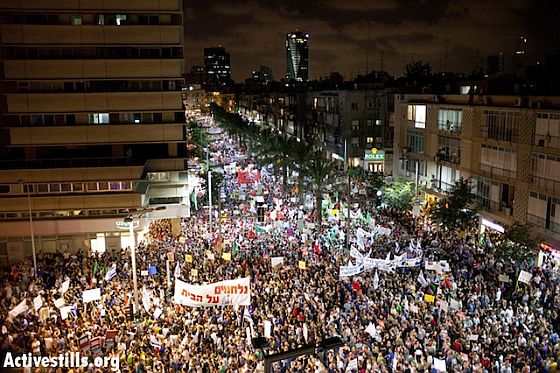
Around 300 thousands Israelis took the streets on Saturday night, calling for social justice and the introduction of a welfare state. Estimates are that this has been the largest demonstration in the country’s history.

The biggest of several rallies took place in Tel Aviv, where over 200,000 marched to the government building on Kaplan Street (Rabin Square, the usual site of such protests, is being renovated and was closed to the public). 30,000 marched in Jerusalem to PM Netanyahu’s house. Smaller rallies were held in Modi’in, Haifa, Nes Tziona and other towns. In Kiryat Shmone, protesters blocked the highway leading north.

Despite attempts by the organizers to convey a non-partisan message, many of the demonstrators directed their calls at Prime Minister Binyamin Netanyahu, and some held signs calling for his resignation. Former activist and Hadash MK called to the protesters: “With you, we will win over this pathetic government.” As was the case in previous rallies, the most popular call was “the people demand social justice,” followed by “Here comes the welfare state.”

Gideon Levy writes:

Tel Aviv was bursting at the seams last night. It was not the mother of all protests – it was the grandmother of all protests. The city looked yesterday like one of the stormiest cities on earth. Streams of people were flowing in every direction, some on foot, some in cars. Buses and trains spewed out the crowds, and not everyone even managed to get to the area of the protest. An amazingly large sign, in Hebrew and Arabic – the latter is about to cease being an official language in this country – read “Egypt is here.”

Indeed, the pictures last night looked like the nights of Tahrir Square. Now the comparison to the Cairo revolution is not exaggerated or wishful thinking. Now it really does resemble it, not including the violence, of course.

And really, when size talks, as it did last night, violence is not needed. A regime that remains impassive to such gigantic rallies would be completely insensitive, and in any case is destined to fall.

Prime Minister Benjamin Netanyahu can go on joking with his ministers; his fate is sealed. The cynics can continue tsk-tsking and talking about the “confused” and “spoiled” protest, and yet, a protest it is, the likes of which has never been seen here.

Facebooktwittermail

Broadcasting Hama ruins, Syria says it has ended revolt

The New York Times reports:

Syria’s state news media broadcast stark images of the destruction in the besieged city of Hama for the first time on Friday, showing burned buildings, makeshift barricades and deserted streets strewn with rubble in footage that appeared designed to show that government forces had put down a rebellion in the city.

The images were unmistakably Hama, Syria’s fourth-largest city and a focal point of the five-month-old uprising that has left President Bashar al-Assad’s leadership isolated and weakened. They suggested the military had retaken control of a city that had briefly wrested itself from four decades of authoritarian rule by the Assad family and enjoyed an unprecedented measure of freedom.

The reports by Syrian television and Sana, the official news agency, portrayed the army as Hama’s savior. The news appeared aimed at reinforcing the leadership’s message to internal opponents that they are regarded as armed insurrectionist gangs inspired by hostile foreign powers and will be dealt with accordingly. But the television footage of the wreckage in Hama also implicitly acknowledged that the violence there had been far more serious than Mr. Assad’s government had until now been willing to publicly admit.

It also underlined a legacy of the assault: Hama was remarkably peaceful after security forces withdrew in June. Violence erupted only when the government, fearing the momentum the city might provide the uprising, began its ferocious assault on Sunday. Although government officials insist the protesters were armed, not a single weapon was seen in the streets on a recent visit, an account confirmed by diplomats in their trips there. Barricades were set up, but only to block the return of the military and security forces.

“Today we are alive, but tomorrow we don’t know,” said a resident reached by telephone who gave his name as Fadi. “The humanitarian situation is getting worse day by day.”

Government officials offered an altogether different version of events, in reports from Damascus, the capital, that appeared more and more to defy reality.

Facebooktwittermail

Israel’s “July 14” movement

Zeev Sternhell writes:

In these times of hope and anticipation, it is difficult not to wonder what form the protest might have taken, and what results it might already have achieved, if there had been a large and authentic social-democratic party here with a labor union worthy of the name, at its side. Indeed a spontaneous uprising that does not find political expression very soon, and does not threaten those who are in power, will of necessity have very limited achievements.

Even Prime Minister Benjamin Netanyahu understands that when there is no opposition with an ideology of structural social change, and which is capable of garnering electoral support for a comprehensive national economic program, the danger facing him and his party is negligible. The truth is that the protesters themselves have already presented him with a way out. His representatives will anoint the protest leaders with pure oil, will set up teams and present ideas, will throw them a few bones and then will move to the area where there is no greater expert than Netanyahu: drawing out time and making promises that no one intends to keep.

The real problem, however, is not the government but rather the political elite. Except for a small number of politicians on the center-left, like Knesset member Shelly Yachimovich (Labor ), most of the political leadership is partner to the blind belief in the unique qualities of a free market. There were indeed people outside the political arena who for decades contended that a free market creates no less poverty and misery than wealth and welfare; there were those who believed that poverty is not some kind of natural phenomenon but rather something created by man. But all of them were considered “populist.” There were people who saw in the state a tool for correcting distortions and supplying cheap and good-quality services to the entire population, but they were denounced as wanting to return to the 1950s.

Therefore the young demonstrators would do well to remember May 1968 in Europe. Beyond the obvious differences, there is a common denominator: a protest that does not find immediate political expression is destined to disintegrate.

Uri Avnery writes:

It all started in a remote little town in Tunisia, when an unlicensed market vendor was arrested by a policewoman. It seems that in the ensuing altercation, the woman struck the man in the face, a terrible humiliation for a Tunisian man. He set himself on fire. What followed is history: the revolution in Tunisia, regime change in Egypt, uprisings all over the Middle East.

The Israeli government saw all this with growing concern – but they didn’t imagine that there might be an effect in Israel itself. Israeli society, with its ingrained contempt for Arabs, could hardly be expected to follow suit.

But follow suit it did. People in the street spoke with growing admiration of the Arab revolt. It showed that people acting together could dare to confront leaders far more fearsome than our bumbling Binyamin Netanyahu.

Some of the most popular posters on the tents were “Rothschild corner Tahrir” and, in a Hebrew rhyme, “Tahrir – Not only in Cahir” – Cahir being the Hebrew version of al-Cahira, the Arabic name for Cairo. And also: “Mubarak, Assad, Netanyahu”.

In Tahrir Square, the central slogan was “The People Want to Overthrow the Regime”. In conscious emulation, the central slogan of the tent cities is “The People Want Social Justice”.

Who are these people? What exactly do they want?

It started with a demand for “Affordable Housing”. Rents in Tel Aviv, Jerusalem and elsewhere are extremely high, after years of Government neglect. But the protest soon engulfed other subjects: the high price of foodstuffs and gasoline, the low wages . The ridiculously low salaries of physicians and teachers, the deterioration of the education and health services. There is a general feeling that 18 tycoons control everything, including the politicians. (Politicians who dared to show up in the tent cities were chased away.) They could have quoted an American saying: “Democracy must be something more than two wolves and a sheep voting on what to have for dinner.”

A selection of the slogans gives an impression: We want a welfare state! Fighting for the home! Justice, not charity! If the government is against the people, the people are against the government! Bibi, this is not the US Congress, you will not buy us with empty words! If you don’t join our war, we shall not fight your wars! Give us our state back! Three partners with three salaries cannot pay for three rooms! The answer to privatization: revolution! We were slaves to Pharaoh in Egypt, we are slaves to Bibi in Israel! I have no other homeland! Bibi, go home, we’ll pay for the gas! Overthrow swinish capitalism! Be practical, demand the impossible!

What is missing in this array of slogans? Of course: the occupation, the settlements, the huge expenditure on the military.

This is by design. The organizers, anonymous young men and women – mainly women – are very determined not to be branded as “leftists”. They know that bringing up the occupation would provide Netanyahu with an easy weapon, split the tent-dwellers and derail the protests.

We in the peace movement know and respect this. All of us are exercising strenuous self-restraint, so that Netanyahu will not succeed in marginalizing the movement and depicting it as a plot to overthrow the right-wing government.

Meanwhile, the Los Angeles Times reports:

Israel’s Interior Ministry gave the final green light Thursday to the construction of more than 900 new homes in a Jewish development built on land seized during the 1967 Mideast war.

Palestinians and anti-settlement groups said the Har Homa expansion, which has been working its way through Israeli regulatory agencies since last year, will occupy one of the last remaining undeveloped hillsides in the area and effectively cut off direct access between Palestinian neighborhoods in East Jerusalem and Bethlehem.

Palestinians hope to one day include both areas in a contiguous, independent state.

“This is very alarming because it will create a very big obstacle to the two-state solution,” said Hagit Ofran of Peace Now, an Israeli group that tracks settlements.

She said the project, one of the largest planned in East Jerusalem in recent years, appears to have been fast-tracked, based on the speed of the approval process. Nevertheless, she said construction would not likely break ground for three more years.

Facebooktwittermail

Once untouchable, the old despot and his sons faced the wrath of the nation they had terrorised

Robert Fisk writes:

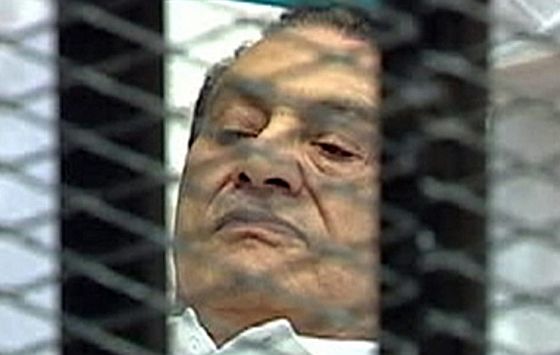
Just when the Arab dictators desperately need to drink the secure, cool waters of an Arab summer, along came the Egyptians yesterday to poison the well. Deep into its depths, those dictators could see a flickering enmeshed face, fragile, fingers playing over its nose and mouth, the arm of a man on a stretcher raised to prevent the light getting too close but – for just a few brief moments – with the same old arrogant eyes. Then the heavy black mike appeared in the man’s left hand. “I am here, your honour,” said a chillingly strong voice. “I have not committed any such crimes.”

Yes, the Egyptians really did put their wretched, ancient dictator on trial yesterday, along with his effete, sullen sons – both dressed in white as if heading for yet another summer tennis party, an illusion broken only by the green Koran under Alaa Mubarak’s arm. An encouragement to his dessicated, 83-year-old father, Hosni? Or an insult to the dead?

The lawyers screamed their clients’ pain; of torture, of snipers, of the murder of Egypt’s own people in the January-February uprising, of the brutality of the security forces, of corruption on a Mafia scale. And to whom else did these terrible charges apply? We thought about Damascus, of course. And Tripoli. And the Bahraini capital of Manama. And of Rabat and Amman and Algiers and Riyadh…

And across the vast, arid wastelands of the Arab despots, the government televisions continued to show game shows and cooking classes and domestic dramas and friendly crowds, all of whom loved their presidents and kings and potentates, who could never – could they? – be accused of these awful crimes. Outside Egypt itself, the only live coverage of the trial was broadcast by post-revolutionary Tunisia and that nemesis of the Mubarak regime and of the United States and of Israel: the Hezbollah’s Al-Manar television.

“Are you Mohamed Hosni Sayed Mubarak?” asked Judge Ahmed Refaat. Or Bachar al-Assad? Or Muammar Gaddafi? Or His Majesty King Hamad? Or even His Highness King Abdullah, Guardian of the Three Holy Places in a place called Saudi Arabia?

Facebooktwittermail

Inside Egypt’s Salafis

Lauren Bohn writes:

“All Americans think I’m a terrorist,” 34-year-old Salafi political organizer Mohammed Tolba exhales with his trademark belly laugh. He grips his gearshift and accelerates to 115 miles per hour down a winding overpass in Cairo. “But I only terrorize the highways.” Since the fall of Egyptian president Hosni Mubarak, Tolba has constantly been on the go. “The media says we all wear galabeyas (long Islamic dress), put our women in niqabs (a face veil), and will cut off people’s hands,” Tolba says, dramatically feigning a yawn. “We’re the new boogey-man, but people need to know we’re normal — that we drink lattes and laugh.”

To this end, the silver-tongued IT consultant shuttles regularly from the modish offices of popular television personality Bassem Youssef (he’s starring in a segment on the “Egyptian Jon Stewart’s” highly anticipated new show) to the considerably less shiny quarters of Cairo’s foremost Salafist centers. He’s been conducting leadership and media-training workshops for Salafis. “These guys don’t know how to talk to the public,” says Tolba, rubbing his eyes in exhaustion. “Once they open their mouths and face a camera, man, they ruin everything.”

The same might be said for their debut on Egypt’s main stage last Friday, as hundreds of thousands of Salafis joined other Islamist groups in Cairo’s Tahrir Square. Droves of people from governorates across Egypt got off buses near Tahrir Square, chanting “Islamic, Islamic, we don’t want secular.” One Salafi, Hisham al-Ashry, beamed with pride as he walked back from the square to his tailor shop downtown. “Today is a turning point, we finally showed our strength.” Meanwhile, “the liberals and the leftists are freaking out. God protect the nation and revolution,” noted popular blogger Zeinobia.

Who are the faces and voices of an oft-deemed bearded and veiled monolith that packed the square? And what exactly do they want?

“Salafi” has become something of a catchall name for any Muslim with a long beard, but Salafism is not a singular ideology or movement with one leader. As Stéphane Lacroix, a French scholar of Islamist movements, explains, it’s more a “label for a way of thinking” guided by a strict interpretation of religious text. Salafis aspire to emulate the ways of the first three generations of Islam. Many Salafis have cultivated a distinctive appearance and code of personal behavior, including untrimmed beards for men and the niqab for women.

The Salafi culture has been growing in Egypt for decades, but until the revolution had little formal political presence. “Satellite salafism” hit Egypt in 2003, with around 10 Salafi-themed TV channels broadcasting from Egypt on Nilesat. The intensely popular Al-Nas, Arabic for the People, began broadcasting in 2006. Its programming focuses on issues of social justice and sermons by prominent Salafi preachers, like Mohammed Yaqoub and Mohammed Hassan, whose tapes and books are common fixtures among street vendors throughout Cairo. Nobody knows exactly how many Salafis there now are in Egypt, but Abdel Moneim Abouel Fotouh, a presidential candidate formerly of the Muslim Brotherhood, recently estimated their number at around 20 times the number of Muslim Brotherhood members (unofficial reports estimate Muslim Brotherhood membership between 400,000 to 700,000 members).

Facebooktwittermail

Syrian tanks thrust into Hama, 45 reported killed

Reuters reports:

At least 45 civilians were killed in a tank assault by Syrian President Bashar al-Assad’s forces to occupy the center of Hama, an activist said on Thursday, in a sharp escalation of a military campaign aimed at ending an uprising against his rule.

Reacting to intensifying assaults on Syrian cities and towns, the U.N. Security Council overcame deep divisions and condemned Assad’s bloody crackdown on civilian protesters. It was the first substantive action by the United Nations on Syria’s five-month-old uprising for political freedoms.

An activist who managed to leave the besieged city told Reuters that 40 people were killed by heavy machinegun fire and shelling by tanks in al-Hader district north of the Orontes river on Wednesday and early on Thursday.

The activist, who gave his name as Thaer, said five more people from the Fakhri and Assa’ad families, including two children, were killed as they were trying to leave Hama by car on the al-Dhahirya highway.

Syrian authorities have expelled most independent media, making it difficult to verify witness accounts and official statements.

Residents earlier said tanks had advanced into central Hama on Wednesday after heavily shelling the city and occupied the main Orontes Square, the site of some of the largest protests against Assad, who succeeded his father, the late President Hafez al-Assad, in 2000.

Snipers spread onto rooftops and into the nearby citadel. They said shelling concentrated on al-Hader district, large parts of which were razed in 1982 when forces loyal to Hafez al-Assad overran Hama to crush Islamist insurgents, killing many thousands of people.

Facebooktwittermail

Egyptians watch in disbelief as Mubarak goes on trial

Al-Masry Al-Youm reports:

In downtown Cairo on Wednesday morning, people huddled around television sets to watch an historical moment unfold as former President Hosni Mubarak, his two sons Gamal and Alaa, and former Interior Minister Habib al-Adly faced trial on charges of murder for killing protesters during the 18-day uprising that led to Mubarak’s resignation.

Their gazes were glued to the TV screens in disbelief as they watched the dictator who ruled them for 30 years lying on a hospital bed inside a cage, wearing the white uniform of a defendant.

In a car parts shop downtown, a dozen people stood chatting and waiting in anticipation. When the former president appeared on screen, the observers cheered. Then suddenly quiet fell on the shop. As the employees of the shop and passersby watched the trial, they demanded complete silence, asking anyone who talked to remain quiet.

Many around Cairo expressed joy that some kind of real justice is being served.

“This is a historic day,” said Islam Khalil, a 28-year-old lawyer. “It shows progress and development of our country. I feel that I took my right and the rights of all those who have been living under his suppression.”

Mostafa, who owns a clothing shop in Bab al-Louk, agreed. “Glimpses of justice are finally starting to show in the country. I do not feel sorry for him. If someone stole LE 100 from you, would you be sorry for that person? What if he stole a whole country?” he said.

Anthony Shadid reports:

The sheer symbolism of the day made it one of the most visceral episodes in modern Arab history. In a region whose destiny was so long determined by rulers who deemed their people unfit to rule, one of those rulers was being tried by his public. On this day, the aura of power — uncontested and distant — was made mundane, and Mr. Mubarak, dressed in white and bearing a look some read as disdain, was humbled.

“The first defendant, Mohammed Hosni al-Sayyid Mubarak,” the judge, Ahmed Rifaat, said, speaking in a wood-paneled courtroom to a cage holding Mr. Mubarak, his two sons, Gamal and Alaa, former Interior Minister Habib e-Adly and six other senior officers.

“Sir, I am present,” Mr. Mubarak replied into a microphone, from his bed.

“You heard the changes that the prosecutor made against you,” the judge said from the podium. “What do you say?”

“I deny all these accusations completely,” he replied, wearily waving his hand.

Then he handed the microphone to his son, Gamal.

The trial began precisely at its start time, 10 a.m. in Cairo. While the other defendants took a seat, Mr. Mubarak’s sons remained standing, the youngest, Gamal, seeming to block the view of his father from the cameras in the courtroom. Mr. Mubarak appeared tired but alert, occasionally speaking with his sons, who both held Korans.

As Mr. Mubarak denied the charges in the proceedings, which were broadcast on a large-screen television outside the police academy, his opponents gathered there roared in disapproval.

“Then who did it?” some asked.

The scene was tumultuous there on a sun-drenched parking lot, with a few dozen of Mr. Mubarak’s supporters sharing space with his opponents. At times, they scuffled; in intermittent clashes, the two sides threw rocks at each other. As Mr. Mubarak arrived at the courtroom, some of his supporters cried, waving pictures that read, “The insult to Mubarak is an insult to all honorable Egyptians.” Others shouted adulation at the screen.

“We love you, Mr. President,” some chanted.

Those sentiments were overwhelmed by the denunciations of his critics, in a trial that seemed to incarnate all the frustrations and degradations of a state that treated its people as rabble. Someone was finally being held to account, many said Wednesday.

Facebooktwittermail

Syria — ‘Hama is getting massacred’

The New York Times reports:

Syrian security forces bombed the central city of Hama for a second day on Monday as the government pressed its campaign to crush a four-month-old popular uprising against the government of President Bashar al-Assad. On Sunday, at least 70 people were killed when the military and security forces assaulted Hama and other restive cities before dawn, in the broadest and fiercest crackdown yet.

The shelling resumed Monday in the early hours of the morning as people were returning home from mosques where they had performed dawn prayers, according to residents and protesters. At least three people were killed, according to activists.

Obada Arwany, an activist reached by telephone, said that tanks had entered two neighborhoods, Al Qousour and Al Hamidiya, and bombed residential buildings there. One man died in his sleep when his house was bombed and another was killed by a sniper’s bullet as he was getting in his car.

“The city is like a ghost town,” Mr. Arwany said. “We were not expecting this at all. Hama is getting massacred.”

Facebooktwittermail

Visions collide in a sweltering Tahrir Square

Sandy Tolan writes:

After midnight the Cairo heat finally broke. Mamdouh Hamza, an Egyptian civil engineer, businessman and longtime government critic, was sitting in a plastic chair in an outdoor café at Tahrir Square, puffing on a water pipe. The white-haired Hamza was holding court with his cadre of young revolutionaries, to whom he’d become a kind of beneficent godfather. My colleague Charlotte and I had met him an hour earlier, having interviewed him for a story on Egyptian agriculture and food issues we’re producing for US public radio and TV.

Hamza – builder of major Egyptian development projects but nevertheless a longtime critic of the regime – had been trying to keep a dialogue going between the military council and his “kids” But recently things had broken down, and that morning at 5am, he said, something disturbing and perhaps unrelated happened: Someone called Hamza to say he’d been hired to kill him. But the would-be hit man had changed his mind – “I like you,” he told Hamza – and so he had given the blood money back. Or so the story went.

Hamza seemed to think this was all a hoax, designed to rattle him, and he had no plans to heed the reluctant killer’s warning: that Hamza shouldn’t show up at the square the next day, lest he take a bullet.

Now came Wael Ghonim, he of the social media revolution, with his own followers, to say hello to Hamza. He engaged the older man about finding common ground with the Islamists. Charlotte caught the moment on camera – a young man in a purple pinstripe shirt and designer wire-rim glasses, talking to the shaggy haired professor nearly old enough to be his grandfather – but when Ghonim spotted Charlotte, he insisted she stop shooting. “If you use this,” he said, “I will sue you”. It wasn’t that he didn’t want to be seen speaking of reconciliation with the Islamists; rather, a friend reported, he said he didn’t want to be caught on camera being friendly with Hamza, a fellow secularist.

“If you use this, I will sue you,” the Google MBA repeated to Charlotte, a smile frozen onto his face, before moving off with his entourage.

Signs of strains between secular and Islamic forces have been showing for months. But both sides were expected to be represented in Friday’s mass demonstration. Hamza predicted between 800,000 and a million people would show up.

At two in the morning we headed back downtown to catch a few hours sleep. As we climbed into the taxi, the bearded Salafis, bussed in from all over the nation, were pouring single file into the square: a stream of white robes and skullcaps, part of a planned show of force by Islamists. They would be spending the night in the square, ready with their banners and chants as the sun rose on Cairo three hours later.

Facebooktwittermail

‘Full-on warfare by the Syrian government on its own people’

Al Jazeera reports:

Syrian forces have killed nearly 140 people, including 100 when the army stormed the flashpoint protest city of Hama to crush dissent on the eve of Ramadan, activists have said.

Rights groups said it was one of deadliest days in Syria since demonstrators first took to the streets on March 15, demanding democratic reforms and the downfall of the government.

As reports of the brutal crackdown on Hama unfurled, Britain, Germany, France, Italy and Turkey condemned the violence, while a US diplomat said it was “full-on warfare”.

AFP reports:

Speaking to the BBC World Service’s Newshour programme, [JJ] Harder [the press attache at the US embassy in Damascus] said: “I think we can safely say it’s full-on warfare by the Syrian government on its own people.”

He said: “This full-on warfare in which the government is engaged in today, I think, amounts to nothing less than a last act of utter desperation.

“They’re killing their own people, they’re sending their tanks into their own cities. It’s ridiculous.”

Asked if he accepted the Syrian government’s contention that its forces were up against armed gangs, Harder said: “There is one big armed gang in Syria and it’s named the Syrian government.

“That’s the armed gang that is pillaging its own cities, that’s the armed gang that is striking terror into the hearts of a lot of these people who are out there who just want to peacefully protest.”

Facebooktwittermail

Islamists flood Tahrir Square in Cairo in show of strength

Anthony Shadid reports:

Tens of thousands of Egyptian Islamists poured into Tahrir Square on Friday calling for a state bound by strict religious law and delivering a persuasive show of force in a turbulent country showing deep divisions and growing signs of polarization.

The shape of Egypt five months into its revolution remains distinctly undecided, and Islamists have long been the best organized political force in this religiously conservative country. Some activists speculated that their show of strength would serve as a jolt to the secular forces who helped to start the revolution but who remain divided, largely ineffectual and woefully unprepared for coming elections.

Others speculated that it might force groups to pick sides in a country where the glow of unity after President Hosni Mubarak’s fall in February has dimmed amid recriminations over the pace, style and substance of change.

“Islamic, Islamic,” went a popular chant. “Neither secular nor liberal.”

After days of negotiations between the rival factions, the demonstration Friday had been billed as a show of national unity, but adherents to a spectrum of religious movements — from the most puritan and conservative, known as Salafists, to the comparatively more moderate Muslim Brotherhood — vastly outnumbered other voices in a sun-drenched Tahrir Square. The numbers of Salafists, in particular, represented the most definitive declaration yet that they represent a formidable force in Egyptian politics, riding an ascent since the revolution that has surprised and unnerved many secular and liberal activists — and poses new challenges to the Muslim Brotherhood.

“It’s simple,” said Mohammed Awad, a 28-year-old accountant. “We’re stronger than any other force in the country, and we’ve made that clear on this day.”

Steve Negus at The Arabist adds:

A few notes on yesterday’s demonstration in Tahrir, generally viewed as an Islamist show of force. First, the numbers. Based on visual cues (beards, galabiyas), signs and slogans I’m guessing at least 90 percent of those in Tahrir were affiliated with the Islamists, and at least half of those were Salafi. I’m guessing also that this was one of the half dozen largest Tahrir “million” rallies since January. The square wasn’t elbow-to-elbow all the way through, but it was elbow-to-elbow in some spots, and a lot of people stayed camped out on downtown streets where they had gone to pray. I understand why the numbers have alarmed revolutionaries who had come to think of the square as their own space.

There have been some reports that Salafis tried to forcefully take control of a speakers’ stage, but the parts of the demonstration which I witnessed were peaceful. I saw no instances of bullying. Islamists and non-Islamists mingled and argued. I saw one angry anti-Islamist marching up Qasr al-Aini between ranks of weary demonstrators shouting “Egypt, my kind mother/I’m not leaving you to the Brothers!”, yet she did not get much of a reaction.

The Salafis’ slogans were provocative. I didn’t hear the “Obama, Obama, we’re all Osama” or “Shut up secularists!” lines that journalists reported, nor did I see Saudi flags. But the tone of what I did here was pretty defiantly affirmative of an Islamic identity for Egypt, ie, not a civic one. “Raise your head high! You’re a Muslim!” might not sound so bad unless you realize it’s a variation on a far more Christian-friendly original, “Raise your head high. You’re an Egyptian”.

A bit of background: Islamist groups including both Brothers and Salafis had originally planned a Friday rally to oppose the idea of “supra-constitutional principles” proposed by some left/liberals — which as they saw it, was a way for Tahrir revolutionaries to decide what was going to be in the constitution before any elections, and before anyone else had a chance to contribute. But the mostly leftist and liberal groups occupying Tahrir weren’t going to vacate the square, so it looked like there were going to be two rival demonstrations. Islamist and non-Islamists got together and agreed to merge the two rallies and focus on things with which they could agree — ie, swifter trials for officials, justice for the “martyrs”. But the demonstrators to whom I spoke, at least the Islamist ones, were clear that they were there to oppose the supra-constitutional principles, and for Egypt to “remain” Islamic.

Many liberals and leftists considered this to be a bit of an ambush. Look at it from the Salafi point of view, though. They’re already worried that the established political forces, none of whom have got to where they are through elections, are going to shape the constitution behind their backs. They finally get a chance to organize an Islamist show of force to insist that they be listened to, but then it’s decided that they can’t actually be Islamist at it. So, it would have been a minor miracle had the Salafis stuck to the program, and chanted only anodyne, uncontroversial slogans.

Facebooktwittermail

Activists vow daily Ramadan protests in Syria

The Guardian reports:

A sweep by government forces has seized one person every hour during the five-month Syrian uprising and detained them in secret, leaving their families no way to locate them, says a human rights group.

The group, Avaaz, claims 2,918 people have been “forcibly disappeared” since anti-government demonstrations began in Syria on 15 March. Most are accused of being involved in the rebellion that continues to undermine a regime long renowned as the Middle East’s most formidable police state.

An additional 12,617 people also remain in detention; however their incarceration has been declared to family members. Tens of thousands more people have fled from towns and villages in northern Syria in the face of intensive military assaults that Damascus claims are ridding the area of criminals and collaborators.

The scale of the detentions in Syria has been compiled by a network of activists and researchers who have provided information to Avaaz. The group has gathered photos of many of the disappeared and is launching an awareness campaign today.

“Hour by hour, peaceful protesters are plucked from crowds by Syria’s infamously brutal security forces, never to be seen again,” said Avaaz’s executive director, Ricken Patel. “President Assad’s attempt to terrorise Syrians into submission isn’t working, but they urgently need the international community to demand the release of the disappeared and a transition to democracy.”

Al Jazeera reports:

When widespread protests broke out in Syria in March, President Bashar al-Assad’s regime turned to its feared security services to smother the anti-government movement.

The bloody response has so far succeeded where other attempts to put down the “Arab awakening” have failed, and President Assad remains in power.

Verifying the toll of the crackdown is difficult, since the government has banned most journalists and observers, but activists and researchers say more than 10,000 people have been detained and at least 1,500 killed since March. A response of proportional size in the United States, by way of comparison, would have meant more than 136,000 people detained and 20,450 killed.

At least 66 people are believed to have died while in the custody of Syrian authorities, according to a list provided by activists to Human Rights Watch researcher Nadim Houry in June.

Outside audiences have encountered the regime’s brutal response primarily through grainy YouTube footage and second-hand accounts relayed by expatriate activists.

These brushstrokes paint a useful yet broad picture: a dozen people killed in this city, a thousand people protesting in that city.

But first-hand accounts from those who have been through the packed cells of Assad’s jails or those who have come under gunfire from his troops offer a more personal understanding of the uprising.

Recently, Al Jazeera spoke with six men, three of whom were in Syria, and three of whom had left the country. All had been arrested or seen relatives suffer at the hands of the security services.

Their stories, which are available below, portray a violent state system in a spasm of panic, unsure of what it is confronting, yet nevertheless determined to crush it.

Stories of six survivors.

Facebooktwittermail

When is Palestine’s Arab revolution?

Larbi Sadiki writes:

‘Parity of esteem’ is the name of the game – and finding a way to overcome inter-communal conflict matters. It matters because the Arab state has failed three basic tests: provision of security, provision of welfare, and distribution of power.

However, as the literati carry on unpacking the still-unfolding Arab revolution, one dimension is missing from this ongoing investigation which must be highlighted: The Palestinian corollary.

Observers have been hasty in dismissing Palestine from the Arab revolution. I argue here that it was one of many dynamics, definitely one of the final straws that broke the back of an already heavily weighed down camel.

Two betes noires of international politics loomed large, by negation and denial, in much of the early diagnosis of the Arab revolution.

Islamists and the Palestinian cause were written off as inconsequential in the Arab revolution. The first is of issue to secularists, Westernisers and many Westerners. The second is of concern for those concerned about the Arab revolution’s implications for Israel.

Facebooktwittermail