Category Archives: Arab Spring

Egyptian woman tells of ‘virginity tests’

Der Spiegel reports:

On the day Husseini Gouda was arrested, Hosni Mubarak, the country’s deposed president, had been in self-imposed exile in the seaside resort of Sharm el-Sheik for nearly four weeks. A month before the arrest, the masses at Tahrir Square had cheered for the military, which took over power in the country after Mubarak resigned. “The people and the army are one,” demonstrators shouted, dancing and celebrating in front of the tanks. Mothers pressed their babies into soldiers’ arms for pictures. The world watched Egypt with amazement, seeing men and women, Muslims and Christians, fighting side by side for freedom. Then, 18 days later, the revolution was, the pharaoh chased off. The people were victorious. It was a triumph that belonged to women as well — or so it seemed at the time.

When Husseini Gouda arrived at the military prison on March 9, she says she was led to a small room together with two other women. There they were forced to undress and allow their clothing to be searched. Then they noticed a soldier standing outside the open window, photographing them naked. “I was afraid they would use the pictures to make us look like prostitutes,” Husseini Gouda says.

That night, the women were locked in a cell and given water and bread that stank of kerosene. The next day, they saw a stretcher in the hallway outside their cell. Here, an officer announced, a doctor would inspect the unmarried women for virginity. “We couldn’t believe it,” Husseini Gouda says. “We asked if it could at least be a female doctor, but he said no. One girl who tried to resist was plied with electroshocks.”

Several human rights organizations are investigating the events that occurred at the military prison in Heikstep northeast of Cairo between March 9 and 13. Amnesty International has called on Egyptian authorities to “stop the shocking and degrading treatment of women protesters.” The European Parliament denounced the “forced virginity tests” as torture.

Psychiatrist Mona Hamed, from El Nadeem Center for Rehabilitation of Victims of Violence, has documented statements from several of the women who were arrested on March 9, including Husseini Gouda. Hamed’s conclusion: “What’s new is that it isn’t the police or the secret police behind this, but the military.” The virginity tests, she says, send a message to the people, because the army wants to control citizens’ freedom of movement. If a woman at a demonstration were beaten or arrested, Hamed says, her family would perhaps be able to accept that — but not the charge that their daughter is a prostitute. “That’s an unthinkable humiliation for the woman and her family,” she explains.

Facebooktwittermail

The Saudi counter-revolutionaries

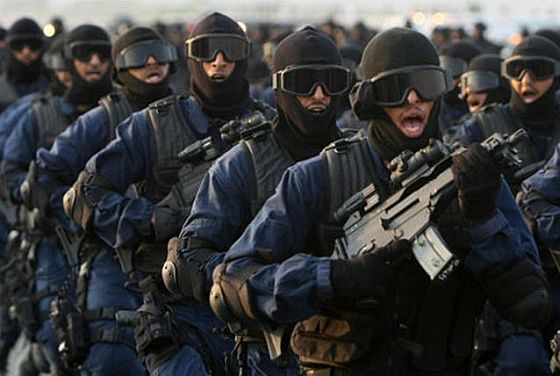
Saudi special security forces

Nawaf Obaid, a Senior Fellow at the King Faisal Center for Research & Islamic Studies in Riyadh, is confident that Saudi Arabia has the military and economic strength sufficient to crush the aspirations for political freedom that threaten Saudi and other autocratic rulers across the region.

The so-called “Arab Spring” has not brought new life to the Middle East, but leaderless anarchy, creating a virtual pan-regional movement that is alarmingly dangerous and ultimately unsustainable.

Recognizing the threat that the spread of this movement represents, Saudi Arabia is expanding its role internationally and mobilizing its vast resources to help countries facing domestic upheaval.

As the birthplace of Islam and the leader of the Muslim and Arab worlds, Saudi Arabia has a unique responsibility to aid states in the region, assisting them in their gradual evolution toward more sustainable political systems and preventing them from collapsing and spreading further disorder.

That the Kingdom has the ability to implement this foreign policy goal should not be in doubt – it is backed by significant military and economic strength.

The foundation for this more robust strategic posture is Saudi Arabia’s investment of around $150 billion in its military. This includes a potential expansion of the National Guard and Armed Forces by at least 120,000 troops, and a further 60,000 troops for the security services at the Interior Ministry, notably in the special and various police forces. A portion of these will join units that could be deployed beyond the Kingdom’s borders.

In addition, approximately 1,000 new state-of-the-art combat tanks may be added to the Army, and the Air Force will see its capabilities significantly improve with the doubling of its high quality combat airplanes to about 500 advanced aircraft.

A massive new missile defense system is in the works. Finally, the two main fleets of the Navy will undergo extensive expansion and a complete refurbishment of existing assets.

As part of this new defense doctrine, the leadership has decided to meet the country’s growing needs for new equipment by diversifying among American, European and Asian military suppliers.

Facebooktwittermail

The specter of civil war in Syria

The World reports:

[Robin] Yassin-Kassab says the Syrian regime is stoking fears of sectarian conflict to shore up support. He says the regime wants to portray the demonstrations as akin to the violent tactics of the Muslim Brotherhood in Syria in the 1980s.

The government’s crackdown back then culminated in a massacre of 20,000 people in the town of Hama. It still haunts people today. But, Yassin-Kassab says the two situations are not the same.

“Now we’ve had Alawis and Christians and Druze and so on have been involved in the protests,” said Yassin-Kassab. “There have also been people from all communities shot and tortured and the overwhelming majority of slogans are for national unity. People are calling things like “the Syrian people are One. It’s not a sectarian uprising and the regime is trying to pretend that it is.”

Yassin-Kassab shared an ominous anecdote to share about a friend from a prominent Alawite family unconnected to the regime.

“His parents are receiving threatening phone calls from anonymous numbers,” said Yassin-Kassab. “People saying things like ‘We know where you are, we’re coming after you, your time is up.’ His parents believe that these are Syrian Sunni Muslims, ordinary people, calling up and threatening what’s going to happen to the whole community once this regime has fallen. I believe and my friend believes that it’s actually more likely the Mukhabarat, the secret police, who are calling them up trying to scare them.”

Historian Anne Alexander, a fellow at Cambridge University, also thinks the regime is trying to use sectarianism as a counterrevolutionary tool. She says the real differences in Syria are not ones of religious identity but of social class and geography.

“One view point that I fundamentally disagree with is the perspective that sees the Middle East as some kind of fermenting mass of people who all hate each other on religious grounds,” said Alexander. “And that once you remove the strong state this will all fly apart into people trying to kill each other because their neighbor is from a different religion.”

In fact, says Alexander, the history of the region shows that the gut reaction of national protest movements is to fight for unity, while time and time again, the gut reaction of regimes is to use any mechanisms they can to break that unity apart. In Syria’s case that impulse could hasten the slide toward civil war.

The New York Times reports:

Since violent clashes broke out in a northern Syrian town close to this border last weekend at least 140 Syrians have fled into Turkey, some bearing tales of black-clad gunmen opening fire on protesters without warning. Many other Syrians, camped out in scrubby fields within sight of the Turkish border, are ready to follow them at the first sign that security forces are pursuing them, those who have crossed say.

The influx of refugees has prompted Turkey’s leaders to toughen their criticism of the situation in Syria. Prime Minister Recep Tayyip Erdogan expressed increasing concern about the refugees and repeated his call for immediate reforms in Syria, including that authorities allow peaceful civilian protests.

“We hope that Syria will immediately become more tolerant in its attitude towards civilians and fully realize the steps it has started towards reforms in a way to persuade civilians,” the semi-official Anatolian News Agency quoted Mr. Erdogan as saying.

In all, hundreds of Syrians have crossed into Turkey since the protests against the rule of President Bashar al-Assad began in April. Many have taken advantage of a porous border and the relaxed border controls put in place last year. Some have gradually returned to Syria on their own; Turkish officials have also provided assistance to nearly 260 people sheltered in a tent city less than 40 miles from Hatay, in Turkey’s southeast.

The Lede at the New York Times reports on doubts about the authenticity of what has come to be viewed as one of Syria’s most prominent blogs:

On Wednesday, the mystery surrounding the identity of the Gay Girl in Damascus blogger further deepened when The Wall Street Journal reported that photographs said to show Ms. Arraf were in fact pictures of someone else entirely. As Isabella Steger explained in a post on The Journal’s Web site:

The photos are of Jelena Lecic, who lives in London, according to [a] publicist, Julius Just. A press release he distributed includes a photo of a woman who he says is Ms. Lecic, who appears to be the same woman in the photos accompanying stories about Ms. Araf. Mr. Just said Ms. Lecic’s ex-husband contacted him when he saw that the photos circulating of Ms. Araf were in fact of his ex-wife.

Later on Wednesday, Ms. Lecic herself appeared on a BBC television program and insisted that she did not know the author of the Gay Girl in Damascus blog. She said the photographs appear to be taken from her Facebook page.

Jillian York of Global Voices Online, who made contact with the blogger last year, posted a gallery of photographs Ms. Arraf added to her Facebook page last year under the title “Me!” — which are all of Ms. Lecic.

The Guardian, which conducted an interview with the author of the blog last month, reported on Wednesday that one of the photographs Ms. Lecic said was of her had been “supplied directly to the paper last month by the blog’s author.”

The newspaper also explained that a journalist in Damascus “was given an e-mail for the blogger by a trusted Syrian contact, and suggested in extensive e-mail correspondence that they meet in person or talk by Skype. The contact had never met Araf. Araf, who according to blog posts was living on the run, agreed to meet Marsh in person but did not turn up for the rendezvous. In later e-mails she said she had been followed, and so aborted the meeting.”

The Lede, NPR and The Associated Press searched unsuccessfully on Wednesday to find anyone who had ever met Ms. Arraf in person. The A.P. reported that it had also looked for family or friends in Virginia, where the author of the blog wrote that she was born. A.P. reporters “found no public records with her name or her parents’ names, or evidence they were there.”

Facebooktwittermail

U.S. is intensifying a secret campaign of Yemen airstrikes

The New York Times reports:

The Obama administration has intensified the American covert war in Yemen, exploiting a growing power vacuum in the country to strike at militant suspects with armed drones and fighter jets, according to American officials.

The acceleration of the American campaign in recent weeks comes amid a violent conflict in Yemen that has left the government in Sana, a United States ally, struggling to cling to power. Yemeni troops that had been battling militants linked to Al Qaeda in the south have been pulled back to the capital, and American officials see the strikes as one of the few options to keep the militants from consolidating power.

On Friday, American jets killed Abu Ali al-Harithi, a midlevel Qaeda operative, and several other militant suspects in a strike in southern Yemen. According to witnesses, four civilians were also killed in the airstrike. Weeks earlier, drone aircraft fired missiles aimed at Anwar al-Awlaki, the radical American-born cleric who the United States government has tried to kill for more than a year. Mr. Awlaki survived.

The recent operations come after a nearly year-long pause in American airstrikes, which were halted amid concerns that poor intelligence had led to bungled missions and civilian deaths that were undercutting the goals of the secret campaign.

Officials in Washington said that the American and Saudi spy services had been receiving more information — from electronic eavesdropping and informants — about the possible locations of militants. But, they added, the outbreak of the wider conflict in Yemen created a new risk: that one faction might feed information to the Americans that could trigger air strikes against a rival group.

Facebooktwittermail

After Golan clashes, is Israel rethinking the Assad (or Palestine) file?

Daniel Levy writes:

To most observers witnessing events in Syria, the goal is clear-cut: end the killing, support democracy, and change the Assad regime — hoping it will be removed or reformed to an unrecognizable degree. State actors looking at the same reality will often bring a different set of considerations into play, especially if they happen to be neighboring Syria. Israel has had a complicated relationship with the popular upheaval in its northern neighbor — and, indeed, with the Baathist Damascus regime in general over the years.

As of Sunday, that complexity entered a new dimension. Of course the popular uprising in Syria is not about Israel, nor will it be particularly determined by Israel’s response. Nevertheless, Israel’s leaders, like those elsewhere in the region, will have to position themselves in relation to this changing environment, and this will, in part, impact Syria’s options.

On Sunday, June 5, marking Naksa Day (the Arab “setback” in the 1967 war), protesters — mostly Palestinian refugees and their descendents — marched to the Israel/Syria disengagement line representing the border between Syria and the Israeli occupied Golan Heights. According to reports up to 22 unarmed Syrian-Palestinian protesters were killed when Israeli forces apparently resorted to live fire (Israeli laid mines may also have been detonated and may have caused causalities, the exact unraveling of events remains sketchy). In most respects, this Sunday’s events were a repeat performance of the outcome of May 15’s Nakba Day commemorations (which Palestinians mark as the anniversary of their catastrophe in 1948).

Israel’s initial response to the wave of regional anti-regime protests reaching Syria was, according to reliable reports, to privately root for the “devil we know” approach — encouraging allies, including the U.S., to go easy on the Assad regime. That may sound counterintuitive — Israel is not at peace with Syria, the Assad regime is close to Iran, hosts the Hamas leadership, and is considered to actively assist in the arming of Hezbollah. Yet an explanation for this Israeli disposition is also not too hard to fathom.

The Israel-Syria border has been quiet since the 1973 war. While a member of the “resistance axis,” Syria under Assad has not itself challenged Israel in any military way. It is also a regime with very few soft-power assets with which to challenge Israel in the regional or international diplomatic arena. Syria under the Assads engaged in frequent peace-partner flirtations with Israel and could be considered the most domesticated of the members of that resistance alliance.

At least until Sunday’s events, Israel’s position on revolution in Syria hued closely to the status-quo conservatism that has so characterized the shared Israeli-Saudi response to the Arab Spring. Both Israel and Saudi had been critical of the “premature” abandonment of the Mubarak regime, especially by the U.S. Unlike Mubarak, of course, Assad is not an ally (for either the Israelis or the Saudis), but he is part of an ancien régime for which Israel had effective management strategies in place.

Facebooktwittermail

Libya rebels frustrated by Nato’s safety-first strategy

The Guardian reports:

Tension between Libyan rebels and Nato commanders is growing over the military tactics being used to put pressure on Colonel Gaddafi’s forces.

Rebel leaders in Misrata say they are being urged not to launch further pushes against regime troops to the east of the city, and claim they have been told not to cross certain “red lines”, even though they feel prepared for battle.

The frustration on the ground has been heightened by their belief that Gaddafi’s troops are demoralised and depleted after nearly three months of conflict.

While coalition officials insist they have not issued any direct orders not to attack, they concede they are worried about civilians being caught up in further chaotic fighting, and do not want rebel troops being accidentally hit in bombing raids by Nato warplanes. These continued on Monday and Tuesday, when Tripoli experienced what were perhaps the heaviest daylight bombardments by Nato since the air strikes began in March.

Facebooktwittermail

The ‘fallen’ heroines of the Arab spring

Nesrine Malik writes:

Since the start of the wave of uprisings that have swept the Arab world, “establishment” figures, especially women, have been celebrated as the “icons” of the revolution – symbols of its homegrown, indigenous nature.

Tawakkol Karman in Yemen, and Saida Saadouni in Tunisia are examples of this fierce matriarchy. They are of the tradition, and respected more so because of it. Hijab-clad, religiously conservative and socially conventional, they reserve their rebellion for the political arena, rendering them relatively immune to accusations of immorality or harsh personal attacks.

Karman is a member of an Islamic political reform party and a mother of three in a stable marriage, and Saadouni is in her late seventies and hailed as “the mother of the Tunisian revolution”.

But there is another breed of vanguard, whose members exist somewhat on the periphery, or who have been ostracised and dismissed as eccentric or louche. Those who, for some reason, in their personal or professional lives, have “fallen”.

The latest member of this contingent is the controversial “Gay Girl in Damascus” – a half-American half-Syrian blogger based in Damascus who was allegedly kidnapped two days ago. There are allegations that she is an agent, a hoax, her very existence doubted. Hardly an everywoman, but she has nevertheless captured attention and galvanised people. As a blogger she has garnered more support than the unpublished.

More importantly however, whether real or fake, or real with a dash of poetic licence, she demonstrates the benefits of opting out of mainstream values:

My views are heavily informed by being both a member of a small marginal minority as an Arab Muslim in America and as a part of a majority as a Sunni in Syria, and of course as a woman and as a sexual minority.

Being, as she describes herself, “the ultimate outsider”, is a position that is bittersweet: you are denied the cushioning comfort and acceptance of an extended circle of friends and family, a warm cocoon of predictable familiarity (she speaks of the terror she felt when she realised the life that was mapped out for her was not to be), but also given a vantage point, from which to criticise and point out the truths that others cannot.

Facebooktwittermail

European powers step up pressure on Syria

Al Jazeera reports:

European powers are increasing pressure on the UN Security Council to break its silence on events in Syria following a bloody government crackdown on pro-democracy protests in the country.

Britain, France, Germany and Portugal have circulated a draft resolution that would condemn the crackdown and demand an immediate end to the violence in Syria.

However, the proposal falls short of calling for military action or further UN sanctions against the Syrian government.

“Today in New York, Britain and France will be tabling a resolution at the Security Council condemning the repression and demanding accountability and humanitarian access,” David Cameron, the British prime minister, said on Wednesday.

“And if anyone votes against that resolution or tries to veto it, that should be on their conscience,” he told parliament members.

Facebooktwittermail

Egyptian celebrities who backed Mubarak become pariahs

Hannah Allam reports:

Before Egypt’s revolution, Tamer Hosny’s rakish, goateed face was everywhere. His Pepsi billboards dotted the Cairo skyline, his videos played non-stop on music channels, and his catchy love songs were the ringtones of choice for millions of teenage fans.

Then came what Egyptian bloggers, borrowing from American teen parlance, dubbed his “epic fail.”

In a now-notorious phone call to state television, Hosny, 33, the top-selling singer whose nickname is “star of a generation,” professed support for then-President Hosni Mubarak. Speaking early in the uprising, when security forces were tear-gassing and shooting unarmed protesters, Hosny chided Egyptians for turning against their “father.”

Punishment was swift, and forgiveness remains elusive for what many Egyptians viewed as Hosny’s deep betrayal. Protesters ripped down his posters, trashed his CDs and vowed to boycott his music. Four months after Mubarak’s ouster, Hosny is still regarded as an outcast. Last week, Cairo tabloid newspapers reported, a group of young men attacked a film set to stop Hosny from shooting a TV series in their neighborhood. Reports say the pop star has doubled the size of his security staff.

Facebooktwittermail

Talking democracy

Maria Golia writes:

Several years ago, I attended a posh dinner party where conversation turned to Gamal Mubarak’s chances of becoming president. Most guests said they didn’t mind the idea and even supported it. They were intelligent, well-travelled Egyptians who might have known better. “The people will never go for it,” I said, “they’ve had enough of having nothing”. Protests arose regarding the number of families who owned satellite dishes, as if this signaled some great achievement. Populist outrage overcame good manners as I accused both Mubarak fils and my dinner companions of not knowing much about where they lived or with whom. “Oh come on, he’s a good man,” said a well-known businessman, “you can’t hold it against him just because he’s the son of the president”. This bit of sideways logic silenced me; nothing I could say would matter and dinner was anyway about to be served. I didn’t see this circle of acquaintances much afterwards; some have lately gone to jail and others into politics.

I was reminded of that conversation at a very different, recent gathering, where concerned members of the 30-40-something bourgeoisie and academia spent a convivial evening talking about the revolution. One woman asked if I’d seen it coming. She said she didn’t: “We knew things couldn’t go on like this, but still…”. She wanted to be involved, had attended revolutionary youth meetings but found them incoherent and was wondering what to do. So was an articulate young man who felt the real revolution must come from within the privileged class who should step up to the plate and present alternatives. “We can’t leave this to the masses”, someone else said. But who were these masses, anyway? For many of my companions, Tahrir was their first real contact apart from exchanges with cab drivers and employees.

The separation between Egypt’s haves and have-nots has never been quite so profound, partly because there have never been so many millions belonging to the latter category, but also because the opportunities for encounters between Egyptians of different backgrounds have grown slim. To reduce the stress of urban life – the overcrowding, traffic, pollution, noise – we stick to our neighborhoods, workplaces and shopping routines. People who once regularly visited village relatives stopped going; they were too busy, those places too far and painfully deteriorated. The Emergency Law has made public entertainments rare and civic activities nil; mosques and churches became the default gathering places in the absence of more inclusive, accessible venues. The consequences of this social disconnect are now unfolding.

Facebooktwittermail

The press and the Arab spring: six reasons for failure

Chris Doyle writes:

Most people in the West, analysts and experts included, were stunned and amazed at the revolts which spread across the Arab World that started in Tunisia in January. At least, they were surprised at the speed, the scale and the breadth of the popular movements and that they were largely non‐violent and non‐sectarian. Few were surprised that they were met with violence. This sadly seems to have been the default setting of too many of the region’s regimes.

It has been an extraordinary media event as well, with 24‐hour news stations devoting huge resources to covering the Arab Spring, creating mesmerising images, especially during the 18 days that shook Egypt.

Yet the reality was all the ingredients for such uprisings were present and well known. Events in Tunisia had been bubbling for some time, with Kasserine and Sidi Bouzid at the centre of socioeconomic discontent. Egypt too had been in turmoil with increased workers’ strikes and opposition action. In most Arab states, there is a dangerous combination of high unemployment, high food prices and corruption together with a lack of political freedom and abuse of human rights. Perhaps the more pertinent question is why such uprisings had not happened before?

It begs the question as to why the media were part of a collective failure: how come there was no sense in the press of this impending tempest that has swept away two Presidents, four Prime Ministers, and has shaken every regime from Morocco to Iran?

Facebooktwittermail

Waves of NATO aircraft intensify strikes on Tripoli

Reuters reports:

Waves of NATO aircraft hit Tripoli on Tuesday in the most sustained bombardment of the Libyan capital since Western forces began air strikes in March.

By Tuesday afternoon, war planes were striking different parts of the city several times an hour, hour after hour, rattling windows and sending clouds of grey smoke into the sky, a Reuters correspondent in the center of the city said.

The Libyan government attributed earlier blasts to NATO air strikes on military compounds in the capital, a day after rebels drove Muammar Gaddafi’s forces out of a western town.

Bombs have been striking the city every few hours since Monday, at a steadily increasing pace. On Tuesday they began before 11 a.m. (5 a.m. ET) and were continuing five hours later.

Air strikes were previously rarer and usually at night.

The New York Times reports:

The nightly propaganda tour to NATO bombing sites around the Libyan capital — the main component of every foreign reporter’s routine in a city controlled by Col. Muammar el-Qaddafi — led to a rustic backyard in the predawn hours of Monday where a family with several small, frightened children, said to have been dining outside late into the night, had supposedly endured a narrow escape from a NATO missile.

But a NATO missile with Cyrillic script on its components? With that discovery from the wreckage, the official briefing about 50 journalists paused in his fulminations against NATO, but only to recalibrate his account. Yes, he said, it was a Russian missile, part of Libya’s armory, but it had reached the backyard by what foreign reporters familiar with arcade games quickly dubbed the “bank shot” or “pinball” method.

In that sequence, a NATO bomb or missile first hits a Libyan arsenal somewhere out in the dark, igniting the Russian missile and sending it blasting off into the night. The effect, the handler said, was the same, regardless of the missile’s provenance. NATO had nearly killed innocent Libyan civilians.

“It is an aggression,” he said. “It is evil.”

The Libyan government has a growing record of improbable statements and carefully manipulated news events, but four months into the conflict here, it is showing signs of desperation and disorganization. The loyalist locker seems increasingly bare.

The Associated Press reports:

The small note in curly handwriting was quietly passed by a medic to a foreign reporter in a Tripoli hospital.

Its hastily scrawled contents suggested that Libyan officials were lying when they said a baby girl was wounded in a NATO attack. Government officials had bused reporters to the Tripoli Central Hospital to see the baby, whom they identified as Haneen.

She lay on a stark hospital cot, with colorful tubes attached to her body. Her foot was bandaged.

“This is a case of road traffic accident,” the medic’s note read.

“This is the trouth,” said the last line, the word misspelled.

That small scrap of paper underlines the absurdity confronting reporters who try to cover Moammar Gadhafi’s regime in Tripoli, the Libyan capital.

It appears that officials exaggerate the scope of and casualties from two months of NATO airstrikes that have targeted sites critical to Gadhafi. Regime officials try to prove that alliance strikes, instead of protecting Libyan civilians, is doing them harm.

Those thundering NATO strikes do sometimes kill and wound civilians. They do cause damage to homes, hospitals and roads.

But some government officials appear determined, understandably, to exagerate the damage done and casualties caused.

Facebooktwittermail

Yemen, and the trouble with ‘democratic transition’

Brian Whitaker writes:

The US said on Monday that it wants to see an orderly, peaceful and democratic transition of power in Yemen. But, as one tweeter pointed out, that is not quite the same thing as saying it wants a transition to democracy.

The US has always viewed Yemen as a security problem and very little else – a view reinforced by media scares about al-Qaida taking over – but beyond providing military and economic aid it has very little influence on the ground. It is therefore relying on one of the world’s least democratic countries, Saudi Arabia, to help manage this “democratic transition”.

The Saudis have always been deeply involved in Yemen’s politics, though their meddling has often failed miserably. They backed the losing side in the 1960s when Yemenis overthrew the monarchy, and again in 1994 when secessionists took up arms in the south.

This time, however, they hold a strong card in the shape of President Ali Abdullah Saleh himself, who reluctantly agreed to be treated in Saudi Arabia for the injuries he received in Friday’s explosion. His injuries seem to be far more serious than was originally claimed – which should keep him in Riyadh for a while. Even as he recuperates, the likelihood is that he will remain as the king’s more or less involuntary guest, being showered with financial and other inducements until he eventually resigns.

Facebooktwittermail

Bahrain medics say tortured to confess

AFP reports:

Shiite medics on trial in Bahrain on charges of involvement in anti-government protests said on Monday that they had been tortured into signing false confessions, family members said.

The medics told their families and lawyers after a hearing at a special court that they had been “subjected to physical and psychological torture to extract confessions,” a relative said.

They were also tortured to “force them to sign statements that contained untrue accusations,” a relative added, requesting anonymity.

The medics appeared in the court set up under emergency laws decreed by King Hamad in mid-March on the eve of an all-out crackdown on Shiites who led a month of pro-democracy protests.

A total of 24 doctors and 23 nurses working at Salmaniya hospital were in May referred to the court on an array of charges.

Facebooktwittermail

Syrian blogger Amina Abdallah kidnapped by armed men

The Guardian reports:

A blogger whose frank and witty thoughts on Syria’s uprising, politics and being a lesbian in the country shot her to prominence was last night seized by armed men in Damascus.

Amina Arraf, who blogged under the name Amina Abdallah, holds dual Syrian and American citizenship and is the author of the blog A Gay Girl in Damascus, which has drawn fans from Syria and across the world.

She was kidnapped last night as she and a friend were on their way to a meeting in Damascus. The kidnapping was reported on her blog by a cousin.

“Amina was seized by three men in their early 20s. According to the witness (who does not want her identity known), the men were armed,” wrote Rania Ismail.

“Amina hit one of them and told the friend to go find her father. One of the men then put his hand over Amina’s mouth and they hustled her into a red Dacia Logan with a window sticker of Basel Assad.”

Basel is the brother of president Bashar al-Assad, and was being groomed for the presidency until his death in a car crash in 1994.

Amina, who was midway through writing a book, had become increasingly popular after capturing the imagination of the Syrian opposition as the protest movement struggled in the face of the government crackdown.

Meanwhile, The Guardian reports:

The Syrian government has vowed to retaliate after claiming that dozens of its police and security forces were killed in attacks in and around the north-western town of Jisr al-Shughour.

In an indication they will intensify the crackdown on protesters that has already killed an estimated 1,200 civilians, authorities rapidly upgraded the toll in the town 20 miles from the Turkish border.

The state news agency, Sana, initially said 28 personnel had been killed, including in an armed ambush and at a state security post. It revised the figure up to 43, 80 and then 120 within the space of an hour without an explanation. The claims could not be independently verified.

“We will act firmly and decisively based on the law [and] will never be silent over any armed attack that targets the country’s security,” the interior minister, Ibrahim Shaar, said in a statement broadcast on state television.

A military operation took place in the town as part of a wider crackdown on 12 weeks of protests calling for the end of President Bashar al-Assad’s rule, although residents said the town was calm on Monday.

The regime and state media have little credibility, having waged an unprecedented war of disinformation while refusing to acknowledge a role in the crackdown, blaming the escalating violence on armed gangs and extremist insurgents.

Facebooktwittermail

West presses rebels for more details on a post-Gaddafi government

The New York Times reports:

As NATO airplanes and attack helicopters struck fresh targets in Tripoli and the oil port of Brega on Sunday, senior British and American officials said there was no way of knowing how long it might take for the rebellion against Col. Muammar el-Qaddafi — already in its fourth month, and the third month of NATO airstrikes — to drive him from power.

But Britain’s foreign secretary, William Hague, returning from a brief visit to the rebel headquarters in the eastern Libyan city of Benghazi, hinted at concern in Western capitals about what might come after the toppling of Colonel Qaddafi. Mr. Hague said he had pressed the rebel leaders to make early progress on a more detailed plan for a post-Qaddafi government that would include sharing power with some of Colonel Qaddafi’s loyalists.

In particular, Mr. Hague said, the rebels should learn from Iraq’s experience, in which a mass purge of former Saddam Hussein loyalists occurred under the American-backed program of “de-Baathification,” and shun any similar undertaking. The reference was to a policy that many analysts believe helped to propel years of insurgency in Iraq by stripping tens of thousands of officials of jobs.

According to news agency reports, crowds in Benghazi’s streets greeted Mr. Hague and Britain’s overseas aid minister, Andrew Mitchell, with shouts of “Libya free!” and “Qaddafi, go away!” as they met with leaders of the rebels’ Transitional National Council, headed by Mustafa Abdul Jalil, who was justice minister in Colonel Qaddafi’s government until the rebellion began in February. Back in London, Mr. Hague described the rebel leaders as “genuine believers in democracy and the rule of law,” but said that they should make more detailed post-Qaddafi plans.

Al Jazeera reports:

Libyan rebels have entered the northwestern town of Yafran, previously held by Muammar Gaddafi’s forces, reports say.

Youssef Boudlal, a Reuters photographer in the town, on Monday said the town had been wrested by the rebels.

“We are inside the town … There is no sign of any Gaddafi forces. I can see the rebel flags … We have seen posters and photos of Gaddafi that have been destroyed,” he said.

Facebooktwittermail

Bahraini doctors and nurses charged

Al Jazeera reports:

Scores of Bahraini doctors and nurses who treated injured anti-government protesters have been charged with attempting to topple the kingdom’s monarchy.

The 23 doctors and 24 nurses were formally charged on Monday during a closed door hearing in a special security court.

The 47 accused have been in detention since March, when the country declared martial law in order to clamp down on a wave of demonstrations that swept the tiny kingdom earlier this year.

Facebooktwittermail

Yemeni president in Saudi hospital with ‘extensive’ injuries from palace attack

The Guardian reports:

Ali Abdullah Saleh, the Yemeni president, suffered “extensive” injuries including severe burns in an attack on his Sana’a palace last week, reducing the chances that he will be able to return home after undergoing treatment in Saudi Arabia.

Saleh was said on Monday to be in a stable condition in a military hospital in Riyadh after he was operated on by a Saudi-German medical team for shrapnel wounds to his face, neck and chest.

Aides initially claimed he had suffered only minor injuries, but diplomatic sources estimated that he had received burns to 40% of his body.

Al-Jazeera Arabic TV reported that he would require cosmetic surgery and quoted Saudi medical sources as saying he would need to recuperate for two weeks before returning to the Yemeni captial, a timeframe which looks far too long in the current uncertain and volatile climate.

Facebooktwittermail