For a couple of weeks now, Libyan authorities have clearly believed that a carefully chaperoned foreign press corps could be useful for presenting images to the world suggesting that, at least in Tripoli, Colonel Gaddafi does not lack popular support.
That hasn’t stopped reporters complaining about the restrictions that prevent them from real news-gathering and naturally the government’s blatant effort to control reporting has become a story itself. But an incident today inside the hotel where the press spends much of its time sequestered, has effectively ripped back the veil. It looks like it’s going to be just a matter of time before all the foreign press gets kicked out of Gaddafi-controlled Libya.
A Libyan woman burst into the hotel housing the foreign press in Tripoli on Saturday morning in an attempt to tell journalists that she had been raped and beaten by members of Col. Muammar el-Qaddafi’s militia. After struggling for nearly an hour to resist removal by Colonel Qaddafi’s security forces, she was dragged away from the hotel screaming.
“They say that we are all Libyans and we are one people,” said the woman, who gave her name as Eman al-Obeidy, barging in during breakfast at the hotel dining room. “But look at what the Qaddafi men did to me.” She displayed a broad bruise on her face, a large scar on her upper thigh, several narrow and deep scratch marks lower on her leg, and marks that seemed to come from binding around her hands and feet.
She said she had been raped by 15 men. “I was tied up, and they defecated and urinated on me,” she said. “They violated my honor.”
She pleaded for friends she said were still in custody. “They are still there, they are still there,” she said. “As soon as I leave here, they are going to take me to jail.”
For the members of the foreign news media here at the invitation of the government of Colonel Qaddafi — and largely confined to the Rixos Hotel except for official outings — the episode was a reminder of the brutality of the Libyan government and the presence of its security forces even among the hotel staff. People in hotel uniforms, who just hours before had been serving coffee and clearing plates, grabbed table knives and rushed to physically restrain the woman and to hold back the journalists.
Ms. Obeidy said she was a native of the rebel stronghold of Benghazi who had been stopped by Qaddafi militia on the outskirts of Tripoli. After being held for about two days, she said, she had managed to escape. Wearing a black robe, a veil and slippers, she ran into the Rixos Hotel here, asking specifically to speak to the news service Reuters and The New York Times. “There is no media coverage outside,” she yelled at one point.
“They swore at me and they filmed me. I was alone. There was whiskey. I was tied up,” she told Michael Georgy of Reuters, the only journalist who was able to speak with her briefly. “I am not scared of anything. I will be locked up immediately after this.” She added: “Look at my face. Look at my back.” Her other comments were captured by television cameras.
A wild scuffle began as journalists tried to interview, photograph and protect her. Several journalists were punched, kicked and knocked on the floor by the security forces , working in tandem with people who until then had appeared to be members of the hotel staff. A television camera belonging to CNN was destroyed in the struggle, and security forces seized a device that a Financial Times reporter had used to record her testimony. A plainclothes security officer pulled out a revolver.
Two members of the hotel staff grabbed table knives to threaten both Ms. Obeidy and the journalists.
“Turn them around, turn them around,” a waiter shouted, trying to block the foreign news media from having access to Ms. Obeidy. A woman on the staff shouted: “Why are you doing this? You are a traitor!” and briefly put a coat over Ms. Obeidy’s head.
There was a prolonged standoff behind the hotel as the security officials apparently restrained themselves because of the presence of so many journalists, but Ms. Obeidy was ultimately forced into a white car and taken away.
“Leave me alone,” she shouted as one man tried to cover her mouth with his hand.
“They are taking me to jail,” she yelled, trying to resist the security guards, according to Reuters. “They are taking me to jail.”
Questioned about her treatment, Khalid Kaim, the deputy foreign minister, promised that she would be treated in accordance with the law. Musa Ibrahim, a government spokesman, said she appeared to be drunk and mentally ill. “Her safety of course is guaranteed,” he said, adding that the authorities were investigating the case, including the possibility that her reports of abuse were “fantasies.”
Charles Clover of The Financial Times, who had put himself in the way of the security forces trying to apprehend her, was put into a van and driven to the border shortly afterward. He said that the night before he had been told to leave because of what Libyan government officials said were inaccuracies in his reports.
Demonstrations in the Syrian capital, Damascus, and elsewhere were met with force as security forces struggled to contain unrest that had begun in the southern city of Deraa a week ago.
Thousands once again joined funeral processions in Deraa on Friday, chanting: “Deraa people are hungry, we want freedom.”
Hundreds took to the streets in the cities of Homs, Hama, Tel and Latakia and in towns surrounding Deraa, with smaller protests in the major cities of Damascus and Aleppo, which are more firmly under the watch of security forces. Troops reportedly opened fire in some cases.
Protests in the capital are rare and not tolerated by the Ba’athist regime. A witness told the Guardian that efforts at protests in Damascus were broken up by plain-clothed agents using batons.
By nightfall, a counter-demonstration had been mounted near the historic Umayyad mosque in the heart of the capital. Brief clashes were reported between anti-regime demonstrators and loyalists. A large rally then began in support of President Bashar al-Assad. Hundreds drove around the capital beeping horns and waving flags, whilst posters of the president were put up in the city.
The violence in Syria came after the government had pledged on Thursday to look into reforms. But activists using the Syrian Revolution Facebook page had called for a day of solidarity with Deraa, where according to unofficial reports at least 44 have been killed in the past week.
In the past, many young Syrians had been willing to overlook corruption, a lack of freedom and the slow pace of reforms in return for what they have seen as dignified leadership brought about by Assad’s anti-Western foreign policy. He has also had a youthful appeal. Both appear to now be wearing thin.
“Regimes become really weak when their image turns to brutality. The killings in Deraa have done that,” said Ziad Malki, an activist living in exile in Switzerland. “The Syrian people want more now.”
Others agreed that a turning point had been reached. “Syrians [normally] never come out to protests. This shows how the killings, the worthless reforms announced yesterday and the government propaganda is insulting and is only making us angrier,” said a 32-year-old man.
The Baathist regime that has ruled Syria for 48 years is on the ropes. Even President Bashar al-Assad himself seems to have been shocked by the level of violence used by Syria’s security forces to suppress demonstrations that began a week ago, and on Thursday afternoon his office announced unprecedented concessions to popular demands. But the question of whether those concessions assuage protesters’ concerns or prove to be too little too late may be answered in the escalation of clashes that followed Friday prayers, with a number of demonstrators reportedly killed when security forces again opened fire.
The protests began a week ago in the dusty agricultural town of Dara’a, near the border with Jordan, over the arrests of high school students for scrawling antigovernment graffiti. Those demonstrations quickly spun out of control, with thousands joining in, inspired by the wave of revolutions that have rocked the Arab world, to demand political freedoms and an end to emergency rule and corruption. The government responded brutally, killing over 30 demonstrators and wounding many more, according to activists. Gruesome videos of the crackdown, disseminated via the Internet in recent days, have enraged Syrians from one end of the country to the other.
On Thursday, the regime began to try a different tack, with Assad’s spokeswoman Buthaina Shaaban offering the President’s condolences to the people of Dara’a and acknowledging their “legitimate” demands, even as she insisted that reports of the scale of protests and the number of casualties had been exaggerated. Oddly, the President has himself not appeared on TV since Syria’s political troubles began, apparently hoping to protect himself from criticism. But Shaaban insisted that Assad was completely against the use of live fire in suppressing the demonstrations. She emphasized that she had been present in the room when the President ordered the security agencies to refrain from shooting at protesters — “not one bullet.”
But the only promised concessions that can be taken to the bank are pay rises for state employees of up to 30%, and the release of all activists arrested in the past weeks. Other reforms, which the regime undertook to study, are job creation, press freedom, permitting the formation of opposition parties and lifting emergency law. Should they be implemented, those changes would be nothing short of revolutionary. But many activists have already dismissed Assad’s offer as a stalling tactic to make it through the next few days of funerals and demonstration. The opposition had called for Syrians to assemble in large numbers in mosques for a day of “dignity” and demonstrations.
In order to mount a serious challenge to the regime’s iron grip on power, opposition activists will have to move their protest actions beyond Dara’a and its surrounding villages, and extend it to the major cities. Their attempt to do so presents the country with a choice of great consequence: they must decide if Syria is more like Egypt and Tunisia, where the people achieved sufficient unity to peacefully oust their rulers, or whether Syria is more like Iraq and Lebanon, which slipped into civil war and endless factionalism.
Before France, Britain, and the United States stumbled into its current attempt to dislodge Muammar al-Qaddafi from power in Libya — and let’s not kid ourselves, that’s what they are trying to do — did anyone bother to ask what recent social science tells us about the likely results of our intervention?
I doubt it, because recent research suggests that we are likely to be disappointed by the outcome. A 2006 study by Jeffrey Pickering and Mark Peceny found that military intervention by liberal states (i.e., states like Britain, France and the United States) “has only very rarely played a role in democratization since 1945.” Similarly, George Downs, and Bruce Bueno de Mesquita of New York University found that U.S. interventions since World War II led to stable democracies within ten years less than 3 percent of the time, and a separate study by their NYU colleague William Easterly and several associates found that both U.S and Soviet interventions during the Cold War generally led to “significant declines in democracy.” Finally, a 2010 article by Goran Piec and Daniel Reiter examines forty-two “foreign imposed regime changes” since 1920 and finds that when interventions “damage state infrastructural power” they also increase the risk of subsequent civil war.
The best and most relevant study I have yet read on this question is an as-yet unpublished working paper by Alexander Downes of Duke University, which you can find on his website here. Using a more sophisticated research design, Downes examined 100 cases of “foreign imposed regime change” going all the way back to 1816. In particular, his analysis takes into account “selection effects” (i.e., the fact that foreign powers are more likely to intervene in states that already have lots of problems, so you would expect these states to have more problems afterwards too). He finds that foreign intervention tends to promote stability when the intervening powers are seeking to restore a previously deposed ruler. But when foreign interveners oust an existing ruler and impose a wholly new government (which is what we are trying to do in Libya), the likelihood of civil war more than triples.
It’s not as though Susan Rice and Samantha Power lack grounding in the social sciences, but if President Obama, when being pressed to authorize an urgent intervention in Libya, had responded by calling for a report to see what useful lessons social scientists had drawn from previous interventions, his request might have been greeted with an exclamation: “give me a break!” or at least a polite admonition: “we don’t have the time.” But even if the situation was not quite as urgent, how much could social science reveal about the situation in Libya?
The problem is, social science isn’t science. In real science, you can test theories by running multiple experiments, changing the variables and comparing the different outcomes. You can’t prove that something is true if there are no means by which it could be proved false. In this case, all a social scientist can do is posit a number of what are deemed to be parallel cases, pointing to the outcomes there and then and predict a similar outcome in Libya.
But whatever generalizations you want to make, it’s hard to dispute the Colonel Gaddafi is one of a kind and however important the lessons from history might be, they do no more than suggest a number of possible outcomes. Indeed, we do well to remember that only a matter of weeks ago scholarly opinion was quite confident in asserting that Egypt was not ripe for revolution. History is not a process of endless repetition and there are periods of change when it becomes foolish to predict with much conviction what is going to happen.
In real life we make choices and the nature of most major decisions is that they foreclose the possibility of backtracking and finding out the consequences of each alternative.
The US and its allies chose to intervene in Libya and now those who doubt the wisdom of that choice can second guess it and make all sorts of claims about how things would have worked out better if that choice had not been made. These are to a significant degree idle forms of speculation because they involve making unprovable claims. There is no parallel reality in which we can observe what would have happened had UN Res. 1973 not passed and the intervention thus not occurred. The only incontrovertable statements are of the kind, we wouldn’t be spending $300 million a week on an intervention in Libya if we hadn’t intervened in Libya. You don’t say?
Walt concludes, “these various scholarly studies suggest that the probability that our intervention will yield a stable democracy is low, and that our decision to intervene has increased the likelihood of civil war.”
Who claimed this intervention was going to lead to a stable democracy? At this point there has yet to be a clear consensus on what the operation’s aims are. I haven’t heard any grand predictions about the dawn of a new democracy. This sounds like another instance of the echoes of Iraq emerging out of silence.
As for the risks of civil war, many of the skeptics claim that a civil war had already started. That, I would dispute.
By the point at which Gaddafi’s power briefly appeared not to reach far out of Tripoli, the uprising had all the marks of being a popular and contagious rejection of his rule. Had he not already anticipated the need to guard his power by relying on foreign mercenaries, he would most likely already be gone.
And as for the danger of instability in a post-Gaddafi Libya, the truth is that in a revolutionary society, stability is just another name for oppression. It might look appealing to those of us outside for whom it has tangible benefits, like lower oil prices, but for the Libyans who have risen up to overthrow a tyrant, the prize of freedom they seek is all that they can now accept — even if the price is turmoil.
Does that sound like Rumsfeld’s view of the collapse of civil order in Baghdad? Superficially, but the rupture Iraq went through was triggered by an American invasion. This time around the outsiders have inserted themselves (though not literally stepped in) at a point at which a society was already being ripped apart. We didn’t make this happen.
[The following statement in English and Arabic (below) was written by Mona Kareem on Friday March 18th, 2011, and can be found on her personal blog.]
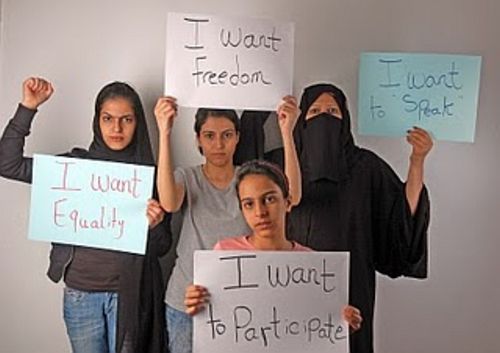
After the recent importance of Social Media in creating change in our societies, a lot of Saudi women have been active on Twitter through the hash tag #SaudiWomenRevoltion to write their demands of applying social equality in Saudi society, giving examples and telling stories on the injustice they are facing in their society.
Media has talked about this hash tag but did not care to push this cause forward. Saudi Women, however, have created a page for their revolution on Facebook and talked to several media means to support their legal and legitimate human rights to fight sexism in their society. Thus, this following statement comes as a document that gathers different demands from the Saudi Women Revolution:
Women cannot have their rights until the system of Male Guardianship is completely taken off the laws and rules of the Saudi state. The Male Guardian or “Mahram” is the father, brother, husband, or even son who has all the legal rights to control a Saudi woman’s life in different ways. The Kingdom of Saudi Arabia has promised the Human Rights Council of the United Nations in June 2009 to cancel Male Guardianship and to end Sexism in the country, but these promises remain unaccomplished. Saudi women mostly suffer from the Male Guardianship because of the following reasons:
– The Saudi Woman cannot work or apply to a job without the permission of her legal male guardian.
– The Saudi Woman does not have the right to travel without her “Mahram” or without his written permission. The Ministry of interior affairs has decided to permit women who are over 45 years in age to travel without a male guardian or his permission; however, airport officials did not apply the decision, as the Human Rights watch stated in its report in April 2008.
– The Saudi Woman cannot receive education without the permission of her male guardian and cannot travel to receive education abroad without his permission even if she was awarded a scholarship from the state. The Saudi woman also suffers from the limited academic majors although she has proved a better educational performance than the Saudi man as the official statistics show.
– The Saudi woman does not have the rights of marriage and divorce without the permission from her male guardian. Saudi Arabia has had different examples of how women suffered from this system in particular. Human Rights Watch 2010 report stated two incidents of men marrying off their sisters five times to get money, in Braida and Riyadh.
– The Saudi Woman does not have the right to follow and finish her official documents and papers without the permission of her male guardian including her cases in court. Human Rights Watch 2010 report mentioned a woman named Sawsan Salim in Qasim who was punished with 300 lashes and one year and a half in jail for showing up to court without a “Mahram”. Justice ministry itself has promised in February 2010 to permit women to work as lawyers, but the promise is still not fulfilled.
– The Saudi woman cannot have medical surgery without the permission of her male guardian. Women have talked a lot about the damages done because of this system. Human Rights Watch report stated in July 2009 that Saudi women need a “Mahram” to enter and leave the hospital. If no “Mahram” showed up to get her out of the hospital, she will stay in until someone does so.
– The Saudi Woman cannot make a bank account for her kids, enroll them in schools, ask for their school files, or travel with them without the permission of her male guardian. [Continue reading…]
Syria’s government pledged to consider protesters’ “legitimate demands” after thousands took to the streets for the funerals of nine people killed by the military.
Rights activists described Wednesday’s shootings in the southern city of Daraa as a massacre, claiming that more than 100 people may have been killed when troops fired on a mosque in the early hours and throughout the day.
With protests called for after Friday prayers, Buthaina Shaaban, adviser to President Bashar al-Assad, announced that the government would consider ending Syria’s emergency law and revise legislation for political parties and the media. Similar reform pledges have been announced in the past, and are unlikely to satisfy protesters.
In Deraa, funeral-goers chanted “God, Syria, Freedom” and “The blood of martyrs is not spilt in vain!”, Reuters news agency reported. Some reports said that up to 20,000 people attended, but this could not be verified. The city has been cordoned off .
Deraa’s hospital reported receiving 37 bodies from Wednesday’s violence. YouTube videos apparently showed bloody scenes at the mosque.
Electricity and communications in the city were cut before the attack, which sources said was by a unit of forces headed by the president’s brother, Maher al-Assad.
“This is a crime against humanity because forces opened fire on unarmed civilians without any warning,” said Radwan Ziadeh, head of the Damascus Centre for Human Rights and a visiting scholar at Harvard University.
A key indicator of the uprising’s momentum will be whether the situation escalates after Friday prayers this week. The Assads are taking no chances. The brutality in Dara is a testament to the family’s sense of vulnerability. The minority Alawite-led regime controls all levers of power and intimidation in Syria, including elite military units and the intelligence services. Reports have suggested that troops whose principal role is regime protection were swiftly dispatched to the south. According to Syrian dissident Ammar Abdulhamid, this included Republican Guard detachments, and rumor has it that Assad’s younger brother, Maher, has been directing operations.
Haytham Manna, the spokesman for the Arab Committee for Human Rights, appeared to agree that internal security companies, not the army, were leading the repression. He told the BBC Arabic service that “security branches, military and civilian, wearing civilian clothes, they are the ones engaging in [attacks against the Omari mosque].”
The fear is that the situation may take on a sectarian coloring, with Sunnis, some 74 percent of the population, turning against Alawites, who represent roughly 8 to 12 percent. This is simplistic. The Assads will defend Alawite domination as an existential necessity, but Sunnis thrive in many sectors, especially the economy. Assad is married to a Sunni. Syria is characterized by complex, sometimes crisscrossing, political, regional, tribal, ethnic, and class bonds that transcend a narrow sectarian reading of events. That’s why a breakdown of authority could bring about a situation even more volatile and vicious than in Libya.
The Syrian leadership seems for the moment to have drawn back from the kind of draconian repression that it meted out to crush a revolt by the Muslim Brotherhood in Hama in 1982.
It seems to be following the Egyptian and Tunisian examples rather than the Libyan model, though clearly with the hope that placatory measures may be in time to head off a national upheaval.
In theory, the political reforms promised would – if implemented swiftly and seriously – meet most of the demands of reformists and activists.
The Baath party would no longer enjoy an official monopoly of power, the press would be free, citizens’ rights would be respected, and the corrupt would be punished.
It is hard to imagine.
For it to happen, powerful vested interests would have to be overridden.
Some diehards within the regime may not admit the necessity for radical self-reform until it is too late – if it is not already.
To listen to the hype about social networking websites and the Egyptian revolution, one would think it was Silicon Valley and not the Egyptian people who overthrew Mubarak.
Via its technologies, the West imagines itself to have been the real agent in the uprising. Since the internet developed out of a US Defense Department research project, it could be said the Pentagon did it, along with Egyptian youth imitating wired hipsters from London and Los Angeles.
Most narratives of globalisation are fantastically Eurocentric, stories of Western white men burdened with responsibility for interconnecting the world, by colonising it, providing it with economic theories and finance, and inventing communications technologies. Of course globalisation is about flows of people as well, about diasporas and cultural fusion.
But neither version is particularly useful for organising resistance to the local dictatorship. In any case, the internet was turned off at decisive moments in the Egyptian uprising, and it was ordinary Egyptians, mothers and fathers, daughters and sons, who toppled the regime, not the hybrid youth of the global professional classes.
Are there other tales of globalisation, perhaps those told by rebels and guerrillas?
Globalisation is also coming to awareness of the situations of other peoples, such as those similarly oppressed by local and faraway powers. Of particular interest are those moments when these peoples rise up, when they devise forms of revolt and struggle. Defeats provide lessons, and victories give hope. These revolutions need not be on satellite TV to effect their instruction. Revolutionaries in France and Haiti in the 1790s received news of one another””s activities by the regular packet ship that plied between Jamaica and London.
Sailors, slaves, and workers circulating in the Atlantic between the seventeenth and nineteenth centuries shared and improved upon their repertoires of revolt and resistance, bringing the good news to ports from Rio to Boston, Bristol to Havana.
When Indians rose in revolt in 1857, Frederick Engels analysed their mistakes – like the Libyan rebels today, they were too eager to stand and fight against a better organised opponent. Engels publicised the uprising in a series of newspaper articles that ultimately inspired Mao Tse-tung”s theories of guerrilla warfare, which went on to circulate as well-thumbed texts in the pockets of Vietnamese, Cuban, Algerian and other revolutionaries (and of those who sought to defeat them).
In a Pentagon briefing, Rear Adm. Gerard Hueber, the chief of staff for the operational command, told reporters:
As long as the regime’s forces are fighting in and around cities where the allies have ordered them to back off, he said, coalition attacks would continue. He said the allies are in communication with the Libyan units about what they need to do, where to go and how to arrange their forces to avoid attack, but that there was “no indication” that the regime’s ground forces were following the instructions.
A senior British commander said Wednesday that the allies had effectively destroyed the Libyan air force and air defenses and were now able to operate “with near impunity” across the country, Reuters reported. “We are now applying sustained and unrelenting pressure on the Libyan armed forces,” the commander, Air Vice Marshal Greg Bagwell, said at an airbase in southern Italy where British warplanes are based.
At sea, news reports said six NATO warships had started patrolling off Libya’s coast Wednesday to enforce a United Nations arms embargo, but Germany, which has opposed military intervention in the Libya crisis, said it was withdrawing four of its ships in the Mediterranean from NATO command. To offset the impact of its action on other NATO allies, Germany said it would send 300 more troops to Afghanistan to help operate surveillance aircraft, German officials said.
Colonel Qaddafi himself made a brief but defiant appearance on Libyan television on Tuesday night, appearing at what reporters were told was his Tripoli residence to denounce the bombing raids and pledge victory. “I am here!” he shouted from a balcony to supporters waving green flags. “I am here! I am here!” It was his first known public appearance since the allied bombing began on Saturday.
“We will not surrender,” he told supporters. “We will defeat them by any means. We are ready for the fight, whether it will be a short or a long one. We will be victorious in the end,” he said. “This assault is by a bunch of fascists who will end up in the dustbin of history.”
Khaled al-Sayeh, the rebels’ ostensible military spokesman, insists that rebel forces have captured both the eastern and southern gates to Ajdabiyah, bypassing the regime forces dug in at the northern gate by moving along the coast. They have effectively surrounded Gaddafi’s forces and have even begun to encroach on his stronghold of Sirte. Before long, the loyalist forces will run out of ammunition.
At a press conference on Tuesday evening, without so much as glancing at a sheet of paper, al-Sayeh runs off a long list of impressive achievements. In recent days, he says, rebels and allied air forces have destroyed all but 11 of the 80 tanks Gaddafi had sent to Benghazi. Ten other tanks were captured intact, along with 20 pickup trucks, two armored vehicles and a vehicle with radar equipment. He estimates that between 400 and 600 government troops were killed over the weekend.
But al-Sayeh’s message seems to change from day to day. On Monday, he had been more defensive, insisting that “the army is starting from scratch; we are putting the structure in place.” The army needs training. It needs arms. And the real officers and commanders have no control over the youth gathered at the front line. “The youth advanced today and it was spontaneous, as always. They don’t take orders from anyone,” he said bitterly. “If it was up to the regular military, the advance by the youth today would not have happened.”
“I am here to defend Benghazi,” says Muatasim Billah Mohamed, waiting with a crowd of young men on the roadside some 5 km from where the shells are falling. He has gone all the way from Tobruk and has a flag tied around his head like a bandanna, but carries no weapon. God will protect him, he says, pointing to the sky.
Others point to the sky to signify salvation from allied warplanes, expecting to see more wreckage of Gaddafi’s armor. “People now are waiting for the planes to hit Gaddafi’s forces,” explains Ahmed al-Faytoori, a former government bureaucrat, waiting beside his truck on the road. “The revolutionaries cannot proceed without the air strikes because we have very light weapons.”
He has approached the front with a vague intention of fighting Gaddafi, but makes no indication that he plans to move forward into the fray. “There are people here who are prepared to do suicide missions against Gaddafi’s forces, to shake them if the airplanes don’t come,” he says. “But it’s necessary for the planes to come so the rebels can move into Ajdabiyah, and after Ajdabiyah, Ras Lanuf.”
The roar of fighter jets had inspired fear in many of the volunteer fighters and local townspeople along this road less than a week ago. Now it generates excitement. “Air strikes,” a group of young men cheered from a sand dune on Sunday, as explosions to the south sent white clouds of smoke into the air. They turned out to be incoming tank shells, and an older fighter urged them to go down from the dune where he said they were vulnerable.
On Monday, the roar of the warplanes has filled many of those gathered with hope and expectation, but the strikes on Gaddafi’s forces defending the approach to Ajdabiyah never seem to arrive. And as the braver ones press forward into shelling despite their inferior weapons, the war tourists who stay behind get a glimpse of the real horror as well.
Anthony Shadid, Lynsey Addario, Stephen Farrell and Tyler Hicks recount their experience as captives held for several days by Gaddafi forces.
All of us had had close calls over the years. Lynsey was kidnapped in Falluja, Iraq, in 2004; Steve in Afghanistan in 2009. Tyler had more scrapes than he could count, from Chechnya to Sudan, and Anthony was shot in the back in 2002 by a man he believed to be an Israeli soldier. At that moment, though, none of us thought we were going to live. Steve tried to keep eye contact until they pulled the trigger. The rest of us felt the powerlessness of resignation. You feel empty when you know that it’s almost over.
“Shoot them,” a tall soldier said calmly in Arabic.
A colleague next to him shook his head. “You can’t,” he insisted. “They’re Americans.”
They bound our hands and legs instead — with wire, fabric or cable. Lynsey was carried to a Toyota pickup, where she was punched in the face. Steve and Tyler were hit, and Anthony was headbutted.
Even that Tuesday, a pattern had begun to emerge. The beating was always fiercest in the first few minutes, an aggressiveness that Colonel Qaddafi’s bizarre and twisted four decades of rule inculcated in a society that feels disfigured. It didn’t matter that we were bound, or that Lynsey was a woman.
But moments of kindness inevitably emerged, drawing on a culture’s far deeper instinct for hospitality and generosity. A soldier brought Tyler and Anthony, sitting in a pickup, dates and an orange drink. Lynsey had to talk to a soldier’s wife who, in English, called her a donkey and a dog. Then they unbound Lynsey and, sitting in another truck, gave Steve and her something to drink.
From the pickup, Lynsey saw a body outstretched next to our car, one arm outstretched. We still don’t know whether that was Mohammed. We fear it was, though his body has yet to be found.
If he died, we will have to bear the burden for the rest of our lives that an innocent man died because of us, because of wrong choices that we made, for an article that was never worth dying for.
No article is, but we were too blind to admit that.
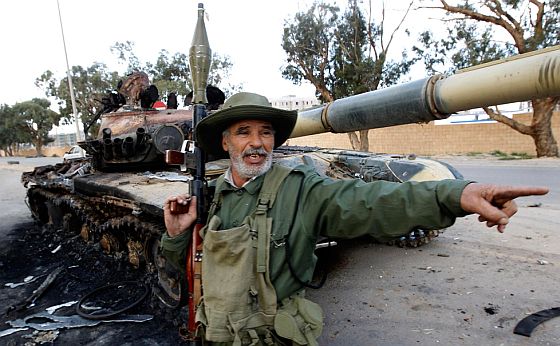
Napoleon famously said an army marches on its stomach, and in the case of Libya’s rebel forces, that would be tuna sandwiches, fava beans and a lot of junk food.
As Western air strikes are restarting once thoroughly defeated rebel advance, the once weirdly successful aspect of their rag tag forces should be gearing up again — their food supply lines.
Like everything else about the uprising in eastern Libya seeking to challenge Moammar Gadhafi’s four decade hammerlock on power, the fighters’ food supply was an ad hoc affair of entreprising individuals and local charities with official sanction that somehow seemed to work — even when nothing else really did.
Rebel checkpoints always featured cases of bottled water, juice, piles of bread and plenty of junk food such as biscuits and packaged cupcakes that fighters can grab and throw into their pick up truck before taking off for the front.
“We never run short of food, we have good kids from Benghazi who come and bring it down to us,” said Mohammed Selim, 23, as he cleaned up the empty boxes of Twinkies, cookies and sugary juice drinks piled outside a rebel checkpoint in the oil refinery town of Ras Lanouf, two weeks ago before they were driven out.
Some observers of the Libyan uprising, particularly those who now most vehemently oppose intervention, insist that Libya is a special case, really a civil war rather than a revolution — the implication being that if Gaddafi were to crush his opponents, then the wider Arab revolution would not suffer a major setback.
Activists involved in the uprising that has now started in Syria indicate that, on the contrary, the fate of Libya has very much been in their minds. Fearing that a Gaddafi victory in Libya would make it more difficult to plead their case for revolution to the Syrian people, activists launched demonstrations this month, instead of allowing several more weeks for organization, as they had earlier intended.
In whichever countries it has already broken out – from Yemen, whose President Saleh is suffering new, perhaps even terminal reverses, to Libya, where Colonel Gaddafi defies the military “crusaders” from the west – the Arab democratic revolution pursues its seemingly inexorable, if chequered, course. But is it yet another country’s turn now? Of all Arab regimes, none more resembles those of former presidents Mubarak and Ben Ali than President Assad and the ruling Ba’athists of Syria; and, after their fall, his 51-year-old “republican monarchy” looked the next most logically in line of candidates to succumb to the Arab uprising.
Yet Assad himself begged to differ. “We are not Egyptians or Tunisians,” he said; Syria might have “more difficult circumstances than most of the Arab countries” but it was “stable”. And outwardly it did remain an island of calm, even as pro-democracy turbulence rocked other Arab countries from the Atlantic to the Gulf. But last week things suddenly changed. A series of small-scale and isolated but audacious protests developed into much larger ones after Friday prayers in a string of Syrian cities.
One, in the southern city of Dera’a, was particularly serious. It had been triggered by the arrest of 15 schoolchildren accused of scrawling anti-government graffiti on city walls, among them that trademark slogan – “the people want the overthrow of the regime” – of the uprisings elsewhere. It was a peaceful gathering but the security services opened fire, killing three. The next day a much larger, angrier crowd – estimated to number as many as 20,000 – turned out for the burial of the previous days’ victims.
Syrian troops are forcing people to stay at home in the southern city of Daraa after six people were killed in renewed anti-government protests that have swept across the country, Amnesty International said.
“People are being asked through loudspeakers to remain at home or they will be shot,” Neil Sammonds, a researcher on Syria for the rights group, said today by telephone from London. Snipers are enforcing the orders and all the city’s entrances are being watched, he said. “The town is besieged.”
Seven people were also wounded when security forces opened fire earlier today during the funeral of two of those killed during the night in Daraa, according to an Agence France-Presse photographer who visited one of the local hospitals. President Bashar al-Assad sacked Faisal Kalthum, the governor of Daraa, state television reported today.
The rallies in Syria mark the latest extension of the political turmoil that has engulfed the region this year.
Ammar Abdulhamid, a Syrian dissident and democracy activist now living in exile in Washington, DC, writes:
What a difference six weeks make. Back in early February I was asked whether Syria would be next on the growing list of countries to witness a popular revolution. My answer, which came in the form of an article published on Comment is free, was, in essence, “not yet”.
The “day of anger” that exiled opposition figures called for on 5 February fizzled out largely because the networks that were being built on the grounds at the time were not ready to take up such a call. Activists needed time to ensure that they had networks of supporters all over the country and that clear communication strategies and methods were agreed, both within these networks and between them and their supporters in the country and across the world.
Formulating the right messages meant to address the concerns of certain segments within Syrian society, as well as those of the international community, especially with regards to the potential role Islamists would play in a future democratic Syria, was also something that required more time.
These points were being debated online through emails and on various Facebook groups; the main thrust of the debate was not whether a revolution could take place but when. Myself and others were on the side of waiting until mid-summer at least, to give in-country activists more time to organise their networks, while others worked on messaging.
Others were less patient, with some fearing a Gaddafi victory in Libya could make it more difficult to plead our case for revolution to the Syrian people; they pushed for a quicker move. Obviously, seeing that Syria has been caught in the midst of a revolutionary upheaval since the Ides of March, it was this latter side that won the debate.
Maher Arar, an engineer with dual Canadian and Syrian citizenship who was a victim of the Bush administration’s rendition program in 2002, writes:
At the time of his ascent to power in 2000, still only, the young president [Bashar al-Assad] promised major reforms were coming.
Popularly elected by 97% of all votes, Syrians of all stripes thought they finally had a glimpse of hope after the 30-year, iron-fist rule of his father.
Assad pledged he would fight corruption, would guarantee his people more freedom of expression, and would adopt a more liberal market policy. He may have partially succeeded on the latter point but it became clear a few years into his rule that he miserably failed on the first two, leading some Syrians to speculate that the new president was simply a puppet in the hands of his father’s old camp.
Furthermore, Syria’s human rights situation steadily deteriorated under the new ruler, especially after the unofficial alliance with the Unites States to fight al-Qaida, a historically common enemy. For instance, it became clear around 2001 that Syria was a preferred rendition destination for terror suspects. The cases of Hydar Zammar, Ahmed El-Maati, Abdullah El-Malki and my own are only a few examples . Bob Baer, a former CIA official, stated at the time: “If you want a serious interrogation, you send a prisoner to Jordan. If you want them to be tortured, you send them to Syria,” something to which I can personally attest.
Britain, France and the United States have agreed that Nato will take over the military command of the no-fly zone over Libya in a move which represents a setback for Nicolas Sarkozy, who had hoped to diminish the role of the alliance.
Barack Obama agreed in separate phone calls with Sarkozy and David Cameron that political oversight would be handed to a separate body consisting of members of the coalition, including Arab countries such as Qatar and the United Arab Emirates that are outside Nato.
The agreement, which will have to be put be to all 28 members of Nato, indicates that the alliance has resolved one of its most serious disagreements. Countries had been splintering as they tried to comply with Obama’s demand that Washington be relieved of command of the air campaign.
Sarkozy moved to portray the agreement as a Franco-American success. In a statement the Élysée Palace said: “The two presidents have come to an agreement on the way to use the command structures of Nato to support the coalition.”
But the agreement represents a blow for Sarkozy, who had tried to persuade Britain set up an Anglo-French command for all military operations in Libya. This was strongly resisted by Britain, who said Nato was best placed to run the military operations.
With his brutal military assault on civilians, and his rantings about spiked Nescafé, Col. Muammar el-Qaddafi handed many leaders across the Arab world what had otherwise eluded them: A chance to side with the people while deflecting attention from their own citizens’ call for democracy, political analysts around the region said. And they really do not like him.
Even Arab leaders most critical of the United States’ intervention in the Middle East have reluctantly united behind the military intervention in Libya. That has given a boost to Arab leaders in places like Saudi Arabia who are at the same moment working to silence political opposition in their backyards.
“The Arab street reaction to the Western attacks on Libya has been warm,” said Hilal Khasan, chairman of the department of political studies at American University of Beirut. “This is not Iraq.”
It is another disorienting twist in this season of upheaval in the Arab world. A fierce resentment about a legacy of Western intervention, fed by historical memories of colonialism and present-day anger at the invasions of Iraq and Afghanistan, has given way to a belief that the Libyan rebels desperately needed help that only the West could fully provide. The apparent hypocrisy of repressive Arab leaders endorsing military action against a repressive Qaddafi government did not escape many Arabs.
“I see hypocrisy in everything the Arab leaders do, and I’m talking as a person of the Arab world,” said Randa Habib, a political commentator in Jordan. “I wanted them to take such a decision. There were too many people being killed in Libya. That man is cuckoo.”
This new and unpredictable tone seemed to partly explain the flip-flopping of Amr Moussa, the longtime secretary general of the Arab League who plans to run for the Egyptian presidency. Last week, the Arab League asked the United Nations to impose a no-fly zone in Libya, largely on humanitarian grounds. On Sunday, Mr. Moussa said military action there had gone too far. But he repeated his contention that the no-fly zone could not have been imposed were it not for the Arab League.
“We respect the no-fly zone, and there is no conflict with it,” he said, in a clarification that was seen in Egypt, given his political ambitions, as an overt acknowledgment of the public support for the actions in Libya. A day earlier Mr. Moussa had appeared to back away from support for the military intervention.
“In a way, the Arab League is trying to follow the sentiment of the Arab street,” said Shafeeq Ghabra, a political science professor at Kuwait University. “The street is now more in control. If we ever had an Arab street, this is the moment.”
Little is known for certain about the make-up and political outlook of the rebels’ Transitional National Council, which controls Benghazi and other parts of “liberated” Libya. Even its name is in doubt. It also goes by the title of “revolutionary council” and other variations. Eleven members of the council have been named. The identity of 20 others has been withheld, ostensibly for security reasons.
Mustafa Abdul Jalil, a former Gaddafi justice minister who chairs the council, has been condemned as a traitor by his old boss, who put a $400,000 (£240,000) bounty on his head. In an interview with the Daily Beast, Jalil asked the international community “to recognise our council as the sole representative of the Libyan people”. Among the western powers, only France has done so. But Britain, the EU and the Arab League are supportive. And Hillary Clinton met a council representative in Paris last week to discuss how the US could help.
Jalil claimed the council has grassroot support. It derived its legitimacy, he said, from local councils that were organised by revolutionaries in every village and city. “We are striving for a new, democratic, civil Libya, led by democratic and civil government [and] a multi-party system,” he said. ” Members of the council were chosen with no regard to their political views or leaning.”
‘This is not wholly true,” said Venetia Rainey, writing in the First Post online magazine. “The key players of the council, at least those we know about, all hail from the north-eastern Harabi confederation of tribes,” she said. This included Jalil and Major General Abdul Fattah Younis, a former Gaddafi interior minister who also defected to the rebels.
“Although the tribes’ influence has waned … Libya’s tribal divides linger on. Their stance [the Harabi] is not necessarily representative of the wider Libyan attitude to Gaddafi,” Rainey said.
Western tribes loyal to Gaddafi, such as the Hasoony, had flourished at the expense of the Harabi and other easterners, the Wall Street Journal reported from Benghazi. “Early in his reign, Gaddafi targeted Libya’s powerful eastern tribes, redistributing their land to others and awarding them few influential posts … The weaker tribes’ empowerment [following the revolt] helps explain why Gaddafi’s supporters appear to be clinging to power more desperately” than counterparts in Egypt or Tunisia.
“These guys know they aren’t going to fare very well if the regime goes down,” Jason Pack, a Libya scholar at Oxford university, told the journal.
Eastern Libya also has a different religious tradition from the rest of the country and this was reflected in the rebels’ transitional council, argued Andy Stone, a columnist on the Nolan Chart website. “This is no Solidarnosc movement,” he said (referring to the Polish trade union-led anti-communist movement).
“The [Libyan] revolt was started on February 15-17 by the group called the National Conference of the Libyan Opposition [an umbrella organisation founded in London in 2005]. The protests had a clear fundamentalist religious motivation and were convened to commemorate the 2006 Danish cartoons protests which had been particularly violent in Benghazi.” (The 2006 protests had turned into an anti-Gaddafi demonstration).
Stone went on to claim that much of the eastern Libyan opposition to Gaddafi was rooted in the region’s strong Islamist tradition which resulted, for example, in a large numbers of eastern Libyan jihadis taking part in the Iraq war (second in number only to Saudis) and support for the al-Qaida-affiliated, anti-Gaddafi Libyan Islamic Fighting Group, many of whose members had fought in Afghanistan.
“It is these same religiously and ideologically trained east Libyans who are now armed and arrayed against Gaddafi. Gaddafi’s claim that all his opponents are members of al-Qaida is overblown, but also not very far off in regard to their sympathies. Anyone claiming the eastern Libyans are standing for secular, liberal values needs to overcome a huge burden of proof,” Stone wrote.
A former British diplomat familiar with Libya said these and other claims that Islamists dominated the rebel movement in the east were exaggerated. Most of the population of Benghazi and other cities were political and religious moderates primarily motivated by opposition to Gaddafi, the diplomat said.
Chris McGreal witnesses the advance, retreat and panicked dispersal of young fighters on the outskirts of Ajdabiya:
The day’s events around Ajdabiya provided further evidence that the rebels stand little hope of defeating Gaddafi’s forces militarily on their own and are relying on coalition air strikes to destroy, or at least greatly weaken, the ability of the government’s army to fight.
Some of the rebels mistake the air strikes for their own victories. They dance on the burned out tanks, wave V for victory signs and declare that they are beating Gaddafi.
But the revolutionaries outside Ajdabiya only advanced because they expected to move into the town with little resistance.
The rebel leadership frankly admits that it cannot defeat the government militarily on its own and acknowledges that if it cannot take a relatively small town unaided, its forces are unlikely to be able to seize the better defended cities further west – leaving France, Britain and the US to decide if they are going to fight the insurgents’ war for them by clearing the way for the revolutionaries to advance.
Alongside the military campaign, the rebels’ political leadership says it intends to encourage fresh popular uprisings in cities still under Gaddafi’s control. But it may find it hard to persuade Libyans to take the risk unless they have the assurance that rebel forces are close enough to come to their rescue.
Members of the revolutionary council have already said they fear that the result of a limited air campaign will be military stalemate and a divided Libya. For that reason, they have called for an escalation of the air strikes to wipe out Gaddafi’s army as a fighting force.
The chaos outside Ajdabiya holds another concern for ordinary Libyans in areas now claimed as liberated territory by the revolutionary council.
There is growing alarm in Benghazi in particular at growing disorder by young men with guns who have claimed the authority for themselves to set up arbitrary road blocks, order people around and fire their weapons for the fun of it.
Even in combat situations, they do not obey orders, shooting at will and wasting ammunition. Rebels manning an anti-aircraft gun were probably responsible for shooting down the revolutionaries’ only fighter plane on Saturday.
Gen Abdul Fatteh Younis, who recently defected from Gaddafi’s military and now commands the rebel forces, was interviewed by the Irish Times:
“This man is stubborn. He will not leave the country or surrender easily . . . The situation is very complicated at the moment and I hope it will not continue for long but all the evidence suggests that Gadafy is trying to make it last even longer.” Younis talks of rumours that Gadafy has left the capital Tripoli and is now in southern Libya, and adds that there is “some evidence” that he has withdrawn money, gold and foreign currency from the central bank. He speculates that Gadafy might use this to establish himself in Chad or Niger, from where he would launch military operations in an attempt to return.
“I’m calling on the international community to realise that the sooner he is gone, the better it is for everybody, for the peace of the world,” he says.
Some opposition figures hope that the US and European coalition strikes against Gadafy’s air defences will trigger more senior defections and weaken Gadafy’s grip on power. Younis seems less certain.
“You cannot bet on something you do not have in your own hands,” he says.
“Gadafy’s strategy now is that he is effectively holding families of some of his cadre hostage in his compound so he can control their movements and make sure they will not defect or leave him. He is keeping them as human shields. He is a shrewd man in this way.”
Younis claims the rebel fighters are succeeding in pushing regime forces west, though eyewitness accounts from the front yesterday challenge this assertion.
“The no-fly zone is very helpful to allow the opposition forces come together and advance to the west . . to free those areas,” he says. He acknowledges that militarily his forces – a mix of fellow defectors and masses of untrained volunteers – are little match for the regime but argues that continuing air strikes on army installations will tip the balance in the rebels’ favour because, he insists, they are supported by the majority of Libyans.
“We are asking the international community to finish his security services because once they are gone then the rest will be done by the Libyan people.”
Younis talks of having between 15-20,000 fighters. “With that large number of revolutionaries, even with the light weapons they have, we can manage to achieve our goals, especially after air strikes help prepare the ground.”
Asked whether the rebels have been receiving foreign military assistance in the form of weapons, Younis replies: “So far we did not receive anything. A lot of countries promised to help us but they haven’t.”
Six villagers in a field on the outskirts of Benghazi were shot and injured when a US helicopter landed to rescue a crew member from the crashed jet, reports Lindsey Hilsum.
Channel 4 News International Editor, Lindsey Hilsum, says that the villagers were shot when a US helicopter picked up the pilot who had ejected from the F-15E Eagle plane after it experienced a mechanical failure.
The US aircraft crashed on Monday night and was found in a field outside Benghazi and landed in rebel-held territory.
The local Libyans who were injured in the rescue mission are currently in hospital. They are the first confirmed casualities of allied operations, almost four days after operations began. At the time of writing, no one had died as a result of the gunfire.
Babak Dehghanpisheh reports on a second American pilot who ejected from the same F-15E jet:
One of the pilots was picked up by rebel forces near the site of the crash and brought by car to the Fadeel Hotel in Benghazi around 2 a.m., according to a handful of people who said they met with the pilot. It’s unclear why the opposition forces brought the pilot to that particular hotel. Dina Omar, 30, an Egyptian cardiologist who has been volunteering at the rebel frontlines was in the Internet café at the hotel at the time. She heard from the hotel staff that a pilot had been brought in and went to see him in a large suite in the hotel. She saw a man wearing a light brown pilot suit in his early 30s lying down on a couch. “He was feeling insecure and unsafe,” she said. “He did not talk much.”
Omar and two fellow Egyptian medical volunteers offered him coffee, which he refused, they said. He did allow the doctors to check out his right leg, which had a slight contusion. Omar, who speaks fluent English, also offered him some Panadol, which he initially refused, until he saw her take a couple of pills from the same pack. He was concerned that the medical staff were Gaddafi sympathizers and Omar tried to convince him of their real work by showing a phone video she had taken of civilian victims from Saturday’s military assault on Benghazi. The doctors stayed with him until he relaxed and opened up a bit, they said. “After two hours, he started to speak and started to smile,” said Omar. The pilot reportedly confirmed he was American and said he thought the plane had gone down for technical reasons. But he refused to give much personal information or confirm whether there was another pilot with him, the sources said.
Not long after the pilot’s arrival, rebel officials brought him a bouquet of flowers, they said. “He was a very nice guy,” said Ibrahim Ismail, 42, a Libyan businessman who said he met the pilot at the hotel. “He came to free the Libyan people.” As Ismail spoke, a fellow businessman said, “I thought we agreed not talk about this,” indicating that rebel officials were trying to keep the pilot’s stay in Benghazi under wraps. Even though the pilot had a radio with a large aerial, he wanted help communicating with his family. Omar, the doctor, took him up to the hotel’s Internet café and tried to help him arrange a Skype chat which didn’t go through. Someone eventually brought the pilot a Thuraya satellite phone which he used to call his family. The witnesses at the hotel say the pilot left in a civilian car in the early morning hours.
This video allegedly shows Gaddafi forces “bombarding eastern regions of Libya” (LibyaFeb17.com)
“A city held by any organized rioters will be attacked generally in the same manner as one held by enemy troops.”
This is not a direction on how to suppress the Libyan uprising handed down from Colonel Gaddafi to his field commanders. It comes from the newly declassified 1945 US military field manual.
The manual provides instructions on how the military should handle civil disturbances in the event that local law enforcement are unable to contain the unrest. Riots and protests are anticipated to be caused by “agitators, racial strife, controversies between employees and employers concerning wages or working conditions, unemployment, lack of housing or food, or other economic or social conditions.”
According to the manual, when necessary, live rounds should be fired directly into a mob (“a crowd whose members, under the stimulus of intense excitement, have lost their sense of reason and respect for law”), aiming low to avoid injuring innocent bystanders. The manual also says: “Bayonets are effective when used against rioters who are able to retreat, but they should not be used against men who are prevented by those behind them from retreating even if they wish to do so.”
If the crises of Bosnia, Kosovo, Iraq and Afghanistan, which have consumed more than 100,000 lives, four trillion dollars and absorbed a million foreign soldiers from 60 countries, have not made us more prudent, they should at least have made us wiser. For two decades our policies in these countries have been described, explained and criticised by political philosophers, civil servants, human rights activists, journalists, development workers, film-makers and 10,000 consultants. Parliamentarians round the world refer confidently to ‘Chapter 7 resolutions’, ‘no-fly zones’, ‘the experience of the Kurds’ and ‘the responsibility to protect’. But the basic questions about intervention seem to remain as obvious as they are unhelpful. You do not need to be able to name four cities in Libya to have four arguments against or for what we are doing. You can simply deploy those which were used in 1960s Vietnam, 1920s Syria and 1860s Afghanistan.
The arguments against intervention are neatly itemised by Albert Hirschman as ‘perversity’, ‘futility’ and ‘jeopardy’: an intervention could be dangerous (for us or for Libya); it could achieve nothing; or it could achieve exactly the reverse of what it intended. This line can be bolstered by the language of medicine or commerce: ‘first do no harm’; ‘it’s none of our business’; ‘we’re broke’. Or even race. Thus Conor Cruise O’Brien in 1992: ‘There are places where a lot of men prefer war, and the looting and raping and domineering that go with it, to any sort of peacetime occupation. One such place is Afghanistan. Another is Yugoslavia after the collapse of the centralising Communist regime.’
Against these stand the four national security arguments for intervention: fear of a rogue state, fear of a failed state, fear for the neighbours and fear for ourselves. First, we called Iraq a rogue state – the weapons of mass destruction, which could be launched within 45 minutes. Second, we called Afghanistan in 2002 a failed state – the vacuum filled by drug-dealers and terrorists. Third, in 2009, we emphasised the fear for Afghanistan’s neighbour Pakistan: ‘If Afghanistan falls, Pakistan will fall and mad mullahs will get their hands on nuclear weapons in Pakistan.’ (In Vietnam, this was called ‘the domino theory’.) Fourth, we are fearful for our reputation. From Kissinger in Vietnam to the British in Afghanistan there is the eternal anxiety about being seen to be defeated, of giving confidence to enemies, of losing credibility. In Libya’s case, these arguments focus on fear of Gaddafi; fear of al-Qaida in a post-Gaddafi failed state; fear of instability in the region (civil war in Libya shaking North Africa and pushing refugees across the Mediterranean into Europe); and fear for our own credibility (what if he survives our threats and imprecations?).
Then there are the moral arguments. There are the arguments against from international law (‘it is in contravention of state sovereignty’) and arguments from guilt (‘we are the people who armed and supported Gaddafi in the first place’). There are the arguments in favour based on the scale – brought home in continual news footage – of human suffering, which make the point that inaction is leading to more deaths: that we have a right and a duty to prevent the killing, a moral obligation to the Libyan people.
Thus, three arguments against action. Four fears about inaction. And a background of guilt, law and moral obligation. Each position has its own historical analogy. If you oppose intervention, you call it ‘another Vietnam’. If you support intervention on national security grounds, you call the opponents appeasers and invoke Munich. And you could still do a ‘replace all’ and instead of Libya insert Zimbabwe, Darfur or for that matter Abyssinia, the Hejaz or ‘the Kingdom of Caubul and its dependencies’. Here more than ever what seems to matter is not detailed knowledge of the country concerned but a basic attitude of mind: a high optimism, a reactionary pessimism and very rarely anything in between.
This is not to say that the millions of pages produced over the last two decades have achieved nothing. The arguments have been given a makeover and presented in a more contemporary design, encrusted with sparkling statistics, buttressed with new analogies. If you want, you can now replace Vietnam with Iraq, Munich with Rwanda and the Second World War with Bosnia. The ‘forward policy’ is now called ‘state-building’ and ‘pacification’ is ‘counter-insurgency’.
But the basic positions remain black and white. Do it or don’t do it, but no halfway houses. And therein lies the danger.
That should not be forgotten because after 112 cruise missiles slammed into Libya’s air defense sites that day and the phrase “shock and awe” started getting tossed around once again, the implication for many observers was that Western intervention in Libya marked the beginning of another American-made war in the Arab world. It didn’t.
If I am asked, do you support the war? Or, do you support the intervention? Or, are you an interventionist? My response is: none of the above. They are all misleading questions.
By the week beginning March 13, the collapse of the Libyan revolution and the beginning of a major and very bloody assault on Benghazi were imminent. For anyone to believe in the likelihood of a massacre leading to thousands of deaths, did not depend on the political impact of dubiously sourced newspaper reports or how effectively highly questionable intelligence could be presented. Nor did it depend on ascribing to Muammar Gaddafi the intent to invade other countries or supply terrorists with weapons of mass destruction. Indeed, pretty much the only way one could avoid coming to the conclusion that Benghazi and its population of close to a million was in a position of immense danger would have been by avoiding reading the news.
Towns and cities along the Libyan coast that only days before had been liberated by a rag-tag army of protesters-turned-freedom-fighters, were being reclaimed by Gaddafi’s forces one by one as the rebels were pushed back towards Benghazi. The uprising had not been fully crushed, but it was in the process of rapid collapse.
When the members of the UN Security Council discussed the issue last week, debate did not revolve around whether the situation was urgent but on whether any consensus could be reached on how the international community could effectively respond to this emergency and prevent an assault on Benghazi. Since by that point there seemed no plausible way to protect the city other than by military force, the core issue became whether there was any validity to the claim that the fate of Benghazi had become an international responsibility.
In the end, no member of the Security Council was willing to assume a position which would effectively had said: what happens inside Libya’s borders is not our concern. Those who doubted that their concerns could be met through some form of military action, abstained.
In the wider arena of political debate, opposition to intervention in Libya has come primarily from those who are ideologically opposed to military intervention. Implicitly, their argument runs from the general to the particular.
Military intervention is always entered into with unrealistic optimism, inevitably has unintended consequences and will necessarily do more harm than good. Intervention in Libya will simply reaffirm what has universally already been shown to be true.
What about Benghazi?
The less said the better. Who knows, perhaps their plucky fighters would have been able to keep Gaddafi’s forces at bay. Perhaps Egypt would eventually have intervened.
What about the repeated appeals from the rebels?
From who? Who are these people? Is Libya really part of the wider Arab uprising or is this just a civil war in which the losing side wants our help?
“[W]e know nothing about the opposition. It ain’t Egypt,” declares Michael Ratner. As a hard-headed attorney, he says the only circumstance in which intervention in Libya could be justified would be “in response to genocide.”
It’s questionable whether a massacre of any size would cross that legal threshold, so Ratner’s message to the people there essentially amounts to this: sorry guys, you’re on your own.
And what about the impact the crushing of the Libyan uprising might have on the wider Arab revolution?
This for me is one of the most important questions. It’s clear that in Tunisia, Egypt, Yemen, Bahrain and Libya, everyone is fighting their own fight. It is also clear that there is a sense of solidarity that spans the Arab uprising — that the examples of Tunisia and then Egypt demonstrated to the region as a whole that ordinary people rising up en masse can in just a few weeks topple ruthless dictatorial regimes.
If Gaddafi stays in power he will demonstrate that popular support, enthusiasm, the use of social media, desperation and even the willingness to take up arms, will not necessarily be enough to bring down a dictator who is ruthless enough to set no limit on how much violence he is willing to use to crush his opponents.
This is a message that will disempower everyone now on the streets across the region, protesting to win their political rights. At the same time it will encourage every threatened regime and the security apparatus upon which each depends, to maintain their faith that violence can continue to sustain the status quo.
How intervention in Libya will ultimately impact the Arab democratic revolution we don’t know, but Gaddafi’s position is more vulnerable than it was a week ago. Success for Libya’s revolutionaries is far from guaranteed but they now have what is perhaps the most they can or should hope to derive from outside support — a fighting chance.
Make no mistake about it, the battle over Libya did take a turn for the worse with the international intervention to protect the Libyan people and impose no-fly zone among other measures.
The ongoing bombardment is and will remain a controversial subject that has already been criticised by the Arab league. Further escalation could lead to a backlash.
So who bears the responsibility for turning Libya into a war zone and an object of an international military intervention?
Could it be those who confronted a peaceful civil uprising for freedom with lethal force, and when it escalated into a full-fledged revolt, used aerial bombardments, heavy artillery to quell it?
Libya could have and should have gone Tunisia or Egypt’s path of change. But while their militaries conceded the need for regime change, in Libya the family-led powerful militias, financed and groomed to defend the regime’s “country estate”, sided with their pay masters.
While the Gaddafis continue to show images of pro-Gaddafi demonstrators in Tripoli to offset the images of widespread anti-Gaddafi/pro-change, in reality, Libya is not divided between two visions for their country.
Rather between a majority that seeks free and prosperous Libya, and a mostly small heavily-armed minority that runs or benefits from a corrupt rule.
As the military operation continued over Libya on Monday, there was some confusion about which country or organization is actually leading it, and for how long. France, Britain and the United States are in charge of their own operations, which each have different code names.
The participants are being “coordinated” by the United States, but not commanded by it, according to the French Defense Ministry. The Americans, with the most assets, seem to be the lead coordinator, but Washington has said it wants to step back after the initial phase and have NATO take charge of maintaining a no-fly zone and arms embargo.
Britain wants NATO to take over but France does not, and Italy is threatening to rethink its participation unless NATO takes command.
George Bush assembled coalitions of the willing, a euphemism for his failure to get the UN to back his invasion of Iraq in 2003. Barack Obama has UN cover for a no-fly zone in Libya, but he has paradoxically produced a coalition of the unwilling to enforce it. US commanders expected that Nato would announce yesterday that it was taking over. That was blocked by Turkey, whose prime minister Recep Tayyip Erdogan called for immediate talks. Neither Germany nor eastern European members are keen on Nato heading an operation that has nothing to do with the defence of Europe. That might leave Britain or France carrying the can, “using Nato machinery”.
An operation no one wants to lead reflects deeper unease about the scale of the air strikes and confusion about their strategic purpose. The Arab League is meeting in an emergency session today after its outgoing secretary general, Amr Moussa, called for an immediate halt to the military action and for talks. He clearly believes that the attacks have gone far beyond their stated purpose in protecting civilian lives. Mr Moussa’s position is important for two reasons. Not only have Qatari planes yet to become involved, but Mr Moussa himself is a participant in the democratic revolution in his native Egypt. As a possible presidential candidate of a country that will one day resume leadership of the Arab world, he has a personal interest in what he puts his name to.
In Britain, the government appeared increasingly at odds with its defence chiefs over whether Muammar Gaddafi was a legitimate military target. General Sir David Richards said the Libyan leader was “absolutely not” a target, while Downing Street appeared to side with the view of the defence secretary, Liam Fox, that the Libyan leader was a legitimate target if his forces continued to threaten civilian lives. Three days into this mission, these are not insignificant questions. While much was made of the fact that China and Russia abstained in the security council vote, the fact remains that a large part of the world – including India, Brazil and much of Africa – is against this operation. The Arab League, whose support was so essential to the argument that military action had regional backing, is plainly wavering. Mr Cameron may say until he is blue in the face that it will be up to the Libyans to choose their leader once this is all over, but history in this part of the world is against him.
The longer the bombing campaign goes on, the sooner the real issue will have to be confronted: where is it leading? The answer matters on a day-to-day basis. Yesterday, as our correspondent’s account made clear, an ad hoc motorised cavalry of scores of youth fighters on pick-up trucks charged at Ajdabiya, only to retreat in disarray when Gaddafi’s tanks, which were dug in around the town, fired back. The fighters thought that air strikes had knocked out the enemy’s tanks and rockets. And they were surely entitled to think that what was good for Benghazi was also good for Ajdabiya, or Tripoli for that matter. Some had families trapped behind Gaddafi’s tanks, and in other loyalist-held towns there were reports of civilians being used as human shields. If the rebels lack the military means to take these towns back, are coalition warplanes going to fight their battles for them? And if not, would the revolutionary council in Benghazi accept partition? As things stand, the answer to both questions is no. So even if Gaddafi’s forces accepted the ceasefire, the rebels would keep on fighting.
Members of the council have already said they fear the result of a limited air campaign will be a military stalemate and have called for an escalation of air strikes to wipe out Gaddafi’s army. This is the logic of intervention, but it is not in the remit of the UN resolution. Three days ago, air strikes launched to save innocent lives looked simple enough. Very quickly, they have become part of the war.
President Barack Obama Monday formally notified Congress the U.S. had begun military attacks on Libya, prompting complaints from lawmakers that the president waged war without congressional consent, appearing to contradict his own previous position.
In a letter to congressional leaders, the president said the U.S. had “commenced operations to assist an international effort authorized by the United Nations (U.N.) Security Council” and “to prevent a humanitarian catastrophe and address the threat posed to international peace and security by the crisis in Libya.”
Presidents over the decades have conducted military operations without prior congressional approval, including Harry Truman in Korea, George H.W. Bush in Iraq and and President Bill Clinton in Serbia. Congress in 1991 approved the Iraq military action, five months after Mr. Bush deployed forces to the region in response to Iraq’s invasion of Kuwait. The military action in Libya, which Congress wasn’t asked to approve, irked lawmakers.
More than 8,000 Libyan rebels have been killed in the revolt against Muammar Gaddafi’s rule, it has been claimed.
“Our dead and martyrs number more than 8,000 killed,” said Abdel Hafiz Ghoga, spokesman for the National Transitional Council rebel group.
He criticised Arab League Secretary General Amr Moussa over comments that appeared to be critical of military action by the United States and its allies against Libya.
The Arab League had called for the imposition of a no-fly zone over Libya to protect civilians from Gaddafi’s forces but Moussa on Sunday condemned “the bombardment of civilians”.
“What is happening in Libya differs from the aim of imposing a no-fly zone, and what we want is the protection of civilians and not the bombardment of more civilians,” Egypt’s state news agency quoted Moussa as saying.
Ghoga said: “Today, when the secretary general spoke, I was surprised.
“What is the mechanism that stops the extermination of the people in Libya, what is the mechanism, Mr Secretary General?
“If the protection of civilians is not a humanitarian obligation, what is the mechanism that you propose to us?”
After Turkish diplomats were able to secure the release of Stephen Farrell, Tyler Hicks, Lynsey Addario and Anthony Shadid, four New York Times journalists who had been captured by Gaddafi forces six days ago, they have now provided an account of their capture and captivity.
The four had been covering fighting near Ajdabiya when they decided that the battle had grown too dangerous for them to continue covering it safely. Their driver, however, inadvertently drove into a checkpoint manned by forces loyal to Colonel Qaddafi. By the time they knew they were in trouble, it was too late.
“I was yelling to the driver, ‘Keep driving! Don’t stop! Don’t stop!’ ” Mr. Hicks recalled in a telephone interview from the hotel where he and the three others were recuperating. “I knew that the consequences of being stopped would be very bad.”
The driver, Mohamed Shaglouf, is still missing. If he had tried to drive straight through, Mr. Hicks said, the vehicle certainly would have been fired on. In any event, the soldiers flung the doors to their gold four-door sedan wide open so quickly that they had little chance to get away.
As they were being pulled from the car, rebels fired on the checkpoint, sending the four running for their lives.
“You could see the bullets hitting the dirt,” Mr. Shadid said.
All four made it safely behind a small, one-room building, where they tried to take cover. But the soldiers had other plans. They told all four to empty their pockets and ordered them on the ground. And that is when they thought they were seconds from death.
“I heard in Arabic, ‘Shoot them,’ ” Mr. Shadid said. “And we all thought it was over.”
Then another soldier spoke up. “One of the others said: ‘No, they’re American. We can’t shoot them,’ ” Mr. Hicks said.
The intervention is a high-stakes gamble. If it succeeds quickly, and Qaddafi’s regime crumbles as key figures jump ship in the face of its certain demise, then it could reverse the flagging fortunes of the Arab uprisings. Like the first Security Council resolution on Libya, it could send a powerful message that the use of brutal repression makes regime survival less rather than more likely. It would put real meat on the bones of the “Responsibility to Protect” and help create a new international norm. And it could align the U.S. and the international community with al-Jazeera and the aspirations of the Arab protest movement. I have heard from many protest leaders from other Arab countries that success in Libya would galvanize their efforts, and failure might crush their hopes.
But if it does not succeed quickly, and the intervention degenerates into a long quagmire of air strikes, grinding street battles, and growing pressure for the introduction of outside ground forces, then the impact could be quite different. Despite the bracing scenes of Benghazi erupting into cheers at the news of the Resolution, Arab support for the intervention is not nearly as deep as it seems and will not likely survive an extended war. If Libyan civilians are killed in airstrikes, and especially if foreign troops enter Libyan territory, and images of Arabs killed by U.S. forces replace images of brave protestors battered by Qaddafi’s forces on al-Jazeera, the narrative could change quickly into an Iraq-like rage against Western imperialism. What began as an indigenous peaceful Arab uprising against authoritarian rule could collapse into a spectacle of war and intervention.
Buoyed by U.S. and allied airstrikes that relieved a siege of Benghazi, Libyan rebels launched an offensive early Monday aimed at retaking the strategic city of Ajdabiya, as Western warplanes continued pounding forces loyal to longtime leader Moammar Gaddafi.
Explosions and plumes of smoke marked the scene of the strikes against Gaddafi’s forces in Ajdabiya, about 100 miles south of the rebels’ de facto capital of Benghazi, and advancing rebels cheered when Western warplanes flew overhead. The rebels by Monday had regained control of Zuwaytinah, an oil terminal about 16 miles northwest of Ajdabiya that had been captured by loyalist forces last week, news agencies reported
Despite the airstrikes, however, Gaddafi’s forces were digging in outside Ajdabiya, which straddles highways that go north to Benghazi and east across the desert to Tobruk.
From a point about five miles from the northern entrance to Ajdabiya, rebels jumped into dozens of vehicles and made a massive push toward the city Monday when they heard jets in the air and the sounds of bombardment. But after about half a mile, the rebels came under fire from loyalist tank and mortar shelling and promptly turned back.
Afterward, rebel commanders said they plan to wait for more allied airstrikes against Gaddafi’s forces before pushing forward again.
In Benghazi, Libya’s second-largest city, anti-Gaddafi spokesmen said the rebels ultimately still plan to march on Tripoli, the Libyan capital where the 68-year-old strongman remains ensconced. Opposition spokesman Ahmed al-Hasi said the rebels would welcome more airstrikes but want to achieve their aims without the intervention of foreign ground troops, Reuters news agency reported.
In the next few weeks Colonel Muammar Gaddafi is likely to lose power. The forces arrayed against him are too strong. His own political and military support is too weak. The US, Britain and France are scarcely going to permit a stalemate to develop whereby he clings on to Tripoli and parts of western Libya while the rebels hold the east of the country.
Even before the air strikes Gaddafi had not been able to mobilise more than about 1,500 men to advance on Benghazi, and many of these were not trained soldiers. The reason for their advance is that the rebels in the east were unable to throw into the fighting the 6,000 soldiers whose defection touched off the original uprising.
The first days of foreign intervention mirror the experience of the US and its allies in Afghanistan in 2001 and Iraq in 2003, by going extremely well. Air attacks shattered a column of tanks and infantry south of Benghazi. Survivors have fled. The rout may soon resemble the rapid dissolutions of the Taliban and the Iraqi army.
In Iraq and Afghanistan most people were glad to get rid of their rulers, and most Libyans will be glad to see the back of Gaddafi. His regime may well fall more quickly than is currently expected. Pundits have been wagging their fingers in the last few days, saying Gaddafi may be mad but he is not stupid, but this is to underestimate the opéra bouffe quality of his regime.
It is the next stage in Libya – after the fall of Gaddafi – which has the potential to produce a disaster similar to Afghanistan and Iraq. In both cases successful war left the US as the predominant power in the country. In Iraq this rapidly turned into an old-fashioned imperial occupation. “The occupation was the mother of all mistakes,” as one Iraqi leader is fond of repeating. In Afghanistan the US always called the shots, even if Hamid Karzai headed the government.
The same problem is going to arise in Libya. There will be a lack of a credible local partner. The rebels have shown that they are politically and militarily weak. Indeed, if this had not been so, there would have been no need for a last-minute foreign intervention to save them.
The local leaders who rise to the top in these circumstances are usually those who speak the best English and get on with the US and its allies. In Baghdad and Kabul those who initially rose were those who fawned the most and who were prepared to go before Congress to express fulsome gratitude for America’s actions.
This website or its third-party tools use cookies, which are necessary to its functioning. By closing this banner, you agree to the use of cookies.