Hallie Golden writes: An increasing number of Americans now acknowledge that climate change exists and is exacerbated by humans. But, even as the uproar from climate deniers diminishes into a whisper, a fresh and potentially detrimental ideology is taking hold: neoskepticism.
Neoskeptics aren’t deniers. They recognize the prevalence and cause of climate change, but still, they advocate against large-scale efforts to stop it. Why? Some believe there’s too much uncertainty surrounding the issue. Others think stopping climate change would simply be too costly. But whatever their reasons, this increasingly popular perspective has started to worry scientists. With this summer seeing the warmest global temperatures in NASA’s records, neoskepticism could lead to “policy paralysis,” says Paul Stern, co-author of a recent report about the ideology in the journal Science. By waiting for more certainty on the threat of climate change or more evidence of its catastrophic nature, the country is “postponing decisions that need to be made,” he says.
Neoskeptics have been increasingly vocal in the public sphere over the last two years. In 2014, American climatologist Judith Curry wrote in The Wall Street Journal that the need to reduce carbon-dioxide emissions is less urgent than many assume. In the same publication, Steven Koonin, the director of the Center for Urban Science and Progress at New York University, argued that we should invest in “accelerating the development of low-emissions technologies and in cost-effective energy-efficiency measures,” but not much else, since “we are very far from the knowledge needed to make good climate policy.” [Continue reading…]
Category Archives: climate change
How Costa Rica has become a world leader in renewable energy
U.S. and China ratify Paris Agreement, upping pressure on other nations
Inside Climate News reports: China and the United States, the two biggest emitters of the carbon pollution that has brought global warming to a crisis point, formally ratified the Paris climate agreement on Saturday. Their move propels the ambitious global pact toward its entry into force by the end of this year.
The leaders acted the day before a meeting in Hangzhou of the G20 group of international economic powerhouses. Those nations account for almost all current emissions, and must all act swiftly to strengthen their commitments if the Paris accord is to meet its objectives.
Appearing together, President Barack Obama and President Xi Jinping pledged to extend their countries’ Paris commitments to encompass “mid-century, long-term low greenhouse gas emission development strategies.” The treaty’s ultimate objective is to bring the whole world to zero net emissions of greenhouse gases as quickly as possible.
For the Paris agreement to take force early, 55 countries representing 55 percent of global CO2 emissions must ratify it. Together, China and the U.S. account for about 38 percent of emissions. According to the World Resources Institute, 24 other parties have already ratified, but together those parties only account for another 1 percent of emissions. The fastest way to hit the 55/55 goal would be for the European Union and a smattering of additional countries to sign on. [Continue reading…]
The Guardian reports: With China, the US and a host of smaller countries signed up, the biggest emitter left outstanding is the EU, which negotiated the agreement as a bloc. The EU is unlikely to be able to ratify the accord any time soon, because of the mechanics of getting legal surety from its 28 member states.
There is a way around this. Nicholas Stern, chairman of the Grantham Institute on Climate Change and author of the landmark 2006 report on the economics of climate change, called on EU member states and the UK to ratify the agreement individually, through their national parliaments, to speed up the process. EU members are legally parties to the accord at a national as well as a bloc level, so if enough major countries – including the UK and Germany – were to enact the necessary processes then the accord could pass the final hurdle.
“This is a tremendous opportunity,” Stern told the Guardian. “It’s very important for the credibility of the process [of gaining global agreement on climate action through the UN] to get the treaty ratified this year. EU countries can and should ratify as soon as possible. It’s not sensible to hold back, when they could make a big difference.” [Continue reading…]
Just 90 companies are to blame for most climate change, this ‘carbon accountant’ says
Science reports: Last month, geographer Richard Heede received a subpoena from Representative Lamar Smith (R-TX), chairman of the House of Representatives Committee on Science, Space, and Technology. Smith, a climate change doubter, became concerned when the attorneys general of several states launched investigations into whether ExxonMobil had committed fraud by sowing doubts about climate change even as its own scientists knew it was taking place. The congressman suspected a conspiracy between the attorneys general and environmental advocates, and he wanted to see all the communications among them. Predictably, his targets included advocacy organizations such as Greenpeace, 350.org, and the Union of Concerned Scientists. They also included Heede, who works on his own aboard a rented houseboat on San Francisco Bay in California.
Heede is less well known than his fellow recipients, but his work is no less threatening to the fossil fuel industry. Heede (pronounced “Heedie”) has compiled a massive database quantifying who has been responsible for taking carbon out of the ground and putting it into the atmosphere. Working alone, with uncertain funding, he spent years piecing together the annual production of every major fossil fuel company since the Industrial Revolution and converting it to carbon emissions.
Heede’s research shows that nearly two-thirds of anthropogenic carbon emissions originated in just 90 companies and government-run industries. Among them, the top eight companies — ranked according to annual and cumulative emissions below — account for 20 percent of world carbon emissions from fossil fuels and cement production since the Industrial Revolution. [Continue reading…]
Study finds biofuels worse for climate than gasoline
Climate Central reports: Years of number crunching that had seemed to corroborate the climate benefits of American biofuels were starkly challenged in a science journal on Thursday, with a team of scientists using a new approach to conclude that the climate would be better off without them.
Based largely on comparisons of tailpipe pollution and crop growth linked to biofuels, University of Michigan Energy Institute scientists estimated that powering an American vehicle with ethanol made from corn would have caused more carbon pollution than using gasoline during the eight years studied.
Most gasoline sold in the U.S. contains some ethanol, and the findings, published in Climatic Change, were controversial. They rejected years of work by other scientists who have relied on a more traditional approach to judging climate impacts from bioenergy — an approach called life-cycle analysis. [Continue reading…]
Climate change will mean the end of national parks as we know them
Oliver Milman writes: After a century of shooing away hunters, tending to trails and helping visitors enjoy the wonder of the natural world, the guardians of America’s most treasured places have been handed an almost unimaginable new job – slowing the all-out assault climate change is waging against national parks across the nation.
As the National Parks Service (NPS) has charted the loss of glaciers, sea level rise and increase in wildfires spurred by rising temperatures in recent years, the scale of the threat to US heritage across the 412 national parks and monuments has become starkly apparent.
As the National Parks Service turns 100 this week, their efforts to chart and stem the threat to the country’s history faces a daunting task. America’s grand symbols and painstakingly preserved archaeological sites are at risk of being winnowed away by the crashing waves, wildfires and erosion triggered by warming temperatures.
The Statue of Liberty is at “high exposure” risk from increasingly punishing storms. A national monument dedicated to abolitionist Harriet Tubman, who will be enshrined on a new $20 note, could be eaten away by rising tides in Maryland. The land once walked by Pocahontas and Captain John Smith in Jamestown, the first English settlement in the US, is surrounded by waters rising at twice the global average and may be beyond rescue.
These threats are the latest in a pile of identified calamities to befall national parks and monuments due to climate change. Receding ice, extreme heat and acidifying oceans are morphing America’s landscapes and coasts at a faster pace than at any time in human history. [Continue reading…]
Green beans: Why pulses are the eco-friendly option for feeding – and saving – the world
By Caroline Wood, University of Sheffield and Wayne Martindale, Sheffield Hallam University
We all know the score: current trends predict there will be 9.7 billion mouths to feed by 2050. Producing enough food without using more land, exacerbating climate change or putting more pressure on water, soil and energy reserves will be challenging.
In the past, food security researchers have focused on production with less attention paid to consumer demand and how food is ultimately used in meals. However as developing nations aspire towards the “Western diet”, demand for meat and animal products is rapidly climbing.
This is bad news for the planet. Meat is a luxury item and comes at a huge environmental cost. Shuttling crops through animals to make protein is highly inefficient: in US beef, just 5% of the original protein survives the journey from animal feed to meat on the plate. Even milk, which has the best conversion efficiency, has just 40% of the original protein.
Consequently, livestock farming requires huge amounts of water and land for grazing and feed production, taking up an estimated 70% of all agricultural land and 27% of the human water footprint. Much of this land is becoming steadily degraded through overgrazing and erosion, prompting farmers to expand into new areas; 70% of cleared forest in the Amazon, for instance, is now pastureland. Livestock production is also one of the greatest contributors to greenhouse gas emissions, including 65% of man-made nitrous oxide emissions (which have a global warming potential 296 times greater than CO₂).
Nevertheless, millions of people in developing countries still suffer from protein malnutrition. The burden, therefore, must fall on people in richer nations to reduce their meat consumption and embrace other sources of protein.
A world-war mentality is needed to face the threat from climate change
Bill McKibben writes: In the North this summer, a devastating offensive is underway. Enemy forces have seized huge swaths of territory; with each passing week, another 22,000 square miles of Arctic ice disappears. Experts dispatched to the battlefield in July saw little cause for hope, especially since this siege is one of the oldest fronts in the war. “In 30 years, the area has shrunk approximately by half,” said a scientist who examined the onslaught. “There doesn’t seem anything able to stop this.”
In the Pacific this spring, the enemy staged a daring breakout across thousands of miles of ocean, waging a full-scale assault on the region’s coral reefs. In a matter of months, long stretches of formations like the Great Barrier Reef — dating back past the start of human civilization and visible from space — were reduced to white bone-yards.
Day after day, week after week, saboteurs behind our lines are unleashing a series of brilliant and overwhelming attacks. In the past few months alone, our foes have used a firestorm to force the total evacuation of a city of 90,000 in Canada, drought to ravage crops to the point where southern Africans are literally eating their seed corn, and floods to threaten the priceless repository of art in the Louvre. The enemy is even deploying biological weapons to spread psychological terror: The Zika virus, loaded like a bomb into a growing army of mosquitoes, has shrunk the heads of newborn babies across an entire continent; panicked health ministers in seven countries are now urging women not to get pregnant. And as in all conflicts, millions of refugees are fleeing the horrors of war, their numbers swelling daily as they’re forced to abandon their homes to escape famine and desolation and disease.
World War III is well and truly underway. And we are losing. [Continue reading…]
The countries leading the world in happiness and sustainability are not the economically wealthiest
Anna Bruce-Lockhart writes: Is life on this planet getting better? When it comes to the progress of nations, how do you measure what matters most? There’s wealth, there’s health, there’s basic human freedoms. These criteria, and others, make regular appearances in a variety of international rankings, from the Better Life Index to the Sustainable Economic Development Assessment and the World Happiness Report.
But a new study takes a different approach. The Happy Planet Index, which has just published its 2016 edition, measures health and happiness not in isolation but against a crucial new gold standard for success: sustainability.
The formula goes something like this: take the well-being and longevity of a population, measure how equally both are distributed, then set the result against each country’s ecological footprint.
In this calculation, the most successful countries are those where people live long and happy lives at little cost to the environment.
So which countries are they?
They’re not the wealthy Western countries you’d expect to see, or even the progressive Nordic ones that normally bag the lifestyle laurels. Instead, a list of the top 10 (the index ranks 140 countries overall) shows that when it comes to people’s ability to live good lives within sustainable limits, Latin American and Asia Pacific countries are ahead of the crowd. [Continue reading…]
An epic Middle East heat wave could be global warming’s hellish curtain-raiser

The Washington Post reports: Record-shattering temperatures this summer have scorched countries from Morocco to Saudi Arabia and beyond, as climate experts warn that the severe weather could be a harbinger of worse to come.
In coming decades, U.N. officials and climate scientists predict that the region’s mushrooming populations will face extreme water scarcity, temperatures almost too hot for human survival and other consequences of global warming.
If that happens, conflicts and refugee crises far greater than those now underway are probable, said Adel Abdellatif, a senior adviser at the U.N. Development Program’s Regional Bureau for Arab States who has worked on studies about the effect of climate change on the region.
“This incredible weather shows that climate change is already taking a toll now and that it is — by far — one of the biggest challenges ever faced by this region,” he said. [Continue reading…]
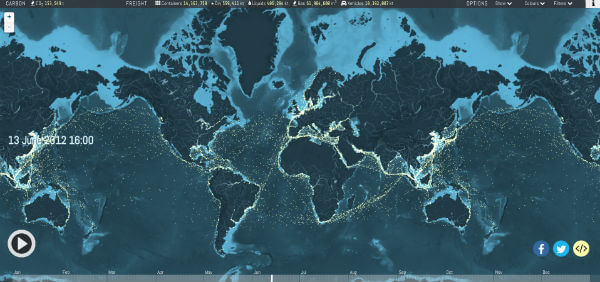
Visualizing the world’s shipping routes
Click on the image above to view a data visualization of the world’s shipping routes created by Kiln studio and the UCL Energy Institute. Click the play button to follow a guided tour around the map. (Note: this data visualization web page uses a lot of memory — you might experience problems if you’re using an old computer and/or have a slow internet connection.)
What can I see?
You can see movements of the global merchant fleet over the course of 2012, overlaid on a bathymetric map. You can also see a few statistics such as a counter for emitted CO2 (in thousand tonnes) and maximum freight carried by represented vessels (varying units).
What can I do?
You can pan and zoom in the usual ways, and skip back and forward in time using the timeline at the bottom of the screen. The controls at the top right let you show and hide different map layers: port names, the background map, routes (a plot of all recorded vessel positions), and the animated ships view. There are also controls for filtering and colouring by vessel type.
What the are types of ships shown?
The merchant fleet is divided into five categories, each of which has a filter and a CO2 and freight counter for the hour shown on the clock. The ship types and units are as follows:
- Container (e.g. manufactured goods): number of container slots equivalent to 20 feet (i.e. a 40-foot container takes two slots)
- Dry bulk (e.g. coal, aggregates): combined weight of cargo, fuel, water, provisions, passengers and crew a vessel can carry, measured in thousand tonnes
- Tanker (e.g. oil, chemicals): same as dry bulk
- Gas bulk (e.g. liquified natural gas): capacity for gases, measured in cubic metres
- Vehicles (e.g. cars): same as dry bulk
Why do ships sometimes appear to move across land?
In some cases this is because there are ships navigating via canals or rivers that aren’t visible on the map. Generally, though, this effect is an artefact of animating a ship between two recorded positions with missing data between, especially when the positions are separated by a narrow strip of land. We may develop the map to remove this effect in the future.
Why are there fewer ships visible in the first part of the year?
Unfortunately the data we are using for the map is incomplete for the first few months of the year: roughly January to April.
Greenland melt could expose hazardous Cold War waste
Climate Central reports: When the U.S. military abandoned Camp Century, a complex of tunnels dug into the ice of northwest Greenland, in the mid-1960s, they left behind thousands of tons of waste, including hazardous radioactive and chemical materials. They expected the detritus would be safely entombed in the ice sheet for tens of thousands of years, buried ever deeper under accumulating layers of snow and ice.
But a new study suggests that because of warming temperatures that are driving substantial melting of the ice, that material could be exposed much, much sooner – possibly even by the end of this century – posing a threat to vulnerable local ecosystems.
These remnants of the Cold War are also an example of an unanticipated political issue that could arise because of the effects of climate change, particularly as countries seek to establish a presence in the Arctic as warming makes it increasingly accessible.
“We think it’s a nice case study for this kind of political tension stemming from climate change,” study author William Colgan, a glaciologist at York University in Toronto, said. [Continue reading…]
The climate crisis is already here — but no one’s telling us
George Monbiot writes: What is salient is not important. What is important is not salient. The media turns us away from the issues that will determine the course of our lives, and towards topics of brain-melting irrelevance.
This, on current trends, will be the hottest year ever measured. The previous record was set in 2015; the one before in 2014. Fifteen of the 16 warmest years have occurred in the 21st century. Each of the past 14 months has beaten the global monthly temperature record. But you can still hear people repeating the old claim, first proposed by fossil fuel lobbyists, that global warming stopped in 1998.
Arctic sea ice covered a smaller area last winter than in any winter since records began. In Siberia, an anthrax outbreak is raging through the human and reindeer populations because infected corpses locked in permafrost since the last epidemic in 1941 have thawed. India has been hammered by cycles of drought and flood, as withering heat parches the soil and torches glaciers in the Himalayas. Southern and eastern Africa have been pitched into humanitarian emergencies by drought. Wildfires storm across America; coral reefs around the world are bleaching and dying.
Throughout the media, these tragedies are reported as impacts of El Niño: a natural weather oscillation caused by blocks of warm water forming in the Pacific. But the figures show that it accounts for only one-fifth of the global temperature rise. The El Niño phase has now passed, but still the records fall.
Eight months ago in Paris, 177 nations promised to try to ensure the world’s average temperature did not rise by more than 1.5C above the pre-industrial level. Already it has climbed by 1.3C – faster and further than almost anyone predicted. In one respect, the scientists were wrong. They told us to expect a climate crisis in the second half of this century. But it’s already here. [Continue reading…]
Greenland lost a staggering 1 trillion tons of ice in just four years
The Washington Post reports: It’s no news that Greenland is in serious trouble — but now, new research has helped quantify just how bad its problems are. A satellite study, published last week in the journal Geophysical Research Letters, suggests that the Greenland ice sheet lost a whopping 1 trillion tons of ice between the years 2011 and 2014 alone. And a big portion of it came from just five glaciers, about which scientists now have more cause to worry than ever.
It’s the latest story in a long series of increasingly worrisome studies on ice loss in Greenland. Research already suggests that the ice sheet has lost at least 9 trillion tons of ice in the past century and that the rate of loss has increased over time. Climate scientists are keeping a close eye on the region because of its potentially huge contributions to future sea-level rise (around 20 feet if the whole thing were to melt) — not to mention the damage it’s already done. Ice loss from Greenland may have contributed as much as a full inch of sea-level rise in the last 100 years and up to 10 percent of all the sea-level rise that’s been documented since the 1990s.
The new study takes a detailed look at ice loss in Greenland between 2011 and 2014 using measurements from the CryoSat-2, an environmental research satellite launched by the European Space Agency in 2010. It relied on a type of measurement known as altimetry — basically, measuring how the surface of Greenland’s altitude changed over time in response to ice gains or losses. [Continue reading…]
A stunning prediction of climate science — and basic physics — may now be coming true
The Washington Post reports: A lot of people deny climate change. Not many, though, deny gravity.
That’s why a recent animation released by NASA’s Jet Propulsion Laboratory — well, it came out in April, but people seem to be noticing it now — is so striking. Because it suggests the likely gravitational imprint of our changing climate on key features of the Earth in a way that’s truly startling.
The animation uses measurements from NASA’s squadron of GRACE satellites (Gravity Recovery and Climate Experiment), which detect changes in mass below them as they fly over the Earth, to calculate how the ocean changed from April 2002 until July 2013, based on corresponding changes in the mass of the continents. The resulting animation suggests the oceans gained mass overall, as seas rose, albeit with seasonal variations that result from water moving from the continents into the seas and back again.
But in key areas where glaciers have been melting — coastal Alaska, West Antarctica and, above all, Greenland — it suggests something very different happened. Here, the animation finds that the ocean actually fell, and in some places by as much as 50 millimeters (2 inches) over this short decadal span: [Continue reading…]
The global environmental impact of air conditioning is big and will get even bigger
By Lucas Davis, University of California, Berkeley
With a heat wave pushing the heat index well above 100 degrees Fahrenheit (38 Celsius) through much of the U.S., most of us are happy to stay indoors and crank the air conditioning. And if you think it’s hot here, try 124°F in India. Globally, 2016 is poised to be another record-breaking year for average temperatures. This means more air conditioning. Much more.
In a paper published in the Proceedings of the National Academy of Science (PNAS), Paul Gertler and I examine the enormous global potential for air conditioning. As incomes rise around the world and global temperatures go up, people are buying air conditioners at alarming rates. In China, for example, sales of air conditioners have nearly doubled over the last five years. Each year now more than 60 million air conditioners are sold in China, more than eight times as many as are sold annually in the United States.

NOAA Forecast Daily Maximum Heat Index
This is mostly great news. People are getting richer, and air conditioning brings great relief on hot and humid days. However, air conditioning also uses vast amounts of electricity. A typical room air conditioner, for example, uses 10-20 times as much electricity as a ceiling fan.
Meeting this increased demand for electricity will require billions of dollars of infrastructure investments and result in billions of tons of increased carbon dioxide emissions. A new study by Lawrence Berkeley Lab also points out that more ACs means more refrigerants that are potent greenhouse gases.
Stephen Hawking says pollution and ‘stupidity’ still biggest threats to humanity
The Independent reports: Professor Stephen Hawking says he believes pollution and human “stupidity” remain the biggest threats to mankind, while also expressing his concerns over the use of artificial intelligence in warfare.
The world’s leading theoretical physicist argued “we have certainly not become less greedy or less stupid” in our treatment of the environment over the past decade, during an interview on Larry King Now, which is hosted on Ora TV.
Professor Hawking said: “Six years ago, I was warning about pollution and overcrowding, they have gotten worse since then. The population has grown by half a billion since our last interview, with no end in sight.
“At this rate, it will be eleven billion by 2100. Air pollution has increased by 8 percent over the past five years. More than 80 percent of inhabitants of urban areas are exposed to unsafe levels of air pollution.
“The increase in air pollution and the emission of increasing levels of carbon dioxide. Will we be too late to avoid dangerous levels of global warming?”
The cosmologist was speaking at the Starmus science conference in Tenerife, themed this year as a tribute to his life’s work.
Professor Hawking went on to outline his concerns about the future of artificial intelligence technologies, and specifically their primary use in weaponry. [Continue reading…]
Climate change department shut down by Theresa May in ‘plain stupid’ and ‘deeply worrying’ move
The Independent reports: The decision to abolish the Department for Energy and Climate Change has been variously condemned as “plain stupid”, “deeply worrying” and “terrible” by politicians, campaigners and experts.
One of Theresa May’s first acts as Prime Minister was to move responsibility for climate change to a new Department for Business, Energy & Industrial Strategy.
Only on Monday, Government advisers had warned of the need to take urgent action to prepare the UK for floods, droughts, heatwaves and food shortages caused by climate change.
The news came after the appointment of Andrea Leadsom – who revealed her first question to officials when she became Energy Minister last year was “Is climate change real? – was appointed as the new Environment Secretary.
And, after former Energy and Climate Change Secretary Amber Rudd announced in November that Britain was going to “close coal” by 2025, Ms Leadsom later asked the coal industry to help define what this actually meant.
Former Labour leader Ed Miliband tweeted: “DECC abolition just plain stupid. Climate not even mentioned in new deptartment title. Matters because departments shape priorities, shape outcomes.” [Continue reading…]