Bill McKibben writes: Two years ago, on a gorgeous November day, 12,000 activists surrounded the White House to protest the proposed Keystone XL pipeline. Signs we carried featured quotes from Barack Obama in 2008: “Time to end the tyranny of oil”; “In my administration, the rise of the oceans will begin to slow.”
Our hope was that we could inspire him to keep those promises. Even then, there were plenty of cynics who said Obama and his insiders were too closely tied to the fossil-fuel industry to take climate change seriously. But in the two years since, it’s looked more and more like they were right – that in our hope for action we were willing ourselves to overlook the black-and-white proof of how he really feels.
If you want to understand how people will remember the Obama climate legacy, a few facts tell the tale: By the time Obama leaves office, the U.S. will pass Saudi Arabia as the planet’s biggest oil producer and Russia as the world’s biggest producer of oil and gas combined. In the same years, even as we’ve begun to burn less coal at home, our coal exports have climbed to record highs. We are, despite slight declines in our domestic emissions, a global-warming machine: At the moment when physics tell us we should be jamming on the carbon brakes, America is revving the engine.
You could argue that private industry, not the White House, has driven that boom, and in part you’d be right. But that’s not what Obama himself would say. Here’s Obama speaking in Cushing, Oklahoma, last year, in a speech that historians will quote many generations hence. It is to energy what Mitt Romney’s secretly taped talk about the 47 percent was to inequality. Except that Obama was out in public, boasting for all the world to hear:
“Over the last three years, I’ve directed my administration to open up millions of acres for gas and oil exploration across 23 different states. We’re opening up more than 75 percent of our potential oil resources offshore. We’ve quadrupled the number of operating rigs to a record high. We’ve added enough new oil and gas pipeline to encircle the Earth, and then some. . . . In fact, the problem . . . is that we’re actually producing so much oil and gas . . . that we don’t have enough pipeline capacity to transport all of it where it needs to go.” [Continue reading…]
Category Archives: climate change
Capitalism’s march toward global collapse
Harald Welzer writes: The municipal utility company in the city of Potsdam is currently wooing new customers with a special “BabyBonus” offer. The slogan reads, “We value little energy robbers! Welcome to the world!” Every newborn receives a credit of 500 kilowatt hours of electricity, allowing him or her to revel from the start in a world where everything, especially energy, will always be available in abundance. These babies may later find they’re in for a surprise.
When the United Nations Climate Change Conference wrapped up in Warsaw the weekend before last, it did, despite what most observers and disappointed NGO representatives believe, yield a result. It just wasn’t officially announced: the termination of the at-least symbolic general agreement that urgent action must be taken to counter global warming. In other words, climate change has been definitively removed from the global policy agenda.
The intense concern over climate change triggered by Intergovernmental Panel on Climate Change reports in 2007 and widely popularized by Al Gore’s movie, “An Inconvenient Truth” — a concern that led even Angela Merkel to make an appearance in the Arctic as the “climate chancellor,” decked out in a red all-weather jacket — actually dissipated a while ago, but no one wanted to say so out loud.
The United States’ lack of interest in an international treaty is dressed up by its argument that gas extracted by fracking is more climate-friendly than coal, while in Japan, the Fukushima disaster and resulting phase-out of nuclear power has provided those responsible with an excellent argument for why the country now needs to burn more coal in order to stay economically competitive. Hannelore Kraft, governor of the German state of North Rhine-Westphalia, feels much the same way about her own state. And Australia, Canada, Poland and Russia have never really grasped why global warming should stop anyone from burning everything the oil rigs, mines and pipelines have to offer in the first place.
To put it another way: The primacy of economics has prevailed. It no longer seems to matter how we’re supposed to get through the rest of this century if the world grows warmer by three, four or five degrees Celsius. National economies require an ever-growing dose of energy if their business models are to continue functioning, and, in the face of this logic, all scientific objections to the contrary are just as powerless as the climate protest movements, which are, in any case, marginal. [Continue reading…]
Dangerous global warming already happening, climate scientists say
Scientific American reports: Abrupt climate change is not only imminent, it’s already here. The rapid dwindling of summer Arctic sea ice has outpaced all scientific projections, which will have impacts on everything from atmospheric circulation to global shipping. And plants, animals and other species are already struggling to keep up with rapid climate shifts, increasing the risk of mass extinction that would rival the end of the dinosaurs. So warns a new report from the U.S. National Research Council.
That’s exactly why longtime climate scientist James Hansen and a panoply of scientists and economists are urging in another new paper that current efforts to restrain global warming are woefully inadequate. In particular, global negotiations to limit global warming to no more than 2 degrees Celsius risk “wrecking the planet,” in the words of lead author Hansen, recently retired head of the Goddard Institute for Space Studies and a researcher at Columbia University’s Earth Institute.
“We started this paper to provide a basis for legal actions against governments for not doing their jobs and protecting the rights of young people and future generations,” Hansen said of the paper, entitled “Assessing ‘Dangerous Climate Change.'” “We can’t burn all these fossil fuels. There is no recognition of this in government policies.”
The paper, published in PLOS ONE, lays out the case for why fossil fuel emissions to date are dangerous enough to permanently alter the planet’s climate—raising CO2 concentrations in the atmosphere above 400 parts-per-million, or levels not seen in at least 3 million years. Global emissions of CO2 from burning fossil fuels — which set another new high in 2012, according to the Global Carbon Project — must decline to zero new pollution within the next few decades, according to the analysis. “Affordable, clean energy is probably the biggest requirement that the planet has,” Hansen noted at a gathering of journalists at Columbia University to discuss the new analysis. [Continue reading…]
Working around Keystone XL, Suncor Energy steps up oil production in Canada
The New York Times reports: Suncor Energy, Canada’s top petroleum producer, announced on Thursday that it would expand its oil production in 2014 by 10 percent in another sign that the Obama administration’s delay in approving the Keystone XL pipeline extension is not holding back growth in the western Canadian oil sands fields.
“We’re set for a strong year of continued production,” Suncor’s chief executive, Steven W. Williams, said. The company announced a capital spending program of $7.45 billion for 2014, $477 million more than it had forecast earlier this year.
Suncor, which is based in Calgary, produces oil and gas around Canada, and has operations in North Africa and the North Sea. But its oil sands operations are the main driver for the company. In the most recent quarter, its oil sands output rose 16 percent from the year before for a record of 396,000 barrels a day, nearly 20 percent of the country’s total oil sands production.
The company said it expected its oil sands production to increase again next year to 430,000 barrels a day.
Reports of increased production are coming even as Canadian oil executives are privately questioning whether the Obama administration will ever approve the Keystone XL pipeline, which it has been considering for more than two years.
The extension is intended to transport more than 800,000 barrels a day of oil sands output to refineries on the Gulf of Mexico coast, but environmentalists have made stopping the pipeline their top priority since emissions from oil sands production are higher than for most crude oils consumed in the United States.
But over the last several months, oil companies have sought to go around the dispute by announcing plans for three large rail loading terminals with the combined capacity of transporting 350,000 barrels a day.
The companies are poised to quadruple rail-loading capacity over the next few years to as many as 900,000 barrels a day, whether or not the Keystone pipeline is built. [Continue reading…]
It’s long been reported that rail transportation of oil was already making the construction of Keystone XL an issue of questionable relevance in relation to the environmental consequences of oil sands production, which makes me wonder why so much activist energy was focused on the pipeline. Was it simply because “stop the pipeline” is such an easy rallying-cry?
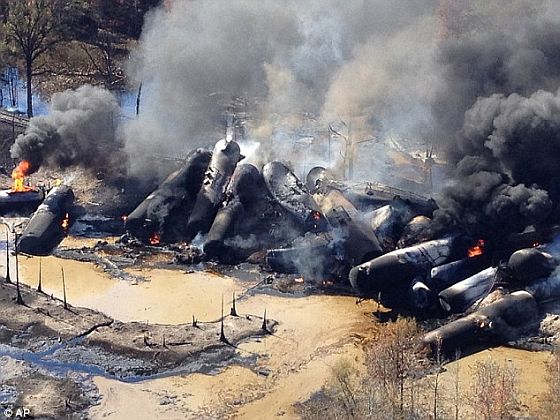
Ironically, the dangers posed by rail delivery of oil are probably far greater than those posed by Keystone XL as an accident in Alabama earlier this month made all too clear:

Just 90 companies caused two-thirds of man-made global warming emissions
The Guardian reports: The climate crisis of the 21st century has been caused largely by just 90 companies, which between them produced nearly two-thirds of the greenhouse gas emissions generated since the dawning of the industrial age, new research suggests.
The companies range from investor-owned firms – household names such as Chevron, Exxon and BP – to state-owned and government-run firms.
The analysis, which was welcomed by the former vice-president Al Gore as a “crucial step forward” found that the vast majority of the firms were in the business of producing oil, gas or coal, found the analysis, which has been accepted for publication in the journal Climatic Change.
“There are thousands of oil, gas and coal producers in the world,” climate researcher and author Richard Heede at the Climate Accountability Institute in Colorado said. “But the decision makers, the CEOs, or the ministers of coal and oil if you narrow it down to just one person, they could all fit on a Greyhound bus or two.”
Half of the estimated emissions were produced just in the past 25 years – well past the date when governments and corporations became aware that rising greenhouse gas emissions from the burning of coal and oil were causing dangerous climate change.
Many of the same companies are also sitting on substantial reserves of fossil fuel which – if they are burned – puts the world at even greater risk of dangerous climate change. [Continue reading…]
Video: Leaked memo reveals U.S. plan to oppose helping poor nations adapt to climate change
The fight against climate injustice
The New York Times reports: Following a devastating typhoon that killed thousands in the Philippines, a routine international climate change conference here turned into an emotional forum, with developing countries demanding compensation from the worst polluting countries for damage they say they are already suffering.
Calling the climate crisis “madness,” the Philippines representative vowed to fast for the duration of the talks. Malia Talakai, a negotiator for the Alliance of Small Island States, a group that includes her tiny South Pacific homeland, Nauru, said that without urgent action to stem rising sea levels, “some of our members won’t be around.”
From the time a scientific consensus emerged that human activity was changing the climate, it has been understood that the nations that contributed least to the problem would be hurt the most. Now, even as the possible consequences of climate change have surged — from the typhoons that have raked the Philippines and India this year to the droughts in Africa, to rising sea levels that threaten to submerge entire island nations — no consensus has emerged over how to rectify what many call “climate injustice.”
Growing demands to address the issue have become an emotionally charged flash point at negotiations here at the 19th conference of the United Nations Framework Convention on Climate Change, which continues this week.
“We are in a piece of land which is smaller than Denmark, with a population of 160 million, trying to cope with this extreme weather, trying to cope with the effect of emissions for which we are not responsible,” Farah Kabir, the director in Bangladesh for the anti-poverty organization ActionAid International, said at a news briefing here. [Continue reading…]
America’s diminishing dependence on Middle East oil will be short-lived
The New York Times reports: The boom in oil from shale formations in recent years has generated a lot of discussion that the United States could eventually return to energy self-sufficiency, but according to a report released Tuesday by the International Energy Agency, production of such oil in the United States and worldwide will provide only a temporary respite from reliance on the Middle East.
The agency’s annual World Energy Outlook, released in London, said the world oil picture was being remade by oil from shale, known as light tight oil, along with new sources like Canadian oil sands, deepwater production off Brazil and the liquids that are produced with new supplies of natural gas.
“But, by the mid-2020s, non-OPEC production starts to fall back and countries from the Middle East provide most of the increase in global supply,” the report said. A high market price for oil will help stimulate drilling for light tight oil, the report said, but the resource is finite, and the low-cost suppliers are in the Middle East.
“There is a huge growth in light tight oil, that it will peak around 2020, and then it will plateau,” said Maria van der Hoeven, executive director of the International Energy Agency. The agency was founded in response to the Arab oil embargo of 1973-74, by oil-importing nations.
The agency’s assessment of world supplies is consistent with an estimate by the United States Energy Department’s Energy Information Administration, which forecasts higher levels of American oil production from shale to continue until the late teens, and then slow rapidly.
“We expect the Middle East will come back and be a very important producer and exporter of oil, just because there are huge resources of low-cost light oil,” Ms. van der Hoeven said. “Light tight oil is not low-cost oil.” [Continue reading…]
Tacloban mayor advises residents to flee
The New York Times reports: Typhoon relief gridlock threatened to paralyze rescue operations in the most devastated part of the Philippines on Wednesday, with aid piling up but few ways to distribute it, plentiful gasoline but no merchants willing to sell it, and an influx of emergency volunteers with no places to house them.
The intensifying frustrations of delivering aid five days after Typhoon Haiyan struck elicited a plea from the top United Nations relief official to the mayor of Tacloban, imploring him to help find a solution to persuade gasoline station owners to open so relief convoys could begin a large-scale expansion into the razed port city of 220,000 and the interior regions. The gasoline stations have fuel in their tanks but the owners fear robberies and violence if they reopen.
“We have to have fuel, so we have to have some kind of refueling center,” the relief official, Valerie Amos, told the mayor, Alfred S. Romualdez, after she flew here for an assessment in which she promised a vast relief effort. Mr. Romualdez told her that the city could not easily cope with the influx of aid workers, as practically no vehicles are available to bring them in from the airport, while food and drinking water are running out. “I’m asking those who come here, ‘Please be self-sufficient, because there’s nothing,’ ” he said.
The mayor’s best advice to residents was to flee to other cities and find shelter with relatives if they could, saying that the local authorities were struggling to provide enough food and water and faced difficulties in maintaining law and order.
The paralysis was epitomized by the first attempt in Tacloban to conduct a mass burial of Haiyan victims whose corpses had spent days putrefying on streets and under piles of debris. The attempt ended in failure as trucks carrying more than 200 corpses were forced to turn back as gunfire greeted them on the city limits. The identities of the shooters were not clear. [Continue reading…]
Typhoon Haiyan: we cannot afford to procrastinate on climate action
Naderev Saño writes: It was barely 11 months ago in Doha when my delegation appealed to the world to open our eyes to the stark reality that we face, as we confronted a catastrophic storm that resulted in the costliest disaster in Philippine history. Less than a year after, we could not imagine that a disaster much bigger would come.
With a cruel twist of fate, my country is being tested by this hellstorm called Super Typhoon Haiyan, which has been described by experts as the strongest typhoon that has ever made landfall in the course of recorded human history. It was so strong that if there was a category 6, it would have fallen squarely in that box.
We remain uncertain as to the full extent of the devastation, as information trickles in in an agonizingly slow manner because electricity lines and communication lines have been cut off. The initial assessment shows that Haiyan left a wake of massive devastation that is unprecedented, unthinkable and horrific, affecting two–thirds of the Philippines, with about half a million people now rendered homeless, and with scenes reminiscent of the aftermath of a tsunami, with a vast wasteland of mud and debris and dead bodies.
Despite the massive efforts that my country had exerted in preparing for the onslaught of this monster of a storm, it was just a force too powerful and, even as a nation familiar with storms, Haiyan was nothing we have ever experienced before, or perhaps nothing that any country has ever experienced before. [Continue reading…]
Hello Warsaw, this is Haiyan calling
Walden Bello writes: It seems these days that whenever Mother Nature wants to send an urgent message to humankind, it sends it via the Philippines. This year the messenger was Haiyan, known in the Philippines as Yolanda.
For the second year in a row, the world’s strongest typhoon barreled through the Philippines, Yolanda following on the footsteps steps of Pablo, a k a Bopha, in 2012. And for the third year in a row, a destructive storm deviated from the usual path taken by typhoons, striking communities that had not learned to live with these fearsome weather events because they were seldom hit by them in the past. Sendong in December 2011 and Bopha last year sliced Mindanao horizontally, while Yolanda drove through the Visayas, also in a horizontal direction.
That it was climate change creating the super typhoons that were taking weird directions was a message from Nature not just to Filipinos but to the whole world, whose attention was transfixed on the televised digital images of a massive, angry cyclone bearing down, then sweeping across the central Philippines on its way to the Asian mainland. The message that Nature was sending via Yolanda–which packed winds stronger than Superstorm Sandy, which hit New Jersey and New York last October, and Hurricane Katrina, which devastated New Orleans in 2005–was especially meant for the governments of the world that are assembling in Warsaw for the annual global climate change negotiations (COP 19), beginning on November 11.
Is it a coincidence, ask some people who are not exactly religious, that both Pablo and Yolanda arrived at the time of the global climate negotiations? Pablo smashed into Mindanao during the last stages of the Conference of Parties (COP 18), in Doha last year.
To reinforce Haiyan’s message, Commissioner Naderev Sano, the top negotiator for the Philippines in Warsaw, went on a hunger strike when the talks began.
It is doubtful, however, that the governments assembling in Warsaw will rise to the occasion. For a time earlier this year, it appeared that Hurricane Sandy would bring climate change to the forefront of President Obama’s agenda. It did not. [Continue reading…]
Typhoon Haiyan overshadows UN climate talks
The Associated Press reports: The devastation caused by Typhoon Haiyan cast a gloom over U.N. climate talks Monday as the envoy from the Philippines broke down in tears and announced he would fast until a “meaningful outcome is in sight.”
Naderev “Yeb” Sano’s emotional appeal was met with a standing ovation at the start of two-week talks in Warsaw where more than 190 countries will try to lay the groundwork for a new pact to fight global warming.
U.N. climate chief Christiana Figueres also made reference to the “devastating impact” of the typhoon in her opening speech, and urged delegates to “go that extra mile” in their negotiations.
Scientists say single weather events cannot conclusively be linked to global warming. Also, the link between man-made warming and hurricane activity is unclear, though rising sea levels are expected to make low-lying nations more vulnerable to storm surges.
Nevertheless, extreme weather such as hurricanes often prompt calls for urgency at the U.N. talks.
Last year, Hurricane Sandy’s assault on the U.S. East Coast and Typhoon Bopha’s impact on the Philippines were mentioned as examples of disasters the world could see more of unless it reins in the greenhouse gas emissions that scientists say are warming the planet.
“We can fix this. We can stop this madness. Right now, right here,” Sano told delegates in Warsaw. [Continue reading…]
Sano appeared on CNN earlier this year:
Super Typhoon Haiyan is a wake-up call for UN Climate Summit
Jamie Henn writes: The timing is tragically ironic. As Super Typhoon Haiyan — one of the strongest storms ever recorded — smashes into the Philippines, sending millions fleeing for safety, negotiators from around the world are beginning to arrive in Warsaw, Poland for the latest installment of the United Nations Climate Talks, COP 19.
Climate change is loading the dice for extreme weather events like Haiyan. The storms strength and rapid development have been aided by unusually warm ocean waters and warm, moist air (warm air holds more water vapor than cold). Global warming also causes sea level rise, increasing the risk of flooding from storm surges, especially in low-lying areas like much of the Philippines. Carbon dioxide is the steroids that leads to grand-slam storms like Haiyan.
Haiyan should be a five-alarm wake up call for negotiators in Warsaw and the capitals that sent them here. Over the next two-weeks, despite the best attempts of the nations most vulnerable to climate change, negotiators from the largest emitting countries will bask under the fluorescent lights of yet another conference center to bicker, delay, and obfuscate. Meanwhile, millions of people in the Philippines — and other impacted communities around the world — will be sleeping in relief centers and bravely trying to rebuild their homes.
John Vidal writes: I met Naderev Saño last year in Doha, when the world’s governments were meeting for the annual UN climate talks. The chief negotiator of the Filipino delegation was distraught. Typhoon Bopha, a category five “super-typhoon” with 175mph winds (282km/h) had just ripped through the island of Mindanao. It was the 16th major storm of the year, hundreds of thousands of people had lost their homes and more than 1,000 had died. Saño and his team knew well the places where it had hit the hardest.
“Each destructive typhoon season costs us 2% of our GDP, and the reconstruction costs a further 2%, which means we lose nearly 5% of our economy every year to storms. We have received no climate finance to adapt or to prepare ourselves for typhoons and other extreme weather we are now experiencing. We have not seen any money from the rich countries to help us to adapt … We cannot go on like this. It cannot be a way of life that we end up running always from storms,” he said. He later told the assembly: “Climate change negotiations cannot be based on the way we currently measure progress. It is a clear sign of planetary and economic and environmental dysfunction … The whole world, especially developing countries struggling to address poverty and achieve social and human development, confronts these same realities.
“I speak on behalf of 100 million Filipinos, not as a leader of my delegation, but as a Filipino …” At this point he broke down.
The nuclear question
Reducing carbon emissions will require nuclear power
I’d like to live in a world where people prize culture and the environment more than their personal possessions; a world in which people are not afflicted by the disease of materialism; a world in which people do not strive for the false freedom of absolute autonomy but can see in mutual reliance, shared strength; a world which invests in people’s creative capacities while tempering their destructive propensities. In other words, a world so far removed from the one in which we live, that it’s extremely difficult to discern a path that might lead from here to there. And before that path gets found — if it ever does — we are much more likely to cause irreparable damage to the planet through our insatiable appetites.
Hitting the breaks on carbon emissions may, with the help of nuclear power, be a goal far easier to attain in the short run than the radical transformation of human values that will be necessary for long-term sustainability.
Rachel Pritzker writes: Last week a leaked draft of a report by the Intergovernmental Panel on Climate Change warned that climate change will have severe ramifications for the global food supply, making it harder for crops to survive and leading to rising food prices.
This report, scheduled for publication in March, provides the latest evidence of the dramatic impacts that the shifting climate is already beginning to have on the planet and on human societies.
Clearly, climate change is a global challenge unlike any other we face, which is why I, along with a small but growing number of progressives, support a unique and potentially surprising solution to it.
It is time for policymakers to recognize that nuclear power must be a robust part of our nation’s energy plan to reduce carbon emissions.
These may seem like strange words coming from a liberal whose family has been active in progressive politics, and who grew up on a Wisconsin goat farm in a home heated by wood fires. Like many of my fellow progressives, I care deeply about the environment and the future of our planet, which is precisely why I do not think we should be reflexively shutting the door on a technology that may be able to help address global climate change.
Energy production is the largest single contributor to global greenhouse gas emissions. Some people believe that we can solve climate change by reducing global energy demand and switching to solar, wind, and other renewable energy sources. But, as I’ve seen first hand in Latin America, people in the developing world are consuming an increasing amount of energy as they seek to live the modern lives that we in the West enjoy. As a result, studies show that energy demand is actually poised to triple, or even quadruple, over the next century.
As much as we might instinctively prefer renewable energy sources like solar and wind to meet this energy demand, last year solar provided a mere 0.1 percent of America’s electricity, while wind provided just 3.5 percent — and that is after at least $34 billion was funneled into clean energy projects from the Obama stimulus package.
Meanwhile, 19% of U.S. electricity comes from nuclear power plants; that number rises to 60% among clean energy sources.
We need all the help we can get from renewable energy, but it’s a risky bet that wind and solar alone will be able to provide 100% of America’s energy, let alone meet a global energy demand three times the size it is today. [Continue reading…]
Is it too late to prepare for climate change?
Elizabeth Kolbert writes: Late last week, a Web site that claims that there is no scientific consensus on global warming published a leaked draft report on the impacts of global warming. The leak was apparently intended to embarrass the authors of the report, which is the latest installment from the Intergovernmental Panel on Climate Change. However, it seems mostly to have had the opposite effect: what the leaked document shows is just how dire the impacts are likely to be. The report was the lead story on the front page of Saturday’s Times, under the two-column headline “Climate Change Seen Posing Risk to Food Supplies.”
“Many of the ills of the modern world — starvation, poverty, flooding, heat waves, droughts, war and disease –are likely to worsen as the world warms from man-made climate change,” the Associated Press observed in its analysis of the report.
Technically, what got leaked was a summary of the second part of the I.P.C.C.’s Fifth Assessment Report. (Part one, released in Stockholm in September, focussed on the geophysics of climate change and asserted with virtual certainty that human activity “has been the dominant cause of the observed warming since the mid-20th century.”) The I.P.C.C. doesn’t conduct any research of its own — its conclusions are based entirely on already-published scientific papers — so it could be argued that there was no real news in the latest document. The force of the report comes simply from assembling all the data in one place; the summary reads like a laundry list of the apocalypse — flood, drought, disease, starvation. Climate change, the group noted, will reduce yields of major crops by up to two per cent each decade for the remainder of this century. (One of the reasons for this is that heat waves, which will become more common as the world warms, depress the yields of staple crops like corn.)
Since the global population is projected to grow throughout the century — to eight billion by 2025, nine billion by 2050, and almost eleven billion by 2100 — this is obviously rather bad news. At the same time, the incidence of flooding, drought, and general weather-related mayhem will increase, and already-vulnerable populations will be pushed closer to the edge, or, quite possibly, over it. Conflict is bound to ensue. Climate change “will increasingly shape national security policies,” the report warns.
Meanwhile, as bad as things look for humans, the prognosis for non-humans is, in many ways, worse. [Continue reading…]
Chomsky slams Canada’s tar sands energy plans
The Guardian reports: Canada’s rush to exploit its tar sands and shale gas resources will destroy the environment “as fast as possible”, according to Noam Chomsky.
In an interview with the Guardian, the linguist and author criticised the energy policies of the Canadian government under Prime Minister Stephen Harper.
He said: “It means taking every drop of hydrocarbon out of the ground, whether it’s shale gas in New Brunswick or tar sands in Alberta and trying to destroy the environment as fast as possible, with barely a question raised about what the world will look like as a result.”
But indigenous peoples in Canada blocking fossil fuel developments are taking the lead in combatting climate change, he said. Chomsky highlighted indigenous opposition to the Alberta tar sands, the oil deposit that is Canada’s fastest growing source of carbon emissions and is slated for massive expansion despite attracting international criticism and protest.
“It is pretty ironic that the so-called ‘least advanced’ people are the ones taking the lead in trying to protect all of us, while the richest and most powerful among us are the ones who are trying to drive the society to destruction,” said Chomsky. [Continue reading…]
Climate change seen posing risk to food supplies
The New York Times reports: Climate change will pose sharp risks to the world’s food supply in coming decades, potentially undermining crop production and driving up prices at a time when the demand for food is expected to soar, scientists have found.
In a departure from an earlier assessment, the scientists concluded that rising temperatures will have some beneficial effects on crops in some places, but that globally they will make it harder for crops to thrive — perhaps reducing production over all by as much as 2 percent each decade for the rest of this century, compared with what it would be without climate change.
And, the scientists say, they are already seeing the harmful effects in some regions.
The warnings come in a leaked draft of a report under development by a United Nations panel, the Intergovernmental Panel on Climate Change. The document is not final and could change before it is released in March.
The report also finds other sweeping impacts from climate change already occurring across the planet, and warns that these are likely to intensify as human emissions of greenhouse gases continue to rise. The scientists describe a natural world in turmoil as plants and animals colonize new areas to escape rising temperatures, and warn that many could become extinct.
The warning on the food supply is the sharpest in tone the panel has issued. Its previous report, in 2007, was more hopeful. [Continue reading…]