British Isles in 2100 by JaySimons on deviantART
 Click on image above to see larger version.




The Observer reports: On 17 January, scientists downloaded fresh data from a pair of Nasa satellites and distributed the findings among the small group of researchers who track the world’s water reserves. At the University of California, Irvine, hydrologist James Famiglietti looked over the data from the gravity-sensing Grace satellites with a rising sense of dread.
The data, released last week, showed California on the verge of an epic drought, with its backup systems of groundwater reserves so run down that the losses could be picked up by satellites orbiting 400km above the Earth’s surface.
“It was definitely an ‘oh my gosh moment’,” Famiglietti said. “The groundwater is our strategic reserve. It’s our backup, and so where do you go when the backup is gone?”
That same day, the state governor, Jerry Brown, declared a drought emergency and appealed to Californians to cut their water use by 20%. “Every day this drought goes on we are going to have to tighten the screws on what people are doing,” he said.
Seventeen rural communities are in danger of running out of water within 60 days and that number is expected to rise, after the main municipal water distribution system announced it did not have enough supplies and would have to turn off the taps to local agencies.
There are other shock moments ahead – and not just for California – in a world where water is increasingly in short supply because of growing demands from agriculture, an expanding population, energy production and climate change. [Continue reading…]
Global Post reports: Brazil’s largest city, Sao Paulo, is on the verge of rationing water because of a severe drought, according to a nonprofit group that monitors regional water resources.
The Cantareira water system is supplied to more than 10 million in South America’s largest city and is more than 75 percent empty.
The city could possibly see shortages when Brazil hosts the World Cup soccer tournament in June and July.
January was the hottest month on record in the city and meteorologists expect little rain or relief in the next week. [Continue reading…]

AFP reports: The amount of harmful pollutants released in the process of recovering oil from tar sands in western Canada is likely far higher than corporate interests say, university researchers said Monday.
Actual levels of polycyclic aromatic hydrocarbon (PAH) emissions into the air may be two to three times higher than estimated, said the findings in the Proceedings of the National Academy of Sciences, a peer-reviewed US journal.
The study raises new questions about the accuracy of environmental impact assessments on the tar sands, just days after a US State Department report said the controversial Keystone pipeline project to bring oil from Canada to Texas would have little impact on climate change or the environment.
Current government-accepted estimates do not account for the evaporation of PAHs from wastewater pools known as tailing ponds, which are believed to be a major source of pollution, said researchers at the University of Toronto.
According to corporate interests which are responsible for projecting their environmental impact, the Athabasca oil sands beneath Alberta, Canada — which hold the third largest reserve of crude oil known in the world — are only spewing as much pollution into the air as sparsely populated Greenland, where no big industry exists.
Lead study author Frank Wania, a professor in the department of physical and environmental sciences, described the corporate estimates as “inadequate and incomplete.”
“If you use these officially reported emissions for the oil sands area you get an emissions density that is lower than just about anywhere else in the world,” he told AFP. [Continue reading…]

Huffington Post reports: The National Security Agency monitored the communications of other governments ahead of and during the 2009 United Nations climate negotiations in Copenhagen, Denmark, according to the latest document from whistleblower Edward Snowden.
The document, with portions marked “top secret,” indicates that the NSA was monitoring the communications of other countries ahead of the conference, and intended to continue doing so throughout the meeting. Posted on an internal NSA website on Dec. 7, 2009, the first day of the Copenhagen summit, it states that “analysts here at NSA, as well as our Second Party partners, will continue to provide policymakers with unique, timely, and valuable insights into key countries’ preparations and goals for the conference, as well as the deliberations within countries on climate change policies and negotiation strategies.” [Continue reading…]
Meanwhile, Reuters reports: Berlin and Washington are still “far apart” in their views on the U.S. National Security Agency’s (NSA) mass surveillance of Germany but they remain close allies, Chancellor Angela Merkel told parliament on Wednesday.

Paul Willis writes: Science is not a democracy. A consensus of evidence may be interesting, but technically it may not be significant. The thoughts of a majority of scientists doesn’t mean a hill of beans. It’s all about the evidence. The science is never settled.
These are refrains that I and other science communicators have been using over and over again when we turn to analysing debates and discussions based on scientific principles. I think we get torn between remaining true to the philosophical principles by which science is conducted and trying to make those principles familiar to an audience that probably does not understand them.
So let me introduce a concept that is all-too-often overlooked in science discussions, that can actually shed some light deep into the mechanisms of science and explain the anatomy of a scientific debate. It’s the phonically beautiful term ‘consilience’.
Consilience means to use several different lines of inquiry that converge on the same or similar conclusions. The more independent investigations you have that reach the same result, the more confidence you can have that the conclusion is correct. Moreover, if one independent investigation produces a result that is at odds with the consilience of several other investigations, that is an indication that the error is probably in the methods of the adherent investigation, not in the conclusions of the consilience.
Let’s take an example to unpack this concept, an example where I first came across the term and it is a beautiful case of consilience at work. Charles Darwin’s On Origin Of Species is a masterpiece of consilience. Each chapter is a separate line of investigation and, within each chapter there are numerous examples, investigations and experiments that all join together to reach the same conclusion: that life changes through time and that life has evolved on Earth. Take apart On Origin Of Species case by case and no single piece of evidence that Darwin mustered conclusively demonstrates that evolution is true. But add those cases back together and the consilience is clear: evidence from artificial breeding, palaeontology, comparative morphology and a host of other independent lines of investigation combine to confirm the same inescapable conclusion.
That was 1859. Since then yet more investigations have been added to the consilience for evolution. What’s more, these investigations within the biological and geological sciences have been joined with others from physics and chemistry as well as completely new areas of science such as genetics, radiometric dating and molecular biology. Each independent line of investigation builds the consilience that the world and the universe are extremely old and that life has evolved through unfathomable durations of time here on our home planet.
So, when a new line of investigation comes along claiming evidence and conclusions contrary to evolution, how can that be accommodated within the consilience? How does it relate to so many independent strains conjoined by a similar conclusion at odds with the newcomer? Can one piece of evidence overthrow such a huge body of work?
Such is the thinking of those pesky creationists who regularly come up with “Ah-Ha!” and “Gotcha!” factoids that apparently overturn, not just evolution, but the whole consilience of science. [Continue reading…]

The New York Times reports: Nations have dragged their feet in battling climate change so much that the situation has grown critical and the risk of severe economic disruption is rising, according to a UN draft report. Another 15 years of failure to limit carbon emissions could make the problem virtually impossible to solve with current technologies, the experts found.
Delay would probably force future generations to develop the capability to suck greenhouse gases out of the atmosphere and store them underground to preserve the livability of the planet, the report found. But it is not clear whether such technologies will ever exist at the necessary scale, and even if they do, the approach would probably be wildly expensive compared with taking steps now to slow emissions.
The report said that governments of the world were still spending far more money to subsidize fossil fuels than to accelerate the shift to cleaner energy, thus encouraging continued investment in projects like coal-burning power plants that pose a long-term climate risk.
While the spread of technologies like solar power and wind farms might give the impression of progress, the report said, such developments are being overtaken by rising emissions from fossil fuels over the past decade, especially in fast-growing countries like China. And one of the most important sources of low-carbon energy, nuclear power, is actually declining over time as a percentage of the global energy mix, the report said.
“The fundamental drivers of emissions growth are expected to persist despite major improvements in energy supply” and in the efficiency with which energy is used, the report declared.
The new warnings come in a draft report from the Intergovernmental Panel on Climate Change, a panel of climate experts that won the Nobel Peace Prize in 2007 for its efforts to analyze and communicate the risks of climate change. The report is not final, but a draft dated Dec. 17 leaked this week and was first reported by Reuters. The New York Times obtained a copy independently. [Continue reading…]

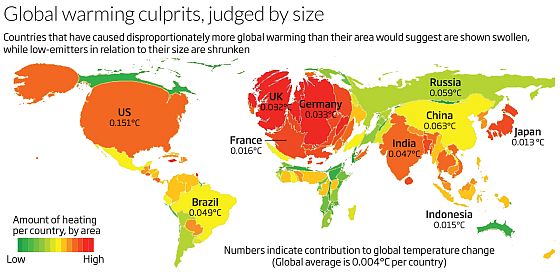
New Scientist reports: It’s a chart that no one wants to top, but global warming’s worst offenders, in absolute terms, are the US, China, Russia, Brazil, India, Germany and the UK. New calculations suggest that these nations are responsible for more than 60 per cent of the global warming between 1906 and 2005.
Damon Matthews of Concordia University in Montreal, Canada, and his colleagues calculated national contributions to warming by weighting each type of emission according to the atmospheric lifetime of the temperature change it causes. Using historical data, they included carbon dioxide from burning fossil fuels and changes in land use – such as deforestation. They also accounted for methane, nitrous oxide and sulphate aerosols. These together account for 0.7 °C of the world’s 0.74 °C warming between 1906 and 2005.
The US is the clear leader, responsible for 0.15 °C, or 22 per cent of the 0.7 °C warming. China accounts for 9 per cent, Russia for 8 per cent, Brazil and India 7 per cent each, and Germany and the UK for 5 per cent each. [Continue reading…]

The New York Times reports: The Obama administration is retreating from previous demands of strong international environmental protections in order to reach agreement on a sweeping Pacific trade deal that is a pillar of President Obama’s strategic shift to Asia, according to documents obtained by WikiLeaks, environmentalists and people close to the contentious trade talks.
The negotiations over the Trans-Pacific Partnership, which would be one of the world’s biggest trade agreements, have exposed deep rifts over environmental policy between the United States and 11 other Pacific Rim nations. As it stands now, the documents, viewed by The New York Times, show that the disputes could undo key global environmental protections.
The environmental chapter of the trade deal has been among the most highly disputed elements of negotiations in the pact. Participants in the talks, which have dragged on for three years, had hoped to complete the deal by the end of 2013.
Environmentalists said that the draft appears to signal that the United States will retreat on a variety of environmental protections — including legally binding pollution control requirements and logging regulations and a ban on harvesting sharks’ fins — to advance a trade deal that is a top priority for Mr. Obama. [Continue reading…]
The Guardian reports: The freezing polar vortex that has gripped the US has extended an abnormally mild winter in Scandinavia and disrupted the seasonal patterns of flora and fauna.
The weather system that brought snow, ice and record low temperatures to many parts of the United States this week left Iceland, Greenland and Scandinavia much warmer than normal.
On the back of a generally mild winter, there have been reports of bears emerging early from hibernation in Finland, changes in the behaviour of migratory birds off the coast of Sweden and plants appearing earlier than normal in Norway.
Scandinavia and Russia’s cold weather during the winter comes from a high-pressure system that keeps warmer, more humid air and low-pressure systems with wind and rain from coming up from the Atlantic Ocean.
The weakening of the jetstream that holds this in place has allowed cold air to spill further south into much of the United States and Canada, while bringing above-average temperatures to parts of Europe.
The knock-on effects of the vortex follow one of the mildest Decembers in a century in Nordic countries. [Continue reading…]
Dawn Stover writes: My favorite gift of 2013 arrived in the mail a few days before Christmas: two cans of pure maple syrup made in Quebec by longtime friends, the Stevenson family. Printed on the metal cans is an image that instantly transports me back to my childhood in Canada: In a woodland scene, several men in plaid jackets pour sap from tapped sugar maple trees into buckets, and from there into a horse-drawn tank. Firewood is stacked alongside a red shanty, and steam rises from its roof. I can almost smell the sap boiling, and the scene conjures memories of Floyd Stevenson trickling hot syrup across a pan of fresh snow, and offering me a fork to taste the strands of sweet, frozen taffy.
In the eyes of a first-grader, Canada was a land of vast forests, deep snow, and crisp Macintosh apples. I knew that the nation that put a maple leaf on its flag wasn’t simply one big national park, but for many years afterward, Canada seemed to be a great green land where large carnivores still roamed, and key environmental protections remained intact.
In recent years, however, Canada’s conservative leaders—who are not so when it comes to conserving natural resources—have systematically trashed those protections. My Canadian friends tell me that many of their countrymen don’t even discuss climate change; it is considered unpatriotic to do so, now that Canada has hitched its economic sled to oil.
Oh, Canada. What happened to you, eh? Where is the “land glorious and free” described in your national anthem? Who is now standing “on guard for thee?” You have lost your true north.
The natural resources that Canada is increasingly tapping today are fossil fuels. Canada’s crude oil production has increased by about a third during the past decade, mostly because of tar sands development in Alberta. If the Obama administration approves the Keystone XL pipeline proposed by the energy company TransCanada, the conduit will extend from Alberta to the US Gulf Coast and open new markets for Canadian oil exports.
While environmental activists in the United States have focused on Keystone, though, another Canadian project has flown under the radar. A federal review panel recently approved plans for the Enbridge Northern Gateway Project, a new pipeline and port that would facilitate oil exports from Canada’s Pacific Coast to Asia. According to a report in InsideClimate News, “The goal is to double or triple tar sands output in the decades ahead, clearing the transportation bottlenecks that have depressed prices for tar sands crude, and getting Canada’s vast reserves onto more lucrative markets outside North America.” But while the government review panel assessed the climate impacts of building and operating the pipeline, it did not study the effects of the increased production that would result, saying that the latter was “beyond the scope of its review.”
Largely because of oil production, Canada is now expected to miss its target of reducing greenhouse gas emissions by 17 percent (below 2005 levels) by 2020, which it committed to under the 2009 Copenhagen Accord. A government report released in October showed that emissions decreased between 2005 and 2011 but have since risen, and that by the end of the decade they will be 20 percent higher than the target. Annual emissions attributed to the tar sands are forecast to grow from 34 million metric tons in 2005 to 101 million metric tons in 2020. Canada’s per-capita emissions are now only slightly less than in the United States and Saudi Arabia. [Continue reading…]
The Guardian reports: The west’s drive to reduce its carbon footprint cheaply is fuelling a dirty war in Honduras, where US-backed security forces are implicated in the murder, disappearance and intimidation of peasant farmers involved in land disputes with local palm oil magnates.
More than 100 people have been killed in the past four years, many assassinated by death squads operating with near impunity in the heavily militarised Bajo Aguán region, where 8,000 Honduran troops are deployed, according to activists.
Farmers’ leader Antonio Martínez, 28, is the latest victim of this conflict. His corpse was discovered, strangled, in November.
Peasant farmers say they are the victims of a campaign of terror by the police, army and private security guards working for palm oil companies since a coup in June 2009 ended land negotiations instigated by the deposed president, Manuel Zelaya.
Witnesses have implicated Honduran special forces and the 15th Battalion, which receives training and material support from the US, in dozens of human rights violations around the plantations of Bajo Aguán.
They say private security guards regularly patrol and train with the soldiers, and have even been given military uniforms and weapons for some operations.
The military denies the allegations, blaming the United Peasant Movement (Muca) for escalating violence in the region. Repeated requests for comment from the US embassy in Honduras failed to elicit a response.
The Bajo Aguán dispute dates back almost 20 years, to a World Bank-funded land modernisation programme. The farmers say thousands of hectares of land used for subsistence farming were fraudulently and coercively transferred to agribusinesses that grow African palms, which are lucratively exported to the west for biofuel, and are traded in the carbon credit market.
Since then, they have tried to reclaim the land using the courts, as well as roadblocks and illegal land occupations.
Zelaya launched an investigation to resolve the conflicts, but this came to an abrupt halt when he was toppled in a coup in 2009 that was backed by the business, political, military and church elites. [Continue reading…]
The Guardian reports: Temperature rises resulting from unchecked climate change will be at the severe end of those projected, according to a new scientific study.
The scientist leading the research said that unless emissions of greenhouse gases were cut, the planet would heat up by a minimum of 4C by 2100, twice the level the world’s governments deem dangerous.
The research indicates that fewer clouds form as the planet warms, meaning less sunlight is reflected back into space, driving temperatures up further still. The way clouds affect global warming has been the biggest mystery surrounding future climate change.
Professor Steven Sherwood, at the University of New South Wales, in Australia, who led the new work, said: “This study breaks new ground twice: first by identifying what is controlling the cloud changes and second by strongly discounting the lowest estimates of future global warming in favour of the higher and more damaging estimates.”
“4C would likely be catastrophic rather than simply dangerous,” Sherwood told the Guardian. “For example, it would make life difficult, if not impossible, in much of the tropics, and would guarantee the eventual melting of the Greenland ice sheet and some of the Antarctic ice sheet”, with sea levels rising by many metres as a result.
The research is a “big advance” that halves the uncertainty about how much warming is caused by rises in carbon emissions, according to scientists commenting on the study, published in the journal Nature. [Continue reading…]
ThinkProgress: Just one week after Al Jazeera discovered that regulatory responsibility for Alberta, Canada’s controversial tar sands would be handed over to a fossil-fuel funded corporation, federal scientists have found that the area’s viscous petroleum deposits are surrounded by a nearly 7,500-square-mile ring of mercury.
Canadian government scientists have found that levels of mercury — a potent neurotoxin which has been found to cause severe birth defects and brain damage — around the region’s vast tar sand operations are up to 16 times higher than regular levels for the region. The findings, presented by Environment Canada researcher Jane Kirk at an international toxicology conference, showed that the 7,500 miles contaminated are “currently impacted by airborne Hg (mercury) emissions originating from oilsands developments.”
The Canadian government touts Alberta’s oil sands as the third-largest proven crude oil reserve in the world, next to Saudi Arabia and Venezuela. The region’s heavy crude oil is mixed with clay, bitumen, and a good deal of sand — hence the name “oil sands.” This makes for a unique and energy-intensive extraction process that some scientists say produces three times the greenhouse gas emissions of conventionally produced oil. Environment Canada has said it expects production emissions from tar sands to hit 104 million tonnes of CO2 by 2020 under current expansion plans. [Continue reading…]
Chris Huhne writes: Would you enjoy the cosiness and warmth of Christmas with your children or grandchildren just that little bit less if you knew that other people’s children were dying because of it? More than four million children under five years old are now at risk of acute malnutrition in the Sahel, an area of the world that is one of the clearest victims of the rich world’s addiction to fossil fuels.
About 18 million people in the Sahel – the vulnerable pan-African strip of land that runs from Senegal to Sudan along the southern edge of the Sahara – faced famine last year. Life has never been easy there. Its land is poor. Its people are often semi-nomadic, moving their animals between the grasslands. But science is increasingly pointing a hard finger at those to blame for the persistence of Sahelian drought – and it is us.
This is an ineluctable consequence of improving the computer models of climate change. Of course, there are still large uncertainties. But what has long persuaded me of the strength of the scientific case for human-induced climate change is that climate-sceptic scientists have not managed to build a model that explains global warming without human-induced effects. The human hand is indispensable in understanding what has happened.
There are legitimate doubts about the scale of the impact, and about other offsetting factors that may reduce human-induced global warming. But what should be a wake-up call is science’s growing ability to highlight the blame for particular extreme events, and not just in the Sahel. [Continue reading…]
Raw Story: The world faces two potentially existential threats, according to the linguist and political philosopher Noam Chomsky.
“There are two major dark shadows that hover over everything, and they’re getting more and more serious,” Chomsky said. “The one is the continuing threat of nuclear war that has not ended. It’s very serious, and another is the crisis of ecological, environmental catastrophe, which is getting more and more serious.”
Chomsky appeared Friday on the last episode of NPR’s “Smiley and West” program to discuss his education, his views on current affairs and how he manages to spread his message without much help from the mainstream media.
He told the hosts that the world was racing toward an environmental disaster with potentially lethal consequence, which the world’s most developed nations were doing nothing to prevent – and in fact were speeding up the process.
“If there ever is future historians, they’re going to look back at this period of history with some astonishment,” Chomsky said. “The danger, the threat, is evident to anyone who has eyes open and pays attention at all to the scientific literature, and there are attempts to retard it, there are also at the other end attempts to accelerate the disaster, and if you look who’s involved it’s pretty shocking.”
Chomsky noted efforts to halt environmental damage by indigenous people in countries all over the world – from Canada’s First Nations to tribal people in Latin America and India to aboriginal people in Australia—but the nation’s richest, most advanced and most powerful countries, such as the United States, were doing nothing to forestall disaster.
Drexel University: A new study conducted by Drexel University environmental sociologist Robert J. Brulle, PhD, exposes the organizational underpinnings and funding behind the powerful climate change countermovement. This study marks the first peer-reviewed, comprehensive analysis ever conducted of the sources of funding that maintain the denial effort.
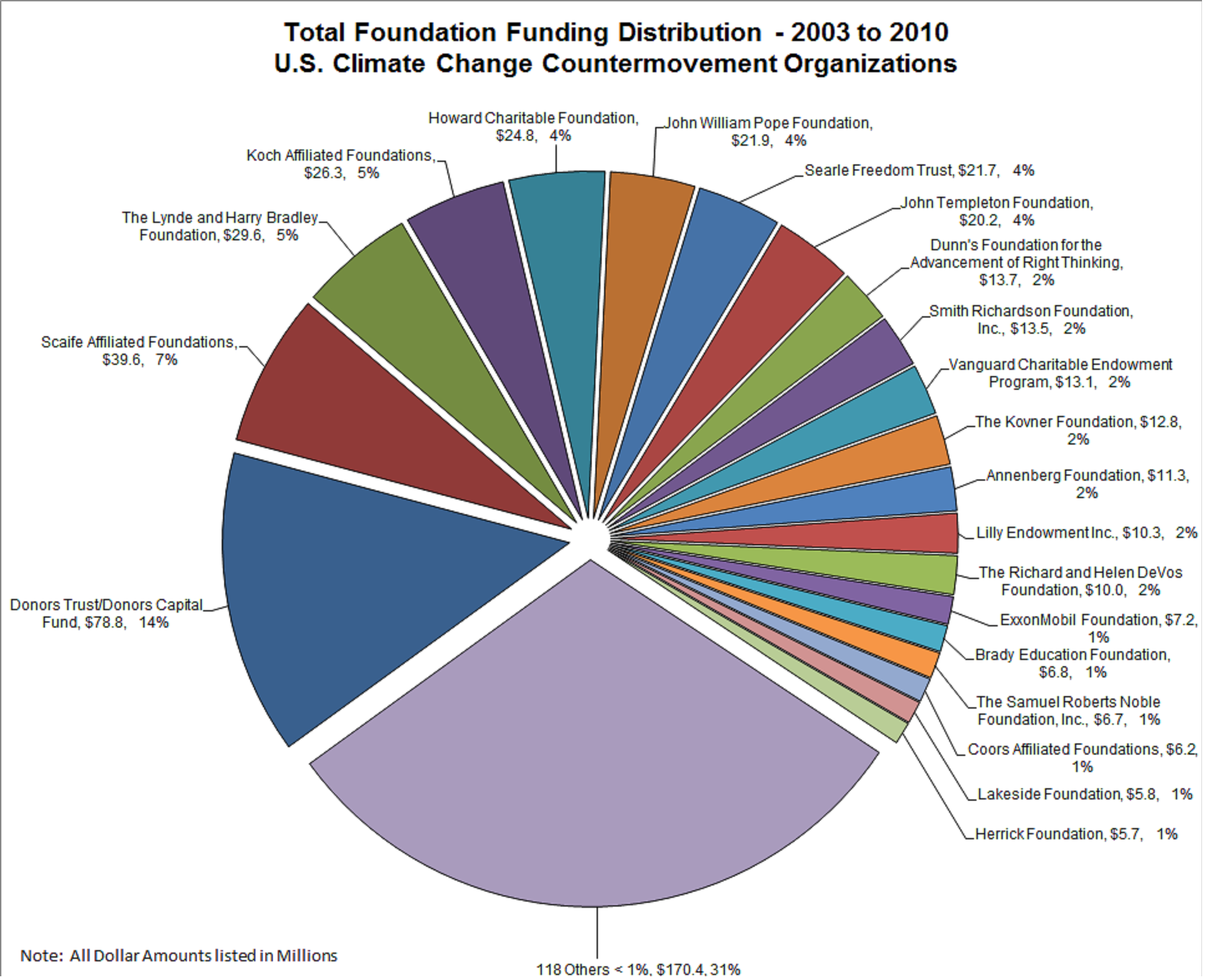
Through an analysis of the financial structure of the organizations that constitute the core of the countermovement and their sources of monetary support, Brulle found that, while the largest and most consistent funders behind the countermovement are a number of well-known conservative foundations, the majority of donations are “dark money,” or concealed funding.
The data also indicates that Koch Industries and ExxonMobil, two of the largest supporters of climate science denial, have recently pulled back from publicly funding countermovement organizations. Coinciding with the decline in traceable funding, the amount of funding given to countermovement organizations through third party pass-through foundations like Donors Trust and Donors Capital, whose funders cannot be traced, has risen dramatically.
Brulle, a professor of sociology and environmental science in Drexel’s College of Arts and Sciences, conducted the study during a year-long fellowship at Stanford University’s Center for Advanced Study in the Behavioral Sciences. The study was published today in Climatic Change, one of the top 10 climate science journals in the world.
The climate change countermovement is a well-funded and organized effort to undermine public faith in climate science and block action by the U.S. government to regulate emissions. This countermovement involves a large number of organizations, including conservative think tanks, advocacy groups, trade associations and conservative foundations, with strong links to sympathetic media outlets and conservative politicians.
“The climate change countermovement has had a real political and ecological impact on the failure of the world to act on the issue of global warming,” said Brulle. “Like a play on Broadway, the countermovement has stars in the spotlight – often prominent contrarian scientists or conservative politicians – but behind the stars is an organizational structure of directors, script writers and producers, in the form of conservative foundations. If you want to understand what’s driving this movement, you have to look at what’s going on behind the scenes.”
To uncover how the countermovement was built and maintained, Brulle developed a listing of 118 important climate denial organizations in the U.S. He then coded data on philanthropic funding for each organization, combining information from the Foundation Center with financial data submitted by organizations to the Internal Revenue Service.
The final sample for analysis consisted of 140 foundations making 5,299 grants totaling $558 million to 91 organizations from 2003 to 2010. The data shows that these 91 organizations have an annual income of just over
$900 million, with an annual average of $64 million in identifiable foundation support. Since the majority of the organizations are multiple focus organizations, not all of this income was devoted to climate change activities, Brulle notes.Key findings include:
- Conservative foundations have bank-rolled denial. The largest and most consistent funders of organizations orchestrating climate change denial are a number of well-known conservative foundations, such as the Searle Freedom Trust, the John William Pope Foundation, the Howard Charitable Foundation and the Sarah Scaife Foundation. These foundations promote ultra-free-market ideas in many realms.
- Koch and ExxonMobil have recently pulled back from publicly visible funding. From 2003 to 2007, the Koch Affiliated Foundations and the ExxonMobil Foundation were heavily involved in funding climate-change denial organizations. But since 2008, they are no longer making publicly traceable contributions.
- Funding has shifted to pass through untraceable sources. Coinciding with the decline in traceable funding, the amount of funding given to denial organizations by the Donors Trust has risen dramatically. Donors Trust is a donor-directed foundation whose funders cannot be traced. This one foundation now provides about 25% of all traceable foundation funding used by organizations engaged in promoting systematic denial of climate change.
- Most funding for denial efforts is untraceable. Despite extensive data compilation and analyses, only a fraction of the hundreds of millions in contributions to climate change denying organizations can be specifically accounted for from public records. Approximately 75% of the income of these organizations comes from unidentifiable sources.
“The real issue here is one of democracy. Without a free flow of accurate information, democratic politics and government accountability become impossible,” said Brulle. “Money amplifies certain voices above others and, in effect, gives them a megaphone in the public square. Powerful funders are supporting the campaign to deny scientific findings about global warming and raise public doubts about the roots and remedies of this massive global threat. At the very least, American voters deserve to know who is behind these efforts.”
This study is part one of a three-part project by Brulle to examine the climate movement in the U.S. at the national level. The next step in the project is to examine the environmental movement or the climate change movement. Brulle will then compare the whole funding flow to the entire range of organizations on both sides of the debate.
Brulle has authored numerous articles and book chapters on environmental science, and is a frequent media commentator on climate change. He co-edited Power, Justice and the Environment: A Critical Appraisal of the Environmental Justice Movement (2005) with David Pellow, and is the author of Agency, Democracy, and Nature: U.S. Environmental Movements from a Critical Theory Perspective (2000).
Brulle previously served as a commissioned officer in the United States Coast Guard for two decades. He received a doctorate in sociology from George Washington University, a master of science degree in natural resources from the University of Michigan, a master of arts degree in sociology from the New School for Social Research and a bachelor of science degree in marine engineering from the United States Coast Guard Academy.
The full paper is available here.
Think Progress charts the data:
- Global Temperatures Keep Going Up
- Carbon Dioxide Levels Hit 400ppm For The First Time In Recorded History
- Most Congressional Republicans Denied Climate Change
- The First Bulk Freighter Passed Through The Arctic, Carrying Coal
- Arctic Sea Ice Volume Still In Jeopardy
- The Price Of Solar Dropped Dramatically
- 99 Percent of New Electric Capacity In October Came From Renewables
- Turns Out More Shale Gas Will Not Bring A Major Climate Benefit
Eric Holthaus writes: So it’s come to this.
Last year, a researcher presented a paper on climate change at the American Geophysical Union’s meeting entitled ”Is Earth F**ked?” which advocated “environmental direct action, resistance taken from outside the dominant culture, as in protests, blockades and sabotage by indigenous peoples, workers, anarchists and other activist groups.”
Last month, the Philippines climate commissioner and self-styled revolutionary Naderev “Yeb” Saño held a 13-day fast in the midst of an international climate summit, just hours after Typhoon Haiyan ravaged his home country. In a tearful speech quoting Gandhi, he said: “We cannot sit and stay helpless staring at this international climate stalemate. It is now time to take action. We need an emergency climate pathway.”
And only last week, a conference of climate scientists in London explored the theme of “radical emissions reduction” after noting that “nothing that we’ve said or done to date about climate change has made any detectable dip whatsoever”. Via a weblink, author Naomi Klein compared the fight against climate change with the struggle against South African apartheid, and said, “an agenda capable of delivering radical emissions reductions will only advance if accompanied by a radical movement.”
Fed up with slow (or in some cases, backwards) progress on climate change, environmental advocates are mulling desperate measures. Emerging at the head of this pack is arguably the world’s most prominent climate scientist: James Hansen, a former NASA researcher turned activist.
In a provocative study published earlier this month, Hansen and a group of colleagues make the case for why radical action is needed. [Continue reading…]