Category Archives: climate change

How science is calling for a global revolution

Naomi Klein writes: In December 2012, a pink-haired complex systems researcher named Brad Werner made his way through the throng of 24,000 earth and space scientists at the Fall Meeting of the American Geophysical Union, held annually in San Francisco. This year’s conference had some big-name participants, from Ed Stone of Nasa’s Voyager project, explaining a new milestone on the path to interstellar space, to the film-maker James Cameron, discussing his adventures in deep-sea submersibles.

But it was Werner’s own session that was attracting much of the buzz. It was titled “Is Earth F**ked?” (full title: “Is Earth F**ked? Dynamical Futility of Global Environmental Management and Possibilities for Sustainability via Direct Action Activism”).

Standing at the front of the conference room, the geophysicist from the University of California, San Diego walked the crowd through the advanced computer model he was using to answer that question. He talked about system boundaries, perturbations, dissipation, attractors, bifurcations and a whole bunch of other stuff largely incomprehensible to those of us uninitiated in complex systems theory. But the bottom line was clear enough: global capitalism has made the depletion of resources so rapid, convenient and barrier-free that “earth-human systems” are becoming dangerously unstable in response. When pressed by a journalist for a clear answer on the “are we f**ked” question, Werner set the jargon aside and replied, “More or less.”

There was one dynamic in the model, however, that offered some hope. Werner termed it “resistance” – movements of “people or groups of people” who “adopt a certain set of dynamics that does not fit within the capitalist culture”. According to the abstract for his presentation, this includes “environmental direct action, resistance taken from outside the dominant culture, as in protests, blockades and sabotage by indigenous peoples, workers, anarchists and other activist groups”. [Continue reading…]

Facebooktwittermail

Oil companies are sued for burning off natural gas

The New York Times reports: In the sharpest challenge yet to the surge in flaring of natural gas in the Bakken shale oil field, North Dakota mineral owners this week filed 10 class-action lawsuits seeking millions of dollars in lost royalties from some of the nation’s largest oil companies.

Roughly 1,500 fires burn above western North Dakota because of the deliberate burning of natural gas by companies rushing to drill for oil without having sufficient pipelines to transport their production. With cheap gas bubbling to the top with expensive oil, the companies do not have an economic incentive to build the necessary gas pipelines, so they flare the excess gas instead.

Flaring is environmentally less harmful than releasing raw natural gas into the atmosphere, but the flared gas still spews climate-warming carbon dioxide into the atmosphere. The quantities of gas burned are so large that the fires rising above wheat and sunflower fields look like a small city in NASA photographs taken from satellites.

Flared gas has nearly tripled in the last two years in North Dakota, with almost 30 percent of the output in the state burned at wells, producing emissions equivalent to more than two medium-size coal-fired power plants. [Continue reading…]

Facebooktwittermail

How do you get people to give a damn about climate change?

Chris Mooney writes: As two top researchers studying the science of science communication – a hot new field that combines public opinion research with psychological studies — Dan Kahan and Stephan Lewandowsky tend to agree about most things.

There’s just one problem. The little thing that they disagree on — whether it actually works to tell people that there’s a “scientific consensus” on climate change — is a matter of huge practical significance. After all, many scientists, advocates, and bloggers are doing this all the time. Heck, Barack Obama and Al Gore are out there doing it. And the central message that the U.N.’s Intergovernmental Panel on Climate Change sought to convey with its latest report, that scientists are now 95-percent certain that humans are driving global warming, is a message about scientific consensus.

In this episode of Inquiring Minds (click below to stream audio), Kahan and Lewandowsky debate this pressing issue. The discussion begins with a paper published in Nature Climate Change last year by Lewandowsky and two colleagues, providing experimental evidence suggesting a consensus message ought to work quite well.

Facebooktwittermail

Under Obama, U.S. leads the world in oil and gas production

Slate reports: The United States will pass Russia this year to lead the world in production of oil and natural gas, the U.S. Energy Information Administration reports.

America has been closing in on Russia since 2008 thanks to a boom in both oil and gas production, primarily on private lands. This year it’s on track to out-produce it by a substantial margin. Saudi Arabia is third overall and remains the world’s largest oil producer — though the United States may be on track to take that title as well.

“This is a remarkable turn of events,” the head of the EIA told the Wall Street Journal. “This is a new era of thinking about market conditions, and opportunities created by these conditions, that you wouldn’t in a million years have dreamed about.”

As recently as 2007, economists were writing things like, “the amount of oil produced in America each year has been on a path of inexorable decline now for two generations.” Turns out the path was exorable after all. All it took was a whole lot of fracking. [Continue reading…]

DeSmogBlog: What’s it like living in a small town that’s gone from rust belt farmland to fracking boomtown?

First, residents often say, there’s the traffic. Communities have been unexpectedly flooded with heavy tractor trailers that locals say turn 10 minute commutes into hour-long ordeals, choke back roads and decimate pavement so badly that in some areas, drilling companies are barred from entering until they agree to pay for road repairs. “The traffic here is horrendous,” Towanda, PA resident Joe Benjamin told NPR.

Others often describe the impacts on the social fabric – a “wild west” atmosphere that brings with it increased crime and public health problems.

But these reports have been largely anecdotal, with little to quantify how big these impacts are or how much of it is due to fracking. Until now.

A new report by Food and Water Watch examines the social impacts of fracking, comparing traffic, crime and sexually transmitted infections in rural Pennsylvania counties. Using a decade worth of county-level data, they compare the differences between counties with substantial fracking and without, and how these counties have changed over time, from before the boom until after it set in. [Continue reading…]

Facebooktwittermail

Climate change will hit poor countries hardest, study shows

The Guardian reports: Low-income countries will remain on the frontline of human-induced climate change over the next century, experiencing gradual sea-level rises, stronger cyclones, warmer days and nights, more unpredictable rains, and larger and longer heatwaves, according to the most thorough assessment of the issue yet.

The last major UN assessment, in 2007, predicted runaway temperature rises of 6C or more by the end of the century. That is now thought unlikely by scientists, but average land and sea temperatures are expected to continue rising throughout this century, possibly reaching 4C above present levels – enough to devastate crops and make life in many cities unbearably hot.

As temperatures climb and oceans warm, tropical and subtropical regions will face sharp changes in annual rainfall, says the Intergovernmental Panel on Climate Change (IPCC) report, released on Thursday in Stockholm before online publication on 30 September.

East Africa can expect to experience increased short rains, while west Africa should expect heavier monsoons. Burma, Bangladesh and India can expect stronger cyclones; elsewhere in southern Asia, heavier summer rains are anticipated. Indonesia may receive less rainfall between July and October, but the coastal regions around the south China Sea and Gulf of Thailand can expect increased rainfall extremes when cyclones hit land. [Continue reading…]

Facebooktwittermail

Why has geoengineering been legitimised by the IPCC?

Jack Stilgoe writes: Today marked an important punctuation mark in story of humanity’s attempts to get to grips with climate change. The Intergovernmental Panel on Climate Change published its summary for policymakers (pdf here). Climate sceptic journalists and interest groups will be making the most of the tiniest surprises and variations in the climate scientists’ new representation of the state of their art. But the evidence is largely unsurprising. For all the talk of a ‘hiatus’ in warming, the IPCC continue to fly their one big fact: more greenhouse gases means more warming.

The big surprise comes in the final paragraph, with a mention of geoengineering. In the scientific world, a final paragraph is often the place to put caveats and suggestions for further research. In the political world, a final paragraph is a coda, a big finish, the place for a triumphant, standing-ovation-inducing summary. The IPCC tries to straddle both worlds. The addition of the word ‘geoengineering’ to the most important report on climate change for six years, counts as a big surprise.

There are many reasons to be worried about geoengineering. The idea is old. Countless inventions have been proposed as a technological fix to climate change. But scientists have only recently taken it seriously. Their previous reticence was largely due to a concern that talking about easy solutions to climate change would wobble the consensus on the need for emissions cut that had been painstakingly built over decades. Geoengineering was taboo – too seductive, too dangerous and too uncertain. It is now moving towards the mainstream of climate science. As the number of geoengineering studies published shoots up, it is now acceptable to discuss it in polite scientific company.

There is an argument that the taboo has already been broken and that, like sex education, it therefore has to be discussed. Those of us interested in geoengineering were expecting it to appear in one or two of the main reports when they are published in the coming months. To bring it up front is to give it premature legitimacy. [Continue reading…]

Clive Hamilton writes: Momentum is gathering to respond to global warming using geoengineering instead of, or in addition to, carbon abatement policies. Last week Russia proposed adding support for research into methods such as sulphate aerosol spraying and ocean iron fertilization to the Intergovernmental Panel on Climate Change’s (IPCC) Summary for Policy Makers, a move that would have given geoengineering – efforts to alter the Earth’s natural systems to slow or reverse global warming – a powerful stamp of legitimacy.

Russia’s move failed, but it only means a delay of six months because the third part of the IPCC’s report, due out in April, will for the first time carry an assessment of climate engineering as a policy response.

A network of geoengineering researchers, some with links to entrepreneurs and large corporations, is pushing ahead and taking out patents. And research programs are now underway in the United States, China, Germany, Britain and Russia. [Continue reading…]

Note to commenters: Geoengineering is a serious issue not to be confused with crackpot conspiracy theories about chemtrails. Spare me any comments on the latter.

Facebooktwittermail

Climate panel says upper limit on emissions is nearing

The New York Times reports: For the first time, the world’s top climate scientists on Friday formally embraced an upper limit on greenhouse gases while warning that it is likely to be exceeded within decades if emissions continue at a brisk pace, underscoring the profound challenge humanity faces in bringing global warming under control.

A panel of experts appointed by the United Nations, unveiling its latest assessment of climate research, reinforced its earlier conclusions that global warming is real, that it is caused primarily if not exclusively by human emissions, and that it is likely to get substantially worse unless efforts to limit those emissions are rapidly accelerated.

“Human influence has been detected in warming of the atmosphere and the ocean, in changes in the global water cycle, in reductions in snow and ice, in global mean sea level rise, and in changes in some climate extremes,” the report said. “It is extremely likely that human influence has been the dominant cause of the observed warming since the mid-20th century.”

Going well beyond its four previous analyses of the emissions problem, the Intergovernmental Panel on Climate Change endorsed a “carbon budget” for humanity — an upper limit on the amount of the primary greenhouse gas, carbon dioxide, that can be emitted from industrial activities and forest destruction.

To stand the best chance of keeping the planetary warming below an internationally agreed target of 3.6 degrees Fahrenheit above preindustrial levels and thus avoiding the most dangerous effects of climate change, the panel found, only about 1 trillion tons of carbon can be burned and the resulting gas spewed into the atmosphere.

Just over half that amount has already been emitted since the beginning of the Industrial Revolution, and at current rates of energy consumption, the trillionth ton will be released around 2040, according to calculations by Myles R. Allen, a scientist at the University of Oxford and one of the authors of the new report. More than 3 trillion tons of carbon are still left in the ground as fossil fuels. [Continue reading…]

The Guardian notes some of the key points from the IPCC report:

• Atmospheric concentrations of carbon dioxide, methane and nitrous oxide are now at levels “unprecedented in at least the last 800,000 years.”

• Since the 1950’s it’s “extremely likely” that human activities have been the dominant cause of the temperature rise.

• Concentrations of CO2 and other greenhouse gases in the atmosphere have increased to levels that are unprecedented in at least 800,000 years. The burning of fossil fuels is the main reason behind a 40% increase in C02 concentrations since the industrial revolution.

• Global temperatures are likely to rise by 0.3C to 4.8C, by the end of the century depending on how much governments control carbon emissions.

• Sea levels are expected to rise a further 26-82cm by the end of the century.

• The oceans have acidified as they have absorbed about a third of the carbon dioxide emitted.

Facebooktwittermail

Climate change: IPCC issues stark warning over global warming

The Guardian reports: Scientists will this week issue their starkest warning yet about the mounting dangers of global warming. In a report to be handed to political leaders in Stockholm on Monday, they will say that the burning of fossil fuels and deforestation have now led to a warming of the entire globe, including land surfaces, oceans and the atmosphere.

Extreme weather events, including heatwaves and storms, have increased in many regions while ice sheets are dwindling at an alarming rate. In addition, sea levels are rising while the oceans are being acidified – a development that could see the planet’s coral reefs disappearing before the end of the century.

Writing in the Observer ahead of the report’s release, the economist and climate change expert Lord Stern calls on governments to end their dithering about fossil fuels and start working to create a global low-carbon economy to curtail global warming. Governments, he states, must decide what “kind of world we want to present to our children and grandchildren”.

The fifth assessment report on the physical science of climate change by the Intergovernmental Panel on Climate Change (IPCC) warns that humanity is on course over the next few decades to raise global temperatures by more than 2C compared with pre-industrial levels. Such a rise could trigger the release of plumes of the greenhouse gas methane from the thawing Arctic tundra, while the polar ice caps, which reflect solar radiation back into space, could disappear.

Although the report does not say so, Earth would probably then be facing a runaway greenhouse effect.

The scientists’ warning – the most comprehensive and convincing yet produced by climate scientists – comes at a time when growing numbers of people are doubting the reality of global warming. Last week, the UK Energy Research Centre (UKERC) published a survey showing that the proportion of British people who do not think the world’s climate is changing has almost quadrupled since 2005.

Asked if they thought Earth’s climate was changing, 5% of respondents said “no” in 2005, a figure that rose to 11% last year and reached 19% this year. [Continue reading…]

Facebooktwittermail

The world’s vanishing ice

Union of Concerned Scientists: In the next few days the Arctic sea ice will reach its minimum extent for 2013. At the end of this year’s summer melt season, the areal extent covered by sea ice was more than a million square kilometers below the 30-year average. That’s a lot of ice missing compared to an average year. An area of frozen ocean—ten times the size of Indiana, or four times the size of Colorado, or a third bigger than Texas—is just not there this summer.

While this is shocking and part of a several-decade decline in Arctic sea ice, what’s also alarming is the lack of substantive media coverage. The decline in Arctic sea ice should concern all of us in the same way that a collapse of the economic system does. It deserves front page billing. A recent Nature commentary stated that “the costs of a melting Arctic will be huge, because the region is pivotal to the functioning of Earth systems such as oceans and the climate.” They don’t mince their words.

Here are five reasons why the decline of the Arctic sea ice matters:

1. Sea ice reflects sunlight, keeping earth cool

When bright, reflective sea ice melts, it gives way to a darker ocean. More heat is absorbed by a darker surface, leading to more warming. This is known as the ice-albedo feedback effect. Largely due to the recent dramatic loss of sea ice and this feedback, the Arctic is now warming at twice the global rate. [Continue reading…]

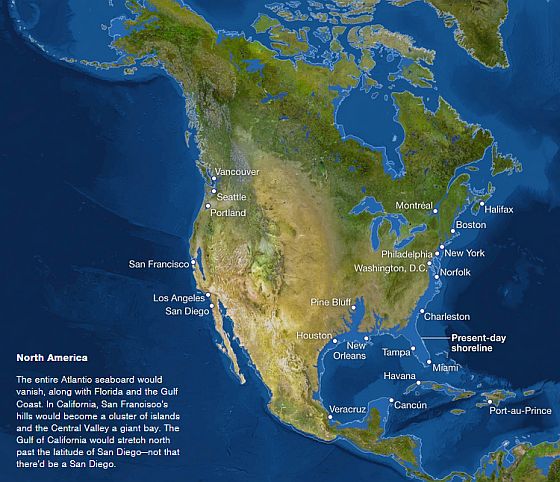
National Geographic depicts the world without ice: All the ice on land has melted and drained into the sea, raising it 216 feet and creating new shorelines for our continents and inland seas.

There are more than five million cubic miles of ice on Earth, and some scientists say it would take more than 5,000 years to melt it all. If we continue adding carbon to the atmosphere, we’ll very likely create an ice-free planet, with an average temperature of perhaps 80 degrees Fahrenheit instead of the current 58.

ice-melted

Facebooktwittermail

Naomi Klein: Green groups may be more damaging than climate change deniers

Earth Island Journal: In a piece you wrote for the Nation in November 2011 you suggested that when it comes to climate change, there’s a dual denialism at work – conservatives deny the science while some liberals deny the political implications of the science. Why do you think that some environmentalists are resistant to grappling with climate change’s implications for the market and for economics?

Naomi Klein: Well, I think there is a very deep denialism in the environmental movement among the Big Green groups. And to be very honest with you, I think it’s been more damaging than the right-wing denialism in terms of how much ground we’ve lost. Because it has steered us in directions that have yielded very poor results. I think if we look at the track record of Kyoto, of the UN Clean Development Mechanism, the European Union’s emissions trading scheme – we now have close to a decade that we can measure these schemes against, and it’s disastrous. Not only are emissions up, but you have no end of scams to point to, which gives fodder to the right. The right took on cap-and-trade by saying it’s going to bankrupt us, it’s handouts to corporations, and, by the way, it’s not going to work. And they were right on all counts. Not in the bankrupting part, but they were right that this was a massive corporate giveaway, and they were right that it wasn’t going to bring us anywhere near what scientists were saying we needed to do lower emissions. So I think it’s a really important question why the green groups have been so unwilling to follow science to its logical conclusions. I think the scientists Kevin Anderson and his colleague Alice Bows at the Tyndall Centre have been the most courageous on this because they don’t just take on the green groups, they take on their fellow scientists for the way in which neoliberal economic orthodoxy has infiltrated the scientific establishment. It’s really scary reading. Because they have been saying, for at least for a decade, that getting to the emissions reduction levels that we need to get to in the developed world is not compatible with economic growth.

What we know is that the environmental movement had a series of dazzling victories in the late ’60s and in the ’70s where the whole legal framework for responding to pollution and to protecting wildlife came into law. It was just victory after victory after victory. And these were what came to be called “command-and-control” pieces of legislation. It was “don’t do that.” That substance is banned or tightly regulated. It was a top-down regulatory approach. And then it came to screeching halt when Reagan was elected. And he essentially waged war on the environmental movement very openly. We started to see some of the language that is common among those deniers – to equate environmentalism with Communism and so on. As the Cold War dwindled, environmentalism became the next target, the next Communism. Now, the movement at that stage could have responded in one of the two ways. It could have fought back and defended the values it stood for at that point, and tried to resist the steamroller that was neoliberalism in its early days. Or it could have adapted itself to this new reality, and changed itself to fit the rise of corporatist government. And it did the latter. Very consciously if you read what [Environmental Defense Fund president] Fred Krupp was saying at the time.

It was go along or get along.

Exactly. We now understand it’s about corporate partnerships. It’s not, “sue the bastards;” it’s, “work through corporate partnerships with the bastards.” There is no enemy anymore.

More than that, it’s casting corporations as the solution, as the willing participants and part of this solution. That’s the model that has lasted to this day. [Continue reading…]

Facebooktwittermail

The climate denial machine vs. climate science

Greenpeace has just released a new report, Dealing in Doubt — the complete report can be read here. This is the introduction:

This report describes organized attacks on climate science, scientists and scientific institutions like the UN Intergovernmental Panel on Climate Change (the IPCC), that have gone on for more than 20 years. It sets out some of the key moments in this campaign of climate denial started by the fossil fuel industry, and traces them to their sources.

The tobacco industry’s misinformation and PR campaign in the US against regulation reached a peak just as laws controlling tobacco were about to be introduced. Similarly, the campaign against climate change science – and scientists – has intensified as global policy on climate change has become more likely. This time though there is a difference. The corporate PR campaign has gone viral, spawning a denial movement that is distributed, decentralised and largely immune to reasoned response.

This report updates our March 2010 report, ahead of the forthcoming 2013 release of the IPCC’s Fifth Assessment report.

The 2010 report was published just after the hysteria that greeted the release of climate scientists’ personal email hacked or stolen from the University of East Anglia on the eve of the Copenhagen Climate Summit in late 2009. This scandal showed the depth and sophistication of the climate denial movement and the willingness of the media to amplify their message, despite its lack of evidence or scientific support – and to be distracted from the urgency of the issue by unfounded attacks on leading research scientists.

Since 2009, there have been nine separate investigations into this so-called “scandal,” each of which have exonerated the scientists at the centre of the accusations. Yet that hasn’t stopped the continued hysteria around the scandals. There have been two more attempts at a “climategate” type scandal, releasing more emails, with very little effect. Unfortunately, traditional media outlets failed to properly correct the misinformation they were so culpable in helping to spread.

With this new edition of Dealing In Doubt we:

  • Detail the ongoing attempts to attack the integrity of individual climate scientists and their work.
  • Look beyond the strategic parallels between the tobacco industry’s campaign for “Sound Science” (where they labeled mainstream science as “junk”) to the current climate denial campaign, to new research that has come to light revealing the deeper connections: the funding, personnel and institutions between the two policy fights.
  • Detail how some scientists are now fighting back and taking legal action.
  • Showcase the Heartland Institute as an example of how tobacco-friendly free market think tanks use a wide range of tactics to wage a campaign against the climate science.
  • Reveal the range of tricks used by the denier campaign, from “pal review” instead of peer review, to personal attacks on scientists through Freedom of Information requests, self-publishing books, and the general conspiratorial noise from the denial machine in the blogosphere.

The majority of the front groups or free market think tanks running campaigns against climate science continue to receive funding from big oil and energy interests.

Since our first report, the massive campaign against climate science – and action on climate, funded by oil barons the Koch Brothers has come to light. And while fossil fuel companies like ExxonMobil, whose very products are causing global warming, continue to fund think tanks driving the campaigns, much of the foundation funding has now been driven underground, masked by a funding front-group called the Donors Trust – and its associate Donors Capital Fund, two “donor-advised” funds created to hide the real givers and thus shield them from negative exposure of their support for these campaigns.

Funding to the organizations that comprise the denial machine has risen during the Obama presidency, just as the urgency of climate solutions and promise of policy advances also rose.

“The side that has been issuing these attacks are extremely well-funded, well-organized. They have had an attack infrastructure of this sort for decades, developed it during the tobacco wars, they honed it further … in further efforts to attack science that industry or other sceptical interests find inconvenient. So they have a very well honed, well-funded organized machine that they are bringing to bear in their attack now against climate science.

“It’s literally like a marine in battle against a cub scout when it comes to the scientists defending themselves… We’re not PR experts like they are, we’re not lawyers and lobbyists like they are. We’re scientists, trained to do science.”

– Climate scientist Michael Mann: February 2010

Meanwhile the consensus – and evidence – continues to grow

None of the climate denial machine’s counter attack has changed the harsh reality, the scientific consensus, that climate change is underway and it is caused by humanity’s pollution and other insults to the planet..

If there wasn’t already enough proof in the years of replicated scientific evidence, a May 2013 peer reviewed study examined more than 11,000 climate change papers, and of the 4,000 papers that discussed whether climate change was caused by humans, 97 percent agreed. On the other hand, the percentage of papers challenging this consensus didn’t move – it had flatlined. This corroborated a similar finding in 2010 from the Proceedings of the National Academy of Sciences (PNAS).

The IPCC scientific assessment is a rigorous and robust process, one of the biggest organized scientific endeavours in the world, involving thousands of scientists in hundreds of research institutes around the world, who assess and compile the findings of thousands of published and peer reviewed papers across a wide range of topics, from the measurement of shrinking ice caps to oceans, clouds, temperature records and observed impacts. It is also a human endeavour and therefore not perfect.

The very purpose of the IPCC itself, and its periodic assessments and reports, is to inform governments participating in the UNFCCC process of the latest science in order to evaluate policy measures. Science is indeed the engine that drives the policy train. Certainty adds urgency and should spur action. The coal, oil and gas industries have always recognized this and have therefore strived for uncertainty to slow policy advances.

One of the most fascinating aspects of the IPCC is that the work is done entirely voluntarily. For many of the scientists involved, it’s the equivalent of having a second job, where you spend as much, if not more time on it as your primary job, unpaid.

Greenpeace has, and continues to have, confidence in the IPCC. There is no more reliable guide to – and summary of – the world’s climate science than the IPCC reports. If anything, due to the long lead-in time for the IPCC reports, they err on the side of conservatism. In late 2012, studies that compared the IPCC’s predictions over 22 years of weather data showed that the organisation has consistently underplayed the intensity of global warming in its reports. The denier campaigns against the IPCC consistently accuse it of overplaying the science, but, if anything, it has underplayed it.

Dealing in Doubt, the complete report, can be read here.

Facebooktwittermail

Some credible scientists believe humanity is irreparably close to destruction

Nathan Curry writes: If you were to zoom out and take a comparative look back at our planet during the 1950s from some sort of cosmic time-travelling orbiter cube, you would probably first notice that millions of pieces of space trash had disappeared from orbit.

The moon would appear six and a half feet closer to Earth, and the continents of Europe and North America would be four feet closer together. Zooming in, you would be able to spot some of the industrial clambering of the Golden Age of Capitalism in the West and some of the stilted attempts at the Great Leap Forward in the East. Lasers, bar codes, contraceptives, hydrogen bombs, microchips, credit cards, synthesizers, superglue, Barbie dolls, pharmaceuticals, factory farming, and distortion pedals would just be coming into existence.

There would be two thirds fewer humans on the planet than there are now. Over a million different species of plants and animals would exist that have since gone extinct. There would be 90 percent more fish, a billion less tons of plastic, and 40 percent more phytoplankton (producers of half the planet’s oxygen) in the oceans. There would be twice as many trees covering the land and about three times more drinking water available from ancient aquifers. There would be about 80 percent more ice covering the northern pole during the summer season and 30 percent less carbon dioxide and methane in the atmosphere. The list goes on…

Most educated and semi-concerned people know that these sorts of sordid details make up the backdrop of our retina-screened, ethylene-ripened story of progress, but what happens when you start stringing them all together?

If Doomsday Preppers, the highest rated show on the National Geographic Channel is any indication, the general public seems to be getting ready for some sort of societal collapse. There have always been doomsday prophets and cults around and everyone has their own personal view of how the apocalypse will probably go down (ascension of pure souls, zombie crows), but in the midst of all of the Mayan Calendar/Timewave Zero/Rapture babble, there are some clarion calls coming from a crowd that’s less into bugout bags and eschatology: well-respected scientists and journalists who have come to some scarily-sane sounding conclusions about the threat of human-induced climate change on the survival of the human species.

Recent data seems to suggest that we may have already tripped several irrevocable, non-linear, positive feedback loops (melting of permafrost, methane hydrates, and arctic sea ice) that make an average global temperature increase of only 2°C by 2100 seem like a fairy tale. Instead, we’re talking 4°C, 6°C, 10°C, 16°C (????????) here.

The link between rapid climate change and human extinction is basically this: the planet becomes uninhabitable by humans if the average temperature goes up by 4-6°C. It doesn’t sound like a lot because we’re used to the temperature changing 15°C overnight, but the thing that is not mentioned enough is that even a 2-3°C average increase would give us temperatures that regularly surpass 40°C (104°F) in North America and Europe, and soar even higher near the equator. Human bodies start to break down after six hours at a wet-bulb (100% humidity) temperature of 35°C (95°F). This makes the 2003 heat wave in Europe that killed over 70,000 people seem like not a very big deal.

Factoring in the increase we’re already seeing in heat waves, droughts, wildfires, massive storms, food and water shortages, deforestation, ocean acidification, and sea level rise some are seeing the writing on the wall: [Continue reading…]

Facebooktwittermail

The oceans are acidifying at the fastest rate in 300 million years

Brad Plumer writes: The world’s oceans are turning acidic at what’s likely the fastest pace in 300 million years. Scientists tend to think this is a troubling development. But just how worried should we be, exactly?

It’s a question marine experts have been racing to get a handle on in recent years. Here’s what they do know: As humans keep burning fossil fuels, the oceans are absorbing more and more carbon-dioxide. That staves off (some) global warming, but it also makes the seas more acidic — acidity levels have risen 30 percent since the Industrial Revolution.

There’s reason for alarm here: Studies have found that acidifying seawater can chew away at coral reefs and kill oysters by making it harder to form protective shells. The process can also interfere with the food supply for key species like Alaska’s salmon.

But it’s not fully clear what this all adds up to. What happens if the oceans keep acidifying and water temperatures keep rising as a result of global warming? Are those stresses going to wipe out coral reefs and fisheries around the globe, costing us trillions (as one paper suggested)? Or is there a chance that some ecosystems might remain surprisingly resilient?

That’s one of the big outstanding questions on climate change. “We understand the physics of simple things like how oceans become acidic,” said Richard Norris, a paleobiologist at Scripps Institution of Oceanography, UC San Diego. “But when it comes to how ecosystems might react, that’s big and complex and messy, with all these interactions going on, both physiological and how organisms interact with each other.” [Continue reading…]

Facebooktwittermail

Cooling Pacific has dampened global warming, research shows

The Guardian reports: Cooling waters in the tropical Pacific Ocean appear to be a major factor in dampening global warming in recent years, scientists said on Wednesday.

Their work is a big step forward in helping to solve the greatest puzzle of current climate change research – why global average surface temperatures, while still on an upward trend, have risen more slowly in the past 10 to fifteen years than previously.

Waters in the eastern tropical regions of the Pacific have been notably cooler in recent years, owing to the effects of one of the world’s biggest ocean circulatory systems, the Pacific decadal oscillation.

Many people are aware of the El Niño and La Niña weather systems, which affect the Pacific and bring hotter and stormier or cooler weather in cycles of just a few years, and can have a strong effect on global weather. But few are aware that both of these systems are just part of the much bigger Pacific decadal oscillation, which brings warmer and cooler weather over decades.

The system is now in a cooling phase, scientists have noted, which could last for years. The last such phase was from the 1940s to the 1970s. [Continue reading…]

Facebooktwittermail

The campaign to mislead the public about the scientific consensus on climate change

At the Bulletin of the Atomic Scientists, John Cook writes: Since the late 1980s, governments and policy makers have worked to develop policy to mitigate climate change. At the same time, opponents have worked to delay and prevent climate action—not just by attacking policy solutions, but also by attacking climate science. A key focus in this decades-long campaign has been to cast doubt on the scientific consensus that humans are causing global warming.

Why attack the consensus? In recent years, social scientists have started to put the pieces together. A study published in the journal Nature Climate Change in 2011, replicated by a 2013 study published in the journal Climatic Change, found that public perceptions about scientific agreement are linked to support for policy to mitigate climate change. When people think that scientists are still debating about what’s causing climate change, they’re less likely to support climate action.

Social scientists were not the first to come to this realization. Political consultant Frank Luntz advised Republicans in the 2000 presidential election to cast doubt on the consensus, arguing “should the public come to believe that the scientific issues are settled, their views about global warming will change accordingly.” More than a decade before social scientists observed the link between perceived consensus and support for climate policy, opponents of climate action understood this link and implemented communication strategies designed to erode public support for climate policy.

In fact, attacks on the consensus date back to the early 1990s. In 1991, the Western Fuels Association spent more than $500,000 on a campaign to “reposition global warming as theory (not fact).” More recently, an analysis of conservative columns published from 2007 to 2010 found that the most repeated climate myth was “there is no scientific consensus.” [Continue reading…]

Facebooktwittermail

As northeast Asia bakes, climate scientists predict more extreme heat waves on the horizon

Time magazine reports: Northeast Asia is on fire. Yesterday temperatures in Shanghai hit an all-time high of 105.4ºF (40.8ºC), the hottest day in the coastal megacity since Chinese officials began keeping records some 140 years ago — during the Qing dynasty. On Aug. 12 the heat reached 105.8ºF (41ºC) in the southern Japanese city of Shimanto, the hottest temperature ever recorded in the country. Hundreds of people throughout South Korea have been hospitalized because of heatstroke, even as the government was forced to cut off air-conditioning in public buildings because of fears of a power shortage. As heat waves go, it’s a tsunami, similar to the brutally hot weather that singed Europe 10 years ago, which contributed to the deaths of over 30,000 people.

It’s also a glimpse of a blazingly hot future. We know that temperatures will generally rise as the globe warms thanks to increased greenhouse-gas emissions. (It’s right there in the name: global warming.) But as a new study published in Environmental Research Letters shows, the sort of scorching heat waves currently baking Northeast Asia are likely to become more frequent and more severe in the decades to come — and that’s going to happen no matter what we do about carbon emissions in the near future. There are some very uncomfortable summers on the horizon.

The study, by researchers at the Potsdam Institute for Climate Impact Research (PIK) in Germany and the Complutense University of Madrid in Spain, used climate models to project how heat extremes would change over the next century. The scientists found that extreme heat waves like the one that baked much of the U.S. in 2012 — when the country had its warmest year on record — are projected to cover double the amount of land globally by 2020 and quadruple the territory by 2040. The most severe heat waves — so-called five-sigma events, because they would involve temperatures that are five standard deviations above the norm — would go from essentially nonexistent today to covering about 3% of the globe by 2040. [Continue reading…]

Facebooktwittermail

Global communications systems use as much electricity as the whole world used in 1985

The Daily Mail: Your iPhone guzzles more energy than your refrigerator.

iPhones burn through significantly more energy than a new mid-sized refrigerator, according to a new study. The average new mid-sized refrigerator uses about 322 kilowatt hours a year while your iPhone uses about 361 kilowatt hours annually. The majority of that energy isn’t used to charge your battery, it’s used to power data centers responsible for the wireless connections and data streaming that bring your device to life.

This revelation was made in ‘The Cloud Begins with Coal: Big Data, Big networks, Big Infrastructure and Big Power,’ a paper published by the technology investment advisory Digital Power Group.

The world’s communications systems use 1,500 terawatt hours – 10 per cent of global energy and as much as Germany and Japan combined, according to the paper. The usage is equal to total global electricity usage in 1985. [Continue reading…]

Facebooktwittermail