Category Archives: internet

Jaron Lanier asks whether we have given up too much power to the big digital corporations

The Guardian: Jaron Lanier, groundbreaking computer scientist and infectious optimist, is concerned that we are not making the most of ourselves. In Who Owns the Future? he tellingly questions the trajectory of economic value in the information age, and argues that there has been a fundamental misstep in how capitalism has gone digital. For Lanier, late capitalism is not so much exhausted as humiliating: in an automated world, information is more important to the economy than manual labour, and yet we are expected to surrender information generated by or about ourselves – a valuable resource – for free.

Information here is a broad term for any conscious intellectual, artistic, or pragmatic contribution to the production of goods, services and cultural output, but it also includes the data that we unconsciously radiate simply by exhibiting certain behavioural and consumer traits. Lanier’s project is to foresee how livelihoods might be better sustained in a world in which information is king.

In his view, disproportionate economic power now accumulates around companies who “own the fastest computers with the most access to everyone’s information”. We donate extremely lucrative information – our interests, demographic predilections, buying habits, cyber-movements – in exchange for “free” admission into social media networks. (Digitisation has also allowed banks to repackage the “information” of a mortgage debt and sell it on as increasingly complex financial products, while excluding the indebted home-owner from a percentage of the profits.) Lanier argues that the early internet years have fetishised open access and knowledge-sharing in a way that has distracted people from demanding fairness and job security in an economy predicated on data flow. [Continue reading…]

Facebooktwittermail

Why online civility matters

Dominique Brossard and Dietram A. Scheufele write: In the beginning, the technology gods created the Internet and saw that it was good. Here, at last, was a public sphere with unlimited potential for reasoned debate and the thoughtful exchange of ideas, an enlightening conversational bridge across the many geographic, social, cultural, ideological and economic boundaries that ordinarily separate us in life, a way to pay bills without a stamp.

Then someone invented “reader comments” and paradise was lost.

The Web, it should be said, is still a marvelous place for public debate. But when it comes to reading and understanding news stories online — like this one, for example — the medium can have a surprisingly potent effect on the message. Comments from some readers, our research shows, can significantly distort what other readers think was reported in the first place.

But here, it’s not the content of the comments that matters. It’s the tone.

In a study published online last month in The Journal of Computer-Mediated Communication, we and three colleagues report on an experiment designed to measure what one might call “the nasty effect.”

We asked 1,183 participants to carefully read a news post on a fictitious blog, explaining the potential risks and benefits of a new technology product called nanosilver. These infinitesimal silver particles, tinier than 100-billionths of a meter in any dimension, have several potential benefits (like antibacterial properties) and risks (like water contamination), the online article reported.

Then we had participants read comments on the post, supposedly from other readers, and respond to questions regarding the content of the article itself.

Half of our sample was exposed to civil reader comments and the other half to rude ones — though the actual content, length and intensity of the comments, which varied from being supportive of the new technology to being wary of the risks, were consistent across both groups. The only difference was that the rude ones contained epithets or curse words, as in: “If you don’t see the benefits of using nanotechnology in these kinds of products, you’re an idiot” and “You’re stupid if you’re not thinking of the risks for the fish and other plants and animals in water tainted with silver.”

The results were both surprising and disturbing. Uncivil comments not only polarized readers, but they often changed a participant’s interpretation of the news story itself. [Continue reading…]

Facebooktwittermail

The militarization of the internet

Katherine Maher writes: Governments around the world are sounding alarms about the existential threat posed by cyberwar. From hostile foreign regimes to lawless nonstate actors, the threat of attacks on critical infrastructure to the theft of state secrets, the danger of economic warfare to corporate espionage, not a day goes by when cybersecurity is not in the news.

In response, governments around the world are devoting significant financial, military, and personnel resources to developing frameworks for cybersecurity and cyberconflict. Cyberspace is no longer the independent space of the cyberlibertarians; it is now a military domain. And when a freewheeling place like the Internet militarizes, the Internet’s laissez-faire culture of privacy, anonymity, and free expression inevitably comes into conflict with military priorities of security and protocol.

In the United States, the Pentagon has been tasked with the development of rules of engagement for cyberconflict. Just last week on Feb. 12, President Barack Obama issued a long-awaited executive order on cybersecurity and used his State of the Union address to call for new bipartisan legislation on the issue, emphasizing the need to protect U.S. critical infrastructure. The very next day, Rep. Mike Rogers (R-Mich.) and Rep. Dutch Ruppersberger (D-Md.) reintroduced CISPA, the Cyber Intelligence Sharing and Protection Act — a bill reviled by the privacy and civil liberties community for its lack of credible privacy protections and provisions for warrantless information-sharing.

Make no mistake, cyberhostilities are on the increase. Every day around the world, critical systems come under attack, whether from petty cybercriminals or coordinated state efforts. From Stuxnet, which set back Iran’s nuclear efforts, to Shamoon, which destroyed the control systems of oil giant Saudi Aramco, to the recent compromise of the Washington Post, New York Times, Twitter, and Facebook, we’re witnessing large-scale attempts to penetrate and interfere with both private and public systems.

Many cybersecurity experts, however, disagree on how to best tackle the threats at hand. Many dismiss proposals such as public-private data exchanges, arguing that such solutions erode civil liberties while failing to address critical problems. Others argue that reducing cyberconflict is best achieved through embracing the values of an open Internet: creating transparent norms, such as establishing clear red lines, common terminology, and mutual confidence-building measures. But the most influential voices remain those arguing for greater militarization: investing in the development of strategic exploits or offensive capacity that double down on the idea of the Internet as a domain subject to dominance by state actors.

Facebooktwittermail

The right to remain invisible and assume fictitious identities

When online communication first took shape, it often involved exchanges between individuals who had professional reasons to want to conceal their identities. Software engineers, who tend to be libertarian by nature, wanted to be able to engage in freewheeling discussions with like-minded cyber-adventurers without being constrained too much by overbearing managers or corporate dictates. Free speech and anonymity seemed to dovetail together.

But when the use of anonymity or fictitious identities is regarded as a right, all too often this ends up turning into a license for irresponsibility. The liberating effect of not having to be held accountable for ones own communication, breeds a fake boldness: the willingness to say things one would otherwise not dare say; the courage to “speak out” on the condition that one can do so while remaining in hiding.

The New York Times reports: There is a saying about academia that the disputes are so vicious because the stakes are so low. In the case of Raphael Haim Golb, a son of a Dead Sea Scrolls scholar, the last few years have provided ample support for the first half of the saying. But the second half is less accurate.

Raphael and Norman Golb

In his cluttered fifth-floor walk-up apartment in Greenwich Village, Mr. Golb, 53, is waiting to begin serving a six-month sentence for waging an Internet campaign against his father’s academic rivals, including sending e-mails under a rival professor’s name. The younger Mr. Golb, who has a Ph.D. from Harvard and a law degree from New York University, is six feet tall, 120 pounds; digressive, tightly wound, bookish; a gadfly, an irritant, an obsessive. If you saw him on the street, you might worry about his safety.

Between 2006 and 2009, he created more than 80 online aliases to advance his father’s views about the Dead Sea Scrolls against what he saw as a concerted effort to exclude them. Along the way, according to a jury and a panel of appellate court judges, he crossed from engaging in academic debate to committing a crime.

What he accomplished through this manner of intellectual warfare is, like the Dead Sea Scrolls themselves, a topic on which opinion is passionately diverse, with no shortage of bad blood.

“This has nothing to do with scholarly debate,” said Lawrence H. Schiffman, vice provost of Yeshiva University and a widely published authority on the Dead Sea Scrolls, who became the prime target of Mr. Golb’s online activities. “It has to do with criminal activity.

“Fraud, impersonation and harassment are criminal matters,” he continued. “This was actually designed to literally end my career.” [Continue reading…]

Facebooktwittermail

Idolizing the Internet

Evgeny Morozove writes: There are two ways to be wrong about the Internet. One is to embrace cyber-utopianism and treat the Internet as inherently democratizing. Just leave it alone, the argument goes, and the Internet will destroy dictatorships, undermine religious fundamentalism, and make up for failures of institutions.

Another, more insidious way is to succumb to Internet-centrism. Internet-centrists happily concede that digital tools do not always work as intended and are often used by enemies of democracy. What the Internet doesis only of secondary importance to them; they are most interested in what the Internet means. Its hidden meanings have already been deciphered: decentralization beats centralization, networks are superior to hierarchies, crowds outperform experts. To fully absorb the lessons of the Internet, urge the Internet-centrists, we need to reshape our political and social institutions in its image.

They arrive at this reform agenda in a rather circuitous way. First, they assume that the Internet has a logic that is currently at work re-shaping a bevy of digital platforms and industries. Here is how Clay Shirky — the thinker who has done the most to popularize the McLuhanesque idea that the Internet has a coherent logic — explains why we are so worried about privacy and Facebook: “Facebook is . . . our current target for our worries about privacy in exactly the same way that the music industry obsessed about Napster [and] the newspaper industry obsessed about Craigslist, which is to say: the logic of Facebook, the logic that Facebook is exposing, is, in many ways, the logic that is implicit in the Internet itself; Facebook just happens to be its current corporate avatar.”

Once the elusive logic of the Internet has been located, it is not uncommon to see Internet-centrists move to deflate its actual novelty. Thus, Yochai Benkler, a Harvard legal scholar and an exquisite purveyor of Internet-centrism, can marvel at the worlds of Wikipedia, open-source software, and file-sharing — which he, too, takes to represent the logic of the Internet — and then proceed to weave them into a larger narrative about human nature. For Benkler, the Internet proves that humans are collaborative, well-meaning creatures, and that our political institutions, shaped in accordance with a much darker Hobbesian view of human nature, have never been adequate for facilitating meaningful social interaction.

Benkler does not view the Internet as a tool so much as an idea that proves (and disproves) philosophical theories about how the world works. The Internet, for him, reveals only what has been true — that humans love to collaborate — all along. Not surprisingly, the Internet occupies just a few chapters of Benkler’s most recent book; the rest is him deploying the latest research in evolutionary biology, neuroscience, and experimental economics to find the spirit of the Internet in the worlds of Toyota and lobster fishermen, of Spanish farmers and Obama’s 2008 campaign.

This attempt to rediscover reality in terms and categories of a supposedly coherent Internet culture is the crucial idea behind Internet-centrism. In defining what is knowable, on what terms, and to what purposes, Internet-centrism produces a novel epistemology of its own. Analytically, it is similar to anthropocentrism — only it worships a different deity. Most adherents of Internet-centrism have traditionally kept quiet about their quasi-religion. But with the publication of Steven Johnson’s  Future Perfect, they finally have a briskly written manifesto that distills all the major tenets of their worldview — and adds quite a few blinkers of its own. [Continue reading…]

Facebooktwittermail

How academia betrayed and continues to betray Aaron Swartz

Michael Eisen writes: As news spread last week that digital rights activist Aaron Swartz had killed himself ahead of a federal trial on charges that he illegally downloaded a large database of scholarly articles with the intent to freely disseminate its contents, thousands of academics began posting free copies of their work online, coalescing around the Twitter hashtag #pdftribute.

This was a touching tribute: a collective effort to complete the task Swartz had tried – and many people felt died trying – to accomplish himself. But it is a tragic irony that the only reason Swartz had to break the law to fulfill his quest to liberate human knowledge was that the same academic community that rose up to support his cause after he died had routinely betrayed it while he was alive.

The most obvious culprit was MIT, whose computer system Swartz used for his downloads. Their decision to make sharing journal articles a criminal matter is inexcusable. But their real betrayal was allowing these articles to fall into private hands in the first place.

Although most academic research is funded by the public, universities all but force their scholars to publish their results in journals that take ownership of the work and place it behind expensive pay walls.

Centuries ago, when printing and mailing paper journals was the most efficient way to disseminate new knowledge, a symbiotic relationship developed between scholars, who had ideas they wanted to share, and publishers, who had printing presses and the means to convey printed works to a wide audience. Transferring copyright to publishers, which protected their ability to recover costs and profit from their investment, was a reasonable price for authors to pay to further their disseminating mission.

But with the birth of the internet, scholars no longer needed publishers to distribute their work. As NYU’s Clay Shirky has noted, publishing went from being an industry to being a button.

Had the leaders of major research universities reacted to this technological transformation with any kind vision, Swartz’s dream of universal free access to the scholarly literature would now be a reality. But they did not. Rather than seize this opportunity to greatly facilitate research and education, both within and outside the academy, they chose instead to reify the status quo. [Continue reading…]

Facebooktwittermail

The tension at the heart of the Internet: whether to own or to make

A 2003 map of the internet created by the Opte Project.

I don’t make it a habit to copy and paste whole articles. Instead, I generally engage in an informal exchange — take an extract and send some readers to the source. It seems like an equitable arrangement. But once in a while a piece just seems too good to break apart and so I take the liberty of re-posting it from beginning to end.

On a weekend when there was a torrent of posts responding to the death of Aaron Swartz, an obituary by Brendan Greeley stood out for me. It serves as an eloquent reminder about how the internet came into existence and what allows it to function.

The Internet is not so old. Its graybeards live still. Vint Cerf, author of the Internet Protocol, has been installed as Google’s “chief Internet evangelist,” a ceremonial title he chose himself. Tim Berners-Lee, who gave us HTML, has been knighted. He now sits at the head of his own foundation at Massachusetts Institute of Technology, a guardian of the language he wrote. And languages are the best way to think of these contributions.

The Internet is a voluntary agreement, a group of languages we’ve all decided to have in common. The Internet Protocol allows computers to talk to each other. You could use a different language, but since the rest of the world already speaks IP, you’d be lonely, speaking only to yourself.

When he was barely a teenager, Aaron Swartz began playing with XML, an Internet language like Sanskrit or classical Greek—flexible, elegant, and capable of great complexity. XML is most often used to move large amounts of information, entire databases, among computers. You open XML by introducing new terms and defining what they’ll do, nesting new definitions inside of those you’ve already created. Of this, Swartz created a kind of pidgin, a simple set of definitions called RSS.

Before RSS, the Web was static, a place of bookmarks. You had to go to a site to see what was new. Swartz’s pidgin made it easy for updates to travel among websites. If you see a box on a Web page that reads “new headlines,” those headlines very likely arrived on the back of an RSS feed. At the age of 14, Swartz made the Web move. He committed suicide on Jan. 11 at the age of 26.

Swartz was not the only author of RSS. Dave Winer, also often credited with the standard, wrote his own remembrance of Swartz; he also linked to his own chronology of the development of RSS, which does not mention Swartz at all. This uncertainty is endemic of the way the Internet moves forward. Its greatest advances have come from smart people trying to solve the same problem for free, together or at odds, and often in the orbit of a university. As a teenager, Swartz hung out at the Berkman Center for Internet and Society at Harvard Law School, where Winer was also later a fellow.

Commercial empires rely on these advances. Then they attempt to own them. When Apple decided to start accepting RSS as a way to get podcasts into iTunes, it marched all over the standard, muddying it with its own mostly superfluous Apple-centric definitions. It had the power to do this, back when it owned the market for portable MP3 players. Apple did not invent RSS or podcasting, but it has won mightily from the work of Swartz and Winer. Twitter was founded as a podcasting company. It later used RSS as one of the ways to distribute its messages.

This is the tension at the heart of the Internet: whether to own or to make. You can own a site or a program — iTunes, Microsoft Word, Facebook, Twitter — but you can’t own a language. Yet the languages, written for beauty and utility, make sites and programs useful and possible. You make the Internet work by making languages universal and free; you make money from the Internet by closing off bits of it and charging to get in. There’s certainly nothing wrong with making money, but without the innovations of complicated, brilliant people like Swartz, no one would be making any money at all.

RSS was just one of Swartz’s accomplishments. He helped found Reddit, a social networking site. He could have been Mark Zuckerberg, and the two traveled in the same circles in Cambridge, Mass. But where Zuckerberg built an empire, Swartz kept looking for fights. He challenged the practice of charging to download case law, which sits in the public domain. He snuck into a closet at MIT with a laptop and used the university’s connection to download much of the archive of JSTOR, a fee-based catalogue of journal articles, many written by taxpayer-funded academics. The Department of Justice prosecuted him for this; his family believes the harassment played a part in his death.

Swartz wasn’t an anarchist. He came to believe that copyright law had been abused and was being used to close off what, by law, should be open. It’s hard to find fault with his logic, and there’s much to admire in a man who, rather than become a small god of the Valley, was willing to court punishment to prove a point. The world will have no trouble remembering Steve Jobs and Mark Zuckerberg, and this is as it should be. But it should remember, too, people like Aaron Swartz, the ones who make those empires possible.

Facebooktwittermail

On the so-called crimes of Aaron Swartz

Alex Stamos would have served as the expert witness on Aaron Swartz’s side in a trial which won’t now happen, following Swartz’s suicide. (Swartz had been charged by the federal government with having “stolen” over 4 million academic papers from the online archives operated by JSTOR.)

Stamos is no champion of a free internet and his testimony would not have been the expression of an ideological affiliation with Swartz.

I have led the investigation of dozens of computer crimes, from Latvian hackers blackmailing a stock brokerage to Chinese government-backed attacks against dozens of American enterprises. I have investigated small insider violations of corporate policy to the theft of hundreds of thousands of dollars, and have responded to break-ins at social networks, e-tailers and large banks. While we are no stranger to pro bono work, having served as experts on EFF vs Sony BMG and Sony vs Hotz, our reports have also been used in the prosecution of at least a half dozen attackers. In short, I am no long-haired-hippy-anarchist who believes that anything goes on the Internet. I am much closer to the stereotypical capitalist-white-hat sellout that the antisec people like to rant about (and steal mail spools from) in the weeks before BlackHat.

Had Stamos testified in the case against Swartz, it’s hard not to wonder whether as a result, the prosecution’s case would have fallen apart.

Stamos writes:

If I had taken the stand as planned and had been asked by the prosecutor whether Aaron’s actions were “wrong”, I would probably have replied that what Aaron did would better be described as “inconsiderate”. In the same way it is inconsiderate to write a check at the supermarket while a dozen people queue up behind you or to check out every book at the library needed for a History 101 paper. It is inconsiderate to download lots of files on shared wifi or to spider Wikipedia too quickly, but none of these actions should lead to a young person being hounded for years and haunted by the possibility of a 35 year sentence.

Professor Lessig will always write more eloquently than I can on prosecutorial discretion and responsibility, but I certainly agree that Aaron’s death demands a great deal of soul searching by the US Attorney who decided to massively overcharge this young man and the MIT administrators who decided to involve Federal law enforcement.

For the Electronic Frontier Foundation, Peter Eckersley writes: Aaron did more than almost anyone to make the Internet a thriving ecosystem for open knowledge, and to keep it that way. His contributions were numerous, and some of them were indispensable. When we asked him in late 2010 for help in stopping COICA, the predecessor to the SOPA and PIPA Internet blacklist bills, he founded an organization called Demand Progress, which mobilized over a million online activists and proved to be an invaluable ally in winning that campaign.

Other projects Aaron worked on included the RSS specifications, web.py, tor2web, the Open Library, and the Chrome port of HTTPS Everywhere. Aaron helped launch the Creative Commons. He was a former co-founder at Reddit, and a member of the team that made the site successful. His blog was often a delight.

Aaron’s eloquent brilliance was mixed with a complicated introversion. He communicated on his own schedule and needed a lot of space to himself, which frustrated some of his collaborators. He was fascinated by the social world around him, but often found it torturous to deal with.

For a long time, Aaron was more comfortable reading books than talking to humans (he once told me something like, “even talking to very smart people is hard, but if I just sit down and read their books, I get their most considered and insightful thoughts condensed in a beautiful and efficient form. I can learn from books faster than I can from talking to the authors.”). His passion for the written word, for open knowledge, and his flair for self-promotion, sometimes produced spectacular results, even before the events that proved to be his undoing.

Facebooktwittermail

What turned Jaron Lanier against the Web?

Ron Rosenbaum writes: I couldn’t help thinking of John Le Carré’s spy novels as I awaited my rendezvous with Jaron Lanier in a corner of the lobby of the stylish W Hotel just off Union Square in Manhattan. Le Carré’s espionage tales, such as The Spy Who Came In From the Cold, are haunted by the spectre of the mole, the defector, the double agent, who, from a position deep inside, turns against the ideology he once professed fealty to.

And so it is with Jaron Lanier and the ideology he helped create, Web 2.0 futurism, digital utopianism, which he now calls “digital Maoism,” indicting “internet intellectuals,” accusing giants like Facebook and Google of being “spy agencies.” Lanier was one of the creators of our current digital reality and now he wants to subvert the “hive mind,” as the web world’s been called, before it engulfs us all, destroys political discourse, economic stability, the dignity of personhood and leads to “social catastrophe.” Jaron Lanier is the spy who came in from the cold 2.0.

To understand what an important defector Lanier is, you have to know his dossier. As a pioneer and publicizer of virtual-reality technology (computer-simulated experiences) in the ’80s, he became a Silicon Valley digital-guru rock star, later renowned for his giant bushel-basket-size headful of dreadlocks and Falstaffian belly, his obsession with exotic Asian musical instruments, and even a big-label recording contract for his modernist classical music. (As he later told me, he once “opened for Dylan.” )

The colorful, prodigy-like persona of Jaron Lanier—he was in his early 20s when he helped make virtual reality a reality—was born among a small circle of first-generation Silicon Valley utopians and artificial-intelligence visionaries. Many of them gathered in, as Lanier recalls, “some run-down bungalows [I rented] by a stream in Palo Alto” in the mid-’80s, where, using capital he made from inventing the early video game hit Moondust, he’d started building virtual-reality machines. In his often provocative and astute dissenting book You Are Not a Gadget, he recalls one of the participants in those early mind-melds describing it as like being “in the most interesting room in the world.” Together, these digital futurists helped develop the intellectual concepts that would shape what is now known as Web 2.0—“information wants to be free,” “the wisdom of the crowd” and the like.

And then, shortly after the turn of the century, just when the rest of the world was turning on to Web 2.0, Lanier turned against it. With a broadside in Wired called “One-Half of a Manifesto,” he attacked the idea that “the wisdom of the crowd” would result in ever-upward enlightenment. It was just as likely, he argued, that the crowd would devolve into an online lynch mob. [Continue reading…]

Facebooktwittermail

Google boss: I’m very proud of our tax avoidance scheme

The Independent reports: The head of the internet giant Google has defiantly defended his company’s tax avoidance strategy claiming he was “proud” of the steps it had taken to cut its tax bill which were just “capitalism”.

In an interview in New York Eric Schmidt, Google’s Chairman, confirmed the company had no intention of paying more to the UK exchequer. Documents filed last month show that Google generated around £2.5 billion in UK sales last year but paid just £6m in corporation tax.

The Californian based search giant has also been revealed to have sheltered nearly $10bn of its revenues in Bermuda allowing it to avoid some $2bn in worldwide income taxes in 2011.

But Mr Schmidt said such schemes were legitimate and the company paid taxes “in the legally prescribed ways”.

“I am very proud of the structure that we set up. We did it based on the incentives that the governments offered us to operate,” he said.

The Silicon Valley boss went on to suggest that Google would not turn down the opportunity to draw on the big savings allowed under the law in the countries it operates in: “It’s called capitalism. We are proudly capitalistic. I’m not confused about this.”

Facebooktwittermail

Syria not alone in spying on citizens

CSO: The Internet, long viewed as a tool to expand freedom, is an equally effective tool for repression. That is just as true in the United States as anywhere else.

Security guru Bruce Schneier noted in a recent blog post, citing Evgeny Morozov’s book, “The Net Delusion: The Dark Side of Internet Freedom,” that, “Repressive regimes all over the world are using the Internet to more efficiently implement surveillance, censorship, and propaganda. And they’re getting really good at it.”

Schneier, chief security technology officer at BT and a well-known author, wrote that while IT technologies are generally mastered first, “by the more agile individuals and groups outside the formal power structures … unfortunately, and inevitably, governments have caught up.”

One of the most visible examples of that at present is Syria, where in February 2011, at the height of the Arab Spring demonstrations, the government of President Bashar al-Assad inexplicably reversed a long-standing ban on websites such as Facebook, Twitter, YouTube, and the Arabic version of Wikipedia.

But it was essentially a sting. The government used those social networking sites to spy on and track dissidents, and then to arrest and torture them, Stephan Faris reported for Bloomberg Businessweek.

Faris reported on the case of Taymour Karim, who withstood torture under interrogation and refused to give up the names of his friends, all for naught.

“It didn’t matter,” Faris wrote. “His computer had already told all. ‘They knew everything about me,’ Karim said. ‘The people I talked to, the plans, the dates, the stories of other people, every movement, every word I said through Skype. They even knew the password of my Skype account … My computer was arrested before me.'”

Assad has long been known as an oppressive dictator, and U.S. officials including President Obama have called for his ouster. But Americans watching from half a world away should not get too smug, say some security experts. If the U.S. ever gets its own version of a President Assad, the tools are not only in place to monitor the activities of citizens, they are already in use. [Continue reading…]

Facebooktwittermail

The 61 countries a mad despot could instantly unplug from the internet

Wired: It’s becoming the trademark move of failing regimes: silence your critics and cripple their communications by cutting off the internet. Libya did it. Egypt too. And last week, Syria pulled the plug on its own internet system.

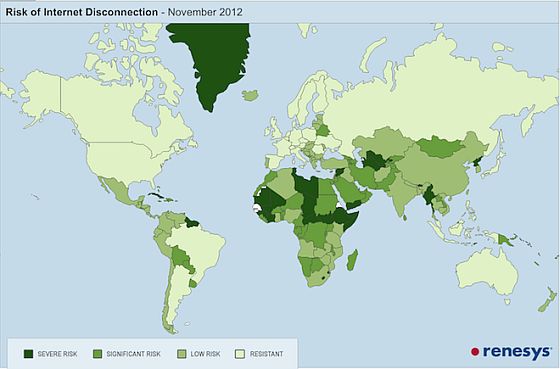
According to new research from network monitoring company Renesys, it could just as easily happen in many other countries too, including Greenland, Yemen, and Ethiopia. Sixty-one of the world’s countries have just one or two service providers connecting them to the rest of the internet.

“If you’re a sufficiently small place it’s almost inescapable that there will be so little internet that it’s almost trivial to turn it off,” says James Cowie, chief technology officer with Renesys.

On the other extreme, more than 30 countries — including the U.S., Canada and the Netherlands — have over 40 network providers each at their electronic frontiers. They’re almost impossible to unplug.

No disrespect intended towards Greenlanders, but I think they should have been left off the map. The massive dark green country at the top of the map jumps out as the largest country in jeopardy of having its internet access cut off. But there are only 56,749 people who live there. How many ISPs could they expect to have?

Facebooktwittermail

Power, pollution and the internet

A yearlong examination by The New York Times has revealed that this foundation of the information industry is sharply at odds with its image of sleek efficiency and environmental friendliness.

Most data centers, by design, consume vast amounts of energy in an incongruously wasteful manner, interviews and documents show. Online companies typically run their facilities at maximum capacity around the clock, whatever the demand. As a result, data centers can waste 90 percent or more of the electricity they pull off the grid, The Times found.

To guard against a power failure, they further rely on banks of generators that emit diesel exhaust. The pollution from data centers has increasingly been cited by the authorities for violating clean air regulations, documents show. In Silicon Valley, many data centers appear on the state government’s Toxic Air Contaminant Inventory, a roster of the area’s top stationary diesel polluters.

Worldwide, the digital warehouses use about 30 billion watts of electricity, roughly equivalent to the output of 30 nuclear power plants, according to estimates industry experts compiled for The Times. Data centers in the United States account for one-quarter to one-third of that load, the estimates show.

“It’s staggering for most people, even people in the industry, to understand the numbers, the sheer size of these systems,” said Peter Gross, who helped design hundreds of data centers. “A single data center can take more power than a medium-size town.”

Energy efficiency varies widely from company to company. But at the request of The Times, the consulting firm McKinsey & Company analyzed energy use by data centers and found that, on average, they were using only 6 percent to 12 percent of the electricity powering their servers to perform computations. The rest was essentially used to keep servers idling and ready in case of a surge in activity that could slow or crash their operations.

A server is a sort of bulked-up desktop computer, minus a screen and keyboard, that contains chips to process data. The study sampled about 20,000 servers in about 70 large data centers spanning the commercial gamut: drug companies, military contractors, banks, media companies and government agencies.

“This is an industry dirty secret, and no one wants to be the first to say mea culpa,” said a senior industry executive who asked not to be identified to protect his company’s reputation. “If we were a manufacturing industry, we’d be out of business straightaway.”

These physical realities of data are far from the mythology of the Internet: where lives are lived in the “virtual” world and all manner of memory is stored in “the cloud.”

The inefficient use of power is largely driven by a symbiotic relationship between users who demand an instantaneous response to the click of a mouse and companies that put their business at risk if they fail to meet that expectation.

Even running electricity at full throttle has not been enough to satisfy the industry. In addition to generators, most large data centers contain banks of huge, spinning flywheels or thousands of lead-acid batteries — many of them similar to automobile batteries — to power the computers in case of a grid failure as brief as a few hundredths of a second, an interruption that could crash the servers.

“It’s a waste,” said Dennis P. Symanski, a senior researcher at the Electric Power Research Institute, a nonprofit industry group. “It’s too many insurance policies.”

At least a dozen major data centers have been cited for violations of air quality regulations in Virginia and Illinois alone, according to state records. Amazon was cited with more than 24 violations over a three-year period in Northern Virginia, including running some of its generators without a basic environmental permit.

A few companies say they are using extensively re-engineered software and cooling systems to decrease wasted power. Among them are Facebook and Google, which also have redesigned their hardware. Still, according to recent disclosures, Google’s data centers consume nearly 300 million watts and Facebook’s about 60 million watts.

Many of these solutions are readily available, but in a risk-averse industry, most companies have been reluctant to make wholesale change, according to industry experts.

Improving or even assessing the field is complicated by the secretive nature of an industry that is largely built around accessing other people’s personal data. [Continue reading…]

Facebooktwittermail

How Google builds its maps — and what it means for the future of everything

Alexis Madrigal writes: Behind every Google Map, there is a much more complex map that’s the key to your queries but hidden from your view. The deep map contains the logic of places: their no-left-turns and freeway on-ramps, speed limits and traffic conditions. This is the data that you’re drawing from when you ask Google to navigate you from point A to point B — and last week, Google showed me the internal map and demonstrated how it was built. It’s the first time the company has let anyone watch how the project it calls GT, or “Ground Truth,” actually works.

The company opened up at a key moment in its evolution. The company began as an online search company that made money almost exclusively from selling ads based on what you were querying for. But then the mobile world exploded. Where you’re searching has become almost important as what you’re searching. Google responded by creating an operating system, brand, and ecosystem in Android that has become the only significant rival to Apple’s iOS.

And for good reason. If Google’s mission is to organize all the world’s information, the most important challenge — far larger than indexing the web — is to take the world’s physical information and make it accessible and useful.

“If you look at the offline world, the real world in which we live, that information is not entirely online,” Manik Gupta, the senior product manager for Google Maps, told me. “Increasingly as we go about our lives, we are trying to bridge that gap between what we see in the real world and [the online world], and Maps really plays that part.”

This is not just a theoretical concern. Mapping systems matter on phones precisely because they are the interface between the offline and online worlds. If you’re at all like me, you use mapping more than any other application except for the communications suite (phone, email, social networks, and text messaging).

Google is locked in a battle with the world’s largest company, Apple, about who will control the future of mobile phones. Whereas Apple’s strengths are in product design, supply chain management, and retail marketing, Google’s most obvious realm of competitive advantage is in information. Geo data — and the apps built to use it — are where Google can win just by being Google. That didn’t matter on previous generations of iPhones because they used Google Maps, but now Apple’s created its own service. How the two operating systems incorporate geo data and present it to users could become a key battleground in the phone wars.

But that would entail actually building a better map. [Continue reading…]

Facebooktwittermail

The revolution will not be identified

Nic Halverson writes: After Iran’s 2009 presidential elections, in what came to be known as the Green Movement, protesters flooded the streets and demanded that Mahmoud Ahmadinejad be removed from office after he was accused of rigging votes to get reelected.

During that time, the Islamic Revolutionary Guard Corps asked people to help identify dissenters in videos and photos, many of which were obtained from YouTube and social media sites. Since then, corrupt regimes, military and law enforcement agencies from across the Middle East, Europe and North America have routinely trolled YouTube and social media sites to try and identify protesters.

According to the 2011 Cameras Everywhere Report by human rights organization Witness, “No video-sharing site or hardware manufacturer currently offers users the option to blur faces or protect identity.”

Well, not anymore. YouTube has an announcement to make:

“As citizens continue to play a critical role in supplying news and human rights footage from around the world, YouTube is committed to creating even better tools to help them…Today we’re launching face blurring — a new tool that allows you to obscure faces within videos with the click of a button.” [Continue reading…]

Facebooktwittermail

Is the internet a pipeline for digital junk food?

A director of a global internet services company writes: I like the internet. I use it a lot. In fact, I work at a senior level in the industry and from here the internet does not look like a fad that will pass any time soon.

Hundreds of millions think Facebook is fun, that Google is useful, and that iPlayer is essential. Each day people reach for their phones to see if their latest Instagram is a hit, if a new profile pic is liked, or if they have been retweeted.

We do this because it is addictive – literally addictive. Each time there’s a new email, our brains reward us with a hit – a dopamine high – which encourages repeat behaviour. Apparently, it’s one of the ways in which we learn. As one behavioural psychologist put it, the internet creates “a dopamine-induced loop”, giving us “almost instant gratification of our desire to seek“.

Computer game manufacturers have long known this, and so they make products, apps or games that are “sticky”, in the jargon. Society has long known it too: stories of gamers dying of exhaustion at their keyboards are more than five years old now, not to mention “crackberries“. What they want most is for their app to be the first thing to come to your mind when your brain is idle for a second and you think, “What shall I do now?”

But why has the internet industry not asked itself whether it should be taking responsibility for these products, for creating content that is actually designed to be addictive? Does it ask whether building the digital equivalent of a Skinner box or discussing how to manufacture desire is necessarily a good thing?

In other words, are we – the internet industry – the new tobacco? And, if we are, what stage of the marketing of this new industry are we at? Is this the equivalent of the 1930s? Are we at the stage of “More doctors smoke Camels”? [Continue reading…]

Facebooktwittermail