Michael Ignatieff writes: According to the Migration Policy Institute in Washington, since September 11 the US has taken in 784,000 refugees and of these only three have been arrested subsequently on terrorism-related charges.
Fear makes for bad strategy. A better policy starts by remembering a better America. In January 1957, none other than Elvis Presley sang a gospel tune called “There Will Be Peace in the Valley” on The Ed Sullivan Show to encourage Americans to welcome and donate to Hungarian refugees. After the 1975 collapse of South Vietnam, President Ford ordered an interagency task force to resettle 130,000 Vietnamese refugees; and later Jimmy Carter found room in America for Vietnamese boat people. In 1999, in a single month, the US processed four thousand Kosovar refugees through Fort Dix, New Jersey.
These examples show what can be done if the president authorizes rapid refugee clearance in US military installations, and if the US were to process and repatriate refugees directly from the frontline states of Jordan, Lebanon, and Turkey. As Gerald Knaus of the European Stability Initiative has been urging since September, direct processing in the camps themselves will cut down on deaths by drowning in the Mediterranean. If Europe and the United States show them a safe way out, refugees won’t take their chances by paying smugglers using rubber dinghies.
The Obama administration should say yes to the UNHCR appeal to settle 65,000 refugees on an expedited basis. Refugee agencies across the United States — as well as religious communities from all faiths — have said they will take the lead in resettlement and integration. If the Liberal government in Canada can take in 25,000 refugees directly from Turkey, Lebanon, and Jordan, and process their security clearance at Canadian army bases, the US can do the same with 65,000.
Taking 65,000 people will only relieve a small portion of a refugee flow of 4.1 million, but it is an essential political gesture designed to encourage other allies — Australia, New Zealand, Brazil, Argentina — and other immigrant countries to do their part. The strategic goal is to relieve the pressure on the three frontline states. Refugee resettlement by the US also acknowledges a fact that the refugees themselves are trying to tell us: even if peace eventually comes to their tormented country, there will be no life for all of them back home.
Once the US stops behaving like a bemused bystander, watching a neighbor trying to put out a fire, it can then put pressure on allies and adversaries to make up the shortfall in funding for refugee programs run by the UNHCR and the World Food Program. One of the drivers of the exodus this summer was a sudden reduction in refugee food aid caused by shortfalls in funding. Even now these agencies remain short of what they need to provide shelter and food to the people flooding out of Syria.
Now that ISIS has brought down a Russian aircraft over Sinai and bombed civilians in Paris, Beirut, and Ankara, the US needs to use its refugee policy to help stabilize its allies in the region. The presumption that it can sit out the refugee crisis makes a hugely unwise bet on the stability of Jordan, where refugees amount to 25 percent of the total population; and Lebanon, where largely Sunni refugees, who have hardly any camps, are already destabilizing the agonizingly fragile multiconfessional order; and Turkey, where the burdens of coping with nearly two million refugees are driving the increasingly authoritarian Erdoğan regime into the arms of Vladimir Putin. [Continue reading…]
Category Archives: Issues
Roots of ISIS go deeper than the 2003 invasion of Iraq
Since most of the victims of ISIS have been Muslims and since much of the group’s conduct and philosophy are widely viewed as a perversion of Islam, one of the commonly cited pieces of evidence supporting the view that ISIS is not genuinely religious, is the fact that it is run by Iraqi former Baathists. On that basis, the organization’s religious trappings could be seen as merely a cloak for a political project.
In a discussion on the BBC World Service, however, Hassan Hassan and Jason Burke underline that the Baathists in ISIS are indeed religiously driven.
Hassan Hassan: It’s well known that the top echelon of ISIS is dominated by former Baathists who served during the Saddam Hussein regime in one way or another and that also applies to some elements within Jabhat al-Nusra in fact.
For ISIS, the Saddamist elements within ISIS also should be viewed as religious zealots. They are not any more secular Saddamist —
Owen Bennett Jones: I’ve wondered about that. You think they’ve genuinely come around to this jihadi point of view…
Hassan Hassan: There’s no doubt that’s the case. The process of transformation that these people went through is quite clear.
Jason Burke: I was in Iraq in the 90s on a number of occasions and the vision from outside was of the secular Baathist state of Saddam Hussein. Whereas he had already by the mid-90s worked out that the broad shifts in the rest of the Arab world were towards a much more religious posture — culturally, politically, otherwise — and he was tacking very much that way.
I don’t think for a moment that he himself was in any way pious, but he launched a “faith campaign” as he called it. He talked about building the biggest mosque in the world. There was some huge construction under way in Baghdad that I used to go and look at. He talked about writing the Quran in his own blood. There was lots of religious programming on the TV.
So, at the same time of course you had the UN sanctions that were on Iraq. And I remember going to schools and hearing school children singing songs — the normal stuff about fighting the Zionists and so forth, but also against the U.S. and the West and so on. So the process of radicalization, if you like, or Islamization, was well advanced even before 2003 and an invasion that effectively ousted the Sunnis from their position of dominance.
And just a very telling anecdote: When I was in Baghdad after the war I spent a day with an insurgent fighter who was very much in that kind of Sunni nationalist mode and he clearly professed himself to be a devout Muslim, but he still didn’t like what he called the terrorists.
So, there were still all sorts of different currents at that stage, but I think it is certainly the case, as Hassan was saying, that a lot of the senior Baathists and a lot of the society more generally Shia and Sunni, was very much more advanced down the path towards a religious resurgence than people would think.
Amid the ongoing debate about how to tackle ISIS, many observers prefer to sidestep that question by pointing out that ISIS would not have come into existence had it not been for the disastrous choice the U.S. made by invading Iraq in 2003.
Much as this observation is valid, it also has the effect of reinforcing the dogma which portrays the ills of the world as all ultimately being products of America’s excessive military power and the misuse of that power.
Devout believers of this political dogma, especially those who are themselves Americans and who can easily point to the destructive impact of decades of U.S. meddling in global affairs, on this basis commonly conclude that little else really needs to be understood about the world than that America is the problem.
From this perspective, the best the U.S. can do is to get out of the way. If America is the problem, then non-interference is the panacea. Moreover, a common assumption is that even if chaos continues to prevail, U.S. involvement will only make the situation worse and thus we can and should disengage from the affairs of the Middle East.
I have little doubt that those Americans who subscribe to this view see it as a foreign-policy equivalent of the Hippocratic oath, thinking that the only way the U.S. can do no harm in the world is by attending to its domestic concerns and assuming a much more modest role on the global stage.
This sentiment, however, licenses ignorance and the ready acceptance of simplistic analysis — such as much of that now being applied to ISIS. It also facilitates the propagation of conspiracy theories.
But anyone who wants to seriously think about ISIS — to understand how it emerged and how it is evolving — needs to set aside this perspective that insistently overstates American power.
If we only see ISIS as a product of the 2003 U.S. invasion of Iraq, we’re not going to see how its emergence needs to be placed in a wider historical perspective: as a product of the failure of Arab secular nationalism and authoritarian rule.
The uprisings of 2011 during the Arab Spring posed a threat to every single government across the region. What has in large part saved most of them from the threat of democracy is the subsequent growth of a threat from terrorism.
ISIS as a reactionary political force has played a major role in shifting the regional debate from a contest between dictatorship and democracy, to a bloody struggle between stability and chaos.
Those who are threatened by ISIS’s expansion nevertheless also benefit from its existence. Stability becomes imperative only when instability is seen as the sole alternative.
This is how Bashar al-Assad, in spite of destroying much of Syria and driving half the population out of their homes, is succeeding in keeping tyranny alive.
Surveillance challenge: The transition from struggling identity to mujahid is often fast and furious
Scott Atran and Nafees Hamid write: French counterterrorism surveillance data (FSPRT) has identified 11,400 radical Islamists, 25 percent of whom are women and 16 percent minors — among the minors, females are in a majority. Legal proceedings are now underway against 646 people suspected of involvement in terrorist activity. French Prime Minister Manuel Valls conceded after Friday’s attacks that even keeping full track of those suspected of being prone to violent acts is practically impossible: around-the-clock surveillance of a single individual requires ten to twenty security agents, of which there are only 6,500 for all of France.
Nor is it a matter of controlling the flow of people into France. France’s Center for the Prevention of Sectarian Drift Related to Islam (CPDSI) estimates that 90 percent of French citizens who have radical Islamist beliefs have French grandparents and 80 percent come from non-religious families. In fact, most Europeans who are drawn into jihad are “born again” into radical religion by their social peers. In France, and in Europe more generally, more than three of every four recruits join the Islamic State together with friends, while only one in five do so with family members and very few through direct recruitment by strangers. Many of these young people identify with neither the country their parents come from nor the country in which they live. Other identities are weak and non-motivating. One woman in the Paris suburb of Clichy-sous-Bois described her conversion as being like that of a transgender person who opts out of the gender assigned at birth: “I was like a Muslim trapped in a Christian body,” she said. She believed she was only able to live fully as a Muslim with dignity in the Islamic State.
For others who have struggled to find meaning in their lives, ISIS is a thrilling cause and call to action that promises glory and esteem in the eyes of friends, and through friends, eternal respect and remembrance in the wider world that many of them will never live to enjoy. A July 2014 poll by ICM Research suggested that more than one in four French youth of all creeds between the ages of eighteen and twenty-four have a favorable or very favorable opinion of ISIS. Even if these estimates are high, in our own interviews with young people in the vast and soulless housing projects of the Paris banlieues we found surprisingly wide tolerance or support for ISIS among young people who want to be rebels with a cause — who want, as they see it, to defend the oppressed.
Yet the desire these young people in France express is not to be a “devout Muslim” but to become a mujahid (“holy warrior”): to take the radical step, immediately satisfying and life-changing, to obtain meaning through self-sacrifice. Although feelings of marginalization and outrage may build over a long time, the transition from struggling identity to mujahid is often fast and furious. The death of six of the eight Paris attackers by suicide bombs and one in a hail of police bullets testifies to the sincerity of this commitment, as do the hundreds of French volunteer deaths in Syria and Iraq. [Continue reading…]
The global surge in terrorism
The Atlantic reports: The grisly attacks in France and Lebanon last week have fixed attention on the violence perpetrated by ISIS. But a study published this week indicates that the world’s deadliest terrorist organization actually operates thousands of miles south of Paris and Beirut, in Nigeria.
The 2015 Global Terrorism Index, published by the Institute for Economics & Peace, found that Boko Haram, the Nigerian jihadist group, was responsible for 6,644 deaths in 2014, compared with 6,073 at the hands of ISIS. Boko Haram, which was founded in 2002 as an Islamist movement against Western education and morphed into an armed insurgency in 2009, has rapidly expanded its scope and ambitions over the past two years, achieving international notoriety in the spring of 2014 by kidnapping more than 200 schoolgirls. Much like ISIS, the organization controls territory in Nigeria (although it has lost some of it over the past year) and has declared a caliphate in that territory. The group is also international; although based in northeastern Nigeria, it has launched attacks in Cameroon, Chad, and Niger. In the latest incident, Boko Haram is the suspected author of an attack in the Nigerian city of Yola that has left more than 30 people dead. [Continue reading…]
Conflict makes countries more vulnerable to climate change
Reuters reports: Syria, Libya and Yemen are among the countries whose ability to withstand climate change shocks and stresses has deteriorated most in the past five years, suggesting conflict makes people more vulnerable to climate impacts, researchers said.
The University of Notre Dame Global Adaptation Index (ND-GAIN), released on Tuesday, uses 46 indicators to measure climate change risks to 180 countries and how ready they are to accept investment that could help them cope with more extreme weather and rising seas.
The main contributing factors to the falling scores of the three fragile states in the Middle East and North Africa, riven by armed conflict, are increases in political instability, violence, corruption and poor rule of law, according to the index. [Continue reading…]
The U.S. Holocaust Museum urges lawmakers not to turn their backs on Syrian refugees
Quartz reports: On Monday, Nov. 19, mere hours after legislators voted to pass a bill making it even harder for Syrian refugees to seek refuge in the United States, the US Holocaust Memorial Museum released the following statement:
Acutely aware of the consequences to Jews who were unable to flee Nazism, the United States Holocaust Memorial Museum looks with concern upon the current refugee crisis. While recognizing that security concerns must be fully addressed, we should not turn our backs on the thousands of legitimate refugees.
The Museum calls on public figures and citizens to avoid condemning today’s refugees as a group. It is important to remember that many are fleeing because they have been targeted by the Assad regime and ISIS for persecution and in some cases elimination on the basis of their identity.
It’s a statement perhaps reflective of growing sentiments among North America’s Jewish communities; a recollection of policies that kept those fleeing terror and persecution in Nazi-occupied Europe from settling down in the United States. [Continue reading…]
Republican Ben Carson compares Syrian refugees to ‘rabid dogs’
Reuters reports: Republican presidential candidate Ben Carson on Thursday likened refugees fleeing violence in Syria to “rabid dogs,” and said that allowing them into the United States would put Americans at risk.
“If there is a rabid dog running around your neighborhood, you’re probably not going to assume something good about that dog,” Carson, a front-runner in some opinion polls, said Thursday at a campaign event in Mobile, Alabama.
“By the same token, we have to have in place screening mechanisms that allow us to determine who the mad dogs are, quite frankly,” the retired neurosurgeon said, criticizing President Barack Obama’s plan to admit 10,000 Syrian refugees within a year. [Continue reading…]
Ted Cruz, the Syrian Muslim Hunter
Dean Obeidallah writes: “We have no earthly way to know who they are,” exclaimed Republican Congressman Michael Burgess while speaking about the Syrian refugees on MSNBC Monday night. “The FBI doesn’t even have a database.”
But there’s one man who can sort it all out. A special dude from Texas, by way of Canada, who has the ability to decide which refugees are good and which are bad. And that person is Ted Cruz: The Muslim Hunter.
You see, Cruz, as opposed to Marco Rubio and Donald Trump, who oppose any Syrian refugees being admitted into the United States, has a more creative way to deal with this human catastrophe. He’s announced plans to introduce federal legislation to ban the Muslim refugees, but accept the Christian ones.
Why the distinction? Well, the Muslim Hunter tends to believe that any Muslim might be evil. In contrast, he declared that “there is no meaningful risk of Christians committing acts of terror.” Ooops, looks like Cruz never heard of Christian terrorists like Olympic bomber Eric Rudolph, the killer of “abortion doctor” George Tiller, Robert Doggart (the Christian minister on trial for plotting terrorist attack to kill Muslims in New York State) the KKK, Timothy McVeigh, etc.
With that aside, Cruz’s plan raises a few questions. For example, how do you accurately determine a refugee’s religion? I would imagine many would be willing to claim they are Christian in order to save their families and start a new life in America.
Have no fear because The Muslim Hunter undoubtedly will come up with some tests to sniff out those stealth Muslims. Maybe the refugees will be required to eat a bacon cheeseburger while drinking Jagermeister. Or perhaps each refugee will be shown a photo of Bill Maher—if they reflexively recoil, it’s no USA for them. Possibly Cruz will employ a subtler test like asking them which way is Mecca? If the refugee quickly points in the right direction, he’s got ’em! [Continue reading…]
‘People become outraged, they cry, and they do nothing’ — how compassion mutated into fear
Remember this little boy? A Syrian. Can we be sure he wasn’t a terrorist? https://t.co/HGQDZyWldO pic.twitter.com/At01ywBVqy
— csdickey (@csdickey) November 19, 2015
America’s Muslims face backlash after Paris attacks
The Associated Press reports: Muslims around the US are facing backlash following the deadly attacks in Paris, including vandalism to mosques and Islamic centres, hate- filled phone and online messages and threats of violence.
Advocacy leaders say they have come to expect some anti-Muslim sentiment following such attacks, but they now see a spike that seems notable, stirred by anti-Muslim sentiment in the media.
“The picture is getting increasingly bleak,” said Ibrahim Hooper, a spokesman for the Washington, D.C.-based Council on American-Islamic Relations. “There’s been an accumulation of anti—Islamic rhetoric in our lives and that I think has triggered these overt acts of violence and vandalism.” [Continue reading…]
Americans fear terrorism because they are easy to terrify
Mark Edmundson writes: Among the puzzling questions of world history and national identity, a few stand out. How, one might ask, did the Vikings, once the roving terrors of the world, manage to become equable Nordic socialists with lessons to teach us in the arts of decency and fairness? And how did the tough, soldierly Romans, conquerors of the world, manage to evolve into the charming, pleasure-loving Italians, with their gifts for good food, good wine, and civic instability?
Soon, a similarly unexpected question may be asked about Americans. How did a people who settled a continent, created enormous wealth, and fought and (mostly) won war after war devolve into a nation of such tremulous souls? And how did it happen so quickly? Where once there was the generation of the Second World War, ready to leave home and fight fascists on the far sides of the world, we now have a nation that at times seems composed largely of field mice, prone to quiver when they detect an unfriendly shadow. As a people, we seem to value security and prosperity above all. When someone threatens either, or seems about to, we become (in this order) confused, then terrified, and then very angry.
Those who dislike us around the world (and of course there are more than a few) tend to see us as a powerful, imperial beast, brutally pursuing our own ends across the globe. We are strong and violent, and when we want something, we assert ourselves with overwhelming force. But is that really the case?
What appear to the outside world as instances of bullying, and what appear to us as expressions of strength, may reveal themselves, on closer examination, to be actions driven by fear. We are a people obsessed with security. Our imagination of what counts as a threat to our security is hyperactive and becoming more so all the time. Two years into World War II, it took the fierce attack on Pearl Harbor to persuade Americans that it was finally time to fight. Once persuaded, they did. Now it takes only the least incitement to make us feel threatened. When even the most shadowy forces and conditions imperil what we call “our security,” we assault them with the furor of the easily scared. [Continue reading…]
Trump receptive to idea that Muslims in the U.S. be treated like Jews in Nazi Germany — ‘security is going to rule’
Yahoo News reports: After Paris, Trump said “security is going to rule” in the United States, in order to take on what he calls “radical Islamic terrorism.” America has currently agreed to take in 10,000 refugees from the ISIS stronghold in Syria. However, if he is elected, Trump said he would deport any Syrian refugees allowed to enter this country under President Obama.
“They’re going to be gone. They will go back. … I’ve said it before, in fact, and everyone hears what I say, including them, believe it or not,” Trump said of the refugees. “But if they’re here, they have to go back, because we cannot take a chance. You look at the migration, it’s young, strong men. We cannot take a chance that the people coming over here are going to be ISIS-affiliated.”
Yahoo News has reported that about half of the approximately 2,000 refugees from Syria who have come to the U.S. so far have been children. Another quarter are more than 60 years old. The Obama administration has maintained that the extensive screening process for these refugees makes the program safe to maintain — not to mention a reflection of America’s core values.
But Trump doesn’t buy it. He also has concerns about the larger Muslim community here in the U.S., he said.
Yahoo News asked Trump whether his push for increased surveillance of American Muslims could include warrantless searches. He suggested he would consider a series of drastic measures.
“We’re going to have to do things that we never did before. And some people are going to be upset about it, but I think that now everybody is feeling that security is going to rule,” Trump said. “And certain things will be done that we never thought would happen in this country in terms of information and learning about the enemy. And so we’re going to have to do certain things that were frankly unthinkable a year ago.”
Yahoo News asked Trump whether this level of tracking might require registering Muslims in a database or giving them a form of special identification that noted their religion. He wouldn’t rule it out.
“We’re going to have to — we’re going to have to look at a lot of things very closely,” Trump said when presented with the idea. “We’re going to have to look at the mosques. We’re going to have to look very, very carefully.” [Continue reading…]
Anti-refugee stance by Republican politicians is alienating some of their own supporters
Jason Boyett writes: Throughout the Gospels, Jesus taught his followers to love their enemies (Matthew 5:43-44), welcome strangers (Matthew 25:40), and show mercy to those in need (Luke 10:25-37). No doubt these teachings apply to families on the run from Isis.
These passages represent only a sliver of biblical teaching on the topic, and the Christians I know don’t just believe these verses, but act on them.
Consider my conservative Republican family. We live in Amarillo, Texas, a highly religious, conservative stronghold in a very red state. Amarillo also has an abnormally high ratio of new refugees to residents – higher than any Texas city. What’s more, many in the city are on the front-lines of welcoming those fleeing war or persecution. You wouldn’t know this from the political stances of the Republican lawmakers claiming to represent Texas, or Amarillo, as their constituents.
My mother and mother-in-law teach English to refugees and immigrants at my childhood Southern Baptist church. Both women love interacting with these foreign families, many of whom are Muslims from war-torn nations like Iraq, Iran and Sudan. They have shared meals together. They have visited these families in the hospital. They have become friends.
My brother, who runs a religious nonprofit, mentors youth at apartment projects across Amarillo. In recent years, the resident base at these complexes has shifted from low-income minorities to immigrant and refugee families. This makes my brother one of the first Americans they meet – and definitely one of the first they trust.
On a typical weekday after school, he might lead activities for 15 children and hear 15 different languages. He tells me the Muslim families in particular work harder than anyone else and are more welcoming to him than anyone else. They have never made him feel unsafe.
Unfortunately, the politicians claiming to represent us don’t feel that way. [Continue reading…]
McCain tells fellow Republicans: ‘Refugees are not the problem — they are the symptom of the problem’
The Hill reports: Sen. John McCain (R-Ariz.) warned his fellow Republicans on Wednesday not to place too much emphasis on Syrian refugees following the terrorist attacks in Paris last week, calling their focus misguided.
“I believe the overwhelming focus on the refugee program in recent days is misplaced,” said McCain, chairman of the Senate Armed Services Committee, in a written statement. “I especially encourage my fellow Republicans to recognize that refugees are not the problem — they are the symptom of the problem.”
Since attacks credited to the Islamic State in Iraq and Syria (ISIS) killed at least 129 people on Friday, Republicans have called for pausing — or in some cases stopping altogether — the admission of Syrian refugees into the U.S. [Continue reading…]
Belgium is a failed state
Tim King (editor of European Voice for The Economist) writes: [Molenbeek] is one of the most densely populated parts of Brussels, but its population is only 95,000. And it is not that the entire borough is a no-go zone. The lawlessness problems are concentrated in much smaller areas.
All of which raises the question of why Molenbeek’s problems have been allowed to persist for so long. This is not a task on the same scale as reviving the South Bronx or redressing the industrial blight of Glasgow. The nearest parallel I can think of is Brixton, a London suburb, three miles south of Westminster. Blighted by wartime bomb damage, then home to large contingents of West Indian immigrants in the 1950s and 1960s, it suffered race riots in the 1980s. But much of Brixton has been turned round, so why not Molenbeek?
The answers are an indictment of the Belgian political establishment and of successive reforms over the past 40 years.
Those failures are perhaps one part politics and government; one part police and justice; one part fiscal and economic. In combination they created the vacuum that is being exploited by jihadi terrorists.
Belgium has the trappings of western political structures, but in practice those structures are flawed and have long been so. The academics Kris Deschouwer and Lieven De Winter gave a succinct, authoritative account of the development of political corruption and clientelism in an essay published back in 1998 as part of the piquantly titled book “Où va la Belgique?” (Whither Belgium?)
Almost from the beginning, they explain, the state suffered problems of political legitimacy. [Continue reading…]
Drone operators see children as ‘fun-sized terrorists’
The Guardian reports: When Michael Haas, a former senior airman with the US air force, looks back on the missions he flew over Afghanistan and other conflict zones in a six-year career operating military drones, one of the things he remembers most vividly is the colorful language airmen would use to describe their targets. A team of three would be sitting, he recalls, in a ground control station in Creech air force base outside Las Vegas, staring at computer screens on to which images would be beamed back from high-powered sensors on Predator drones thousands of miles away.
The aim of the missions was to track, and when the conditions were deemed right, kill suspected insurgents. That’s not how they put it, though. They would talk about “cutting the grass before it grows out of control”, or “pulling the weeds before they overrun the lawn”.
And then there were the children. The airmen would be flying the Predators over a village in the tribal areas of Pakistan, say, when a series of smaller black shadows would appear across their screens – telling them that kids were at the scene.
They called them “fun-sized terrorists”.
Haas is one of four former air force drone operators and technicians who as a group have come forward to the Guardian to register their opposition to the ongoing reliance on the technology as the US military’s modern weaponry of choice. Between them, the four men clocked up more than 20 years of direct experience at the coalface of lethal drone programs and were credited with having assisted in the targeted killings of hundreds of people in conflict zones – many of them almost certainly civilians. [Continue reading…]
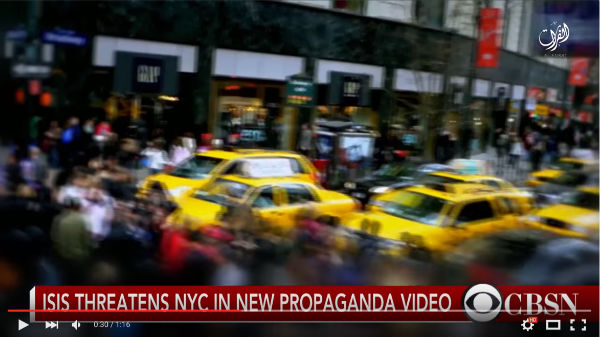
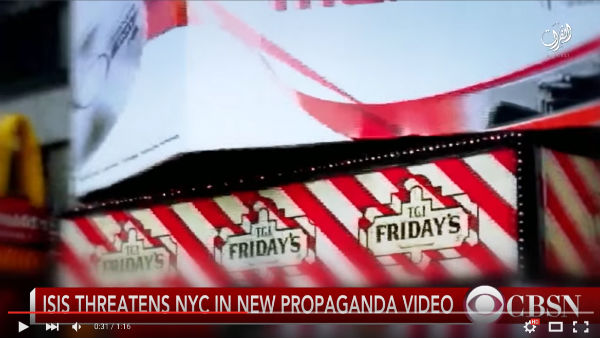
New ISIS video threatening New York City uses stock images
The fact that a new ISIS video threatening New York City uses snippets from commercial videos available on YouTube, does not mean that the threat can be dismissed.
It does, nevertheless, indicate that the imagery in this video should not be taken at face value. This is not footage that was filmed on the ground by would-be attackers.
It’s reasonable to assume that ISIS produced the sections of the video showing a bomb being assembled, but they have then spliced these together with stock footage in a slick piece of editing that creates the appearance of a single production.
In one snippet of the ISIS video, we see a tracking shot showing taxis stopped at an intersection next to a Gap store:

This comes from a video made by StockFootage.com “Fast tracking shot of crowded street in nyc.“:

The ISIS video shows a TGI Friday’s:

This comes from another StockFootage.com video, “Panning shots of signs in Times Square New York City“:

Call fear of Syrian refugees for what it is: Islamophobia
There is a vile current of hostility that has existed in America throughout its history. It resulted in the extermination and internment of the indigenous population of this continent. It cradled the capture, enslavement, and oppression of many generations of Africans and their descendants.
Festering American fear and hatred has caught in its gaze, Irish, German, Chinese, and Latino immigrants, Catholics, Jews, Japanese Americans, homosexuals, Communists, and all people of color.
Nowadays it lingers in the last domain where animosity towards others can freely be expressed with relatively little risk of public censure: by voicing fear of Islam and Muslims.
Well-tutored by the codes of political correctness, the haters understand that their enmity must be delivered through ostensibly impersonal vehicles. Their critique is of the doctrine, not its adherents. A nod of respect is made towards America’s tradition of religious tolerance, but simultaneously dismissed by claiming that Islam is not a religion.
*
No one is a bigot in their own eyes and no ones bigotry gets dislodged simply by pointing out its offensiveness.
Hatred is born out of fear rooted in ignorance.
Let’s, for a moment, indulge the fears of those Americans who currently want to exclude Syrian refugees from entering this country and acknowledge that it is possible that in spite of the careful vetting process which all refugees must pass through, a few individuals with ties to ISIS could use this as a route for entering the U.S. and once here launch a terrorist attack. Even if candidates were further limited by only allowing Christians, it’s conceivable that a member of ISIS could claim to be a Christian. There is as far as I know, no blood test or scanning device that is able to differentiate between Christians and non-Christians.
So, would blocking the entry of all Syrian refugees significantly guard against this risk posed by ISIS?
No. Why?
Several reasons:
Although ISIS, with ridiculous ease, was able to dupe many in the West into imagining that the Paris attacks were tied to Syrian refugees — seriously, folks, consider for a few seconds what would motivate someone to take their passport on a suicide mission — we need to remember that ISIS is rooted in the Sunni provinces of Iraq.
The Islamic State of Iraq and Syria was previously the Islamic State of Iraq and before that it was al-Qaeda in Iraq.
So, if the U.S. wants to implement a discriminatory refugee policy and pander to fears surrounding the risk of an ISIS attack, then blocking the entry of 10,000 Syrians would definitely be too little, too late.
In the three years prior to 2015, the U.S. has accepted 51,107 Iraqi refugees.
Still, let’s also not lose sight of the fact that ISIS has recruited fighters from many nations and its suicide attacks tend to be carried out by neither Iraqis nor Syrians.
If the U.S. wants to be systematic and comprehensive in formulating its anti-ISIS refugee policy, it will also need to prevent refugees entering this country from Afghanistan, Algeria, Bahrain, Egypt, Jordan, Kazakhstan, Kuwait, Kyrgyzstan, Lebanon, Libya, Pakistan, Palestine, Saudi Arabia, Tunisia, Turkmenistan, Uzbekistan, and Yemen.
But that won’t be enough. In ISIS’s ranks there are passport holders from Russia, Serbia, and Ukraine whose citizens can enter this country with a visa.
And then there are ISIS passport holders from Australia, Austria, Belgium, Canada, Denmark, Estonia, Finland, France, Germany, Ireland, Italy, Luxembourg, the Netherlands, New Zealand, Norway, Spain, Sweden, and the UK, all of whom can come here without a visa as tourists.
It looks like fortress America doesn’t just need a wall — it can’t even afford the risk of having any entry points.
Would that make America safe?
Not if the Paris attacks serve as a model for an ISIS attack in the U.S.
In such an event we will not be attacked by Frenchmen. Instead, ISIS will reveal its American face.
Does that mean we should now be afraid of an enemy within?
Robert F. Dees, a retired Army officer who describes himself as “an ambassador for the Lord Jesus Christ,” and who serves as a foreign policy adviser to GOP presidential hopeful, Ben Carson, says “we’ve been infiltrated.” He sees all Muslims inside and outside America — almost a quarter of the world’s population — as potential terrorists.
This is McCarthyism on steroids.
Those who foment these fears are not simply promoting irrational thinking but they are also playing a fundamentally divisive role in American society.
*
National traumas have healing power when they open opportunities for people to stand together and set aside their differences.
This doesn’t mean finding camaraderie through a shared hatred.
It means having the courage to show that love is more powerful than hate.
When English and French football supporters all sang La Marseillaise in Wembley stadium in London last night, this was more than an act of defiance — a refusal to give in to terrorism.
It was an opportunity for ordinary people to show they care about each other and know that life as precious.