Category Archives: Issues

The passionate intensity of terrorists who lack true conviction

Slavoj Žižek writes: Long ago Friedrich Nietzsche perceived how Western civilisation was moving in the direction of the Last Man, an apathetic creature with no great passion or commitment. Unable to dream, tired of life, he takes no risks, seeking only comfort and security, an expression of tolerance with one another: “A little poison now and then: that makes for pleasant dreams. And much poison at the end, for a pleasant death. They have their little pleasures for the day, and their little pleasures for the night, but they have a regard for health. ‘We have discovered happiness,’ – say the Last Men, and they blink.”

It effectively may appear that the split between the permissive First World and the fundamentalist reaction to it runs more and more along the lines of the opposition between leading a long satisfying life full of material and cultural wealth, and dedicating one’s life to some transcendent Cause. Is this antagonism not the one between what Nietzsche called “passive” and “active” nihilism? We in the West are the Nietzschean Last Men, immersed in stupid daily pleasures, while the Muslim radicals are ready to risk everything, engaged in the struggle up to their self-destruction. William Butler Yeats’ “Second Coming” seems perfectly to render our present predicament: “The best lack all conviction, while the worst are full of passionate intensity.” This is an excellent description of the current split between anemic liberals and impassioned fundamentalists. “The best” are no longer able fully to engage, while “the worst” engage in racist, religious, sexist fanaticism.

However, do the terrorist fundamentalists really fit this description? What they obviously lack is a feature that is easy to discern in all authentic fundamentalists, from Tibetan Buddhists to the Amish in the US: the absence of resentment and envy, the deep indifference towards the non-believers’ way of life. If today’s so-called fundamentalists really believe they have found their way to Truth, why should they feel threatened by non-believers, why should they envy them? When a Buddhist encounters a Western hedonist, he hardly condemns. He just benevolently notes that the hedonist’s search for happiness is self-defeating. In contrast to true fundamentalists, the terrorist pseudo-fundamentalists are deeply bothered, intrigued, fascinated, by the sinful life of the non-believers. One can feel that, in fighting the sinful other, they are fighting their own temptation.

It is here that Yeats’ diagnosis falls short of the present predicament: the passionate intensity of the terrorists bears witness to a lack of true conviction. How fragile the belief of a Muslim must be if he feels threatened by a stupid caricature in a weekly satirical newspaper? [Continue reading…]


Facebooktwittermail

Rate of environmental degradation puts life on Earth at risk, say scientists

The Guardian reports: Humans are “eating away at our own life support systems” at a rate unseen in the past 10,000 years by degrading land and freshwater systems, emitting greenhouse gases and releasing vast amounts of agricultural chemicals into the environment, new research has found.

Two major new studies by an international team of researchers have pinpointed the key factors that ensure a livable planet for humans, with stark results.

Of nine worldwide processes that underpin life on Earth, four have exceeded “safe” levels – human-driven climate change, loss of biosphere integrity, land system change and the high level of phosphorus and nitrogen flowing into the oceans due to fertiliser use.

Researchers spent five years identifying these core components of a planet suitable for human life, using the long-term average state of each measure to provide a baseline for the analysis. [Continue reading…]

Facebooktwittermail

Charlie Hebdo founder says slain editor ‘dragged’ team to their deaths

The Telegraph reports: One of the founding members of Charlie Hebdo has accused its slain editor, Patrick Charbonnier, or Charb, of “dragging the team” to their deaths by releasing increasingly provocative cartoons, as five million copies of the “survivors’ edition” went on sale.

Henri Roussel, 80, who contributed to the first issue of the satirical weekly in 1970, wrote to the murdered editor, saying: “I really hold it against you.”

In this week’s Left-leaning magazine Nouvel Obs, Mr Roussel, who publishes under the pen name Delfeil de Ton, wrote: “I know it’s not done”, but proceeds to criticise the former “boss” of the magazine.

Calling Charb an “amazing lad”, he said he was also a stubborn “block head”.

“What made him feel the need to drag the team into overdoing it,” he said, referring to Charb’s decision to post a Mohammed character on the magazine’s front page in 2011. Soon afterwards, the magazine’s offices were burned down by unknown arsonists.

Delfeil adds: “He shouldn’t have done it, but Charb did it again a year later, in September 2012.”

The accusation sparked a furious reaction from Richard Malka, Charlie Hebdo’s lawyer for the past 22 years, who sent an angry message to Mathieu Pigasse, one of the owners of Nouvel Obs and Le Monde. [Continue reading…]

Facebooktwittermail

What is the religion-terrorism connection?

John Esposito and Dalia Mogahed write: The religious language and symbolism that terrorists use tend to place religion at center stage. Many critics charge that global terrorism is attributable to Islam — a militant or violent religion — and terrorists who are particularly religious folks. For example, in a Washington Times commentary, author Sam Harris writes:

It is time we admitted that we are not at war with “terrorism”. We are at war with Islam. This is not to say that we are at war with all Muslims, but we are absolutely at war with the vision of life that is prescribed to all Muslims in the Koran. The only reason Muslim fundamentalism is a threat to us is because the fundamentals of Islam are a threat to us. Every American should read the Koran and discover the relentlessness with which non-Muslims are vilified in its pages. The idea that Islam is a “peaceful religion hijacked by extremists” is a dangerous fantasy — and it is now a particularly dangerous fantasy for Muslims to indulge.

Lawrence Auster of FrontPage magazine echoes this sentiment. He writes: “The problem is not ‘radical’ Islam but Islam itself, from which it follows that we must seek to weaken and contain Islam…”

What do the data say? Does personal piety correlate with radical views? The answer is no. Large majorities of those with radical views and moderate views (94% and 90%, respectively) say that religion is an important part of their daily lives. And no significant difference exists between radicals and moderates in mosque attendance.

Gallup probed respondents further and actually asked those who condone and condemn extremist acts why they said what they did. The responses fly in the face of conventional wisdom. For example, in Indonesia, the largest Muslim majority country in the world, many of those who condemn terrorism cite humanitarian or religious justifications to support their response. For example, one woman says, “Killing one life is as sinful as killing the whole world,” paraphrasing verse 5:32 in the Quran.

On the other hand, not a single respondent in Indonesia who condones the attacks of 9/11 cites the Quran for justification. Instead, this group’s responses are markedly secular and worldly. For example, one Indonesian respondent says, “The US government is too controlling toward other countries, seems like colonizing”. The real difference between those who condone terrorist acts and all others is about politics, not piety.

How then do we explain extremists’ religious rhetoric? As our data clearly demonstrate, religion is the dominant ideology in today’s Arab and Muslim world, just as secular Arab nationalism was in the days of Egyptian President Gamal Abdel Nasser. The Palestinian Liberation Organization — from its inception, a staunchly secular group — used secular Palestinian nationalism in its rhetoric to justify acts of violence and to recruit. Just as Arab nationalism was used in the 1960s, today religion is used to justify extremism and terrorism.

Examining the link between religion and terrorism requires a larger and more complex context. Throughout history, close ties have existed among religion, politics, and societies. Leaders have used and hijacked religion to recruit members, to justify their actions, and to glorify fighting and dying in a sacred struggle. [Continue reading…]

Facebooktwittermail

French court banned advertisement insulting Christian faith

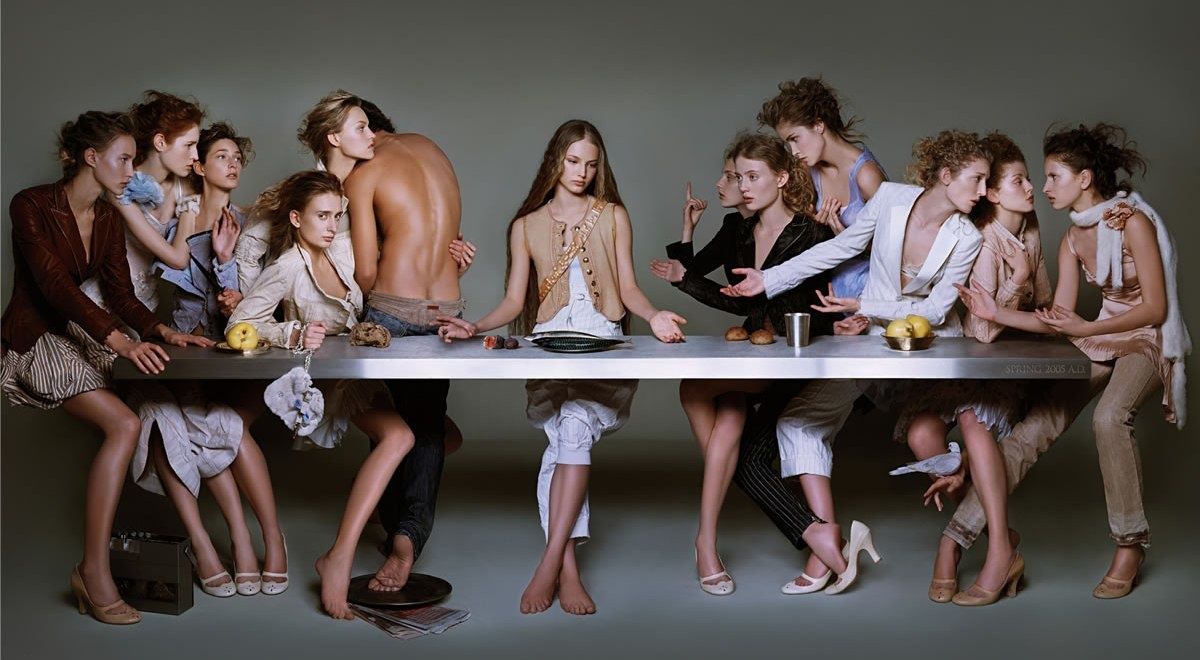
On March 11, 2005, BBC News reported: France’s Catholic Church has won a court injunction to ban a clothing advertisement based on Leonardo da Vinci’s Christ’s Last Supper.

The display was ruled “a gratuitous and aggressive act of intrusion on people’s innermost beliefs”, by a judge.

The church objected to the female version of the fresco, which includes a female Christ, used by clothing designers Marithe et Francois Girbaud.

The authorities in the Italian city of Milan banned the poster last month.

The French judge in the case ordered that all posters on display should be taken down within three days.

The association which represented the church was also awarded costs.

Facebooktwittermail

Rapid deterioration in living conditions of Syrian refugees in Jordan

UNHCR: UN High Commissioner for Refugees António Guterres says large numbers of Syrian refugees are sliding into abject poverty, and at an alarming rate, due to the magnitude of the crisis and insufficient support from the international community.

He made the statement at the launch of a new UNHCR study, Living in the Shadows, which reveals evidence of a deepening humanitarian crisis. High Commissioner Guterres is on a two-day visit to Jordan, where he will meet refugees profiled in the study in Amman and others at the Za’atari refugee camp.

“I am here to express my solidarity with Syrian refugees, as the impact of snowstorm Huda is still tangible and posing an even greater strain on their already dire living conditions.” Guterres is also meeting with Jordanian officials and with donors to coordinate efforts to improve living conditions for Syrian refugees and support the communities hosting them.

Conducted by UNHCR and International Relief and Development (IRD) the study is based on data from home visits with almost 150,000 Syrian refugees living outside of camps in Jordan in 2014.

According to the study, two-thirds of refugees across Jordan are now living below the national poverty line, and one in six Syrian refugee households is in abject poverty, with less than $40 per person per month to make ends meet.

Almost half of the households researchers visited had no heating, a quarter had unreliable electricity, and 20 per cent had no functioning toilet. Rental costs accounted for more than half of household expenditures, and refugee families were increasingly being forced to share accommodations with others to reduce costs.

Facebooktwittermail

Media coverage of Charlie Hebdo and the Baga massacre: a study in contrasts

By Ethan Zuckerman, Massachusetts Institute of Technology

Consider two tragic events that took place last week.

A small cell of Islamic terrorists attacked cartoonists at the satirical magazine Charlie Hebdo and shoppers in a Paris supermarket, killing 17 people and sparking international outcry, solidarity and support.

The hashtag #JeSuisCharlie trended globally, and world leaders took to the streets to march in support of Parisian resilience.

In northern Nigeria, meanwhile, an army of Islamic extremists razed the village of Baga, killing as many as 2,000 people – mostly women and children who were unable to flee the attacks.

Later in the week, the same army – Boko Haram – introduced a horrific new weapon of war in the nearby city of Maiduguri. They strapped explosives to the body of a ten year old girl and sent her into the city’s main poultry market. The girl was stopped by guards and a metal detector at the market’s entrance, but the bomb detonated and killed at least 19.

There has been no global hashtag campaign or march for the victims of these most recent Boko Haram massacres.

Continue reading

Facebooktwittermail

Would Prophet Muhammad say ‘Je Suis Charlie’?

Khaled Diab asks: Would the prophet forgive Charlie Hebdo’s lampooning of him and his religion? If he were alive today, would he tweet his solidarity with the slain cartoonists?

My own reading of Muhammad’s life and history leads me to conclude that although the prophet may not have tweeted “#JeSuisCharlie,” he would have condemned these savage murders and even forgiven French satirists no matter what insult was directed his way.

While some might find my assertion hard to believe, it is backed up by Muhammad’s own actions and convictions. Although the prophet’s contemporary self-appointed defenders take offence on his behalf and believe they are doing his will by protesting perceived insults or punishing those who commit them, their actions could not be further from the truth.

During the vulnerable early years of Islam, the Islamic prophet endured and tolerated mockery and disdain. Even in victory, Muhammad wisely advised to exercise tolerance. Upon his triumphant return to Mecca, he forgave the inhabitants of the city which had been home to his fiercest enemies. He even pardoned a member of his inner circle, Abdullah Ibn Saad, who denounced the prophet as a charlatan.

More importantly, the Islam Muhammad preached recognised the pluralistic nature of society and guaranteed freedom of belief. Surat al-Baqara of the Quran reminds Muslims: “There shall be no compulsion in religion.” [Continue reading…]

Facebooktwittermail

The power of any faith comes from within

Mustafa Akyol writes: The only source in Islamic law that all Muslims accept indisputably is the Quran. And, conspicuously, the Quran decrees no earthly punishment for blasphemy — or for apostasy (abandonment or renunciation of the faith), a related concept. Nor, for that matter, does the Quran command stoning, female circumcision or a ban on fine arts. All these doctrinal innovations, as it were, were brought into the literature of Islam as medieval scholars interpreted it, according to the norms of their time and milieu.

Tellingly, severe punishments for blasphemy and apostasy appeared when increasingly despotic Muslim empires needed to find a religious justification to eliminate political opponents.

One of the earliest “blasphemers” in Islam was the pious scholar Ghaylan al-Dimashqi, who was executed in the 8th century by the Umayyad Empire. His main “heresy” was to insist that rulers did not have the right to regard their power as “a gift of God,” and that they had to be aware of their responsibility to the people.

Before all that politically motivated expansion and toughening of Shariah, though, the Quran told early Muslims, who routinely faced the mockery of their faith by pagans: “God has told you in the Book that when you hear God’s revelations disbelieved in and mocked at, do not sit with them until they enter into some other discourse; surely then you would be like them.”

Just “do not sit with them” — that is the response the Quran suggests for mockery. Not violence. Not even censorship. [Continue reading…]

Facebooktwittermail

Did the Kurdish women of the YPJ simply fall from the sky?

Meral Çiçek, from the Kurdish Women’s Relations Office in Erbil, writes: “These Remarkable Women Are Fighting ISIS. It’s Time You Know Who They Are”

This was the title of an article published in the October issue of the women’s magazine Marie Claire: “There’s a group of 7,500 soldiers who have been fighting an incalculably dangerous war for two years. They fight despite daily threats of injury and death. They fight with weapons that are bigger and heavier than they are against a relentless enemy. And yet they continue to fight. They are the YPJ (pronounced Yuh-Pah-Juh) or the Women’s Protection Unit, an all-women, all-volunteer Kurdish military faction in Syria that formed in 2012 to defend the Kurdish population against the deadly attacks lead by Syrian President, Bashar al-Assad, the al-Nusra Front (an al-Qaeda affiliate), and ISIS.”

Or so it was frequently reported in the world press about the “YPJ: The Kurdish feminists fighting the Islamic State”(The Week). There is hardly an internationally known daily newspaper, a magazine or broadcaster that has not sent their reporters in recent months to Kurdistan to document these ‘Amazons of the 21st century’. And so on the cover page of Der Spiegel there was a picture of a PKK woman fighter with a bazooka, while a YPJ fighter was depicted on the cover of Newsweek with a firm grip on her Kalashnikov.

The phenomenon of armed Kurdish women fighting against the terrorists of the Islamic State (IS), has been uncovered by the world press and the public realm due to the IS-attack on the Southern Kurdish/Northern Iraqi, predominantly Yazidi, town of Sinjar at the beginning of August 2014. Suddenly, Kurdistan became a Mecca for journalists. From everywhere, reporters and camera crews made pilgrimages to the Maxmur refugee camp (which was being shelled by the IS), to the guerrilla fighters of the PKK in the Qandil Mountains, to Sinjar and across the border into Rojava (northern Syria), where in September, the battle for Kobanê had begun.

The international coverage of the fighting against the Islamic State by the YPJ women and YJA-Star (Women’s Army of PKK guerrillas) can be looked at and interpreted from many different perspectives. One might, for example, examine how the fighters are portrayed visually, which of their characteristics come to the foreground, with what words they are described, etc. However, this is not the concern of this article. Rather, what is written here is that which was mostly omitted from the press coverage concerning the YPJ. [Continue reading…]

Facebooktwittermail

Steven Emerson: Fox News ‘terrorism expert’ and ‘complete idiot’

Steven Emerson, who describes himself as “one of the leading authorities on Islamic extremist networks, financing and operations,” and is treated as such by Fox News had this to say after the Charlie Hebdo shootings:

Birmingham, Britain’s second largest city, completely Muslim! Naturally, this is a source of much city pride. Here’s the reaction from “Mobeen” (Gunam Khan):

(Since I’m not a brummie, I can’t make out everything this character is saying, but I get the gist of it. And since humor doesn’t often feature on this site, for those who don’t already get it, Khan is a stand-up comic.)

It wasn’t long before British Prime Minister David Cameron and others pointed out that Emerson is, in the PM’s words, “a complete idiot.”

Emerson was asked on the BBC how he reached his conclusions and how he feels about being called “a complete idiot.”

Needless to say, Emerson’s comments have generated an abundance of priceless tweets:

Facebooktwittermail

Charlie Hebdo promotes radical idea: forgiveness

The Guardian reports: The front cover of Wednesday’s edition of the French satirical magazine Charlie Hebdo, the first since last week’s attack on its Paris offices that left 12 people dead, is a cartoon of the prophet Muhammad.

The cover shows the prophet shedding a tear and holding up a sign reading “Je suis Charlie” in sympathy with the dead journalists. The headline says “All is forgiven”.

Zineb El Rhazoui, a surviving columnist at Charlie Hebdo magazine who worked on the new issue, said the cover was a call to forgive the terrorists who murdered her colleagues last week, saying she did not feel hate towards Chérif and Saïd Kouachi despite their deadly attack on the magazine, and urged Muslims to accept humour.

“We don’t feel any hate to them. We know that the struggle is not with them as people, but the struggle is with an ideology,” she told BBC Radio 4’s Today programme.

The angle much of the media wants to play on this story is that publishing another cartoon of the prophet Muhammad is yet another provocation.

Britain’s Anjem Choudray wants to up the ante a few notches more and says this is an “act of war.”

But let’s take Rhazoui at her word and see this cover as a call to forgiveness. (During the attack, she was vacationing in her native Morocco.)

Christians can’t make an exclusive claim on forgiveness as a spiritual value, yet there probably isn’t any other religion that makes forgiveness so central to its message.

So here’s the irony: a stridently secular magazine is promoting a message that’s more Christian than anything one regularly hears from the camp that so often sees its Christian culture and Western values threatened by Islam.

The cover image is also a taunt to the media and everyone else who has so vigorously been declaring “Je suis Charlie” for the last week. How do we defend free speech while objecting to its practice?

Yet the image and text are ambiguous. Most viewers will see it without hearing Rhazoui’s interpretation and like Joseph Harker, many will wonder: who is being forgiven?

Is this aimed at the killers – which would be strange because they barely deserve this after their acts of terror, and they are not referenced in the drawing?

More likely, given the image of the prophet, it’s aimed at Muslims in general. But why do Muslims need to be forgiven?

“All is forgiven” can be read as a Christian message in which case it might seem directed at Muslims, but it’s coming from a very secular and satirical magazine so it might be better read as a challenge to the assumptions we make about power dynamics.

The popular response to terrorism — the one that George Bush reflexively tapped into on 9/11 — was that we must fight back. We either crush them or they will crush us.

Ultimately the drive to survive will always be more powerful than the willingness to forgive, but the deception of terrorism is that by its very nature it can never pose a threat as large as the one it assumes.

Our ability to forgive does not depend on us being willing to martyr ourselves, but simply that we retain a sense of proportion.

Facebooktwittermail

Russia warns media: You’ll be blacklisted for publishing Charlie Hebdo cartoons

Mashable: Russia’s notoriously rigid government media watchdog has warned newspapers and news sites around the country: Should you publish Charlie Hebdo cartoons, prepare to be blacklisted.

The warning was issued via letter to the offices of several media outlets, including editorial department of a local Kamchatka editor, who published the text of it on Facebook.

Facebooktwittermail

A Paris photo op for world leaders who threaten press freedom


See storify list for details of the enemies of press freedom shown above.

Facebooktwittermail

‘Welcome to Stalingrad. Welcome to Kobane’: Inside the Syrian town under siege by ISIS

Vice News: “Welcome to Stalingrad. Welcome to Kobane,” said a Kurdish militant, starting his car. A mad dash across the closed Turkish border had just brought us into the majority Kurdish Syrian town, then nearing its 100th day of fighting off a brutal siege by the Islamic State. The jihadists have blitzed it since mid-September from the south, west, and east after taking over all the nearby towns, sending wave after wave of fighters for more than three months.

The Kurdish militia defending the city, the People’s Protection Units (YPG), have made progress in pushing back the Islamic State back in recent weeks, but it was still necessary for the YPG fighter driving to keep the headlights off so as not to draw attention to the vehicle. All across the city, hardened YPG fighters are still on guard, defending against new Islamic State attacks daily and pushing forward, block by block and house by house.

When VICE News arrived in late December, the YPG had effectively pushed the Islamic State outside the city center. One YPG commander said they controlled 75 percent of the city, but that appeared an over-estimation, and a sizeable portion is changing hands regularly. Fierce street battles have mostly given way to mortar and rocket attacks, as well as constant sniper fights.

Facebooktwittermail

Afghan officials: ISIS operating in volatile southern Helmand province

Associated Press: Afghan officials confirmed for the first time Monday that the extremist Islamic State group is active in the south, recruiting fighters, flying black flags and, according to some sources, even battling Taliban militants.

The sources, including an Afghan general and a provincial governor, said a man identified as Mullah Abdul Rauf was actively recruiting fighters for the group, which controls large parts of Syria and Iraq.

Gen. Mahmood Khan, the deputy commander of the army’s 215 Corps, said that within the past week residents of a number of districts in the southern Helmand province have said Rauf’s representatives are fanning out to recruit people.

“A number of tribal leaders, jihadi commanders and some ulema (religious council members) and other people have contacted me to tell me that Mullah Rauf had contacted them and invited them to join him,” Khan said.

Facebooktwittermail