Category Archives: Issues

For Syrian refugees in Yemen the future has become fearfully uncertain

Middle East Eye reports: When Abu Saleh [a pseudonym] sits down to talk about why Syria’s unremitting civil war forced him to seek refuge in Yemen, he stops every few minutes to scroll through photos on his phone.

“See here,” he said, pointing to a snapshot of six young men, their grins and embrace of one another discernible even through the phone’s cracked screen. “All dead.” More photos follow. More loved ones lost to Syria’s spiraling violence.

Abu Saleh then returns to explain why Jordan is too expensive, in Turkey he doesn’t speak the language, the welcome for refugees in Egypt has grown painfully thin, uncertainty has long loomed in Iraq and when he briefly found himself in Lebanon, Hezbollah tried to recruit him.

Syria’s neighbouring countries – whose infrastructure and social fabric have been buckling under the strain of hosting the majority of the more than three million refugees that have fled Syria’s bloody civil war – did not seem like options for him. But neither did remaining in Syria.

The 25-year-old former soldier feared persecution after he fled Bashar al-Assad’s army when he received orders to fire at protests in early 2011 challenging the government’s rule. This was all before Syria came to be called the worst humanitarian crisis in the world today.

Abu Saleh fled to Yemen two years ago to escape the fate of his friends in the photos.

Yemen’s low cost of living, ease of obtaining entry and relative stability at the time of his arrival offered Abu Saleh – like many of the Syrians who have found their way to the southern Gulf nation – a potentially ephemeral retreat from the bombs of his home country. [Continue reading…]

Facebooktwittermail

Iranian newspaper shut down for showing solidarity with Charlie Hebdo

The Guardian: Iranian authorities have shut down a newspaper and suspended its licence after it published a front page depicting George Clooney at the Golden Globes alongside the headline “I am Charlie, too”.

A media court in Tehran ordered the reformist daily Mardom-e-Emrooz, which was in its first month of publication, to be closed down at the weekend because it had shown solidarity with the French satirical magazine Charlie Hebdo following the deadly shootings at its offices.

Iran’s press watchdog, which operates under the country’s culture ministry and Islamic guidance, also suspended the newspaper’s licence on Monday, confirming its closure was due to the publication of the headline as well as Clooney’s picture showing him wearing a “Je Suis Charlie” badge, according to the state news agency Irna.

Facebooktwittermail

From Gitmo to an American supermax, the horrors of solitary confinement

Ted Conover writes: I first visited the prison camp at Guantánamo Bay in April 2003. The “war on terror” prisoners, most of them captured in Afghanistan, had begun to arrive 15 months earlier. They were first locked up in Camp X-Ray, an outdoor prison that looked like a kennel complex for very large dogs. (The police dogs at Camp X-Ray, in fact, had their own cages—the ones without a funnel in the corner for urine.) By the time I arrived, Camp X-Ray had been replaced by Camp Delta; the wire cages had given way to what looked like a heavy-duty, high-security trailer park. The prison cells at Camp Delta were made of shipping containers, sliced in half the long way so that a corridor could be added down the middle, then re-assembled into a kind of grim double-wide. Windows were cut out and fitted with heavy mesh; bugs could penetrate, but not the ubiquitous banana rats, and at least the prisoners didn’t get soaked when it rained.

The prison population peaked that year at 684. But even as the count began to decline, a feeling of permanence took hold. By 2006, Camps 5 and 6 had been built. These were the real thing, copies of high-security facilities in Indiana and Michigan, with electronically controlled gates, central video monitoring of each cell, one-way glass everywhere, and cramped exercise pens. Camps 5 and 6 are where almost all of the remaining prisoners are now kept.

Throughout modern history, governments have used islands for imprisonment or exile. South Africa had Robben Island. Russia had Sakhalin Island. France had Devil’s Island. Guantánamo’s location does not set it apart—nor does the use of physical torture, or the prevalence of hunger strikes, or the nefarious reputation. What is new about Guantánamo has become clear only recently. Rear Admiral Richard W. Butler, who headed up the prison camp until last July, unwittingly alluded to it during my most recent visit earlier in the year. “Twelve years ago,” he said, gesturing to his desk chair, “none of us thought that anybody would still be sitting here today.”

The Bush Doctrine redefined war as something that might go on forever. It created a permanent state of exception, in which extraordinary means were permitted to pursue terrorists (wherever they may be) and to detain suspects (for any length of time). What this has meant for prisoners at Guantánamo is, on one level, well known: without prospect of trial or tribunal, their sentences are effectively open-ended. On another level, what this has meant has never been fully acknowledged. Many of the Guantánamo prisoners are being held in solitary confinement, a difficult condition under the best of circumstances, and psychologically excruciating when no concluding point is specified. Two centuries ago, America was a pioneer in the use of punitive isolation. Now it is pioneering a refinement: the use of solitary without end. [Continue reading…]

Facebooktwittermail

Richest 1% soon to own 50% of global wealth

The New York Times reports: The richest 1 percent are likely to control more than half of the globe’s total wealth by next year, the charity Oxfam reported in a study released on Monday. The warning about deepening global inequality comes just as the world’s business elite prepare to meet this week at the annual World Economic Forum in Davos, Switzerland.

The 80 wealthiest people in the world altogether own $1.9 trillion, the report found, nearly the same amount shared by the 3.5 billion people who occupy the bottom half of the world’s income scale. (Last year, it took 85 billionaires to equal that figure.) And the richest 1 percent of the population, who number in the millions, control nearly half of the world’s total wealth, a share that is also increasing.

The type of inequality that currently characterizes the world’s economies is unlike anything seen in recent years, the report explained. “Between 2002 and 2010 the total wealth of the poorest half of the world in current U.S. dollars had been increasing more or less at the same rate as that of billionaires,” it said. “However since 2010, it has been decreasing over that time.”

Winnie Byanyima, the charity’s executive director, noted in a statement that more than a billion people lived on less than $1.25 a day.

“Do we really want to live in a world where the 1 percent own more than the rest of us combined?” Ms. Byanyima said. “The scale of global inequality is quite simply staggering.” [Continue reading…]

Facebooktwittermail

The CIA officer who got jailed for blowing the whistle on torture while the torturers remain free

The Intercept: You don’t have access to the internet in prison, so have you been able to see just one page of the Senate Intelligence Committee’s report?

John Kiriakou: Well, my cousin ended up printing the entire thing and sent it to me. Yeah, he sent it to me in five different envelopes.

So was there anything in the report that surprised you? Did you feel even more despair at being the only CIA officer jailed since the program came into existence?

One thing that I think most everybody has missed is, we knew about the waterboarding, we knew about the cold cells, we knew about the loud music and the sleep deprivation. We knew about all the things that have been ‘approved’ by the Justice Department. But what we didn’t know was what individual CIA officers were doing on their own without any authorization. And I would like to know why those officers aren’t being prosecuted when clearly they’ve committed crimes and those crimes were well documented by both the CIA and the Senate Committee of Intelligence. [Continue reading…]

Facebooktwittermail

Maya Schenwar: Prison by any other name

If they were moved all at once, they could almost replace the population of Jamaica (2.7 million) and they would leave Qatar, Namibia, Macedonia, or Latvia swimming in extra people.  I’m talking about the incarcerated in America — an estimated 2.4 million people at any moment in “1,719 state prisons, 102 federal prisons, 2,259 juvenile correctional facilities, 3,283 local jails, and 79 Indian Country jails as well as in military prisons, immigration detention facilities, civil commitment centers, and prisons in the U.S. territories.”   That’s just about one of every 100 Americans, more than 60% of whom are people of color.  Add in another almost five million on probation or in some way under the supervision of the criminal justice system and you’ve reached about seven million, the equivalent of the population of Serbia or Paraguay.  In other words, a reasonably sized nation of prisoners.

Not surprisingly, that’s also the largest prison population on Earth.  No other country comes close. Put another way, on any day of your choice, the United States, with 5% of the world’s population, has close to 25% of the people imprisoned on this planet.  That population, by the way, has risen by 700% since 1970, a tidal movement for incarceration that only in recent years has shown small signs of finally ebbing. In short, state by state or as a country, the U.S. leaves the rest of the world in the dust. (USA! USA!)

And that’s just to scratch the surface of what, if we were being honest, would have to be called the American Gulag, a vast carceral archipelago that no other country can match and into which millions of human beings are simply deep-sixed. The urge to reform such a system should be applauded, but as with so many “reforms” in our era, the latest “alternative” forms of confinement may, in the end, only be extending and expanding the prison system into other parts of American life.  It may, suggests Maya Schenwar, editor-in-chief of Truthout and author of the new book Locked Down, Locked Out: Why Prison Doesn’t Work and How We Can Do Better, ensure that new concepts of how to lock down America are coming to a neighborhood near you. Tom Engelhardt

Your home is your prison
How to lock down your neighborhood, your country, and you
By Maya Schenwar

On January 27th, domestic violence survivor Marissa Alexander will walk out of Florida’s Duval County jail — but she won’t be free.

Alexander, whose case has gained some notoriety, endured three years of jail time and a year of house arrest while fighting off a prison sentence that would have seen her incarcerated for the rest of her life — all for firing a warning shot that injured no one to fend off her abusive husband. Like many black women before her, Alexander was framed as a perpetrator in a clear case of self-defense. In November, as her trial date drew close, Alexander accepted a plea deal that will likely give her credit for time served, requiring her to spend “just” 65 more days in jail. Media coverage of the development suggested that Alexander would soon have her “freedom,” that she would be “coming home.”

Many accounts of the plea deal, however, missed what Alexander will be coming home to: she’ll return to “home detention” — house arrest — for two years.

Continue reading

Facebooktwittermail

Patriot Act idea rises in France, and is ridiculed

The New York Times reports: The arrests came quickly after the Sept. 11, 2001, attacks. There was the Muslim man suspected of making anti-American statements. The Middle Eastern grocer, whose shop, a tipster said, had more clerks than it needed. Soon hundreds of men, mostly Muslims, were in American jails on immigration charges, suspected of being involved in the attacks.

They were not.

After shootings last week at a satirical newspaper and a kosher market in Paris, France finds itself grappling anew with a question the United States is still confronting: how to fight terrorism while protecting civil liberties. The answer is acute in a country that is sharply critical of American counterterrorism policies, which many see as a fearful overreaction to 9/11. Already in Europe, counterterrorism officials have arrested dozens of people, and France is mulling tough new antiterrorism laws.

Many European countries, and France in particular, already have robust counterterrorism laws, some of which American authorities have studied as possible models. But the terrorist rampage at the Charlie Hebdo newspaper offices and the Hyper Cacher market prompted calls to go even further. Valérie Pécresse, a minister under former President Nicolas Sarkozy, said France needed its own version of the USA Patriot Act, which gave the United States more authority to collect intelligence and pointed America’s surveillance apparatus at its citizens.

Politicians and civil rights advocates on both sides of the Atlantic bristled at that suggestion, and at a string of arrests in which French officials used a new antiterrorism law to crack down on what previously would have been considered free speech. One man was sentenced to six months in prison for shouting support for the Charlie Hebdo attackers. Up to 100 others are under investigation for remarks that support or tried to justify terrorism, authorities said.

Dominique de Villepin, the former French prime minister, warned against the urge for “exceptional” measures. “The spiral of suspicion created in the United States by the Patriot Act and the enduring legitimization of torture or illegal detention has today caused that country to lose its moral compass,” he wrote in Le Monde, the French newspaper. [Continue reading…]

Facebooktwittermail

It’s not about whether you represent the Prophet, but how

Sajjad Rizvi writes: After the Charlie Hebdo attacks in Paris last week, much of our discussion has focused on whether anyone has the freedom to depict Mohamed. But this is misguided in my opinion.

Back in 2006, many Muslims were angered when a right-wing Danish newspaper published a series of cartoons that portrayed the Prophet Mohamed in a negative light. At the same time, many other Muslims were rather taken by a portrait of Mohamed as a young man that was making the rounds in the markets.

That image was understood to be an old image of Mohamed on one of his early trading journeys up to Syria. It had been sketched by the Christian monk Bahira, the legendary figure of early Islam, who confirmed the prophetic status of the young man.

The contrasting responses to these two sets of images suggest that the issue is not whether one represents Muhammad, but how.

A study of the scriptures does not confirm any prohibition on images. The Quranic proscription of idolatry, the story of Abraham as a idol-breaker, and the condemnation of the Golden Calf, are all specific elements of the prohibition of images as objects of worship. But they do not prevent anyone from producing images of men — even sacred ones. [Continue reading…]

Facebooktwittermail

Are more Arabs becoming extremists or are extremists becoming more extreme?

Koert Debeuf writes: With the humiliating defeat of the Arabs in the 1967 War against Israel, most non-Islamist ideologies died. Egypt’s President Gamal Abdel Nasser’s pan-Arabism, socialism and secularism died on the battlefield, as well as the liberalism of his predecessors. The Arab world fell into an identity crisis, opening the way for the only remaining ideology: Islamism or conservative political Islam.

Saudi Arabia used this momentum and its newly gained petrodollars after the oil crisis in 1973 to spread Salafism or Islam without modernity. The Muslim Brotherhood too regained ground. It was founded in 1928, four years after Turkey’s Atatürk abolished the Caliphate. Its main goal was (and continues to be) reinstalling this Caliphate. This could only be achieved by getting rid of the Western-backed Arab dictators.

The Arab revolutions of 2011 were a golden opportunity for the Islamists. Knowing that the young revolutionaries were too unorganized and idealistic, Islamists took the power. The entire Arab World looked to Egypt, where for the first time, the Muslim Brotherhood had the leverage to execute their plan and organize an Islamist society. They miserably failed.

The psychological effect on the Arab World cannot be underestimated. With the exception of Ennahda in Tunisia that moderated its course, but still lost the elections, it turned many Islamists in other Arab Awakening countries more extreme. The failure of the Muslim Brotherhood in Egypt convinced them that democracy and Islamism are not the way forward. The Arab World fell into a new identity crisis.

The Islamic State offered one answer to this crisis by going further, reinstalling the Caliphate and abolishing this other European decision, the national borders of the Middle East. It is an appealing project to disillusioned Islamists and adventurers trying to escape from their own personal identity crisis. But after all, the numbers of foreign fighters and supporters are rather small.

Much more important is what is happening to the silent majority in the Arab World. And here the opposite trend slowly starts becoming clear. Fewer taxi drivers place a copy of the Koran visibly in their car. More women are taking off their veil. The young revolutionary generation is also attending prayers at the mosque less often. Most of them only denounce the political Islam preached at many mosques. Others go further and flirt with atheism. The Egyptian government doesn’t like this trend and in Alexandria even a special police taskforce has been created to arrest atheists. [Continue reading…]

Facebooktwittermail

Four years after the Egyptian revolution

Thanassis Cambanis writes: In the four years that I’ve been reporting closely on Egypt’s transition from revolution to restoration, I’ve seen young activists go from stunned to euphoric to traumatized and sometimes defeated. I’ve seen stalwarts of the old regime go from arrogant and complacent to frightened and unsure to bullying and triumphalist. And yet, so far, the core grievances that drew frustrated Egyptians to Tahrir Square in the first place remain unaddressed. Police operate with complete impunity and disrespect for citizens, routinely using torture. Courts are whimsical, uneven, at times absurdly unjust and capricious. The military controls a state within a state, removed from any oversight or scrutiny, with authority over a vast portion of the national economy and Egypt’s public land. Poverty and unemployment continue to rise, while crises in housing, education, and health care have grown even worse than the most dire predictions of development experts. Corruption has largely gone unpunished, and [President Abdel Fattah el-]Sisi has begun to roll back an initial wave of prosecutions against Mubarak, his sons, and his oligarchs.

[Basem] Kamel [one of the leaders of the revolution] has abandoned his revolutionary rhetoric of 2011 for a more modest platform of reform, working within the system. He was one of just four revolutionary youth who made it into the short-lived revolutionary parliament of 2012, and he helped found the Egyptian Social Democratic Party, one of the most promising new political parties after the fall of Mubarak.

He expects to run for parliament again with his party, but the odds are longer and the stakes lower. The parliament will have hardly any power under Sisi’s setup. Most of the seats are slated for “independents,” which in practice means well-funded establishment candidates run by the former ruling party network. The Muslim Brotherhood, the nation’s largest opposition group, is now illegal. Existing political parties can only compete for 20 percent of the seats, and most of them, like Kamel’s have dramatically tamed their criticisms.

“I think Sisi is in control of everything,” Kamel said. “Of course I am not with Sisi, but I am not against the state.”

That’s why he’s devoting his efforts to a training program for Social Democratic cadres, a sort of political science-and-organizing academy for activists and operatives that will take years to bear fruit. “It’s long-term work,” he said.

Still, something fundamental changed in January 2011, and no amount of state brutality can reverse it. Many people who before 2011 cowered or kept their ideas to themselves now feel unafraid. [Continue reading…]

Facebooktwittermail

The Iraqis America has forgotten

Among opponents of the war in Iraq there remains a considerable amount of bitterness that none of the authors of the war were held accountable for their actions.

The past cannot be so easily swept aside, many reasonably argue.

But alongside this righteous insistence that the past must not be forgotten, there seems to be a simultaneous eagerness to forget Iraq itself.

America, like a hit-and-run driver, must keep facing forward — no point looking back to a scene of carnage if one lacks the skill to help… Or so the sentiment seems to go.

President Obama might have just been serving his own interests — anticipating a similar need in the future to be excused by his own successors for authorizing extrajudicial killings — when he enunciated his belief that “we need to look forward as opposed to looking backwards” and not hold torturers accountable. But he was also expressing the spirit of a nation that has so often preferred to bury and forget its crimes and mistakes, seeming to regard amnesia as an aid to progress.

The Wall Street Journal reports: The battles to control Fallujah were the most devastating of the Iraq war. To rebuild after the fighting subsided, the Americans needed local Iraqi partners. Gaining their trust was Mr.[John Kael] Weston’s mission.

For most of three years, Mr. Weston was the only [U.S.] diplomat embedded with more than 30,000 Marines and soldiers in Fallujah and Anbar province.

Mr. Weston met Capt. Saad in early 2005 during a long lunch of meat over rice. The American was curious about domestic life in Fallujah. Capt. Saad, a Sunni, told Mr. Weston about his family and talked to Mr. Weston about American politics and policy.

The two men saw eye-to-eye about the need to stamp out al Qaeda and reduce sectarian tensions. They swapped intelligence about Hollywood blockbusters for sale in Fallujah’s black market and stories about their mutual love of German shepherds.

Mr. Weston’s local ties surprised some of his American colleagues, who preferred to keep their Iraqi partners at greater distance. Maj. Gen. Nicholson, then a colonel, recalls a meeting attended by the U.S. ambassador to Iraq, Zalmay Khalilzad, where Mr. Weston was introduced by Fallujah’s city-council chairman as “Kael al-Falluji,” using the middle name by which Mr. Weston is known to his friends. The nickname stuck.

Almost every week, a city council leader in Fallujah was assassinated. Capt. Saad’s family also paid a steep price. His younger brother was shot and killed while visiting a mosque.

By 2007, Mr. Weston felt burned out. He said goodbye without fanfare and started a new assignment in Afghanistan.

The two men last saw each other when Mr. Weston returned to Fallujah for Iraq’s elections in 2009. Security and stability had improved, and he saw the grinning Capt. Saad on the street.

“Look, no masks!” the policeman said, referring to facemasks long worn to shield officials’ identities from insurgents.

As the U.S. pulled out its troops from Iraq, Mr. Weston and Capt. Saad used email for updates on work and family. “I often wish I was closer so that we could visit in person,” Mr. Weston wrote in October 2011.

Capt. Saad soon resigned from the police force, tired of corruption in the ranks and eager to pursue his dream of teaching physics. He found a job at a boys’ high school and wrote excitedly to Mr. Weston about having a quieter life.

Mr. Weston quit the State Department and started writing a book about his wartime experiences. Iraq was never far from his mind. The sound of explosives used by the ski patrol at Utah’s Solitude Mountain to reduce avalanche risk reminded him of 155mm howitzers.

Islamic State seized Fallujah in January. On New Year’s Day, Mr. Weston got a harrowing email in broken English from a Fallujah highway-patrol officer with whom he had also kept in touch.

“Al Qaeda flags is over all the goverment buildings…..all the citizens of fallujah start to leave,” wrote the officer. “We are looking for help.”

The frantic messages stopped as suddenly as they had started. The silence left Mr. Weston with no idea if his Fallujah friends were still alive. [Continue reading…]

Facebooktwittermail

Turkey threatens to block social media over released documents

The New York Times reports: Turkish officials threatened to shut down Twitter in the country unless the social-media company blocked the account of a left-wing newspaper that had circulated documents about a military police raid on Turkish Intelligence Agency trucks that were traveling to Syria last January.

The demand came on Thursday, a day after a local court in Adana, a southern Turkish province, issued an order barring coverage of the investigation, hinting at the possibility of an overall ban on social media networks where documents on legal proceedings of the raid have been circulated.

The court argued that publication of the information violated national security and interfered with a continuing inquiry. Turkish government officials strongly denied opposition claims that the intelligence agency’s trucks had carried weapons for extremists fighting the regime of President Bashar al-Assad in Syria.

Instead, the trucks were trying to deliver humanitarian aid for the Turkmen minority in Syria, who had been stranded in the conflict since 2011, officials said.

Networks like Twitter, Facebook and Google Plus complied with the court order on Wednesday, removing content from accounts to avert a shutdown, Turkish news outlets reported.

But the BirGun newspaper, as well as other Twitter users, continued to challenge the ban by posting new messages. Twitter refused to block the newspaper’s account but did block specific messages that BirGun had posted showing images of leaked documents in which the military police were said to have confirmed that the trucks contained weapons and explosives. The documents also said the weapons were destined for Al Qaeda. [Continue reading…]

Facebooktwittermail

ICC opens examination of Israeli-Palestinian conflict

Reuters: The International Criminal Court has launched an inquiry into possible war crimes in the Palestinian territories, opening a path to possible charges against Israelis or Palestinians.

In a statement on Friday, prosecutors said they would examine “in full independence and impartiality” crimes that may have occurred since June 13 last year. This allows the court to delve into the war between Israel and Hamas militants in Gaza in July-August 2014 during which more than 2,100 Palestinians and 73 Israelis were killed.

The U.S. State Department said it strongly disagreed with the move. The United States has argued that Palestine is not a state and therefore not eligible to join the ICC.

Facebooktwittermail

The new war: How targeted killing has become the tactic of choice for both governments and terrorists

After Israel assassinated Sheikh Ahmed Yassin, the founder and spiritual leader of Hamas in Gaza on March 22, 2004, John Negroponte, the U.S. Ambassador to the UN, said that the United States was “deeply troubled by this action by the Government of Israel.”

Britain’s Foreign Secretary Jack Straw (representing the U.S.’s closest ally in the war in Iraq) went further and said that Israel “is not entitled to go in for this kind of unlawful killing and we condemn it. It is unacceptable, it is unjustified and it is very unlikely to achieve its objectives.”

A decade later, so-called targeted killing is no longer a counter-terrorism tactic favored mostly just by the Israelis — it has become a tactic of choice both for the U.S. government and for groups and individuals linked to Al Qaeda.

When Barack Obama took office in 2009, he entered the White House with the promise of ending the wars in Iraq and Afghanistan and closing down Guantánamo Bay, but with no hope of being able to credibly claim victory in the war on terrorism, he opted to replace boots on the ground with drone warfare.

He seemed enamored with the technique’s precision, its futuristic glamor and the fact that it would have an even less impact on the lives of ordinary Americans — lives already far removed from the effects of foreign wars. A drone war was a war that America could conduct with very few Americans needing to leave home or even pay much attention.

War was going to shift from shock-and-awe to background noise with drone strikes occurring like lightening strikes in a storm too distant for any American to hear the thunder.

The use of targeted killing apparently no longer deeply troubled the U.S. government. But the tactic that was supposed to finish off Al Qaeda seems to have had the opposite effect.

The U.S. might at this point retain close to exclusive control over deadly drone warfare but it has neverthless created an easy to imitate model of targeted violence where the claimed legitimacy of the violence is not defined by its instruments or the authority of its perpetrators but simply by the idea that the targets are not innocent.

Following the Charlie Hebdo killings, the unity of “Je suis Charlie” in France is meant to show the terrorists that they cannot win, but in as much as Cherif and Said Kouachi and Amedy Coulibaly hoped to be of influence, I doubt very much that they cared about broad public opinion. Their target audience, narrow yet widely dispersed, readily accepts the idea that a war defending Islam can legitimately strike “blasphemers,” security forces, Jewish, and political targets.

Terrorism is redefining itself, shifting away from the use of indiscriminate violence in preference for precision targeting.

Analysts in the media have generally ascribed this shift to a matter of expedience — it’s easier to buy guns than construct bombs. But true as that might be, I suspect the shift has more to do with an ideological shift which springs from the desire to widen the recruiting base of future killers.

Killing innocent people is very hard to justify in the name of any cause. Moreover, to hold ordinary citizens accountable for the actions of their governments isn’t a particularly persuasive argument when universally people feel like they have little influence over the affairs of state.

Just hours before the Kouachi brothers were killed, a Frenchman identified in the media simply as Didier was greeted by one of them at the entrance to the print shop in Dammartin-en-Goele where they had taken refuge. As he left, the gunman said, “Go, we don’t kill civilians.”

This seems to now be central to Al Qaeda’s message: we are not indiscriminate killers.

When President Obama ordered the killing of Anwar al-Awlaki, no doubt he believed his decision was legally defensible and morally justifiable, but in the eyes of Awlaki’s supporters this action must have reinforced the notion that anyone can claim the right to kill when they are convinced that their victims deserve to die.

U.S. Attorney General Eric Holder last week reiterated what have become frequent warnings about the rising threat from “lone wolf” terrorists — those whose actions are impossible to anticipate.

But the lone wolves are not out committing random acts of violence:

A new ISIS video released last week warned: “We will expand across all of Europe, to France, Belgium, Germany, Switzerland and also the USA… I say to my brothers, if you see a police officer — kill him. Kill them all.”

(The same video also encouraged killing “all infidels that you see in the streets” — an indication that ISIS still has a predilection for old-school, indiscriminate, mass violence.)

Over the last year, as government and security officials in Europe and North America have made increasingly frequent warnings about the dangers posed by Western fighters returning to their home countries from Syria, bringing the war with them, I have been among those who thought the threat was being exaggerated.

The flow of fighters appeared to be going overwhelmingly in the opposite direction and if a few returned home, it seemed much more likely that their decision would be precipitated by disenchantment with jihad rather than the desire to take their fight to the West.

The evidence now suggests, however, that the official warnings were not the kind of fear-mongering that commonly and cynically gets ascribed to nothing more than the promotion of an ever-expanding national security state.

When 80,000 security personnel get deployed to hunt down two men, it’s easy to argue that this kind of response amounts to a massive over-reaction. To a degree, that seems true, yet police and other domestic security forces do actually find themselves in a situation for which there are neither parallels in conventional law enforcement or even earlier forms of terrorism.

Even so, as Hans-Georg Maassen, the head of Germany’s domestic intelligence service, said on German public television this week, “we must be calm and master the situation with a sense of proportion. Panic and hysteria don’t help.”

Facebooktwittermail

A mysterious Twitter whistleblower is trying to take down the president of Turkey

Vice News reports: An anonymous whistleblower is captivating Turkey by tweeting revelations from the upper echelons of Turkish politics. The latest claims are the most explosive yet: The whistleblower says Turkish President Recep Tayyip Erdogan plotted terrorist-style attacks on Turkish civilians to frame his opponents.

The whistleblower, who operates on Twitter as Fuat Avni (@FuatAnvi, or @FuatAvniEng for tweets in English), claims he’s male, works alone, and is part of Erdogan’s inner circle. In Turkey, a country that ranks 154th out of 180 in the press freedom index compiled by Reporters without Borders, Fuat Avni has shattered the tightly controlled political discourse and enthralled Turks.

“Fuat Avni’s consistent credibility has established him as a reliable source of information,” Greg Barton, an expert on Turkish politics at Monash University, told VICE News. “The tweets are taken seriously because they have substance behind them; they predict something breaking that is then confirmed to be true.”

In the latest series of tweets, posted January 9, he claims Erdogan and the head of Turkey’s National Intelligence Organization, Hakan Fidan, are planning “a terror act that would kill dozens of innocent people in a large city,” while framing the Gülenists — a splinter faction of Erdogan’s government and his main opposition — for the attack. [Continue reading…]

Facebooktwittermail

Turkey seeks prison for TV presenter over tweet

The Associated Press: A local news agency says Turkish prosecutors are seeking up to five years in prison for a former television presenter who was detained last month for posting a tweet suggesting a cover-up in a government corruption scandal.

Private Dogan news agency reported Friday that Sedef Kabas was charged with “targeting public servants tasked with fighting against terrorism.”

She was questioned after telling her Twitter followers not to forget the name of a prosecutor who dropped a corruption and bribery probe earlier this year that implicated people close to President Recep Tayyip Erdogan.

Facebooktwittermail

Criticizing Islam without being Islamophobic

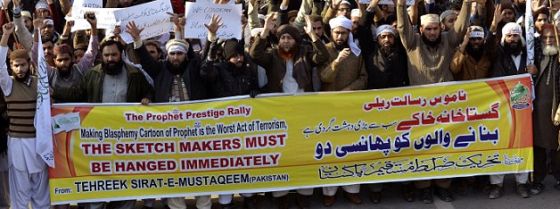
Rally in Lahore, Pakistan, protesting against Charlie Hebdo cartoonists.

Rally in Lahore, Pakistan, protesting against Charlie Hebdo cartoonists.

If the text on the banner above had been faked by someone using Photoshop, one might imagine that this was some kind of Islamophobic satire. But it is not. These are Muslims who unwittingly satirize themselves. Nothing that can be said about them is more damning than what they say themselves.

I am not a Muslim, nor a scholar of Islam and thus have no competence to engage in a critique of Islamic doctrine. So when I talk about criticizing Islam, I’m not implying that I think it is doctrinally defective.

Islam, in my view, is just like any other religion, in the sense that it is an amorphous, complex entity, expressed collectively through the lives of everyone who calls themselves a Muslim. Islam equals 1.8 billion Muslims, almost a quarter of the world’s population, including as much diversity as the non-Muslim world.

Arguments about “good” Muslims and “bad” Muslims, authentic Islam and distorted Islam, radical Islam and moderate Islam, generally involve questions about how Muslims want to represent themselves or how they are represented by others. Like all representations, these have the tendency of projecting uniformity by masking complexity.

In the polarized atmosphere following 9/11 and once again following the Charle Hebdo attacks, at one extreme are those who say that the attacks reveal the true nature of Islam and at the other those who say the attacks and attackers have nothing to do with Islam. Each camp sees the other as promoting a lie.

Among those in the West who see anti-Muslim rhetoric escalating to a dangerous degree, the standard response has been to attribute this to an underlying racism and Islamophobia — both of which are of course clearly in evidence in Europe and North America — but the problem in making this analysis is that it tends to gloss over some glaringly obvious and disturbing facts.

The French gunmen chose as their target, individuals whose only “crime” was that they had insulted the Prophet Muhammad, and having accomplished their goal, loudly declared “We have avenged the Prophet Muhammad.” Even if they were alone in thinking this, it seems undeniable that in their own minds they believed that they were acting in defense of Islam.

But they were not alone. At a small demonstration in Peshawar, Pakistan, this week, protesters chanted “Long live Cherif Kouachi, long live Said Kouachi.” They branded the cartoonists, not the gunmen, as the terrorists. They marched behind a placard which said: “A strong message was needed and they [the Kouachis] delivered it. We salute the messengers. May they live long.”

Expressions of support for the attacks can be found in abundance online.

Today there are again protests across Pakistan against the cartoons in the latest issue of Charlie Hebdo.

But the Lebanese journalist, Nadim Koteich, points out bluntly what should be obvious to Muslims and non-Muslims alike:

Nothing insults Islam more than the Charlie Hebdo massacre.”

In a similar vein, Nervana Mahmoud laments: “We are more offended by cartoons than butcheries, crucifixion, slavery, flogging. That how twisted is our mindset!”

Meanwhile, Raif Badawi, a blogger in Saudi Arabia has received 50 lashes — the first installment in a sentence of 1,000 lashes — for “insulting Islam.”

Badawi’s “crime” is that he has expressed ideas like this: “States which are based on religion confine their people in the circle of faith and fear.”

While the Paris attacks were widely condemned in Saudi Arabia, the Saudi rulers have been criticized for not condemning the cartoons and so the Badawi case serves as a way they can boost their religious credibility.

“They’re under pressure inside to punish people like him, especially among Salafis. It is a question of the legitimacy of the state. You have to remember those people are very influential at a street level,” Mustafa Alani, an Iraqi security expert with close ties to the Saudi Interior Ministry, told Reuters.

In the West, the popular and visceral response to the Paris attacks was they represented a dire threat to free speech and thus free speech must be vigorously defended.

This then provoked a smaller but fairly vocal “yes, but…” reaction which focused on the need to oppose Islamophobia and to acknowledge that the cartoonists had been unnecessarily provocative.

One of the many problems with this backlash is that it prompts an eminently reasonable question: If now is not the time to be speaking in defense of free speech, when would such a need arise?

Slavoj Žižek refers to “the pathological fear of many Western liberal Leftists to be guilty of Islamophobia,” and I agree that such a fear exists.

Indeed, I would say that the only way a non-Muslim can genuinely show solidarity with Muslims right now is, paradoxically, by taking the risk of appearing Islamophobic.

Rather than treat Islam and Muslims like a delicate fruit which will bruise unless handled with the greatest care, it might actually be a sign of greater respect to assume that this religious tradition and its living representatives have enough resilience to withstand criticism from both the inside and the outside.

(And I’d apply the same argument to Jews and any other group that have a tendency of hiding behind their own sense of victimization.)

Facebooktwittermail