Category Archives: Issues

How Obama has failed his own supporters

In “An open letter to the President from a bereaved sister,” Abby Okrent writes:

Dear Mr. President,

My younger brother was an early believer in you. He worked for your Senate campaign. At the age of 25, he ran the GOTV campaign in North Carolina, delivering an improbable victory for you in a Southern state that helped give you your first term. This year, slightly less bright-eyed but nonetheless a believer, he was working on your campaign again when he died suddenly, a brilliant, energetic 29 year old, dead in his tracks. You know this. You called my parents. Your campaign, to my greatest appreciation and respect, brought grief counselors for his coworkers, dedicated a corner of the office and much of your fundraising efforts to him, and bussed his coworkers to join the hundreds of others at his funeral.

You may not know that after his sudden passing, many of his friends quit their jobs, moved, changed their lives to continue working on your campaign in his memory. One of these friends ran your GOTV effort in Ohio, delivering a close swing state that resulted in the race being called for you early. My mom and I joined these efforts in Ohio, door-knocking until right before the polls closed, pounding the pavement in Alex’s memory and in hopes of your next presidency. Despite my disappointment in some of your stances, I proudly kept my Ohio for Obama sticker on my jacket.

Until yesterday. Mr. President, when the bombs began raining on Gaza again and you reiterated Israel’s “right to defend itself”, I took that sticker off my jacket. Later, you called Prime Minister Netanyahu and asked him to “use restraint,” as though he were a glutton at a feast, rather than an elected official of a powerful military nation, using your own country’s weaponry to engage in a one-sided assault. Mr. President, you are the most powerful man in the world. You do not need to politely request anything of Mr. Netanyahu; you can stop him by ending U.S. military aid to Israel until Israel complies with international and U.S. law. Mr. Netanyahu and his right-wing allies in the U.S. actively campaigned against your re-election, assuming that Governor Romney would be better positioned to give them carte blanche to violate Palestinian human rights and start regional wars. It is not to them that you now need to prove your allegiance, but to we the people who knocked doors for you, who made phone calls for you, who died getting you this 4 years more of opportunity. [Continue reading…]


Facebooktwittermail

U.S. escalation against Iran would carry high cost for global economy

IPS reports: The world economy would bear substantial costs if the United States took steps to significantly escalate the conflict with Iran over its controversial nuclear programme, according to the findings of a Federation of American Scientists’ (FAS) special report released here Friday.

Based on consulations with a group of nine bipartisan economic and national security experts, the findings showed the effects of U.S. escalatory action against Iran could range from 64 billion to 1.7 trillion dollars in losses for the world economy over the initial three-month term.

The least likely scenario of de-escalation, which would require U.S. unilateral steps showing it was willing to make concessions to resolve the standoff, would result in an estimated global economic benefit of 60 billion dollars.

“The study’s findings suggest that there are potential costs to any number of U.S.-led actions and, in general, the more severe the action, the greater the possible costs,” Mark Jansson, FAS’s special projects director, told IPS.

“That being said, even among experts, there is tremendous uncertainty about what might happen at the higher end of the escalation ladder,” added Jansson, the second author of the report after Charles P. Blair, an FAS senior fellow on state and non-state threats.

The six plausible scenarios of U.S.-led actions against Iran included isolation and a Gulf blockade, which would include U.S. moves to “curtail any exports of refined oil products, natural gas, energy equipment and services”, the banning of the Iranian energy sector worldwide (incurring an estimated global economic cost of 325 billion dollars), and a comprehensive bombing campaign that would also target Iran’s ability to retaliate (incurring an estimated global economic cost of 1.082 trillion dollars). [Continue reading…]

Facebooktwittermail

I’m losing hope for a peaceful Israel

Jessica Apple writes: Mr. Netanyahu has been ignoring the peace process for most of his current four-year term. For the first time since Yitzhak Rabin and Yasir Arafat shook hands in 1993, and as Israel prepares to elect a new Knesset in January, its political leaders are not talking about a two-state solution.

When I moved to Israel 15 years ago, the picture was very different. There was never a question of whether Israel and the Palestinians would make peace, only of when. The dream of peace inspired me, and even after an intifada, scores of suicide bombings and a war, I stayed in Israel. I remained hopeful.

But today, as the missiles get closer to Tel Aviv, I think of leaving. It’s not the missiles that are breaking me. It’s the lack of an alternative to them.

Mr. Netanyahu has avoided the Palestinian issue while enabling and encouraging settlement building; he has ignored the Arab initiative and focused solely on the threat of Iran. Late last month he struck a coalition deal with his ultranationalist foreign minister, Avigdor Lieberman, to have their two parties run one slate in the next elections in January. It signaled that Mr. Netanyahu would have no plans to make peace if he were re-elected.

Now Mr. Netanyahu has chosen to enter into a conflict that ensures that the vote in the upcoming elections will be about security — something he says he can provide. There is no great surprise in that. The surprise is that there is no opposition to Mr. Netanyahu’s policies — a signal that Israelis are resigned to living indefinitely with the threat of war. [Continue reading…]

Facebooktwittermail

Tehran looks ready to tango

Reza Marashi and Sahar Namazikhah write: “The Iranian regime is not interested in a diplomatic solution with the United States. Sustained enmity with America is a defining, inextricable pillar of the Islamic Republic. Any shift in this paradigm will irreparably destabilise the regime.” This is the argument proffered by those opposed to sustained US-Iran diplomacy.

At face value, regular chants of “Death to America” and yearly commemorations of the US embassy hostage seizure lend credence to these claims. But behind these assertions lies a deeper reality – and the latest demonstration comes from a surprising source: Iran’s Ministry of Intelligence and Security (MOIS).

As the Washington Post‘s correspondent in Tehran, Jason Rezaian, pointed out last week, the MOIS published a report – publicly available on its website – that assesses Israeli threats of war over Iran’s nuclear programme and highlights the benefits of negotiations with the US to avert a deeper crisis.

To the surprise of many, Iran’s Intelligence Ministry shares the assessment of its counterparts in the US and Israel: the potential destruction caused by military strikes on Iran’s nuclear facilities would set back the programme only a few years. More telling is their final conclusion: diplomacy is the preferred way forward.

This sober, pragmatic analysis is devoid of the rhetoric commonly emanating from the Islamic Republic. More importantly, it suggests three important points for policymakers in Washington to consider: [Continue reading…]

Facebooktwittermail

Obama’s ‘tough’ approach to climate change

In his press conference yesterday, when President Obama talked about tackling climate change he said it would involve making some “tough political choices.” He didn’t say what those would be. Indeed, the agenda he’s apparently willing to support has to be one that reverses climate change while boosting American prosperity (as defined by economic growth). We can save the planet and get rich in the process. In other words, Obama wants to tackle climate change but only if he can do so without making any tough political choices.

Mat McDermott responded to Obama’s comments:

Good on the President for repeatedly asserting the scientifically correct fact that the planet is indeed warming and that human activity is causing it—although it’s a bit sad that this is the state of discussion regarding climate in the United States that simply admitting the issue exists deserves kudos.

And good on the President for increasing fuel efficiency standards. Indeed it’s one his genuine environmental victories of his first term in office.

But it all goes downhill from there, quickly.

The President makes a huge rhetorical mistake in repeating and therefore reinforcing the erroneous notion that combatting climate change will cost jobs.

He also makes the intellectual mistake of continuing the fetishization of the universal good of economic growth, when the evidence is solidly on the side of, using renowned ecological economist Herman Daly’s words, future expansion of the scale of the economy is actual uneconomic growth—in other words, it actually does more harm than good. More economic growth, if defined as increased consumption of natural resources, is itself the problem of the century, of which climate change is but a subset, albeit perhaps the most dramatic one.

Facebooktwittermail

Racism and classism in the heart of America’s capital

Michael Shank writes: Of the two rivers that cup our nation’s capital – the Potomac and the Anacostia – the latter of the two is, perhaps, the most apt reflection of where America is at socio-economically. The Anacostia River – the Anglicised namesake of which was first officially recorded by Thomas Jefferson and referred to the Nacochtank Native American tribe dwelling east of the river – is just down the hill from my Anacostia house and reflects well what divides our nation’s capital, and, ultimately, America.

A quick dig into the District’s demographics and it is painfully apparent: A growing white majority living west of the river, encroaching east, and a predominantly African American majority living east of the river. There is no question that we are a deeply and demographically divided city. As I take Metro’s green line home to Anacostia after work, I am frequently the only white person on the train. Any remaining white folks on the green line generally disembark at Navy Yard, the last stop before crossing east of the Anacostia River.

As it happens in DC, so too does it happen in America: This year, researchers at Dartmouth, the University of Georgia, and the University of Washington looked at Census neighbourhood data to compare trends in racial diversity and found that highly diverse neighbourhoods are actually rare, African Americans remain concentrated in segregated neighbourhoods, and newly arrived immigrants continue to settle in concentrated racial residential patterns.

Yet, this trend is not the only divider in the District. Anacostia River is a divider of class as well, with a majority of the town’s wealth living to the west of the river and a much poorer population living to the east. Hovering much lower than the national average of $50,000, the average median household income in Anacostia struggles at $30,000 for a family of four, compared with Washington, DC’s $60,000, and the broader DC metro area at well over $80,000. In fact, US Census data cites the income gap in the District as one the highest in the nation. Furthermore, the unemployment rate west of the river is roughly 8.9 percent, while east of the river it’s 35 percent. [Continue reading…]

Facebooktwittermail

The health of the planet must come first

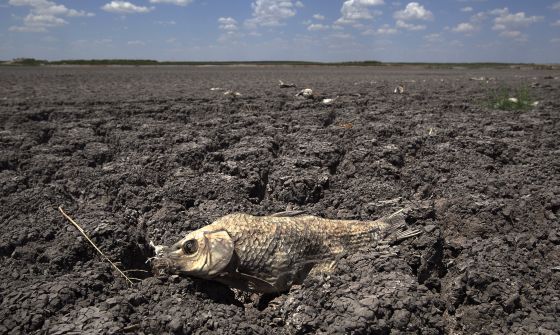
The remains of a carp in a dried out lake bed in San Angelo, Texas, August, 2011.

David Remnick writes: Barack Obama can take pride in having fought off a formidable array of deep-pocketed revanchists. As President, however, he is faced with an infinitely larger challenge, one that went unmentioned in the debates but that poses a graver threat than any “fiscal cliff.” Ever since 1988, when NASA’s James Hansen, a leading climate scientist, testified before the Senate, the public has been exposed to the issue of global warming. More recently, the consequences have come into painfully sharp focus. In 2010, the Pentagon declared, in its Quadrennial Defense Review, that changes in the global climate are increasing the frequency and the intensity of cyclones, droughts, floods, and other radical weather events, and that the effects may destabilize governments; spark mass migrations, famine, and pandemics; and prompt military conflict in particularly vulnerable areas of the world, including the Middle East, Southeast Asia, and sub-Saharan Africa. The Pentagon, that bastion of woolly radicals, did what the many denialists in the House of Representatives refuse to do: accept the basic science.

The economic impact of weather events that are almost certainly related to the warming of the earth—the European heat wave of 2003 (which left fifty thousand people dead), the Russian heat waves and forest fires of 2010, the droughts last year in Texas and Oklahoma, and the preëlection natural catastrophe known as Sandy—has been immense. The German insurer Munich Re estimates that the cost of weather-related calamities in North America over the past three decades amounts to thirty-four billion dollars a year. Governor Andrew Cuomo, of New York, has said that Sandy will cost his state alone thirty-three billion. Harder to measure is the human toll around the world—the lives and communities disrupted and destroyed.

“If we are willing to work for it, and fight for it, and believe in it,” Obama said, when he clinched the Democratic nomination in 2008, future generations will look back and say, “This was the moment when the rise of the oceans began to slow and our planet began to heal.” Those generations assuredly will not. Although Obama, unlike his predecessor, recognized the dimensions of the problem, he never pursued measures remotely equal to it. To his credit, his Administration has directed ninety billion dollars to investments in clean energy, and has secured several billion for energy-conservation upgrades; he got Detroit to agree to better gas-mileage standards, and finally introduced CO2 emission standards for commercial trucks and buses. For the most part, though, the accumulating crisis of climate change has been treated as a third-tier issue.

Last week, in his acceptance speech, Obama mentioned climate change once again. Which is good, but, at this late date, he gets no points for mentioning. The real test of his determination will be a willingness to step outside the day-to-day tumult of Washington politics and establish a sustained sense of urgency. There will always be real and consuming issues to draw his and the political class’s attention: a marital scandal at the C.I.A., a fiscal battle, an immigration bill, an international crisis. But, all the while, a greater menace grows ever more formidable. [Continue reading…]

Facebooktwittermail

Israel considers resumption of Gaza assassinations

The Associated Press reports: Israel is considering resuming its contentious practice of assassinating militant leaders in the Hamas-ruled Gaza Strip in an effort to halt intensified rocket attacks on Israel’s south, according to defense officials.

That Israel might renew a practice that brought it harsh international censure is evidence of the tight spot Prime Minister Benjamin Netanyahu is in. With Israeli elections two months away, rocket barrages from Gaza are disrupting the lives of 1 million residents of southern Israel, pressuring the government to come up with an effective response.

In the latest flare-up, Gaza militants have fired more than 100 rockets at Israel in recent days, triggering retaliatory Israeli airstrikes that have killed six people in Gaza.

Some Israelis are demanding a harsh military move, perhaps a repeat of Israel’s bruising incursion into Gaza four years ago. Others believe Israel should target Hamas leaders, a method it used to kill dozens of militants nearly a decade ago. [Continue reading…]

Facebooktwittermail

Afghanistan seeks India’s help as West pullout nears

Reuters reports: India will step up training of the Afghan police and military after a request on Monday by President Hamid Karzai, who also urged Indian businesses to invest in his battle-weary nation as it gears up for the departure of NATO troops.

The extra help is likely to be welcomed by the United States, which sees India as a stabilizing power in South Asia. But it may unnerve Pakistan, which frets about losing influence in neighboring Afghanistan.

“We do want to expand that as required and wished by Afghanistan. We will respond,” said India’s Foreign Minister Salman Khurshid when asked about the security program following a lecture given by the Afghan president in New Delhi.

In June, U.S. Secretary of Defense Leon Panetta called on India to do more to support both the Afghan economy and security forces as Western nations prepare to end their combat missions there in 2014.

Al Jazeera reports: The European Union has announced that it is suspending $25million in aid for Afghanistan, warning that aid will be increasingly conditional on the government sticking to agreed reforms.

Payment of the $25 million aimed at reforming the justice system was deferred because of a lack of progress on the issue, EU ambassador Vygaudas Usackas said on Monday.

Usackas was speaking at the signing of a $76 million financing agreement on “efficient and effective governance” and “justice for all” with Afghan Finance Minister Omar Zakhiwal.

“If the European Union is deeply committed in supporting Afghanistan, it needs to stress that in the spirit of the Tokyo agreement, support will be increasingly conditional of the delivery of the Afghan government on the agreed reform agenda,” Usackas said.

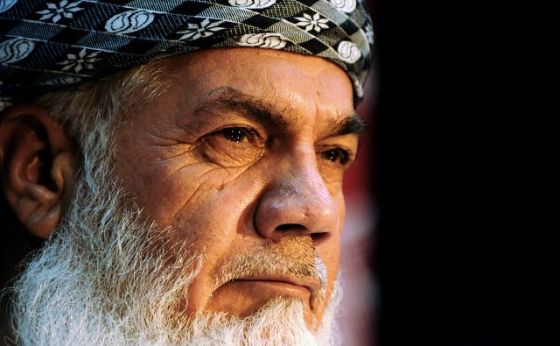
Ismail Khan

Meanwhile, the New York Times reports: One of the most powerful mujahedeen commanders in Afghanistan, Ismail Khan, is calling on his followers to reorganize and defend the country against the Taliban as Western militaries withdraw, in a public demonstration of faltering confidence in the national government and the Western-built Afghan National Army.

Mr. Khan is one of the strongest of a group of warlords who defined the country’s recent history in battling the Soviets, the Taliban and one another, and who then were brought into President Hamid Karzai’s cabinet as a symbol of unity. Now, in announcing that he is remobilizing his forces, Mr. Khan has rankled Afghan officials and stoked fears that other regional and factional leaders will follow suit and rearm, weakening support for the government and increasing the likelihood of civil war.

This month, Mr. Khan rallied thousands of his supporters in the desert outside Herat, the cultured western provincial capital and the center of his power base, urging them to coordinate and reactivate their networks. And he has begun enlisting new recruits and organizing district command structures.

“We are responsible for maintaining security in our country and not letting Afghanistan be destroyed again,” Mr. Khan, the minister of energy and water, said at a news conference over the weekend at his office in Kabul. But after facing criticism, he took care not to frame his action as defying the government: “There are parts of the country where the government forces cannot operate, and in such areas the locals should step forward, take arms and defend the country.”

President Karzai and his aides, however, were not greeting it as an altruistic gesture. The governor of Herat Province called Mr. Khan’s reorganization an illegal challenge to the national security forces. And Mr. Karzai’s spokesman, Aimal Faizi, tersely criticized Mr. Khan.

“The remarks by Ismail Khan do not reflect the policies of the Afghan government,” Mr. Faizi said. “The government of Afghanistan and the Afghan people do not want any irresponsible armed grouping outside the legitimate security forces structures.”

In Kabul, Mr. Khan’s provocative actions have played out in the news media and brought a fierce reaction from some members of Parliament, who said the warlords were preparing to take advantage of the American troop withdrawal set for 2014.

“People like Ismail Khan smell blood,” Belqis Roshan, a senator from Farah Province, said in an interview. “They think that as soon as foreign forces leave Afghanistan, once again they will get the chance to start a civil war, and achieve their ominous goals of getting rich and terminating their local rivals.”

Indeed, Mr. Khan’s is not the only voice calling for a renewed alliance of the mujahedeen against the Taliban, and some of the others are just as familiar. [Continue reading…]

Facebooktwittermail

Why Israel should trade its nukes

Uri Bar-Joseph writes: On September 19, to nobody’s surprise, Shaul Chorev, the director-general of Israel’s Atomic Energy Commission, announced that his government would not attend an upcoming conference devoted to establishing a nuclear-free Middle East. The announcement reaffirmed Israel’s long-standing position that a nuclear-free zone can come about only as a consequence of a lasting regional peace. Until such a peace is achieved, Jerusalem will not take any tangible steps toward eliminating its nuclear weapons.

At least on the face of it, this stand is sensible. For 45 years, Israel has been the only nuclear power in the Middle East, enjoying a formidable strategic safety net against any existential threat. Since 1957, Israel has invested tremendous resources in building up a solid nuclear arsenal in Dimona. Today, according to various estimates, this stockpile comprises some 100–300 devices, including two-stage thermonuclear warheads and a variety of delivery systems, the most important of which are modern German-built submarines, which constitute the backbone of Israel’s second-strike capability. For Israel to give up these assets in the midst of an ongoing conflict strikes most Israelis as irrational.

This consensus, however, overlooks the fact that Israel’s nuclear capability has not played an important role in the country’s defense. Unlike other nuclear-armed states, Israel initiated its nuclear project not because of an opponent’s real or imagined nuclear capability but because of the worry that, in the long run, Arab conventional forces would outstrip the power of the Israel Defense Forces (IDF). As early as the 1950s, Israeli Prime Minister David Ben-Gurion sought to manage the threat of modernizing Arab armies, which were inspired by pan-Arab sentiment and backed by the Soviet Union, by developing the ultimate deterrent. Shimon Peres, the architect of Israel’s nuclear program and now Israel’s president, relentlessly argued in public speeches and writings that Israel needed to compensate for the large size of the Arab armies with “science” — a code word for nuclear arms.

As it turned out, however, Arab conventional superiority never materialized. Ever since Israel crossed the nuclear threshold on the eve of the 1967 war, the qualitative gap between Israel’s conventional forces and those of its Arab neighbors has only grown. Today, particularly as the Syrian army slowly disintegrates, the IDF could decisively rout any combination of Arab (and Iranian) conventional forces. This advantage, combined with the United States’ support for Israel, is what has kept Arab countries from taking up arms against the Jewish state — not the fear of nuclear retaliation. [Continue reading…]

Facebooktwittermail

Facebook attempts to shut down the voice of “The Uprising of Women in the Arab World”

Jadaliyya: [The following statement was issued by activists involved in The Uprising of Women in the Arab World on 7 November 2012 in response to attempts by Facebook to suppress their online activities. It was originally issued in Arabic, English, and French. This English version has been slightly edited for style. The Arabic version, along with an introduction and background to the issue, can be found on Beirut Walls.]

On the morning of 7 November 2012, the five admins of The Uprising of Women in the Arab World Facebook Page logged onto Facebook to find out that one’s account had been blocked for thirty days, another for three days, two others for twenty-four hours, and one other received a warning notification.

According to Facebook, those persons had violated its policy by sharing a post asking Twitter followers to support Dana Bakdounes. The message that was sent to the admins explaining the reasoning for the ban from Facebook read as follows: “You have posted a content that violates Facebook Community Rules. The post says: Follow us on Twitter @UprisingOFWomen. Support Dana with hashtag #WindToDana”

Dana Bakdounes is one of the hundreds of women and men who participated in the Uprising of Women in the Arab World campaign, holding a sign expressing the reason why they support this uprising. Dana’s slogan stated: “I am with the uprising of women in the Arab world because for twenty years I was not allowed to feel the wind in my hair and on my body.” Her picture showed an unveiled woman carrying her passport with a picture of when she was veiled.

Dana’s picture was initially posted on 21 October 2012, among many other photos and statements of women and men of various religious beliefs and practices. Some women were veiled, some unveiled, some in niqab, and all were demanding women’s rights and equal enjoyment of freedom of speech, in a secular space that promotes tolerance and embraces differences. But on 25 October, Facebook chose to censor Dana’s image and to suspend the account of the admin who posted it for twenty-four hours. This incident provoked an outrage among the defenders of freedom of speech who started sharing Dana’s picture all over Facebook, Twitter, and other media outlets.

On 28 October, having been persuaded that Facebook had mistakenly taken down the photo due to abusive reports of haters of the Page, that the photo held no offensive content, as well as seeing that it was all over the web, we uploaded it again. A few hours later, Facebook removed it again and blocked another admin’s account for seven days.

However, on 31 October, Facebook restored Dana’s censored photo to The Uprising of Women in the Arab World Page without any notice or explanation. However, it did not lift the ban on the admin’s account, which ended only on 5 November.

On 7 November, all five admins of The Uprising of Women in the Arab World Page received threats by Facebook for the earlier cited reasons that their accounts may be permanently deleted. The repeated temporary blocks on the admins’ personal accounts with no clear motive or explanation constitute a direct attack on The Uprising of Women in The Arab World’s Page. It also raises serious questions about the true intentions behind Facebook’s policies and whether Dana’s “controversial” image is a mere excuse to shut down the voice of The Uprising of Women in The Arab World. [Continue reading…]

Facebooktwittermail

Climate change: Lessons from Ronald Reagan

Cass R. Sunstein writes: The re-election of President Obama, preceded by the extraordinary damage done by Hurricane Sandy, raises a critical question: In the coming years, might it be possible for the United States to take significant steps to reduce the risks associated with climate change?

A crucial decision during Ronald Reagan’s second term suggests that the answer may well be yes. The Reagan administration was generally skeptical about costly environmental rules, but with respect to protection of the ozone layer, Reagan was an environmentalist hero. Under his leadership, the United States became the prime mover behind the Montreal Protocol, which required the phasing out of ozone-depleting chemicals.

There is a real irony here. Republicans and conservatives had ridiculed scientists who expressed concern about the destruction of the ozone layer. How did Ronald Reagan, of all people, come to favor aggressive regulatory steps and lead the world toward a strong and historic international agreement?

A large part of the answer lies in a tool disliked by many progressives but embraced by Reagan (and Mr. Obama): cost-benefit analysis. Reagan’s economists found that the costs of phasing out ozone-depleting chemicals were a lot lower than the costs of not doing so — largely measured in terms of avoiding cancers that would otherwise occur. Presented with that analysis, Reagan decided that the issue was pretty clear. [Continue reading…]

Facebooktwittermail

Obama faces Latin America revolt over drugs, trade

Reuters reports: President Barack Obama will face an unprecedented revolt by Latin American countries against the U.S.-led drug war during his second term and he also may struggle to pass new trade deals as the region once known as “America’s backyard” flexes its muscles like never before.

Washington’s ability to influence events in Latin America has arguably never been lower. The new reality is as much a product of the United States’ economic struggles as a wave of democracy and greater prosperity that has swept much of the region of 580 million people in the past decade or so.

It’s not that the United States is reviled now – far from it. Although a few vocally anti-U.S. leaders like Venezuela’s Hugo Chavez tend to grab the media spotlight, Obama has warm or cordial relations with Brazil, Mexico and other big countries in the region.

Most Latin American leaders were rooting, either privately or publicly, for his re-election on Tuesday.

That said, even close allies are increasingly emboldened to act without worrying about what “Tio Sam” will say or do. Nowhere is that more evident than on anti-narcotics policy. [Continue reading…]

Facebooktwittermail

Climate change report outlines perils for U.S. military

The New York Times reports: Climate change is accelerating, and it will place unparalleled strains on American military and intelligence agencies in coming years by causing ever more disruptive events around the globe, the nation’s top scientific research group said in a report issued Friday.

The group, the National Research Council, says in a study commissioned by the C.I.A. and other intelligence agencies that clusters of apparently unrelated events exacerbated by a warming climate will create more frequent but unpredictable crises in water supplies, food markets, energy supply chains and public health systems.

Hurricane Sandy provided a foretaste of what can be expected more often in the near future, the report’s lead author, John D. Steinbruner, said in an interview.

“This is the sort of thing we were talking about,” said Mr. Steinbruner, a longtime authority on national security. “You can debate the specific contribution of global warming to that storm. But we’re saying climate extremes are going to be more frequent, and this was an example of what they could mean. We’re also saying it could get a whole lot worse than that.”

Mr. Steinbruner, the director of the Center for International and Security Studies at the University of Maryland, said that humans are pouring carbon dioxide and other climate-altering gases into the atmosphere at a rate never before seen. “We know there will have to be major climatic adjustments — there’s no uncertainty about that — but we just don’t know the details,” he said. “We do know they will be big.”

The study was released 10 days late: its authors had been scheduled to brief intelligence officials on their findings the day Hurricane Sandy hit the East Coast, but the federal government was shut down because of the storm. [Continue reading…]

Facebooktwittermail

America’s new mandate on climate change

Richard Schiffman writes: For Americans concerned about the environment, disaster was avoided on Tuesday. President Obama – with his somewhat lackluster record, if decidedly more exalted rhetoric, on global warming – defeated the Republican challenger who had vowed to gut federal emissions standards, and kill loan programs and tax breaks for green energy companies.

But activists say that it would be wrong to read the election as a stamp of approval for four more years of business as usual. They argue that voters have sent a clear signal that they want more aggressive action on the environment during the president’s second term.

The League of Conservation Voters (LCV) cites the defeat of three members of their “Flat Earth Five” – Anne Marie Buerlke (Republican, New York), Francisco Canseco (Repub;lican, Texas) and Joe Walsh (Republican, Illinois) – Republican representatives who were outspoken for their anti-science stance on climate change. (One race remains too close to call.) And ten of the League’s “dirty dozen” candidates – targeted for “consistently voting against clean energy and conservation” – lost their election bids.

Meanwhile, 11 out of 12 of the office-seekers dubbed “climate heroes” by a coalition led by environmental activist Bill McKibben, prevailed in Tuesday’s vote. The 12th “hero”, Jay Inslee, a gubernatorial candidate in Washington state who wants to jump-start the state’s lagging economy by transforming it into a national green-tech hub, continues to hold a small lead over Republican Rob McKenna and looks poised to win that race.

The election results overturn the conventional wisdom that voters don’t care about green issues, according to LCV’s spokesperson Jeff Gohringer:

“We went into this election cycle and the notion was that environmental champions were going to be wiped off the map. We did $3m-worth of advertising on climate change in places like Texas, and we won.”

This sentiment was echoed by Frances Beinecke, the president of the Natural Resources Defense Council who wrote to her members on Wednesday that:

“By rejecting Big Oil’s candidates, voters sent a message loud and clear that they want more clean energy, less climate denial and an end to the $4bn in taxpayer subsidies for fossil fuels.”

Some environmentalists have characterized Obama’s very re-election as a mandate for strong action on climate change. This is a hard argument to make given that the topic scarcely came up during the presidential race. [Continue reading…]

Facebooktwittermail