Category Archives: Issues

Iran taps diplomat to field U.S. non-official contacts

Laura Rozen writes: In a sign of Iranian interest in streamlining back channel contacts and reducing mixed messages ahead of anticipated, resumed nuclear negotiations next month, Iran was said to appoint a central point of contact for approaches from outside-government Americans, two Iran nuclear experts told Al-Monitor this week.

Mostafa Dolatyar, a career Iranian diplomat who heads the Iranian think tank, the Institute for Political and International Studies (IPIS), which has close ties to Iran’s foreign ministry, was tapped by Iran’s leadership to coordinate contacts with American outside-government policy experts, including those with former senior US officials involved unofficially in relaying ideas for shaping a possible nuclear compromise, the analysts told Al-Monitor in interviews this week. The IPIS channel is for coordinating non-official US contacts, which in the absence of formal diplomatic ties, have formed an important, if not unproblematic, part of Iran’s diplomatic scouting and Washington’s and Tehran’s imperfect efforts to understand and influence each others’ policy positions.

The appointment is the result of a desire “on the Iranian side for a more structured approach to dealing with America,” Mark Fitzpatrick, an Iran nuclear expert at the Institute for International and Strategic Studies (IISS) in London, told Al-Monitor in an interview Monday, adding that he now doubts that there are agreed plans for direct US-Iran talks after the elections.

“I was told … that Iran had appointed one person to be the channel for all approaches from the Americans,” specifically for former officials and non-governmental experts, Fitzpatrick continued. “And Iran wants to structure that so that Iran is speaking from one voice.” [Continue reading…]

Facebooktwittermail

Chris Christie, Democratic hero

Steve Kornacki writes: That Chris Christie is providing a serious political assist to President Obama less than a week before the election is indisputable. The question is why he’s doing it.

Christie, who was the keynote speaker at the Republican convention and has been one of Mitt Romney’s top campaign surrogates, will survey the post-Sandy wreckage in New Jersey with the president today. This comes after Christie went out of his way to praise Obama at the height of the storm and after Christie angrily shot down a Fox News host’s query about whether Romney might tour New Jersey with him too.

“I have a job to do,” he said. “If you think right now I give a damn about presidential politics, then you don’t know me.”

Needless to say, this is all music to the ears of Democrats. Christie is one of the most prominent Republicans in the country, and one of the better-liked ones too. This is exactly the sort of cross-partisan boost that candidates dream of receiving in a race’s final days, especially a race as close as this one. So what’s Christie up to?

The simplest explanation is that this is just Christie being Christie. [Continue reading…]

Facebooktwittermail

Video: ‘We have a planetary emergency’ — NASA’s James Hansen addressing union leaders

School of Industrial and Labor Relations at Cornell University: The world’s most well-known climate scientist, James Hansen of NASA’s Goddard Institute, addressed 75 union leaders and allies at a global trade union roundtable in New York City this month.

Entitled “Energy Emergency, Energy Transition,” the event was convened by ILR’s Global Labor Institute (GLI), part of the new Worker Institute at Cornell. The Rosa Luxemburg Foundation’s New York City office partnered with GLI in organizing the Oct. 10-12 event.

“The truth is, we have a planetary emergency,” Hansen said. Union representatives from 18 countries listened in silence as Hansen described what is happening to the earth’s climate, ice sheets, oceans and weather patterns.

“The volume of Arctic sea ice has been reduced by 75 percent in just 30 years. Greenland’s ice sheet is losing mass at about 300 cubic kilometers per year. Sea levels are going up, and there is a danger that the ice sheets will begin to collapse and we could get several meters (of rising sea levels) in one year – which would be disastrous,” Hansen said.

“The frequency of extreme weather events is changing because the planet is getting warmer. It was exceedingly hot this past summer, and the frequency and area covered by these events are both increasing.”

“We have only burned a small fraction of the fossil fuels, but we can not burn all of them. And yet the governments are going right ahead, encouraging even more use of fossil fuels through mountain top removal, tar sands, tar shale, drilling in the Arctic. We can’t do that if we want to be fair to our children.”

Solutions for the climate problem and for our children’s futures are really going to depend on workers understanding the situation, he said.

“It’s hard to communicate with people if they feel their job is threatened, but the jobs associated with clean energy technologies would be good jobs. Workers will get much better opportunities. We need to have cooperation and understanding between labor and environmental organizations and people who are concerned about the future of their children.”

In an interview following the presentation, Hansen said, “Unions are an important force globally. They represent hundreds of millions of workers and their families. The thought of having them joining in the effort to bring about an energy revolution to fight climate change is very exciting. Stabilizing the climate is a battle for survival that needs everyone involved.”

More information about the roundtable, including participants, presentations and trade union statements on climate change and energy, is available at http://energyemergencyenergytransition.org/

Facebooktwittermail

New York City: For years, warnings that it would happen here

The New York Times reports: The warnings came, again and again.

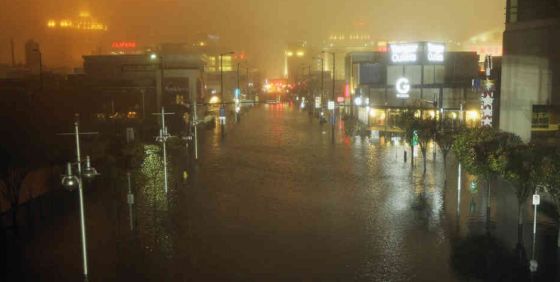
For nearly a decade, scientists have told city and state officials that New York faces certain peril: rising sea levels, more frequent flooding and extreme weather patterns. The alarm bells grew louder after Tropical Storm Irene last year, when the city shut down its subway system and water rushed into the Rockaways and Lower Manhattan.

On Tuesday, as New Yorkers woke up to submerged neighborhoods and water-soaked electrical equipment, officials took their first tentative steps toward considering major infrastructure changes that could protect the city’s fragile shores and eight million residents from repeated disastrous damage.

Gov. Andrew M. Cuomo said the state should consider a levee system or storm surge barriers and face up to the inadequacy of the existing protections.

“The construction of this city did not anticipate these kinds of situations. We are only a few feet above sea level,” Mr. Cuomo said during a radio interview. “As soon as you breach the sides of Manhattan, you now have a whole infrastructure under the city that fills — the subway system, the foundations for buildings,” and the World Trade Center site.

The Cuomo administration plans talks with city and federal officials about how to proceed. The task could be daunting, given fiscal realities: storm surge barriers, the huge sea gates that some scientists say would be the best protection against floods, could cost as much as $10 billion.

But many experts say, given what happened with the latest storm, that inertia could be more expensive.

After rising roughly an inch per decade in the last century, coastal waters in New York are expected to climb as fast as six inches per decade, or two feet by midcentury, according to a city-appointed scientific panel. That much more water means the city’s flood risk zones could expand in size.

“Look, the city is extremely vulnerable to damaging storm surges just for its geography, and climate change is increasing that risk,” said Ben Strauss, director of the sea level rise program at the research group Climate Central in Princeton, N.J. “Three of the top 10 highest floods at the Battery since 1900 happened in the last two and a half years. If that’s not a wake-up call to take this seriously, I don’t know what is.” [Continue reading…]

Facebooktwittermail

Twelve terrifying tales from the nuclear crypt

Jeffrey Lewis writes: October is a scary month. And it’s not just Halloween. October also happens to be the anniversary of the Cuban Missile Crisis. And if the ghosts and goblins don’t make you wet your pants, the thought of Khrushchev, Kennedy, and Castro dancing on the edge of nuclear war should.

During the Cold War, the United States twice more raised the alert status of its nuclear forces — in October 1969 and October 1973. And one of the worst reactor accidents at a military program — the fire at Britain’s Windscale reactor — also happened in October.

You might start to think there is something particularly dangerous about October. But the reality is that there have been so many accidents, false alarms, and other mishaps involving nuclear weapons that you haven’t heard about — and every month contains at least one seriously scary incident. The Department of Defense has released narrative summaries for 32 accidents involving nuclear weapons between 1950 and 1980, many of which involve aircraft bearing bombs. False alarms? Please. The Department of Defense admitted 1,152 “moderately serious” false alarms between 1977 and 1984 — roughly three a week. (I love the phrase “moderately serious.” I wonder how many “seriously serious” false alarms they had?) I kind of get the feeling that if NORAD went more than a week without a serious false alarm, they would start to wonder if the computers were ok.

The hard part was choosing the most frightening moments. There is no reason to believe the apocryphal story about the British Army choosing red uniforms because they do not show blood. But after 60-odd years of nuclear accidents, incidents, and whatnot, I can recommend that the STRATCOM commander consider brown pants.

So, here’s my list of 12 seriously scary events, one for each month. This list is not comprehensive, nor is it intended to be the worst events. [Continue reading…]

Facebooktwittermail

Get ready for 10 more years of drones

Micah Zenko writes: Nov. 3 marks the tenth anniversary of America’s Third War — the campaign of targeted killings in non-battlefield settings that has been a defining feature of post-9/11 American military policy as much as the conflicts in Iraq or Afghanistan.

Unlike other wars, there won’t be any ceremonies at the White House or Pentagon, parades down Main Streets, or town square rallies to acknowledge the sacrifices made by the countless civilian and military personnel involved. There won’t even be a presidential statement since targeted killings cannot and will not be recognized by the U.S. government. The war is conducted by both the CIA — covert and totally unacknowledged — and by the Joint Special Operations Command (JSOC) — described without any specificity as “direct action” by the White House. Whether the CIA or JSOC is the lead executive agency, the Third War is marked by the limited transparency and accountability of U.S. officials.

The Third War, which began with a drone strike in Yemen, had two simple goals: preventing another attack on the U.S. homeland and capturing or killing those al Qaeda operatives responsible. Bush administration officials warned ominously that its forward-leaning counterterrorism approach mandated preventive attacks against terrorist safe havens. Five days after 9/11, Vice President Dick Cheney stated that the United States would have to work “the dark side,” and an anonymous senior official declared: “The gloves are off. The president has given the [CIA] the green light to do whatever is necessary. Lethal operations that were unthinkable pre-September 11 are now underway.”

On September 17, 2001, President Bush signed a memorandum of notification that authorized the CIA to kill, without further presidential approval, “two or three dozen” high-value targets. A former CIA official estimated: “There are five hundred guys out there you have to kill. There’s no way to sugarcoat it — you just have to kill them.” (In a quaint historical footnote, on October 15, 2001, the Bush administration rebuked Israel for killing the suspected plotter of a Tel Aviv terror attack: “It’s the same position that we’ve said over and over again, and that is that we oppose the policy of targeted killings.”) [Continue reading…]

Facebooktwittermail

Superstorm Sandy estimated to cause $20 billion or more in damage in U.S.

Time reports: Even before Hurricane Sandy made landfall on the East Coast of the U.S., economists were predicting that the historic storm would cause billions of dollars in damage across more than a dozen states where planes were grounded, stock exchanges were closed, public transportation was halted and homes began to get pounded by devastating wind and torrential rain.

By Monday, disaster-modeling company Eqecat estimated that Sandy would cause $5 billion to $10 billion in insured losses and $10 billion to $20 billion in economic damages. (In 2008, Hurricane Ike had similar economic damages at $20 billion.) Others have estimated as much as $100 billion in damages. The real cost is probably somewhere in the middle. For example, Peter Morici, a business professor at the University of Maryland, is estimating up to $45 billion in losses by comparing Sandy with Hurricane Irene when it hit the Northeast in 2011.

The initial estimates last year for Irene were around $7 billion, but it eventually caused about $10 billion to $15 billion worth of damage. Morici says he’s predicting a similar increase from the estimate to the actual damages for Sandy considering the size of the storm, the number of Americans who will be affected (estimated around 60 million) and the possibility that metropolitan areas like New York City and Washington, D.C., could essentially be shut down for several days. [Continue reading…]

Facebooktwittermail

We are all from New Orleans now: Climate change, hurricanes and the fate of America’s coastal cities

Mike Tidwell writes: The presidential candidates decided not to speak about climate change, but climate change has decided to speak to them. And what is a thousand-mile-wide storm pushing 11 feet of water toward our country’s biggest population center saying just days before the election? It is this: we are all from New Orleans now. Climate change—through the measurable rise of sea levels and a documented increase in the intensity of Atlantic storms—has made 100 million Americans virtually as vulnerable to catastrophe as the victims of Hurricane Katrina were seven years ago.

Arriving atop fantastically warm water and aided by a full foot of sea-level rise during the last century, Hurricane Sandy is just the latest example of climate change’s impact on human society. Unless we rapidly phase out our use of fossil fuels, most Americans within shouting distance of an ocean will—in coming years—live behind the sort of massive levees and floodgates that mark Louisiana today.

The New York Academy Sciences has already begun examining the viability of three massive floodgates near the mouth of New York Harbor, not unlike the Thames River floodgate that protects London today. Another floodgate has been proposed for the Potomac River just south of Washington, fending against tsunami-like surge tides from future mega storms. Plus there will be levees—everywhere. Imagine the National Mall, Reagan National Airport and the Virginia suburbs—all well below sea level—at the mercy of “trust-us-they’ll-hold” levees maintained by the Army Corps of Engineers.

Oceans worldwide are projected to rise as much as three more feet this century—much higher if the Greenland ice sheet melts away. Intense storms are already becoming much more common. These two factors together will in essence export the plight of New Orleans, bringing the Big Easy “bowl” effect here to New York City and Washington, as well as to Charleston, Miami, New York and other coastal cities. Assuming we want to keep living in these cities, we’ll have to build dikes and learn to exist beneath the surface of surrounding tidal bays, rivers and open seas—just like New Orleans.

Meanwhile, it’s not our imagination that hurricanes have grown more ferocious than in the past. Multiple scientific studies in the past few years have found that rising sea-surface temperatures linked to global warming are causing an increase in the number of stronger hurricanes. Sandy, right now, is approaching the east coast atop Atlantic sea-surface temperatures a full five degrees Fahrenheit above normal. [Continue reading…]

Facebooktwittermail

A big storm requires big government

A New York Times editorial says: Most Americans have never heard of the National Response Coordination Center, but they’re lucky it exists on days of lethal winds and flood tides. The center is the war room of the Federal Emergency Management Agency, where officials gather to decide where rescuers should go, where drinking water should be shipped, and how to assist hospitals that have to evacuate.

Disaster coordination is one of the most vital functions of “big government,” which is why Mitt Romney wants to eliminate it. At a Republican primary debate last year, Mr. Romney was asked whether emergency management was a function that should be returned to the states. He not only agreed, he went further.

“Absolutely,” he said. “Every time you have an occasion to take something from the federal government and send it back to the states, that’s the right direction. And if you can go even further and send it back to the private sector, that’s even better.” Mr. Romney not only believes that states acting independently can handle the response to a vast East Coast storm better than Washington, but that profit-making companies can do an even better job. He said it was “immoral” for the federal government to do all these things if it means increasing the debt.

It’s an absurd notion, but it’s fully in line with decades of Republican resistance to federal emergency planning. FEMA, created by President Jimmy Carter, was elevated to cabinet rank in the Bill Clinton administration, but was then demoted by President George W. Bush, who neglected it, subsumed it into the Department of Homeland Security, and placed it in the control of political hacks. The disaster of Hurricane Katrina was just waiting to happen.

The agency was put back in working order by President Obama, but ideology still blinds Republicans to its value. Many don’t like the idea of free aid for poor people, or they think people should pay for their bad decisions, which this week includes living on the East Coast.

Over the last two years, Congressional Republicans have forced a 43 percent reduction in the primary FEMA grants that pay for disaster preparedness. Representatives Paul Ryan, Eric Cantor and other House Republicans have repeatedly tried to refuse FEMA’s budget requests when disasters are more expensive than predicted, or have demanded that other valuable programs be cut to pay for them. The Ryan budget, which Mr. Romney praised as “an excellent piece of work,” would result in severe cutbacks to the agency, as would the Republican-instigated sequester, which would cut disaster relief by 8.2 percent on top of earlier reductions.

Does Mr. Romney really believe that financially strapped states would do a better job than a properly functioning federal agency? Who would make decisions about where to send federal aid? Or perhaps there would be no federal aid, and every state would bear the burden of billions of dollars in damages. After Mr. Romney’s 2011 remarks recirculated on Monday, his nervous campaign announced that he does not want to abolish FEMA, though he still believes states should be in charge of emergency management. Those in Hurricane Sandy’s path are fortunate that, for now, that ideology has not replaced sound policy.

Facebooktwittermail

Documents found in meth house bare inner workings of dark money group

By Kim Barker, ProPublica, and Rick Young and Emma Schwartz, Frontline, October 29, 2012

This post was co-published with PBS’ Frontline.

The boxes landed in the office of Montana investigators in March 2011.

Found in a meth house in Colorado, they were somewhat of a mystery, holding files on 23 conservative candidates in state races in Montana. They were filled with candidate surveys and mailers that said they were paid for by campaigns, and fliers and bank records from outside spending groups. One folder was labeled “Montana $ Bomb.”

The documents pointed to one outside group pulling the candidates’ strings: a social welfare nonprofit called Western Tradition Partnership, or WTP.

Altogether, the records added up to possible illegal “coordination” between the nonprofit and candidates for office in 2008 and 2010, said a Montana investigator and a former Federal Election Commission chairman who reviewed the material. Outside groups are allowed to spend money on political campaigns, but not to coordinate with candidates.

“My opinion, for what it’s worth, is that WTP was running a lot of these campaigns,” said investigator Julie Steab of the Montana Commissioner of Political Practices, who initially received the boxes from Colorado.

The boxes were examined by Frontline and ProPublica as part of an investigation into the growing influence on elections of dark money groups, tax-exempt organizations that can accept unlimited contributions and do not have to identify their donors. The documents offer a rare glimpse into the world of dark money, showing how Western Tradition Partnership appealed to donors, interacted with candidates and helped shape their election efforts.

Though WTP’s spending has been at the state level, it’s best-known nationally for bringing a lawsuit that successfully challenged Montana’s ban on corporate spending in elections, extending the provisions of the U.S. Supreme Court’s landmark Citizens United decision to all states.

Continue reading

Facebooktwittermail

Iran has drone photos of Israeli bases, says Iranian MP

Iran’s Mehr news agency reports: Member of Parliament Esmail Kosari announced on Sunday that Iran has photos of restricted areas in Israel, which were transmitted by a drone launched into Israeli airspace earlier this month.

On October 6, Israel shot down an Iranian-made drone operated by Hezbollah that had penetrated hundreds of kilometers into Israeli airspace and gotten very close to the Dimona nuclear plant without being detected by advanced Israeli and U.S. radar systems.

The drone transmitted photos of Israel’s “sensitive bases” said Kosari, who is a member of the Majlis National Security and Foreign Policy Committee.

“These aircraft transmit their photos… and now we have photos of restricted areas,” he added.

He also stated that Hezbollah possesses more advanced aircraft, adding, “That is why we say that if Israel intends to take the smallest action against us, we will respond to the regime within their territorial boundaries.”

He went on to say that Iran has the expertise to design and manufacture unmanned aerial vehicles (UAVs) that can carry weapons.

On Sunday, Iranian Defense Minister Ahmad Vahidi said Iran has manufactured UAVs that are far more advanced than the drone which the Hezbollah resistance movement recently sent into Israel.

In April, Iran announced it had started to back-engineer the RQ-170 Sentinel, a U.S. surveillance drone that was brought down by the armed forces of the Islamic Republic last year.

Facebooktwittermail

Getting Iran to say ‘uncle’ might not be smart

Stephen Walt writes: What if our current policy towards Iran actually works, and Tehran gives in to every one of our demands? You’d think that would be a crowning diplomatic success, wouldn’t you? Think again. In fact, a one-sided triumph over Iran might solve little, because a deal dictated by Washington probably wouldn’t last.

Given where U.S. policy is today, there are two paths to a resolution of the Iranian nuclear issue. Both are inherently coercive. The first path is the one we are currently on: The United States and its allies keep ratcheting up economic sanctions until the Iranian economy collapses, accompanied by a fair amount of human suffering and untold deaths due to economic hardship. At that point, the clerical regime either says “uncle” or gets overthrown. In either case, whoever is in charge in Iran subsequently agrees to abandon all nuclear enrichment, get rid of all their current stockpile of enriched uranium, and dismantle all their centrifuges, with compliance to be verified by the United States and the IAEA.

In this scenario, a tightening vise of economic pressure will convince Iran to do what the late Muammar Qaddafi did in Libya in 2003 and abandon any interest in a nuclear capability. Unfortunately for us, Tehran has probably noticed what happened to him, which makes it less likely that they’d ever surrender in quite the same way.

The second path is the military option: The United States attacks Iran and destroys as much of its nuclear infrastructure as it can find. We also manage to convince Iran that we’ll keep coming back to repeat the job if they try to rebuild. In response, the clerical regime ignores the popular outrage that our attack would provoke and agrees to remain a non-nuclear power in perpetuity.

Let’s ignore for the moment the fact that U.S. intelligence services still believe that Iran is not actively seeking nuclear weapons at all, a view that our allies in Great Britain apparently share. Let’s also leave aside the question of whether either of these two paths is likely to succeed. Instead, let’s suppose one of them did, and Iran capitulated to our current demands. Would that be a good thing? I’m not so sure. [Continue reading…]

Facebooktwittermail

Obama’s next war in Africa

Time reports: Why should Americans care about Mali? Many probably asked themselves that question during the last presidential debate, when Mitt Romney twice mentioned the northwest African nation, a place most Americans might be hard-pressed to locate on a map. Yet seven months after Islamic militant groups seized control of northern Mali, the Western-designed military strategy to push them out could have real consequences for future antiterrorist operations, including for the U.S., according to some analysts. As the pieces steadily fall into place for a military assault on northern Mali, the intervention could serve as a model for future conflicts, at a time when Americans and Europeans have no appetite to fight another war. “We’re moving to a form of intervention which is much more typical of the post-Afghanistan era than anything we have seen before,” says François Heisbourg, a special advisor to the Foundation for Strategic Research in Paris. “If you are looking at future military interventions, it will not be like Iraq and Afghanistan.”

The objective is clear: to seize back control of northern Mali — an area the size of Texas — and crush the Islamic militants who have controlled it since last April. As a measure of how urgent the West believes the situation is, U.S. Secretary of State Hillary Clinton landed in Algiers on Monday to try to lock in President Abdelaziz Bouteflika’s support for a military assault across his border, with an aide telling reporters on the plane headed to Algeria’s capital that the country was “a critical partner” in dealing with al-Qaeda in North Africa. And last Wednesday U.S. Secretary of Defense Leon Panetta told reporters in Washington that the U.S. had to “ensure that al-Qaeda has no place to hide and that we have to continue to go after them.”

That will not be easy — especially since no Western troops will be deployed on the ground. The plan, crafted in a frenzy of diplomatic activity in Africa during the past two weeks, will instead rely on about 3,200 West African troops, together with 3,000 Malian troops trained by the E.U. Many of the West African troops are Nigerian, who have little experience in fighting across the remote, vast desert that characterizes northern Mali. In a French-led resolution at the U.N. on Oct. 12, African countries have until late November to craft a plan to get the Islamic groups out of northern Mali. Behind the scenes, U.S. and French Special Forces are increasingly involved in training and advising African militaries, according to Heisbourg, in advance of the attack, which could come early next year. And French officials have said they would likely deploy unarmed surveillance drones of the kind the U.S. already has at hand in the area.

But all that leaves out the region’s biggest military player: Algeria. Until now, Bouteflika has vowed to sit out the conflict, just as he did in last year’s war against Muammar Gaddafi in next-door Libya. The Algerian leader has good reason to fear getting involved: an all-out war by Algeria against al-Qaeda could spark conflict at home, in a country that is still recovering from a bitter, bloody civil war during the 1990s that claimed at least 150,000 lives. Algerian officials last week announced they were deploying more troops along their 1,200-mile border with Mali, but only in order to stop Islamic militants from escaping to Algeria once a military assault begins. [Continue reading…]

Facebooktwittermail

Homeland no more: The end of the two-state solution

Joseph Dana reviews Occupation Diaries by Raja Shehadeh: Where has all the excitement gone for statehood in the West Bank? A year ago in September there were festivities and public displays of hope on the streets of Ramallah; one year later, little attention was paid to Palestinian Authority (PA) President Mahmoud Abbas’s United Nations speech reiterating the need for an independent Palestinian state. Lackluster support for the PA should come as no surprise. In the past 12 months alone, the United States blocked the PA’s bid to declare statehood; Israel has intensified settlement growth while Israeli settlers have rampaged, destroying property and desecrating holy sites with impunity; the international community, focused on Iran and the threat of regional war, has stood idly by. An equitable two state solution between Israel and the Palestinians is all but dead.

Last month’s surprise economic protests are a stark reminder of the genuine discontent simmering in the West Bank, as well as the dire economic straits many Palestinians experience. Fed up with rising prices for goods and services, Palestinians rose up in sweeping protests throughout the major cities dotting the rugged landscape of the West Bank. Demonstrators stormed the municipality of Hebron while thousands threw shoes at a poster of former IMF official and current Palestinian Prime Minister Salam Fayyad. Riding a wave of media hysteria that the Arab Spring might have arrived in Palestine, the Associated Press referred to these protests as the largest against the Palestinian Authority in its 18-year history.

Yet seemingly as soon as these protests began, they were gone. Some in Ramallah believed they were a show to scare the international community into providing emergency aid to the Palestinian Authority, another way of perpetuating the status quo of dependent Palestinians. From this melancholy perspective, the protests were successful. Israel released 250 million shekels in tax revenue, while the European Union authorized 100 million euros for the fledging Palestinian Authority. While this round of protests might have been carefully scripted, there can be no doubt that they tapped into a large reservoir of deep Palestinian anger. [Continue reading…]

Facebooktwittermail

The dangers of American exceptionalism

Janice Kennedy writes: My fellow North Americans, can we talk? Yes, I mean you, my starred-and-striped friends.

I’ve been mesmerized by the election campaign that will send you to the polls shortly, and I’d love to bounce an idea off you.

True, I’m an outsider. And I know what you think about outsiders, when you’re even aware they exist. (We Canadians sometimes get huffy that you pay no attention to us, but we shouldn’t. Unless you’re being attacked, you don’t pay attention to anyone beyond your borders.)

But I hope, as continental cousins, you’ll give me a moment of your time.

Here’s my idea. How about climbing down the hill? How about abandoning that shining city you love so much, and joining the rest of us here in the real world?

I realize that will be hard. The “city upon a hill” has been your informing inspirational metaphor since John Winthrop, the Puritan governor of the Massachusetts Bay Colony, invoked it in a 1630 sermon. Be a beacon unto the world, he urged the colonists. It’s a powerful image, crucial to your nation-building mythology. I can see why you’d be loath to abandon it.

But it’s time. American exceptionalism is no longer taking you where you need to be.

As long as you keep insisting you’re the biggest and best (a superiority complex that really grates on your world neighbours, whether in the Middle East or next door), your arrogant fantasy deprives you of the realities you need to fix your problems. In truth, you’re far from the best in many areas, as a brilliant essay in last Sunday’s New York Times suggested.

In The Opiate of Exceptionalism, reporter Scott Shane pointed to such things as the U.S. ranking in child poverty (34th of 35 countries); higher education among young adults (14th); infant mortality (worse than 48 other countries); incarceration rates, guns and obesity (top spot in all three).

And your cradle of modern democracy has become a sick joke, whether your gauge is woeful voter turnout (the U.S. ranks a distant last among G8 nations) or the plutocratic politics you have created.

But there has been no suggestion of such truths, from either party, during the campaign. In the presidential debates, there wasn’t even a hint that the U.S. is anything less than naturally the brightest and best. The mainstream credo of American exceptionalism means that some truths simply cannot be acknowledged.

In Tuesday’s debate (ostensibly about foreign policy, though the “foreign” seemed marginal), the president asked Mitt Romney how America can be expected to lead the world if it doesn’t maintain the world’s best school system — the assumption being that it’s already in place. Except it’s not.

Exceptionalism not only doesn’t recognize the truth, it doesn’t even accept that it might exist.

Nor does it accept abiding by the same rules that govern everyone else. Consider the murder of Osama bin Laden by Navy Seals — or other enemies, by drones — approved by a liberal president and applauded enthusiastically by Americans of all political stripes.

Romney (a classic exceptionalist, and not just because his Mormonism holds that the Garden of Eden was in Missouri) even voiced support for Obama’s kill missions during Monday’s debate. It is indeed desirable, he suggested from an ethical landscape shaped in the Wild West, to shoot up the bad guys.

In your city on the hill, might is usually right.

The thing is, you do yourselves no favours, at home or abroad, with your misplaced swaggering. We all like to think we live in “the greatest country in the world,” but only you Americans believe it wholeheartedly. Your claim to greatness is legitimate, but THE greatest? Ever? [Continue reading…]

Facebooktwittermail

Thank you Vasili Arkhipov, the man who stopped nuclear war

Edward Wilson writes: If you were born before 27 October 1962, Vasili Alexandrovich Arkhipov saved your life. It was the most dangerous day in history. An American spy plane had been shot down over Cuba while another U2 had got lost and strayed into Soviet airspace. As these dramas ratcheted tensions beyond breaking point, an American destroyer, the USS Beale, began to drop depth charges on the B-59, a Soviet submarine armed with a nuclear weapon.

The captain of the B-59, Valentin Savitsky, had no way of knowing that the depth charges were non-lethal “practice” rounds intended as warning shots to force the B-59 to surface. The Beale was joined by other US destroyers who piled in to pummel the submerged B-59 with more explosives. The exhausted Savitsky assumed that his submarine was doomed and that world war three had broken out. He ordered the B-59’s ten kiloton nuclear torpedo to be prepared for firing. Its target was the USS Randolf, the giant aircraft carrier leading the task force.

If the B-59’s torpedo had vaporised the Randolf, the nuclear clouds would quickly have spread from sea to land. The first targets would have been Moscow, London, the airbases of East Anglia and troop concentrations in Germany. The next wave of bombs would have wiped out “economic targets”, a euphemism for civilian populations – more than half the UK population would have died. Meanwhile, the Pentagon’s SIOP, Single Integrated Operational Plan – a doomsday scenario that echoed Dr Strangelove’s orgiastic Götterdämmerung – would have hurled 5,500 nuclear weapons against a thousand targets, including ones in non-belligerent states such as Albania and China.

What would have happened to the US itself is uncertain. The very reason that Khrushchev sent missiles to Cuba was because the Soviet Union lacked a credible long range ICBM deterrent against a possible US attack. It seems likely that America would have suffered far fewer casualties than its European allies. The fact that Britain and western Europe were regarded by some in the Pentagon as expendable pawn sacrifices was the great unmentionable of the cold war.

Fifty years on, what lessons can be drawn from the Cuban missile crisis? One is that governments lose control in a crisis. [Continue reading…]

Facebooktwittermail