Category Archives: Issues

The progressive case against Obama

Matt Stoller argues in favor of voting for a third party candidate — even when this may result in Mitt Romney becoming president. His argument hinges on this claim:

The case against Obama is that the people themselves will be better citizens under a Romney administration, distrusting him and placing constraints on his behavior the way they won’t on Obama. As a candidate, Obama promised a whole slew of civil liberties protections, lying the whole time. Obama has successfully organized the left part of the Democratic Party into a force that had rhetorically opposed war and civil liberties violations, but now cheerleads a weakened America too frightened to put Osama bin Laden on trial. We must fight this thuggish political culture Bush popularized, and Obama solidified in place.

Stoller’s reasons for opposing Obama are cogent and persuasive, but whether a President Romney would have the mobilizing effect on the opposition that Stoller envisages is debatable.

Stoller writes: A few days ago, I participated in a debate with the legendary antiwar dissident Daniel Ellsberg on Huffington Post live on the merits of the Obama administration, and what progressives should do on Election Day. Ellsberg had written a blog post arguing that, though Obama deserves tremendous criticism, voters in swing states ought to vote for him, lest they operate as dupes for a far more malevolent Republican Party. This attitude is relatively pervasive among Democrats, and it deserves a genuine response. As the election is fast approaching, this piece is an attempt at laying out the progressive case for why one should not vote for Barack Obama for reelection, even if you are in a swing state.

There are many good arguments against Obama, even if the Republicans cannot seem to muster any. The civil liberties/antiwar case was made eloquently a few weeks ago by libertarian Conor Friedersdorf, who wrote a well-cited blog post on why he could not, in good conscience, vote for Obama. While his arguments have tremendous merit, there is an equally powerful case against Obama on the grounds of economic and social equity. That case needs to be made. For those who don’t know me, here is a brief, relevant background: I have a long history in Democratic and liberal politics. I have worked for several Democratic candidates and affiliated groups, I have personally raised millions of dollars for Democrats online, I was an early advisor to Actblue (which has processed over $300 million to Democratic candidates). I have worked in Congress (mostly on the Dodd-Frank financial reform package), and I was a producer at MSNBC. Furthermore, I aggressively opposed Nader-style challenges until 2008.

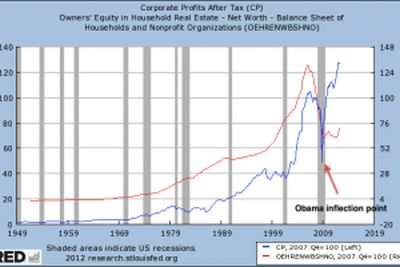
So why oppose Obama? Simply, it is the shape of the society Obama is crafting that I oppose, and I intend to hold him responsible, such as I can, for his actions in creating it. Many Democrats are disappointed in Obama. Some feel he’s a good president with a bad Congress. Some feel he’s a good man, trying to do the right thing, but not bold enough. Others think it’s just the system, that anyone would do what he did. I will get to each of these sentiments, and pragmatic questions around the election, but I think it’s important to be grounded in policy outcomes. Not, what did Obama try to do, in his heart of hearts? But what kind of America has he actually delivered? And the chart below answers the question. This chart reflects the progressive case against Obama.

The above is a chart of corporate profits against the main store of savings for most Americans who have savings — home equity. Notice that after the crisis, after the Obama inflection point, corporate profits recovered dramatically and surpassed previous highs, whereas home equity levels have remained static. That $5-7 trillion of lost savings did not come back, whereas financial assets and corporate profits did. Also notice that this is unprecedented in postwar history. Home equity levels and corporate profits have simply never diverged in this way; what was good for GM had always, until recently, been good, if not for America, for the balance sheet of homeowners. Obama’s policies severed this link, completely.

This split represents more than money. It represents a new kind of politics, one where Obama, and yes, he did this, officially enshrined rights for the elite in our constitutional order and removed rights from everyone else (see “The Housing Crash and the End of American Citizenship” in the Fordham Urban Law Journal for a more complete discussion of the problem). The bailouts and the associated Federal Reserve actions were not primarily shifts of funds to bankers; they were a guarantee that property rights for a certain class of creditors were immune from challenge or market forces. The foreclosure crisis, with its rampant criminality, predatory lending, and document forgeries, represents the flip side. Property rights for debtors simply increasingly exist solely at the pleasure of the powerful. The lack of prosecution of Wall Street executives, the ability of banks to borrow at 0 percent from the Federal Reserve while most of us face credit card rates of 15-30 percent, and the bailouts are all part of the re-creation of the American system of law around Obama’s oligarchy. [Continue reading…]
Facebooktwittermail

The price of a black president

Frederick C Harris writes: When African-Americans go to the polls next week, they are likely to support Barack Obama at a level approaching the 95 percent share of the black vote he received in 2008. As well they should, given the symbolic exceptionalism of his presidency and the modern Republican Party’s utter disregard for economic justice, civil rights and the social safety net.

But for those who had seen in President Obama’s election the culmination of four centuries of black hopes and aspirations and the realization of the Rev. Dr. Martin Luther King Jr.’s vision of a “beloved community,” the last four years must be reckoned a disappointment. Whether it ends in 2013 or 2017, the Obama presidency has already marked the decline, rather than the pinnacle, of a political vision centered on challenging racial inequality. The tragedy is that black elites — from intellectuals and civil rights leaders to politicians and clergy members — have acquiesced to this decline, seeing it as the necessary price for the pride and satisfaction of having a black family in the White House.

These are not easy words to write. Mr. Obama’s expansion of health insurance coverage was the most significant social legislation since the Great Society, his stimulus package blunted much of the devastation of the Great Recession, and the Dodd-Frank financial overhaul added major new protections for consumers. His politics would seem to vindicate the position of civil rights-era leaders like Bayard Rustin, who argued that blacks should form coalitions with other Democratic constituencies in support of universal, race-neutral policies — in opposition to activists like Malcolm X, who distrusted party politics and believed that blacks would be better positioned to advance their interests as an independent voting bloc, beholden to neither party.

But the triumph of “post-racial” Democratic politics has not been a triumph for African-Americans in the aggregate. It has failed to arrest the growing chasm of income and wealth inequality; to improve prospects for social and economic mobility; to halt the re-segregation of public schools and narrow the black-white achievement gap; and to prevent the Supreme Court from eroding the last vestiges of affirmative action. The once unimaginable successes of black diplomats like Colin L. Powell, Condoleezza Rice and Susan E. Rice and of black chief executives like Ursula M. Burns, Kenneth I. Chenault and Roger W. Ferguson Jr. cannot distract us from facts like these: 28 percent of African-Americans, and 37 percent of black children, are poor (compared with 10 percent of whites and 13 percent of white children); 13 percent of blacks are unemployed (compared with 7 percent of whites); more than 900,000 black men are in prison; blacks experienced a sharper drop in income since 2007 than any other racial group; black household wealth, which had been disproportionately concentrated in housing, has hit its lowest level in decades; blacks accounted, in 2009, for 44 percent of new H.I.V. infections. [Continue reading…]

Facebooktwittermail

Obama’s squandered advantages

Frank Bruni writes: After “a couple of Cadillacs,” a summer belly-flop abroad, a dismissive swipe at 47 percent of the population and a convention best remembered for Clint Eastwood’s chat with a chair, Mitt Romney is seemingly tied with President Obama. He has a real chance. It’s a remarkable turn of events, given how many errors he’s made and how ill suited he is to this particular juncture in the American story. And to size up the situation honestly is to consider one conclusion as seriously as any other:

Obama isn’t quite the candidate, or politician, he’s cracked up to be. The One is a fraction of his reputed self.

Yes, I know: the economy. It’s supposedly the source of most of his woes, the great weight he lugs around, a nearly fatal handicap. And the fact that he’s doing as well as he is affirms the sway of his personality and sense of his policies, at least according to his most fervent admirers.

I don’t buy it. For starters, a great many Americans understand that he doesn’t bear primary responsibility for the high rate of unemployment and the drops in home prices and incomes. A CNN/ORC poll last month showed that 54 percent of likely voters placed the blame chiefly on George W. Bush and Republicans.

Additionally, 68 percent indicated some optimism about economic conditions, which they said would be “somewhat good” or “very good” in a year. There’s room in those numbers for Obama to pull well ahead of a rival as profoundly flawed as Romney. Yet he hasn’t. [Continue reading…]

Facebooktwittermail

U.N. team to investigate civilian drone deaths

The Bureau of Investigative Journalism reports: The United Nations plans to set up a special investigation unit examining claims of civilian deaths in individual US covert drone strikes.

UN investigators have been critical of US ‘extrajudicial executions’ since they began in 2002. The new Geneva-based unit will also look at the legality of the programme.

The latest announcement, by UN special rapporteur Ben Emmerson QC, was made in a speech on October 25 at Harvard law school. Emmerson, who monitors counter-terrorism for the UN, previously called in August for the US to hand over video of each covert drone attack.

The London-based lawyer became the second senior UN official in recent months to label the tactic of deliberately targeting rescuers and funeral-goers with drones ‘a war crime’. That practice was first exposed by the Bureau for the Sunday Times in February 2012.

‘The Bureau has alleged that since President Obama took office at least 50 civilians were killed in follow-up strikes when they had gone to help victims and more than 20 civilians have also been attacked in deliberate strikes on funerals and mourners. Christof Heyns … has described such attacks, if they prove to have happened, as war crimes. I would endorse that view,’ said Emmerson. [Continue reading…]

Facebooktwittermail

U.S. officials ‘question Imran Khan on drones’

Al Jazeera reports: Imran Khan, the Pakistani cricketer turned politician, has been stopped by US immigration officials and questioned about his views on US drone strikes in his country, party officials have said.

Khan, the leader of the Pakistan Movement for Justice party (PTI), has campaigned vociferously for an end to the controversial US campaign of missile strikes against suspected Taliban and al-Qaeda fighters in Pakistan’s tribal areas.

The 59-year-old, who was headed to New York, said he was stopped by US officials in Toronto on Friday.

“I was taken off from plane and interrogated by US Immigration in Canada on my views on drones. My stance is known. Drone attacks must stop,” he wrote on Twitter.

Khan said the delay meant he missed his flight and a party fundraising lunch in New York, but insisted “nothing will change my stance”.

Facebooktwittermail

Iran military action not ‘right course at this time’, Downing Street says

The Guardian reports: The UK government has reiterated that it does not believe military action against Iran would be appropriate at the moment, following the disclosure that Britain has rebuffed US requests to use UK military bases to support the buildup of forces in the Gulf.

Downing Street said: “We are working closely with the US with regard to UK bases” but “the government does not think military action is the right course at this point of time”.

David Cameron made a lengthy speech last week urging Israel to show restraint, and pointing to the way in which sanctions are having an impact on the Iranian economy.

The Guardian has been told that US diplomats have also lobbied for the use of British bases in Cyprus, and for permission to fly from US bases on Ascension Island in the Atlantic and Diego Garcia in the Indian Ocean, both of which are British territories.

The US approaches are part of contingency planning over the nuclear standoff with Tehran, but British ministers have so far reacted coolly. On Friday, Downing Street said such contingency planning was something that was done as a matter of routine.

They have pointed US officials to legal advice drafted by the attorney general’s office and which has been circulated to Downing Street, the Foreign Office and the Ministry of Defence.

It states that providing assistance to forces that could be involved in a pre-emptive strike would be a clear breach of international law on the basis that Iran, which has consistently denied it has plans to develop a nuclear weapon, does not currently represent “a clear and present threat”. [Continue reading…]

Facebooktwittermail

Neither Obama nor Romney have the guts to talk about the greatest global threat

The New York Times reports: For all their disputes, President Obama and Mitt Romney agree that the world is warming and that humans are at least partly to blame. It remains wholly unclear what either of them plans to do about it.

Even after a year of record-smashing temperatures, drought and Arctic ice melt, none of the moderators of the four general-election debates asked about climate change, nor did either of the candidates broach the topic.

Throughout the campaign, Mr. Obama and Mr. Romney have seemed most intent on trying to outdo each other as lovers of coal, oil and natural gas — the very fuels most responsible for rising levels of carbon dioxide in the atmosphere.

Mr. Obama has supported broad climate change legislation, financed extensive clean energy projects and pushed new regulations to reduce global warming emissions from cars and power plants. But neither he nor Mr. Romney has laid out during the campaign a legislative or regulatory program to address the fundamental questions arising from one of the most vexing economic, environmental, political and humanitarian issues to face the planet. Should the United States cut its greenhouse gas emissions, and, if so, how far and how fast? Should fossil fuels be more heavily taxed? Should any form of clean energy be subsidized, and for how long? Should the United States lead international mitigation efforts? Should the nation pour billions of new dollars into basic energy research? Is the climate system so fraught with uncertainty that the rational response is to do nothing?

Many scientists and policy experts say the lack of a serious discussion of climate change in the presidential contest represents a lost opportunity to engage the public and to signal to the rest of the world American intentions for dealing with what is, by definition, a global problem that requires global cooperation. [Continue reading…]

Facebooktwittermail

Obama’s African base for drone warfare

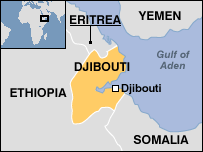
Camp Lemonier, Djibouti

The Washington Post reports: Around the clock, about 16 times a day, drones take off or land at a U.S. military base here, the combat hub for the Obama administration’s counterterrorism wars in the Horn of Africa and the Middle East.

Some of the unmanned aircraft are bound for Somalia, the collapsed state whose border lies just 10 miles to the southeast. Most of the armed drones, however, veer north across the Gulf of Aden to Yemen, another unstable country where they are being used in an increasingly deadly war with an al-Qaeda franchise that has targeted the United States.

Camp Lemonnier, a sun-baked Third World outpost established by the French Foreign Legion, began as a temporary staging ground for U.S. Marines looking for a foothold in the region a decade ago. Over the past two years, the U.S. military has clandestinely transformed it into the busiest Predator drone base outside the Afghan war zone, a model for fighting a new generation of terrorist groups.

The Obama administration has gone to extraordinary lengths to conceal the legal and operational details of its targeted-killing program. Behind closed doors, painstaking debates precede each decision to place an individual in the cross hairs of the United States’ perpetual war against al-Qaeda and its allies.

Increasingly, the orders to find, track or kill those people are delivered to Camp Lemonnier. Virtually the entire 500-acre camp is dedicated to counterterrorism, making it the only installation of its kind in the Pentagon’s global network of bases.

Secrecy blankets most of the camp’s activities. The U.S. military rejected requests from The Washington Post to tour Lemonnier last month. Officials cited “operational security concerns,” although they have permitted journalists to visit in the past.

After a Post reporter showed up in Djibouti uninvited, the camp’s highest-ranking commander consented to an interview — on the condition that it take place away from the base, at Djibouti’s lone luxury hotel. The commander, Army Maj. Gen. Ralph O. Baker, answered some general queries but declined to comment on drone operations or missions related to Somalia or Yemen.

Despite the secrecy, thousands of pages of military records obtained by The Post — including construction blueprints, drone accident reports and internal planning memos — open a revealing window into Camp Lemonnier. None of the documents is classified and many were acquired via public-records requests.

Taken together, the previously undisclosed documents show how the Djibouti-based drone wars sharply escalated early last year after eight Predators arrived at Lemonnier. The records also chronicle the Pentagon’s ambitious plan to further intensify drone operations here in the coming months. [Continue reading…]

Facebooktwittermail

Britain rejects U.S. request to use U.K. bases in nuclear standoff with Iran

The Guardian reports: Britain has rebuffed US pleas to use military bases in the UK to support the build-up of forces in the Gulf, citing secret legal advice which states that any pre-emptive strike on Iran could be in breach of international law.

The Guardian has been told that US diplomats have also lobbied for the use of British bases in Cyprus, and for permission to fly from US bases on Ascension Island in the Atlantic and Diego Garcia in the Indian Ocean, both of which are British territories.

The US approaches are part of contingency planning over the nuclear standoff with Tehran, but British ministers have so far reacted coolly. They have pointed US officials to legal advice drafted by the attorney general’s office which has been circulated to Downing Street, the Foreign Office and the Ministry of Defence.

This makes clear that Iran, which has consistently denied it has plans to develop a nuclear weapon, does not currently represent “a clear and present threat”. Providing assistance to forces that could be involved in a pre-emptive strike would be a clear breach of international law, it states.

“The UK would be in breach of international law if it facilitated what amounted to a pre-emptive strike on Iran,” said a senior Whitehall source. “It is explicit. The government has been using this to push back against the Americans.”

Facebooktwittermail

Non-Jewish majority: The beginning of the end or the end of the beginning?

Mark LeVine writes: “The Jewish majority is history.”

So declared Haaretz columnist Akiva Eldar in the space of Palestine/Israel in his most recent column, published on October 16. Eldar learned the news not from a public pronouncement to that effect by the Israeli government, which naturally has little interest to disseminate information of such “unparalleled importance”.

Rather, the new data, revealing that Jews now account for approximately 5.9 million out of the 12 million residents of Israel and the Occupied Territories was published in Haaretz’s economic magazine, The Marker, in an article dealing with government attempts to raise the bar for obtaining tax benefits.

A Ministry of Finance memorandum on the proposed changes to the law revealed the population figures without comment. But the implications are crucial. Not merely because of the demographic ceiling that has now been broken, but also because of what the structure of the tax law in question tells us about how Israelis have long considered the territory of Israel/Palestine – as one unit.

The Ministry of Finance wants to increase the threshold for companies to obtain tax breaks based on the number of consumers they sell to. The existing minimum market is 12 million people, and now that the population of Israel/Palestine as a whole has reached that level, any company that serves the Israeli/Palestinian market would be eligible for the tax break, when the law was intended to encourage exports outside the home market.

Fair enough. But what’s not fair is the fact that Israel and the Occupied Territories are considered as a single market from the perspective of Israeli enterprises, which have long had the West Bank and Gaza as a captive market, while Palestinian industries and agriculture have been severely restricted by Israel for decades in order to prevent them from competing with Israel.

The process of de-development and de-industrialisation has been a marked feature of Israeli rule over the Occupied Territories. Thanks to the weakness of Palestinian negotiators, the incompetence and corruption of the political leadership, and the connivance of the American and EU as “honest brokers”, it was institutionalised into the Oslo-era economic relationship through various agreements, most notably the Paris Protocol of 1994, which severely restricted the ability of Palestinians to develop any new industries which might challenge existing Israeli industries. [Continue reading…]

Facebooktwittermail

In Afghan war, enter Sir Mortimer Durand

Myra MacDonald writes: When the British decided to define the outer limits of their Indian empire, they fudged the question. After two disastrous wars in Afghanistan, they sent the Foreign Secretary of India, Sir Mortimer Durand, to Kabul in 1893 to agree the limits of British and Afghan influence. The result was the Durand Line which Pakistan considers today as its border and Afghanistan refuses to recognise. Then, rather than extend the rule of the Raj out to the Durand Line, the British baulked at pacifying the tribes in what is now Pakistan’s Federally Administered Tribal Areas (FATA). Instead, they used the still-extant Frontier Crimes Regulation of 1901 to keep them at bay, if necessary through collective punishment. The Pashtun tribes living on either side of the Durand Line continued to move back and forth, resenting outside interference and rejecting an arbitrary division of their lands by a foreign power.

The situation remains as nebulous to this day. Pakistan, like the British Raj before it, wants a secure western frontier and has been ready to back Islamist militants in Afghanistan to obtain it. Indeed, its emphasis on Islam has been used as a means of countering ethnic Pashtun nationalism, lest the Pashtun lay claim to a Pashtunistan covering both sides of the Durand Line. Meanwhile, remembering the days when Peshawar was a fabled Afghan city, some Afghans hanker after a Greater Afghanistan, incorporating the lands of all Pashtun (or Afghan) tribes as far as the Indus river. (Historically, the identification of Afghanistan with the Pashtun was such that the words “Afghan” and “Pashtun” were treated as synonyms.) And even those Afghans who recognise how unrealistic it would be to claim a sizeable chunk of modern-day Pakistan retain a proprietary sense over the Pashtun living on the other side of the Durand Line. Meanwhile the Pashtun themselves resent their arbitrary separation between two countries, which has reduced their capacity to exercise political power.

Facebooktwittermail

Rethinking open checkbook for America’s security colossus

The New York Times reports: Last week, a Bangladeshi student was charged in an F.B.I. sting operation with plotting to blow up the Federal Reserve Bank in New York. A Somali-American man was convicted of sending young recruits from Minneapolis to a terrorist group in Somalia. In Libya, extremists responsible for the killing of four Americans last month in Benghazi remained at large.

The drumbeat of terrorism news never quite stops. And as a result, for 11 years since the Sept. 11 attacks, the security colossus constructed to protect the nation from Al Qaeda and its ilk has continued to grow, propelled by public anxiety, stunning advances in surveillance technology and lavish spending — about $690 billion over a decade, by one estimate, not including the cost of the wars in Iraq and Afghanistan.

Now that may be changing. The looming federal budget crunch, a sense that major attacks on the United States are unlikely and new bipartisan criticism of the sprawling counterterrorism bureaucracy may mean that the open checkbook era is nearing an end.

While the presidential candidates have clashed over security for American diplomats in Libya, their campaigns have barely mentioned domestic security. That is for a reason: fewer than one-half of 1 percent of Americans, in a Gallup poll in September, said that terrorism was the country’s most important problem.

But the next administration may face a decision: Has the time come to scale back security spending, eliminating the least productive programs? Or, with tumult in the Arab world and America still a prime target, would that be dangerous?

Many security experts believe that a retrenchment is inevitable and justified. [Continue reading…]

Facebooktwittermail

For Sheldon Adelson ‘Israel is at the core of everything he does’

The Washington Post reports: When casino magnate Sheldon Adelson switched his support from Newt Gingrich to Mitt Romney during the spring primaries, the billionaire and the candidate were eager to shed their skepticism of each other. If Adelson was going to give a political campaign more money than anyone ever had, he wanted to be certain Romney would join him in steadfast support of Israel. And Romney, according to friends of both, sought assurance that Adelson wouldn’t embarrass him.

Since then, Adelson has joined Romney during the candidate’s visit to Israel this summer, attended presidential debates and gotten together with Romney so often that their wives have become friends, according to confidants of the two men.

Although Adelson, 79, has said he will give $100 million to help Romney and quash President Obama’s “socialist-style” approach to the economy, he remains skeptical, believing that politicians don’t deliver on promises and can’t be trusted.

“Many people who give very significant donations to political campaigns come to me afterwards very frustrated that they don’t get what they wanted once the person is elected,” says Morton Klein, president of the Zionist Organization of America, which Adelson has supported for years. “Sheldon doesn’t expect people to change. He’s very realistic about politics.”

Adelson — whose gambling operations span the globe from Las Vegas to casinos open or planned in Macau, Singapore and Spain — tells friends he finds the way U.S. elections are funded to be abhorrent, putting too much power in the hands of a wealthy few. So as one of those wealthy few, why would he pour more money into a campaign than 65 average Americans will earn in their combined lifetimes?

Adelson would not agree to an interview unless he could screen all questions in advance, a condition The Washington Post declined to meet. But more than 20 friends, critics, colleagues and beneficiaries portray a man with several motives for his massive donations to political, religious and medical causes.

He’s a scrappy fighter who defends what is his, a self-made man who held more than 50 jobs before striking gold with his Venetian casino on the Vegas Strip, and he has developed a powerful aversion to taxes and unions. He is the 12th-richest person in the nation, according to Forbes magazine, with a fortune valued at $21 billion. ­Under Obama, Adelson has achieved a larger increase in his wealth than anyone else in the country. In the past two decades, he has also undergone a political conversion, from a Massachusetts Democrat who considered Republicans to be the establishment that resisted newcomers like him, to a Nevada Republican who believes that his former party coddles the idle and has fallen captive to identity politics.

Adelson is driven by the idea of Israel as a muscular riposte to the Holocaust. Based on his experience as a Jewish kid who would get insulted and roughed up in a tough Boston neighborhood, Adelson believes Jewish Americans should back an Israel that puts security first and resists compromise with Arabs who do not accept its existence.

“Israel is at the core of everything he does,” says Fred Zeidman, a friend of Adelson, fellow Romney backer and former chairman of the U.S. Holocaust Memorial Museum. [Continue reading…]

Facebooktwittermail

U.S. on track to become ‘the new Middle East’

The Associated Press reports: U.S. oil output is surging so fast that the United States could soon overtake Saudi Arabia as the world’s biggest producer.

Driven by high prices and new drilling methods, U.S. production of crude and other liquid hydrocarbons is on track to rise 7% this year to an average of 10.9 million barrels per day. This will be the fourth straight year of crude increases and the biggest single-year gain since 1951.

The boom has surprised even the experts.

“Five years ago, if I or anyone had predicted today’s production growth, people would have thought we were crazy,” says Jim Burkhard, head of oil markets research at IHS CERA, an energy consulting firm.

The Energy Department forecasts that U.S. production of crude and other liquid hydrocarbons, which includes biofuels, will average 11.4 million barrels per day next year. That would be a record for the U.S. and just below Saudi Arabia’s output of 11.6 million barrels. Citibank forecasts U.S. production could reach 13 million to 15 million barrels per day by 2020, helping to make North America “the new Middle East.”

Meanwhile Bloomberg reports: Mecca, which hosts millions of pilgrims a year visiting Islam’s most holy shrine, is working toward becoming the first city in Saudi Arabia to operate a utility-scale plant generating electricity from renewables.

The city on Jan. 5 plans to select from a group of at least 20 bidders competing to build and operate facilities producing 385 gigawatt-hours per year of power including 100 megawatts of solar capacity, said Mayor Osama al-Bar.

“No city in Saudi Arabia owns power-generation assets, and we want to be first city that owns power plants and hopefully the first in the Muslim world,” al-Bar said in an interview on Sept. 16 in the nation’s capital, Riyadh.

The plans are the latest indication that the desert kingdom is stepping up efforts to diversify its sources of energy as economic and population growth threaten to erode Saudi Arabia’s status as the world’s biggest oil exporter.

The central government is seeking $109 billion of investment for building a solar industry, aiming to get a third of Saudi Arabia’s power from the sun by 2032 compared with almost none now. The target is almost as much as the $136 billion invested worldwide in solar energy last year, according to Bloomberg New Energy Finance.

So, even while most Americans are finally waking up to the reality of global warming and Saudi Arabia is grappling with the challenge of breaking its dependence on oil, the United States is turning itself into a petro-state that wrecks the environment through fracking and tar sands oil extraction.

Facebooktwittermail

The 5 percent whose need is greatest

David Runciman writes: There is some competition to be the person who inspired the slogan of Occupy Wall Street: ‘We are the 99 per cent.’ Joseph Stiglitz thinks it might be him, on the back of an article he wrote for Vanity Fair in 2011 entitled: ‘Of the 1 per cent, by the 1 per cent, for the 1 per cent.’ Others think it was the economist Emmanuel Saez, who helped popularise the idea that 99 per cent of American households have been watching their incomes stagnate or fall while the top 1 per cent pulled away. As Saez reported back in 2007, since the 1970s half of all income growth has been captured by just 1 per cent of the population, leaving everyone else to get by on what’s left. But Rolling Stone magazine identified the originator of ‘We are the 99 per cent’ as David Graeber, the anthropologist and activist, who first spotted its potential as an organising tool.[*] You can see why people might want to lay claim to ‘We are the 99 per cent’: it’s a brilliant slogan and an increasingly successful brand, doing its work on T-shirts and banners around the world. But it’s a half-baked idea.

The problem is that 99 per cent is far too many. Majorities on that scale sound overwhelming, but they always come apart on closer scrutiny. There is nothing on which so many people will ever be able to agree. You often find polling questions to which only 1 per cent of the sample are willing to give their assent – flailing candidates for office can easily plumb those depths – but it would be a big mistake to assume that the other 99 per cent are united on anything at all, even on their dislike of the unpopular candidate (many will never have heard of him). The only time the figure 99 per cent appears in polling data is when the poll is a fraudulent one. It’s a number I still associate with elections in the old Soviet bloc, or with the last remaining dictatorships. Kim Jong Un can get the backing of 99 per cent of his electorate. No one else can.

Occupy Wall Street is not trying to get 99 per cent of the population to vote for anyone or anything. The movement is simply highlighting an experience that the 99 per cent have in common, which is to have been stiffed by the current system. But this is another way in which 99 per cent is too many. Something must have gone very wrong with democracy when so many can be outwitted by so few. The implication of the slogan ‘We are the 99 per cent’ is that we have all been duped. If we had known what was going on we wouldn’t have let it happen. Now that we know about it we can stop it. But how? Any system in which 99 per cent of the population can be duped at the same time is not merely a defective democracy; it is no democracy at all. ‘We are the 99 per cent’ is intended as an accommodating idea, but really it’s a revolutionary one. It implies that we have been the victims of a giant confidence trick. You can’t work to improve a system like that, any more than you can work to improve a Ponzi scheme; you need to scrap it and start again. Some prominent figures associated with Occupy Wall Street are quite happy with this line of thought. Slavoj Žižek is unabashed about the movement’s revolutionary implications. He sees it as a harbinger of the coming transformation, ‘a message from the communist future’. But for all Žižek’s brilliance as a sloganeer, he would be hard-pressed to get many of the 99 per cent to agree with him on that. They don’t want to scrap the democracy we have. They just want it to work better.

So how were we duped? Mainly by not paying attention. The 1 per cent didn’t conspire to rip everyone else off. They got their way by walking through the door we left open for them. We were too distracted and disorganised among ourselves to put up enough resistance. What the 99 per cent have in common is that they don’t have enough in common to make a difference politically, compared to the very rich, who are a well-organised bunch. The 99 per cent are a lot more numerous than the 1 per cent; they are also a lot more divided, and it’s the second fact that counts. [Continue reading…]

Facebooktwittermail