Trita Parsi writes: Two weeks ago, Netanyahu launched a public campaign to persuade Ki-Moon not to go to Tehran. Attending the international summit in Tehran would be “a big mistake,” he told Ki-Moon. Later he issued a statement, telling the Secretary General that “you do not belong in Tehran.” A visit by the UN Secretary General would undermine the efforts to isolate Tehran, the Israeli cabinet figured.
And Washington agreed. At a time when Tehran’s isolation has increased significantly, a visit by the Secretary General could send the wrong signal.
Problem is, the likelihood of Ban Ki-Moon agreeing not attending the NAM meeting was minimal to begin with. NAM countries represent a majority of the world’s population and given the tradition of UN Secretary General’s attending such meetings, it was almost inevitable that Ki Moon would go. With this campaign, Bibi was jeopardizing his own standing in pursuit of an almost impossible goal.
But perhaps more importantly, Bibi’s folly in getting personally involved in the campaign to prevent Ki-Moon from going to Tehran presented the Iranian government with a PR coup. Bibi had significantly increased the importance and media interest in the NAM summit, and by Ki-Moon rejecting Netanyahu’s pressure and going to Tehran, the Iranian regime could declare victory and draw much more credit from the Secretary General’s visit than if Netanyahu had not bothered with summit in the first place.
But when it comes to self-inflected wounds, Netanyahu has his match in President Mahmoud Ahmadinejad. While both Iran’s conflict with the West and the current nuclear quarrel precede Ahmadinejad’s emergence on the Iranian political scene, his reckless, venomous rhetoric—particularly against Israel—has made him politically toxic and lent significant support to Israel’s efforts to isolate Iran. Had it not been for Ahmadinejad’s never-ending ability to insult, it is not clear if the current international consensus against Iran could have formed. No wonder Israeli diplomats in the US expressed their desire for Ahmadinejad to be re-elected in 2009. [Continue reading…]
Rosa Brooks writes: In 1999, Qiao Liang and Wang Xiangsui, both colonels in China’s People’s Liberation Army, published a slender book called Unrestricted Warfare. The two officers predicted that technological innovations and globalization would change warfare almost beyond recognition. In a world of cyberattacks, asymmetric warfare, and transnational terrorism, they wrote, “the three indispensable ‘hardware’ elements of any war … soldiers, weapons and a battlefield … have changed so that it is impossible to get a firm grip on them.… [I]s the war god’s face still distinct?”
Qiao and Wang published Unrestricted Warfare two years before the 9/11 attacks, and their description of likely changes in warfare was strikingly prescient. In previous columns, I’ve described some ways these changes challenge our most basic ideas of what a military is, does, and should do, and suggested that failing to fully confront those changes and challenges is a surefire way to end up with a national security strategy that’s both incoherent and inefficient.
It’s also a surefire way to damage the rule of law.
A lot of ink has been spilled defining the rule of law (some of it by me), but at root it’s pretty simple. The rule of law requires that governments follow transparent, universally applicable, and clearly defined laws and procedures. The goal is to prevent the arbitrary exercise of power. When you’ve got the rule of law, the government can’t fine you, lock you up, or kill you on a whim — it can only do that in accordance with pre-established rules that reflect basic notions of humanity and fairness.
When you don’t have the rule of law, life can get unpleasant. Qiao and Wang, for instance, come from a country where the rule of law is only partially realized, and arbitrary detention and executions without due process remain common. Or consider the grievances enumerated in the American Declaration of Independence: Britain’s King George III, the colonists complained, deprived them of “the benefits of Trial by Jury,” refused “his Assent to Laws for establishing Judiciary powers,” transported prisoners “beyond Seas to be tried for pretended offences,” and “affected to render the Military independent of and superior to the Civil power.”
Bad stuff! Americans fought a long and bloody war over it.
Today, however, the very same changes that challenge our long-held assumptions about the military also challenge the rule of law America once fought so hard to establish both domestically and globally. (The United States was instrumental in the creation of the United Nations and the various international human rights treaties and institutions.) For when the idea of “war” loses definition — when the war god’s face grows indistinct — we lose any principled basis for deciding when the law of war applies, and when it doesn’t. [Continue reading…]
In a speech in Washington DC yesterday, Ambassador Chas W. Freeman, Jr. (USFS, Ret.), said: The United States remains the world’s only superpower but the diffusion of wealth and power to regions beyond the North Atlantic has greatly reduced our military’s ability to shape trends and events around the world. China, in particular, is emerging as an immovable military object, if not yet an irresistible military force. Our political influence, economic clout, and self-confidence are not what they used to be. The “sequester” and the political dysfunction that led us to it promise to weaken us still more. Major adjustments in U.S. policies and diplomacy are overdue.
Global governance was once mainly a vector of the struggle between the two superpowers and the blocs they led. After Moscow defaulted on the Cold War and dropped out of the contest for worldwide dominance, Americans briefly imagined that our matchless economic strength and unchallengeable military supremacy would enable us unilaterally to shape the world to our advantage. In the first decade of this century, however, the wizards of Wall Street brought down the global economy even as they discredited the so-called “Washington consensus” and emasculated the once-robust image of American capitalism.
Meanwhile, much of the world was disappointed by the lack of U.S. leadership on other issues ranging from climate change to peace in the Middle East. People everywhere looked hopefully to worldwide institutions, like the United Nations, the G-20, the International Monetary Fund, and the World Trade Organization. None of them proved up to the job. Responsibility for the regulation of the planetary political economy began to devolve to its regions, if only by default.
The globally coherent worldwide order that American power configured itself to enforce after the Cold War is clearly morphing into something new. We can see the outlines of the new order even if we cannot yet make out its details and don’t know what to call it. The “post-Cold War era” is long past. The “American Century” ended eleven years ago, on 9/11. We are exiting the “age of antiterrorism.” We are uncertain against whom we should deploy our incomparable military might or to what international purposes we should bend ourselves.
Call it what you will. This is an era of enemy deprivation syndrome. There is no overarching contest to define our worldview. The international system is once again governed by multiple contentions and shifting strategic geometries. In such a world, diplomatic agility is as important as constancy of commitment – or more so.
Before the Cold War, the United States twice fought in coalition with Britain, France, Australia, Canada, and a few other countries, but we had no permanent alliances. The Soviet threat and the need to deal with the instabilities that attended the end of European empires in Asia and Africa led Americans to reverse our traditional aversion to foreign entanglements and to embrace them with a vengeance. The United States ultimately extended formal protection to about a fourth of the world’s countries and informal protection to nearly another fourth. In our usage, the word “ally” lost its original sense of “accomplice” and came to mean “protectorate,” not partner.
There have been huge changes in the global security environment since the collapse of our Soviet enemy. But, there have been no adjustments at all in our alliance and defense commitments to foreign nations – other than their enlargement. The alliance structure we built in the Cold War has long outlived the foe it was created to counter. Remarkably, however, the preservation of our prestige at the head of that alliance structure seems to have become the principal objective of our foreign policy. Carrying on with approaches that address long-disappeared realities rather than adjusting to new circumstances is patently dysfunctional behavior. It represents the triumph of complacency and inertia over reason, statesmanship, and strategy. [Continue reading…]
Mike Lofgren writes: It was 1993, during congressional debate over the North American Free Trade Agreement. I was having lunch with a staffer for one of the rare Republican congressmen who opposed the policy of so-called free trade. To this day, I remember something my colleague said: “The rich elites of this country have far more in common with their counterparts in London, Paris, and Tokyo than with their fellow American citizens.”
That was only the beginning of the period when the realities of outsourced manufacturing, financialization of the economy, and growing income disparity started to seep into the public consciousness, so at the time it seemed like a striking and novel statement.
At the end of the Cold War many writers predicted the decline of the traditional nation-state. Some looked at the demise of the Soviet Union and foresaw the territorial state breaking up into statelets of different ethnic, religious, or economic compositions. This happened in the Balkans, the former Czechoslovakia, and Sudan. Others predicted a weakening of the state due to the rise of Fourth Generation warfare and the inability of national armies to adapt to it. The quagmires of Iraq and Afghanistan lend credence to that theory. There have been numerous books about globalization and how it would eliminate borders. But I am unaware of a well-developed theory from that time about how the super-rich and the corporations they run would secede from the nation state.
I do not mean secession by physical withdrawal from the territory of the state, although that happens from time to time—for example, Erik Prince, who was born into a fortune, is related to the even bigger Amway fortune, and made yet another fortune as CEO of the mercenary-for-hire firm Blackwater, moved his company (renamed Xe) to the United Arab Emirates in 2011. What I mean by secession is a withdrawal into enclaves, an internal immigration, whereby the rich disconnect themselves from the civic life of the nation and from any concern about its well being except as a place to extract loot.
Our plutocracy now lives like the British in colonial India: in the place and ruling it, but not of it. If one can afford private security, public safety is of no concern; if one owns a Gulfstream jet, crumbling bridges cause less apprehension—and viable public transportation doesn’t even show up on the radar screen. With private doctors on call and a chartered plane to get to the Mayo Clinic, why worry about Medicare? [Continue reading…]
The Associated Press reports: An Assembly resolution urging California colleges and universities to squelch nascent anti-Semitism also encouraged educators to crack down on demonstrations against Israel, angering advocates for Muslim students.
With no debate, lawmakers on Tuesday approved a resolution that encourages university leaders to combat a wide array of anti-Jewish and anti-Israel actions.
“California schools need to recognize that anti-Semitism is still a very real issue on college campuses around the state — it did not disappear with the end of World War II,” said Assemblywoman Linda Halderman, R-Fresno, the resolution’s author.
Most of the incidents of anti-Semitism the resolution cited are related to the Israel-Palestine debate. These include instances of protesters comparing Israeli police to Nazis and urging support for Hamas.
The resolution, which is purely symbolic and does not carry policy implications, also condemns the suggestion that Israel is a “racist” state and that Jews “wield excessive power over American foreign policy.” The resolution characterizes the student campaign to pressure the University of California system to divest from Israel as anti-Semitic, and applauds university leaders’ refusal to consider it.
The Council on American Islamic Relations said the resolution went too far and constituted an attack on students’ right to free expression.
“To be clear, genuine acts of anti-Semitism should be condemned, but this resolution goes far beyond that,” said Rachel Roberts, a spokeswoman for the group. “By characterizing pro-Palestinian speech as anti-Jewish, the Legislature sidelines those Muslim students and progressive Jewish students who often organize together to raise awareness about the Middle East.”
Roberts said the council was disappointed that the resolution was drafted and passed while California colleges were out of session.
Pro-Palestinian protests have become a regular occurrence on many University of California campuses. Students sometimes use sensational tactics including simulating checkpoints and combining swastikas with the Star of David.
In 2010, 10 Muslim students were convicted of misdemeanors for repeatedly interrupting a speech by Israeli Ambassador Michael Oren at UC Irvine, where students were suspected of painting swastikas in university buildings.
The Assembly’s actions also drew criticism from free speech advocates. Carlos Villarreal, director of the San Francisco chapter of the National Lawyers Guild, called the resolution irresponsible and dangerous because it combines legitimate condemnations of acts of intimidation and hate with specific objections to tactics used to support the Palestinian people.
“In doing so, it can be seen as having no other purpose than to demonize all those who criticize the nation-state of Israel or support the rights of the Palestinian people,” he said.
Max Blumenthal writes: In a small courtroom on the sixth floor of Haifa’s District Court, a colonel in the Israeli engineering corps who wrote a manual for the bulldozer units that razed the Rafah Refugee Camp in 2003 offered his opinion on the killing of the American activist Rachel Corrie.
“There are no civilians during wartime,” Yossi declared under oath.
Yossi made his remarkable statement under withering cross-examination by Hussein Abu Hussein, the lawyer for Corrie’s family, who was crushed to death by an Israeli bulldozer in Rafah on 17 March 2003. Rachel’s parents, Craig and Cindy, and her sister, Sarah, stood in the back of the courtroom to witness the 2010 proceedings. This marked their second visit for the second round of hearings in their civil suit against the state of Israel. Yesterday, an Israeli court issued its final judgment and exculpated the Israeli soldier who drove the bulldozer, the Army, and the State for all blame. Instead, the court held that Rachel bore responsibility for her own death for failing to move out of the bulldozer’s way.
In the immediate wake of Corrie’s killing, Colonel Lawrence Wilkerson, then the chief of staff to Secretary of State Colin Powell, instructed Corrie’s parents to demand a “thorough, fair and transparent investigation” from the Israeli government. Since then, the Israelis have stonewalled them, refusing to provide key details of their investigation, which was corrupted from the start by the investigators’ apparent attempts to find evidence that a bulldozer did not in fact kill Rachel. [Continue reading…]
Matt Taibbi writes: The great criticism of Mitt Romney, from both sides of the aisle, has always been that he doesn’t stand for anything. He’s a flip-flopper, they say, a lightweight, a cardboard opportunist who’ll say anything to get elected.
The critics couldn’t be more wrong. Mitt Romney is no tissue-paper man. He’s closer to being a revolutionary, a backward-world version of Che or Trotsky, with tweezed nostrils instead of a beard, a half-Windsor instead of a leather jerkin. His legendary flip-flops aren’t the lies of a bumbling opportunist – they’re the confident prevarications of a man untroubled by misleading the nonbeliever in pursuit of a single, all-consuming goal. Romney has a vision, and he’s trying for something big: We’ve just been too slow to sort out what it is, just as we’ve been slow to grasp the roots of the radical economic changes that have swept the country in the last generation.
The incredible untold story of the 2012 election so far is that Romney’s run has been a shimmering pearl of perfect political hypocrisy, which he’s somehow managed to keep hidden, even with thousands of cameras following his every move. And the drama of this rhetorical high-wire act was ratcheted up even further when Romney chose his running mate, Rep. Paul Ryan of Wisconsin – like himself, a self-righteously anal, thin-lipped, Whitest Kids U Know penny pincher who’d be honored to tell Oliver Twist there’s no more soup left. By selecting Ryan, Romney, the hard-charging, chameleonic champion of a disgraced-yet-defiant Wall Street, officially succeeded in moving the battle lines in the 2012 presidential race.
Like John McCain four years before, Romney desperately needed a vice-presidential pick that would change the game. But where McCain bet on a combustive mix of clueless novelty and suburban sexual tension named Sarah Palin, Romney bet on an idea. He said as much when he unveiled his choice of Ryan, the author of a hair-raising budget-cutting plan best known for its willingness to slash the sacred cows of Medicare and Medicaid. “Paul Ryan has become an intellectual leader of the Republican Party,” Romney told frenzied Republican supporters in Norfolk, Virginia, standing before the reliably jingoistic backdrop of a floating warship. “He understands the fiscal challenges facing America: our exploding deficits and crushing debt.”
Debt, debt, debt. If the Republican Party had a James Carville, this is what he would have said to win Mitt over, in whatever late-night war room session led to the Ryan pick: “It’s the debt, stupid.” This is the way to defeat Barack Obama: to recast the race as a jeremiad against debt, something just about everybody who’s ever gotten a bill in the mail hates on a primal level.
Last May, in a much-touted speech in Iowa, Romney used language that was literally inflammatory to describe America’s federal borrowing. “A prairie fire of debt is sweeping across Iowa and our nation,” he declared. “Every day we fail to act, that fire gets closer to the homes and children we love.” Our collective debt is no ordinary problem: According to Mitt, it’s going to burn our children alive.
And this is where we get to the hypocrisy at the heart of Mitt Romney. Everyone knows that he is fantastically rich, having scored great success, the legend goes, as a “turnaround specialist,” a shrewd financial operator who revived moribund companies as a high-priced consultant for a storied Wall Street private equity firm. But what most voters don’t know is the way Mitt Romney actually made his fortune: by borrowing vast sums of money that other people were forced to pay back. This is the plain, stark reality that has somehow eluded America’s top political journalists for two consecutive presidential campaigns: Mitt Romney is one of the greatest and most irresponsible debt creators of all time. In the past few decades, in fact, Romney has piled more debt onto more unsuspecting companies, written more gigantic checks that other people have to cover, than perhaps all but a handful of people on planet Earth. [Continue reading…]
Bloomberg reports: Wealthy donors and corporations are more heavily invested in this presidential election than at any time since the 1972 Watergate scandal led to stricter campaign- finance laws.
A series of court decisions and regulatory changes in 2010 unraveled federal limits on donations, paving the way for a return of the big players. They are pooling their money in nonprofits, which keep contributor names secret, and super- political action committees, which amassed $350 million through the end of July.
One-quarter of that money comes from just 10 donors, led by Las Vegas casino billionaire Sheldon Adelson, according to data from the Center for Responsive Politics, a Washington-based group that tracks such spending.
Top Republican contributors say they back the party’s presidential candidate Mitt Romney because they agree with his small-government philosophy or oppose President Barack Obama’s new regulations on banks and the health-care industry.
Yet Romney is more than just a political kindred spirit; he’s a sound investment. Here’s how a Romney presidency might pay off — literally — for some of these super-donors. [Continue reading…]
Sarah Stillman reports: On the evening of May 7, 2008, a twenty-three-year-old woman named Rachel Hoffman got into her silver Volvo sedan, put on calming jam-band music, and headed north to a public park in Tallahassee, Florida. A recent graduate of Florida State, she was dressed to blend into a crowd—bluejeans, green-and-white patterned T-shirt, black Reef flip-flops. On the passenger seat beside her was a handbag that contained thirteen thousand dollars in marked bills.
Before she reached the Georgia-peach stands and Tupelo-honey venders on North Meridian Road, she texted her boyfriend. “I just got wired up,” she wrote at 6:34 P.M. “Wish me luck I’m on my way.”
“Good luck babe!” he replied. “Call me and let me know what’s up.”
“It’s about to go down,” she texted back.
Behind the park’s oaks and blooming crape myrtles, the sun was beginning to set. Young mothers were pushing strollers near the baseball diamonds; kids were running amok on the playground. As Hoffman spoke on her iPhone to the man she was on her way to meet, her voice was filtered through a wire that was hidden in her purse. “I’m pulling into the park with the tennis courts now,” she said, sounding casual.
Perhaps what put her at ease was the knowledge that nineteen law-enforcement agents were tracking her every move, and that a Drug Enforcement Administration surveillance plane was circling overhead. In any case, Rachel Hoffman, a tall, wide-eyed redhead, was by nature laid-back and trusting. She was not a trained narcotics operative. On her Facebook page you could see her dancing at music festivals with a big, goofy smile, and the faux profile she’d made for her cat (“Favorite music: cat stevens, straycat blues, pussycat dolls”).
A few weeks earlier, police officers had arrived at her apartment after someone complained about the smell of marijuana and voiced suspicion that she was selling drugs. When they asked if she had any illegal substances inside, Hoffman said yes and allowed them in to search. The cops seized slightly more than five ounces of pot and several Ecstasy and Valium pills, tucked beneath the cushions of her couch. Hoffman could face serious prison time for felony charges, including “possession of cannabis with intent to sell” and “maintaining a drug house.” The officer in charge, a sandy-haired vice cop named Ryan Pender, told her that she might be able to help herself if she provided “substantial assistance” to the city’s narcotics team. She believed that any charges against her could be reduced, or even dropped.
Hoffman’s legal worries were augmented by the fact that this wasn’t her first drug offense. A year earlier, while she was a senior, police pulled her over for speeding and found almost an ounce of marijuana in her car. She was ordered into a substance-abuse program, which required regular drug testing. Later, after failing to report for a test, she spent three days in jail.
Hoffman chose to coöperate. She had never fired a gun or handled a significant stash of hard drugs. Now she was on her way to conduct a major undercover deal for the Tallahassee Police Department, meeting two convicted felons alone in her car to buy two and a half ounces of cocaine, fifteen hundred Ecstasy pills, and a semi-automatic handgun.
The operation did not go as intended. By the end of the hour, police lost track of her and her car. Late that night, they arrived at her boyfriend’s town house and asked him if Hoffman was inside. They wanted to know if she might have run off with the money. Her boyfriend didn’t know where she was.
“She was with us,” he recalled an officer saying. “Until shit got crazy.”
Two days after Hoffman disappeared, her body was found in Perry, Florida, a small town some fifty miles southeast of Tallahassee, in a ravine overgrown with tangled vines. Draped in an improvised shroud made from her Grateful Dead sweatshirt and an orange-and-purple sleeping bag, Hoffman had been shot five times in the chest and head with the gun that the police had sent her to buy.
By the evening of her death, Rachel Hoffman had been working for the police department for almost three weeks. In bureaucratic terms, she was Confidential Informant No. 1129, or C.I. Hoffman. In legal parlance, she was a “coöperator,” one of thousands of people who, each year, help the police build cases against others, often in exchange for a promise of leniency in the criminal-justice system.
Informants are the foot soldiers in the government’s war on drugs. By some estimates, up to eighty per cent of all drug cases in America involve them, often in active roles like Hoffman’s. [Continue reading…]
Time magazine reports: Richard Millet is an accomplished figure in French literature. His le Sentiment du Langue (The Feeling of Language) won the Académie Française’s 1994 essay award. His work as an editor for celebrated publisher Gallimard, meanwhile, helped produce two recent Goncourt winners—including the 2006 novel les Bienveillantes (The Kindly Ones) by American author Jonathan Littell. Now, however, Millet is getting attention of an entirely different kind with a new work attacking immigration and multi-culturalism, and describing the acts of convicted Norwegian multi-murderer Anders Behring Breivik as “formal perfection…in their literary dimension.”Richard Millet
That bookish qualifier, says newsweekly l’Express in its critique of Millet’s new essay, Eloge Littéraire d’Anders Breivik (Literary Elegy of Anders Breivik), is a “gratuitous façade” for an otherwise “vindictive text” and thesis. Indeed, though Millet states he does not approve of Breivik’s murderous action July 22, 2011 that left 77 innocent people dead, he does write the slaughter was “without doubt what Norway deserved.” The reason? Norway, Millet contends, allowed immigration, multi-culturalism, and the domination of foreign customs, language, and religion to become such dominant influences that a self-designated defender of traditional society felt compelled to take decisive action.
“Multi-culturalism as it has been imported from the United States is the worst thing possible for Europe…and creates a mosaic of ghettoes in which the [host] nation no longer exists,” Millet told France Info radio Aug. 27. “Breivik, I believe, perceived that, and responded to that question with the most monstrous reply.”
Little wonder that such views — published just as Breivik was being sentenced Aug. 24 — have sparked controversy in France. As word of Millet’s writing spreads, so, too, may the objections it has inspired.
If so, that may only serve to reinforce Millet’s accusations that most of Europe — and indeed the West — is dominated by the same attitudes that motivated Breivik’s attack. Breivik, Millet writes, is “an exemplary product of Western decadence,” and a “child of the ideologico-racial fracture that extra-European immigration has introduced in Europe.” Because he sees the resulting “loss of national identity” and “Islamization of Europe” decaying “Christian roots” everywhere, Millet appears to believe acts similar to Breivik’s may be replicated outside Norway as well. [Continue reading…]

Chris McGreal writes: Reporters covering Israel are routinely confronted with the question: why not call Hamas a terrorist organisation? It’s a fair point. How else to describe blowing up families on buses but terrorism?
But the difficulty lies in what then to call the Israeli army when it, too, at particular times and places, has used indiscriminate killing and terror as a means of breaking Palestinian civilians. One of those places was Rafah, in the southern tip of the Gaza strip, where Rachel Corrie was crushed by a military bulldozer nine years ago as she tried to stop the Israeli army going about its routine destruction of Palestinian homes.
An Israeli judge on Tuesday perpetuated the fiction that Corrie’s death was a terrible accident and upheld the results of the military’s own investigation, widely regarded as such a whitewash that even the US ambassador to Israel described it as neither thorough nor credible. Corrie’s parents may have failed in their attempt to see some justice for their daughter, but in their struggle they forced a court case that established that her death was not arbitrary but one of a pattern of killings as the Israeli army pursued a daily routine of attacks intended to terrorise the Palestinian population of southern Gaza into submission.
The case laid bare the state of the collective Israeli military mind, which cast the definition of enemies so widely that children walking down the street were legitimate targets if they crossed a red line that was invisible to everyone but the soldiers looking at it on their maps. The military gave itself a blanket protection by declaring southern Gaza a war zone, even though it was heavily populated by ordinary Palestinians, and set rules of engagement so broad that just about anyone was a target.
With that went virtual impunity for Israeli troops no matter who they killed or in what circumstances – an impunity reinforced by Tuesday’s verdict in Haifa. [Continue reading…]
George Monbiot writes: There are no comparisons to be made. This is not like war or plague or a stockmarket crash. We are ill-equipped, historically and psychologically, to understand it, which is one of the reasons why so many refuse to accept that it is happening.
What we are seeing, here and now, is the transformation of the atmospheric physics of this planet. Three weeks before the likely minimum, the melting of Arctic sea ice has already broken the record set in 2007. The daily rate of loss is now 50% higher than it was that year. The daily sense of loss – of the world we loved and knew – cannot be quantified so easily.
The Arctic has been warming roughly twice as quickly as the rest of the northern hemisphere. This is partly because climate breakdown there is self-perpetuating. As the ice melts, for example, exposing the darker sea beneath, heat that would previously have been reflected back into space is absorbed.
This great dissolution, of ice and certainties, is happening so much faster than most climate scientists predicted that one of them reports: “It feels as if everything I’ve learned has become obsolete.” In its last assessment, published in 2007, the Intergovernmental Panel on Climate Change noted that “in some projections, Arctic late-summer sea ice disappears almost entirely by the latter part of the 21st century”. These were the most extreme forecasts in the panel’s range. Some scientists now forecast that the disappearance of Arctic sea-ice in late summer could occur in this decade or the next.
As I’ve warned repeatedly, but to little effect, the IPCC’s assessments tend to be conservative. This is unsurprising when you see how many people have to approve them before they are published. There have been a few occasions – such as its estimate of the speed at which glaciers would be lost in the Himalayas – on which the panel has overstated the case. But it looks as if these will be greatly outnumbered by the occasions on which the panel has understated it. [Continue reading…]
In the last two years, American arms manufacturers have profited massively from increased tension between Gulf states and Iran, thanks in large part to repeated threats of war emanating from Israel.
The New York Times reports: Weapons sales by the United States tripled in 2011 to a record high, driven by major arms sales to Persian Gulf allies concerned about Iran’s regional ambitions, according to a new study for Congress.
Overseas weapons sales by the United States totaled $66.3 billion last year, or more than three-quarters of the global arms market, valued at $85.3 billion in 2011. Russia was a distant second, with $4.8 billion in deals.
The American weapons sales total was an “extraordinary increase” over the $21.4 billion in deals for 2010, the study found, and was the largest single-year sales total in the history of United States arms exports. The previous high was in fiscal year 2009, when American weapons sales overseas totaled nearly $31 billion.
A worldwide economic decline had suppressed arms sales over recent years. But increasing tensions with Iran drove a set of Persian Gulf nations — Saudi Arabia, the United Arab Emirates and Oman — to purchase American weapons at record levels. [Continue reading…]
Jeff Stein reports: Gwenyth Todd had worked in a lot of places in Washington where powerful men didn’t hesitate to use sharp elbows. She had been a Middle East expert for the National Security Council in the Clinton administration. She had worked in the office of Defense Secretary Dick Cheney in the first Bush administration, where neoconservative hawks first began planning to overthrow Iraqi dictator Saddam Hussein.
But she was not prepared a few years later in Bahrain when she encountered plans by high-ranking admirals to confront Iran, any one of which, she reckoned, could set the region on fire. It was 2007, and Todd, then 42, was a top political adviser to the U.S. Navy’s 5th Fleet.
Previous 5th Fleet commanders had resisted various ploys by Bush administration hawks to threaten the Tehran regime. But in spring 2007, a new commander arrived with an ambitious program to show the Iranians who was boss in the Persian Gulf.
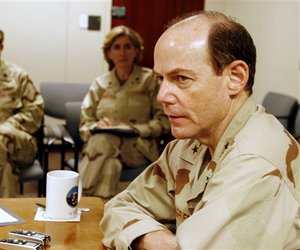
Vice Adm. Kevin J. Cosgriff had amassed an impressive résumé, rising through the ranks to command a cruiser and a warship group after the Sept. 11, 2001, terrorist attacks. Following a customary path to three stars, he had also spent as much time in Washington as he had at sea, including stints at the Defense Intelligence Agency and as director of the Clinton White House Situation Room.Vice Adm (Ret) Kevin J. Cosgriff now sits on the board of the Washington DC think tank, the Stimson Center.
Cosgriff — backed by a powerful friend and boss, U.S. Central Command (Centcom) chief Adm. William J. “Fox” Fallon — was itching to push the Iranians, Todd and other present and former Navy officials say.
“There was a feeling that the Navy was back on its heels in dealing with Iran,” according to a Navy official prohibited from commenting in the media. “There was an intention to be far more aggressive with the Iranians, and a diminished concern about keeping Washington in the loop.”
Two people who were there said Cosgriff mused in a staff meeting one day that he’d like to steam a Navy frigate up the Shatt al Arab, the diplomatically sensitive and economically crucial waterway dividing Iraq and Iran. In another, they said, he wanted to convene a regional conference to push back Iran’s territorial claims in the waterway, a flash point for the bloody Iran-Iraq war in the 1980s.
Then he presented an idea that not only alarmed Todd, but eventually, she believes, launched the chain of events that would end her career.
Cosgriff declined to discuss any of these meetings on the record. This story includes information from a half-dozen Navy and other government officials who demanded anonymity because of the sensitivity of the matter, many parts of which remain classified.
According to Todd and another witness, Cosgriff’s idea, presented in a series of staff meetings, was to sail three “big decks,” as aircraft carriers are known, through the Strait of Hormuz — to put a virtual armada, unannounced, on Iran’s doorstep. No advance notice, even to Saudi Arabia and other gulf allies. Not only that, they said, Cosgriff ordered his staff to keep the State Department in the dark, too.
To Todd, it was like something straight out of “Seven Days in May,” the 1964 political thriller about a right-wing U.S. military coup. [Continue reading…]

Simon Johnson writes: Two diametrically opposed views of Wall Street and the dangers posed by global megabanks came more clearly into focus last week. On the one hand, William B. Harrison, Jr. – former chairman of JP Morgan Chase – argued in the New York Times that today’s massive banks are an essential part of a well-functioning market economy, and not at all helped by implicit government subsidies.
On the other hand, there is a new powerful voice who knows how big banks really work and who is willing to tell the truth in great and convincing detail. Jeff Connaughton – a former senior political adviser who has worked both for and against powerful Wall Street interests over the years – has just published a page-turning memoir that is also a damning critique of how Wall Street operates, the political capture of Washington, and our collective failure to reform finance in the past four years. “The Payoff: Why Wall Street Always Wins,” is the perfect antidote to disinformation put about by global megabanks and their friends.
Specifically, Mr. Harrison makes six related arguments regarding why we should not break up our largest banks. Each of these is clearly and directly refuted by Mr. Connaughton’s experience and the evidence he presents.
First, Mr. Harrison claims that megabanks are the natural outgrowth of requests from customers, rather than the result of extraordinary resources spent on lobbying over the past 30 years. Mr. Connaughton’s book contains all you need to know – and more than you can stomach – about the realities of how the influence industry has worked diligently to build and defend megabanks. The people who really wanted the banks to become bigger were the executives in charge of those organizations – like Mr. Harrison. They spent a lot of money to make this happen. [Continue reading…]