Category Archives: Issues

Israel lobby casts itself as an enemy of Occupy Wall Street

Eli Clifton reports: The Emergency Committee for Israel (ECI), has joined the pack of conservative groups working to discredit the Occupy Wall Street Movement. The ECI — a Bill KristolGary BauerRachel Abrams-conceived organization — launched a YouTube ad this morning, seeking to paint the Wall Street protests as anti-Semitic.

The ad, which was faithfully promoted by ECI’s go-to media outlets — Politico’s Ben Smith, the Weekly Standard, and Commentary — alleges that Democratic party leaders are “turning a blind eye to anti-Semitic, anti-Israel attacks,” and urges President Obama and House Minority Leader Nancy Pelosi to “stand up to the mob.” Watch it:

While the anti-Semitic signs and clips shown in the commercial are deeply offensive, the Occupy Wall Street protesters have consistently rejected the attempts of a small number of extremists to hijack the movement. In fact, on Friday, “new media activist” Daniel Sieradski organized over 700 Occupy Wall Street protesters to participate in Kol Nidre, the prayers that begin Yom Kippur.

It turns out that one of the characters being highlighted in the ECI video was honing his act as a loud mouth on the streets of New York well before Occupy Wall Street began. The man in question is Danny Cline aka “Lotion Man” and his desire to capture the interest of anyone holding a camera seems stronger than anything else. Offending people seems to be Cline’s preferred way of gaining attention. As a self-confessed petty thief, he isn’t representative of the movement he’s attempted to insert himself inside. But he turned out to be a useful performer for ECI’s purposes.

The last thing the Israel lobby would want to highlight would be scenes such as this: Jewish demonstrators celebrating Yom Kippur.

As for what an accurate representation of the incredibly diverse face of Occupy Wall Street actually looks like, here’s just one example:

Facebooktwittermail

Saudi Arabia needs powerful enemies more than ever

Tariq Alhomayed, Editor-in-Chief of Asharq Al-Awsat, advises his readers that they should develop their understanding of the Washington bombing plot by paying attention to official statements — not the media. As the editor of a publication supporting the Saudi government, I guess he sees himself as more of a mouthpiece of government than as a journalist.

Reviving one of the favorite claims of the neocons, Alhomayed insinuates that al Qaeda is a proxy for Iran:

Had the planned assassination of the Saudi Ambassador succeeded – God forbid – we would have seen a statement issued by al-Qaeda claiming that the operation was in retaliation to the killing of Osama bin Laden, and the real story would be lost as usual.

Alhomayed then gets even more carried away by likening Saudi Arabia to the World Trade Center and Iran to the 9/11 hijackers:

Tehran wants to target the only high-rise building in our region, namely Saudi Arabia, more than ever before. With the consecutive impact of the Arab political earthquake upon most principal Arab states, only one Arab edifice remains intact; Saudi Arabia, with its religious, economic and political weight.

What for others is likened to Spring, for the Saudis feels like an earthquake.

Ironically, Saudi Arabia and Iran both face the same enemy: democracy. Yet each must direct attention away from this internal threat by pointing to an external and existential threat. The fact that the US government is such a willing collaborator in this counter-democratic program suggests that it too is becoming unnerved by emerging and unwelcome democratic possibilities.

The Obama administration’s willingness to support Saudi Arabia’s counter-revolutionary efforts has nowhere been more evident than in Washington’s tepid response to the brutal suppression of Bahrain’s democracy movement. This has provided part of the context in which the Saudis now feel at liberty to inject yet another twist to a story that is still being written.

McClatchy reports:

[A]n adviser to the Saudi government said that Gholam Shakuri, named in the U.S. Justice Department’s criminal complaint as the Iranian official supporting the plot, was already known to the Saudi government as one of the officers who directed Iranian support to Shiite Muslims in Bahrain when they rose up in February to demand political rights from the minority Sunni regime.

“The officer does exist, and we have known him for a while,” said the adviser, Nawaf Obeid. He said that based on telephone intercepts and other intelligence, the Bahraini and Saudi governments believe that Shakuri, a colonel, had urged protesters to go to the Saudi embassy and backed a plan to take control of Bahrain’s state television.

Like Gaddafi, the Saudis want to cast the Arab Awakening as a destabilizing force, not only as great as the threat from terrorism but intimately tied to terrorism.

Meanwhile, the people of Bahrain understand that an American president who shows much more concern about the danger posed by a scatterbrained used-car salesman than he does about the threat the Bahrain government poses to its own people, also know that the struggle for freedom is one they must continue to fight largely on their own. Obama has no tangible support to offer.

Reuters reports:

In a defiant show of unity, Bahrain opposition parties have jointly denounced the Sunni-ruled Gulf Arab island as a police state and demanded a transition to a constitutional monarchy.

Five groups, including the main Shi’ite party Wefaq and the secular Waad party, vowed to keep up a pro-democracy campaign with peaceful rallies and marches — despite a Saudi-backed government crackdown that crushed similar protests in March.

In their “Manama Document,” the first such joint statement since the unrest, the opposition groups said Bahrain was a police state akin to those that prevailed in Egypt and Tunisia before popular uprisings swept their leaders from power.

The document, issued on Wednesday, said the ruling Al Khalifa family’s role should be to “govern without powers” in a constitutional monarchy, drawing attacks from pro-government media which described it as a power grab by majority Shi’ites.

Unrest still roils Bahrain months after the ruling family brought in troops from Sunni allies Saudi Arabia and the United Arab Emirates to help crush a protest movement they said was fomented by Iran and had Shi’ite sectarian motives.

The government says nightly clashes between police and Shi’ite villagers and other forms of civil disobedience are hurting the economy of the banking and tourism hub. Many firms have relocated elsewhere in the Gulf.

A military court has convicted 21 opposition figures, human rights campaigners and online activists who led the protests of trying to overthrow the ruling system. Eight were jailed for life. Waad leader Ibrahim Sharif, a Sunni, received a five-year sentence.

“In pursuit of democracy, opposition forces intend to fully and solely embrace peaceful measures,” the Manama Document said, calling for a direct dialogue between the government and opposition, backed by unspecified international guarantees.

Facebooktwittermail

Saudi oil exports under threat from within

Reuters reports: The world may have to live on a lot less Saudi Arabian crude towards the end of this decade as rampant internal demand eats into oil exports and the kingdom’s alternative energy plans may prove too little too late.

The top crude exporter is already burning more than 10 percent of its output in power plants on hot summer days. Meanwhile huge fuel subsidies, which have helped sedate Saudi social unrest throughout the Arab Spring, are exacerbating a demand boom that is lapping up the world’s largest oil reserves.

Faced with ever increasing quantities of its biggest export earner being consumed at home, Riyadh is banking on a massive nuclear plant building programme to drastically reduce oil use from around 2020, with solar power bridging the gap.

But that may not be quick enough to avert a supply crunch by the end of the decade for a world economy still hooked on abundant Saudi crude.

“Domestic consumption has been growing very fast as a result of rapid demographics, steady economic growth and heavy subsidies, with the latter leading to excess demand,” said Ali Aissaooui, head of economic research at Arab Petroleum Investments Corporation in Saudi Arabia.

“With the ongoing turmoil in parts of the region, social demands are featuring prominently on top of governments’ policy agenda. In this context phasing out subsidies to rein in excess demand growth has become extremely tricky,” he told Reuters.

“Excess demand could affect the capacity of some countries, such as Saudi Arabia, to maintain the spare capacity needed to provide flexibility to the global oil market.”

Thanks to huge subsidies, which the International Energy Agency (IEA) warned last week encourage waste, Saudi energy demand has been growing much faster than its non-oil economy in the last few years, while the rest of the world has become more efficient in its energy use.

According to analysts at Riyadh-based Jadwa Investment, oil demand in the kingdom rose by 22 percent between 2007 and 2010, out pacing the Chinese oil demand growth rate despite China’s economy expanding almost three times faster.

Facebooktwittermail

In UK, Goldman Sachs let off paying £10m interest on failed tax avoidance scheme

The Guardian reports: Britain’s tax authorities have given Goldman Sachs an unusual and generous Christmas present, leaked documents reveal. In a secret London meeting last December with the head of Revenue, the wealthy Wall Street banking firm was forgiven £10m interest on a failed tax avoidance scheme.

HM Revenue and Customs sources admit privately that the interest-free deal is “a cock-up” by officials, but refuse to say who was responsible.

Documents leaked to Private Eye magazine and published in full by the Guardian record that Britain’s top tax official, HMRC’s permanent secretary Dave Hartnett, personally shook hands on a secret settlement last December.

Hartnett is due to be questioned on Wednesday by the Commons public accounts committee. The leaked documents suggest that a previous PAC chairman, Edward Leigh, was misled when he was told it was illegal to reveal details of such cases to parliament.

Leaked legal advice from James Eadie QC, which the Guardian also publishes today, says the opposite. Hartnett has discretion to reveal such facts to the parliamentary watchdog, according to the advice.

Leigh said: “It just underlines the absurd culture of secrecy that still pervades Whitehall.”

Hartnett also refused to give the facts about Goldman Sachs to MP Jesse Norman on the Treasury committee last month, claiming disclosure would be illegal. He also refuses to brief ministers on the details.

The £10m Christmas gift for Goldman was the culmination of a prolonged attempt by the US firm to avoid paying national insurance on huge bonuses for its bankers working in London.

The sum was pocket change to Goldman, whose employees received $15.3bn (£9.5bn) in pay and bonuses last year. Its Wall Street head, Lloyd Blankfein, received $68m in 2008 and at the height of Britain’s banking crisis 100 London partners set their bonuses at £1m each. This level was considered a mark of restraint.

Facebooktwittermail

Roubini: Occupy Wall Street is a symptom of the economic malaise facing the world

Foreign Policy magazine interviewed the economist Nouriel Roubini and Ian Bremmer, head of the Eurasia Group political-risk analysis firm.

Foreign Policy: What do you think of the Occupy Wall Street protests? Have you been down to see them?

Nouriel Roubini: I stopped by. My view of it is that it is a symptom of the economic malaise that we’re facing not just in the United States, but all over the world. It started with the Arab Spring, and of course, poverty, unemployment, corruption, inequality eventually leads to people becoming restless. But now, you have middle-class people in Israel saying we cannot afford homes; you have middle-class students in Chile saying we don’t have education; you have riots in London; people smashing Mercedes and BMWs of fat cats in Berlin and Frankfurt; you have an anti-corruption movement in India. It takes a lot of different manifestations, but we live in a world with a lot of economic insecurity, of worries about the future, of inequality, poverty, of concerns about jobs. And [Occupy Wall Street] is the manifestation in the U.S.

In 2009, [President Barack] Obama told the bankers, “I’m the only one who’s standing between you and the pitchforks.” The bankers got the bailouts; they were supposed to extend credit, extend mortgages. They did pretty much nothing, and they went back to the same actions as before: making money through trading. At this point, I think people are fed up with it. Rightly or wrongly, there’s a huge amount of anger.

FP: Ian, do you think the so-called 1 percent feels any pressure to change its practices?

Ian Bremmer: Less than you think. It’s very clear that there is rising animosity toward the financial sector. It’s true in the United States and in Europe, as well. And I do think these economic protests have legs, even though they’re very poorly organized and it’s not entirely clear what they are or what the agenda is. And I say that because we’re in an election year and there are a lot of wealthy, vested interests that are both on the Democratic and the Republican side that will try to throw money at these guys and tap into some of that anger. We’ll see where it goes.

Having said that, the United States is not Egypt. It’s not as if you have unemployment in the U.S. and as a consequence people starve. You still have a lot of political apathy in the United States. You also have a country — frankly, much like Saudi Arabia — where a lot of immigrants come in and take jobs that the average American, even an unemployed American, wouldn’t necessarily want. 9.1 percent unemployment is very, very high, and it’s an outrage in this country to have that level of sustained unemployment. Yet it appears to be something that Washington is prepared to tolerate. We don’t see an urgency in Washington to truly address the issue, certainly nothing like the urgency you see in Europe today.

So I don’t think the 1 percent is coming under the kind of pressure that would force them to take a different position.

NR: I would make the point that, however, while I agree with what Ian says, that the “official” unemployment rate is 9.1 percent — but the one that includes discouraged workers who have left the labor force or partially unemployment has gone from 16.2 percent to 16.5 percent. And if you add to it the millions of people that you have in jail in the U.S. — which is four times the amount of any civilized country as a share of population — than unemployment is probably closer to 20 percent. And that’s just among the average population. For minorities, the youth, or unskilled people that don’t have a high school degree, the number is closer to 30 percent. It’s a stressful situation.

The U.S. might not be Europe, but the U.S. is not used to having an unemployment rate so high — and staying so high. Usually, when you get a recession the monetary and fiscal stimulus leads to a recovery of jobs in short order. But this is becoming chronic and longer term. Either the United States becomes like Europe — and we’ve already extended unemployment benefits three or four times over — or otherwise you have a much bigger social welfare state and safety net. Or you’ll have people rioting in the streets. We have to do something either way. Either we’ll have a fiscal problem or a social problem.

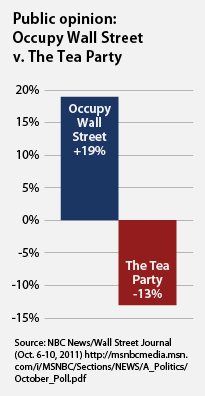
ThinkProgress reports: The new NBC/Wall Street Journal poll [PDF] shows that Americans support the Occupy Wall Street protests by a two-to-one margin (37 percent in favor, 18 percent opposed) while more Americans view the Tea Party negatively (28 percent in favor, 41 percent opposed). This means the Occupy Wall Street protests have a net favorability of +19 percent while the Tea Party has a net favorability of -13 percent, as this chart produced by ThinkProgress shows (right).

A new Time Magazine poll found an even more positive results for Occupy Wall Street, showing 54 percent held a favorable view of the movement, compared to just 27 percent with a favorable view of the Tea Party. In the Time poll, just 23 percent had an unfavorable view of Occupy Wall street, for a net rating of +31 percent. Meanwhile, 33 percent had an unfavorable view of the Tea Party, giving it a a net rating of -6 percent.

Facebooktwittermail

Egypt’s military more brutal than Mubarak regime, eyewitnesses say

Al-Masry Al-Youm reports: A day after Egypt’s military rulers provided their account of this week’s deadly clashes between soldiers and mostly Christian protesters, activists responded with an opposing narrative that accused the army of committing brutalities hitherto unseen under former President Hosni Mubarak.

Armed with videos of the clashes, human rights activists, lawyers and victims’ families who witnessed the incident told their side of the story on Thursday at a news conference. The clashes, which happened on Sunday, left at least 26 killed and more than 300 injured.

“The performance of the military, which always took pride in never firing a bullet at the revolutionaries, surpassed that of Mubarak’s mercenaries. It shed the blood of Egyptians in cold blood and with the cruelest of means, even throwing dead bodies in the Nile in an attempt to cover up their crimes,” read a statement signed by at least 12 political parties and youth groups and distributed to local and foreign media at the conference.

On the stage, Mary Daniel, sister of Mina Daniel, who was killed on Sunday, sat in her mourning black to describe what happened in the Coptic-led march which began in Shubra and ended in tragedy once demonstrators reached the Maspero area in downtown Cairo.

“I was with Mina,” said Daniel. “We marched from Shubra until we reached Maspero. It was a long distance. If we had been armed, people would have resisted us from the beginning. We were peaceful.”

After reaching Maspero, “We saw an influx of armored vehicles, bullets, tear gas bombs and stones,” said Daniel. “The scene was horrible. Even if we were in the middle of a war, things would not have been like that.”

Mariz Tadros writes: At first, it looked like a repeat of the worst state brutality during the January 25 uprisings that unseated the ex-president of Egypt, Husni Mubarak: On Sunday, October 9, security forces deployed tear gas, live bullets and armored vehicles in an effort to disperse peaceful protesters in downtown Cairo. Joined by Muslim sympathizers, thousands of Coptic Christians had gathered that afternoon in front of the capital’s state television and radio building, known as Maspero, and in many other parts of Egypt, to protest the burning of a church in the Upper Egyptian village of al-Marinab. A few days earlier, their initial demonstrations had also been met with violence.

What happened next, however, was worse than any single incident of state violence in January and February: Captured live by the cameras of the al-‘Arabiyya satellite channel, armored personnel carriers bearing army markings sped toward the protesters, at one point bumping cumbrously over curbs and a sidewalk, and crushed several people to death underneath their massive treads. By night’s end, 17 demonstrators were dead, and 300 more injured, some in critical condition. The death toll is now at least 25 and counting. Furthermore, the army’s claim to fame during the January-February popular uprising — that it would not, under any circumstances, harm Egyptian civilians — has now been given the definitive lie.

How it all started is hotly debated. At a press conference on October 12, representatives of the Supreme Council of the Armed Forces (SCAF), Egypt’s de facto ruling authority since Mubarak’s ouster, insisted that the army did not attack first or even engage the demonstrators. Some SCAF defenders put forward the notion that the army did engage, but only because it was provoked by the assaults of the protesters. Others argue that “thugs” of unknown provenance infiltrated the demonstration to foment chaos and invite the army’s retaliation. Yet the overwhelming thrust of eyewitness accounts, from both Muslims and Christians, is that the army initiated the violence, first throwing stones, then wielding batons, then firing live ammunition, before taking the grim final step of grinding protesters into the pavement. Certainly, several protesters threw stones as well, but eyewitnesses are adamant that they did so in response to the bullets being shot at them.

Facebooktwittermail

How Obama could benefit from the alleged Iranian bombing plot

If Iran was going to engage in as risky an operation as to attempt to assassinate the Saudi ambassador in Washington, it wouldn’t use a flaky used-car salesman as its lead operative and it wouldn’t outsource the attack to some unknown hit men from a Mexican drug cartel. Anyone who knows anything about how Iran operates finds such a scenario highly implausible.

On the other hand, if someone else wanted to frame Iran, since they wouldn’t be able to enlist the kind of Iranian team capable of carrying out such an attack, they might well end up recruiting the very cast of characters who are alleged to have been involved. Indeed, if the object of the exercise was that the plot be exposed rather than carried out, then unwitting amateurs would be perfect for the job.

Given that informants for the US Drug Enforcement Agency played a pivotal role, suspicion about who might have been directing this operation has to fall on Washington. Are we talking about a false flag operation and a pretext for war?

The intemperate response from the Obama administration over the last few days might suggest that escalating tension with Iran has at this juncture passed a critical point and that the American public and the rest of the world is being warned that war may be on the horizon.

The drums of war have been beating for so long — mostly from Israel — that in some quarters the question has not been if a war will start, but when.

Has Obama now boarded the war train? I seriously doubt it.

Firstly, I think his innate timidity would make him very reluctant to start his own full-scale war — least of all a war that would likely be more devastating than all the wars of the preceding decade. Shock-and-awe was the style for his predecessor — this is a president who prefers assassinations.

Secondly, the American appetite for war has already been well and truly drained. Economic pain has promoted a grim realism in which most people recognize that another war is really the last thing this country needs. Launching a war against Iran would be like pounding the last nails into our own coffin.

So, if Washington was really behind this bombing plot and it wasn’t trying to start a war, how would it stand to benefit?

Here’s how: by driving down the price of oil.

Why make the Saudis the target of the attack? Because they would then feel compelled to retaliate and since they cannot threaten Iran militarily, they will rely on the only weapon they have: increasing oil production.

The consequent drop in oil prices will hurt Iran much more than Saudi Arabia and if by the summer of 2012, gas prices in the US have dropped below $3 a gallon, Americans will travel more and perhaps regain a bit of economic optimism — good news for Obama as he tries to close the deal in securing his second term.

At the same time, the attack-Iran hawks who love to talk war but who are actually happy with anything that undermines the regime in Tehran, will be pleased to see Iran suffer.

Andrew Scott Cooper writes: The alleged Iranian plot to blow up Saudi Arabia’s ambassador in Washington made for blazing headlines even as it obscured a deeper truth: Iran and Saudi Arabia have been engaged in a different sort of war of attrition over the past few decades, with economics, not explosives, the weapon of choice. Both regimes are keenly aware that although bullets may kill, they can’t bankrupt: only a sudden collapse in oil revenue can do that.

Skeptics who find it implausible that the oil markets can be harnessed as a weapon, and that oil can be turned into a financial super bomb to destabilize a national economy, should heed the words of a leading member of the Saudi royal family. Prince Turki al-Faisal, previously his country’s head of intelligence and ambassador to Washington, has long enjoyed a reputation for frank talk. Three and a half months ago, he delivered an address to a select group of NATO officials at an air base deep in the heart of the British countryside. In his remarks, the prince fired a shot across the bows of the Iranian regime.

This past year, the Saudi royal family was caught off-guard by the Arab Spring uprisings and badly shaken by the overthrow of old friends and allies in Egypt and Tunisia. The Saudis blame their neighbor Iran for inciting and stoking the troubles as part of a sinister plot to divide, weaken, and eventually topple the region’s conservative Sunni monarchies. Prince Turki made it clear that after six months of being on the defensive, the Saudi royal family had rallied and was about to fight its corner by unleashing the most powerful weapon in its arsenal: the kingdom’s massive oil reserves.

The Islamic Republic of Iran, jeered Prince Turki, was “dysfunctional,” a “paper tiger,” though one with “steel claws” whose survival depended on its ability to cash in on high oil prices “to maintain a level of economic prosperity that is just enough to pacify its people.” The implication was that Iran’s reliance on a single revenue stream to prop up a sclerotic political structure had left the regime in Tehran vulnerable to sabotage.

The Saudis, continued Prince Turki, were quite prepared to use their swing power as the world’s biggest oil producer to “squeeze” the Iranian economy. They could presumably do this by opening the spigots to flood the market with cheap oil, enough cheap oil indeed to force prices down and deprive Iran’s rulers of billions of dollars in government revenue necessary to buy social tranquility at home. Flooding the market is economic warfare on a grand scale, the oil industry’s equivalent of dropping the bomb on a rival. The prince’s threat sounds like a diabolical plot best suited for a novel–holding the world economy to ransom by manipulating commodity prices to settle scores with a neighbor–until you realize it’s been done before.

Facebooktwittermail

Iran sees terror plot accusation as diversion from Occupy Wall Street

The New York Times reports: Iran’s leaders marshaled a furious formal rejection on Wednesday of the United States accusations that the Islamic republic had schemed to assassinate the Saudi ambassador in Washington, calling the case a cynical fabrication meant to vilify Iran and distract Americans from their own severe economic problems, highlighted by the Occupy Wall Street movement.

The Foreign Ministry of Iran issued an angry complaint to the Swiss Embassy in Tehran, which is responsible for monitoring United States interests in Iran since the two broke diplomatic relations 32 years ago after the Islamic Revolution. The ministry said it had summoned the Swiss ambassador to personally convey its outrage over the American charges and warn “against the repetition of such politically motivated allegations.”

Iran’s supreme leader, Ayatollah Ali Khamenei, went a step further. In a speech broadcast on Iran state television, he predicted what he called the demise of American capitalism and corporate favoritism. Press TV, an Iran government Web site that translated portions of the ayatollah’s speech, said he emphasized that “the corrupted capitalist system shows no mercy to any nation, including the American people.”

The ayatollah commended the Occupy Wall Street protests in New York, Washington and other American cities, calling them a consequence of “the prevalence of top-level corruption, poverty and social inequality in America.” He denounced what he called “the heavy-handed treatment of the demonstrators by U.S. officials” and said that such treatment “is not seen even in underdeveloped countries with dictatorial regimes.”

“They may crack down on this movement but cannot uproot it,” Ayatollah Khamenei said. “Ultimately, it will grow so that it will bring down the capitalist system and the West.”

Not that Khamenei would have any experience in heavy-handed treatment of demonstrators!

Facebooktwittermail

Syria: Assad’s Alawites

A multi-part series by Al Jazeera special correspondent Nir Rosen, who recently spent seven weeks travelling throughout Syria with unique access to all sides.

Part one — The guardians of the throne: As we left the central Syrian city of Homs, Abu Laith pulled a 9mm Llama pistol from under his shirt, loaded it and placed it in the gap between our seats. He was a sergeant in Syria’s State Security and drove a small Chinese-made taxi to avoid the attention of armed men looking for members of the security forces. Heading north to his village of Rabia, in Hama, we passed shops covered in gashes from gunfire.

“There was a sniper here,” he said at one point on the road. “He shot six military buses.” We drove by a Military Security building that had been attacked by armed opposition fighters.

“Here was a statue of the late President Hafez,” he pointed at a now empty pedestal. Visibly offended, he added: “They took it down and put a live donkey there instead.”

Abu Laith belongs to the Alawite sect who make up about ten per cent of Syria’s population. Sunni Arabs comprise 65 per cent, while Sunni Kurds and Christians constitute ten per cent each. Druze, Shia, Ismailis and others make up the remainder. Since the Baathists seized power in Syria, sectarianism has been taboo, ever-present but unspoken of, with perpetrators of incitement harshly punished.

Prejudice in all its forms – racism, sexism, sectarianism – exist in all societies, but, in times of crisis, collective identity often comes to dominate social relations. Identity is complex and membership of ethno-religious sects is only one part of Syrian identity.

Social class, profession, nationalism, regional identities and other factors are all very important. But one is born into a sect and few but the wealthy elite transcend these classifications, typically revealed by one’s name and place of birth. As in the Balkans, religious identities are often cultural identities and lead to ethnic-like divisions, even within same-language groups.

In the Arab world, the Sunni exercise a hegemony which has often made minority sects feel insecure. Shia and heterodox sects – such as the Alawites – have been persecuted.

Little is known about the history of the Alawite faith – even among the Alawite community – as its beliefs and practices are available only to the initiated few. It bears little resemblance to mainstream doctrines of Islam and involves belief in transmigration of the soul, reincarnation, the divinity of Ali ibn Abi Talib – the fourth Caliph and a cousin of Prophet Muhamad – and a holy trinity comprising Ali, Muhamad and one of the prophet’s companions, Salman al Farisi.

A common theme to Alawite identity is a fear of Sunni hegemony, based on a history of persecution that only ended with the demise of the Ottoman empire. Sunni cultural hegemony, however, remains. [Continue reading…]

Part two — An entrenched community: Driving near the high-altitude resort of Slonfeh in the Alawite mountains of the Latakia region, I passed a funeral tent for a Syrian soldier killed in the region the previous week, one of two military “martyrs” Slonfeh had lost to armed opposition activists. When my driver entered the village of Mazar al-Qatriyeh, he asked to be directed towards Sheikh Khalil Khatib, a respected Alawite elder. “Ask the rocks and they will tell you,” said one man. “Everybody knows him.”

The sheikh was an intense old man who lectured me while a television behind him screened the Hezbollah-affiliated al-Manar satellite channel.

“You can be called a sheikh for being old or for being educated,” he explained to me. He blamed religious sheikhs for the crisis in Syria. “They aren’t sheikhs of thought,” he said. “They are sheikhs of air, that’s why Syria has all these problems. I am a sheikh of logic.”

I told him that the opposition said Alawites controlled the regime. “This is rejected,” he said. “It’s for justifying the attack against the regime.” He listed ministers, governors, and director-generals and insisted very few were Alawites and most were Sunni.

“Our president is Alawite and we suffer from this,” he said. “There are four million Alawites,” he claimed with some exaggeration. “We don’t have even one per cent of the positions in the government.” He and his guests said they believed Syria was being pressured so it would make a deal with Israel. “If Bashar signs a humiliating peace we are against him,” said Ali Janud, a professor of civil engineering. “I am not with Hezbollah because they are Shia,” he said, “only because they are resistance.”

The sheikh agreed. “We are with the devil if he fights Israel,” he said. If outside powers intervened in Syria it would lead to armageddon, the sheikh said. “If they want to destroy us,” he said, “they are welcome.”

The sheikh conflated the protesters with the armed opposition. “The armed people are ignorant and don’t have any education,” he said. “In the mountains we are all educated,” said one of his guests. “Our orientation is education.” Janud agreed: “This is a conflict between ignorance and knowledge,” he said. Bayda and Baniyas, two coastal towns that had seen demonstrations, had nobody educated in them, the sheikh said, and they were majority Sunni. “And the Alawite villages around [those towns] are all educated.”

He recommended that I read the Protocols of the Elders of Zion, an infamous anti-semitic book about a fabricated Jewish conspiracy written in Russia a century ago – but still sometimes believed to be true. This would help me understand how Saudi Arabia was a chess piece in the hands of world Zionism, he said. “Jews are the cause of corruption in the world,” he told me. [Continue reading…]

The preceding parts in this series:
Syria: The revolution will be weaponised (September 23)
Armed defenders of Syria’s revolution (September 27)
Syria’s symphony of scorn (September 30)
Ghosts in the mosques (September 30)
The tides of mosques (October 2)
A conversation with Grand Mufti Hassoun (October 3)

Facebooktwittermail

Irvine 11 conviction reveals double standard and bias

Amirah Mizrahi, Antonia House and Emily Ratner write: When we disrupted Israeli Prime Minister Benyamin Netanyahu’s keynote speech at the Jewish Federations of North America’s annual general meeting last November in New Orleans, we were met with hisses, boos, verbal harassment and even physical attacks from other members of the audience. But criminal charges were never so much as mentioned. Yet, on September 23rd, ten students who interrupted Israeli Ambassador Michael Oren’s speech at UC Irvine in February 2010 were convicted of two misdemeanors for their participation in that protest. Today, October 11, 2011, is a national day of action to protest those unjust convictions. We think it’s a perfect opportunity to look at the similarities and differences in these two actions.

In both protests, each person who stood up to bring attention to crimes committed by the Israeli government acted non-violently, and cooperated fully with security personnel and the police. So what was the difference? Why were we not arrested, charged and tried while the Irvine 11 were? Logically, the opposite should have been true: our target was bigger – the Prime Minister of Israel; our venue was bigger – the largest Jewish event in North America; and our protest came later – inspired in part by the brave actions of the Irvine 11. But there is one more difference, and it proved to be the crucial one: we are Jews and the Irvine 11 are Muslims.

Facebooktwittermail

Get hacked, don’t tell: drone base didn’t report virus

Danger Room reports: Officials at Creech Air Force Base in Nevada knew for two weeks about a virus infecting the drone “cockpits” there. But they kept the information about the infection to themselves — leaving the unit that’s supposed to serve as the Air Force’s cybersecurity specialists in the dark. The network defenders at the 24th Air Force learned of the virus by reading about it in Danger Room.

The virus, which records the keystrokes of remote pilots as their drones fly over places like Afghanistan, is now receiving attention at the highest levels; the four-star general who oversees the Air Force’s networks was briefed on the infection this morning. But for weeks, it stayed (you will pardon the expression) below the radar: a local problem that local network administrators were determined to fix on their own.

“It was not highlighted to us,” says a source involved with Air Force network operations. “When your article came out, it was like, ‘What is this?’”

The drones are still flying over warzones from Afghanistan to Pakistan to Yemen. There’s no sign, yet, that the virus either damaged any of the systems associated with the remotely piloted aircraft or transmitted sensitive information outside the military chain of command — although three military insiders caution that a full-blown, high-level investigation into the virus is only now getting underway.

Facebooktwittermail

Obama’s obsequiousness is shameful

Avraham Burg writes: It was depressing to see American President Barack Obama’s weak appearance at the United Nations. It was depressing to see this talented man, who brought such great hope to the world, presenting the pitiable position of a feeble empire. It was embarrassing to see him defending positions and people whom only a few months earlier he had attacked with fury. His obsequiousness is shameful, and this weakness is a real danger to the world. Therefore anyone who wants peace cannot make do merely with accusing Obama. One cannot allow his desperation to have veto power over our hope.

It is strange, but we no longer have anyone on whom to rely but the head of the Palestinian Authority, Mahmoud Abbas. If the current Palestinian move in the UN is successful, it will be wonderful. There will be two states between whom negotiations will be conducted – on an equal footing, and not as an occupying force and the vanquished – about their future and the relations between them. But if the move fails, because Obama has become a hostage in the hands of Prime Minister Benjamin Netanyahu, who himself is a hostage in the hands of the settlers and other Israeli extremists, we will be left merely to wonder what the next step will be.

In the past few years, there has been a change in the cast of players in the Middle East theater of the absurd. Israel has become big and clumsy, erring and intransigent. The Palestinians, or at least those among them who support the PA and the government in Ramallah, have taken over the role that was once ours: seeking peace, restraining violence, building a state, and initiating diplomacy. That is how things are in history – yesterday’s weak ones are today’s sated, decadent ones; the victim becomes the oppressor.

On the other hand, as has happened more than once in history, the hope for change lies with the weak. The weak side is the side that stands to gain most from change, and is therefore prepared to take great personal and political risks for change. Netanyahu is several times worse than former prime ministers – David Ben-Gurion, who established the state, or Menachem Begin who achieved peace with Egypt, or Yitzhak Rabin, who tried to follow the Oslo path and paid for it with his life. Abbas is several times better than PLO leader Yasser Arafat who preceded him. That is how things are. They are in a state of evolving and we are receding.

I realize that the commitment to democracy is an inseparable part of the PA’s leadership today. (It is not possible to say the same for the Israeli leadership ). I hope it is a path of no return. If the idea of realizing this aspiration in the framework of a democratic Palestinian state does not bear fruit, the Palestinians must embark on a worldwide initiative demanding that they be allowed to vote for the Knesset. Yes, Israel’s parliament.

This initiative must be accompanied by a non-violent civil rebellion. It will attract a great deal of attention and will cast the spotlight on the paradox of Israeli hypocrisy which claims that we are the only democracy in the Middle East but forgets to point out that we are a democracy for Jews alone. Because we are also the only colonialist conqueror that is left in the Western world.

In order to prove the seriousness of their intentions, the Palestinians need a pilot project, so here it is. The Palestinian leadership must ask the Arabs of East Jerusalem to get organized for the next municipal elections. Since 1967, there have been about one quarter of a million Arabs who have the right to vote in the municipality of Jerusalem alone. In protest against the offensive annexation of the eastern part of the city, they have never realized their democratic right. However this protest does not really help.

The time has come for the anger to be turned into a constructive step. I have no doubt that the moment that one third of the members of the city council of Israel’s capital represent the residents of East Jerusalem, everyone will start to wake up.

Even Netanyahu, who is always the last to wake up, will make sure to stay alert. Because Palestinian political partnership in Jerusalem means one city that belongs to all its residents. That will be very different from the disgraceful situation of discrimination that exists today. One city that belongs to all its residents is only the prologue to one state that belongs to all its citizens between the Jordan River and the sea. That is the real price of the refusal on the part of Netanyahu and the right.

Anyone who is not prepared to do anything to promote two states today – and who is not prepared to pay the price by evacuating the settlements – will, in the end, have to concede all of the state of Israel. That is to say, the Jewish and not so democratic state will be renounced in favor of a legitimate democratic process in which everyone between the Jordan River and the sea has one basic right – the human and civic equality to elect and to be elected. They will have at least the very same rights that are enjoyed by Obama and his new friend who knows just how to manipulate him, Netanyahu.

Avraham Burg is an Israeli author and a former Speaker of the Knesset.

Facebooktwittermail

Trust bust: Why no one believes the banks

Jesse Eisinger writes: Morgan Stanley by any measure is a safe and solid investment bank. Except for one: The amount of trust people have in the whole financial and political system. It’s just about zero.

That’s why the bank’s shares are down 42 percent this year. That’s why all the big bank stocks have double-digit dips.

True, they start their next round of quarterly reporting in a matter of days. Morgan Stanley is scheduled to report its third-quarter earnings on Oct. 19, and its earnings may calm fears temporarily.

But the essential problem will still be there, a slow burn beneath the global financial system that flares up at the worst moments. Banks don’t have faith in other banks, investors are deeply scarred and wary, and nobody believes that the governments around the world could grapple with the magnitude of the problems, even if they wanted to.

Three months ago, the Belgian bank Dexia passed the European stress tests. By that measure, it was fine. Then it collapsed.

Facebooktwittermail

Wall Street Journal circulation scam claims senior Murdoch executive

The Guardian reports: One of Rupert Murdoch’s most senior European executives has resigned following Guardian inquiries about a circulation scam at News Corporation’s flagship newspaper, the Wall Street Journal.

The Guardian found evidence that the Journal had been channelling money through European companies in order to secretly buy thousands of copies of its own paper at a knock-down rate, misleading readers and advertisers about the Journal’s true circulation.

The bizarre scheme included a formal, written contract in which the Journal persuaded one company to co-operate by agreeing to publish articles that promoted its activities, a move which led some staff to accuse the paper’s management of violating journalistic ethics and jeopardising its treasured reputation for editorial quality.

Internal emails and documents suggest the scam was promoted by Andrew Langhoff, the European managing director of the Journal’s parent company, Dow Jones and Co, which was bought by Rupert Murdoch’s News Corporation in July 2007. Langhoff resigned on Tuesday.

Facebooktwittermail

Financial giants put New York City cops on their payroll

Pam Martens writes: Videos are springing up across the internet showing uniformed members of the New York Police Department in white shirts (as opposed to the typical NYPD blue uniforms) pepper spraying and brutalizing peaceful, nonthreatening protestors attempting to take part in the Occupy Wall Street marches. Corporate media are reporting that these white shirts are police supervisors as opposed to rank and file. Recently discovered documents suggest something else may be at work.

If you’re a Wall Street behemoth, there are endless opportunities to privatize profits and socialize losses beyond collecting trillions of dollars in bailouts from taxpayers. One of the ingenious methods that has remained below the public’s radar was started by the Rudy Giuliani administration in New York City in 1998. It’s called the Paid Detail Unit and it allows the New York Stock Exchange and Wall Street corporations, including those repeatedly charged with crimes, to order up a flank of New York’s finest with the ease of dialing the deli for a pastrami on rye.

The corporations pay an average of $37 an hour (no medical, no pension benefit, no overtime pay) for a member of the NYPD, with gun, handcuffs and the ability to arrest. The officer is indemnified by the taxpayer, not the corporation.

New York City gets a 10 percent administrative fee on top of the $37 per hour paid to the police. The City’s 2011 budget called for $1,184,000 in Paid Detail fees, meaning private corporations were paying wages of $11.8 million to police participating in the Paid Detail Unit. The program has more than doubled in revenue to the city since 2002.

Facebooktwittermail

Inside Story – Is the promise of democracy fading in Egypt?

The Associated Press reports: A military official on Wednesday blamed a group of Christian protesters for starting violent clashes with armed troops, saying some attacked soldiers with swords and firebombs during a Christian rally earlier this week that turned into Egypt’s worst violence since Hosni Mubarak was ousted.

Gen. Adel Emara denied the troops opened fire with live ammunition on the protesters or intentionally ran over them with armored vehicles. The violence late Sunday left at least 26 people dead, most of whom where Christians and many of whom were crushed by vehicles or died from gunfire, according to forensic reports. State media said at least three soldiers were also killed.

Emara spoke at a press conference Wednesday that was clearly aimed at defending Egypt’s military rulers from heavy criticism they have come under for the violence at the protests. He gave a detailed account of the military’s version of the events, using video footage of the events culled from state TV and independent stations. One of the images showed a protester hurling a heavy stone at soldiers inside an armored vehicle.

And what about the armored vehicles which shocked the world as they were seen charging through crowds like raging bulls?

Facebooktwittermail

American and Israeli exceptionalism

Foreign Policy‘s latest issue looks at American exceptionalism and Stephen Walt writes:

Over the last two centuries, prominent Americans have described the United States as an “empire of liberty,” a “shining city on a hill,” the “last best hope of Earth,” the “leader of the free world,” and the “indispensable nation.” These enduring tropes explain why all presidential candidates feel compelled to offer ritualistic paeans to America’s greatness and why President Barack Obama landed in hot water — most recently, from Mitt Romney — for saying that while he believed in “American exceptionalism,” it was no different from “British exceptionalism,” “Greek exceptionalism,” or any other country’s brand of patriotic chest-thumping.

Most statements of “American exceptionalism” presume that America’s values, political system, and history are unique and worthy of universal admiration. They also imply that the United States is both destined and entitled to play a distinct and positive role on the world stage.

The only thing wrong with this self-congratulatory portrait of America’s global role is that it is mostly a myth. Although the United States possesses certain unique qualities — from high levels of religiosity to a political culture that privileges individual freedom — the conduct of U.S. foreign policy has been determined primarily by its relative power and by the inherently competitive nature of international politics. By focusing on their supposedly exceptional qualities, Americans blind themselves to the ways that they are a lot like everyone else.

No doubt it behooves Americans to recognize the things that tie this country to the rest of the world, but there is an aspect of exceptionalism Walt does not touch upon — one that sets apart American and Israeli exceptionalism from most others: the exceptionalism of colonizers.

Nations that come into existence by dispossessing, imprisoning and slaughtering the indigenous population have two problems with history:

1. Its ugliness makes it hard to glorify.
2. Its shortness exposes the tenuousness of any claim that this is “our land”.

Others look back at their national history and can trace a rich tapestry of events, places, and people in which the contours of their nation have over the preceding centuries been carved by culture and inscribed in geography. All around are stepping stones that lead into the near, middling, distant, and sometimes ancient past. The punctuations of history rest on a continuum.

If without sentiment we look back into our ancestry as Americans or Israelis, we see migrants and murderers fast preceded by a void. Our actual roots in abandoned lands take us far away from the very thing that supposedly makes us exceptional.

With histories much harder to glorify, we find the need to make our pasts less linear and more mythically grandiose. We ignore the catastrophes that we imposed on others. We didn’t steal the land; it was a gift from God.

Facebooktwittermail