Category Archives: Issues

Panic of the plutocrats as Occupy Wall Street heads for their castles

Paul Krugman writes: It remains to be seen whether the Occupy Wall Street protests will change America’s direction. Yet the protests have already elicited a remarkably hysterical reaction from Wall Street, the super-rich in general, and politicians and pundits who reliably serve the interests of the wealthiest hundredth of a percent.

And this reaction tells you something important — namely, that the extremists threatening American values are what F.D.R. called “economic royalists,” not the people camping in Zuccotti Park.

Consider first how Republican politicians have portrayed the modest-sized if growing demonstrations, which have involved some confrontations with the police — confrontations that seem to have involved a lot of police overreaction — but nothing one could call a riot. And there has in fact been nothing so far to match the behavior of Tea Party crowds in the summer of 2009.

Nonetheless, Eric Cantor, the House majority leader, has denounced “mobs” and “the pitting of Americans against Americans.” The G.O.P. presidential candidates have weighed in, with Mitt Romney accusing the protesters of waging “class warfare,” while Herman Cain calls them “anti-American.” My favorite, however, is Senator Rand Paul, who for some reason worries that the protesters will start seizing iPads, because they believe rich people don’t deserve to have them.

Michael Bloomberg, New York’s mayor and a financial-industry titan in his own right, was a bit more moderate, but still accused the protesters of trying to “take the jobs away from people working in this city,” a statement that bears no resemblance to the movement’s actual goals.

And if you were listening to talking heads on CNBC, you learned that the protesters “let their freak flags fly,” and are “aligned with Lenin.”

The way to understand all of this is to realize that it’s part of a broader syndrome, in which wealthy Americans who benefit hugely from a system rigged in their favor react with hysteria to anyone who points out just how rigged the system is.

The New York Daily News reports: Occupy Wall Street protesters are heading uptown Tuesday to get in the face of some of New York’s richest tycoons.

A “Millionaires March” will visit the homes – or, more realistically, the gleaming marble lobbies – of five of the city’s wealthiest residents, including News Corp. CEO Rupert Murdoch, JPMorgan Chase CEO Jamie Dimon and conservative billionaire David Koch.

Marchers want to present the moguls with oversize checks to dramatize how much less they will pay when New York State’s 2% tax on millionaires expires in December.

“Ninety-nine percent of the residents of New York are going to suffer from this tax giveaway so the 1% who already live in absolute luxury can put more money in their pockets,” said Doug Forand, one of the march organizers.

“This is fiscally, economically and morally wrong.”

Gov. Cuomo staunchly opposes calls from his fellow Democrats to renew the tax, which generates up to $5 billion per year in much-needed revenue. He says he fears the rich will move away.

Day 24 of the chaotic, festive protest in Zuccotti Park saw a demonstration by schoolchildren who sang songs and waved signs saying “Money for Schools Not War,” a Native American protest against Columbus Day and a brief frenzy over the arrival of hip-hop icons Kanye West and Russell Simmons.


Facebooktwittermail

U.N. finds ‘systematic’ torture in Afghanistan

Is this why President Obama banned torture? Just so that American hands could remain clean while its allies used torture techniques even more gruesome than the kind George Bush and Dick Cheney approved?

The New York Times reports: Detainees are hung by their hands and beaten with cables, and in some cases their genitals are twisted until the prisoners lose consciousness at sites run by the Afghan intelligence service and the Afghan National Police, according to a United Nations report [PDF] released here on Monday.

The report, based on interviews over the past year with more than 300 suspects linked to the insurgency, is the most comprehensive look at the Afghan detention system and an issue that has long concerned Western officials and human rights groups.

It paints a devastating picture of abuse, citing evidence of “systematic torture” during interrogations by Afghan intelligence and police officials even as American and other Western backers provide training and pay for nearly the entire budget of the Afghan ministries running the detention centers.

The report does not assess whether American officials knew of the abuses. But such widespread use of torture in a detention system supported by American mentors and money raises serious questions about potential complicity of American officials and whether they benefited from information obtained from suspects who had been tortured.

Facebooktwittermail

Libya: Sirte battle flushes out pro-Gaddafi fighters

Peter Beaumont reports: The stories of some of those inside Ibn Sana hospital in Sirte do not add up. Hamad Ashrak Ali from Sudan is lying on a bed in the hospital’s basement. He shows us his wound before explaining the circumstances of it. He has been shot through the side. The bullet exited through one buttock – the wound is becoming septic.

He says he came from Abyei in his own country to Sirte to earn money: “I thought I could earn money here by loading trucks.”

He does not explain why he chose Gaddafi’s hometown in particular and claims at first to have been in the hospital with his wound for 50 days.

But his wound is relatively recent, the muscles still pronounced. He has not spent almost two months in a hospital bed.

“Kids were doing handbrake turns,” – doughnuts, he calls them. “Someone fired a gun and I was shot.” He is asked again how long he has been in hospital. He changes his story. “Since April,” he says.

A bearded fighter from the forces of the NTC suggests quietly that Hamad is lying. Other fighters say they have a list and know who are the mercenaries and pro-Gaddafi fighters in the hospital.

Not far away an emaciated man struggles up from his bed, stick thin.

Other patients in this dreadful place seem comatose, afflicted with wounds long gone rotten, people in desperate need of evacuation.

But for now there is nowhere for them to go.

Not even the Red Cross has been able to evacuate the bombed out hospital. The nearby field hospitals are full, as is the hospital in Misrata. So they are stuck in this shattered shell.

Outside on the street, a three-car convoy drives by towards the Ouagadougou conference centre.

Skinny men with dark-skinned, emaciated faces are packed into two cars, with more sitting slumped in open boots.

Recent deserters from the pro-Gaddafi forces, who have been fighting to defend this city for a fallen and defeated regime, they are guarded by NTC fighters in the final car.

As the new government force push forward from the east and west towards the sea, life in Gaddafi’s home town and in his second capital is revealed.

The pro-Gaddafi forces – for so long invisible in their positions, where they have poured down fire on the advancing fighters – have been revealed for what they are. Ordinary men, frightened, who now want only to survive by surrendering, hiding in the hospital or trying to escape with fleeing civilians.

Time reports: An official on Libya’s governing council said Monday that he believes Muammar Gaddafi is hiding in the southwestern desert near the borders with Niger and Algeria, but denied allegations that the Tuareg minority ethnic group is protecting the fugitive leader.

Moussa al-Kouni, who is a Tuareg representative on the revolution’s leadership body, claimed Gadhafi had sent his son Khamis to the area to set up a radio station and make preparations for a possible escape route two months before Tripoli fell to revolutionary forces in late August.

Al-Kouni provided no evidence, saying he based his assertion on the fact that the Gadhafi regime had used the area before because it has rough terrain and porous borders that would make detection difficult. He also pointed out that Gadhafi had cultivated close ties with the Niger government and could even be going back and forth across the border.

“As far as I am aware, Gadhafi is in that region … on the border with Niger,” he told reporters in Tripoli, adding that Gadhafi could get safe passage through Niger to Mali, where he allegedly has a house in Timbuktu. Niger has put Gadhafi’s son al-Saadi under house arrest.

Facebooktwittermail

‘This is not religious strife, this is state sponsored terrorism’

Hani Bushra describes his experience of the violence in Cairo on Sunday night and points to evidence of the ways it was choreographed by state security services intent on fomenting sectarian conflict. “Christians where are you, Islam is here,” was the chant the mobs had been fed. And as these mobs hunted down their victims, innocent people were accused of carrying concealed weapons. (H/t Issandr El Amrani.)

The people marching were chanting “Christians and Muslims are one Hand” and I was leading them in saying that. I met with Alaa of manalaa.com and we continued to march towards Maspero.

The group was peaceful, and I was taking pictures using my Ipad. We reached the point where the 6th October bridge exits towards Maspero, and there was a large cordon of police who are members of the Central Security Forces (CSF). There, I was told not take pictures by people wearing civilian clothing and I fought back saying it was my right.

I began to walk back towards Hilton Ramsis, and suddenly 5 vehicles full of CSF soldiers showed up. People began to pelt them with rocks, destroying the wind shields, and the causing the drivers of the vehicles to panic, thereby hitting into each other and the sides of the road. I and some other people were trying to calm people down into not attacking the vehicles but the people were angry.

At that point, I was alone, and so I began to walk back to Tahrir. I was tweeting at that time. Someone saw me tweeting and came to me. He asked my name and so I said Hani Sobhi, he then grabbed my wrists to see if I had a cross tattoo, and when he did not find it, he asked for my full name. I said Hani Sobhi Bushra. He asked if I was a Muslim or a Christian, and I said that I was a Christian.

At that point he began to scream for others that he caught a Christian, and people began to gather. They wanted to search me and my bag, and I said that I will not let them, and that it was best to go to an officer. At that point there was about 30 people around me, with some of them punching me on my head.

I began to walk quickly to the cordon of the police that I had just came from. At that point, someone yanked my gold chain from across my neck and took the cross. All I did was to tell him “wow, you are such a man” and I clapped for him. That pissed the people who were with me, and so someone snatched my phone from my belt.

I kept shouting at the thief to give me my phone back, and he said that he will give it to me in front of the police officer. By that time, I was being hit from many people, my ankle was sprained and I was called a “Nossrani (Christian)” dog.

We reached the officer (rank of general), and the first thing that I did was to show him my U.S. passport and told him that I am now under his protection. I told him that I was attacked because I was a Christian. One of the men who is a policeman but wearing civilian clothing began to talk to the general that I was a Christian and that I institigated the mob to attack me and that I am carrying weapons in my bag. The officer, who had seen my passport, told him to shut up. This policeman in the civilian clothing seemed to be the coordinator between the mob and the police.

Facebooktwittermail

Wall Street is occupying our planet

Bill McKibben speaking at Occupy Wall Street at Washington Square Park on Saturday: Today in the New York Times there was a story that made it completely clear why we have to be here. They uncovered the fact that the company building that tar sands pipeline was allowed to choose another company to conduct the environmental impact statement, and the company that they chose was a company was a company that did lots and lots of work for them. So, in other words, the whole thing was rigged top to bottom and that’s why the environmental impact statement said that this pipeline would cause no trouble, unlike the scientists who said if we build this pipeline it’s “game over” for the climate. We can’t let this pipeline get built.

On November 6, one year before the election, we’re going to be in DC with a huge circle of people around the White House and they’re going to be carrying signs with quotations from Barack Obama from the 2008 campaign. He said, “It’s time to end the tyranny of oil.” He said, “I will have the most transparent government in history.” We have to go to DC to find out where they have locked that guy up. We have to free Obama, because there is some sort of stunt double there now. So on November 6, I hope we can move, just for a day, Occupy Wall Street down to the White House and get them in the fight against corporate power.

The reason that it’s so great that we’re occupying Wall Street is because Wall Street has been occupying the atmosphere. That’s why we can never do anything about global warming. Exxon gets in the way. Goldman Sachs gets in the way. The whole fossil fuel industry gets in the way. The sky does not belong to Exxon. They cannot keep using it as a sewer into which to dump their carbon. If they do, we’ve got no future and nobody else on this planet has a future.

I spend a lot of time in countries around the world organizing demonstrations and rallies in solidarity. In the last three years at 350.org, we’ve had 15,000 rallies in every country except North Korea. Everywhere around the world, poor people and black people and brown people and Asian people and young people are standing up. Most of those places, don’t produce that much carbon. They need us to act with them and for them, because the problem is 20 blocks south of here. That’s where the Empire lives and we’ve got to figure out how to tame it and make it work for this planet or not work at all.

Thank you guys very much.

Facebooktwittermail

If you want to live the American dream, move to Denmark

AlterNet reports: Americans may be deeply divided about what ails our country, but there’s no denying we’re a nation of unhappy campers.

Danes, on the other hand, consistently rank as some of the happiest people in the world, a fact attributed at least in part to Denmark’s legendary income equality and strong social safety net.

Forbes recently cited another possible factor; the Danes’ "high levels of trust." They trust each other, they trust ‘outsiders,’ they even trust their government. 90% of Danes vote. Tea party types dismiss Denmark as a hotbed of socialism, but really, they’re just practicing a more enlightened kind of capitalism.

In fact, as Richard Wilkinson, a British professor of social epidemiology, recently stated on PBS NewsHour, "if you want to live the American dream, you should move to Finland or Denmark, which have much higher social mobility."

While we debate whether climate change is real and a tax on unhealthy foods is nanny state social engineering, the Danish are actually trying to address these problems head on.

They can afford to, because they don’t spend all their waking hours worrying about whether they’re about to lose their job, or their house, or how they’re going to pay their student loans, or their health insurance premiums.

Facebooktwittermail

In Egypt the days of military rule are numbered

Sandmonkey writes: Today the mood in Cairo was wary & melancholic. With the reality of what went down yesterday at Maspero hitting them with its full might, the general population that yesterday found itself on the brinks of chaos is utterly terrified. The number of phone calls I received from people who were worried and horrified made me wish I could shut off my phone, with everyone looking at the future with an incredibly bleak outlook. It’s easy to fall into that mood — after all you have your army killing your people, a long oppressed minority of it at that — but if one looks beyond what happened, one sees a very different picture. What happened yesterday was the beginning of the end of the military rule over Egypt: The days of the SCAF ruling us are numbered. And not because they don’t want to, but because they will no longer have any other choice.

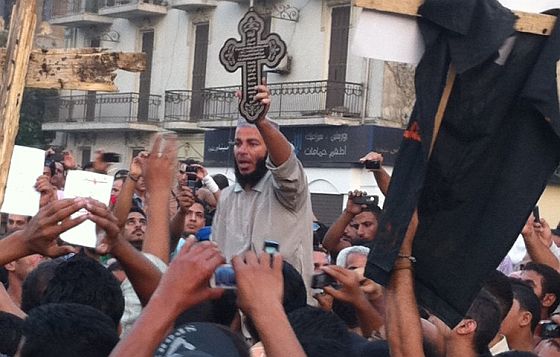
A quick recap over what has went down yesterday: a huge demo held by Coptic Christians & muslim supporters protesting against yet another fight over the building of a Church was attacked by the Egyptian armed forces there to protect it and plainclothed thugs. Shots were fired at protesters killing them, rocks were thrown by protesters in return, protesters were overrun by armored vehicles, the Egyptian State TV issued a plea asking Egyptian citizens to come to the Demo and “protect the army from Christian thugs”, and a street battle that resulted in over 24 dead and 150 injured. The street battle after a while turned into Egyptian citizens fighting each other, without any of them being able to figure out who was fighting who. Pandemonium, for a lack of a better word.

But the moment the dust settled the questions started presenting themselves: This was obviously planned, so what the hell was the SCAF thinking? How could they attack and kill Egyptians on the street so casually, while their sole purpose is to protect them from getting killed? How could they risk enflaming the country into a huge sectarian battle by having state Media so conscientiously attacking the Christians and promoting violence against them? How did they not see that the choice they made is an inherently flawed one that it could spell their doom? How do you explain last night?

Well, the easy explanation is that they — like every single political force in the country throughout this year — fell into the trap of thinking that they have won and asserted their power, only to have the whole thing blow up in their faces. After believing the political street to be dead, and that the revolution is almost dying, they figured they now have the power to put “people in their proper place” like the old days. So, they went down yesterday to terrorize the Christians, counting that they won’t put up a fight (because they never really did before), and that the sectarian rhetoric will cause them all to fear for their lives, stop them from causing trouble, and quite possibly scare them from participating in the elections. With every single respectable political party formed after the revolution having prominent Christians in their founders and as their candidates, they figured that threatening us with the possibility that the next election will turn into a Muslim vs. Christian election will discourage people from voting and participating, leaving the new parties with fewer seats, with the Christians being underrepresented as always in the parliament, and thus allowing the ex NDP people control of the Parliament as the only other choice against the “Islamists”. To basically return us to the pre-revolution status quo. But had they thought this through for more than 5 minutes, they might have seen the inherent flaws in their old-and-reliable plan. They, somehow, didn’t and now they have overplayed their hand and about to face the consequences.

Facebooktwittermail

Egyptians call for end of military rule

Muslims and Christians unite in protest against Egypt's military council

Al-Masry Al-Youm reports: In the wake of Sunday’s violence between Coptic demonstrators and military forces in Cairo, political party leaders and activists called for an immediate transfer of power to civilian authorities, the establishment of a civilian presidential council to help manage the transition period, and the dismissal of Prime Minister Essam Sharaf’s government.

In a conference Monday morning, politicians criticized the security vacuum as well as the state media’s deceptive coverage of the violence.

The conference drew public figures from across the political spectrum, from billionaire telecom tycoon-turned liberal politician Naguib Sawiris to Amin Iskandar, secretary general of the Nasserist Karama Party. Former Finance Minister Samir Radwan and Hossam Eissa, a constitutional law expert, were also present.

Twenty-five protesters died, according to the Health Ministry, when a march by Copts was attacked by thugs and military forces. The march started in the largely Christian neighborhood of Shubra to protest against attacks on Christians, most notably a recent attack on a church in the Upper Egyptian city of Aswan, which resulted from the construction of a dome.

The military prosecution began to investigate 25 suspects on Monday.

“We as Egyptians are facing a problem. It’s not a Coptic and Muslim problem. It’s not a military or civilians problem, but it’s a problem in Egypt’s flawed society and inter-relations. This could end up in a civil war,” said Amr Moussa, a potential presidential candidate and former foreign minister under Mubarak.

Moussa stressed the importance of ruling with an iron-fist in order to protect the country from looming chaos.

Meantime, Abdel Gelil Mostafa, leader of the National Association for Change, slammed the Mubarak-like rule of the Supreme Council of Armed Forces (SCAF), describing it as “semi-divine.”

Speakers at the conference issued calls for a civilian council to serve as Egypt’s executive authority, instead of SCAF, echoing demands made by Mohamed ElBaradei and other secular political figures shortly after Mubarak stepped down in February.

Ursula Lindsey writes: The automatic goverment agit-prop on this is almost as bad as the deaths. Every single (Arabic language) Egyptian newspaper with the exception of Tahrir newspaper led with stories and images today that emphasized the violence on the part of the demonstrators, not the army. Al Ahram’s disingenuous headine reads: “Twenty-Four Soldiers and Demonstrators Dead.” It really is a full return to the days of the revolution.

Facebooktwittermail

The class warfare the rich don’t understand

Heather Digby Parton writes: There have been rumblings in the corners of the Tea party movement for some time, but the minute president Obama announced that he was going to ask wealthy Americans to kick in a small bit more in taxes to help pay for some infrastructure improvements in his jobs proposal, the Republicans have been clutching their pearls and gasping for breath like Aunt Pittypat awaiting the arrival of the marauding Yankees.

GOP leader Rush Limbaugh called for the smelling salts, saying “If [Obama] would get all of this actually passed, it would represent perhaps a fatal blow to the US private sector … I don’t know how anyone could even argue about the fact that this is on purpose anymore. To boldly lie that it’s not class warfare? It is class warfare. Specifically and purposefully class warfare.”

Republican economic guru Paul Ryan dolefully declared, “Class warfare may make for good politics, but it makes for rotten economics. We don’t need a system that seeks to divide people. We don’t need a system that seeks to prey on people’s fear, envy, and anxiety.” Indeed. What could be more destructive to the average American than to ask the upper one per cent to kick in what amounts to tip money? The guilt they will feel at such unfairness is bound to create a profound spiritual crisis throughout the land.

One would have thought that in 2011, the term “class warfare” would be as out of fashion as Nehru jackets, but after watching the Republicans spend the first two years of Obama’s presidency apoplectic over what they defined as hard core socialism put in practice, it stands to reason the old standard would make a comeback. No matter what you call it, rich people complaining about taxes is evergreen. It is also completely ridiculous.

The fact is that the mega-rich have been gobbling up a greater and greater share of the national wealth for several decades now: in 1976 the top 1 per cent of households received 8.9 per cent of all pre-tax income – by 2008, its share had more than doubled to 21.0 per cent. Between 1979 and 2009, the top 5 per cent of American families saw their real incomes increase 72.7 per cent, according to Census data. Over the same period, the lowest-income fifth saw a decrease in real income of 7.4 per cent (by contrast, the 1947-79 period all income groups saw similar income gains, with the lowest income group actually seeing the largest gains). And perhaps most astonishingly, the tax rate for the highest earners was 91 per cent in 1960, 70 per cent in 1980 and only 35 per cent today, the lowest ever with the exception of a couple of years in the late 80s and early 90s.

And it’s not as if these people have been suffering during this recession. Unlike the bottom 99 per cent, they’ve quite smartly recovered from the 2008 unpleasantness. For instance, according to a recent New York Times report, executive pay at 200 big US companies last year went up by an average 23 per cent over 2009 – the median executive salary was 10.8m USD. Meanwhile, the average American family’s household net worth declined 23 per cent between 2007 and 2009.

Facebooktwittermail

Scientists’ analysis disputes FBI closing of anthrax case

The New York Times reports: A decade after wisps of anthrax sent through the mail killed 5 people, sickened 17 others and terrorized the nation, biologists and chemists still disagree on whether federal investigators got the right man and whether the F.B.I.’s long inquiry brushed aside important clues.

Now, three scientists argue that distinctive chemicals found in the dried anthrax spores — including the unexpected presence of tin — point to a high degree of manufacturing skill, contrary to federal reassurances that the attack germs were unsophisticated. The scientists make their case in a coming issue of the Journal of Bioterrorism & Biodefense.

F.B.I. documents reviewed by The New York Times show that bureau scientists focused on tin early in their eight-year investigation, calling it an “element of interest” and a potentially critical clue to the criminal case. They later dropped their lengthy inquiry, never mentioned tin publicly and never offered any detailed account of how they thought the powder had been made.

The new paper raises the prospect — for the first time in a serious scientific forum — that the Army biodefense expert identified by the F.B.I. as the perpetrator, Bruce E. Ivins, had help in obtaining his germ weapons or conceivably was innocent of the crime.

Both the chairwoman of a National Academy of Science panel that spent a year and a half reviewing the F.B.I.’s scientific work and the director of a new review by the Government Accountability Office said the paper raised important questions that should be addressed.

Alice P. Gast, president of Lehigh University and the head of the academy panel, said that the paper “points out connections that deserve further consideration.”

Dr. Gast, a chemical engineer, said the “chemical signatures” in the mailed anthrax and their potential value to the criminal investigation had not been fully explored. “It just wasn’t pursued as vigorously as the microbiology,” she said, alluding to the analysis of micro-organisms. She also noted that the academy panel suggested a full review of classified government research on anthrax, which her panel never saw.

In interviews, the three authors said their analysis suggested that the F.B.I. might have pursued the wrong suspect and that the case should be reopened. Their position may embolden calls for a national commission to investigate the first major bioterrorist attack in American history.

Facebooktwittermail

China’s debt pileup raises risk of hard landing

Reuters reports: When China announced a nearly $600 billion package to ward off the 2008 global financial crisis, city planners across the country happily embarked on a frenzy of infrastructure projects, some of them of arguable need.

Chengdu, the capital of southwestern Sichuan province, answered the call for stimulus action with a bold plan for a railway hub modeled after Waterloo railway station in London.

Except London’s Waterloo was not ambitious enough.

“I was shocked when I finally got to visit Waterloo. It was so small,” said Chen Jun, a director at Chengdu Communications Investment Group, which built the new Chinese terminal. “I realized we would probably need a station a few times bigger to meet the demands of our city.”

In a manner typical of many infrastructure projects in China, Chengdu more than doubled the size of its planned transport hub, borrowed 3 billion yuan ($473 million) from a state bank to finance it, then set out on a blistering construction timeline that saw the finishing touches put on the project two years later.

But instead of getting the accolades they expected for helping to stimulate the economy, Chengdu Communications and many of China’s 10,000 local government financing vehicles (LGFV) have now come under a harsh spotlight for the grim side-effects of the construction binge.

China’s local governments have piled up a mountain of bad debt, some of it to finance bridges to nowhere and other white elephant projects, which now threatens to constrict growth at a time when the global economy is sputtering. It is adding to other systemic risks in China, including a sharp downturn in the property market and a rapid rise in problematic loans.

Facebooktwittermail

Killing of opposition leader in Syria provokes Kurds

The New York Times reports: Tens of thousands of people poured into the streets of a Syrian city on Saturday for the funeral of a celebrated Kurdish opposition leader whose assassination the day before unleashed fury in the country’s Kurdish regions and threatened to open a new theater of opposition to President Bashar al-Assad’s rule.

The crowds attending the funeral of the Kurdish leader, Mashaal Tammo, a prominent figure who had escaped an attempt on his life only a month before, constituted some of the biggest gatherings in weeks in the nearly seven-month uprising against Mr. Assad.

Activists said at least five people were killed when security forces opened fire on the funeral in Qamishli, a city in northeastern Syria, igniting anger among a long restive Kurdish community that the government had tried to avoid provoking.

The government has demonstrated little political strategy in coping with the revolt so far, relying almost exclusively on violence since August, deepening opposition in virtually every region of the country, and provoking extended clans in eastern and southern Syria.

Yet picking a full-fledged fight with the Kurdish minority would add a new, dangerous facet to a revolt that has ebbed but remained resilient despite a crackdown that, by a United Nations count, has killed more than 2,900.

“My father’s assassination is the screw in the regime’s coffin,” said Fares Tammo, who spoke by telephone from the Kurdish city of Irbil in neighboring Iraq. “They made a big mistake by killing my father.”

Facebooktwittermail

Eyewitness account of the violence in Cairo

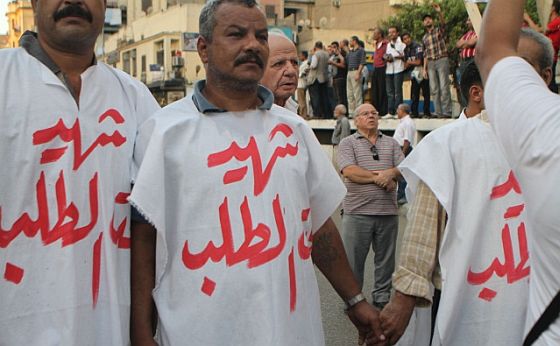
Sarah Carr writes: The march from the Cairo district of Shubra was huge, like the numbers on 28 January. In the front row was a group of men in long white bibs, “martyr upon demand” written on their chests. A tiny old lady walked among them, waving a large wooden cross: “God protect you my children, God protect you.”

The march started down Shubra Street around 4 pm, past its muddle of old apartment buildings, beat up and sad but still graceful compared with the constructions from the Mubarak era next to them – brutish and unfinished-looking.

A man explained why there were bigger numbers than the march last week in response to the attack on the St. George’s Church in Aswan: the army had hit a priest while violently dispersing Coptic protesters in front of the Maspiro state TV building on Wednesday. A video posted online showed a young man being brutally assaulted by army soldiers and riot police.

At a traffic underpass at the end of Shubra Street, at around 6 pm, there was the sudden sound of what sounded like gunfire. Protesters at the front told those behind to stop – the march was under attack. Rocks rained down from left and right and from the bridge, underneath which protesters were taking shelter.

Some threw stones back. Behind them, protesters chanted, “The people want the removal of the Field Commander.” The stone throwing eventually stopped sufficiently for the march to continue. A teenage boy crossed himself repeatedly as he moved forward toward the rocks.

Darkness fell just as the march reached Galaa Street. “This is our country,” protesters chanted, led by a man on a pickup truck full of speakers. An illuminated cross floated through the darkness. At the headquarters of state daily newspaper Al-Ahram, a single rock was thrown at the door, likely a comment on its coverage of violence against Copts.

Outside the Ramsis Hilton Hotel, the chanting stopped momentarily – the exuberance of having escaped the attack in Shubra faded as the march rounded the corner toward Maspiro.

It was immediately met with gunfire in the air. As protesters continued moving forwards, the gunfire continued.

Suddenly, there was a great surge of people moving back, and something strange happened. Two armored personnel carriers (APCs) began driving at frightening speed through protesters, who threw themselves out of its path. A soldier on top of each vehicle manned a gun, and spun it wildly, apparently shooting at random although the screams made it difficult to discern exactly where the sound of gunfire was coming from.

It was like some brutal perversion of the military show the armed forces put on for the 6th of October celebration three days before. The two vehicles zigzagged down the road outside Maspiro underneath the 6th of October Bridge and then back in synchronicity, the rhythm for this particular parade provided by the “tac tac tac” of never-ending gunfire, the music the screams of the protesters they drove directly at.

And then it happened: an APC mounted the island in the middle of the road, like a maddened animal on a rampage. I saw a group of people disappear, sucked underneath it. It drove over them. I wasn’t able to see what happened to them because it then started coming in my direction.

Later, as riot police fired tear gas at another small attempt at a demonstration and fires burned around Maspiro, I found on the floor part of one of the white “martyrs upon demand” bibs the men had been wearing, and took it home. It had been ripped in half.

Facebooktwittermail

Egypt army and police massacre protesters in Cairo — updated

The New York Times reports: A demonstration by Christians angry about a recent attack on a church touched off a night of violent protests here against the military council now ruling Egypt, leaving 24 people dead and more than 200 wounded in the worst spasm of violence since the ouster of President Hosni Mubarak in February.

The sectarian protest appeared to catch fire because it was aimed squarely at the military council that has ruled Egypt since the revolution, at a moment when the military’s latest delay in turning over power has led to a spike in public distrust of its authority.

When the clashes broke out, some Muslims ran into the streets to help defend the Christians against the police, while others said they had come out to help the army quell the protests in the name of stability, turning what started as a march about a church into a chaotic battle over military rule and Egypt’s future.

Nada el-Shazly, 27, who was wearing a surgical mask to deflect the tear gas, said she came out because she heard state television urge “honest Egyptians” to turn out to protect the soldiers from Christian protesters, even though she knew some of her fellow Muslims had marched with the Christians to protest the military’s continued hold on power.

“Muslims get what is happening,” she said. The military, she said, was “trying to start a civil war.”

Issandr El Amrani sees the turn of events as worrisome for multiple reasons.

This marks the first time that the army has taken such an aggressive posture against a predominantly Christian protest, which will easily lead the framing of today’s events as the first time that the military chooses to kill protesting Christians.

Worrisome because state television has behaved thus far tonight much as it did during the 18 days of the Egyptian uprising this winter. In other words, it has deployed propaganda, unverifiable allegations, talk of “foreign agendas” and “outside hands”, and extremely partial reporting. It has repeatedly used sectarian language, with presenters referring to protestors as “the Copts” and using sentences such as “The Copts have killed two soldiers.” On top of this, the military cut off the live TV feeds of several satellite TV stations, including 25TV, al-Hurra, and at a later point al-Jazeera, reducing the independent reporting of an unfolding event. And most of all because TV presenters were urging Egyptians to “protect the army from the Copts.”

Worrisome because many appear to have responded to that call, and tonight on one of Cairo’s main thoroughfares you could see young men marching to that chant of “There is no God but God”, or a woman being attacked simply because she was wearing a cross, or simply because sectarianism has reared its ugly head again after last May’s Imbaba church arson.

Worrisome because this is all happening at a time when the political class is in crisis, its confidence in the SCAF at an all-time low, and the general population is so fed up of all the uncertainty and chaos that it is having buyer’s remorse about the overthrow of Hosni Mubarak.

Most worrisome of all because, taken altogether, this paints a picture of the Egyptian military as resorting to sectarian impulses almost reflexively. It is the flipside of its continued unwillingness, after the sectarian clashes (between civilians as well as between police, military and civilians once fighting had already broken out) of earlier this year, to end once and for all the official discrimination that Copts face when building, expanding or renovating places of worship. SCAF, which rules by decree, could have acted, but did not — and acted weakly in the face of the arson of a church in Aswan last week, which was the cause of today’s protests. And because from so many sides we are getting the old passing of the buck to “foreign agendas” and “foreign hands” in what was.

Facebooktwittermail

Jewish people are just that, people, and far from chosen

In his new book, The Wandering Who, Gilad Atzmon, who was born in Jerusalem, describes his experience of being raised in a society that preferred to disregard the Palestinians in their midst.

“Supremacy was brewed into our soul, we gazed at the world through racist, chauvinistic binoculars. And we felt no shame about it either,” Atzmon writes.

The subject of Jewish supremacy is one that few non-Jews dare touch and those that do are, if not anti-Semitic, then sure to be branded as such. As often proves to be the case, the most courageous voices tend to emerge from inside Israel itself. None is more reliable than that of the Haaretz columnist, Gideon Levy:

On Saturday, the prayer was once again read in the synagogues. “You have chosen us from among all the nations” was once again heard all over the land. The idea that we are a special nation was once again specifically expressed, as is often the case in prayers and in the Torah, and not only on Yom Kippur.

But the idea that we are members of the chosen people is planted far deeper, and not only in Jewish tradition and among those who observe it – modern and ostensibly secular Israel believes in it with all its heart. There are not many other ancient Jewish ideas as deeply implanted in the contemporary Israeli experience as the idea that the “Jewish people,” however it is interpreted, is better than any other nation. If you scratch beneath the skin of almost any Israeli, you’ll discover that he really is convinced of that: We’re the best; the “Jewish genius” is the most successful; the Israel Defense Forces is the most moral. Nobody will tell them different, we’re simply the best in the world.

This is not only unnecessary and groundless arrogance, it’s also an extremely dangerous idea that enables Israel to behave as it does, with blatant disregard of the world’s feelings. Nor does it lack benighted ultra-nationalist and racist foundations. It’s good and well that a nation considers itself successful. The Jewish people have many reasons for that, of course, and many accomplishments of which to boast, as does the State of Israel, which is a kind of wonder, almost a miracle. But among all these, prominent in its absence is an equally important national trait: modesty. It is hard to accuse the Israelis of having it.

At the basis of Israeli arrogance lies the idea that this really is a special nation with special traits that are shared by no other nation. You can see that among Israeli travelers abroad; you can hear it from anyone who comes into contact with foreigners; you can sense it in the deeper currents of Israeli policy. The Americans are “foolish,” the Indians are “primitive,” the Germans are “square,” the Chinese are “strange,” the Scandinavians are “naive,” the Italians are “clowns” and the Arabs are … Arabs. Only we know what’s good for us, and not only for us but for the entire world. There is nothing like Israeli ingenuity, there is nothing similar to Jewish intelligence, the Jewish brain invents new ideas for us like no other brain, because we’re the best, bro.

Facebooktwittermail

Muslim and Christian graves desecrated in Israeli city of Jaffa

The Guardian reports: Dozens of gravestones have been desecrated at Muslim and Christian cemeteries and a firebomb thrown at a synagogue in Jaffa, Israel, on Yom Kippur, the Jewish Day of Atonement.

At least five tombs were smashed and around 20 others sprayed with Hebrew graffiti, including ‘Death to Arabs’ and ‘Price Tag’ – a slogan used by militant Jewish settlers in the occupied West Bank and their supporters.

The “price-taggers” have vowed to avenge any move by Israel to uproot West Bank settlement outposts built without Israeli government permission, and have set fire to mosques and vandalised both Israeli and Palestinian property.

Police spokesman Micky Rosenfeld said a firebomb thrown on to the roof of a synagogue in the Jaffa area caused no damage or casualties. He said an investigation had been launched and that patrols had been stepped up.

A few dozen Israelis and Palestinians turned out in a show of protest against the attacks and a local councillor blamed settlers. Jaffa is the ancient part of Tel Aviv, with a mixed Jewish and Arab population, including Christians and Muslims.

“All these extreme settlers are doing different activities and they are not paying a price for anything,” said Sami Abu-Shehadi, a member of the Tel Aviv-Jaffa municipality council. “Settlers have been saying that they want to bring the conflict inside [Israel] and this is exactly what they are doing now,” he said.

Facebooktwittermail