Category Archives: Issues

Follow the money

Samir Aita writes:

The reasons for the Arab spring go deeper than immediate demands for freedom and democracy. The protesters want to end the political economy and the authoritarian regimes in place since the 1970s.

Monarchies in the Arab world have been absolute, and life-long presidents (with hereditary office) ruled the republics, because they created a supreme power above both state and post-independence institutions. They set up and controlled their own security services to ensure that their powers would endure; the services escaped parliamentary or government supervision, and their members could reprimand a minister and impose decisions. It costs money to run such services, and the clientelist networks of one-party states. The funds derive not from public budgets, as do those for the police and the army, but from different sources of revenue. (The New York Times recently reported that Muammar Gaddafi had demanded in 2009 that oil firms operating in Libya should contribute to the $1.5bn he had promised to pay in compensation for the Lockerbie terrorist murders – or lose their licences. Many paid. And Gaddafi’s immediate cash holdings of billions of dollars are thought to be funding his mercenaries and supporters to defend him.)

After the spectacular 1973 rise in crude oil prices, Middle Eastern revenues increased considerably. Through the distribution circuits, and in collusion with major multinationals, part of the revenue went direct to the coffers of the royal or “republican” families instead of to the state. Nor was oil their only source of revenue. After there were no more commissions on major public contracts, civil and military, because of budget deficits and structural adjustments, new opportunities arose. In the 1990s there were mobile telephone network launches, and the first major privatisations of public services, with public-private partnerships and build-operate-transfer (BOT) contracts. Mobile networks had massive margins, especially at the start when better-off clients were prepared to pay high prices. The major multinational operators, influential businessmen and governments fought to capture the income. (There is evidence for this in the legal dispute over Djezzy, the Algerian branch of the Egyptian operator Orascom, and the Algerian military, and in a previous dispute between Orascom and Syria’s Syriatel, which happened just as the first large Arab multinationals emerged.)

The globalisation of Arab economies and the demands of the International Monetary Fund – supported by the European Commission for the Mediterranean countries – tightened the regimes’ hold on the economy, especially after the oil price crash of 1986. The ensuing decline in public investment and weakening of the governmental regulatory role ensured that the major multinationals held monopolies or oligopolies in exchange for sharing revenue with the powers-that-be. The senior management of the global corporations knew exactly where major decisions were taken and who the imposed local partners were for any new investment: the Trabelsi and Materi families in Tunisia, the Ezz and Sawires in Egypt, the Makhlouf in Syria, Hariri in Lebanon. The Sawires sold their shares in Orascom-Mobinil to France Telecom and offloaded their cement holdings before the Egyptian revolution. Najib Mikati, who had sold Investcom to the South African group MTN, is currently in charge of appointing the new government in Lebanon.

Facebooktwittermail

Heading toward an Israeli apartheid state

Daniel Blatman writes:

It has been 60 years since the apartheid state was established in South Africa. In March 1951, a few years after the racist National Party came to power, racial segregation was anchored in law. As was common in other countries that adopted racist laws in the 20th century, those in South Africa were accompanied by “laundered” explanations.

Hitler declared after the Nuremberg Race Laws were passed in 1935 that they would create a suitable basis for a separate but worthy existence for Jews in Germany alongside German society. The race laws in South Africa established that people of different colors cannot exist when mixed with each other – only in separate, protected spaces.

The tsunami of racist laws passed by the Knesset in recent months is also being explained by reasoned and worthy arguments: the right of small communities to preserve their own character (the Acceptance Committees Law ); the state’s right to prevent hostile use of the funds it allocates to education and culture (the Nakba Law ); and the right to deny citizenship to persons convicted of espionage or treason (the Citizenship Law ). But I believe that as in other historical instances, the aim of this legislation is the gradual establishment of an apartheid state in Israel, and the future separation on a racial basis of Jews and non-Jews.

An apartheid state is not created in the blink of an eye. What was created in Germany in 1935 was the outcome of a long and sometimes violent debate, which had been ongoing since the middle of the 19th century, about the place of Jews in modern Germany and Europe. Indeed, the desire to isolate and distance the Jews from society – legally and socially – was part of the belief system of anti-Semites in Europe for decades before Hitler came into power.

In this respect the Nazi regime, along with other regimes that passed racial separation laws (among them those in Romania, Hungary, Italy and Vichy France in 1940 ), only anchored in legislation a reality that had already been enthusiastically received by the populace. Of course, when such laws were enacted, the regimes involved did not support or imagine that at the end of the road, a “final solution” was waiting in its Nazi format. However, once the seeds were sown, no one was able to figure out what fruit they would bear.

The historical background of the Israeli apartheid state-in-the-making that is emerging before our eyes should be sought in 1967. It is part of a process that has been going on for about 44 years: What started as rule over another people has gradually ripened – especially since the latter part of the 1970s – into a colonialism that is nurturing a regime of oppression and discrimination with regard to the Palestinian population. It is robbing that population of its land and of its basic civil rights, and is encouraging a minority group (the settlers ) to develop a crude, violent attitude toward the Arabs in the territories. This was exactly the reality that, after many years, led to the establishment of the apartheid state in South Africa. [continue reading…]

Facebooktwittermail

Egypt: Israel must pay us back for cut-price gas

Ynet reports:

Egyptian Foreign Minister Nabil al-Arabi stated Sunday that his country would demand that Israel pay the price differences for the reduced gas it purchased during the Hosni Mubarak era.

“We will honor everything we signed on and we’ll demand that they uphold it too,” he was quoted as saying in an interview to the Dream TV channel.

According to the minister, clause No. 8 in the Israel-Egypt peace agreement allows the parties to appoint a joint committee to discuss settling financial disputes, “and we will demand from Israel the price differences of the gas exported to Israel during the previous regime.”

Al-Arabi noted that the Camp David Accords do not include a clause on selling gas and oil to Israel for a reduced price, and that those who interpreted it that way were “wrong” or “wanted to interpret it that way”.

Al-Arabi, who is considered hostile towards Israel, is the first official to raise the possibility that Egypt would demand that Israel pay for the gas retroactively. These comments contradict remarks made by the new oil minister, who said Egypt wanted to enter negotiations with Israel on the possibility of raising the gas prices from now on.

The Egyptian foreign minister added that former President Mubarak was a “strategic treasure” for Israel, implying that this would not be the situation from now on. He also said that Iran should not be considered an enemy state.

Tehran Times reports:

Iranian Foreign Minister Ali Akbar Salehi has welcomed a proposal by his Egyptian counterpart Nabil el-Arabi that Cairo is willing to reestablish diplomatic ties with the Islamic Republic of Iran.

“Good relationship between the two countries will definitely help stability, security, and development in the region,” Salehi noted.

Salehi again praised the Egyptian revolution and said, “The Egyptian people by taking steps toward realizing their just demands opened a new chapter in the history of the country and again I congratulate them on this victory.”

Facebooktwittermail

Forget Goldstone — remember Gaza

Here’s a circle that should never have been closed.

The Goldstone Report, once credited with having provided a hefty shove as Israel veered towards pariah status, is now being held up by Israelis as having unintentionally demonstrated why, when the need arises, Israel will be able to launch Cast Lead Two and once again chant: “we have no choice” — no choice but to slaughter hundreds more Palestinians.

The New York Times reports:

Israel grappled on Sunday with whether a retraction by a United Nations investigator regarding its actions in the Gaza war two years ago could be used to rehabilitate its tarnished international image or as pre-emptive defense in future military actions against armed groups.

The disavowal, by Richard Goldstone, a South African judge who led a panel of experts for the United Nations, appeared in an opinion article in The Washington Post. He said that he no longer believed that Israel had intentionally killed Palestinian civilians during its invasion of Gaza.

Many here considered the article truly significant. Commentary came in a flood, ranging from gracious praise to vindictive indignation. Some cited the message of Proverbs 28:13 that whoever confesses and renounces his sins “finds mercy.”

Still, the question remained whether the harm the Goldstone report caused — the ammunition it gave to those who view Israel as a pariah state and question its right to exist; the campaigns that have stopped some Israeli officials from traveling abroad for fear of arrest for war crimes — could be undone.

Prime Minister Benjamin Netanyahu told his cabinet on Sunday that Israel would work “to formulate practical and public diplomacy measures in order to reverse and minimize the great damage that has been done by this campaign of denigration against the State of Israel.”

A number of officials said that while the blow to Israel’s name had been great, the renunciation of the harshest conclusion would help in the future.

“The one point of light regards future actions,” Gabriela Shalev, a law professor and most recently Israel’s ambassador to the United Nations, said on Israel Radio. “If we have to defend ourselves against terror organizations again, we will be able to say there is no way to deal with this terror other than the same way we did in Cast Lead.”

“If I had known then what I know now, the Goldstone Report would have been a different document,” Judge Goldstone wrote in the Washington Post. But it matters little what kinds of revisions Goldstone would now make; the most significant thing is that he is perceived as having disavowed some of his own conclusions.

The political impact of the report always had more to do with the identity of its author than the report’s contents. Thus the Report of the United Nations Fact Finding Mission on the Gaza Conflict quickly became known simply as the Goldstone Report. It’s supposed authority derived not from the fact that it had been produced by independent international fact-finding mission under the auspices of the United Nations Human Rights Council — what mattered more than anything else was that Goldstone was Jewish and a Zionist.

Israel — the theory went — would be forced to sit up and pay attention if a humanitarian rebuke came from such an impeccable source. But on the contrary, Goldstone ended up being elevated to the status of presenting an existential threat to the Jewish state, on a par with Iran.

He has now effectively disarmed himself.

Israel, long enamored with the notion that its soldiers have higher moral standards than any other military force, has been quick to declare that it has been vindicated. The Goldstone Report itself has ended up better serving those who want to sustain Israel’s sense of victimhood than in being the cause of any change in Israel’s behavior.

There’s a lesson here: don’t attach too much attention to a 500-page report that few people have read, or to the ethnicity or ideology of the messenger. The reason Gaza changed the world’s view of Israel was largely thanks to on-the-ground reporting — not a report — and it came from the voices and faces and presence of young journalists who were describing what they saw, as it happened.

Al Jazeera shone the brightest spotlight on Gaza — in his report, Goldstone did little more than reiterate what we already knew.

Facebooktwittermail

Why the rebels keep running back and forth in the accordion war

'And what kind of training did you get when you joined the rebels?' 'Training?' He laughed. 'Man, I just watched someone else and figured it out on my own.'

Ryan Calder is a PhD candidate from Berkeley, California, currently in Libya doing field research on the uprisings of the 2011 Arab Spring.

What caused the Libyan revolution of 2011? This is the “big question” that motivates my research. At one level, the answers are simple. The Qaddafi regime has been in power for four decades. Most Libyans are tired of its oppression, and of the way it channels economic resources and opportunities to Qaddafi loyalists. With Tunisia and Egypt as inspiration, young, Facebook-using Libyans organized peaceful demonstrations on February 17. After the regime responded with bullets, a revolution began.

That’s the straightforward narrative. It is, I believe, correct. But it doesn’t tell the full story. Many people around the world live under oppressive and corrupt governments, but most of them don’t launch revolutions. Moreover, it’s one thing to protest — as people are doing across the Arab world this year — but it’s quite another to mobilize an armed revolution against a government that has had an iron grip on power for 41 years, with tens of thousands putting their lives at risk.

Why has the Libyan revolution of 2011 has unfolded the way it has? Why now? What concerns do ordinary Libyans have? How do they see the world? Who are the people willing to put their lives on the line to get rid of Qaddafi? Why do some Libyans remain loyal to the Qaddafi government? And what factors might determine whether this revolt succeeds? To answer such questions, we need a textured understanding of Libyan society in 2011, and of the way revolutions happen in the age of Facebook, satellite TV, and mass media. That’s why I’m here.

In one of Ryan’s most recent posts, he describes what has made this an “accordion war” in which day by day, the front swings west and east as the small oil towns west of Benghazi have been repeatedly and quickly liberated by rebels and then just as quickly retaken by Gaddafi forces.

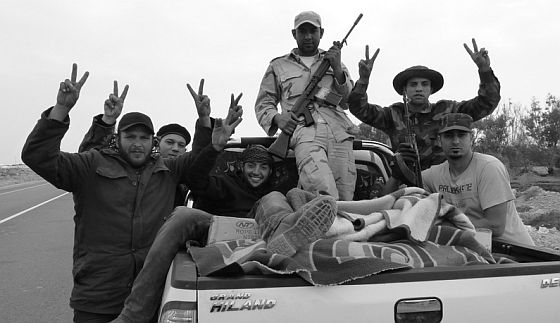
The fact that the young men in this revolution are now most often referred to as “rebels” obscures the fact that this was and remains a civilian uprising. Most of these men have probably had less experience handling and using weapons than the average gun-owning American. And some of these “rebels” don’t even have guns!

Although they contain a few well-trained military units such as Al-Sa’iqah (the special forces who joined the opposition in Benghazi), the vast majority of the rebels are civilians with no military training whatsoever. “I’d never fired a gun in my life before this revolution,” one 25-year-old fighter from Al-Marj told me. “If Gaddafi found you with so much as a bullet, he’d throw you in jail.”

Those rebels fighting at the front don’t even receive military training before they go. “How’d you learn to use that thing?” I asked one 38-year-old engineer I met in Ras Lanuf carrying a Kalashnikov. “And what kind of training did you get when you joined the rebels?”

“Training?” He laughed. “Man, I just watched someone else and figured it out on my own.”

Right now, there’s no military apparatus outside Tripoli with the organizational capacity to train the rebels anyway.

“And where did you go to enlist?” I asked.

He laughed again. “There’s no enlisting. You just find a weapon and show up at the front. If you don’t have one, you wait until another rebel dies and you take his. Or you get some off of Gaddafi’s dead soldiers.” Indeed, I’ve seen groups of rebels scouring the remains of Gaddafi’s bombed-out tanks and armored personnel carriers along the coastal highway, looking for usable weapons and ammunition.

Later, Khalid, a 39-year-old bakery owner from Benghazi who makes a mean bowl of bean soup, showed me his Russian-made Kalashnikov. It was made in 1976.

So what are the ragtag rebels and their outdated weaponry good for? In particular situations – such as street battles within Benghazi against Gaddafi’s Al-Fadil Brigade, or in occasional skirmishes with the Revolutionary Committees – these ragtag fighters have proven effective on an individual level. Many have demonstrated incredible courage, such as Mahdi Ziu, an overweight father of two who loaded his own car with propane and drove it into a heavily defended gate to save his comrades’ lives and help take the main military base in Benghazi. Everyone in Benghazi remembers Mahdi as a hero.

But I’ve seen rebels hightailing it too. A few days ago, at the front 20 km east of Brega, I was interviewing Faraj, a 19-year-old unemployed rebel who lives at home with his parents. He didn’t appear to be armed.

“Do you even have a gun?” I asked. “Yeah – well, you know how it is. There’s about one Kalashnikov for every four or five of us rebels,” he said. “Mine’s in the car.”

We heard one shell land several miles away. A column of black smoke rose slowly.

Faraj and his comrades jumped in their cars and fled, even before the gang of foreign photographers with me stopped clicking their shutters.

The rebels’ rapid retreat is not so much a function of cowardice, but of the fact that when Gaddafi’s shells begin falling, there’s not much they can do. Word on the street here is that even the best of the rebels’ artillery can travel only 20 km, whereas Gaddafi’s newer weaponry fires 40 km. In such situations, amateurs with machine guns and light anti-aircraft guns mounted on their pickup trucks, whether brave or not, have little to contribute.

So when the rebels retreat in the face of enemy fire, they retreat fast. When shells start to land within earshot and Gaddafi’s forces appear to be advancing, a line of Toyota Hilux pickup trucks and ordinary passenger cars – Hyundais and Kias and Chevys and ancient Datsuns that barely putter along — pull U-turns and start streaming away from the front.

These are the ragtag rebels: groups of four or five buddies who carpool to the front in their own cars, high-school teachers and high-school dropouts, petroleum engineers and shepherds and bakery owners, packing their own lunches of macaroni and beans, wearing construction helmets and plastic safety goggles for protection, and carrying the Kalashnikovs they managed to buy on Benghazi’s streets.

When the shells start to land, most of these guys leave the fighting to the trained forces who are at the very front lines. There’s not much for them to do anyway. Those at the very front lines, like Al-Sa’iqah, are better equipped, better trained, under organized command, and know what to do in the face of enemy fire. Lacking training, weaponry, and command the ragtag rebels are mostly useless in these situations. There’s no point for them to stick around and risk getting blown up.

Hence the accordion war.

Facebooktwittermail

The fight for Libya

Al Jazeera reports:

US and Egyptian special forces have reportedly been offering covert armed training to rebel fighters in the battle for Libya, Al Jazeera has been told.

An unnamed rebel source related how he had undergone training in military techniques at a “secret facility” in eastern Libya.

He told our correspondent Laurence Lee, reporting from the rebel-stronghold of Benghazi, that he was sent to fire Katyusha rockets but was given a simple, unguided version of the rocket instead.

“He told us that on Thursday night a new shipment of Katyusha rockets had been sent into eastern Libya from Egypt. He didn’t say they were sourced from Egypt, but that was their route through,” our correspondent said.

“He said these were state-of-the-art, heat-seeking rockets and that they needed to be trained on how to use them, which was one of the things the American and Egyptian special forces were there to do.”

The intriguing development has raised several uncomfortable questions, about Egypt’s private involvement and what the arms embargo exactly means, said our correspondent.

The Associated Press reports:

Something new has appeared at the Libyan front: a semblance of order among rebel forces. Rebels without training — sometimes even without weapons — have rushed in and out of fighting in a free-for-all for weeks, repeatedly getting trounced by Moammar Gadhafi’s more heavily armed forces.

But on Friday only former military officers and the lightly trained volunteers serving under them were allowed on the front lines. Some were recent arrivals, hoping to rally against forces loyal to the Libyan leader who have pushed rebels back about 100 miles (160 kilometers) this week.

The better organized fighters, unlike some of their predecessors, can tell the difference between incoming and outgoing fire. They know how to avoid sticking to the roads, a weakness in the untrained forces that Gadhafi’s troops have exploited. And they know how to take orders.

“The problem with the young untrained guys is they’ll weaken us at the front, so we’re trying to use them as a backup force,” said Mohammed Majah, 33, a former sergeant.

“They don’t even know how to use weapons. They have great enthusiasm, but that’s not enough now,” he said.

Majah said the only people at the front now are former soldiers, “experienced guys who have been in reserves, and about 20 percent are young revolutionaries who have been in training and are in organized units.”

The Guardian reports:

The regime of Muammar Gaddafi has initiated a concerted effort to open lines of communication with western governments in an attempt to bring the conflict in the country to an end.

Libya’s former prime minister, Abdul Ati al-Obeidi, told Channel 4: “We are trying to talk to the British, the French and the Americans to stop the killing of people. We are trying to find a mutual solution.”

Although the regime last night rejected a rebel offer of a ceasefire if Gaddafi withdraws his military from Libya’s cities and permits peaceful protests, senior British sources said the Gaddafi government was open to dialogue.

“If people on the Gaddafi side want to have a conversation, we are happy to talk,” one said. “But we will deliver a clear and consistent message: Gaddafi has to go, and there has to be a better future for Libya.”

The regime rejected the rebels’ ceasefire conditions, saying government troops would not leave cities as demanded.

However, signs that the regime was looking to reach out to the west came after the Guardian reported that a meeting had taken place between Mohammed Ismail, a senior aide to Gaddafi’s influential son Saif al-Islam, and British officials on Wednesday in London. Ismail is a fixer who has been used by the Gaddafi family to negotiate arms deals and has considerable contacts in the west.

The Associated Press reports:

Government forces killed six civilians in the city of Misrata on Saturday in an unrelenting campaign of shelling and sniper fire aimed at driving rebels from the main city they hold in western Libya, medical officials said.

Doctors said that 243 people have been killed and some 1,000 wounded in more than a month and a half of fighting between Moammar Gadhafi’s forces and rebels in Misrata. Most of those slain Saturday were hit by snipers, they said.

One said government forces appeared to be trying to wound civilians.

“The weapons that the Gadhafi brigades use are not meant to prevent movement in the city, but to cause also deformation or paralysis so the suffering of the people endures all their lives,” the doctor told The Associated Press on condition of anonymity for fear of retaliation.

Simon Tisdall writes:

As the Libya conflict enters its third month, Whitehall is full of whispered talk of secret defections and cloak-and-dagger deals with more “reasonable” elements within the much-weakened Tripoli regime. The embattled sons of Muammar Gaddafi are looking for a way out, and may even be prepared to dump their father to save their own skins – or so the grapevine has it.

Security analysts and diplomatic insiders see things differently. It’s clear, they say, that after weeks of inconclusive conflict, neither side can win a military victory. Without a western ground invasion, the rebels are not strong enough to dislodge Gaddafi. So instead, Britain and the US are increasingly engaged in psychological warfare in the hope of fomenting internal dissension and regime collapse. This campaign includes disinformation about the other side’s intentions.

The revamped approach apparently scored a big success this week with the defection of Moussa Koussa, Gaddafi’s foreign minister. But two can play at this game. Gaddafi’s most prominent sons, Saif al-Islam and Mutassim, the national security adviser, were also waging their own “war of nerves”, the sources said. They appeared to be calculating that the Nato-led coalition will run out of time, split apart, and forfeit crucial Arab and domestic support.

Reuters reports:

At least 10 rebels were killed by a coalition air strike on Friday, fighters at the scene said on Saturday, in an increasingly chaotic battle with Muammar Gaddafi’s forces over the oil town of Brega.

The rebel leadership described the deaths as an unfortunate mistake and called for continued air strikes against Gaddafi’s forces, who have reversed a rebel advance along the coastal highway linking their eastern stronghold with western Libya.

Hundreds of mostly young, inexperienced volunteers could later be seen fleeing east from Brega toward the town of Ajdabiyah after coming under heavy mortar and machinegun fire.

A contingent of more experienced and better organized rebel units initially held their ground in Brega, but with most journalists forced east, it was unclear whether they had remained inside the town or pulled back into the desert.

Facebooktwittermail

Can Israel survive without anti-Semitism?

Avraham Burg writes:

In a very short time we will no longer be able to evade the real questions: Are we capable of apprehending our existence without the hatred of others? Do we really need external anti-Semitism as a means to define our inner identity? Think for a moment about a world in which Jews are not hated; about a utopia of peace in the Middle East, fraternity wherever our brethren live. Unreasonable? Definitely not! A hundred years ago, who believed in the existential transformations being played out before our eyes? Few, indeed.

A hundred years ago, Europe was awash in bloodshed that had lasted a thousand years, yet now it is a peaceful continent. Only a few months ago, the Middle East was one of the world’s largest repositories of nasty, bizarre dictatorships, yet today we are on the brink of what appears to be a historic and positive change. And with the world going into this mode, immediately or soon, will the Jewish people be able to survive without an external enemy? It’s not certain.

We have proven methods of coping with persecution, hatred and pogroms. But we don’t have a clue and don’t have experience when it comes to openness, acceptance and full equality for Jews, as for everyone else. That prospect threatens us in the deepest recesses of our being and confronts us with questions about our national existence as such, as “a people that shall dwell alone, and shall not be reckoned among the nations.” This being so, we tend to return to the sick, pathological molds which are so familiar to us: junkies of hatred, we isolate ourselves from the haters, real or imagined. As though the evil we know is preferable to the potential – and threatening – good.

From this point of view, the establishment of the State of Israel not only failed to solve the problems for the sake of which it was founded but, on the contrary, made them a great deal worse. Israel is the biggest shtetl in the history of the world. One big town around which walls of segregation and resentment rise higher every day, cutting it off from its surroundings. Few of us know any other existential reality apart from our unrelenting war with everyone, all the time and over all issues.

Facebooktwittermail

It’s the plutocracy, stupid

M J Rosenberg writes:

I received an email from a Capitol Hill aide who thinks my criticism of AIPAC, the powerful pro-Israel lobby, is overly simplistic. He doesn’t dispute the fact that AIPAC has a disproportionate influence on our Middle East foreign policy. He argues, however, that AIPAC is no different than other powerful special interest lobbies.

I think his whole email is worth a read:

I work on Capitol Hill and I disagree with you about AIPAC. You make it seem as if AIPAC is the only lobby that gets what it wants through threats of cutting off campaign contributions, as if only AIPAC dictates legislation through intimidation.

WRONG! My colleague who handles the Israel issue confirms your analysis. But it’s no different on the domestic issues I cover. The issues of jobs, health, taxes, the environment, regulation to protect kids’ health, oil drilling, workers’ safety, education, guns…they are all dictated by lobbies just as overbearing as AIPAC. All we do up here is cater to rich, selfish people and their special interests. And their interest is cutting all social programs so we can keep cutting taxes to make them even richer.

True, most of them don’t brag as much as AIPAC but that doesn’t make them any better or worse, just smarter (AIPAC gets more negative attention because of its swagger). Big deal. The public is getting screwed eight ways to Sunday by special interests and AIPAC is just one of them. Don’t mislead your readers into thinking it is unique. Not only is it not unique, it’s insignificant in the sense that it’s not the guys robbing the poor to put money in their own pockets. They own US Middle East policy. But the real fat cats own everything else.

I agree with everything my correspondent writes. The American democracy we learned about in school no longer exists. It’s been sold to the highest bidders. And the highest bidder is not, as the Tea Partiers like to say, “We The People.”

Facebooktwittermail

Libya offers lessons for both Washington and al Qaeda

It’s hard to observe Washington without concluding that it fosters a political culture in which stupidity — or at least feigned stupidity — is a prerequisite of success. Pity the politician who might be so naive as to imagine that the appearance of intelligence would boost his or her political fortunes.

It has thus been painfully predictable that as murmurs of an al Qaeda presence on the front lines in Libya have gained wider currency, the only response would be fear and caution. Thus the New York Times reports:

Secretary of State Hillary Rodham Clinton, who pushed the president to intervene in Libya, was described by an administration official on Thursday as supremely cautious about arming the rebels “because of the unknowns” about who they were and whether they might have links to Al Qaeda.

Ring all the alarm bells — links to al Qaeda — God forbid the political penalty for venturing anywhere near there!

But here’s a radical idea: what if links to al Qaeda in Libya turned out to be a good thing?

A report in the Wall Street Journal says that Abdel Hakim al-Hasady, an influential Islamic preacher and high-school teacher who spent five years at a training camp in eastern Afghanistan, now oversees the recruitment, training and deployment of about 300 rebel fighters from the eastern Libyan town of Darna.

Islamist leaders and their contingent of followers represent a relatively small minority within the rebel cause. They have served the rebels’ secular leadership with little friction. Their discipline and fighting experience is badly needed by the rebels’ ragtag army.

Among his followers, Mr. Hasady has the reputation of a trained warrior who stood fearlessly at the front ranks of young protesters during the first days of the uprising.

And his discourse has become dramatically more pro-American, now that he stands in alliance with the West in a battle against Col. Gadhafi.

“Our view is starting to change of the U.S.,” said Mr. Hasady. “If we hated the Americans 100%, today it is less than 50%. They have started to redeem themselves for their past mistakes by helping us to preserve the blood of our children.”

Mr. Hasady also offered a reconsideration of his past approach. “No Islamist revolution has ever succeeded. Only when the whole population was included did we succeed, and that means a more inclusive ideology.”

Facebooktwittermail

Libya’s challenge: democracy under the gun

At Open Democracy, Mark Taylor writes:

The demonstrators at the heart of the Arab spring have redefined the political space in their countries and as a result laid down a new dividing-line in the region. No longer is the political contest between east and west, Muslim against the rest, or pro- or anti-imperialist, humanitarian intervention versus regime change. The dividing-line in the region today is between democratic revolution or counter-revolution.

The new reality means that, for most in the region, the United States and its allies will be judged by their actions and whether these support or forestall democratic change. This change has forced outside powers to adapt and the Libyan intervention is the most dramatic example of this. In stark contrast to only a few weeks ago, not to intervene in Libya would have transformed the struggle in the region into one that defined the fight for democracy as a fight against the US. The US would have been blamed squarely for the defeat of democracy and, because of the changed political landscape, that would have been devastating for US interests in the region.

Doing nothing and allowing the Libyan opposition to be slaughtered held the potential for a backlash that would undermine all US-backed regimes, including Saudi Arabia (in Hillary Clinton’s mind, the violence of Gaddafi probably also raised the spectre of repeating Bill Clinton’s mistake on Rwanda).

The US, long a supporter of dictators in the region, had no good option in Libya. Instead, it chose the less bad one, one which held the possibility of staying on the right side of this story for now – and provided cover in advance for the fact that it will almost certainly be on the wrong side in Bahrain, Saudi Arabia, Yemen and even Syria.

Facebooktwittermail

Why the Libyan revolution deserves support from everyone who believes in democracy

By Anjali Kamat and Ahmad Shokr, Economic and Political Weekly, March 19, 2011

A month into the Libyan revolution, it is easy to forget that what is now an armed rebellion led by a council seeking international recognition began – much like the protests in Tunisia, Egypt, and Yemen – as a peaceful and leaderless popular uprising. Its primary demands were – and to a large extent remain – almost identical to those articulated by demonstrators in other parts of north Africa and west Asia: freedom of expression, democracy, and the ousting of a dictator and his repressive security apparatus. These are fundamentally liberal demands, but when made in a quasi-fascist police state like that ruled by colonel Muammar Gaddafi for nearly 42 years, they acquire a much more radical hue.

The transformation from street protests to armed revolt happened quickly, certainly faster than anyone in Libya could have imagined. After just four days of demonstrations and violent clashes, the long neglected cities of eastern Libya shook off four decades of Gaddafi’s iron-fisted rule. One by one, Benghazi, Al-Bayda, Derna, and Tubruk, all declared their liberation. Almost immediately, protestors established city councils made up of prominent residents and organised popular committees of young men to direct traffic and guard against looting. Even as state-controlled media continued to describe them as treacherous elements implementing a wide range of foreign agendas (western, Egyptian, Tunisian, and Al Qaida), groups of people in Benghazi set up independent newspapers and a handful of former state radio employees took over the local airwaves, broadcasting news about the overnight rebellion and urging everyone to join what came to be known as the “17 February revolution”.

Libya’s revolutionaries are largely middleclass professionals who were suddenly thrust into the leadership of a popular rebellion. They do not represent any single ideological position, but what they do share is a lack of experience with governance or popular mobilisation. This is not surprising given that one of the key achievements of Gaddafi’s four decades in power has been the systematic annihilation of civil society. Any effort towards community or labour organisation or building political associations was swiftly and brutally stamped out as an unacceptable form of dissent, punishable, in some cases, by death. Professional associations that existed were tightly controlled by the state. Notwithstanding his son Saif alIslam’s much-touted PhD dissertation at the London School of Economics on the role of civil society in democratisation, Gaddafi famously said in a televised address last year that civil society is a bourgeois invention of the west with no place in Libya. Labour unions, he added, are for the weak.

A rare exception in this otherwise bleak scenario was the Benghazi Bar Association whose members had been agitating in recent years for relatively minor legal reforms. Their main goal was to oust the former association head, a Gaddafi loyalist who stayed on well past his legally-mandated term. In early February, nervous about the wave of popular uprisings sweeping the Arab world, Gaddafi himself met with the Benghazi lawyers to discuss the standoff. He tried to placate them with promises of reform, and the head of the bar association was dismissed one week before the uprising. But coming on the heels of the dramatic events in Tunisia and Egypt, it was too little, too late.

A Variegated Group

Lawyers, more than any other group, were instrumental in paving the way for the Libyan uprising and several prominent members of the Benghazi Bar Association are now part of Libya’s rebel organisation, the National Transitional Council. Among them are outspoken human rights advocates like Fathy Terbil and Abdel Hafiz Ghogha, who is now the spokesperson of the National Transitional Council. Terbil represented the victims of one of the Gaddafi regime’s most notorious crimes, the mass killing of at least 1,200 inmates of the Abu Salim prison in 1996. When Libyan youth issued a call over Facebook for a “Day of Rage” against the regime on 17 February, the Abu Salim families were among the first to join.

Most of the other figures on the 31-member council have, in the past, publicly questioned Gaddafi’s policies and the terror of his revolutionary committees – and, in some cases, paid for their dissent with long prison terms. Ahmed Zubeir Sanusi, a descendant of Idriss Sanusi, the monarch Gaddafi deposed in 1969, spent 31 years in prison. He is now the council member in charge of political prisoners. Also on the council, in charge of military affairs, is Omar Hariri, who was a young officer who took part in Gaddafi’s coup against Idriss. But since his foiled attempt to overthrow Gaddafi in 1975, Hariri has either been in prison or under house arrest.

A handful of council members held posts in the Gaddafi regime before publicly quitting over the excessive use of force against peaceful demonstrators. The head of the council is the former justice minister, Mustafa Abdel Jalil. During his tenure as a judge and then justice minister since 2007, human rights observers noted that Jalil was unusual in his consistent criticism of the regime’s security forces. The two men on the council responsible for foreign affairs come from pro-business backgrounds. Ali Issawi, who was most recently Libya’s ambassador to India, was minister for economy, trade and investment before that, and holds a doctorate in privatisation. Mahmood Jibril, widely regarded as a reformist, was recently appointed to head the country’s National Planning Council and National Economic Development. He is described in a leaked US diplomatic cable as “a serious interlocutor who gets the US perspective”.

The newly formed council is still grappling with the reality that what began as a hopeful pro-democracy uprising has transformed into a war that they might very well lose. Few among the rebel leadership have military experience. While the rebel army has some defectors from Gaddafi’s forces, it is largely composed of untrained young volunteers who remain bitterly aware that they are in for a long and bloody fight against a far better equipped opponent. As the casualties rise in the besieged towns of the west as well as the frontline towns in the east, some estimates place the numbers of the dead in the thousands.

When asked about the kind of Libyan society they seek to build, members of the National Transitional Council espouse ideals of freedom, human rights, and democracy that some of them have spent years defending. But they have no illusions that translating these ideals into practice will be an easy task. In the current moment, the council does not seem poised – nor does it have a mandate – to formulate a long-term political vision for the country. Its priority, at present, is to gain official recognition from the international community as the legitimate representative of the Libyan people and to bring Gaddafi’s intransigent regime to an end.

No-Fly Zone

One of the council’s immediate, although more controversial, demands is for a no-fly zone over Libya. Council members know full well that a no-fly zone would not necessarily clinch the battle in their favour and could well backfire. Like the courageous protestors in other parts of the region, Libyans want their victory to be their own, achieved without outside help. Everywhere in the east, large banners oppose foreign military intervention. But as the death toll rises, the Libyan’s call for a no-fly zone is a desperate attempt to buy some time.

The anti-imperialist arguments against imposing a no-fly zone are many and convincing. Neutralising Gaddafi’s air power may not give the rebels a much-desired strategic advantage over his ground forces, which are better trained and equipped. Moreover, the decision by foreign powers to impose a no-fly zone is likely to be motivated by their own regional interests rather than a genuine concern for the well-being of Libya’s people.

However, at this crucial time, debates about a no-fly zone should not replace conversations about solidarity. The struggle of the Libyan people for freedom deserves the strongest support. The imperative for solidarity with the Libyan rebels is being lost in anti-imperialist polemics, some of which has casually dismissed those Libyans who call for a no-fly zone as naïve or, even worse, as imperial stooges. This is disrespectful to the many Libyans who have paid a heavy price for challenging Gaddafi’s regime on the streets. A more sensible antiimperialist position would focus less on what a no-fly zone means for western powers and more on listening to Libyan voices on the ground and finding ways to meaningfully support their struggle.

The authors were in eastern Libya when the rebels declared that the area had been liberated. Anjali Kamat (akam47@yahoo.com) reports for the US-based news channel Democracy Now!. Ahmad Shokr (shokr.ahmad@gmail.com) is a doctoral candidate in the History and Middle Eastern and Islamic Studies Departments at New York University and an editor at the independent Egyptian online daily Al-Masry Al-Youm (http://www.almasryalyoum.com/en).

Facebooktwittermail

Getting Libya’s rebels wrong

When Tunisians rose up calling for the end of Zine El Abidine Ben Ali’s rule, beyond the fact that the revolution caught the rest of the world by surprise, no one seemed in much doubt about what the Tunisian people wanted. And shortly after that when Egyptians rose up demanding that Hosni Mubarak must go, the sentiment of the people was not hard to decipher. But when it comes to Libya, many Western observers seem willing to accept the analysis provided by Saif al-Islam Gaddafi who in February warned that Libya is not Tunisia or Egypt and that those challenging his father’s rule would be inviting civil war.

On Wednesday, Libyan officials took Western journalists on a trek 70 miles south of Tripoli to witness the carnage wrought by NATO airstrikes. After 10 days of attacks, Siraj Najib Mohamed Suessi, an 18-month old baby, was described by a New York Times reporter as “the first specific and credible civilian death” from allied airstrikes.

Beyond the earshot of Gaddafi government officials, relatives of the child were clear about who they blamed for his death:

“No, no, no, this is not from NATO,” one relative said, speaking quietly and on condition of anonymity for fear of retaliation. The Western planes had struck an ammunition depot at a military base nearby, he said, and the explosion had sent a tank shell flying into the bedroom of the baby, a boy, in a civilian’s home. “What NATO is doing is good,” he said, referring to the Western military alliance that is enforcing a no-fly zone in Libya.

[A]s government minders directed journalists to the house and the grave, several residents approached foreign correspondents to tell them surreptitiously of their hatred of Colonel Qaddafi.

“He is not a man. He is Dracula,” one said. “For 42 years, it has been dark. Anyone who speaks, he kills. But everyone here wants Qaddafi to go.”

Denunciations of this type have been reported from all over Libya — even now some people in Tripoli are willing to cautiously speak out.

The objective of Libya’s rebel fighters is not hard to decipher — they aim to get rid of Gaddafi — unless, that is, you are skeptical about the intentions of the foreign powers.

Steve Coll says: “It is not clear what the rebels are fighting for, other than survival and the possible opportunity to take power in a country loaded with oil.”

David Bromwich sees the hand of the CIA at work and echoes of the Bay of Pigs.

While the Obama administration itself is raising the specter of al Qaeda:

President Obama’s top two national security officials signaled on Thursday that the United States was unlikely to arm the Libyan rebels, raising the possibility that the French alone among the Western allies would provide weapons and training for the poorly organized forces fighting Col. Muammar el-Qaddafi’s government.

Defense Secretary Robert M. Gates made his views known for the first time on Thursday in a marathon day of testimony to members of Congress. He said the United States should stick to offering communications, surveillance and other support, but suggested that the administration had no problem with other countries sending weapons to help the rebels, who in recent days have been retreating under attack from pro-Qaddafi forces.

Secretary of State Hillary Rodham Clinton, who pushed the president to intervene in Libya, was described by an administration official on Thursday as supremely cautious about arming the rebels “because of the unknowns” about who they were and whether they might have links to Al Qaeda.

Najla Abdurrahman, a Libyan-American writer and activist, expresses her frustration about the confused image of the Libyan pro-democracy movement that is frequently being presented in the media.

The recent remarks by Adm. James Stavridis, NATO’s supreme allied commander for Europe, alleging “flickers in the intelligence of potential al Qaeda, Hezbollah” among Libyan rebels are indicative of a disturbing trend in much of the discussion — and reporting — on Libya over the past several weeks. Ambiguous statements linking Libya and al Qaeda have repeatedly been made in the media without clarifying or providing appropriate context to such remarks. In many instances, these claims have been distorted or exaggerated; at times they have simply been false.

The admiral’s comments — and the subsequent headlines they’ve engendered — represent a new level of irresponsibility, constructing false connections, through use of highly obscure and equivocal language, between al Qaeda and Libyan pro-democracy forces backed by the Transitional National Council. The latter is itself led by a group of well-known and respected Libyan professionals and technocrats. Even more far-fetched is the admiral’s mention of a Hezbollah connection, or “flicker” as he put it.

Statements of this type are troubling because of their tendency to create alarmist ripple effects. Such perceptions, once created, are nearly impossible to reverse and may do serious damage to the pro-democracy cause in Libya. The fact that Stavridis qualified his comments by stating that the opposition’s leadership appeared to be “responsible men and women” will almost certainly be overshadowed by the mention of al Qaeda in the same breath. One must wonder, then, what precisely was the purpose of the admiral’s vague and perplexing remarks.

There is a pressing need for officials and commentators to clarify connections drawn between Libya and al Qaeda and to provide more accurate and responsible analysis. And it’s not just Stavridis’s reference to al Qaeda that is problematic; two similar claims making the media rounds also demand careful scrutiny. One involves an anti-Qaddafi organization called the Libyan Islamic Fighting Group (LIFG) that confronted and was crushed by the regime in the 1990s. The second involves disturbing reports of the recruitment of Libyan youth by al Qaeda in Iraq, some of whom left their homes to take part in suicide missions in that country. Neither is connected to the current uprising, but both are frequently mentioned when discussing it.

Facebooktwittermail

The fight for Libya

Colonel Gaddafi’s regime has sent one of its most trusted envoys to London for confidential talks with British officials, The Guardian can reveal.

Mohammed Ismail, a senior aide to Gaddafi’s son Saif al-Islam, visited London in recent days, British government sources familiar with the meeting have confirmed. The contacts with Ismail are believed to have been one of a number between Libyan officials and the west in the last fortnight, amid signs that the regime may be looking for an exit strategy.

Disclosure of Ismail’s visit comes in the immediate aftermath of the defection to Britain of Moussa Koussa, Libya’s foreign minister and its former external intelligence head, who has been Britain’s main conduit to the Gaddafi regime since the early 1990s.

A team led by the British ambassador to Libya, Richard Northern, and MI6 officers embarked on a lengthy debriefing of Koussa at a safe house after he flew into Farnborough airport on Wednesday night from Tunisia. Government sources said the questioning would take time because Koussa’s state of mind was “delicate” after he left his family in Libya.

The Foreign Office has declined “to provide a running commentary” on contacts with Ismail or other regime officials. But news of the meeting comes amid mounting speculation that Gaddafi’s sons, foremost among them Saif al-Islam, Saadi and Mutassim, are anxious to talk. “There has been increasing evidence recently that the sons want a way out,” said a western diplomatic source.

Al Jazeera reports:

There are unconfirmed reports that more people have left the inner circle of Muammar Gaddafi, the Libyan leader, following the high level desertion of Moussa Koussa, Libya”s foreign minister, who arrived in the UK on Wednesday.

It is understood a group of top officials who had headed to Tunisia for talks have decided to stay there.

Some Arabic newspapers said Mohammad Abu Al Qassim Al Zawi, the head of Libya”s Popular Committee, the country’s equivalent of a parliament, is among the defectors.

Nazanine Moshiri, Al Jazeera”s correspondent in Tunis, said that Abu Zayed Dordah, Libya”s prime minister from 1990 to 1994, has also been mentioned.

On Thursday, a second top official confirmed that he would not serve in Gaddfai”s regime.

Ali Abdessalam Treki, a former foreign minister and UN general assembly president, had been named to represent Libya at the UN after a wave of defections early in the uprising.

Treki, who is currently in Cairo, said in a statement posted on several opposition websites that he was
not going to accept that job or any other.

“We should not let our country fall into an unknown fate,” he said. “It is our nation”s right to live in freedom, democracy and a good life.”

Facebooktwittermail

Holy moly — here comes another 9/11. Fears of blowback from Libya

Reuters reports that the CIA is now on the ground in Libya and the Obama administration is considering arming Gaddafi’s opponents.

This is some of the reaction from Firedoglake‘s David Dayen:

I can just go back to the American track record of arming insurgencies and it’s not very good. Robert Gates knows well from his experience in the CIA that when he armed or helped to arm the Afghan rebels to try to get the Soviets out, that didn’t end well for us.

I just don’t think we know enough about this opposition which is, I think, substantly [sic] different than the opposition that was in peaceful protest throughout the Arab world, to make that assessment that we are going to provide armaments and then possibly trainers to deal with the situation.

Let’s unpack this statement because there’s an awful lot embedded in it that reveals widely held assumptions among those who view Libya as a special case and believe what is going on there can be viewed as intrinsically different from the wider Arab democratic revolution.

Dayen refers to Gaddafi’s opponents as “insurgents” — a term generally applied to armed opponents of a legitimate government. But anyone who doubts that the Gaddafi government has lost its legitimacy needs to explain why so many of Libya’s ambassadors have defected — now even Moussa Koussa, Libya’s foreign minister, has fled to the UK.

I doubt that Dayen’s purpose is to legitimize Gaddafi, but this kind of language certainly delegitimizes those who are fighting to free Libya from Gaddafi’s control. Moreover, to refer to the US’s track record in supporting insurgencies is another way of casting aspersions at the Libyans by invoking memories of the counter-revolutionary anti-Sandinista Contras in Nicaragua or the Mujahadeen out of whose ranks al Qaeda later emerged.

Dayen then makes the ambiguous assertion that on the one hand we don’t know enough about the Libyan opposition, yet apparently we do know enough about them to know that they are intrinsically different from the revolutionaries in Egypt and Tunisia.

Are we supposed to distrust any uprising in which Facebook doesn’t play a prominent role?

Or is the fundamental reason for mistrusting the Libyan rebels because they fairly swiftly armed themselves after hundreds of unarmed demonstrators had been killed?

What would have placated the fears of those in the West who now view with suspicion Libya’s rag-tag army of rebel fighters? That several thousand more would have been killed before the peaceful protest movement transitioned into an armed uprising?

The fact is that peaceful protest movements can be crushed. The partial successes in Tunisia and Egypt says less about the indomitable force of people power, than it says about the extent to which the autocratic leaders in each of those countries were constrained in how far they could go in violently suppressing their own people while still retaining Western support. The West’s support for tyrants is utterly cynical but it does have limits and thus the awkward maneuvering we have repeatedly witnessed as Washington sustains its ties to old autocratic allies while simultaneously coaxing them to institute enough reforms that they might guarantee their survival.

In spite of his relatively brief political rehabilitation, Gaddafi knew from the moment the uprising burst forth, that he wasn’t going to get any protection from the West and thus he did not fear condemnation for his brutality. That’s why he has shown no restraint in his fight for survival. It would be ironic if he now found he was being offered a lifeline by those who oppose Western intervention in Libya.

Facebooktwittermail

CIA agents in Libya aid airstrikes and meet rebels

The New York Times reports:

The Central Intelligence Agency has inserted clandestine operatives into Libya to gather intelligence for military airstrikes and to contact and vet the beleaguered rebels battling Col. Muammar el-Qaddafi’s forces, according to American officials.

While President Obama has insisted that no American military ground troops participate in the Libyan campaign, small groups of C.I.A. operatives have been working in Libya for several weeks as part of a shadow force of Westerners that the Obama administration hopes can help bleed Colonel Qaddafi’s military, the officials said.

In addition to the C.I.A. presence, composed of an unknown number of Americans who had worked at the spy agency’s station in Tripoli and others who arrived more recently, current and former British officials said that dozens of British special forces and MI6 intelligence officers are working inside Libya. The British operatives have been directing airstrikes from British jets and gathering intelligence about the whereabouts of Libyan government tank columns, artillery pieces and missile installations, the officials said.

American officials hope that similar information gathered by American intelligence officers — including the location of Colonel Qaddafi’s munitions depots and the clusters of government troops inside towns — might help weaken Libya’s military enough to encourage defections within its ranks.

In addition, the American spies are meeting with rebels to try to fill in gaps in understanding who their leaders are and the allegiances of the groups opposed to Colonel Qaddafi, said United States government officials, speaking on the condition of anonymity because of the classified nature of the activities. American officials cautioned, though, that the Western operatives were not directing the actions of rebel forces.

A C.I.A. spokesman declined to comment.

The United States and its allies have been scrambling to gather detailed information on the location and abilities of Libyan infantry and armored forces that normally takes months of painstaking analysis.

“We didn’t have great data,” Gen. Carter F. Ham, who handed over control of the Libya mission to NATO on Wednesday, said in an e-mail last week. “Libya hasn’t been a country we focused on a lot over past few years.”

Several weeks ago, President Obama signed a secret finding authorizing the C.I.A. to provide arms and other support to Libyan rebels, American officials said Wednesday. But weapons have not yet been shipped into Libya, as Obama administration officials debate the effects of giving them to the rebel groups. The presidential finding was first reported by Reuters.

Facebooktwittermail

Civilian toll from Western airstrikes in Libya

Here’s a report from the New York Times that needs to be read by anyone who opposes intervention in Libya, primarily on the grounds that there are always innocent victims in war. Have no doubt, that ever since the Western air attacks on Libya began, the Gaddafi regime has been on the lookout for opportunities to take Western journalists to show the toll that has been taken on ordinary Libyan civilians.

Standing at the grave of an 18-month-old baby on Wednesday, officials of the Qaddafi government presented the first specific and credible case of a civilian death caused by Western airstrikes.

But relatives speaking a few yards away said they blamed Col. Muammar el-Qaddafi and welcomed the bombs.

“No, no, no, this is not from NATO,” one relative said, speaking quietly and on condition of anonymity for fear of retaliation. The Western planes had struck an ammunition depot at a military base nearby, he said, and the explosion had sent a tank shell flying into the bedroom of the baby, a boy, in a civilian’s home. “What NATO is doing is good,” he said, referring to the Western military alliance that is enforcing a no-fly zone in Libya.

The testimony of the boy’s parents, a hole in the wall, damage to the house, quietly grieving family members, and a baby-sized and freshly covered grave appeared to confirm the relative’s account of the death.

That made the baby, Siraj Najib Mohamed Suessi, the first specific and credible civilian death from the airstrikes that the Qaddafi government has presented in 10 days of official statements decrying what they say are widespread casualties.

The Qaddafi government’s press office drove journalists 70 miles to this mountain town south of Tripoli to get to it. But as government minders directed journalists to the house and the grave, several residents approached foreign correspondents to tell them surreptitiously of their hatred of Colonel Qaddafi.

“He is not a man. He is Dracula,” one said. “For 42 years, it has been dark. Anyone who speaks, he kills. But everyone here wants Qaddafi to go.”

The town presented none of the theatrical displays of support for Colonel Qaddafi that usually greet official tours. There were no green flags, Qaddafi posters or chanting crowds, and residents were notably cool to the official tour escorts.

Facebooktwittermail

Assad sticks to the Mubarak survival plan

Israelis are quietly confident that Bashar al-Assad can survive the unrest in Syria but fear what might follow if he falls. Assad himself seems confident he can use the same tactics as Mubarak, but with the opposite outcome.

The Guardian reports from Damascus:

The Syrian president, Bashar al-Assad, has blamed foreign conspirators and satellite television channels for two weeks of widespread unrest that has challenged his regime, but in a highly anticipated speech he offered none of the reforms that protesters had hoped for.

The address to the Syrian parliament, which was seen as the most critical of his 11 years as president, left observers bemused and is unlikely to placate protesters who have taken to the streets across the country demanding democratic freedoms and more accountability from the government.

Assad said “conspirators” were pushing an “Israeli agenda”, but offered no further details. “There is chaos in the country under the pretext of reform,” he said.

He said changes to governance in Syria could be considered, but only after the country became more stable and economic conditions improved. However, he offered no timeframe for change, or specific details about what his government would offer.

“We tell those asking for reform that we were late in implementing it but we will start now. Priorities are stability and improving economic conditions,” he said.

Assad had been widely expected to revoke a four-decade-old emergency law, which was put in place by his father and used by security forces to crush dissent ever since. He was also thought to be preparing to lift restraints on the media, which are largely government-controlled.

On Wednesday morning the al-Watan newspaper, which is close to the regime, predicted Assad would “reassure all Syrians and draw clear features for the coming phase”.

Nicholas Blanford reports:

Looking relaxed and smiling and chuckling frequently, Assad delivered his hour-long address to the Syrian parliament in a customary conversational tone. His statements were interrupted every few minutes by parliamentarians standing up and offering individual messages of support and loyalty. He entered and exited to a standing ovation, and was frequently interrupted with coordinated applause.

“Only God, Syria, and Bashar!” chanted the parliamentarians.

“I am talking to you at an exceptional time. It is a test that happened to be repeated due to conspiracies against the country,” said Assad, who became president in 2000 on the death of his father, Hafez al-Assad. “God willing, we will overcome [this conspiracy].”

He acknowledged that reforms have been slow in coming, but he blamed the delay on traumatic distractions over the past decade, including the 2000-2005 Palestinian intifada, the September 2001 attacks, the invasions of Afghanistan and Iraq, and the Hezbollah-Israel war of 2006.

“We know we haven’t addressed many of the people’s aspirations,” he said, adding that not all those that have taken to the streets since March 15 were “conspirators.”

He said that Syria was heading toward “another phase” and admitted that proceeding without reforms “destroys the country.” He said that there would be new measures to combat corruption and “enhance national unity” and that the new government would announce them later. The previous government of Prime Minister Najib Ottari resigned Tuesday, and a new premier is yet to be named.

Patrick Seale writes:

By all accounts, the debate about how to deal with the growing protests has led to increasingly violent confrontations inside the regime between would-be reformers and hard-liners. The outcome of this internal contest remains uncertain.

What is certain, however, is that what happens in Syria is of great concern to the whole region. Together with its two principal allies, the Islamic Republic of Iran and the Lebanese Shiite resistance movement Hezbollah, Syria is viewed with great hostility by Israel and with wary suspicion by the United States. The Tehran-Damascus-Hezbollah axis — of which Syria is the linchpin — has long been seen by many leaders in the region as the lone bulwark against Israeli and American hegemony. With backing from Washington, Israel has sought to smash Hezbollah (notably through its 2006 invasion of Lebanon) and detach Syria from Iran, a country Israel views as its most dangerous regional rival. Neither objective has so far been realized. But now that Syria has been weakened by internal problems, the viability of the entire axis is in danger — which could encourage dangerous risk-taking behavior by its allies as they seek to counter perceived gains by the United States and Israel.

If the Syrian regime were to be severely weakened by popular dissent, if only for a short while, Iran’s influence in Arab affairs would almost certainly be reduced — in both Lebanon and the Palestinian territories. In Lebanon, it would appear that Hezbollah has already been thrown on the defensive. Although it remains the most powerful single movement, both politically and on account of its armed militia, its local enemies sense a turning of the tide in their favor. This might explain a violent speech delivered earlier this month by the Sunni Muslim leader and former prime minister Saad Hariri, in which he blatantly played the sectarian card.

Cheered by his jubilant supporters, he charged that Hezbollah’s weapons were not so much a threat to Israel as to Lebanon’s own freedom, independence, and sovereignty — at the hand of a foreign power, namely Iran. The Syrian uprisings may have already deepened the sectarian divide in Lebanon, raising once more the specter of civil war and making more difficult the task of forming a new government, a job President Michel Suleiman has entrusted to the Tripoli notable, Najib Mikati. If Syria were overrun with internal strife, Hezbollah would be deprived of a valuable ally — no doubt to Israel’s great satisfaction.

Meanwhile, Turkey is deeply concerned by the Syrian disturbances: Damascus has been the cornerstone of Ankara’s ambitious Arab policy. Turkey-Syria relations have flourished in recent years as Turkey-Israel relations have grown cold. Prime Minister Recep Tayyip Erdogan and his foreign minister, Ahmet Davutoglu, have actively sought to mediate local conflicts and bring much-needed stability to the region by forging close economic links. One of their bold projects is the creation of an economic bloc comprising Turkey, Syria, Lebanon, and Jordan — already something of a reality by the removal of visa requirements as well as by an injection of Turkish investment and technological know-how. A power struggle in Syria could set back this project; and regime change in Damascus would likely put a serious dent in further Turkish initiatives.

The Los Angeles Times reports:

As popular unrest threatens to topple another Arab neighbor, Israel finds itself again quietly rooting for the survival of an autocratic yet predictable regime, rather than face an untested new government in its place.

Syrian President Bashar Assad’s race to tamp down public unrest is stirring anxiety in Israel that is even higher than its hand-wringing over Egypt’s recent regime change. Unlike Israel and Egypt, Israel and Syria have no peace agreement, and Syria, with a large arsenal of sophisticated weapons, is one of Israel’s strongest enemies.

Though Israel has frequently criticized Assad for cozying up to Iran, arming Lebanon’s Hezbollah movement and sheltering leaders of the Palestinian militant group Hamas, many in Israel think their country might be better off if Assad keeps the reins of power.

“You want to work with the devil you know,” said Moshe Maoz, a former government advisor and Syria expert at Hebrew University’s Harry S. Truman Institute for the Advancement of Peace.

Several Israeli government and military officials declined to speak in depth about Assad, fearing any comments could backfire given the strong anti-Israel sentiments in the Arab world. That’s what happened when some Israeli officials attempted to bolster Egyptian President Hosni Mubarak before he resigned Feb. 11.

“Officially it’s better to avoid any reaction and watch the situation,” said Maj. Gen. Amos Gilad, the Defense Ministry’s policy director. He predicted Assad’s regime would survive the unrest.

David W. Lesch notes:

When I met with him during the Syrian presidential referendum in May 2007, he voiced an almost cathartic relief that the people really liked him. Indeed, the outpouring of support for Mr. Assad would have been impressive if he had not been the only one running, and if half of it wasn’t staged. As is typical for authoritarian leaders, he had begun to equate his well-being with that of his country, and the sycophants around him reinforced the notion. It was obvious that he was president for life.

Facebooktwittermail

The myth of tribal Libya

The Interim Transitional National Council has presented its “vision of a democratic Libya.”

Simon Tisdall offers a cynical review:

The two-page declaration, published to coincide with the international conference on Libya’s future hosted in London by David Cameron, aspires to all that is correct, admirable, and fashionable in the booming nation-building and nation-shaping business.

Key words such as “transparent”, “green”, “empowerment”, “tolerance” and “rights” litter its elegantly turned paragraphs. Wholesome sentiments about the social contract, civil society, political obligation, and the true awfulness of discrimination (in any shape or form) inform its ineffably do-gooding intent.

There will be those who see here further evidence that Libya’s rebels — or at least their self-appointed leaders — are politically suspect.

Libya, we have often been told, is different. It is not Tunisia or Egypt. It’s poster boys haven’t been Google executives, but youth brandishing AK-47s. If we know the name Shabaab — which just means youth — it’s most likely been in reference to Somalia.

If Egypt came to symbolize the good revolution, the Libya for those most disturbed by Western involvement has in many ways become the bad revolution — or no revolution at all, but a civil conflict whose roots are tribal.

Like warnings issued to nineteenth century European missionaries about the perils of advancing into darkest Africa, the word “tribal” is used to signal no-go territory and a cause that will inevitably turn sour.

Alaa al-Ameri,” a British-Libyan economist and writer, explains why this tribal analysis is an insult to the Libyan people.

In the last few weeks, the word “tribalism” has been used extensively in the context of the Libyan democratic uprising – a spectre looming over the country, embodying the devil we don’t know. This was first introduced into the public mind by Saif al-Islam Gaddafi during his address last month in which he threatened the bloodshed and destruction that his father’s regime has let loose on the Libyan people.

Disappointingly, this image of Libya as a backward tribal society with no real national identity has been picked up and amplified by many western pundits and politicians – often as part of their reasoning why military and material support for the Libyan revolution is a bad idea.

The regime has two main aims for this repeated yet baseless claim. First, people in western Libya are largely cut off from outside media and so the assertion that the Gaddafi regime has the allegiance of regional leaders is intended to crush the confidence of those wishing to rise up in their own cities. Second, it aims to confuse outsiders into believing that the Gaddafi regime is all that’s holding together a fractured and disunited people. Images of Iraq are the desired effect. Among some in the international press and anti-interventionist movements, Gaddafi’s aims seem to have been met without much resistance.

So what is the reality and importance of tribes in modern Libya? For much of Libyan history, tribal groupings were indeed a prevalent social phenomenon. However, when we refer to tribes in today’s Libya we are simply talking about a historical structuring of regional communities in a massive country. These are not the same as distinct sub-national groupings that supersede people’s national identity as Libyans – an identity defended at great cost against fascist Italy and postwar attempts by the British to divide the country.

Tribal leaders traditionally served more or less as local magistrates, arbitrating disputes over land and commerce and presiding over family law. Once Gaddafi came to power, he introduced the revolutionary councils, which he used as a means of incentivising splits between regions and even families. Whereas previously your tribal identity was unlikely to make you rich or powerful, it could now be used as a stepping stone to a position of national authority, wealth and power through election to a revolutionary council.

The big picture, therefore, is not one of long-established tribal conflict. Most recent instances of disputes based on tribal loyalty have been fomented and engineered by Gaddafi’s national policy of divide and conquer. As long as people squabbled among themselves, they were far less likely to unite against him. Well, now they have, and in a desperate attempt to survive, Gaddafi, his son and his close circle are repeatedly attempting to raise the ghost of a rejected system of patronage which they used to maintain power for decades.

Some of those opposed to the international military intervention seem to have unwittingly taken up this call as the defining characteristic of modern Libya. This handy bit of received wisdom, however, needs to be tested against actual events. If there is any genuine tribal separatism among the democratic movement, why are they still fighting to liberate the west of the country? They now have air cover, they control oil-producing areas and have an interim government with international recognition and support.

If tribalism were at the heart of this effort, why risk it all to liberate towns in the west? Why have towns such as Misrata, Zawiya and Zintan, all a short drive from Tripoli, chosen to join the National Transitional Council – a fledgling government on the other side of the country that has so far been powerless to support them or come to their aid?

Is this a tribal act or the brave statement of people taking a stand against a tyrant in solidarity with their fellow Libyans?

One must also remember who sparked this revolution – it was young people, mostly under 30 years of age, who’ve lived their entire lives in urban centres. How many Glaswegians under 30 know or care from which clan they originated? On what basis, other than cultural stereotyping, do commentators presume that the young people of Benghazi, Misrata and Tripoli are any different? Which tribal allegiance was Mohammad Nabbous – a citizen journalist who established the independent internet television station Libya Alhurra in the early days of the revolution – serving when he was shot dead by a sniper at the age of 28 while reporting on the bogus ceasefire cynically announced by the Gaddafi regime on 19 March?

I’d like to ask those who are regurgitating and magnifying the “tribal” propaganda of the Gaddafi regime through the international press – how many Libyans have you consulted about this? How many Libyans who are not members of the Gaddafi regime, not in the middle of a pro-Gaddafi rally in Green Square or some fortified suburb of Tripoli, not under the watchful eye of a pro-Gaddafi minder, have expressed the views you’re repeating in your articles and interviews? As we struggle to liberate ourselves from this horrific regime, you brand us with names hastily acquired from last-minute reading. Tripolitania and Cyrenaica – find me a Libyan who’s ever used those terms to describe their country.

By labelling us as “tribal” you effectively dismiss the notion that our uprising has anything to do with freedom, democracy or human dignity. Do you place narrow regional loyalties above these values? I’m sure you would reject any such characterisation, and naturally so. Please do us, as Libyans, the courtesy of allowing us the same human characteristics you attribute to yourselves.

Facebooktwittermail