Category Archives: Issues

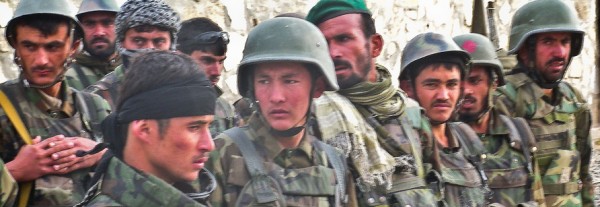
“People here prefer the Taliban to the government”

“People here prefer the Taliban to the government”

Taliban insurgents who have infiltrated Kabul are nailing “night letters” to the doors of policemen, soldiers and government workers, warning them to leave their jobs or face punishment.

The militants are being welcomed in the Afghan capital’s poorer areas among inhabitants who are disaffected with corruption, and who supply them with food, cash and weapons.

Safe houses and bomb-making workshops have begun to appear in run-down districts close to the city centre as the militants increase their presence and plot attacks on prominent local targets.

“They know who we are, where we live and what we do,” said Dr Ehsan Anwari, who used to work as an Afghan army medic and now runs a clinic in Company district, where Highway One, the main road from Kandahar to the south, enters the capital. “Whenever we hear shooting we think that the Taliban are taking over the district by force. We are afraid.” [continued…]

Taliban stalls key hydroelectric turbine project in Afghanistan

An enormous hydroelectric turbine dragged at huge cost by British troops through Taliban heartlands last year may never be installed because Nato has been unable to secure a 30-mile stretch of road leading to an isolated dam in northern Helmand.

The daring mission to deliver 220 tonnes of equipment to the Kajaki dam in Afghanistan in September 2008 was hailed as one of the biggest success stories of the British Army’s three-year deployment in Helmand.

Two thousand British troops took part in the five-day convoy through enemy territory, which was launched because the main road leading to the dam was too vulnerable to Taliban attacks.

Senior British officers privately say the enormous diversion of scarce military resources for the operation allowed the Taliban to make major gains in other critical areas of the province, including Nad Ali, which subsequently saw some of the most intense fighting between British forces and insurgents. [continued…]

Blood, bombs and boys’ talk

The blast tore through Sapper Matthew Weston’s body as he searched the mud compound for mines. The rifle he was carrying sliced off his hand, leaving it dangling by a thread of skin. Both his legs were blown off and he could feel the blood gushing from his two remaining stumps as medics leapt on top of him to stem the bleeding with bandages and tourniquets.

The 20-year-old Royal Engineer struggled to sit up, but his fellow soldiers pushed him back to the ground, afraid he might go into shock if he saw what was left of his legs. “It felt like someone smacking me in the head with a baseball bat. My head was thumping and my ears were ringing,” he told me.

Sapper Weston and his team of mine-clearance experts had been tasked with clearing a dirt track that leads through one of the most dangerous parts of Helmand. Night had fallen when the team from 33 Engineer Regiment began to search for bombs in the compounds that lined the track, known to soldiers as Pharmacy Road.

“I was the man at the front,” he said. “I didn’t have any night-vision equipment. They just didn’t have enough to go round,” he said matter-of-factly, as he sat on his hospital bed. As he turned to his commander to give the all-clear, the bomb that would leave him crippled for life exploded. Seven others were wounded in the blast, some with deep lacerations to their necks. [continued…]

Facebooktwittermail

New US strategy and Pakistan’s response

New US strategy and Pakistan’s response

There are good reasons to conclude that the “new” US strategy for Afghanistan and Pakistan announced by President Obama on 1 December will fail. But it could have serous consequences for Pakistan and the region.

First, the objectives of the strategy are too broad and opaque. Last March, President Obama’s emphasis was on defeating and eliminating Al Qaeda. Now, the aim is also to “roll back” the Taliban insurgency. To eliminate Al Qaeda in the Afghanistan-Pakistan border region, it must be separated and isolated from the Taliban “sea” in which it is currently hiding. But, the US troop surge will be mainly directed against the Taliban insurgency. It will push Al Qaeda and the insurgents closer together, making it more difficult to isolate and target Al Qaeda.

Second, the strategy is mostly a military plan. It fails to address the motivation and causes of the Taliban insurgency, which derives mainly from Pashtun alienation and disempowerment and is now emerging as a Pashtun liberation movement. The Taliban and other Pashtun insurgent groups cannot be “peeled off” to side with a government in Kabul that is dominated by the Tajik and other warlords the Taliban were fighting prior to the 2001 US intervention or with a foreign army supporting this regime. The Taliban may not enjoy significant popular support. But, they are mostly Pashtun and better placed to secure local support and cooperation from common people in the Pashtun regions.

Third, the additional 30-40,000 US-NATO troops may be able to clear and even temporarily hold some of the areas in the South and East of Afghanistan. But, the troop numbers will still be entirely insufficient for sustained control over Afghanistan’s vast deserts, valleys and mountains. (The Soviets could not do this with 140,000 troops plus an effective Afghan Army of 80,000.). In fact, the McChrystal plan envisages defending civilian population centres and withdrawing from “indefensible” outposts including those along the border. As a result, the areas under Taliban and insurgent control are likely to enlarge not contract after this surge. [continued…]

Facebooktwittermail

Drone attacks may be expanded in Pakistan

Drone attacks may be expanded in Pakistan

Senior U.S. officials are pushing to expand CIA drone strikes beyond Pakistan’s tribal region and into a major city in an attempt to pressure the Pakistani government to pursue Taliban leaders based in Quetta.

The proposal has opened a contentious new front in the clandestine war. The prospect of Predator aircraft strikes in Quetta, a sprawling city, signals a new U.S. resolve to decapitate the Taliban. But it also risks rupturing Washington’s relationship with Islamabad.

The concern has created tension among Obama administration officials over whether unmanned aircraft strikes in a city of 850,000 are a realistic option. Proponents, including some military leaders, argue that attacking the Taliban in Quetta — or at least threatening to do so — is crucial to the success of the revised war strategy President Obama unveiled last week.

“If we don’t do this — at least have a real discussion of it — Pakistan might not think we are serious,” said a senior U.S. official involved in war planning. “What the Pakistanis have to do is tell the Taliban that there is too much pressure from the U.S.; we can’t allow you to have sanctuary inside Pakistan anymore.”

But others, including high-ranking U.S. intelligence officials, have been more skeptical of employing drone attacks in a place that Pakistanis see as part of their country’s core. Pakistani officials have warned that the fallout would be severe.

“We are not a banana republic,” said a senior Pakistani official involved in discussions of security issues with the Obama administration. If the United States follows through, the official said, “this might be the end of the road.” [continued…]

Pakistan rebuffs U.S. on Taliban crackdown

Demands by the United States for Pakistan to crack down on the strongest Taliban warrior in Afghanistan, Siraj Haqqani, whose fighters pose the biggest threat to American forces, have been rebuffed by the Pakistani military, according to Pakistani military officials and diplomats.

The Obama administration wants Pakistan to turn on Mr. Haqqani, a longtime asset of Pakistan’s spy agency who uses the tribal area of North Waziristan as his sanctuary. But, the officials said, Pakistan views the entreaties as contrary to its interests in Afghanistan beyond the timetable of President Obama’s surge, which envisions drawing down American forces beginning in mid-2011.

The demands, first made by senior American officials before President Obama’s Afghanistan speech and repeated many times since, were renewed in a written demarche delivered in recent days by the United States Embassy to the head of the Pakistani military, Gen. Ashfaq Parvez Kayani, according to American officials. Gen. David Petraeus followed up on Monday during a visit to Islamabad.

The demands have been accompanied by strong suggestions that if the Pakistanis cannot take care of the problem, including dismantling the Taliban leadership based in Quetta, Pakistan, then the Americans will by resorting to broader and more frequent drone strikes in Pakistan.

But the Pakistanis have greeted the refrain with official public silence and private anger, illustrating the widening gulf between the allies over the Afghan war.

Former Pakistani military officers voice irritation with the American insistence daily on television, part of a mounting grievance in Pakistan that the alliance with the United States is too costly to bear.

“It is really beginning to irk and anger us,” said a security official familiar with the deliberations at the senior levels of the Pakistani leadership.

The core reason for Pakistan’s imperviousness is its scant faith in the Obama surge, and what Pakistan sees as the need to position itself for a major regional realignment in Afghanistan once American forces begin to leave. [continued…]

Facebooktwittermail

To beat al Qaeda, look to the east

To beat al Qaeda, look to the east

Al Qaeda’s main focus is harming the United States and Europe, but there hasn’t been a successful attack in these places directly commanded by Osama bin Laden and company since 9/11. The American invasion of Afghanistan devastated Al Qaeda’s core of top personnel and its training camps. In a recent briefing to the Senate Foreign Relations Committee, Marc Sageman, a former C.I.A. case officer, said that recent history “refutes claims by some heads of the intelligence community that all Islamist plots in the West can be traced back to the Afghan-Pakistani border.” The real threat is homegrown youths who gain inspiration from Osama bin Laden but little else beyond an occasional self-financed spell at a degraded Qaeda-linked training facility.

The 2003 invasion of Iraq encouraged many of these local plots, including the train bombings in Madrid in 2004 and London in 2005. In their aftermaths, European law and security forces stopped plots from coming to fruition by stepping up coordination and tracking links among local extremists, their friends and friends of friends, while also improving relations with young Muslim immigrants through community outreach. Morocco, Saudi Arabia and Turkey have taken similar steps.

Now we need to bring this perspective to Afghanistan and Pakistan — one that is smart about cultures, customs and connections. The present policy of focusing on troop strength and drones, and trying to win over people by improving their lives with Western-style aid programs, only continues a long history of foreign involvement and failure. Reading a thousand years of Arab and Muslim history would show little in the way of patterns that would have helped to predict 9/11, but our predicament in Afghanistan rhymes with the past like a limerick.

A key factor helping the Taliban is the moral outrage of the Pashtun tribes against those who deny them autonomy, including a right to bear arms to defend their tribal code, known as Pashtunwali. Its sacred tenets include protecting women’s purity (namus), the right to personal revenge (badal), the sanctity of the guest (melmastia) and sanctuary (nanawateh). Among all Pashtun tribes, inheritance, wealth, social prestige and political status accrue through the father’s line.

This social structure means that there can be no suspicion that the male pedigree (often traceable in lineages spanning centuries) is “corrupted” by doubtful paternity. Thus, revenge for sexual misbehavior (rape, adultery, abduction) warrants killing seven members of the offending group and often the “offending” woman. Yet hospitality trumps vengeance: if a group accepts a guest, all must honor him, even if prior grounds justify revenge. That’s one reason American offers of millions for betraying Osama bin Laden fail.

Afghan hill societies have withstood centuries of would-be conquests by keeping order with Pashtunwali in the absence of central authority. When seemingly intractable conflicts arise, rival parties convene councils, or jirgas, of elders and third parties to seek solutions through consensus.
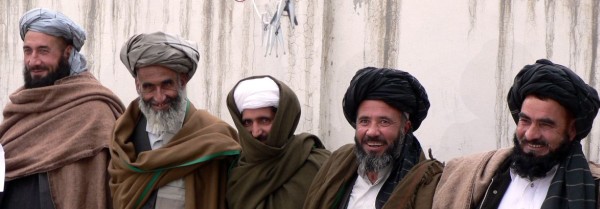
After 9/11, the Taliban leader, Mullah Omar, assembled a council of clerics to judge his claim that Mr. bin Laden was the country’s guest and could not be surrendered. The clerics countered that because a guest should not cause his host problems, Mr. bin Laden should leave. But instead of keeping pressure on the Taliban to resolve the issue in ways they could live with, the United States ridiculed their deliberation and bombed them into a closer alliance with Al Qaeda. Pakistani Pashtuns then offered to help out their Afghan brethren.

American-sponsored “reconciliation” efforts between the Afghan government and the Taliban may be fatally flawed if they include demands that Pashtun hill tribes give up their arms and support a Constitution that values Western-inspired rights and judicial institutions over traditions that have sustained the tribes against all enemies.

The secretary of state, Hillary Clinton, and the special envoy to the region, Richard Holbrooke, suggest that victory in Afghanistan is possible if the Taliban who pursue self-interest rather than ideology can be co-opted with material incentives. But as the veteran war reporter Jason Burke of The Observer of London told me: “Today, the logical thing for the Pashtun conservatives is to stop fighting and get rich through narcotics or Western aid, the latter being much lower risk. But many won’t sell out.”

Why? In part because outsiders who ignore local group dynamics tend to ride roughshod over values they don’t grasp. My research with colleagues on group conflict in India, Indonesia, Iran, Morocco, Pakistan and the Palestinian territories found that helping to improve lives materially does little to reduce support for violence, and can even increase it if people feel such help compromises their most cherished values.

The original alliance between the Taliban and Al Qaeda was largely one of convenience between a poverty-stricken national movement and a transnational cause that brought it material help. American pressure on Pakistan to attack the Taliban and Al Qaeda in their sanctuary gave birth to the Pakistani Taliban, who forged their own ties to Al Qaeda to fight the Pakistani state.

While some Taliban groups use the rhetoric of global jihad to inspire ranks or enlist foreign fighters, the Pakistani Taliban show no inclination to go after Western interests abroad. Their attacks, which have included at least three assaults near nuclear facilities, warrant concerted action — but in Pakistan, not in Afghanistan. As Mr. Sageman, the former C.I.A. officer, puts it: “There’s no Qaeda in Afghanistan and no Afghans in Qaeda.”

Pakistan has long preferred a policy of “respect for the independence and sentiment of the tribes” that was advised in 1908 by Lord Curzon, the British viceroy of India who established the North-West Frontier Province as a buffer zone to “conciliate and contain” the Pashtun hill tribes. In 1948, Pakistan’s founder, Muhammad Ali Jinnah, removed all troops from brigade level up in Waziristan and other tribal areas in a plan aptly called Operation Curzon.

The problem today is that Al Qaeda is prodding the Pakistani Taliban to hit state institutions in the hopes of provoking a full-scale invasion of the tribal areas by the Pakistani Army; the idea is that such an assault would rally the tribes to Al Qaeda’s cause and threaten the state. The United States has been pushing for exactly that sort of potentially disastrous action by Islamabad. [continued…]

Stretching out an ugly struggle

Many decades ago as a fledgling C.I.A. officer in the field, I was naïvely convinced that if the facts were reported back to Washington correctly, everything else would take care of itself in policymaking. The first loss of innocence comes with the harsh recognition that “all politics are local” and that overseas realities bear only a partial relationship to foreign-policy formulation back home.

So in looking at President Obama’s new policy directions for Afghanistan, what goes down in Washington politics far outweighs analyses of local conditions.

I had hoped that Obama would level with the American people that the war in Afghanistan is not being won, indeed is not winnable within any practicable framework. But such an admission — however accurate — would sign the political death warrant of a president to be portrayed as having snatched defeat out of the jaws of “victory.”

The “objective” situation in Afghanistan remains a mess. Senior commanders acknowledge that we are not now winning hearts and minds in Afghanistan; indeed, we never can, and certainly not at gunpoint. Most Pashtuns will never accept a U.S. plan for Afghanistan’s future. The non-Pashtuns — Tajiks, Uzbeks, Hazaras, etc. — naturally welcome any outside support in what is a virtual civil war.

America has inadvertently ended up choosing sides in this war. U.S. forces are perceived by large numbers of Afghans as an occupying army inflicting large civilian casualties. The struggle has now metastasized into Pakistan — with even higher stakes. [continued…]


Facebooktwittermail

Iran’s worst enemy

Iran’s worst enemy

Even among Israel’s tough security chiefs, Meir Dagan has always been known for his raw nerve. As a military trainee he would wander around the base during his off hours flinging a knife at trees and telephone poles like a circus entertainer, one fellow soldier recalls. He earned one of his first decorations as a young commando in Gaza, for snatching a live grenade from the hands of an enemy fighter. Long-haired and confident, Dagan would sometimes bring his pet Doberman, Paco, along on raids. His propensity for solving problems by force continued even after he retired from the military. He was leading a task force on terrorist financing in 2001 when his men told him they had discovered a European bank being used to channel money from Iran to Hamas. “We have the address, no?” Dagan asked his intel officers, according to a participant in the meeting, who asked not to be named for fear of angering Dagan. “Burn it down!” The horrified intelligence officers stalked out of the room in protest. (Dagan declined any comment for this story.)
Soon afterward Dagan was brought in to rejuvenate the Mossad, Israel’s storied foreign intelligence serv-ice. Eight years later, after a string of covert successes attributed to the agency, he has become the country’s longest-serving and most influential spy chief. His men revere him (an affection that does not extend to all their bosses, according to a recent internal survey cited by Mossad sources); even Israel’s civilian leaders heed his strategic advice. But critics say his influence has been achieved at a cost: Dagan, 64, has systematically reoriented the Mossad to focus almost exclusively on what he (and most Israelis) see as the dominant threat to the country—Iran. He views almost all of Israel’s national-security challenges through that prism. [continued…]

Facebooktwittermail

Nuclear Iran: stop the clock ticking and start talking

Nuclear Iran: stop the clock ticking and start talking

Instead of the breakthrough he had hoped for in nuclear diplomacy with Iran, Barack Obama has allowed himself to be painted into a corner. But so, too, have his Iranian counterparts, with neither side now capable of breaking the deadlock.

Mr Obama, under pressure from sceptics of engagement in Washington, Paris and Jerusalem, created an artificial deadline of December 2009 for his diplomatic efforts. The clock is ticking, warn the hawks, with Iran supposedly racing full-tilt to build nuclear weapons (although evidence of this remains scant). So Mr Obama turned a deal to send much of Iran’s stockpile of low-enriched uranium abroad for processing into a take-it-or-leave-it ultimatum. Iran’s leadership has been unable to accept this, insisting on renegotiating the terms even as it faces its own internal paralysis.

Abiding by the deadline, Mr Obama is now pressing for new sanctions against Tehran. But Russia and China remain sceptical, despite being critical of Tehran’s behaviour, and the UN is unlikely to adopt anything close to the “crippling sanctions” which the Secretary of State Hillary Clinton has threatened. [continued…]

Facebooktwittermail

Viva Palestina convoy heading to Gaza – day 7

Vans, plans and solidarity

It’s day 7 and we’ve completed the first leg of our journey to Gaza.

We’ve made it through France, Belgium, Luxembourg, Germany, Austria and Italy, successfully loaded all vehicles onto the overnight ferry at Ancona and off again at Igoumenitsa, crossed the Alps and the northern Greek mountains and are now approaching Thessaloniki, where a warm welcome, the town’s mayor and a sports stadium await us.

And this time, we get to sleep INSIDE the stadium (as opposed to camping in the car park, as we have til now), with toilets, showers, a hot meal and suchlike convivial comforts.

Things we have learned so far

1. No plan survives first contact with the convoy. Expect the worst. Triple all time estimates.

2. A convoy is only as fast as its slowest vehicle. Up a big hill. In the rain.

3. CB radio turns grown men into little boys.

4. Camping is probably more fun in the summer. [continued…]

Facebooktwittermail

Obama’s bloody re-election calculus

Obama’s bloody re-election calculus

Obama’s new “strategy” is no strategy at all. It is a cynical and politically motivated rehash of Iraq policy: Toss in a few more troops, throw together something resembling local security forces, buy off the enemies, and get the hell out before it all blows up. Even the dimmest bulb listening to the president’s speech could not have missed the obvious link between the withdrawal date for combat troops from Iraq (2010), the date for beginning troop reductions in Afghanistan (2011), and the domestic U.S. election cycle.

So we are faced with a conundrum. Obama is one of the most intelligent men ever to hold the U.S. presidency. But no intelligent person could really believe that adding 30,000 troops to Afghanistan, a country four times larger than Vietnam, for a year or two, following the same game plan that has resulted in dismal failure there for the past eight years, could possibly have any impact on the outcome of the conflict.

Arthur Conan Doyle’s character Sherlock Holmes used to say that “when you have eliminated the impossible, whatever remains, however improbable, must be the truth.” The only conclusion one can reach from the president’s speech, after eliminating the impossible, is that the administration has made a difficult but pragmatic decision: The war in Afghanistan is unwinnable, and the president’s second term and progressive domestic agenda cannot be sacrificed to a lost cause the way that President Lyndon B. Johnson’s was for Vietnam. The result of that calculation was what we heard on Dec. 1: platitudes about commitment and a just cause; historical amnesia; and a continuation of the exact same failed policies that got the United States into this mess back in 2001, concocted by the same ship of fools, many of whom are still providing remarkably bad advice to this administration. [continued…]

Facebooktwittermail

Israel expresses anger at new Palestine food labels

Israel expresses anger at new Palestine food labels

Labels will soon show whether food from the West Bank, such as strawberries, dates and olives, comes from Palestinian farms or Israeli settlements, to give buyers a clearer choice.

Supermarkets and other retailers have decided to follow controversial new government guidance, despite Israel’s anger that it will provoke a boycott of its goods.

Goods will specify “produce of the West Bank (Israeli settlement produce)” or “produce of the West Bank (Palestinian produce)”. The Government has decided that produce from Israeli settlements may not be labelled “produce of Israel” because the area is not within the state’s internationally recognised boundaries.

Traders labelling goods from the occupied territories as Israeli produce also face possible enforcement action for breaching EU legislation.

The move immediately provoked a diplomatic spat with Yigal Palmor, the Israeli foreign affairs spokesman. He condemned the move, saying that it was “catering to the demands of those whose ultimate aim is the boycott of Israeli products”. He said: “It is a matter of concern.” [continued…]

Editor’s Comment — Indeed, this surely is a matter of concern to the Israeli government. I wonder how quickly British consumers will respond appropriately and stop buying stolen goods?

Jewish settlers ‘to increase by 10,000 within year’

An Israeli minister has predicted there will be 10,000 new settlers in the occupied West Bank over the next 10 months and insisted that a moratorium did not freeze but only limited construction.

“Over the next 10 months the population of 300,000 will grow by at least 10,000 residents,” said Benny Begin, a minister without portfolio from Prime Minister Benjamin Netanyahu’s Likud party, in comments broadcast on public radio on Friday.

“Properly speaking, this is not a freeze. We are not planning to freeze life but only to impose certain limits on construction” in Israeli settlements in the West Bank, Begin said on Thursday night in Tel Aviv. [continued…]

Abbas slams ‘brutal’ settlers for attack on West Bank mosque

Palestinian Authority President Mahmoud Abbas on Friday said that Israel must rein in settlers’ ‘brutal’ actions, after assailants vandalized a mosque in the West Bank village of Yasuf, torching furniture and spraying Nazi slogans in Hebrew on the premises.

“The torching of the mosque in Yasuf is a despicable crime, and the settlers are behaving with brutality,” said Abbas, who called the act a violation of religious freedom.

“The settlers’ unruly behavior must be stopped,” Abbas added after meeting on Friday with United Arab List-Ta’al chairman Ahmed Tibi in Amman.

Defense Minister Ehud Barak earlier on Friday condemned the vandalization of the West Bank mosque, allegedly at the hands of settlers protesting Israel’s temporary freeze on settlement construction. [continued…]

Palestinian leader speaks from prison

How would you resolve the conflict between Fatah and Hamas?

Marwan Barghouti: During my time in prison brothers from various parties and I were able to draft a prisoners document which became the framework for a national unity document that all 13 Palestinian parties signed on June 27, 2006. It is the first document in the history of Palestinian parties, that the PLO, Hamas, and Islamic Jihad participated in and agreed on a state with 1967 borders, and accepted the PLO and the president of the Palestinian Authority to negotiate in the name of Palestinians, and accepted the call for a national unity government. The conflict will be resolved by referring back to this document and with the signature of all [parties] on the Egyptian national reconciliation document, and by resorting to presidential and legislative elections, and by respecting the law and ending internal strife and through the reestablishment of a national unity government. [continued…]

Yossi Beilin calls for George Mitchell’s resignation

Facebooktwittermail

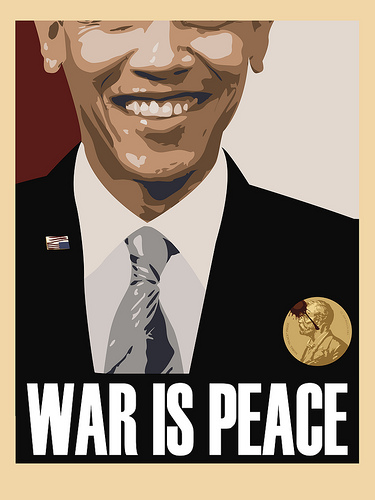
How America won the Nobel Peace Prize

How America won the Nobel Peace Prize

Having been nominated for the peace prize after only ten days in office; having spent the previous three weeks as a president-elect who silently monitored the slaughter in Gaza; and having just assumed the role of commander-in-chief in two wars, for Barack Obama to then craft a credible way to accept an accolade as this year’s most celebrated man of peace, was always going to demand some rhetorical creativity.
Still, this surely ranks as a first: to use the peace prize ceremony as an opportunity to justify war.

Speaking in Oslo last night, Obama said: “the instruments of war do have a role to play in preserving the peace.”

Only within a nation that has largely managed to insulate itself from the effects of war could such a statement be made.

Sixty-four years earlier, in the shadow of two world wars, Americans had a much greater interest in condemning war than in presenting arguments for its justification.

“… our position is that no grievances or policies will justify resort to aggressive war. It is utterly renounced and condemned as an instrument of policy,” wrote Supreme Court Justice Robert H Jackson, on August 12, 1945, when laying out the foundation for the Nuremberg Trials.

On that basis, every war that the United States has fought since World War Two has been branded as a war of necessity — not a war of aggression. Likewise the war that Obama has now made his own is one that he claims to be both necessary, just, and unavoidable. Yet its justness rests on a logical non sequitur: the war in Afghanistan is just because of 9/11.

To say “because of 9/11” is both to present a reason and to simultaneously seal that reason inside a locked box. The logical connection between 9/11 and the war in Afghanistan is apparently so direct and unswerving that even now, those who voice skepticism are generally viewed as either un-American, irrational or naive.

Even so, on September 11, 2001, few Americans had the conviction that this country, out of necessity, was about to go war. President Bush had to present a logical and moral argument and he did so by enunciating what became the first iteration of the Bush doctrine and the foundation for the war on terrorism: “we will make no distinction between the terrorists who committed these acts and those who harbor them.”

On that basis, the Bush administration constructed a legal argument for bombing Afghanistan and killing thousands of people who had nothing whatsoever to do with the attacks.

The unspoken truth was that the US government enacted and the American people supported a war of vengeance. Had the lust for reprisal been tempered with foresight of the carnage and chaos that the following eight years would bring, America’s war of necessity might have been seen then as no more necessary than it is widely seen now.

The “necessity” that took America to war in Afghanistan is no different than the choice Israel makes when it bulldozes the family home of a suicide bomber. This accords with the ancient principle of settling scores, rebalancing power, and reasserting a position of dominance. It’s about showing your enemies and showing the world that you remain top dog. And therein lies the intractability of this war. More troops have to sent in now to buy time for Obama to figure how, without loss of face to himself or this country, the troops can be pulled out later.

As the US president reflects on the principles of a just war, he’s sending young American men and women overseas on the promise that they’re heading out on a path that should bring them back home.

Remember when Obama talked about ending the mindset that took us to war?

I do, but apparently he doesn’t.

Facebooktwittermail

The US cash behind extremist settlers

The US cash behind extremist settlers

Last month, a Brooklyn-based non-profit organisation called the Hebron Fund, which supports Jewish settlers in the Israeli-occupied city of Hebron, held a fundraiser at the New York Mets’ stadium, Citi Field.

The fundraiser went forward despite calls for its cancellation from grassroots human rights organisations from the US, Palestine and Israel. The fact that the Hebron Fund likely raised hundreds of thousands of dollars for extremist Israeli settlers at a major US venue with little public scrutiny is a troubling sign for those who hope that the US can play a constructive role in achieving a just peace in the Middle East.

Perhaps more worryingly, according to Washington Post columnist David Ignatius: “A search of IRS records identified 28 US charitable groups that made a total of $33.4m in tax-exempt contributions to settlements and related organisations between 2004 and 2007.” Some of the larger organisations, including Friends of the Ateret Cohanim and Friends of Ir David, both leading the Jewish settler takeover of Palestinian East Jerusalem, are based in New York City.

Israeli settlements violate the Geneva convention’s prohibition against an occupying power transferring its population into occupied territory, and Israeli settlement expansion directly contradicts the US call for a settlement freeze. [continued…]

How does the U.S. help fund pro-settler IDF troops?

The Task Force to Save the Nation and the Land, the organization that offered every soldier refusing to evacuate a settlement, and the Kfir Brigade soldiers who publicly demonstrated their opposition to evacuation, NIS 1,000 for every day they spend in military prison, is a registered non-profit organization and has a license to operate.

The group receives donations from a U.S. based group that are tax exempt. No comment was available from the organization.

The Global Task Force to Save the Nation and the Land, established in 2003 and rising to fame during the disengagement from the Gaza Strip, melds positions of the extreme right wing and the messianic Hassidic Chabad sect. The group is headed by Rabbi Shalom Dov Wolpe, a Chabad Hassid of the messianic stream, who lives in Kiryat Gat. In recent years the group began offering monetary rewards to soldiers and civilians. Among the rewards it has given was NIS 20,000 to each soldier who lifted a sign of “The Shimshon Battalion does not evict from Homesh” at the Western Wall a month ago, and gave NIS 1,800 to the soldier Tzach Kortz, who shot a terrorist in Kiryat Arba last week. [continued…]

Peace Now and J Street should join the battle against tax breaks for the West Bank colonists

In a sign that the discourse is changing and taboo subjects are coming inside, The Atlantic considers the case for ending the special relationship of US and Israel, and picks up an important piece in the Guardian by Andrew Kadi and Aaron Levitt about the U.S. tax subsidies extended to the Hebron colonists. Kadi and Levitt focus on the Hebron Fund’s fundraiser at the Mets ballpark last month:
“Until the public, advocacy groups, media and the US government scrutinise and rein in settlement non-profits like the Hebron Fund, policy statements about peace in the Middle East will do nothing to stop the daily violence and dispossession suffered by Palestinians.”

My question: Where are Jeremy Ben-Ami of J Street and Michael Walzer of Americans for Peace Now? This is actually an issue we can all do business on. Ben-Ami says that he is trying to end the colonization of the West Bank. Well, focusing on the Hebron Fund and its tax break is one real and significant way to apply pressure. Earlier this year my old professor, Walzer, wrote bravely that the United States must put heavy pressure on Israel to defeat the settler movement (and save the 2-state solution)! Walzer is on the board of Americans for Peace Now. So are Dan Fleshler and Richard Dreyfuss. [continued…]

Israeli minister says settlers’ resistance ‘natural’

As Jewish settlers step up their resistance to a temporary and partial settlement construction freeze ordered last month by the Israeli government, Avigdor Lieberman, Israel’s foreign minister, yesterday said the opposition was “legitimate” and “natural”.

While Mr Lieberman, himself a settler, did not condone the kind of action that has seen settlers try to block access roads to Jerusalem or prevent government officials from reaching settlements to implement the construction freeze order, his comments indicate that the order has struck a nerve with settlers and consequently the reaction will have a political fallout.

Over the past few days, settlers stepped up their action against the order, evident in incidents of vandalism on Palestinians’ properties, their efforts to disrupt the lives of Israelis and target government officials with protests outside their homes. The well-orchestrated campaign seems to have taken the Israeli government by surprise. [continued…]

Who will save Gaza’s children?

Among all the complex and long-term solutions being sought in Copenhagen for averting environmental catastrophe across the world, there is one place where the catastrophe has already happened, but could be immediately ameliorated with one simple political act.

In Gaza there is now no uncontaminated water; of the 40,000 or so newborn babies, at least half are at immediate risk of nitrate poisoning – incidence of “blue baby syndrome”, methaemoglobinaemia, is exceptionally high; an unprecedented number of people have been exposed to nitrate poisoning over 10 years; in some places the nitrate content in water is 300 times World Health Organisation standards; the agricultural economy is dying from the contamination and salinated water; the underground aquifer is stressed to the point of collapse; and sewage and waste water flows into public spaces and the aquifer.

The blockade of Gaza has gone on for nearly four years, and the vital water and sanitation infrastructure went past creaking to virtual collapse during the three-week assault on the territory almost a year ago. [continued…]

Facebooktwittermail

Iran accuses U.S. and Saudis of kidnapping a nuclear scientist

Iran accuses U.S. and Saudis of kidnapping a nuclear scientist

Iran’s top diplomat accused the United States and Saudi Arabia on Tuesday of kidnapping one of its nuclear scientists.

Foreign Minister Manouchehr Mottaki told reporters that Shahram Amiri, who worked for Iran’s Atomic Energy Organization, disappeared during a summer religious pilgrimage to Saudi Arabia. He said Tehran had evidence that the U.S. was involved in the disappearance.

“The U.S. should give back our compatriots based on the call of their family and people,” Mottaki told reporters during an appearance with his United Arab Emirates counterpart, according to the Islamic Republic News Agency. [continued…]

Iran: no sanctions!

Back in the spring, and several times since then, President Obama suggested that if progress hasn’t been made in the talks with Iran, he’d move toward harsher measures, including what Secretary of State Clinton has called “crippling sanctions.” That time is drawing near, and assorted hawks are clamoring now for Obama to put up or shut up. “You said you’d get tough with Iran,” they’re saying. “The time is now.”

Of course, the time isn’t now. After the October 1 session in Geneva, where some limited success was achieved, the talks have stalled, exactly as I (and many others) predicted. Iran’s internal politics is muddled, and neither the Leader, Ayatollah Ali Khamenei, nor President Ahmadinejad, are in a position to strike a deal with the Great Satan just now. They’re under attack from conservatives and reformists opposed to the Oct. 1 deal, which would have sent the bulk of Iran’s enriched uranium to Russia and France for processing, and the anti-Ahmadinejad opposition is showing renewed signs of strength, as evidenced by this week’s round of demonstrations by students and others.

But, in spite of the apparent consensus among the big powers – which produced a tough new resolution by the International Atomic Energy Agency last month – there’s zero chance that either Russia or China will support anything like the embargo on refined oil and gasoline that Obama, in the past, has said he supports. And other key countries, such as India, which has good relations with Iran, and the United Arab Emirates, through which much of Iran’s gasoline imports are transshipped, aren’t likely to back sanctions either. The very best Obama could get, if he goes to the UN Security Council for yet another round of sanctions, is another symbolic set of sanctions that have no force at all. [continued…]

Violent protests in Iran carry into second day

Iran’s broadest and most violent protest in months spilled over into a second day on Tuesday, as bloody clashes broke out on university campuses between students chanting antigovernment slogans and the police and Basij militia members.

As the scale of Monday’s demonstrations became clearer, Tehran’s police chief announced that 204 people had been arrested in the capital, the semiofficial Mehr news agency reported. The clashes took place on campuses in cities across the country, as students and opposition members took advantage of National Student Day to vent their rage despite a lengthy and wide-ranging government effort to forestall them.

The violence continued Tuesday on the campus of Tehran University, where security forces were using tear gas and arresting students, according to reports and video clips relayed through Twitter and Internet postings. There were protests at large squares near the university as well, witnesses said. Iran’s official IRNA news agency reported that the clashes began after groups of pro-government students carrying pictures of Iran’s supreme leader, Ayatollah Ali Khamenei, clashed with protesters on campus. [continued…]

Facebooktwittermail

Baghdad bombs kill 127 as Iraq vote is set

Baghdad bombs kill 127 as Iraq vote is set

As Iraqi officials prepared to announce a date for delayed national elections, car bombs detonated Tuesday at government buildings and in crowded Baghdad streets, killing at least 127 people and wounding nearly 500.

The attacks on state institutions appeared aimed at further eroding the Iraqi people’s faith in the political process, which many already viewed with deep skepticism.

The morning explosions shook the east and west sides of the city over a span of about 30 minutes, gutting portions of a major courthouse on the west side of the Tigris River and other buildings. An ambulance packed with explosives detonated at a checkpoint for the makeshift offices of the Iraqi Finance Ministry, which had been forced to move after a bombing in August. [continued…]

Facebooktwittermail

Hundreds of women lead protest in Afghanistan

Hundreds of women lead protest in Afghanistan

Several hundred women, many holding aloft pictures of relatives killed by drug lords or Taliban militants, held a loud but nonviolent street protest today, demanding that President Hamid Karzai purge from his government anyone connected to corruption, war crimes or the Taliban.

“These women are being very brave,” said the protest leader, her face hidden by a burka. “To be a woman in Afghanistan and an activist can mean death. We want justice for our loved ones!”

Afghan police, in riot gear, monitored the rally as it worked its way slowly through muddy streets to the United Nations building here, but they did nothing to disrupt the event.

The unusual display of political activism by women comes as Karzai is under increasing pressure to remove from his cabinet anyone connected to rampant corruption, including links to the flourishing drug trade. His own finance minister says corruption is the biggest threat to the future of Afghanistan. [continued…]

Facebooktwittermail

McChrystal’s stovepipe operation

McChrystal’s stovepipe operation

President Barack Obama’s national address last Tuesday not only detailed the United States’ strategy on Afghanistan, it laid bare his new administration’s strengths and weaknesses – and confirmed the growing suspicion that, eight years after September 11, 2001, meeting America’s global challenges with a military response remains the default position of the Washington policymaking establishment.

“Don’t underestimate the impact that eight years of the [George W] Bush administration has had in Washington,” a senior State Department official explained this last summer. “The Bush people set out the language of the war on terrorism, invented the vocabulary, defined the terms. People talk about the importance of ‘doing’ diplomacy, but no one really knows what that means or how tough it can really be.”

At least initially, this assessment seemed contradicted by the administration’s flurry of diplomatic activity. Its first months were taken up by Secretary of State Hillary Clinton’s globetrotting, special envoy George Mitchell’s high-profile Jerusalem meetings, AfPak specialist Richard Holbrooke’s repeated initiatives with Pakistan’s President Asif Ali Zardari – and Obama’s decision to engage Iran in direct talks about its nuclear program.

Suddenly, surprisingly, the military seemed relegated to playing a minor role in Washington: Bush’s hero David Petraeus, the US commander for the greater Middle East, was no longer in the headlines, the war in Iraq seemed well in hand and Defense Secretary Robert Gates was nowhere to be seen.

All of this changed in May, when a series of well-timed Taliban offensives led to a spike in US casualties and Gates decided to replace the US Afghan commander, David McKiernan, with Lieutenant General Stanley McChrystal. The change did not come as a surprise to Pentagon officers, who had watched Petraeus and McKiernan struggle through a difficult relationship: “The two couldn’t be in the same room together,” a McKiernan aide says. “We knew there’d be a fist fight if we left them alone.” The disagreement was personal: McKiernan resented answering to an officer whom he had once commanded and viewed as politically ambitious.

But the relationship was also scarred by a subtle disagreement over how to meet the Taliban challenge. Both McKiernan and Petraeus agreed that the Taliban posed a security challenge to the Afghan government, but McKiernan focused first on development – on building what he called “human capital”. Petraeus disagreed: you can’t build “human capital” without security, he argued, and the security situation in the country was deteriorating. Then too, Petraeus thought, what was needed in Afghanistan was an officer who could respond creatively to what Petraeus believed was turning into an asymmetric fight – and McKiernan was an officer with a deep background in running conventional wars.

McChrystal, a former Green Beret and a celebrated special operations commander, was the answer. Petraeus recommended a change to Gates, and Gates agreed. Within days of his May 11 appointment, McChrystal showed up in the Afghan capital, Kabul, with a team of counter-insurgency experts who commandeered McKiernan’s headquarters and fanned out throughout the country.

McChrystal’s teams were told to identify the problem and find a solution. “They absolutely flooded the zone,” a US development officer says. “There must have been hundreds of them. They were in every province, every village, talking to everyone. There were 10 of them for every one of us.” Not surprisingly, within weeks of their deployment, McChrystal’s team leaders had concluded that the US was facing was an escalating insurgency that could only be checked with an increase in US troops. In-country State Department officials rolled their eyes: “What a shock. If you deploy a gang squad, they’re going to find a gang,” a senior State Department official says with a tinge of bitterness. “They were looking for an insurgency and they found one.”

“From the minute that McChrystal showed up in Kabul, he drove the debate,” a White House official confirms. “You’ll notice – from May on it was no longer a question of whether we should follow a military strategy or deploy additional troops. It was always, ‘should we do 20,000 or 30,000 or 40,000, or even 80,000’? We weren’t searching for the right strategy; we were searching for the right number.”

A senior State Department official, watching McChrystal from her State Department perch in Washington, remembers the frustration among the department’s top policymakers: “We kept saying ‘we need to open up to the other side, like we did in Iraq with the Anbar insurgency,’ and the military kept saying, ‘well this isn’t Iraq.’ And so we’d answer: ‘fine, so if Afghanistan isn’t Iraq, then why do you keep talking about a surge?’ And we never got an answer.”

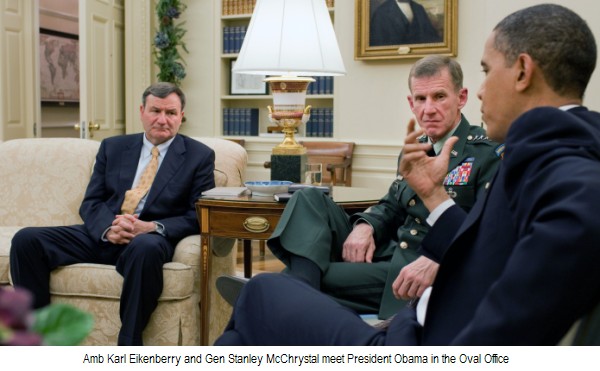
The State Department’s frustration extended into the embassy in Kabul, where the US ambassador, Karl Eikenberry, was having his own problems with McChrystal. The appointment of Eikenberry in March of 2009 had been greeted with skepticism in the State Department because of his background as a West Pointer, a retired lieutenant general and a US security coordinator in the country. But if anyone would be sympathetic to McChrystal, it was now thought, it would be Eikenberry.

But that’s not what happened: Eikenberry won friends among professional diplomats for his easygoing manner and quick understanding of their problems – and for his open irritation at McChrystal’s imperious manner. “McChrystal came in and he just thought he was some kind of Roman proconsul, a [Douglas] MacArthur,” an Eikenberry colleague notes. “He was going to run the whole thing. He didn’t need to consult with the State Department or civilians, let alone the ambassador. This was not only the military’s show, it was his show.”

But McChrystal was not only able to “flood the zone” in Afghanistan, he was able to do so in Washington. As the director of the Joint Staff, a position he held just prior to arriving in Kabul, McChrystal established the Pakistan-Afghanistan Coordinating Cell (PACC), a 70-person military-civilian operations group housed in the Pentagon’s National Command Center, one of the most secure offices in the world. “This isn’t a place you just wander in and out of,” a senior Pentagon official says. The “PACC” bypassed the normal command structure – and the State Department. It reported to McChrystal, who rotated its officers in and out of Kabul every three to four months.

The PACC is “a stovepipe operation”, this senior Pentagon official notes. “It’s beautiful. It’s headed up by McChrystal acolytes, former special operations officers who view him [McChrystal] as their patron. So they follow his lead. And there is no requirement for them to share any of the information they get from Kabul with the State Department or anyone else – let alone with Eikenberry. This is McChrystal’s game. The PACC people in Washington pass information to McChrystal without going through any channels and they take the best information from Kabul and they brief [JCS chairman Admiral Mike] Mullen – and he briefs the president. So during the run-up to the Afghanistan decision, the military always looked current. They had the best information. Everyone else looked like a bunch of amateurs. Eikenberry was out of the loop. He had no chop [influence] on any of it. They just ran circles around him.” [continued…]

Facebooktwittermail

Taliban prepare to return to power

Taliban shadow officials offer concrete alternative

Like nearly all provinces in Afghanistan, this one has two governors.

The first was appointed by President Hamid Karzai and is backed by thousands of U.S. troops. He governs this mountainous eastern Afghan province by day, cutting the ribbons on new development projects and, according to fellow officials with knowledge of his dealings, taking a generous personal cut of the province’s foreign assistance budget.

The second governor was chosen by Taliban leader Mohammad Omar and, hunted by American soldiers, sneaks in only at night. He issues edicts on “Islamic Emirate of Afghanistan” stationery, plots attacks against government forces and fires any lower-ranking Taliban official tainted by even the whiff of corruption.

As the United States prepares to send 30,000 additional troops to Afghanistan to bolster Karzai’s beleaguered government, Taliban leaders are quietly pushing ahead with preparations for a moment they believe is inevitable: their return to power. The Taliban has done so by establishing an elaborate shadow government of governors, police chiefs, district administrators and judges that in many cases already has more bearing on the lives of Afghans than the real government. [continued…]

US surge will only prolong Afghan war

American and British exponents of a military escalation or “the surge” in Afghanistan opportunistically expound two wholly contradictory views of Taliban strength. At one moment they are a movement of immense power on the verge of seizing power in Afghanistan and Pakistan with the possibility that they might soon have control of Pakistan’s nuclear weapons. But the next moment Mr Brown is claiming that the Taliban have almost no support among Afghans. In the US, Mr Obama and Mr Gates imply that the insurgents have such shallow roots that they can be largely defeated in 18 months so US troops can start to withdraw. [continued…]

The surrealism of the Afghan surge

President Barack Obama risks leading the US deeper into the same kind of nightmare as Vietnam, with the same profound misconceptions and arrogance of the US military and the CIA. It just requires a glance at the picture on p. A29 of Sunday’s New York Times to see how absurd the US decision-making process really is. Among the people in the room briefing the president, there isn’t a single person with deep non-military knowledge of either Afghanistan or Pakistan. We see plenty of generals and politicians but nobody who knows about the people, culture, economy, climate, agronomy, extreme poverty, and traditions of the people themselves. [continued…]

US leaves in Iraq equipment that it may need in Afghanistan

Even as the U.S. military scrambles to support a troop surge in Afghanistan, it is donating passenger vehicles, generators and other equipment worth tens of millions of dollars to the Iraqi government.

Under new authority granted by the Pentagon, U.S. commanders in Iraq may now donate to the Iraqis up to $30 million worth of equipment from each facility they leave, up from the $2 million cap established when the guidelines were first set in 2005. The new cap applies at scores of posts that the U.S. military is expected to leave in coming months as it scales back its presence from about 280 facilities to six large bases and a few small ones by the end of next summer.

Some of the items that commanders may now leave behind, including passenger vehicles and generators, are among what commanders in Afghanistan need most urgently, according to Pentagon memos. [continued…]

Facebooktwittermail

Israel must unpick its ethnic myth

Israel must unpick its ethnic myth

What exactly is “Zionism”? Its core claim was always that Jews represent a common and single people; that their millennia-long dispersion and suffering has done nothing to diminish their distinctive, collective attributes; and that the only way they can live freely as Jews – in the same way that, say, Swedes live freely as Swedes – is to dwell in a Jewish state.

Thus religion ceased in Zionist eyes to be the primary measure of Jewish identity. In the course of the late-19th century, as more and more young Jews were legally or culturally emancipated from the world of the ghetto or the shtetl, Zionism began to look to an influential minority like the only alternative to persecution, assimilation or cultural dilution. Paradoxically then, as religious separatism and practice began to retreat, a secular version of it was actively promoted.

I can certainly confirm, from personal experience, that anti-religious sentiment – often of an intensity that I found discomforting – was widespread in left-leaning Israeli circles of the 1960s. Religion, I was informed, was for the haredim and the “crazies” of Jerusalem’s Mea Sharim quarter. “We” are modern and rational and “western”, it was explained to me by my Zionist teachers. But what they did not say was that the Israel they wished me to join was therefore grounded, and could only be grounded, in an ethnically rigid view of Jews and Jewishness.

The story went like this. Jews, until the destruction of the Second Temple (in the First century), had been farmers in what is now Israel/Palestine. They had then been forced yet again into exile by the Romans and wandered the earth: homeless, rootless and outcast. Now at last “they” were “returning” and would once again farm the soil of their ancestors. [continued…]

Is Israel a democracy?

After the war, the 156,000 Arabs remaining in Israel were about 15 percent of the population. They became Israeli citizens, with the right to vote and be elected. But most Arab towns and villages remained under restrictive military government. “The Israeli authorities viewed the Arab population as hostile and potentially seditious,” as Hillel Cohen writes in Good Arabs: The Israeli Security Agencies and the Israeli Arabs, 1948-1967, an Israeli best seller that has just come out in English. Cohen’s title is ironic. It refers to the web of collaborators and informers that security agencies built among the Arab minority. The network’s purpose, Cohen writes, was not only to uncover hostile groups and agents of enemy countries. It was also to control political life down to the village level and to “reshape Arab consciousness and identity,” divorcing Arab citizens from Palestinian nationalism.

Using previously classified documents, Cohen charts in fascinating and disturbing detail how collaboration shaped life among Israeli Arabs. Pro-regime Arabs tried to keep wedding singers from performing communist and Arab nationalist songs. Teachers in Arab-language schools were hired or fired based on political loyalties. “Naturally, this affected the quality of teaching,” especially since educated Arabs were more likely to have Arab nationalist leanings, Cohen writes. The military government over Israeli Arabs was dissolved in 1966. The Arab parties set up as satellites of Jewish ones have vanished. Arab citizens now vote mainly for parties that outspokenly demand their rights. “State supervision of political speech has lessened” but not disappeared, Cohen writes. Yet alongside (frustratingly slow) progress within Israel, a far more blatantly ethnocratic regime has developed in the territories that Israel conquered in 1967. Israel’s democratically elected governments rise and crumble based on their position on the occupation. [continued…]

Editor’s Comment — As a liberal Zionist, Gorenberg is unwilling to judge Israel as a democratic failure, but if instead of asking whether Israel can realize a democratic possibility he was merely to coldly judge whether Israel can be seen moving along a democratic trajectory, he could spare himself any further hand-wringing.

Still, don’t just read the snippet above — read the whole article.

Facebooktwittermail

The interview Ha’aretz doesn’t want you to see

The interview Ha’aretz doesn’t want you to see

Rehaviya Berman conducted an interview with Ali Abunimah, for Ha’aretz, a few weeks ago. The Interview was never published. Berman decided to publish it on his blog [Hebrew] and I decided to translate it, for your reading pleasure:

Exclusive: One On One with the Leader of the Electronic Intifada
Rehaviya Berman

Meet Ali Abunimah, the son of a Jordanian diplomat, a Palestinian activist, and the man who brings the hottest news of the struggle to thousands of people. His message: Forget two states, one will be tough enough to get it right. [continued…]

Inside story – the battle for Jerusalem

Facebooktwittermail