Category Archives: Issues

Nuclear disarmament: a dream or an imperative?

Obama outlines disarmament plan

Under a hazy spring sky, before a swelling Czech crowd, U.S. President Barack Obama called for an international effort to lock down nuclear weapons materials within four years, one of a host of steps he said would move the globe to nuclear disarmament.

Speaking just hours after North Korea launched a controversial multistage rocket, the U.S. president took to the stage in Castle Square here, testifying “clearly and with conviction” to an audience of at least 20,000 of “America’s commitment to seek the peace and security of a world without nuclear weapons.”

“We have to insist, ‘Yes, we can,'” he said, reprising a battle theme recognizable to a crowd a continent away from his campaign victory. [continued…]

Many obstacles to Obama nuclear dream

President Obama’s hopes for a world free of nuclear weapons may just be a dream.

Despite his rousing rhetoric in Prague that “we can do it”, huge obstacles are in the way and even he gave himself two escape clauses.

The first was that he did not necessarily expect this to happen in his lifetime. He is 47 years old, so, given that the life expectancy in the US is about 78, that means another thirty years or more in which the goal might not be realised. [continued…]

Editor’s Comment — A goal is just a dream unless there’s a deadline. When JFK announced his plan to send a man to the moon, he didn’t add the caveat, “but it might not happen in my lifetime.”

In a single breath, Obama inflated hopes and then let them drift away. To turn a dream into a reality will require a clearly defined strategy, a set of intermediary goals and deadlines, and genuine political commitment. If Obama becomes really serious, this could actually be the easy route for him to make history.

Gone are the days when nuclear disarmament could be dismissed as a lofty goal only entertained by dreamers. The CND marchers from the 50’s led by the likes of Bertrand Russell have been replaced an unlikely band of elder-statesman realists. Henry Kissinger, George Shultz, William Perry, and Sam Nunn made appeals for disarmament in 2007 and 2008 that drew a favorable response by pointing out that the risks in failing to disarm are now far greater than the challenge of taking on this goal.

But how can disarmament be easy? Of course it won’t be — but everything is relative. Placed alongside objectives such as tackling climate change, ending poverty or eradicating terrorism, nuclear disarmament is a much less complex undertaking. Whether Obama is ready to lead the way may come down to whether he has the courage to take on a bold political strategy that ties together nuclear disarmament with Middle East policy.

The effort to press Iran to abandon its uranium enrichment program would acquire a moral legitimacy that has so far been lacking if this particular objective was an integral part of a wider campaign for disarmament. At the same time, if Iran is to be persuaded then pressure must simultaneously be placed on Israel to both sign the non-proliferation treaty and commit to its own disarmament.

Benjamin Netanyahu says that stopping Iran becoming a nuclear power is a global imperative. Fair enough — but what is Israel willing to give up to make that happen?

If Obama wants to take a small but highly symbolic step in the right direction, he could tell the Israeli prime minister during his first trip to Washington, that the United States will no longer afford Israel the privelage of colluding in Israel’s policy of “nuclear ambiguity”. Robert Gates already chipped a crack in the foundations of that policy during his confirmation hearings. Now it’s time to drop the pretense altogether.

Challenging Iran’s nuclear aspirations requires acknowledging Israel’s nuclear realities.

US may cede to Iran’s nuclear ambition

US officials are considering whether to accept Iran’s pursuit of uranium enrichment, which has been outlawed by the United Nations and remains at the heart of fears that Iran is seeking nuclear weapons capability.

As part of a policy review commissioned by President Barack Obama, diplomats are discussing whether the US will eventually have to accept Iran’s insistence on carrying out the process, which can produce both nuclear fuel and weapons- grade material.

“There’s a fundamental impasse between the western demand for no enrichment and the Iranian dem­and to continue enrichment,” says Mark Fitzpat­rick, a former state depart­- ­­ment expert now at the International Institute for Strategic Studies. “There’s no obvious compromise bet­ween those two positions.” [continued…]

Facebooktwittermail

Criticizing Israel

Statement by incoming Foreign Minister Avigdor Lieberman at the ministerial inauguration ceremony

The Israeli government never approved Annapolis, neither the Cabinet nor the Knesset, so anyone who wants to amuse himself can continue to do so. I have seen all the proposals made so generously by Ehud Olmert, but I have not seen any results.

So we will therefore act exactly according to the Road Map, including the Tenet document and the Zinni document. I will never agree to our waiving all the clauses – I believe there are 48 of them – and going directly to the last clause, negotiations on a permanent settlement. No. These concessions do not achieve anything. We will adhere to it to the letter, exactly as written. Clauses one, two, three, four – dismantling terrorist organizations, establishing an effective government, making a profound constitutional change in the Palestinian Authority. We will proceed exactly according to the clauses. [continued…]

Editor’s Comment — Lieberman needs to study the agreement that he just promised Israel will assiduously abide by. Phase One concludes:
— Government of Israel immediately dismantles settlement outposts erected since March 2001.

— Consistent with the Mitchell Report, GOI freezes all settlement activity (including natural growth of settlements).

Prominent gentiles must get over their hangups and start criticizing Israel

This post is not aimed at Jews. Note the headline. Many non-Jews have not come into this space–Criticizing Israel– because of fears of being called anti-Semites and written off. Years ago my friend Rob Buchanan said to me, Phil you have to speak out on this ’cause they’ll just smear non-Jews as anti-Semites. And I accepted that responsibility.

But the point of this post is that the passivity of likeminded gentiles has now become a problem. We need more prominent gentiles to step forward. [continued…]

Editor’s Comment — I can’t claim to be a prominent gentile but I’m certainly one who has never been terribly worried about being accused of being an anti-Semite. (Everyone has to be able to read their own moral compass and so long as you are confident in doing that, it doesn’t really matter what kinds of slurs get flung in your direction.)

But the challenge now is not one of recruiting gentiles; it is one of transcending tribalism.

Pro-Israel Jews have two weapons that they predictably unleash. They demean and belittle fellow Jews by calling them “self-hating” whereas they vilify non-Jews by implying that they harbor the murderous intent of anti-Semites.

This is a divide-and-rule tactic and maybe the best way of responding to it is by forging solidarity and recognizing that those who draw attention to the ethnicity of Israel’s critics are merely trying to deflect attention from the criticism to the critic.

New town may be death blow to hopes for Israel peace

The sign in big, red Hebrew letters reads “Welcome to Mevasseret Adumim, the Harbinger of the Hills”. A three-lane road with roundabouts leads up the hill to a police station and street lamps line the flyover that links the new town to neighbouring Ma’aleh Adumim, one of the largest Jewish settlements in Israel.

There are no houses, cars or people in Mevasseret Adumim: it is a town laid out, waiting to be built. That is because international pressure has so far prevented construction from going ahead. The area is the last piece of open land linking Arab East Jerusalem to the West Bank and critics said that to develop it would bury the very notion of a two-state solution to the Middle East crisis.

According to reports in the Israeli media, the area has been earmarked for development under a secret accord between Binyamin Netanyahu, the new, conservative Israeli Prime Minister, and his ultra-nationalist Foreign Minister, Avigdor Lieberman. [continued…]

Netanyahu, America and the cow in the house

To understand how Israel’s new Netanyahu government will handle relations with its neighbours, and a US administration with which it is clearly at odds, it is worth recounting an old Hasidic Jewish folktale

A man’s wife nags him relentlessly that their home is too small. A poor man, he can afford nothing larger, so he asks the advice of his rabbi. “Bring your chickens into the house,” the rabbi advises, which the man duly goes home and does. Naturally his wife’s anger escalates, which he reports back to the rabbi the following day. “Now bring in your goat,” the sage advises – a course of action with predictable consequences, but when the man returns the rabbi orders him to bring a cow into the house the next night. The man returns red-eyed and frantic after a sleepless night. “Rabbi, what can I do, my wife is threatening to leave.” To which the rabbi replies: “Now, take out the cow.”

The basic principle is simple: when you have a problem you can’t solve, create a bigger one. Plainly, Benjamin Netanyahu has a problem he can’t solve: Israel is highly dependent on US support, but America now has an administration determined to move quickly to end the conflict that has raged since Israel’s creation in 1948 by creating a viable, independent Palestinian state. And Mr Netanyahu has repeatedly insisted that he cannot accept such an outcome because he deems sovereign independence for the Palestinians to be an intolerable threat to Israel’s security. [continued…]

Facebooktwittermail

EDITORIAL: Intelligence, information, truth and power

Intelligence, information, truth and power

When the Israel lobby launched its frantic campaign to obstruct the appointment of Chas Freeman as chairman of the National Intelligence Council (NIC), it was as though a notorious anti-Zionist was just about to torpedo US-Israeli relations. The idea that Ambassador Freeman could have played an important role in improving America’s national security and its position in the world apparently didn’t enter the minds of those who saw him as a threat.

Now that the furor has died down, Freeman has given an interview with Jim Lobe from the Inter Press Service and he outlines the approach that he had hoped to bring to the handling of intelligence and its role in government. What Freeman touches upon actually reaches far beyond the issue of intelligence and points to fundamental questions about how information is viewed and how its use shapes our lives.

This is how the issues were laid out in the interview:

Jim Lobe: Because much of the talk around Washington after your appointment – before, during and after your withdrawal – has so narrowly focused on a few issues, there was never much public debate about what you hoped to accomplish in the job of NIC chairman.

Chas Freeman: I was, frankly, approaching this with a fairly well thought out but still hypothetical focus on process with some additional questions of substance that I wanted to explore. I say hypothetical, because you never know until you encounter bureaucratic or other realities whether your notion of what needs to be done is in fact realistic or feasible.

But my sense was there have been several problems with the intelligence community and its output in recent years. Obviously, there’s been a problem of quality, illustrated along with the other problem – credibility – very nicely in the run-up to the Iraq War and the credulity with which the intelligence community responded to assertions by exile and special interest groups and others, and its willingness to slice and dice its conclusions to suit the political taste of its principal consumers.

Jim Lobe: What sorts of procedural changes were you thinking about implementing?

Chas Freeman: In general, I would’ve tried very hard to encourage members of the intelligence community to use classified information as a form of corroboration for information that is not classified, or is not terribly sensitive even if it is classified. In other words, I would urge analysts to write down rather than write up terms of levels of classification.

The theory here is that, whereas many people in the (NIC) have tended to see the value of intelligence as directly proportional to its level of classification, this, in fact, misunderstands the nature of intelligence. Intelligence is simply information that is relevant to statecraft or decision-making. If it’s on the front page of the Financial Times or Inter Press or has been stolen out of the Kremlin safe, the key question is what is its reliability and how much can you rely upon it in understanding the situation you confront and in forming policies to deal with that situation.

I must say much of the criticism of my appointment focused on the apparently horrifying possibility that I might actually produce intelligence that might not conform to political convenience or correctness but reached some other conclusion – intelligence that wouldn’t fit the preconceptions or policy preferences of its consumers. And that would be unacceptable.

The tendency to tie the value of intelligence to its level of classification is the product of a philosophical view of information that has profound implications.

The crucial issue is whether information is viewed as a repository of truth or power.

Is information valued because it illuminates understanding or because it can serve as a means to an end?

Information as a repository of power needs to be guarded and channeled in the most effective way. Its value becomes diluted through loss of ownership.

Information as a repository of truth acquires value if it can be tied to other information through a process of exchange. Its value is enhanced through the relinquishment of ownership.

Democracy rises or falls on its ability to sustain the free flow of information. As a practical necessity that flow needs to be managed yet if this is treated as an exercise in the control of power, democratic governance itself will be undermined.

Those who saw Freeman as a threat were looking through the prism of information-as-power. They thought he would be a gatekeeper who held back information that would serve their agenda while promoting the flow of information whose dissemination would act against their interests. What they failed to see was that Freeman never shared their presuppositions about the nature of information.

Facebooktwittermail

EDITORIAL: The missing Mandela

The missing Mandela

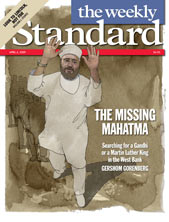
When the long sought solution to the Israeli-Palestinian conflict is being trumpeted from the cover of The Weekly Standard there’s every reason to scoff. Middle East peace has thus far not appeared high up on the neoconservative agenda and I really doubt that Bill Kristol and his cronies suddenly had some extraordinary change of heart.

What’s sad is that Gershom Gorenberg, who is clearly a man of integrity, chose to lend his support to the Israel apologists who happily massage their consciences by pretending that Palestinian violence is the one insurmountable obstacle to ending the conflict.

In a celebration of Israeli impotence we are presented with a mirage of peace in the form of an unfound Palestinian Mahatma. If only a Palestinian Gandhi emerged, anything would be possible.

It’s not that the appeal of a saintly leader of a non-violent resistance movement is lost on me, but the parallels between British India and Israel are beyond tenuous.

Gandhi’s resistance to British rule galvanized the support of a massive population governed by a tiny colonial elite who never had the pretense that Britain was reclaiming a long-lost homeland. To the British, India was a land brimming with resources that could be shipped back to the actual homeland and traded for handsome profits. By the end of World War Two, Britain was bankrupt and in a rush to free itself of what had become its colonial burdens. With or without a gentle shove from the Mahatma, the sun had already set on the British Empire.

As for Gandhi’s nominal success in non-violently waving goodbye to colonial rule, we should not forget that it was accompanied by the horrific failure of partition and a bloodbath in which as many as a million people died.

Another model of non-violent leadership that Gorenberg could have considered is that of the Dalai Lama.

After fifty years of principled resistance to Chinese rule, Tibetans are still no closer to winning autonomy. Thus far, the majority of the Dalai Lama’s followers remain loyal to the religious values that he practices and advocates, yet many are starting to wonder whether it is their pacifism that enables China to retain its firm grip on Tibet.

Of course the most obvious model of political leadership that Gorenberg should have mentioned is that of Nelson Mandela.

The problem is — at least from Gorenberg and The Weekly Standard‘s point of view — Mandela resolutely refused to renounce armed resistance. Apartheid didn’t end because its opponents adopted a spiritually enlightened non-violent perspective. It ended because white South Africans were forced to recognize they were clinging on to a politically unsustainable system.

Israelis still cling on to a politically unsustainable situation, but unlike white South Africans, they are still able to hold on to a security blanket stitched together by American military and economic aid and political protection.

President Obama might say that for Palestinians and Israelis “the status quo is unsustainable”, but unless the US takes away the security blanket, Israel will remain in its manipulatively infantile condition: vacillating between a manicured helplessness that occasionally gets punctuated by a violent tantrum.

Must Israel and its friends wait in frustration for an elusive Palestinian Mahatma or instead might an earnest search for an Israeli FW de Klerk be long overdue?

Facebooktwittermail

Is it too late for peace?

The fierce urgency of peace

Pressure on President Obama to recast the failed American approach to Israel-Palestine is building from former senior officials whose counsel he respects.

Following up on a letter dated Nov. 6, 2008, that was handed to Obama late last year by Paul Volcker, now a senior economic adviser to the president, these foreign policy mandarins have concluded a “Bipartisan Statement on U.S. Middle East Peacemaking” [PDF] that should become an essential template.

Deploring “seven years of absenteeism” under the Bush administration, they call for intense American mediation in pursuit of a two-state solution, “a more pragmatic approach toward Hamas,” and eventual U.S. leadership of a multinational force to police transitional security between Israel and Palestine. [continued…]

Israel’s step back from peace

Emphasizing diplomacy and engagement over isolation and confrontation, President Obama has spoken eloquently of a new era of American leadership. Of the changes he has promised, the most important to Palestinians is his commitment to reinvigorating the Middle East peace process.

Resolving the Palestinian-Israeli conflict remains crucial to achieving stability and peace in the Middle East as well as to advancing vital U.S. interests. The Obama administration clearly understands this, prioritizing the peace process as part of a more integrated approach to U.S. policy in the region. America’s renewed commitment to brokering a just and lasting peace between Palestinians and Israelis offers a measure of hope to Palestinians living under the weight of occupation. But it also comes at a time when Israel’s own commitment to peace is in doubt after the formation of a right-wing coalition government.

Peace is not a word that sits comfortably with the Israeli right, which will dominate Israel’s new government, even with Labor’s decision this week to join it. Among its ranks are those who have long opposed peace with Palestinians, no matter the cost; who use the cover of religion to advocate extremist views; and who have supported the expulsion of Palestinians or now devise loyalty tests designed to achieve the same result. [continued…]

A tax break fuels Middle East friction

For many years, the United States has had a policy against spending aid money to fund Israeli settlements in the West Bank, which successive administrations have regarded as an obstacle to peace. Yet private organizations in the United States continue to raise tax-exempt contributions for the very activities that the government opposes.

There’s nothing illegal about the charitable contributions to pro-settlement organizations, which are documented in filings with the Internal Revenue Service. They’re similar to tax-exempt donations made to thousands of foreign organizations around the world through groups that are often described as “American friends of” the recipient.

But critics of Israeli settlements question why American taxpayers are supporting indirectly, through the exempt contributions, a process that the government condemns. A search of IRS records identified 28 U.S. charitable groups that made a total of $33.4 million in tax-exempt contributions to settlements and related organizations between 2004 and 2007. [continued…]

Facebooktwittermail

Re-dismantling the terrorist infrastructure again

White House debate led to plan to widen Afghan effort

President Obama’s plan to widen United States involvement in Afghanistan came after an internal debate in which Vice President Joseph R. Biden Jr. warned against getting into a political and military quagmire, while military advisers argued that the Afghanistan war effort could be imperiled without even more troops.

All of the president’s advisers agreed that the primary goal in the region should be narrow — taking aim at Al Qaeda, as opposed to the vast attempt at nation-building the Bush administration had sought in Iraq. The question was how to get there. [continued…]

Obama outlines Afghan strategy

President Obama introduced his new strategy for Afghanistan and Pakistan yesterday with a threat assessment familiar from the Bush administration. “The terrorists who planned and supported the 9/11 attacks,” he said, are continuing to devise plots designed to “kill as many of our people as they possibly can.”

Elements of the Obama plan to “disrupt, dismantle and defeat” al-Qaeda in Pakistan and vanquish its Taliban allies in Afghanistan also struck notes from the past. More U.S. troops, civilian officials and money will be needed, he said. Allies will be asked for additional help, and local forces will be trained to eventually take over the fight. Benchmarks will be set to measure progress. [continued…]

Editor’s Comment — By basing a war strategy on the objective of disrupting, dismantling and defeating al Qaeda, Obama is resting on solid political ground.

The question that everyone resolutely refuses to address is this: where’s the evidence that al Qaeda’s capacity to operate is bound together with its ability to maintain some sort of infrastructure in north western Pakistan? Why should we not assume that if another 9/11 type attack is being planned that it may well emanate from a location far removed from al Qaeda’s historical base? In terms of the threat of attacks on the US, what’s happening in some discreet enclave in Karachi or Manila or Melbourne or Toronto or London or even New York may matter much more than the tribal territories.

At the same time, what happens to Pakistan and Afghanistan will certainly be affected by the extent to which the West provides jihadists, insurgents and tribal fighters the foundation for coming together to combat a common enemy.

Pakistan and Afghan Taliban close ranks

After agreeing to bury their differences and unite forces, Taliban leaders based in Pakistan have closed ranks with their Afghan comrades to ready a new offensive in Afghanistan as the United States prepares to send 17,000 more troops there this year.

In interviews, several Taliban fighters based in the border region said preparations for the anticipated influx of American troops were already being made. A number of new, younger commanders have been preparing to step up a campaign of roadside bombings and suicide attacks to greet the Americans, the fighters said.

The refortified alliance was forged after the reclusive Afghan Taliban leader, Mullah Muhammad Omar, sent emissaries to persuade Pakistani Taliban leaders to join forces and turn their attention to Afghanistan, Pakistani officials and Taliban members said. [continued…]

Afghan strikes by Taliban get Pakistan help, U.S. aides say

The Taliban’s widening campaign in southern Afghanistan is made possible in part by direct support from operatives in Pakistan’s military intelligence agency, despite Pakistani government promises to sever ties to militant groups fighting in Afghanistan, according to American government officials.

The support consists of money, military supplies and strategic planning guidance to Taliban commanders who are gearing up to confront the international force in Afghanistan that will soon include some 17,000 American reinforcements.

Support for the Taliban, as well as other militant groups, is coordinated by operatives inside the shadowy S Wing of Pakistan’s spy service, the Directorate for Inter-Services Intelligence, the officials said. There is even evidence that ISI operatives meet regularly with Taliban commanders to discuss whether to intensify or scale back violence before the Afghan elections. [continued…]

White House won’t rule out troops for Pakistan war

President Obama has just laid out his new war strategy. And he’s made it clear that the fight is both in Afghanistan and Pakistan. So I asked Dennis McDonough, with the National Security Council: Does that mean U.S. ground forces in Pakistan? Or more drone attacks? “I’m not going to comment on the notions you laid out there,” he answered, during a White House conference call with bloggers.

But during a separate press conference, Bruce Reidel, who recently completed a strategy review of the region for the White House, offered some hints. “Thus far, our policy sees Afghanistan and Pakistan as two countries, but one theater of operations for our diplomacy, and one challenge for our overall policy,” he said. “We have very concrete proposals for increasing economic assistance to Pakistan, proposals that have already been put forward by the Congress. We’re also looking at what we can do on the military side.” [continued…]

Bomber strikes in Pakistani mosque, killing dozens during prayers

A suicide bomber attacked a crowded mosque in northwest Pakistan on Friday, setting off explosives as a cleric intoned the holy prayers, bringing the roof crashing down and killing scores of people in what was the bloodiest attack this year.

The attack was unleashed in an area where there has been intense activity by Pakistani security forces aimed at protecting the critical Khyber Pass supply route for American forces in Afghanistan. Occurring only hours before President Obama unveiled a new strategy against militants in Afghanistan and Pakistan, it raised questions about Pakistan’s ability to counter the threat from Al Qaeda and the Taliban. [continued…]

The Accidental Guerrilla: Fighting Small Wars in the Midst of a Big One by David Kilcullen

An American patrol ambushed by the Taliban in Uruzgan province on May 19, 2006 found its foes growing in number as the firefight continued. Local farmers working in nearby fields rushed home to get their weapons and join in. In Afghanistan, young men like doing that sort of thing.

The episode exemplifies David Kilcullen’s thesis: that many Muslims who take up arms against the West in Iraq, Afghanistan and indeed Europe are not committed ideologues. Instead, they are young men alienated variously by foreign intrusion, corrupt government, local factionalism and grievances, bitterness about globalisation; or simply enthused by a belief in the dignity of combat.

At the heart of this significant book is the author’s declaration that terrorism cannot be addressed by military means alone; that for American or British soldiers merely to kill insurgents is meaningless. He urges policies based upon securing and succouring populations, not on enemy body counts. [continued…]

A conversation with David Kilcullen

Pakistan is 173 million people, 100 nuclear weapons, an army bigger than the U.S. Army, and al-Qaeda headquarters sitting right there in the two-thirds of the country that the government doesn’t control. The Pakistani military and police and intelligence service don’t follow the civilian government; they are essentially a rogue state within a state. We’re now reaching the point where within one to six months we could see the collapse of the Pakistani state, also because of the global financial crisis, which just exacerbates all these problems. . . . The collapse of Pakistan, al-Qaeda acquiring nuclear weapons, an extremist takeover — that would dwarf everything we’ve seen in the war on terror today. [continued…]

Facebooktwittermail

Britain’s police state

Police identify 200 children as potential terrorists

Two hundred schoolchildren in Britain, some as young as 13, have been identified as potential terrorists by a police scheme that aims to spot youngsters who are “vulnerable” to Islamic radicalisation.

The number was revealed to The Independent by Sir Norman Bettison, the chief constable of West Yorkshire Police and Britain’s most senior officer in charge of terror prevention.

He said the “Channel project” had intervened in the cases of at least 200 children who were thought to be at risk of extremism, since it began 18 months ago. The number has leapt from 10 children identified by June 2008. [continued…]

London cops reach new heights of anti-terror poster stupidity

The London police have bested their own impressive record for insane and stupid anti-terrorism posters with a new range of signs advising Londoners to go through each others’ trash-bins looking for “suspicious” chemical bottles, and to report on one another for “studying CCTV cameras.”

It’s hard to imagine a worse, more socially corrosive campaign. Telling people to rummage in one another’s trash and report on anything they don’t understand is a recipe for flooding the police with bad reports from ignorant people who end up bringing down anti-terror cops on their neighbors who keep tropical fish, paint in oils, are amateur chemists, or who just do something outside of the narrow experience of the least adventurous person on their street. Essentially, this redefines “suspicious” as anything outside of the direct experience of the most frightened, ignorant and foolish people in any neighborhood. [continued…]

Facebooktwittermail

GUEST CONTRIBUTOR – John Robertson: Obama’s outreach and the hierarchy of ‘enlightened nations’

Obama’s outreach and the hierarchy of ‘enlightened nations’

John Mearsheimer (of the University of Chicago, and co-author with Stephen Walt of the much-touted/much-reviled The Israel Lobby) has an important essay in the latest London Review of Books, in which he argues (as has Walt) that the Charles Freeman affair has exposed the Israel Lobby and created some new space for public debate about its excessive and harmful impact on the making of US foreign policy. Continue reading

Facebooktwittermail

Israel’s cloak of democracy is falling away

An Israeli foreign minister who won’t wear velvet gloves

Lieberman is not a passing phenomenon. He represents the integration into Israeli politics of the million immigrants from the former Soviet Union. These new immigrants have displaced the old Labour party, once the elite of the country and the so-called party of peace. In every Labour voter there was a sepia-tinted memory of a kibbutznik taking his horse to be shod in an Arab village. If this fantasy of Jewish-Arab co-operation was ever true, it stopped being so in the 1920s. But the Labour party has always felt that somehow the Arabs can be forced to love, or just get along with, Zionism – a viewpoint which used to sell easily in Europe and the US, even if it never corresponded with facts on the ground. Continue reading

Facebooktwittermail

Israel’s moral autocracy

After Gaza, Israel grapples with crisis of isolation

Israel, whose founding idea was branded as racism by the United Nations General Assembly in 1975 and which faced an Arab boycott for decades, is no stranger to isolation. But in the weeks since its Gaza war, and as it prepares to inaugurate a hawkish right-wing government, it is facing its worst diplomatic crisis in two decades. Continue reading

Facebooktwittermail

EDITORIAL: The Israel lobby gets pumped up with blood lust

The Israel lobby gets pumped up with blood lust

The first line of defense has come crashing down.

Denying the existence of the Israel lobby is like saying there’s no such thing as global warming.

But just as global warming deniers later decided to reposition themselves by acknowledging its reality while suggesting it was harmless, those who now reluctantly concede that the lobby exists want to insist that it is benign and not particularly powerful. They charge that far more dangerous than the lobby are its critics: a fanatic bunch of slanderers who stand at the vanguard of a global wave of anti-Semiticism.

Even so, the lobby that preferred to hide in the shadows has now broken cover and while intoxicated with victory wants to bring down another quarry.

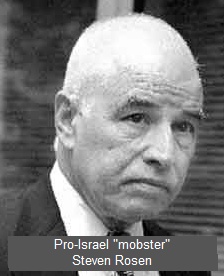
In a victory message (revealed by Mondoweiss), Daniel Pipes, director of the Middle East Forum, heralded Steven Rosen’s “achievement” after having got “the word out” — mobilized the lobby. Pipes applauded Rosen because, “Only someone with Steve’s stature and credibility could have made this happen.” There was a campaign and in three weeks it accomplished its goal: Chas Freeman bowed out.

But even now, the editors of the Washington Post want to try and sustain the charade that there is no lobby and denounce those of us who think otherwise:

Mr. Freeman issued a two-page screed on Tuesday in which he described himself as the victim of a shadowy and sinister “Lobby” whose “tactics plumb the depths of dishonor and indecency” and which is “intent on enforcing adherence to the policies of a foreign government.” Yes, Mr. Freeman was referring to Americans who support Israel — and his statement was a grotesque libel.

For the record, the American Israel Public Affairs Committee says that it took no formal position on Mr. Freeman’s appointment and undertook no lobbying against him. If there was a campaign, its leaders didn’t bother to contact the Post editorial board.

If the Post’s editorial board was truly outside the loop here it probably says less about the vigor of the campaign and more about the diminishing influence of their editorial page. It’s role is now that of being granted the final word — one that can then be applauded by its bloodthirsty allies like Marty Peretz: “With cool and stiletto words, the Post has put this man in the bin.”

(That’s an interesting choice of imagery and reinforces what I suggested yesterday: that it would in many ways be more fitting if we talked about the Israel mob instead of the lobby. Be that as it may, the language has now solidified in popular usage and Israel lobby it is. All that remains to be contested is whether it should be lobby or Lobby. I’m sticking with the small “l” since I think this is an entity held together with much stronger ideological than organizational glue.)

As for the Post’s assertion that AIPAC played no part, that might be its official position though Dan Fleshler says the organization didn’t just sit back and watch:

Very reliable sources inform me that Josh Block, an AIPAC spokesperson, contacted bloggers and journalists expressing concern about Freeman. That is probably what Freeman referred to when he mentioned “easily traceable e-mails” in the announcement that he was giving up the fight. Trust me on this one. I had to think twice about writing it because I want Block, who is generally very nice to critical journalists at the AIPAC Policy Conferences, to be nice to me. There is no way I would have written it unless it were manifestly true, and important.

Even it were not true, it is simply inconceivable that Mark Kirk, Charles Schumer and other Congressfolk who publicly objected to Freeman would have done so without the encouragement – or winks and nods – of AIPAC. The Hill is where it lives and breathes, and nothing this important could have been orchestrated without its blessing.

Walter Pincus adds:

Only a few Jewish organizations came out publicly against Freeman’s appointment, but a handful of pro-Israeli bloggers and employees of other organizations worked behind the scenes to raise concerns with members of Congress, their staffs and the media.

For example, the American Israel Public Affairs Committee (AIPAC), often described as the most influential pro-Israel lobbying group in Washington, “took no position on this matter and did not lobby the Hill on it,” spokesman Josh Block said.

But Block responded to reporters’ questions and provided critical material about Freeman, albeit always on background, meaning his comments could not be attributed to him, according to three journalists who spoke to him. Asked about this yesterday, Block replied: “As is the case with many, many issues every day, when there is general media interest in a subject, I often provide publicly available information to journalists on background.”

Yesterday, the Jewish Institute for National Security Affairs, which tried to derail Freeman’s appointment, applauded his withdrawal. But it added: “We think Israel and any presumed ‘lobby’ had far less effect on the outcome than the common-sensical belief that the person who is the gatekeeper of intelligence information for the President of the United States should be unencumbered by payments from foreign governments.”

The suggestion that neither Freeman’s views on Israel nor the efforts of the Israel lobby were central is however quite easy to refute by engaging in a simple line of conjecture.

Consider the blog post through which Steven Rosen “got the word out”:

Readers of this blog know that I have been generally quite positive about the appointments the new Adminsitration is making for Middle East policy positions. Today’s news is quite different. According to Laura Rozen at the Foreign Policy blog, Chas W. Freeman, Jr., the former U.S. ambassador to Saudi Arabia, will become chairman of the National Intelligence Council, and may at times participate in daily intelligence briefings to President Obama. This is a profoundly disturbing appointment, if the report is correct. Freeman is a strident critic of Israel, and a textbook case of the old-line Arabism that afflicted American diplomacy at the time the state of Israel was born. His views of the region are what you would expect in the Saudi foreign ministry, with which he maintains an extremely close relationship, not the top CIA position for analytic products going to the President of the United States.

Here is a sample of his views on Israel, from his Remarks to the National Council on US-Arab Relations on September 12, 2005: “As long as the United States continues unconditionally to provide the subsidies and political protection that make the Israeli occupation and the high-handed and self-defeating policies it engenders possible, there is little, if any, reason to hope that anything resembling the former peace process can be resurrected. Israeli occupation and settlement of Arab lands is inherently violent. …And as long as such Israeli violence against Palestinians continues, it is utterly unrealistic to expect that Palestinians will stand down from violent resistance and retaliation against Israelis. Mr. Sharon is far from a stupid man; he understands this. So, when he sets the complete absence of Palestinian violence as a precondition for implementing the road map or any other negotiating process, he is deliberately setting a precondition he knows can never be met.”

Here is another example from 2008: “We have reflexively supported the efforts of a series of right-wing Israeli governments to undo the Oslo accords and to pacify the Palestinians rather than make peace with them. … The so-called “two-state solution” – is widely seen in the region as too late and too little. Too late, because so much land has been colonized by Israel that there is not enough left for a viable Palestinian state alongside Israel; too little, because what is on offer looks to Palestinians more like an Indian reservation than a country.”

According to Foreign policy blog, Freeman has told associates that in the job, he will occasionally accompany Director of National Intelligence Adm. Dennis Blair to give the president his daily intelligence briefing. His predecessor, Thomas Fingar, wore a second hat as deputy director of national intelligence for analysis.

Now subtract the parts relating to Israel. You’re left with this:

Readers of this blog know that I have been generally quite positive about the appointments the new Adminsitration is making for Middle East policy positions. Today’s news is quite different. According to Laura Rozen at the Foreign Policy blog, Chas W. Freeman, Jr., the former U.S. ambassador to Saudi Arabia, will become chairman of the National Intelligence Council, and may at times participate in daily intelligence briefings to President Obama. This is a profoundly disturbing appointment, if the report is correct. His views of the region are what you would expect in the Saudi foreign ministry, with which he maintains an extremely close relationship, not the top CIA position for analytic products going to the President of the United States.

According to Foreign policy blog, Freeman has told associates that in the job, he will occasionally accompany Director of National Intelligence Adm. Dennis Blair to give the president his daily intelligence briefing. His predecessor, Thomas Fingar, wore a second hat as deputy director of national intelligence for analysis.

Is this the basis of a campaign? I don’t think so.

What now follows?

Fred Kaplan makes an interesting argument:

Chas Freeman is a high-profile figure. He became one by his own design, through public speeches, some of them deliberately provocative. Making him NIC chairman would—unjustly but unavoidably—hurl all intelligence, and all policy based on intelligence, into the fray of fractious politics.

However, this is where Freeman’s foes misplayed their hand. Had they let Freeman step into the job, they could have used him as the whipping boy for all foreign-policy measures they don’t like—especially those involving the Middle East and China—and it might have been easier for them to rally opposition. But now it will be indisputably clear that the president is the one making policy. They’re left with Barack Obama as their target—and one thing that’s clear, so far, is that those who sling mud at Obama wind up hitting themselves.

This might turn out to be true but there are already indications that having successfully thrust a stiletto into Freeman, those who still have blood on their hands now have DNI Blair in their sights.

“It wasn’t until Mr. Freeman withdrew from consideration for the job, however, that it became clear just how bad a selection Director of National Intelligence Dennis C. Blair had made… The real question is why an administration that says it aims to depoliticize U.S. intelligence estimates would have chosen such a man to oversee them,” says the Washington Post.

“Blair revealed his true colors by hiring Freeman. From here on out, every intel product will be treated as suspect. The Obama administration’s attempt to politicize the intelligence process has badly muddied the waters,” wrote Michael Goldfarb in The Weekly Standard.

Did Freeman’s foes misplay their hand, as Fred Kaplan suggests, or are they now one step closer to achieving a much more significant goal: to be able cast doubt on any statement the DNI makes.

Freeman needed to be finished off and put “in the bin.” Blair just needs to be crippled.

Facebooktwittermail

EDITORIAL: The Israel lobby tightens its stranglehold on American politics

The Israel lobby tightens its stranglehold on American politics

Nothing disturbs Washington’s political culture more than uninvited honesty.

Chas Freeman’s eloquent yet blunt explanation of why he has decided not to take up the post of chairman of the National Intelligence Council was described as “intemperate” by the ever-temperate James Fallows and as “a bit too hot, for my taste” by Joe Klein. (Both Klein and Fallows, I should note, were not among Freeman’s critics.)

To those who regard Freeman’s statement as somehow an affront to the decorum that Washington expects I would ask this: Is it better to apply make-up over a festering boil, or is it better to lance it?

Joe Klein, even now unwilling to acknowledge the existence of an “Israel lobby,” insists that Freeman was the victim of an attack by a mob — a largely Jewish neoconservative mob — but not a lobby. That strikes me as merely a semantic quibble. If Israel “lobby” sounds too dignified, I have no problem with calling it the “Israel mob” — it is indeed a kind of political mafia.

But however anyone wants to characterize or label the Israel lobby, no one can dispute that it is tenacious. Freeman’s assessment that were he to take up the intelligence position he would remain “under constant attack” is most likely accurate. His choice to remain in private life is understandable. If anything constructive is to come out of this episode — and I think it can — it is that the workings of the Israel lobby are now more transparent than ever.

The campaign against Freeman was led by the indicted former director of AIPAC, Steven Rosen. While the victory champagne was no doubt still flowing, the editors of the Washington Post saw fit — with amazing timing — to add their own toast by calling on the Attorney General to drop the case against Rosen in which he has been charged under the Espionage Act. The Post argues:

The government has the right to demand strict confidentiality from government officials and others who swear to protect its secrets. The Justice Department errs egregiously and risks profound damage to the First Amendment, however, when it insists that private citizens — academics, journalists, think tank analysts, lobbyists and the like — also are legally bound to keep the nation’s secrets. The prosecution in effect criminalizes the exchange of information.

I’m no legal expert, but it would seem that the case hinges not on whether individuals outside government can legally be the recipients of classified information. Rather, the case would seem to rest on a determination of AIPAC’s actual nature.

Even if it is not registered as an agent of a foreign government, if AIPAC can be demonstrated to have been functioning as such, then as an AIPAC official, Rosen could presumably be shown to have been acting on behalf of the Israeli government.

As Douglas M. Bloomfield, a former legislative director and chief lobbyist for AIPAC, writes: “The American Israel Public Affairs Committee and its leaders could be the biggest losers in a case that threatens to expose the group’s inner secrets.”

He continues:

Although AIPAC claims it has nothing to do with the convoluted case, it is also on trial, in a way. The organization fired the pair [Steven Rosen and Keith Weissman] and said they were rogues acting beneath the group’s standards. That will be shot full of holes from all directions in court, whether in the criminal case or in a likely civil suit by the defendants claiming damage to their reputations and careers.

The mere threat of a multimillion-dollar civil suit could prompt a very generous settlement offer from AIPAC in exchange for a vow of silence from the former staffers. But don’t worry; AIPAC can easily afford it.

Soon after the FBI raided AIPAC offices, the organization launched a fund-raising campaign to defend against any charges, and the appeals for money didn’t stop when it fired the pair. Since the scandal broke in 2004, AIPAC’s fund-raising juggernaut has hauled in so much dough that one senior staffer told me that “it’s coming in faster than we know what to do with it.”

JTA quoted tax records showing AIPAC raised $86 million in 2007, doubling 2003’s $43 million. Not all of that money was a result of the espionage case, but many millions were.

In cutting loose the pair, AIPAC insisted it had no idea what they were doing. Not so, say insiders, former colleagues, sources close to the defense, and others familiar with the organization.

One of the topics AIPAC won’t want discussed, say these sources, is how closely it coordinated with Benjamin Netanyahu in the 1990s, when he led the Israeli Likud opposition and later when he was prime minister, to impede the Oslo peace process being pressed by President Bill Clinton and Israeli Prime Ministers Yitzhak Rabin and Shimon Peres.

That could not only validate AIPAC’s critics, who accuse it of being a branch of the Likud, but also lead to an investigation of violations of the Foreign Agents Registration Act.

Clearly, nothing worries AIPAC and its supporters more than the possibility that the organization — and by extension the Israel lobby as a political force — might face wider public scrutiny.

The campaign against Chas Freeman was not driven by an exaggerated estimation of his importance; it was a strategic battle in defense of the lobby’s deeply entrenched political authority. The importance of the fight was evident by the fact that it was fought in the open. But having come right out into the open, it is now that much more difficult for the lobby to retreat into the shadows.

And as Steven Rosen once wrote in an AIPAC internal memo: “A lobby is like a night flower. It thrives in the dark and dies in the sun.”

Facebooktwittermail

A statement by Chas Freeman

The tactics of the Israel Lobby plumb the depths of dishonor and indecency

To all who supported me or gave me words of encouragement during the controversy of the past two weeks, you have my gratitude and respect.

You will by now have seen the statement by Director of National Intelligence Dennis Blair reporting that I have withdrawn my previous acceptance of his invitation to chair the National Intelligence Council.

I have concluded that the barrage of libelous distortions of my record would not cease upon my entry into office. The effort to smear me and to destroy my credibility would instead continue. I do not believe the National Intelligence Council could function effectively while its chair was under constant attack by unscrupulous people with a passionate attachment to the views of a political faction in a foreign country. I agreed to chair the NIC to strengthen it and protect it against politicization, not to introduce it to efforts by a special interest group to assert control over it through a protracted political campaign.

As those who know me are well aware, I have greatly enjoyed life since retiring from government. Nothing was further from my mind than a return to public service. When Admiral Blair asked me to chair the NIC I responded that I understood he was “asking me to give my freedom of speech, my leisure, the greater part of my income, subject myself to the mental colonoscopy of a polygraph, and resume a daily commute to a job with long working hours and a daily ration of political abuse.” I added that I wondered “whether there wasn’t some sort of downside to this offer.” I was mindful that no one is indispensable; I am not an exception. It took weeks of reflection for me to conclude that, given the unprecedentedly challenging circumstances in which our country now finds itself abroad and at home, I had no choice but accept the call to return to public service. I thereupon resigned from all positions that I had held and all activities in which I was engaged. I now look forward to returning to private life, freed of all previous obligations.

I am not so immodest as to believe that this controversy was about me rather than issues of public policy. These issues had little to do with the NIC and were not at the heart of what I hoped to contribute to the quality of analysis available to President Obama and his administration. Still, I am saddened by what the controversy and the manner in which the public vitriol of those who devoted themselves to sustaining it have revealed about the state of our civil society. It is apparent that we Americans cannot any longer conduct a serious public discussion or exercise independent judgment about matters of great importance to our country as well as to our allies and friends.

The libels on me and their easily traceable email trails show conclusively that there is a powerful lobby determined to prevent any view other than its own from being aired, still less to factor in American understanding of trends and events in the Middle East. The tactics of the Israel Lobby plumb the depths of dishonor and indecency and include character assassination, selective misquotation, the willful distortion of the record, the fabrication of falsehoods, and an utter disregard for the truth. The aim of this Lobby is control of the policy process through the exercise of a veto over the appointment of people who dispute the wisdom of its views, the substitution of political correctness for analysis, and the exclusion of any and all options for decision by Americans and our government other than those that it favors.

There is a special irony in having been accused of improper regard for the opinions of foreign governments and societies by a group so clearly intent on enforcing adherence to the policies of a foreign government – in this case, the government of Israel. I believe that the inability of the American public to discuss, or the government to consider, any option for US policies in the Middle East opposed by the ruling faction in Israeli politics has allowed that faction to adopt and sustain policies that ultimately threaten the existence of the state of Israel. It is not permitted for anyone in the United States to say so. This is not just a tragedy for Israelis and their neighbors in the Middle East; it is doing widening damage to the national security of the United States.

The outrageous agitation that followed the leak of my pending appointment will be seen by many to raise serious questions about whether the Obama administration will be able to make its own decisions about the Middle East and related issues. I regret that my willingness to serve the new administration has ended by casting doubt on its ability to consider, let alone decide what policies might best serve the interests of the United States rather than those of a Lobby intent on enforcing the will and interests of a foreign government.

In the court of public opinion, unlike a court of law, one is guilty until proven innocent. The speeches from which quotations have been lifted from their context are available for anyone interested in the truth to read. The injustice of the accusations made against me has been obvious to those with open minds. Those who have sought to impugn my character are uninterested in any rebuttal that I or anyone else might make.

Still, for the record: I have never sought to be paid or accepted payment from any foreign government, including Saudi Arabia or China, for any service, nor have I ever spoken on behalf of a foreign government, its interests, or its policies. I have never lobbied any branch of our government for any cause, foreign or domestic. I am my own man, no one else’s, and with my return to private life, I will once again – to my pleasure – serve no master other than myself. I will continue to speak out as I choose on issues of concern to me and other Americans.

I retain my respect and confidence in President Obama and DNI Blair. Our country now faces terrible challenges abroad as well as at home. Like all patriotic Americans, I continue to pray that our president can successfully lead us in surmounting them.

Facebooktwittermail

On Chas Freeman’s decision to step aside

No time to comment on this at greater length until tomorrow, but Ambassador Freeman’s decision to step aside is sad but not surprising. He had accepted an intelligence position; not an invitation to get crucified by the Israel lobby. Indeed, as a realist his decision to bow out seems to reflect an understanding of the lobby’s actual power and that his appointment would be unlikely to be a decisive factor in reigning in a force that clearly retains a stranglehold on Washington.

The last two weeks have really served to showcase the lobby in action. Those who have long claimed that the lobby’s power gets overstated, now have very little ground to stand on.

Israel-first neo-McCarthyism still rules the US government, Congress and the US media. While the power holders may take comfort that they succeeded in winning this battle, they should also know that now more than ever they are viewed with disgust by Americans whose numbers are swelling even if their voices struggle to be heard.
Paul Woodward

Facebooktwittermail

IT’S THE ISRAEL LOBBY, STUPID!

Who’s behind the war on Obama’s intelligence pick

The effort to dislodge Freeman still has the potential to impact the Obama administration’s policies towards Israel, however discredited its architect [indicted former AIPAC director, Steven Rosen] may be. This is, of course, the underlying objective of many of Freeman’s critics. “Freeman is stuck in the latest instance of the deadly power game long played here on what level of support for controversial Israeli government policies is a ‘requirement’ for US public office…” foreign policy analyst Chris Nelson wrote in his Nelson Report, an influential private daily newsletter read by Washington policy makers. “If Obama surrenders to the critics and orders [Director of National Intelligence Dennis Blair] to rescind the Freeman appointment to chair the NIC, it is difficult to see how he can properly exercise leverage, when needed, in his conduct of policy in the Middle East. That, literally, is how the experts see the stakes of the fight now underway.” Continue reading

Facebooktwittermail

VIVA PALESTINA!

Viva Palestina shows the power of the people

While governments have repeatedly demonstrated their indifference, incompetence, and apparent impotence when it comes to responding to the plight of the population in Gaza, a bunch of ordinary folk under the banner “Viva Palestina” have shown what amazing things can be accomplished, when goodwill, imagination, daring and tenacity come together.

Viva Palestina — a lifeline from Britain to Gaza — shows the power of the people.

In Sharm el-Sheikh a week ago, world leaders delivered empty promises. Today, Viva Palestina delivered the goods!

Marwa Awad and Muhammed Eta from Al Arabiya tell the story:

Crossing continents, covering thousands of miles and opening borders long closed are just a few of the feats an emergency relief convoy trekking from London to Gaza made over the past three weeks before arriving at Egypt’s Rafah border Sunday to break a crippling siege and deliver much needed aid to Palestinians in Gaza.

Viva Palestina, a British relief convoy headed by British Parliamentarian George Galloway and planned by hundreds of British volunteers, rolled into Rafah to deliver aid to thousands of destitute Palestinians in Gaza after crossing a 8000-kilometre route from London through France, Spain, Morocco, Algeria, Tunisia, Libya, and finally entering Egypt through the Libyan Egyptian border on Thursday after which the convoy drove along the coast to reach the city of al-Arish, 40 km away from Rafah.

“A lifeline from Britain to Gaza,” is the motto of Viva Palestina, which started out with 110 trucks from London but was doubled in Libya after the Gaddafi Foundation for Charity and Development donated 100 trucks laden with aid.

The convoy, which was over 1.8 miles long when it rolled into Egypt through the Sallum border between Libya and Egypt Thursday, was camped at the city of al-Arish and will enter Gaza through the Rafah border Monday after several border negotiations between Galloway and the Egyptian authorities in Rafah on Sunday.

“It’s a caravan of 500 kind hearts,” Talat Ali Shah, convoy group leader told AlArabiya.net. “The convoy was received by a jubilant crowd, ready to help and encourage us on,” he added. The convoy set out on Feb. 14 from London.

The convoy included a British fire engine, 12 ambulances, and many trucks full of medicine, food, clothes and toys for children, given by the various communities in Britain and the Gaddafi Foundation.

“Gifts from all over the world”

George Galloway, who is a peace advocate and staunch supporter of the Palestinian cause, organized the convoy in response to the humanitarian crisis Israel unleashed on Gaza for 22-days that left the impoverished Strip in ruins while killing 1300 and wounding 5000.

Galloway a “friend of the Arabs”

The Egyptian government’s ruling National Democratic Party in charge of the convoy’s passage through the Egyptian borders expressed gratitude for Galloway’s efforts.

“We know the value of Galloway as a peace advocate and we welcome him as a known friend of the Arabs,” Ali al-Din al-Hilal from the NDP told AlArabiya.net.

Likewise, Galloway thanked the Egyptian government for facilitating the convoy’s safe passage, acknowledging Egypt’s commitment to the Palestinian cause.

“The warm welcome of the people here and their concern for Palestine is overwhelming. Egypt has given so much for Palestine over the last 60 years. Many soldiers have died for Palestine and we acknowledge this commitment,” Galloway said at the press conference.

He added that Viva Palestina is a message to the world that Britain is “not the enemy of the Muslims,” and that while Tony Blair does not represent the people of Britain, Viva Palestina does.

“From Ireland to Gaza”

“In the past 35 years I have entered Palestine many times but I was never as happy as I am this time,” Galloway said in a press conference upon arrival.

Politics of the convoy’s passage

After negotiations with the Egyptian border authorities, aid brought by the Viva Palestina convoy will be split into medical and non-medical category.
While trucks carrying medical aid are to enter through the Rafah border, the rest of the non-medical goods is to enter from Awja, a border crossing controlled by Israel and lies 43 miles away from Rafah.

“The convoy goods will split in order to allow medical aid through Rafah border and the rest will pass through Awja,” General Muhammed Shusha, governor of north Sinai, told AlArabiya.net.

However, all Viva Palestina convoy members including leaders Galloway and Sabbah al-Mokhtar will enter Gaza through the Egyptian border with Gaza.

“Under no circumstance will members of Viva Palestina convoy coordinate with Israel,” Mokhtar told AlArabiya.net. “We shall all gain safe passage into Gaza from the Egyptian/Gaza border tomorrow as agreed upon with the Egyptian border authorities,” he said.

The Egyptian Red Crescent and other U.N. relief organizations such as the World Health Organization and Oxfam will be responsible for transferring non-medical goods through Awja border.

Egyptian border designate the Rafah border for medical aid supplies while all other types of aid enter Gaza through the Awja broder which Israel overlooks.

Yvonne Ridley, award winning journalist who accompanied the convoy, reported that Israel pressured Egypt to divert the convoy to go through Israeli borders.

“Israel is putting huge pressure on Egypt to force the convoy which is now doubled in size, a British-Libyan venture, through Israeli territory,” she said at the conference.

Expectations that the massive Viva Palestina aid convoy will roll in full through the Rafah border continue despite Israel’s diplomatic pressure to force the non-medical part of the convoy to drive through the Israeli controlled Egyptian border of Awja, a route George Galloway and the convoy say is not an option.

Despite these challenges, the convoy has kept its spirits high in anticipation of relieving the hardships of thousands of Palestinians.

“Gaza has broken into many British homes and has touched many British hearts,” Hussein said. “Our experience in this journey of hope makes us feel that we are the luckiest people. Bur our happiness will be complete, when we cross into Gaza and console the children, men and women who have suffered for so long.”

A message of hope from the “streets of Britain”

Bringing together volunteers from different ethnicities and religions, Viva Palestina hopes to bring aid to 1.5 million residents in Gaza who still subsist under a 19-month crippling siege Israel refuses to ease almost one month after its all-out assault.

“The material we are carrying is only a drop in the ocean but the goodwill of volunteers and the people from the countries we have passed through is tremendous,” Mokhtar, one of the leading members of Viva Palestina involved in negotiations with border officials, told AlArabiya.net.

“This convoy is extremely diverse consisting of men, women, Muslims and non Muslims from across England,” he added.

“We truly care and we’ve driven across continents to prove it,” is the message 500 ordinary volunteers plan to deliver to Gazans, according to the Viva Palestina website.

“This is a movement of the streets,” Galloway told AlArabiya.net.

Such a movement wrought unexpected results as Algeria and Morocco opened the border between them for the first time in 15 years since 1994— something which Condoleezza Rice failed to do—to allow the convoy through in clear testament to people power outdoing politics.

“It surely signifies the goodness of human nature and the strength of the will of the people that can overtake any odds,” Iftikhar Hussein, 25-year-old high school teacher from Birmingham told AlArabiya.net.

Galloway added that the volunteers are self-funded. “Each person travelling on the convoy is a self-financed British volunteer. The vehicles will be left with the people of Gaza; volunteers will fly home to the U.K. Thousands of pounds cash has been fundraised [for the people of Gaza]”

“They come from different walks of life. With us are doctors, accountants, house wives, and students,” Mokhtar said.

Viva Palestina is supported by the Stop the War Coalition, the Respect the Anglo-Arab Organisation, several British trade unions and a large number of Muslim organisations.

The American media has completely ignored this story and the British press hasn’t done much better. The story only became “newsworthy” when some of the vehicles were pelted with stones and defaced in El-Arish which lies about 40km away from Rafah. Vehicles had also been daubed with anti-Hamas slogans. That’s a shame, but it’s really just a side note in an amazing story that shows the power of the human spirit.

Just a few hours ago, the goal was accomplished: the convoy crossed into Gaza!

Viva Palestina!

Facebooktwittermail

EDITORIAL: Will Obama capitulate to the Israel lobby?

Will Obama capitulate to the Israel lobby?

After Director of National Intelligence Dennis Blair announced the appointment of Chas Freeman as chairman of the National Intelligence Council on February 26, one might have thought that the Israel lobby would be ready to concede defeat. They put up a fight and they lost. They surely have many more battles up ahead. But maybe not. Maybe this is actually the battle royal that will determine whether the lobby can retain its vice grip on Washington’s approach to the Middle East. Freeman may have been appointed, but the fight to unlodge him is far from over.

On Tuesday, Jake Tapper provided a roundup of the ongoing efforts to have Freeman’s appointment reversed:

Today a group of Congressmen, including Rep. Shelley Berkley, D-Nev., and House Minority Leader John Boehner, R-Ohio, wrote to President Obama expressing concern about Freeman. (Read the letter here [PDF].)

“Given his close ties to the Kingdom of Saudi Arabia we request a comprehensive review of Amb. Freeman’s past and current commercial, financial and contractual ties to the Kingdom to ensure no conflict of interest exists in his new position,” the members of Congress wrote. “As you may know, Amb. Freeman most recently served as president of the Middle East Policy Council, a think-tank funded by the Kingdom of Saudi Arabia. The board of directors includes Dr. Fuad Rihani, a consultant to the Saudi Binladin Group — a multinational construction conglomerate and holding company for the assets owned by the bind Laden family.”

Other critics say Freeman is anti-Israel. Rep. Steve Israel, D-NY, recently asked the Inspector General for the Office of the Director of National Intelligence to look into Freeman’s ties to the Saudis, noting that Freeman in 2006 said:

“For the past half decade, Israel has enjoyed carte blanche from the United States to experiment with any policy it favored to stabilize its relations with the Palestinians and its other Arab neighbors, including most recently its efforts to bomb Lebanon into peaceful coexistence with it and to smother Palestinian democracy in its cradle. The suspension of the independent exercise of American judgment about what best serves our interests as well as those of Israelis and Arabs has caused the Arabs to lose confidence in the United States as a peace partner. … left to its own devices, the Israeli establishment will make decisions that harm Israelis, threaten all associated with them, and enrage those who are not … Tragically, despite all the advantages and opportunities Israel has had over the fifty-nine years of its existence, it has failed to achieve concord and reconciliation with anyone in its region, still less to gain their admiration or affection.”

House Minority Whip Eric Cantor, R-Va., has said that “Freeman’s past associations and positions on foreign policy are deeply alarming. His statements about the U.S.-Israel relationship raise serious concerns about his ability to support the Administration’s attempts to bring security, stability and peace to the Middle East. As director of the NIC, Freeman would be in charge of drafting the National Intelligence Estimate and evaluating the strategic outlook of our nation. This selection threatens to politicize the intelligence community. I urge President Obama to reconsider this decision.”…

Perhaps most controversially, under Freeman’s direction, the Middle East Policy Council was the first outlet in the U.S. to publish the working paper of the controversial paper “The Israel Lobby and U.S. Foreign Policy” by University of Chicago Professor John Mearsheimer and Kennedy School of Government at Harvard University Professor Stephen Walt. Many critics suggested the paper was shoddy academically and anti-Semitic, but Freeman was proud MEPC published it.

“No one else in the United States has dared to publish this article, given the political penalties that the Lobby imposes on those who criticize it,” he said.

Every lobby in Washington is engaged in an effort to exert influence — that’s what lobbying means. But the Israel lobby goes much further. It has become used to enjoying the power of an indomitable force and as such it may well regard defeat on the Freeman appointment as being of such symbolic importance that it cannot be accepted. This is now a loyalty test.

The Washington Times now reports:

An independent inspector general will look into the foreign financial ties of Chas W. Freeman Jr., the Obama administration’s pick to serve as chairman of the group that prepares the U.S. intelligence community’s most sensitive assessments, according to three congressional aides.

The director of national intelligence, Dennis C. Blair, last Thursday named Mr. Freeman, a veteran former diplomat, to the chairmanship of the National Intelligence Council, known inside the government as the NIC. In that job, Mr. Freeman will have access to some of America’s most closely guarded secrets and be charged with overseeing the drafting of the consensus view of all 16 intelligence agencies.

His selection was praised by some who noted his articulateness and experience as U.S. ambassador to Saudi Arabia and a senior envoy to China and other nations. But it sparked concerns among some members of Congress from both parties, who asked the Office of the Director of National Intelligence’s inspector general, Edward McGuire, to investigate Mr. Freeman’s potential conflicts of interest.

Mr. Freeman has not submitted the financial disclosure forms required of all candidates for senior public positions, according to the general counsel’s office of the Office of the Director of National Intelligence.

Nor did Mr. Blair seek the White House’s approval before he announced the appointment of Mr. Freeman, said Mr. Blair’s spokeswoman, Wendy Morigi.

“The director did not seek the White House’s approval,” Ms. Morigi said. “In addition to his formal background security investigation, we expect that the White House will undertake the typical vetting associated with senior administration assignments.”

Among the areas likely to be scrutinized in the vetting process are Mr. Freeman’s position on the international advisory board of the China National Offshore Oil Corp. (CNOOC). The Chinese government and other state-owned companies own a majority stake in the concern, which has invested in Sudan and other countries sometimes at odds with the United States, including Iran.

Mr. Freeman is also president of the nonprofit educational organization Middle East Policy Council (MEPC), which paid him $87,000 in 2006, and received at least $1 million from a Saudi prince. He also has chaired Projects International, a consulting firm that has worked with foreign companies and governments.

Lindsay Hamilton, a spokeswoman for Rep. Steve Israel, a Democrat from New York who sits on the House Appropriations Committee’s select intelligence oversight panel that funds the classified budgets for the intelligence community, said her boss had been in touch with Mr. McGuire, who was appointed by the first director of national intelligence, John D. Negroponte.

“Congressman Israel spoke with DNI inspector McGuire. The inspector said he would look into the matter. And the congressman is pleased with his response.” Two other congressional aides also said the inspector general would start his inquiries soon.

Ms. Morigi said only that Mr. McGuire was “reviewing the letter.”

Clearly there is at least one test that Chas Freeman should be expected to be able to pass: is he at the very least no more susceptible to the appearance of conflicts of interest as, let’s say, Hillary Clinton or Dennis Ross. Am I setting the bar too low?

Daniel Luban and Jim Lobe note:

Freeman’s defenders, most of them veterans of the national-security bureaucracy, have strongly rejected charges that he would be beholden to Saudi Arabia or to the Chinese Communist Party and counter that his attackers are practicing a form of McCarthyism against anyone who might question the wisdom of unconditional support for Israel.

“They seek to eliminate from public life all those whom they think are not completely in the control of ‘the lobby,’ write Pat Lang, the former senior Mideast analyst at the Defense Intelligence agency, on his blog. “Charles Freeman is a man awesomely educated, of striking intellect, of vast experience and demonstrated integrity… Who could possibly be better for this job?”

Similarly, David Rothkopf, a former managing director of Kissinger Associates who has written an authoritative work on the history of the National Security Council, charged in his blog on the “Foreign Policy” website that “there is something ugly to these attacks on Freeman… The notion… that there is no room in the U.S. government for people who are skeptical of Israeli policies or for people who are not in lockstep with one view of, say, Saudi Arabia, is both absurd and dangerous.”

His defenders have also noted that his critics have not raised similar objections to other officials whose organizations have accepted Saudi donations.

In December, for example, shortly before Hillary Clinton was confirmed as secretary of state, her husband Bill Clinton disclosed that his foundation had received between 10 and 25 million dollars from the Saudi kingdom, among other foreign donations. Although some isolated critics in the media raised concerns about potential conflicts of interest, she was overwhelmingly confirmed by the Senate.

As Stephen Walt correctly points out, the fight against Freeman is designed to send a message to the whole foreign policy community in Washington:

…attacking Freeman is intended to deter other people in the foreign policy community from speaking out on these matters. Freeman might be too smart, too senior, and too well-qualified to stop, but there are plenty of younger people eager to rise in the foreign policy establishment and they need to be reminded that their careers could be jeopardized be if they followed in Freeman’s footsteps and said what they thought. Raising a stink about Freeman reminds others that it pays to back Israel to the hilt, or at least remain silent, even when it is pursuing policies — like building settlements on the West Bank — that are not in America’s national interest.

If the issue didn’t have such harmful consequences for the United States, the ironies of this situation would be funny. A group of amateur strategists who loudly supported the invasion of Iraq are now questioning the strategic judgment of a man who knew that war would be a catastrophic blunder. A long-time lobbyist for Israel who is now under indictment for espionage is trying to convince us that Freeman — a true patriot — is a bad appointment for an intelligence position. A journalist (Jeffrey Goldberg) whose idea of “public service” was to enlist in the Israeli army is challenging the credentials of a man who devoted decades of his life to service in the U.S. government. Now that’s chutzpah.

Evidence that the lobby’s message is resonating in the desired way can be seen in the fact that there are only a handful of bloggers who are giving this serious coverage and even worse they include some who are already willing to raise the white flag.

Matthew Yglesias writes: “I’m not thrilled to see things take this turn, but at the same time I don’t think this is the hill I want to die on.”

That’s exactly what the lobby wants to hear.

Facebooktwittermail