Category Archives: Issues

EDITORIAL: The scapegoat with a savage bite

The scapegoat with a savage bite

Everyone’s afraid of the CIA.

On PBS’s Washington Week last night, in a roundtable discussion on the Pelosi-CIA joust, there was a clear consensus among the assembled reporters: anyone who dares pick a fight with the CIA does so at their own peril and is almost certain to lose.

As is always the case, the only thing the press is interested in here is the fight — who, if anyone, is telling the truth is apparently of no consequence. It also appears that journalists — just as much as the White House and Congress — are afraid of challenging the agency. No one’s at risk of ending up with a bullet in the back of their head, but that isn’t because the CIA is benign — it just means it can exploit much subtler but equally effective methods for accomplishing its aims.

Consider for a moment that we supposedly live in a democracy. How can it be that the head of state, the executive and legislative branches of government and the erstwhile Fourth Estate should all be afraid of a single government agency?

Why is it that an agency that enjoys the medieval privilege of operating with a “black budget” in the ostensible interests of national security, nevertheless always seems able to lift the umbrella of secrecy as and when it serves its own interests?

After Nancy Pelosi accused the CIA of lying about briefing Congressional leaders on waterboarding, CIA Director Leon Panetta’s response was to publicly issue a statement to CIA employees. This was a multi-layered message.

Top layer: The agency didn’t lie. He said: “…our contemporaneous records from September 2002 indicate that CIA officers briefed truthfully on the interrogation of Abu Zubaydah, describing ‘the enhanced techniques that had been employed.’ ” (This isn’t a particularly solid statement. “Contemporaneous records” — so might there be other records that tell a different story? “CIA officers briefed truthfully” — briefed who truthfully? “Describing ‘the enhanced techniques that had been employed'” — why didn’t he put it in black and white: Nancy Pelosi was told by CIA officers that Abu Zubaydah was waterboarded?)

Next layer: I’m defending you guys (and want to be seen defending you — hence, he didn’t just send out the memo but also put it on the CIA web site). He said: “We are an Agency of high integrity, professionalism, and dedication. Our task is to tell it like it is — even if that’s not what people always want to hear. Keep it up. Our national security depends on it.”

Next layer: But I do have to cover my own ass: “Let me be clear: It is not our policy or practice to mislead Congress.”

Why should the employees of the CIA need reminding that they shouldn’t mislead — which is to say, lie to or deceive — Congress? Oh yes, because it’s already public knowledge that in 2005, even after having been requested by Rep. Jane Harman not to do so, they destroyed video tapes of the torture of Abu Zubaydah and Abd al-Rahim al-Nashiri — tapes that would almost certainly have been used as evidence if anyone is ever prosecuted for torture.

For the last seven years, the CIA has been playing what probably ranks as the most masterful political game in its history. When 9/11 should have posed an existential threat to the agency, instead it was able to distance itself from the Bush administration to such a degree that it ended up being perceived as the victim of a neocon vendetta. Former agents became honorary members of the anti-Bush movement with Valerie Plame as their poster child.

Even now, as the agency fends off demands for investigations into its use of torture, a defense narrative has already being wheeled into service. We were just honest government employers doing what we were asked to do. The real offenders were in Cheney’s office.

I have no problem with the idea that it is the decision-makers and architects of the torture program who should be held responsible. But that doesn’t mean that torturers and murderers get off the hook. Indeed, an agency that goes to such lengths to protect its own doesn’t just need reform; it needs breaking up.

Facebooktwittermail

NEWS & VIEWS ROUNDUP & EDITOR’S COMMENTS: May 15

The truth about Richard Bruce Cheney

My investigations have revealed to me — vividly and clearly — that once the Abu Ghraib photographs were made public in the Spring of 2004, the CIA, its contractors, and everyone else involved in administering “the Cheney methods of interrogation”, simply shut down. Nada. Nothing. No torture or harsh techniques were employed by any U.S. interrogator. Period. People were too frightened by what might happen to them if they continued.

What I am saying is that no torture or harsh interrogation techniques were employed by any U.S. interrogator for the entire second term of Cheney-Bush, 2005-2009. So, if we are to believe the protestations of Dick Cheney, that Obama’s having shut down the “Cheney interrogation methods” will endanger the nation, what are we to say to Dick Cheney for having endangered the nation for the last four years of his vice presidency?

Likewise, what I have learned is that as the administration authorized harsh interrogation in April and May of 2002–well before the Justice Department had rendered any legal opinion–its principal priority for intelligence was not aimed at pre-empting another terrorist attack on the U.S. but discovering a smoking gun linking Iraq and al-Qa’ida.

So furious was this effort that on one particular detainee, even when the interrogation team had reported to Cheney’s office that their detainee “was compliant” (meaning the team recommended no more torture), the VP’s office ordered them to continue the enhanced methods. The detainee had not revealed any al-Qa’ida-Baghdad contacts yet. This ceased only after Ibn al-Shaykh al-Libi, under waterboarding in Egypt, “revealed” such contacts. Of course later we learned that al-Libi revealed these contacts only to get the torture to stop.

There in fact were no such contacts. (Incidentally, al-Libi just “committed suicide” in Libya. Interestingly, several U.S. lawyers working with tortured detainees were attempting to get the Libyan government to allow them to interview al-Libi….) [continued…]

Editor’s Comment — Conspiracy is notoriously difficult to prove, but can we go at least this far: Dick Cheney, the CIA and Libya all had a mutual interest in Ibn al-Shaykh al-Libi’s death. Might a mutual interest have gone as far as a mutual understanding? Might the former vice president have ever so discreetly let it be known that Libi’s sudden demise could send out a useful message to anyone else with a loose tongue?

Death in Libya, betrayal in the west

News of the death, in a Libyan jail, of Ibn al-Shaikh al-Libi, a US terror suspect who was the subject of an extraordinary rendition, then tortured in Egypt and Jordan as well as CIA prisons in Afghanistan and Poland has, understandably, raised questions about whether he committed suicide – as the Libyan authorities claimed – or whether he was murdered. Just two weeks ago, representatives of Human Rights Watch saw him in Tripoli’s Abu Salim prison, and although he refused to speak to them, they reported that he “looked well.”

Al-Libi’s death should also raise uncomfortable questions for former US vice-president Dick Cheney, who is still turning up with alarming regularity on US television, peddling his claims that the use of torture saved America from further terrorist attacks. The focus on al-Libi should be a stark reminder that, when he was rendered to Egypt in early 2002, the CIA’s proxy torturers extracted a false confession from him – that al-Qaida operatives had received training from Saddam Hussein in the use of chemical and biological weapons – which was used not to protect the US from attack, but to justify the invasion of Iraq. The claim featured prominently in secretary of state Colin Powell’s presentation to the UN, just a month before the invasion began.

However, beyond the story of al-Libi’s mysterious death and of Dick Cheney’s role in torturing him to launch an illegal war – as documented by Moazzam Begg earlier this week – another disturbing aspect of America’s cosy relationship with Colonel Gaddafi, in the war on terror emerged in Human Rights Watch’s press release about al-Libi’s death. The organisation noted that its researchers had interviewed four other prisoners also rendered to Libya by the CIA, who reported that they had been tortured – by or on behalf of US forces – in Afghanistan, Pakistan and Thailand. [continued…]

Graham: CIA gave me false information about interrogation briefings

In testimony that could bolster Speaker Nancy Pelosi’s claim that the CIA misled her during briefings on detainee interrogations, former Senator Bob Graham insisted on Thursday that he too was kept in the dark about the use of waterboarding, and called the agency’s records on these briefings “suspect.”

In an interview with the Huffington Post, the former Senate Intelligence Committee Chairman said that approximately a month ago, the CIA provided him with false information about how many times and when he was briefed on enhanced interrogations. [continued…]

Editor’s Comment — The CIA is immensely concerned about its image. It doesn’t want to appear to be a den of rogues. It wants to be seen as a bastion of upright patriots, but please, let’s get real.

What’s the appeal of joining an intelligence agency? Does the CIA find its recruits among those who believe in transparency in government; in full accountability and strict compliance with the law? Or is it looking for those drawn by the adventure of crossing boundaries, taking risks and avoiding getting caught? To be blunt, does intelligence work not actually appeal to a certain kind of grandiose criminality?

Soufan: CIA torture actually hindered our intelligence gathering

“Within the first hour of interrogation,” Soufan said, “we gained actionable intelligence.” Soufan could not say what that information was because it remains classified. Zubaydah had been injured during his capture, and Soufan’s team arranged for medical care and continued talking to the prisoner. Within the next few days, Soufan made one of the most significant intelligence breakthroughs of the so-called war on terror. He learned from Zubaydah that Khalid Sheikh Mohammed was the mastermind behind the attacks on 9/11.

Then, however, a CIA interrogation team from Washington led by a contractor arrived at the secret location. Zubaydah was stripped naked and the contractor began a series of coercive, abusive interrogations, based on Cold War-era communist techniques designed to elicit false confessions. During the Korean War, for example, Chinese interrogators employed the measures to get captured American pilots to make false confessions. “The new techniques did not produce results, as Abu Zubaydah shut down and stopped talking,” Soufan explained. “After a few days of getting no information, and after repeated inquiries from D.C. asking why all of a sudden no information was being transmitted … we again were given control of the interrogation.”

As Soufan and his team resumed their interrogation, Zubaydah revealed information about Jose Padilla, the alleged “dirty bomber.”

But after that, the CIA and the contractor again took over, using what Soufan called an “untested theory” that the Cold War techniques might work for getting good information. “Again, however, the technique wasn’t working,” Soufan recalled.

Soufan’s team was brought back yet again. “We found it harder to reengage him this time, because of how the techniques had affected him,” Soufan noted. “But eventually, we succeeded.”

A third time the CIA and the contractor team took over, using increasingly brutal methods. Soufan reported what he called “borderline torture” to his superiors in Washington. In protest of the abuse, former FBI Director Robert Mueller pulled Soufan out of the location. [continued…]

Editor’s Comment — As Dick Cheney pursues his campaign to avoid criminal prosecution, it’s natural that he would want to frame the issue of so-called “enhanced interrogations” in terms of necessity and national security. At the same time, for Cheney and Bush the use of torture fits very comfortably into their general approach to politics. These are men who have neither an aptitude in the art of persuasion nor skill in outwitting their opponents. The way you win is through dominance and when necessary, crushing your opponent. The idea that interrogation might involve building a rapport with a terrorist suspect is something that would simply seem objectionable.

Cheney’s role deepens

At the end of April 2003, not long after the fall of Baghdad, U.S. forces captured an Iraqi who Bush White House officials suspected might provide information of a relationship between al Qaeda and Saddam Hussein’s regime. Muhammed Khudayr al-Dulaymi was the head of the M-14 section of Mukhabarat, one of Saddam’s secret police organizations. His responsibilities included chemical weapons and contacts with terrorist groups.

“To those who wanted or suspected a relationship, he would have been a guy who would know, so [White House officials] had particular interest,” Charles Duelfer, head of the Iraqi Survey Group and the man in charge of interrogations of Iraqi officials, told me. So much so that the officials, according to Duelfer, inquired how the interrogation was proceeding.

In his new book, Hide and Seek: The Search for Truth in Iraq, and in an interview with The Daily Beast, Duelfer says he heard from “some in Washington at very senior levels (not in the CIA),” who thought Khudayr’s interrogation had been “too gentle” and suggested another route, one that they believed has proven effective elsewhere. “They asked if enhanced measures, such as waterboarding, should be used,” Duelfer writes. “The executive authorities addressing those measures made clear that such techniques could legally be applied only to terrorism cases, and our debriefings were not as yet terrorism-related. The debriefings were just debriefings, even for this creature.” [continued…]

Facebooktwittermail

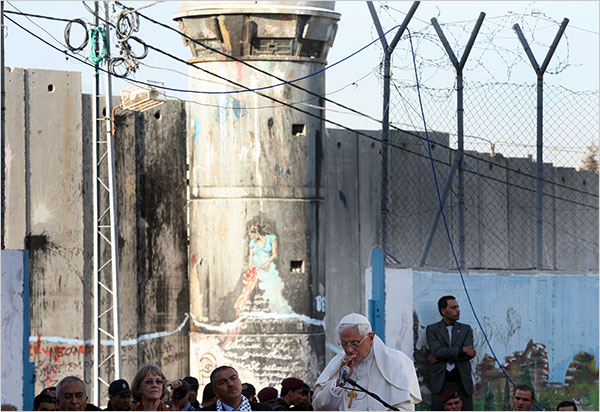
The Pope in the Palestinian prison camp

The Pope in the Palestinian prison camp

Has this image appeared widely in the media? I don’t honestly know, but I’ll assume it hasn’t. So the next question would be: why not?


(Source: The New York Times)

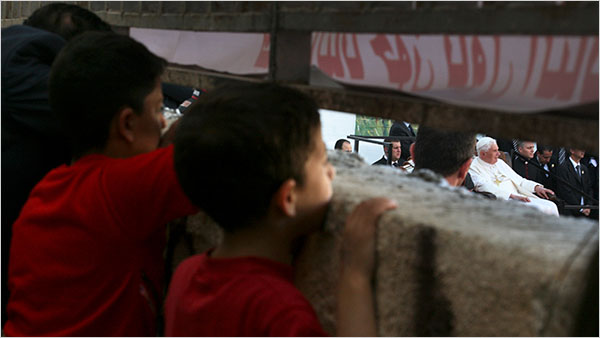
The New York Times ran an article with the headline: “In Bethlehem, Pope laments Israeli wall“. The perfect place to use the image above — the one their own photographer had provided. Right?

Wrong. Instead, they went with a poetic Getty image: little children peaking over a little wall. How enchanting!

Facebooktwittermail

EDITORIAL: Corruption: ‘the greatest single existential threat to Israel’

Corruption: ‘the greatest single existential threat to Israel’

At the web site of the neoconservative magazine, Commentary, Michael B Oren (who is in line to become Israel’s next ambassador to the United States) moves away from the standard position on existential threats to Israel. Seeing an array of existential threats, Oren says that among those, that posed by a nuclear-armed Iran would itself constitute “not one but several existential threats.” Even so, he does not see the risk of Israel being wiped off the map as preeminent among the dangers Israel faces.

This is where Oren locates the greatest threat to Israel’s survival:

Recent years have witnessed the indictment of major Israeli leaders on charges of embezzlement, taking bribes, money laundering, sexual harassment, and even rape. Young Israelis shun politics, which are widely perceived as cutthroat; the Knesset, according to annual surveys, commands the lowest level of respect of any state institution. Charges of corruption have spread to areas of Israeli society, such as the army, once considered inviolate.

The breakdown of public morality, in my view, poses the greatest single existential threat to Israel. It is this threat that undermines Israel’s ability to cope with other threats; that saps the willingness of Israelis to fight, to govern themselves, and even to continue living within a sovereign Jewish state. It emboldens Israel’s enemies and sullies Israel’s international reputation. The fact that Israel is a world leader in drug and human trafficking, in money laundering, and in illicit weapons sales is not only unconscionable for a Jewish state, it also substantively reduces that state’s ability to survive.

When it comes to Oren’s remedy, he sounds less than convincing:

…corruption must be rooted out through a revival of Zionist and Jewish values. These should be inculcated, first, in the schools, then through the media and popular culture. The most pressing need is for leadership.

Perhaps there’s another route — one that’s presumably compatible with Jewish values yet can make no claim to being specifically Judaic: the promotion of public integrity.

Corruption is the most glaring expression of a conflict between words and actions. The gap that separates what Israel’s leaders say from what they do is what renders their utterances worthless. But although such leaders are viewed with cynicism by those who have witnessed how deeply ingrained this lack of integrity has become, that cynicism can easily be washed away if promises are fulfilled through actions.

While Israel’s pathological political culture has been shaped by many powerful internal forces there has also been for many decades an external enabler: the United States.

Having previously given Israel’s leaders a free pass, the US could, if it chose, help break the cycle of corruption.

From an unexpected quarter an opportunity is now emerging through which Israel could reclaim some international faith in the value of its word.

Israel’s US-enabled policy of “nuclear ambiguity” has frayed beyond repair. A policy which was never anything more than a bargain of deceit does nothing more than give Israel an excuse for excluding itself from an international debate within which its unacknowledged nuclear arsenal is a central factor.

Now, the Obama administration’s top arms control negotiator, Assistant Secretary of State Rose Gottemoeller, has effectively declared that the era of nuclear ambiguity is over and that Israel’s nuclear arsenal cannot forever remain outside the regime of the nuclear non-proliferation treaty.

“Universal adherence to the NPT itself, including by India, Israel, Pakistan and North Korea … remains a fundamental objective of the United States,” Gottemoeller said at the UN on Tuesday.

The Jerusalem Post reported:

Former prime minister Ariel Sharon’s chief strategist, Dov Weisglass, said Gottemoeller’s comments were very alarming.

“If these statements indicate a change in American policy on this issue, I believe this may be the most worrisome development for Israel’s security in many years,” he told Army Radio.

The Washington Times reported:

Ms. Gottemoeller endorsed the concept of a nuclear-free Middle East in a 2005 paper that she co-authored, “Universal Compliance: A Strategy for Nuclear Security.”

“Instead of defensively trying to ignore Israels nuclear status, the United States and Israel should proactively call for regional dialogue to specify the conditions necessary to achieve a zone free of nuclear, chemical, and biological weapons,” she wrote.

The paper recommends that Israel take steps to disarm in exchange for its neighbors getting rid of chemical and biological weapons programs as well as Iran forgoing uranium enrichment.

If soon-to-be ambassador Oren is serious about reversing Israel’s problem with corruption, maybe he needs to put into practice the art of political leadership and press Prime Minister Netanyahu to take a bold political initiative by bringing Israel out of the nuclear closet.

Is this likely to happen? Hardly. Why? Because Israel does not perceive Iran so much as an existential threat as much as a strategic threat to its regional military dominance.

Entering the NPT and eventually disarming would not threaten Israel’s existence but would destroy its privileged status as a rogue nation able to resist international pressure.

If Obama really wants to sharpen his challenge to Netanyahu when they meet later this month, perhaps who can present him with this choice: keep your nuclear arsenal and learn how to live with a nuclear Iran, or, sign up for the creation of a non-nuclear Middle East. Nukes or no nukes. Which do you want?

Facebooktwittermail

Thinking about torture

Where this buck stops

The trouble with this desire for retribution isn’t that it goes too far. The trouble is that it doesn’t go far enough. There is another group — a large one — that stood by doing nothing while Americans grabbed people off the streets of foreign countries, took them to other foreign countries (because we don’t allow this sort of thing in the United States!) and tortured them until they said whatever our government wanted to hear. If you’re going to punish people for condoning torture, you’d better include the American citizenry itself.

Sixty-two million of us voted to reelect George W. Bush in 2004. That was more people than had ever voted for a presidential candidate up until then. (In 2008, Obama got 69 million.) Unlike 2000, Bush’s 2004 victory was solid and unambiguous.

Bush was so unpopular by the time he left office that it’s hard to believe he was reelected four years earlier. That gave him and his associates four more years to violate America’s dearest principles. But plenty of torture had gone on by the end of his first term. If you’re looking to punish the ultimate decision makers, you can’t stop at the Justice Department or even the White House. You’ve got to go all the way to the top. You have to ask the famous Howard Baker question about the voters themselves: What did we know, and when did we know it? [continued…]

Editor’s Comment — People don’t think much. It’s sad but true. So to point to the complicity of the American public in supporting the use of torture says as much about what people fail to reflect on as it says about what they believe. It also leaves out the instrumental role that journalists played in making torture acceptable by declining to insist on calling it torture.

In the name of impartiality, reporters generally sided with the Bush administration by using phrases such as “harsh interrogation techniques” without placing the terms in quotation marks. Even now, the New York Times in its reporting prefers the pseudo-neutral term “interrogation” as though it still awaits a directive from the ministry of information (the most effective agency in the executive branch that without a budget or any staff is able to persuade American journalists to police themselves).

When the press has been so shy about using the word “torture,” how are ordinary Americans supposed to reflect on the implications of a state-sanctioned torture program?

If we want to think about torture, we first need to think about human rights.

A few Americans might claim that “human rights” is a concept concocted by liberals and bodies like the UN, but I think the majority would accept the basic proposition that human rights deserve protection. Moreover, most would agree that human rights, if they are fitly named, must be utterly non-discriminatory. I’ve never heard anyone argue that such and such a person or such and such an action provided grounds that would justify someone’s human rights being taken away. Prisoners lose their liberty but they retain their human rights.

The most widely accepted enunciation of human rights is the Universal Declaration of Human Rights adopted by the United Nations in 1948. In laying out prohibitions in conduct, the only act that ranks higher than the prohibition of torture in the articles of the declaration is the prohibition of slavery.

Article Five says:

No one shall be subjected to torture or to cruel, inhuman or degrading treatment or punishment.

“No one” is unequivocal. It’s not, “no one, unless they’re suspected of being a terrorist,” or “no one, unless they’re regarded as an enemy of the state.”

The most fundamental rights exist for the protection of everyone and they can only perform that function if they protect anyone, irrespective of that individual’s history or predispositions.

So far, we have not really had a national conversation about torture. The Bush administration’s torture program was largely hidden — with the press corps’ complicity — behind a shield of terms whose function was to legitimize what had been done. The methods used were portrayed as debatable in character yet judicious in their application and effective in their outcome. Most Americans did not so much condone torture as much as swallow a claim that whatever was being done was done with the best of intentions and for the good of the country.

Even now, when we learn that torture is particularly favored by evangelical church-goers, I’m less inclined to assume that evangelical Christianity has a particular appeal for sadists, than that Americans whose religion and nationalistic fervor are deeply entwined, have a faith-based approach to national security. Their support for torture is an expression of their trust in George Bush — the man willing to do “what needed to be done.”

Ignorance absolves no one of moral responsibility, but the voices that America most needs to hear right now are those made vivid by nightmares — the enduring horror of the tortured and the torturers. Only when such publicly spoken and televised testimony shapes this debate will America begin the process of self-examination that is now needed.

Abu Zubaydah’s suffering

No one can pass unscathed through an ordeal like this. Abu Zubaydah paid with his mind.

Partly as a result of injuries he suffered while he was fighting the communists in Afghanistan, partly as a result of how those injuries were exacerbated by the CIA and partly as a result of his extended isolation, Abu Zubaydah’s mental grasp is slipping away.

Today, he suffers blinding headaches and has permanent brain damage. He has an excruciating sensitivity to sounds, hearing what others do not. The slightest noise drives him nearly insane. In the last two years alone, he has experienced about 200 seizures. [continued…]

Survey: Support for terror suspect torture differs among the faithful

The more often Americans go to church, the more likely they are to support the torture of suspected terrorists, according to a new survey.

More than half of people who attend services at least once a week — 54 percent — said the use of torture against suspected terrorists is “often” or “sometimes” justified. Only 42 percent of people who “seldom or never” go to services agreed, according to the analysis released Wednesday by the Pew Forum on Religion & Public Life.

White evangelical Protestants were the religious group most likely to say torture is often or sometimes justified — more than six in 10 supported it. People unaffiliated with any religious organization were least likely to back it. Only four in 10 of them did. [continued…]

Facebooktwittermail

EDITORIAL: Churchill’s “we don’t torture” — except they did

Churchill’s “we don’t torture” — except they did

During last night’s news conference, President Obama took a less than subtle jab at his predecessor by citing Winston Churchill’s statement: “We don’t torture.” Whether the exact words that we’re so familiar with coming from George Bush’s mouth were ever also uttered by his English hero, I don’t know, but even if they were, it’s unfortunate that Obama would cite Churchill’s as quite such a principled stance. The British war record actually reveals a dark side even more chilling than the one Dick Cheney inspired.

In 2005, The Guardian reported on then newly-revealed records of Britain’s brutal treatment of Nazi prisoners — treatment that led to Britain being accused of operating concentration camps after World War Two had ended. Citing the British example is useful, but not for the purpose of showing that those who espouse high principles necessarily have the integrity to match their words with their actions.

And herein lies the fatal flaw of the conceit: we’re better than that. We don’t torture because we’re Americans.

In truth there is no failing from which Americans are immune. On the contrary, as Americans we’re just like anyone else — just like the British and so many others who under the pressure of a perceived necessity think that torture can be justified even while its use must remain a closely guarded secret.

In other words, if we argue that we must not torture, it should be because we recognize that Americans are just as capable as anyone else of tumbling down a moral spiral in which conscience and individual responsibility make themselves subordinate to a collective imperative.

The reason we should not torture terrorists isn’t because we operate on a higher moral plane than them, but because we know that we too are capable of descending into barbarity and moral depravity. We should not torture because we want to protect ourselves from our own demons.

Consider then the chilling British record:

The interrogation camp that turned prisoners into living skeletons

Despite the six years of bitter fighting which lay behind him, James Morgan-Jones, a major in the Royal Artillery, could not have been more specific about the spectacle in front of him. “It was,” he reported, “one of the most disgusting sights of my life.”

Curled up on a bed in a hospital in Rotenburg, near Bremen, was a cadaverous shadow of a human being. “The man literally had no flesh on him, his state of emaciation was incredible,” wrote Morgan-Jones. This man had weighed a little over six stones (38kg) on admission five weeks earlier, and “was still a figure which may well have been one of the Belsen inmates”. At the base of his spine “was a huge festering sore”, and he was clearly terrified of returning to the prison where he had been brought so close to death. “If ever a man showed fear – he did,” Morgan-Jones declared.

Adolf Galla, 36, a dental technician, was not alone. A few beds away lay Robert Buttlar, 27, a journalist, who had been admitted after swallowing a spoon handle in a suicide attempt at the same prison. He too was emaciated and four of his toes had been lost to frostbite.

The previous month, January 1947, two other inmates, Walter Bergmann, 20, and Franz Osterreicher, 38, had died of malnutrition within hours of arriving at the hospital. Over the previous 13 months, Major Morgan-Jones learned, 45 inmates of this prison, including several women, had been dumped at Rotenburg. Each was severely starved, frostbitten, and caked in dirt. Some had been beaten or whipped.

The same week that Major Morgan-Jones was submitting his report, a British doctor called Jordan was raising similar concerns at an internment camp 130 miles away. Dr Jordan complained to his superiors that eight men who had been transferred from the same prison “were all suffering gross malnutrition … one in my opinion dying”.

They included Gerhard Menzel, 23, a 6ft German former soldier who weighed seven stones, and was described as a living skeleton. Another, admitted as Morice Marcellini, a 27-year-old Frenchman, later transpired to be Alexander Kalkowski, a captain in the Soviet secret police, the NKVD. He weighed a little over eight stones, and complained that he had been severely beaten and forced to spend eight hours a day in a cold bath.

Prisoners complained thumbscrews and “shin screws” were employed at the prison and Dr Jordan’s report highlighted the small, round scars that he had seen on the legs of two men, “which were said to be the result of the use of some instrument to facilitate questioning”. One of these men was Hans Habermann, a 43-year-old disabled German Jew who had survived three years in Buchenwald concentration camp.

All of these men had been held at Bad Nenndorf, a small, once-elegant spa resort near Hanover. Here, an organisation called the Combined Services Detailed Interrogation Centre (CSDIC) ran a secret prison following the British occupation of north-west Germany in 1945.

CSDIC, a division of the War Office, operated interrogation centres around the world, including one known as the London Cage, located in one of London’s most exclusive neighbourhoods. Official documents discovered last month at the National Archives at Kew, south-west London, show that the London Cage was a secret torture centre where German prisoners who had been concealed from the Red Cross were beaten, deprived of sleep, and threatened with execution or with unnecessary surgery.

As horrific as conditions were at the London Cage, Bad Nenndorf was far worse. Last week, Foreign Office files which have remained closed for almost 60 years were opened after a request by the Guardian under the Freedom of Information Act. These papers, and others declassified earlier, lay bare the appalling suffering of many of the 372 men and 44 women who passed through the centre during the 22 months it operated before its closure in July 1947.

They detail the investigation carried out by a Scotland Yard detective, Inspector Tom Hayward, following the complaints of Major Morgan-Jones and Dr Jordan. Despite the precise and formal prose of the detective’s report to the military government, anger and revulsion leap from every page as he turns his spotlight on a place where prisoners were systematically beaten and exposed to extreme cold, where some were starved to death and, allegedly, tortured with instruments that his fellow countrymen had recovered from a Gestapo prison in Hamburg. Even today, the Foreign Office is refusing to release photographs taken of some of the “living skeletons” on their release.

Initially, most of the detainees were Nazi party members or former members of the SS, rounded up in an attempt to thwart any Nazi insurgency. A significant number, however, were industrialists, tobacco importers, oil company bosses or forestry owners who had flourished under Hitler.

By late 1946, the papers show, an increasing number were suspected Soviet agents. Some were NKVD officers – Russians, Czechs and Hungarians – but many were simply German leftists. Others were Germans living in the Russian zone who had crossed the line, offered to spy on the Russians, and were tortured to establish whether they were genuine defectors.

One of the men who was starved to death, Walter Bergmann, had offered to spy for the British, and fell under suspicion because he spoke Russian. Hayward reported: “There seems little doubt that Bergmann, against whom no charge of any crime has ever been made, but on the contrary, who appears to be a man who has given every assistance, and that of considerable value, has lost his life through malnutrition and lack of medical care”.

The other man who starved to death, Franz Osterreicher, had been arrested with forged papers while attempting to enter the British zone in search of his gay lover. Hayward said that “in his struggle for existence or to get extra scraps of food he stood a very poor chance” at Bad Nenndorf.

Many of Bad Nenndorf’s inmates were there for no reason at all. One, a former diplomat, remained locked up because he had “learned too much about our interrogation methods”. Another arrived after a clerical error, and was incarcerated for eight months. As Inspector Hayward reported: “There are a number against whom no offence has been alleged, and the only authority for their detention would appear to be that they are citizens of a country still nominally at war with us.”

Today, the older people of Bad Nenndorf talk about August 1 1945, the day the British arrived, with undisguised bitterness. A convoy of trucks pulled into the village, and the Tommies took over from an easygoing US infantry division. Within hours, the British had ordered everybody in the centre of the village to pack their belongings and leave. Bad Nenndorf was heaving with refugees from the bomb-ravaged ruins of Hanover, 18 miles to the east: hundreds of people were given 90 minutes to pack some food and valuables, and get out.

“We thought everyone would be allowed back in a few days,” recalls Walter Münstermann, now a retired newspaperman, but then a 14-year-old. “Then the soldiers started putting barbed wire fences around the centre of the village, and slowly we began to realise that this was going to be no ordinary camp.”

Walter and his neighbours realised that the centre of their village was being transformed into a prison camp when they heard that the British were converting a large, 40-year-old bath-house, ripping out the baths and installing heavy steel doors to turn each cubicle into a cell. They saw the first batch of prisoners arrive in the back of a truck. Later groups arrived at the village railway station in cattle trucks.

Ingrid Groth, then a seven-year-old, said locals claimed that if you crept up to the barbed wire at night, you could hear the prisoners’ screams. Mr Münstermann, who passed the main gate on his way to school each day, insists that the opposite was true: that it was a sinister place precisely because “you never, ever saw anyone, and you never heard a sound”. Among the people of Lower Saxony, Bad Nenndorf became known as das verbotene dorf – the forbidden village.
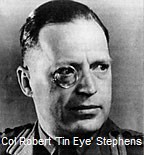
The commanding officer was Robin “Tin Eye” Stephens, 45, a monocled colonel of the Peshawar Division of the Indian Army who had been seconded to MI5 in 1939, and who had commanded Camp 020, a detention centre in Surrey where German spies had been interrogated during the war.

An authoritarian and a xenophobe with a legendary temper, Stephens boasted that interrogators who could “break” a man were born, and not made. Of the 20 interrogators ordered to break the inmates of Bad Nenndorf, 12 were British, a combination of officers from the three services and civilian linguists. The remaining eight included a Pole and a Dutchman, but were mostly German Jewish refugees who had enlisted on the outbreak of war, and who, Inspector Hayward suggested, “might not be expected to be wholly impartial”.

Most of the warders were soldiers barely out of their teens. Some had endured more than a year of combat, at the end of which they had liberated Belsen. Some represented the more unruly elements of the British Army of the Rhine, sent to Bad Nenndorf after receiving suspended sentences for assault or desertion. Often, Hayward said, they were the sort of individuals “likely to resort to violence on helpless men”.

The inmates were starved, woken during the night, and forced to walk up and down their cells from early morning until late at night. When moving about the prison they were expected to run, while soldiers kicked them. One warder, a soldier of the Welsh Regiment, told Hayward: “If a British soldier feels inclined to treat a prisoner decently he has every opportunity to do so; and he also has the opportunity to ill-treat a prisoner if he so desires”.

The Foreign Office briefed Clement Attlee, the prime minister, that “the guards had apparently been instructed to carry out physical assaults on certain prisoners with the object of reducing them to a state of physical collapse and of making them more amenable to interrogation”.

Former prisoners told Hayward that they had been whipped as well as beaten. This, the detective said, seemed unbelievable, until “our inquiries of warders and guards produced most unexpected corroboration”. Threats to execute prisoners, or to arrest, torture and murder their wives and children were considered “perfectly proper”, on the grounds that such threats were never carried out.

Moreover, any prisoner thought to be uncooperative during interrogation was taken to a punishment cell where they would be stripped and repeatedly doused in water. This punishment could continue for weeks, even in sub-zero temperatures.

Naked prisoners were handcuffed back-to-back and forced to stand before open windows in midwinter. Frostbite became common. One victim of the cold cell punishment was Buttlar, who swallowed the spoon handle to escape. An anti-Nazi, he had spent two years as a prisoner of the Gestapo. “I never in all those two years had undergone such treatments,” he said.

Kalkowski, the NKVD officer, claimed that toenails were ripped out and that he had been hung from his wrists during interrogation, with weights tied to his legs. British NCOs, he alleged, would beat him with rubber truncheons “while the interrogating officers went for lunch”. Hayward concluded, however, that “there was not a shred of evidence to support these allegations”.

Whatever was happening during the interrogations must have been widely known among many of the camp’s officers and men. In common with every CSDIC prison, each cell was bugged, so that the prisoners’ private utterances could be matched against their “confessions”.

Inspector Hayward’s investigation led to the courts martial of Stephens, Captain John Smith, Bad Nenndorf’s medical officer, and an interrogator, Lieutenant Richard Langham. The hearings were largely held behind closed doors. A number of sergeants – men who had carried out the beatings – were told they would be pardoned if they gave evidence against their officers. [continued…]

Facebooktwittermail

Torture only used in moderation

Despite reports, Khalid Sheikh Mohammed was not waterboarded 183 times

The New York Times reported last week that Khalid Sheikh Mohammed, the alleged mastermind of the Sept. 11 terror attacks, was waterboarded 183 times in one month by CIA interrogators. The “183 times” was widely circulated by news outlets throughout the world.

It was shocking. And it was highly misleading. The number is a vast inflation, according to information from a U.S. official and the testimony of the terrorists themselves.

A U.S. official with knowledge of the interrogation program told FOX News that the much-cited figure represents the number of times water was poured onto Mohammed’s face — not the number of times the CIA applied the simulated-drowning technique on the terror suspect. According to a 2007 Red Cross report, he was subjected a total of “five sessions of ill-treatment.” [continued…]

Editor’s Comment — So there we were — we torture scaremongers — hyperventilating that Khalid Sheikh Mohammed had been waterboarded an excessive 183 times and it turns out he was only brought close to drowning 183 times during a mere five sessions of waterboarding. It turns out that the CIA torturers studied the rules very carefully and realized that water poured for less than 10 seconds didn’t “count.” It did of course count as far as diligent torture bookkeeping is concerned — hence the carefully recorded 183 fleeting glimpses of death. Thanks goes to Fox News for helping set the record straight.

Since Sean Hannity recently agreed to submit himself to waterboarding “for charity” (is he going to raise money for Amnesty International’s fight against torture?), perhaps when he gets waterboarded he’ll be man enough to take a dozen 9-second pours — the ones that don’t really count. And once he’s graduated from this kiddy torture he’ll be ready to show us he can handle the real thing — Jay Bybee-approved waterboarding, that is.

Facebooktwittermail

Easing some of the obstacles to Palestinian unity

Obama move alarms Israel supporters

The Obama administration, already on treacherous political ground because of its outreach to traditional adversaries such as Iran and Cuba, has opened the door a crack to engagement with the militant group Hamas.

The Palestinian group is designated by the U.S. government as a terrorist organization and under law may not receive federal aid.

But the administration has asked Congress for minor changes in U.S. law that would permit aid to continue flowing to Palestinians in the event Hamas-backed officials become part of a unified Palestinian government. [continued…]

Editor’s Comment — The Israel lobby will want to portray this as a step down the slippery slope towards the legitimization of Hamas. What it really means is that the Obama administration is setting aside the Bush administration’s policy of fomenting division among Palestinians.

For the former administration, under Elliot Abrams’ direction, Palestinian “unity” was only of value if it involved the exclusion of Hamas. What the Obama administration appears to recognize is that Palestinian unity based on reconciliation between Fatah and Hamas is a practical necessity if any semblance of a peace process can be revived.

Israel: PA recognition of Jewish state ‘crucial’ for reconciliation

The Foreign Ministry said Monday that Palestinian recognition of Israel as a Jewish state was ‘crucial’ for reconciliation between the two sides after Palestinian President Mahmoud Abbas dismissed Israeli calls to do so.

“Recognition of Israel as the sovereign state of the Jewish people is an essential and necessary step in the historic reconciliation process between Israel and the Palestinians,” the ministry said in a statement.

“The sooner the Palestinians internalize this basic and essential fact, peace between the two peoples will progress and come to fruition.” [continued…]

Editor’s Comment — Here’s one of the central paradoxes of the Israeli-Palestinian conflict. Supposedly, Israelis attach a great deal of importance to what Palestinians think — do the Palestinians recognize our right to exist? Do they accept that Israel is a Jewish state?

At the same time, the Israelis think its acceptable to kill Palestinians, hold them under siege, restrict their movements and curtail their political rights.

It’s an absurd contradiction. The only rational way of interpreting these demands for recognition is to see them as facets of a more fundamental demand: We reserve the right to exert absolute control over the terms of our co-existence.

The Israelis lay down the demands and the Palestinians either meet or fail to meet those demands. The right of return, the end of the occupation, the dismantling of settlements — all of these Palestinian demands have effectively been made inert by “formaldehyde”: the Israeli decision, five years ago, that the political process would indefinitely be placed on hold.

Barak tells Haaretz: No existential threat to Israel

[In an interview with Haaretz that appears in full on Friday, Israel’s defense minister, Ehud Barak] struck a blustery yet pragmatic tone [on Iran’s nuclear program]. “There is no one who will dare try to destroy Israel. We are not in a position of being able to tell the Americans whether to talk to the Iranians. I told American leaders: First learn from the professionals about what is going on in Iran, what they are doing behind the smoke screen, acquaint yourselves with the intelligence material, and from this you will understand they are working determinedly to deceive, confuse and blur things, and that under the headline of ‘nuclear power for peaceful purposes,’ they are trying to achieve military nuclear capability.

“I told them negotiations should be short and have a deadline, accompanied by ‘soft’ sanctions such as limitations on money transfers, while preparing the ground for harsh sanctions that involve authorizing action afterward. This has to be done in deep cooperation with the Russians and the Chinese, and we say we are not removing any option from the table. We have a tendency to hope for a heroic operation that will end everything, as with the bombing of the Iraqi reactor in 1981. Is that realistic?

“There is no comparison,” he said. “In the Iraqi case there was one target that existed and was working, and a surgical strike eliminated it. We thought we were delaying the project for three to four years, whereas in practice it was delayed forever. Here we are up against something far more complex, sophisticated and extensive.”

“The Iranians don’t play backgammon, they play chess, and in fact they invented the game. They are proceeding with far greater sophistication and are far more methodical. The Iranian nation is a collection of people held together by an identity that includes the perception of being an empire from the dawn of history. Part of their nuclear pretensions have nothing to do with Israel, but with their place in the world and the Orient.” [continued…]

Facebooktwittermail

EDITORIAL: Who did Rep. Harman talk to?

Who did Rep. Harman talk to?

In 1963, the American Zionist Council (AZC) — regarded as the parent organization of American Israel Public Affairs Committee (AIPAC) — was under intense pressure from the Justice Department of the Kennedy administration to register under the Foreign Agents Registration Act due to the fact that it received funding from the Zionist Agency of Israel, a branch of the Israeli government. AZC resisted, making a plea to Justice officials that if it complied this “would eventually destroy the Zionist movement.” No doubt the memory still haunts AIPAC.

The upcoming trial of former AIPAC officials, Steven J. Rosen and Keith Weissman, accused of passing classified documents to Israeli officials, has escalated fears that a thorough examination of the organization’s operations might raise unwelcome questions about the nature of the pro-Israel lobby’s ties.

For that reason, as the Rep. Jane Harman story unfolds, one of the key unanswered questions is the identity of the Israeli agent that the California representative was taped talking to. If a request to intercede with the Justice Department on behalf of Rosen and Weissman, seeking lesser charges than the ones they still face, came from an AIPAC official, that would be one thing. If that official also happened to be an intelligence agent for the Israeli government, then the case has much farther reaching implications.

Interestingly (as David Corn pointed out), when interviewed on NPR this week, Harman initially claimed to have little recollection of the conversation that was wiretapped. “I can’t recall with any specificity a conversation I may have had four years ago.” But later in the interview, she was quite specific in recalling, “The person I was talking to was an American citizen.”

“I didn’t talk to some foreigner,” Harman said. But what about an Israeli agent who also happened to be an American citizen?

If the Israeli government, in contravention with a long-standing agreement not to do so, is in fact conducting intelligence operations inside the United States, it’s hard to imagine that it would not recruit American-Israelis for this purpose. Indeed, staff inside AIPAC with their excellent access to Capital Hill and the highest levels of recent administrations, would seem to be in an ideal position for gathering political intelligence.

Since 1985, after Jonathan Pollard, a US citizen, was convicted of spying on the US for Israel, Israel agreed that it would not conduct intelligence operations inside the United States. Whether it kept to that agreement is clearly open to question. Indeed, that this remains a live issue is apparent from the fact that in 2004 Israel secretly acknowledged to American officials that Pollard was not an isolated case.

In The Forward, in the wake of the Harman accusations, Nathan Guttman writes :

for close observers of the national security establishment, the real news was the extent of its suspicions of American Jewish supporters of Israel — up to and including its willingness to wiretap a member of Congress.

“It’s rooted deep in the system,” an official with an American Jewish organization said, “and it comes from the bottom up.”

The leaked transcripts hint, among other things, at the security establishment’s continued search for an Israeli mole that some reportedly believe remained uncaught after Jonathan Pollard, an American Jewish civilian naval intelligence analyst, was discovered engaged in massive espionage for Israel in 1985. More generally, the wiretap reflects the security establishment’s continuing concern about leaks of classified information to pro-Israel activists and Israeli agents who have shown themselves adept at obtaining nonpublic information from the government.

“We know that we are closely watched, that people might be listening to our phone calls. This is our working premise,” said a former senior Israeli official who was based in Washington in recent years. The official, who spoke on condition of anonymity due to the sensitivity of the issue, said he believed that suspicion toward Israel was prevalent in the military and intelligence establishments but was not common at the political and diplomatic levels.

The disclosure of the Harman wiretaps comes at a time when the government’s most elaborate attempt to crack down on alleged wrongdoings by pro-Israel activists is at a crossroads. The prosecution of two former AIPAC lobbyists, which began more than four years ago and is scheduled to go to trial June 2, is under review and, according to press reports, might be dropped altogether. The conversations involving Harman focused on attempts to put an end to the legal proceedings against the two former AIPAC staffers, Steve Rosen and Keith Weissman.

Although no formal explanation was provided from the National Security Agency for eavesdropping on the Harman conversation, it is widely believed that the wiretap was part of the investigation into the AIPAC case.

According to court records, wiretaps and surveillance in the Rosen-Weissman case began as early as 1999. From the indictment, which is now being reviewed by the attorney general’s office, it is clear that attempts to stop the flow of information to pro-Israel activists led to a wide- ranging counterintelligence operation in which Israeli diplomats and pro-Israel lobbyists were being followed and their conversations monitored. These conversations involved senior government officials who had been in touch with the subjects of the investigation. The U.S. District Court in the Eastern District of Virginia reviewed transcripts of these wiretaps in lengthy pretrial proceedings, and parts of them are expected to be presented if the case reaches trial.

Stephen Green, a Vermont-based writer who has chronicled the counterintelligence spats between the United States and Israel since the late 1970s, said the mistrust toward Israel stems from agents working on the cases and not from an overall anti-Israel ideology. “This has nothing to do with politics or with Israeli foreign policy. These are people who deal with these issues on a daily basis and become very, very upset,” Green said.

If the Justice Department does indeed drop the case against Rosen and Weissman, the person who arguably has the deepest personal interest in this is Larry Franklin, the former Defense Department official who was sentenced to serve 12 and a half years in prison for passing classified information to the AIPAC staffers without authorization.

Although he was sentenced in January 2006, Franklin has yet to be imprisoned. At the time of his conviction, he agreed to assist prosecutors and, according to David Frum, currently works as “a parking lot attendant in West Virginia.” Even so, he has been able to retain the services of one of Washington DC’s highest profile attorneys and no doubt if AIPAC dodges this bullet, Franklin will be wondering why or if he still deserves to go behind bars.

As for Representative Harman, since all sections of the media and fellow members of Congress have happily convinced themselves that this is a story about egregious government overreach and the need for diligent intelligence oversight, the chances that we’ll ever learn the identity of the American-Israeli agent she spoke to now appear slim. Unless of course there’s another useful leak…

Facebooktwittermail

Thank G-d for the IDF!

Gaza probe shows IDF among world’s most moral armies

The Israel Defense Forces announced on Wednesday that an internal investigation has determined that no civilians were purposefully harmed by IDF troops during Operation Cast Lead in the Gaza Strip.

Following the release of the investigation results, Defense Minister Ehud Barak said that the army’s willingness to probe itself “once again proves that the IDF is one of the most moral armies in the world.

“The IDF is not afraid to investigate itself and in that, proves that its operations are ethical,” said Barak. The defense minister added that he has “complete faith in the IDF, from the chief of staff to the last of the combat soldiers.” [continued…]

Editor’s Comment — Oh my! And to think that cynics like me could have judged the IDF so harshly. What better time could there be to watch again this rousing anthem and wonderful tribute to the most moral army in the world: Don’t mess with the IDF.

Lieberman: U.S. will accept any Israeli policy decision

The Obama Administration will put forth new peace initiatives only if Israel wants it to, said Foreign Minister Avigdor Lieberman in his first comprehensive interview on foreign policy since taking office.

“Believe me, America accepts all our decisions,” Lieberman told the Russian daily Moskovskiy Komosolets.

Lieberman granted his first major interview to Alexander Rosensaft, the Israel correspondent of one of the oldest Russian dailies, not to an Israeli newspaper. The role of Israel is to “bring the U.S. and Russia closer,” he declared. [continued…]

Senior Hamas official: Rockets damage Palestinian interests

A senior Hamas official said yesterday that firing rockets at Israel ultimately does a disservice to Palestinian interests.

Ismail al-Ashkar is a member of the security committee in the Palestinian Legislative Council and a leading candidate for the interior minister position. “The firing of rockets at Israel is against the Palestinian interest. It benefits certain individuals and groups, but not the Palestinians themselves,” he said yesterday.

Since January 18, the Hamas armed wing, the Iz al-Din al-Qassam Brigades, has not taken credit for a single Qassam rocket. Sources in the Gaza Strip said just two weeks ago that Hamas detained Islamic Jihad operatives for trying to launch rockets.

Yesterday Hamas representatives met delegates from Islamic Jihad and smaller militant groups in order to ensure the cease-fire with Israel remains in force for now. [continued…]

Clare Short criticised over parliament invitation to Hamas leader

Israel accused former Labour Cabinet minister Clare Short of undermining the Middle East peace process today after she invited the political leader of Hamas to address a meeting in Parliament.

Khaled Mashaal is due to address MPs and peers tonight by video link from Damascus at the event organised by Ms Short, now a independent MP, and Liberal Democrat peer Lord Alderdice.

They say that dialogue with Hamas – which is regarded as a terrorist organisation by the UK, the US and the EU – is crucial if a solution is to be found to the Palestinian crisis. [continued…]

Most Palestinians and Israelis willing to accept two-state solution, poll finds

A majority of both Palestinians and Israelis are willing to accept a two-state solution, according to a poll from the international grassroots movement One Voice.

Based on public opinion research methods used in Northern Ireland, 500 interviews were completed in Israel and 600 in the West Bank and Gaza immediately following the Gaza war and the Israeli elections.

Each side was asked which problems they thought were “very significant” and what the solutions might be.

The results indicate that 74% of Palestinians and 78% of Israelis are willing to accept a two-state solution on an option range from “tolerable” to “essential”, while 59% of Palestinians and 66% of Israelis find a single bi-national state “unacceptable”. [continued…]

Israel puts Iran issue ahead of Palestinians

The new Israeli government will not move ahead on the core issues of peace talks with the Palestinians until it sees progress in U.S. efforts to stop Iran’s suspected pursuit of a nuclear weapon and limit Tehran’s rising influence in the region, according to top government officials familiar with Prime Minister Binyamin Netanyahu’s developing policy on the issue.

“It’s a crucial condition if we want to move forward,” said Deputy Foreign Minister Daniel Ayalon, a member of the Israeli parliament and former ambassador to the United States. “If we want to have a real political process with the Palestinians, then you can’t have the Iranians undermining and sabotaging.”

The emerging Israeli position, a significant change from that of previous governments, presents a challenge for President Obama, who has made quick progress on Palestinian statehood a key foreign policy goal. Obama is also trying to begin engagement with Iran as part of a broad effort to slow its nuclear program and curtail its growing strength in the Middle East. [continued…]

Barack Obama begins push for Middle East peace

Barack Obama is to invite Israeli, ­Palestinian and Egyptian leaders to the White House within the next two months in a fresh push for Middle East peace.

Obama, speaking at the White House yesterday, said there was a need to try to rise above the cynicism about prospects for peace. The decision appeared to mark the end of a debate within the Obama administration between those who argued in favour of devoting time and energy to trying to resolve the conflict and those who argued it was a blind alley.

Meeting King Abdullah of Jordan at the White House yesterday, Obama said he hoped “gestures of good faith” would be made “on all sides” in the coming months. He did not say what these ­gestures, intended as confidence-building ­measures, would amount to. [continued…]

Word games

Lord have mercy: Prime Minister Benjamin Netanyahu has relinquished for the moment his demand that the Palestinians recognize Israel as “a Jewish state” as a condition for negotiations. He has deigned to postpone the demand until future stages. Listen up, world: Perhaps, just perhaps, Netanyahu will also see fit to utter the forbidden phrase “two states for two peoples.”

The slogan of yesterday’s illegitimate radical left will be heard publicly in Washington from the mouth of Israel’s most right-wing prime minister ever, and everyone will sing the praises of the historic turnaround. The diplomatic process will again take wing and the expectations will soar. Peace is just around the corner.

Once again the diplomatic arena has become a playground of words. This will be said and that will be declared and the other will be proclaimed. This is a guarantee of another foregone failure.

Whether or not Netanyahu says two states, nothing will change. The Americans will rejoice, the Europeans will be thrilled, the Israeli right will wax wrathful, commentators will again write with pathos about how the dream of the greater land of Israel has been shelved – and the occupation will flourish. [continued…]

Facebooktwittermail

NEWS & EDITOR’S COMMENTS: Using torture to force “confessions”

Report: Abusive tactics were used to find Iraq-al Qaida link

The Bush administration put relentless pressure on interrogators to use harsh methods on detainees in part to find evidence of cooperation between al Qaida and the late Iraqi dictator Saddam Hussein’s regime, according to a former senior U.S. intelligence official and a former Army psychiatrist.

Such information would’ve provided a foundation for one of former President George W. Bush’s main arguments for invading Iraq in 2003. No evidence has ever been found of operational ties between Osama bin Laden’s terrorist network and Saddam’s regime.

The use of abusive interrogation — widely considered torture — as part of Bush’s quest for a rationale to invade Iraq came to light as the Senate issued a major report tracing the origin of the abuses and President Barack Obama opened the door to prosecuting former U.S. officials for approving them. [continued…]

Editor’s CommentInterrogation is used for extracting information. Torture is used to force confessions.

It’s not about getting the victim to tell you something you don’t yet know; it’s about getting the victim to say what you want to hear.

The New York Times refers to Dr James E. Mitchell as a mastermind of the torture program. In a telling quote that sounds like an account straight from the Spanish Inquisition — who’s purpose was to force confessions — we learn:

    “Jim believed that people of this ilk would confess for only one reason: sheer terror,” said one CIA official who had discussed the matter with Dr. Mitchell.

There you have it: this was about forcing confessions.

Waterboarding someone dozens of times in order to gain new information makes no sense. Repeated application in order to force a confession makes perfect sense.

In adopting harsh tactics, no inquiry into their past use

The program began with Central Intelligence Agency leaders in the grip of an alluring idea: They could get tough in terrorist interrogations without risking legal trouble by adopting a set of methods used on Americans during military training. How could that be torture?

In a series of high-level meetings in 2002, without a single dissent from cabinet members or lawmakers, the United States for the first time officially embraced the brutal methods of interrogation it had always condemned.

This extraordinary consensus was possible, an examination by The New York Times shows, largely because no one involved — not the top two C.I.A. officials who were pushing the program, not the senior aides to President George W. Bush, not the leaders of the Senate and House Intelligence Committees — investigated the gruesome origins of the techniques they were approving with little debate. [continued…]

Editor’s Comment — To hear this story the way the New York Times tells it, then-CIA director George Tenet and his sidekick John McLaughlin added up to a stellar torture sales team. The leaders of the Bush administration passively swallowed the pitch. Good faith was flowing from every direction. It’s yet another ripping yarn in the never ending tale of American innocence. How dreadful that so many eager patriots could have unwittingly become party to the very un-American practice of torture. It’s a great narrative, but somehow it doesn’t quite ring true.

The part that’s missing here is the context — not the context of the United States in a condition of high alert, but the context of an administration that months before had declared its willingness to take the gloves off and operate in the dark side.

The core premise at work here — one that flowed directly from Cheney and Bush — was that the effectiveness of counterterrorism necessarily corresponds with freedom from constraints. From that assumption it naturally follows that the closer one can operate to the boundaries imposed by law, the more effective will be the operation. The perspective on legality is that it is an operational constraint.

Which brings us to the article’s opening words: “The program began…” It began with the assumption that a SERE based interrogation program could not be called torture. Really? Or did it begin with an assignment: find a way to use the most brutal techniques you can devise without any of us running foul of the law.

The idea that brutality and effectiveness might not perfectly coincide never entered the vice president’s mind.

Banned techniques yielded ‘high value information,’ memo says

President Obama’s national intelligence director told colleagues in a private memo last week that the harsh interrogation techniques banned by the White House did produce significant information that helped the nation in its struggle with terrorists.

“High value information came from interrogations in which those methods were used and provided a deeper understanding of the al Qa’ida organization that was attacking this country,” Adm. Dennis C. Blair, the intelligence director, wrote in a memo to his staff last Thursday. [continued…]

Editor’s Comment — Some precision is called for here. Information comes from the suspect, not the technique. To say that the interrogation technique had an instrumental and indispensable role in soliciting the information depends on knowing that the information could not have been gained in any other way and that the information was reliable. As Blair acknowledged: “The information gained from these techniques was valuable in some instances, but there is no way of knowing whether the same information could have been obtained through other means.”

But as I said yesterday, the fundamental problem with the argument of expediency is that this provides a justification for torture. If you think that whatever works is justifiable and you think torture works then you have to condone torture. If you can’t condone torture then pointing to “success” stories is simply a way of deflecting attention away from the central issue: the use of torture.

Report gives new detail on approval of brutal techniques

A newly declassified Congressional report released Tuesday outlined the most detailed evidence yet that the military’s use of harsh interrogation methods on terrorism suspects was approved at high levels of the Bush administration.

The report focused solely on interrogations carried out by the military, not those conducted by the Central Intelligence Agency at its secret prisons overseas. It rejected claims by former Defense Secretary Donald H. Rumsfeld and others that Pentagon policies played no role in harsh treatment of prisoners at Abu Ghraib prison in Iraq or other military facilities.

The 232-page report, the product of an 18-month inquiry, was approved on Nov. 20 by the Senate Armed Services Committee, but has since been under Pentagon review for declassification. Some of the findings were made public in a Dec. 12 article in The New York Times; a spokesman for Mr. Rumsfeld dismissed the report at the time as “unfounded allegations against those who have served our nation.” [continued…]

Facebooktwittermail

Cheney’s bogus pragmatism on torture

Pressure grows to investigate interrogations

Pressure mounted on President Obama on Monday for more thorough investigation into harsh interrogations of terrorism suspects under the Bush administration, even as he tried to reassure the Central Intelligence Agency that it would not be blamed for following legal advice.

Mr. Obama said it was time to admit “mistakes” and “move forward.” But there were signs that he might not be able to avoid a protracted inquiry into the use of interrogation techniques that the president’s top aides and many critics say crossed the line into torture. [continued…]

Cheney wants CIA files for memoir

Researching his memoirs, former Vice President Dick Cheney is pushing the CIA to declassify files that he claims would vindicate the CIA’s use of coercive interrogation techniques that President Barack Obama has banned.

The request, which the CIA has not yet answered, sets up a showdown between the past and current administrations. Cheney can be expected to argue that the Obama administration’s publication of other files last week is a precedent for release of the reports he wants. Cheney contends that the information he seeks does not pose a threat to anyone, nor to intelligence sources and methods. [continued…]

The CIA’s questioning worked

In releasing highly classified documents on the CIA interrogation program last week, President Obama declared that the techniques used to question captured terrorists “did not make us safer.” This is patently false. The proof is in the memos Obama made public — in sections that have gone virtually unreported in the media.

Consider the Justice Department memo of May 30, 2005. It notes that “the CIA believes ‘the intelligence acquired from these interrogations has been a key reason why al Qaeda has failed to launch a spectacular attack in the West since 11 September 2001.’ . . . In particular, the CIA believes that it would have been unable to obtain critical information from numerous detainees, including [Khalid Sheik Mohammed] and Abu Zubaydah, without these enhanced techniques.” The memo continues: “Before the CIA used enhanced techniques . . . KSM resisted giving any answers to questions about future attacks, simply noting, ‘Soon you will find out.’ ” Once the techniques were applied, “interrogations have led to specific, actionable intelligence, as well as a general increase in the amount of intelligence regarding al Qaeda and its affiliates.” [continued…]

Editor’s Comment — Cheney’s interests — as always — are preeminently political, rather than legal or moral. He understands that the argument that the vast majority of Americans will buy without a second thought is that when it comes to counterterrorism, whatever can be demonstrated as having “worked” is demonstrably justifiable. If waterboarding yielded vital intelligence, it was warranted. Lives were saved. Cheney et al did the right thing.

The problem with this line of reasoning is that it provides an ironclad justification for torture. If the protection of American lives is a supreme good, it follows that success in extracting vital intelligence by torturing a terrorist suspect and thereby saving lives, would provide the necessary moral justification for torture — at least for those who subscribe to this ends-justifies-the-means line of reasoning.

Yet — and here’s the problem — the Bush administration cleaved assiduously to the line: “we do not torture.” Why? Simply because it was illegal? Laws can be changed. If the administration was unwilling to change the law then this either means the pragmatic argument didn’t hold — because torture is wrong even when if it saves lives — or, and this would be utterly contrived, the proponents of not-quite-torture believed that their “legal” torture techniques were more effective than illegal torture.

The question Cheney needs to answer is this: If torturing terrorist suspects can save American lives, do you support the use and thus the legalization of torture?

If his answer is “no,” then the documentary evidence of how CIA interrogations “made us safer” is irrelevant to the current debate. If his answer is “yes,” then this begs a further question: Why have you spent all these years arguing that the US does not torture, rather than arguing that the US needs the legal freedom to do whatever it takes — including using torture — to protect its citizens?

Of course, even if Cheney was to face such questions he would decline the debate since he knows perfectly well that torture is indefensible — unless it can be dressed up as something else. “We didn’t torture. We defended America.”

Facebooktwittermail

EDITORIAL: AIPAC on trial

AIPAC on trial

As the Harman-AIPAC story unfolds all I can do at this point is make a few observations whose significance (or irrelevance) will become apparent in the future.

The questions that everyone predictably grab hold of in a situation like this are: Why is the story coming out now? Who’s interests are served by the timing?

In this case a supposedly telling coincidence is the fact that the story comes out in the middle of the waterboarding controversy and, lo and behold, it turns out Harman was the only Congressional leader who had objected to the interrogation program.

Well, Jeff Stein is quite emphatic in asserting that the story came out at this particular time for prosaic rather than political reasons. When asked why it came out now he said: “No special reason. The story was not ‘planted’ on me to influence any other events – in particular the looming AIPAC trial or things related to the NSA’s warrantless wiretapping program. I’ve known about it for some time but just not been able to pull it together until now for various reasons.” He also said, “The fact is, there is no ‘timing’ to any ‘leak.’ No sources ‘came forward,’ so to speak. I learned about this quite a while ago and was just recently able to turn my full attention to it.” Stein has a reputation as a methodical, diligent journalist and I’ll take his word for it on the timing.

Meanwhile, as everyone scrambles to try and figure out what’s going on here there are vying narratives that seem to have more to do with the observers preoccupations than they do with the story.

This is a story about AIPAC. It’s not about waterboarding or warrantless wiretaps.

There are those who, even if they don’t like AIPAC, nevertheless seem to think the AIPAC investigation rests on shaky legal ground and doubt that it will ever make it to trial. But that level of skepticism is hard to square that view with what are already established facts.

Larry Franklin is sitting in jail, serving a 13-year term. Two Israelis involved in the case hold or are about to enter key positions in the new Israeli government. Naor Gilon, who was alleged to receive classified information both from Franklin and then-AIPAC officials, Steve Rosen and Keith Weissman, has just been appointed as Foreign Minister Avigdor Lieberman’s chief of staff. Another Israeli official also involved in the case, former Mosad director, Uzi Arad, is expected to become Prime Minister Netanyahu’s national security adviser.

Unless this trial is avoided (might there be a plea bargain in the works?), this isn’t going to just be about the arcane Espionage Act. It’s going to be about how AIPAC works. Potentially, it’s going to be about whether AIPAC is genuinely an independent lobbying organization, or whether its operations have become so deeply entwined with those of Likud/Kadima-led Israeli governments that AIPAC should be legally treated as an agent of a foreign government.

Sources: wiretap recorded Rep. Harman promising to intervene for AIPAC

Lieberman taps Franklin case diplomat for top slot

The Harman-AIPAC story: a timeline

Lawmaker is said to have agreed to aid lobbyists

Jeff Stein takes the Harman story to MSNBC

Who listened to Harman? NSA or FBI?

More on that “suspected Israeli agent”

Are the Harman leaks fueled by her dissent on waterboarding?

Exclusive: Feds probe a top Democrat’s relationship with AIPAC

Facebooktwittermail

EDITORIAL: Power, humiliation and torture

Power, humiliation and torture

In the wake of 9/11, no phrase more succinctly projected the upwelling of popular jingoism across the United States than the words “Power of Pride.”

America needed to reassert its potency after experiencing the insult and humiliation of witnessing its power simultaneously centralized and instantaneously crushed when two drab towers acquired their national and international iconic significance in the very same moment that they collapsed.

As American power symbolically turned to a cloud of dust, its leaders scurried around in a desperate effort to salvage their authority and reclaim their dominance.

It now appears that central to that process was a calculated effort through which senior members of the Bush administration would restore their own pride and purge their own humiliation by torturing those who had collaborated in the attacks.

The fact that the CIA’s torture program was claimed to merely use “harsh interrogation” techniques was not simply a way of asserting that the legal threshold of torture had not been crossed. By using the term “interrogation” the issue of sadistic retribution was effectively screened out of consideration.

Even those who were critical of the approach the administration had adopted were inclined to confine those criticisms to questions such as whether these coercive methods would have any chance of yielding valuable intelligence. Alternatively they might press a patriotic argument by suggesting that torture was un-American.

The assumption inside the administration was that if its harsh methods could be presented as having been effective in preventing subsequent acts of terrorism, then pragmatic Americans would have less concern about the moral qualms of the administration’s critics — individuals who could be dismissed as civil liberties fanatics.

The moral question of whether the state can be allowed to use torture as a method of extra-judicial punishment and retribution rarely if ever entered the debate. But the evidence now suggests that it should.

We now learn that Khalid Sheikh Mohammed was waterboarded 183 times in March 2003 and Abu Zubaydah was waterboarded 83 times in August 2002.

The New York Times has reported:

Abu Zubaydah had provided much valuable information under less severe treatment, and the harsher handling produced no breakthroughs, according to one former intelligence official with direct knowledge of the case….

…the use of repeated waterboarding against Abu Zubaydah was ordered “at the direction of CIA headquarters,” and officials were dispatched from headquarters “to watch the last waterboard session.”

The memo, written in 2005 and signed by Steven G. Bradbury, who worked in the Office of Legal Counsel, concluded that the waterboarding was justified even if the prisoner turned out not to know as much as officials had thought.

And he did not, according to the former intelligence officer involved in the Abu Zubaydah case. “He pleaded for his life,” the official said. “But he gave up no new information. He had no more information to give.”

A line of command and a set of orders is one way of attempting to explain how it could come about that a man would be waterboarded day after day. Yet the significance of what was taking place at that time was implicit rather than explicit. What mattered most was what was left unstated.

Within a relatively short period, Zubaydah would have learned that as agonizing as waterboarding might be, it was something he could survive. In about the same amount of time, his torturers would have learned that there was no more information they could extract.

And yet the torture continued, day in, day out, multiple times a day.

Cheney knew. Bush knew. Rumsfeld knew.

Each day might yield no new intelligence but for those who had been most deeply humiliated by 9/11, unremitting waterboarding provided its own rewards.

To be able to say, “carry on” — with no reasonable justification — was to silently know: I have the power to exact retribution.

Facebooktwittermail

EDITORIAL: The scars of torture

The scars of torture

How much credit does President Obama deserve for releasing the torture memos?

Glenn Greenwald argues:

Other than mildly placating growing anger over his betrayals of his civil liberties commitments (which, by the way, is proof of the need to criticize Obama when he does the wrong thing), there wasn’t much political gain for Obama in releasing these documents. And he certainly knew that, by doing so, he would be subjected to an onslaught of accusations that he was helping Al Qaeda and endangering American National Security. And that’s exactly what happened, as in this cliché-filled tripe from Hayden and Michael Mukasey in today’s Wall St. Journal, and this from an anonymous, cowardly “top Bush official” smearing Obama while being allowed to hide behind the Jay Bybee of journalism, Politico‘s Mike Allen.

But Obama knowingly infuriated the CIA, including many of his own top intelligence advisers; purposely subjected himself to widespread attacks from the Right that he was giving Al Qaeda our “playbook”; and he released to the world documents that conclusively prove how that the U.S. Government, at the highest levels, purported to legalize torture and committed blatant war crimes. There’s just no denying that those actions are praiseworthy. I understand the argument that Obama only did what the law requires. That is absolutely true. We’re so trained to meekly accept that our Government has the right to do whatever it wants in secret — we accept that it’s best that most things be kept from us — that we forget that a core premise of our government is transparency; that the law permits secrecy only in the narrowest of cases; and that it’s certainly not legal to suppress evidence of government criminality on the grounds that it is classified.

Still, as a matter of political reality, Obama had to incur significant wrath from powerful factions by releasing these memos, and he did that. That’s an extremely unusual act for a politician, especially a President, and it deserves praise.

Really? I honestly don’t see it and I think that drawing a distinction between the act of releasing the memos and the act of throwing out a lifeline to those who might face prosecution is a way of decoupling what were actually interlocking actions.

The Obama administration had already stalled on releasing the memos. Had they continued to do so they would have put themselves in the position of appearing to be complicit in covering up a criminal conspiracy.

Central to that conspiracy was an effort to use evidence derived from observing the effects of the US military’s Survival, Evasion, Resistance and Escape (SERE) training.

In assessing the potential risk involved in the use of torture techniques such as waterboarding, the Department of Justice’s Office of Legal Council rested heavily on the proposition that if no lasting harm had been done to SERE trainees then neither would terrorist suspects be at risk.

In his memo to John Rizzo, Acting General Council of the CIA, Assistant Attorney General Jay Bybee wrote:

…the information derived from SERE training bears upon the impact of the use of the individual techniques and upon their use as a course of conduct. You have found that the use of these methods together or separately, including the use of the waterboard, has not resulted in any negative long-term mental health consequences. The continued use of these methods without mental health consequences to the trainees indicates that it is highly improbable that such consequences would result here. Because you conducted the due diligence to determine that these procedures, either alone or in combination, do not produce prolonged mental harm, we believe that you do not meet the specific intent requirement necessary to violate Section 2340A [the statute prohibiting the use of torture].

But the gaping hole in that argument was acknowledged by Steven Bradbury, a member of Bybee’s own staff, three years later:

Although we refer to the SERE experience below, we note at the outset an important limitation on reliance on that experience. Individuals undergoing SERE training are obviously in a very different situation from detainees undergoing interrogation; SERE trainees know it is part of a training program, not a real-life interrogation regime, they presumably know it will last only a short time, and they presumably have assurances that they will not be significantly harmed by the training.

What was obvious to Bradbury in 2005 somehow eluded Bybee’s grasp in 2002. Maybe it was because Bybee had spent too much time in the company of the likes of Dick Cheney, David Addington and Donald Rumsfeld.

It was Rumsfeld who had famously asserted that as someone who worked standing up, he couldn’t see the harm in forcing someone else to remain standing for many hours — as though it was neither here nor there whether the person standing was also naked, chained in position and being held in secret in a foreign country.

The point — and this is really the core issue in the whole torture debate — is that there is and always has been only one pressure point against which force is applied in the practice of torture, that being, the human mind. Its aim is to break the mind without breaking the body. Its successful practice requires that whatever scars are left behind are not clearly visible.

If its up to Obama, America will now “move forward” and the scars of torture will remain invisible.

The CIA however is bracing itself for examination.

The Washington Post reports:

For the first time, officials said yesterday that they would provide legal representation at no cost to CIA employees subjected to international tribunals or inquiries from Congress. They also said they would indemnify agency workers against any financial judgments.

The announcement appeared to be designed to soothe concerns expressed by top intelligence officials, who argued in recent weeks that the graphic detail in the memos could bring unwanted attention to interrogators and deter others from joining government service.

CIA Director Leon E. Panetta told employees that the interrogation practices won approval from the highest levels of the Bush administration and that they had nothing to fear if they followed the legal guidance from the Justice Department.

“You need to be fully confident that as you defend the nation, I will defend you,” Panetta said.

John Demjanjuk, the former Nazi death camp guard who is awaiting deportation from the United States before being sent to Germany to face trial for his part in the Holocaust, is being defended by lawyers who argue that putting the 89-year-old on trial would cause him pain amounting to torture.

If he does end up on trial, his defense may well suggest that we no longer live in a world where the Nuremberg defense is untenable.

As Barack Obama and Leon Panetta seem to be saying, “I was just following orders,” has now become an honorable American justification for torture.

Facebooktwittermail

Is Obama being blackmailed by the CIA?

Obama tilts to CIA on memos

The Obama administration is leaning toward keeping secret some graphic details of tactics allowed in Central Intelligence Agency interrogations, despite a push by some top officials to make the information public, according to people familiar with the discussions.

These people cautioned that President Barack Obama is still reviewing internal arguments over the release of Justice Department memorandums related to CIA interrogations, and how much information will be made public is in flux.

Among the details in the still-classified memos is approval for a technique in which a prisoner’s head could be struck against a wall as long as the head was being held and the force of the blow was controlled by the interrogator, according to people familiar with the memos. Another approved tactic was waterboarding, or simulated drowning. [continued…]

Editor’s Comment — No wonder there’s so much trepidation around releasing these memos. One can only imagine what kind of phrasing is involved in defining the “appropriate” amount of force with which someone’s head can be bashed against a wall.

Was it something specific like this: With less force than would be required to fracture the skull or spill blood? Or was it something more legalistic but vague, like this: With less force than could reasonably be expected to result in permanent brain damage?

The key issue here, the CIA would have us believe, is that revealing details on the torture techniques it has used would “undermine the agency’s credibility with foreign intelligence services.”

What this means, as far as I can tell from reading reports on the Binyam Mohamed case is this: When the CIA enlisted the support of MI5 (and other intelligence services) in the rendition and torture of suspected terrorists, the agreement was that information about the intelligence process would remain under the control of all participants. Another way of putting it would be to say that the co-conspirators agreed to cover each other’s backs so that they could collectively enjoy legal impunity.

Now that that impunity is in jeopardy, the lawbreakers are upping the ante by implying that exposing torture practices poses a national security threat. Ostensibly the threat comes from providing al Qaeda a propaganda coup, but the underlying threat is that the CIA will no longer get cooperation from foreign agencies and that intelligence gathering will therefore suffer. And what this boils down to is the crudest possible threat: if the administration doesn’t protect the agency, the agency won’t protect the administration. This is, in a word: blackmail.

At the White House, joking about a torture investigation?

I was asked to go on Hardball on Tuesday night to discuss the news that Spanish prosecutors are likely to recommend a full investigation be conducted to determine if six former Bush administration officials—including ex-Attorney General Alberto Gonzales—ought to be indicted for having sanctioned torture at Guantanamo. So I thought I’d ask White House press secretary Robert Gibbs about the matter.

This could become a true headache for the White House—a high-profile case in which Spanish prosecutors bring charges against Gonzales; Douglas Feith, former undersecretary of defense; David Addington, former counsel to Vice President Dick Cheney; William Haynes, a former Pentagon lawyer; and John Yoo and Jay Bybee, two former Justice Department officials. Several steps must occur before any prosecution proceeds. If the prosecutors determine a full criminal investigation is warranted–as is expected–it will be up to a Spanish judge to open a full-fledged inquiry that could produce indictments. He could decide not to accept the recommendation. And, of course, it’s possible that an investigation could end without indictments. The Spanish hook for the case is a simple one: Five Guantanamo detainees were either Spanish citizens or residents. And, by the way, Spanish courts claim jurisdiction that extends to other nations when it comes to torture and war crimes. [continued…]

Facebooktwittermail

Israeli war talk

Israel threatens military strike on Iran

President Shimon Peres has threatened that Israel will take military action against Iran if talks proposed by the US president Barack Obama fail to halt Iran’s nuclear programme. In an interview on the Israeli Kol Hai radio station on Sunday, Mr Peres warned that if the talks don’t soften the approach of the Iranian president, “we’ll strike him”.

Mr Peres ruled out the possibility of Israel engaging in a unilateral attack, and said: “We certainly cannot go it alone, without the US, and we definitely can’t go against the US. This would be unnecessary.”

The Israeli president’s statement comes just a few days after the US Vice President Joe Biden issued a high-level warning to Israel’s new government that it would be “ill advised” to launch a military strike against Iran.

Mr Peres also suggested that the arrest last week of 49 alleged agents of Hizbollah by Egyptian authorities was a blow to the Iranian president’s ambitions. [continued…]

Editor’s CommentIsrael threatens to attack Iran has become a dog-bites-man story. What’s significant here is that Peres went out of his way to say that Israel will not go it alone. An attack either gets US backing or it’s not going to happen.

The subtext here is that the Israelis are becoming genuinely afraid of a US-Israeli rift. And the driving force behind this rift is one that the Israel lobby is powerless to rein in: Avigdor Lieberman.

The diplomatic sleight of hand that the Israelis love to play is to gloss over disagreements and brush away criticisms by suggesting that the differences only exist in the eye of the beholder — that Israel and the US are of one heart, indivisible. But no one makes this posture more difficult than Lieberman, a man who is now too powerful to dismiss as a somewhat harmless embarrassment.

As Douglas Bloomfield wrote in the Jerusalem Post on Sunday, Lieberman “could do what the Arabs and their supporters could only dream of – drive a wedge between Americans and Israel.”

Netanyahu and threat of bombing Iran — the bluff that never stops giving?

Israel does not have the military capability to successfully eliminate Iran’s nuclear program. Even the most successful bombing campaign would only set back the known program for a few years — without affecting any potential clandestine program. This is not classified information. Military experts are well aware of Israel’s capabilities — and its limits.

Yet, the threat of military action, or rather the bluff, serves a purpose: Threats of military action militarizes the atmosphere. It creates an environment that renders diplomacy less likely to succeed — it may even prevent diplomacy from being pursued in the first place.

In the Iranian case, Netanyahu’s tough talk undermines the Obama administration’s prospects for diplomacy in the following ways.

Getting to the negotiating table has proven an arduous task for the US and Iran. Both sides are currently testing each other’s intentions, asking themselves if the other side is serious about diplomacy or if the perceived desire for talks is merely a tactical maneuver to either buy time or build greater international support for more confrontational policies down the road. From Tehran’s perspective, uncertainty about Washington’s intentions during the Bush administration was partly fueled by the insistence of the military option remaining on the table. Tehran seemed to fear entering negotiations that could have been designed to fail, since that could strengthen the case for military action against Iran. [continued…]

U.S. may drop key condition for talks with Iran

The Obama administration and its European allies are preparing proposals that would shift strategy toward Iran by dropping a longstanding American insistence that Tehran rapidly shut down nuclear facilities during the early phases of negotiations over its atomic program, according to officials involved in the discussions.

The proposals, exchanged in confidential strategy sessions with European allies, would press Tehran to open up its nuclear program gradually to wide-ranging inspection. But the proposals would also allow Iran to continue enriching uranium for some period during the talks. That would be a sharp break from the approach taken by the Bush administration, which had demanded that Iran halt its enrichment activities, at least briefly to initiate negotiations.

The proposals under consideration would go somewhat beyond President Obama’s promise, during the presidential campaign, to open negotiations with Iran “without preconditions.” Officials involved in the discussion said they were being fashioned to draw Iran into nuclear talks that it had so far shunned.

A review of Iran policy that Mr. Obama ordered after taking office is still under way, and aides say it is not clear how long he would be willing to allow Iran to continue its fuel production, and at what pace. But European officials said there was general agreement that Iran would not accept the kind of immediate shutdown of its facilities that the Bush administration had demanded. [continued…]

Iran says it controls entire nuclear fuel cycle

Iran now controls the entire cycle for producing nuclear fuel with the opening of a new facility to produce uranium fuel pellets, the Iranian president said Saturday.

Mahmoud Ahmadinejad made the speech two days after the inauguration of the facility which produces uranium oxide pellets for a planned 40-megawatt heavy-water nuclear reactor near the town of Arak, central Iran.

Production of nuclear fuel pellets is the final step in the long, complicated chain of nuclear fuel cycle. The U.S. and its allies have expressed concern over Iran’s developing nuclear program for fear it masks a nuclear weapons program — a charge Iran denies. [continued…]

Differences with US on Mideast ‘semantic’: Israel

Differences between Israel and the United States over the Middle East conflict are fundamentally semantic and will be harmonised within a few weeks, an Israeli minister said on Saturday.

“There are differences of approach toward the problems in the Middle East between our government and the administration of (US President Barack) Obama, but they point more to wording and semantics than to reality,” Transport Minister Israel Katz told public radio.

Israel’s hawkish new Prime Minister Benjamin Netanyahu “has already had meetings with American leaders, and our policies will converge,” he added. [continued…]

Israel lobbies Russia on Iranian arms sales

Israel has lobbied Russia to pull away from selling a strategic air-defense system to Iran but has received only vague assurances, Israeli defense sources said on Monday.

Last week Israel agreed to supply surveillance drones worth $50 million to Russia. The Israeli Haaretz newspaper said this followed a pledge by Moscow not to sell Iran the S-300, which could protect Iranian nuclear facilities against air strikes.

An Israeli defense official said he had no knowledge of such an undertaking by Russia in its talks with Israel on the matter. Moscow has given mixed messages on the prospects of Iran buying S-300s, a deal one Russian newspaper valued at $800 million. [continued…]

U.S. troops take part in Israel X-Band radar test

U.S. troops took part in a missile defense exercise in Israel last week that for the first time incorporated a U.S.-owned radar system deployed to the country in October.

About 100 Europe-based troops continue to operate the X-Band radar, which is intended to give Israel early warning in the event of a missile launch from Iran.

While it’s not a permanent assignment for U.S. troops, as long as the radar is in use, U.S. personnel will be there to operate it, U.S. European Command said. [continued…]

Facebooktwittermail

An Israeli attack on Iran

Realpolitik for Iran

Here’s one normalization scenario:

Iran ceases military support for Hamas and Hezbollah; adopts a “Malaysian” approach to Israel (nonrecognition and noninterference); agrees to work for stability in Iraq and Afghanistan; accepts intrusive International Atomic Energy Agency verification of a limited nuclear program for peaceful ends only; promises to fight Qaeda terrorism; commits to improving its human rights record.

The United States commits itself to the Islamic Republic’s security and endorses its pivotal regional role; accepts Iran’s right to operate a limited enrichment facility with several hundred centrifuges for research purposes; agrees to Iran’s acquiring a new nuclear power reactor from the French; promises to back Iran’s entry into the World Trade Organization; returns seized Iranian assets; lifts all sanctions; and notes past Iranian statements that it will endorse a two-state solution acceptable to the Palestinians.

Any such deal is a game changer, transformative as Nixon to China (another repressive state with a poor human rights record). It can be derailed any time by an attack from Israel, which has made clear it won’t accept virtual nuclear power status for Iran, despite its own nonvirtual nuclear warheads.

“Israel would be utterly crazy to attack Iran,” ElBaradei said. “I worry about it. If you bomb, you will turn the region into a ball of fire and put Iran on a crash course for nuclear weapons with the support of the whole Muslim world.”

To avoid that nightmare Obama will have to get tougher with Israel than any U.S. president in recent years. It’s time. [continued…]

Don’t flash the yellow light

It should go without saying that an Israeli attack on Iran would have disastrous consequences. No matter what Washington might claim, or how vociferously officials there denounce it, such an attack would be widely understood throughout the Muslim world as a joint U.S.-Israeli operation.

It would, as a start, serve as a powerful recruiting tool for extremist Islamist groups. In addition, an outraged Iran might indeed send commandos into Iraq, aid armed Iraqi groups determined to attack U.S. and government forces, shoot missiles into the Saudi or Kuwaiti oilfields, and attempt to block the Straits of Hormuz though which a significant percentage of global oil passes. Washington would certainly have to write off desperately needed cooperation in the war against the Taliban and al-Qaeda in Afghanistan and Pakistan. Any attack would only strengthen the reign of the mullahs in Iran and reinforce the country’s determination to acquire a nuclear deterrent force that would prevent future attacks. And keep in mind, Iran’s nuclear program has overwhelming public support, even from those opposed to the current regime.

Given the Netanyahu government’s visible determination to attack, an ambiguous signal from Washington, something far less than a green light, could be misread in Tel Aviv. Anything short of a categorical, even vociferous U.S. refusal to countenance an Israeli attack might have horrific consequences. So here’s a message to Obama from an observer in Israel: Don’t flash the yellow light — not even once. [continued…]

Peres makes rare hint at possible strike on Iran

President Shimon Peres had some unusually aggressive words for Iran Sunday, seemingly threatening military action if US President Barack Obama’s overtures to the Islamic republic fail to bear fruit.

In an interview with Kol Hai Radio, Peres also said that the arrest before the weekend of a Hizbullah terror cell in Egypt was a blow to Iranian President Mahmoud Ahmadinejad’s power.

“Ahmadinejad recruits forces against us, but there are also forces against him,” Peres said. “What happened in Egypt created a fierce opposition and we must unify all his opponents – the Sunnis and the Europeans, as well as those afraid of nuclear weapons and terror.”

Peres went on to say that he hoped Obama’s call for dialogue with Ahmadinejad would be heeded, but warned that if such talks don’t soften the Iranian president’s approach “we’ll strike him.” [continued…]

Why Israel will bomb Iran

From the standpoint of international relations theory, the scariest thing about recent Israeli rhetoric is that an attack on Iran lines up quite well with Israel’s rational interests as a superpower client.

While Israeli bluster is clearly calculated to push America to take a more aggressive stance toward Iran, that doesn’t mean the Israelis won’t actually attack if President Obama decides on a policy of engagement that leaves the Iranians with a viable nuclear option. In fact, the more you consider the rationality of an Israeli attack on Iran in the context of Israel’s relationship with its superpower patron, the more likely an attack appears. [continued…]

Editor’s Comment — Whatever you want to say about David Samuels’ argument, he certainly deserves credit for creative reasoning. That said, the idea that Israel bombing Iran could be a precursor to a grand bargain that delivers a Palestinian state is, I would say, a mighty stretch.

What interests me more about his piece is that it represents the common thread that unites all those who present a military solution to “the Iranian threat” as desirable, inevitable and necessary. That is, it presents an attack on Iran as an action that will have an upside (success being measured by how far Iran’s nuclear program is set back) but no significant downside. Warnings such as ElBaradei’s that an attack would “turn the region into a ball of fire” are dismissed. Israel’s missile defense systems are assumed to provide the Jewish state with adequate protection from a retaliatory attack. Hamas and Hezbollah have already been “taught a lesson,” while the international community is expected to be outwardly critical yet quietly grateful. Israel will have successfully demonstrated its regional dominance while Iran and its allies will sullenly resign themselves to accepting the status quo.

The risk assessment being made by attack-Iran proponents places all the risk in Iran’s acquisition of nuclear weapons and essentially none in the effects of an attack — an extraordinary replay of the arrogance that led to the war in Iraq.

There is however one major difference. The war in Iraq began during a period of global economic buoyancy. An attack on Iran, if it comes, is going to take place during a dire economic crisis. To blithely assume that Iran would not exploit its economic leverage in such a situation is beyond reckless. It suggests that those whose imaginations are shackled by their obsession with the fate of the Jewish state seem to think that Israel can prosper even while the world goes to ruin.

Facebooktwittermail