Category Archives: Issues

NEWS & VIEWS ROUNDUP & EDITOR’S COMMENTS: October 28

Like, socialism

Back when the polls were nip and tuck and the leaves had not yet begun to turn, Barack Obama had already been accused of betraying the troops, wanting to teach kindergartners all about sex, favoring infanticide, and being a friend of terrorists and terrorism. What was left? The anticlimactic answer came as the long Presidential march of 2008 staggered toward its final week: Senator Obama is a socialist.

“This campaign in the next couple of weeks is about one thing,” Todd Akin, a Republican congressman from Missouri, told a McCain rally outside St. Louis. “It’s a referendum on socialism.” “With all due respect,” Senator George Voinovich, Republican of Ohio, said, “the man is a socialist.” At an airport rally in Roswell, New Mexico, a well-known landing spot for space aliens, Governor Palin warned against Obama’s tax proposals. “Friends,” she said, “now is no time to experiment with socialism.” And McCain, discussing those proposals, agreed that they sounded “a lot like socialism.” There hasn’t been so much talk of socialism in an American election since 1920, when Eugene Victor Debs, candidate of the Socialist Party, made his fifth run for President from a cell in the Atlanta Federal Penitentiary, where he was serving a ten-year sentence for opposing the First World War. (Debs got a million votes and was freed the following year by the new Republican President, Warren G. Harding, who immediately invited him to the White House for a friendly visit.)

As a buzzword, “socialism” had mostly good connotations in most of the world for most of the twentieth century. That’s why the Nazis called themselves national socialists. That’s why the Bolsheviks called their regime the Union of Soviet Socialist Republics, obliging the socialist and social democratic parties of Europe (and America, for what it was worth) to make rescuing the “good name” of socialism one of their central missions. Socialists—one thinks of men like George Orwell, Willy Brandt, and Aneurin Bevan—were among Communism’s most passionate and effective enemies.

The United States is a special case. [continued…]

Editor’s Comment — In America, even though socialism is afforded about as much respect as cannibalism, it’s not quite as damaged a brand as the Right would have us believe.

Secretly, everyone knows that there are limits to how hard socialism can be knocked. For good reason, there is not and never will be an anti-socialist movement. Anyone dumb enough to call themselves an anti-socialist might as well just declare that they are in their heart of hearts a mean, selfish bastard.

We do in fact all subscribe to some form of socialism even if it’s a word that some find strangely unpalatable.

No one in their right mind would want a road system that exists and is maintained on the basis of charitable donations. No one in their right mind would want an exclusively private education system that would result in large sections of society receiving no education whatsoever — a modern economy with a mass of minimum-wage workers who were illiterate would struggle to survive. No one in their right mind would prefer to have private security services replace publicly employed police forces — unless of course they think it’s preferable to be living somewhere like Beirut.

To serve common needs we need common wealth — we need to spread the wealth around. Our social needs have to be addressed collectively because we live in a society whose collective strength demands a broader perspective than individual profit and loss.

To say, “I am an American,” is to say, “I am not one — I am many.” And that’s why we are now participating in the grandest of collectivist enterprises of all: a democratic election.

Why Obama has to stay above 50 percent

As his campaign manager has described it, John McCain is now looking at a “narrow-victory scenario.” “The fact that we’re in the race at all,” added Steve Schmidt, “is a miracle. Because the environment is so bad and the head wind is so strong.”

But talk of miracles and head winds aside, I think John McCain really does have a decent shot at winning, and that’s not just because I’m a longtime Republican political operative. Despite what the polls seem to be saying, a closer look at the numbers shows that a Democratic victory is not a foregone conclusion. Why? Because if history is any guide, Barack Obama, as an African-American candidate for political office, needs to be polling consistently above 50 percent to win. And in crucial battleground states, he isn’t. [continued…]

Call it ‘The Obama Effect’

As Election Day draws near, people are wondering if the presidential race will tighten. Will the undecideds swing to McCain, or will Obama continue to maintain his 4 to 11 point lead?

Some point to a “Bradley effect” suggesting that voters are hiding their true feelings from pollsters because of Obama’s race, while others say the Bradley effect either never existed or no longer exists. People who think there is a Bradley effect believe that the substantial majority of undecideds are likely to vote for McCain, enabling him to close some of the gap.

McCain should win a larger share of undecided voters than Obama, but it has little to do with race.

With Obama outspending McCain by upwards of 4 to 1, getting enormous traction with newspaper editorial boards, generating the enthusiasm to bring out crowds measured in the tens of thousands, and with Palin treated as more of a punch line than a candidate by the press–it seems likely that if voters are not ready to tell a pollster that they are with Obama, they are unlikely to get there. [continued…]

Fourteen Words that spell racism

Daniel Cowart and Paul Schlesselman, the two Tennessee neo-Nazis arrested for plotting to kill 102 African-American schoolchildren and then assassinate Barack Obama, clearly drew inspiration from a violent white nationalist group called the Order. In the 1980s, members of the Order carried out a crime spree that included several high-profile murders.

The connection to the Order is evident in the numbers the two men scrawled on their car on Saturday shortly before they were arrested: 14 and 88. The so-called Fourteen Words is a slogan – “We must secure the existence of our people and a future for white children” – coined by Order member David Lane, who also wrote an essay called 88 Precepts. In white supremacist circles, 14-88 is a shorthand expression of allegiance to the beliefs put forth by Lane and the Order, who wanted to found a white homeland where they could preserve the “Aryan race” from being polluted by non-whites and enslaved by the “Zionist-occupied government” of the US. Lane also advocated polygamy and a kind of European paganism he called Wotanism.

The plot by the two Tennessee men, grotesque as it may be, seems not to have got beyond the half-baked stage. But in the early 1980s, the Order – also known as the Brüder Schweigen or Silent Brotherhood – was active, violent, and deadly. [continued…]

The Jewish extremists behind “Obsession”

I‘ve only watched the 12-minute version of “Obsession,” the film sent to more than 28 million people in various swing states, apparently by associates and partisans of the Jewish movement known as Aish HaTorah, or “Fire of the Torah,” but it was enough for to understand that it is the work of hysterics. One of my favorite hysterics, the Jerusalem Post’s Caroline Glick, is featured prominently, pieces of the sky falling about her head as she rants about the End of Days.

Aish HaTorah denies any direct connection to the film, which is designed to make naive Americans believe that B-52s filled with radical jihadists are about to carpet-bomb their churches, and are only awaiting Barack Obama’s ascension to launch the attack. But the manifold connections, as laid out in this article, among others, make it clear that high-level officials of Aish are up to their chins in this project. The most disreputable flack in New York, Ronn Torossian, who represents Aish, makes an appearance in this story, which was to be expected: Torossian last made the news when he employed sock-puppetry in defense of one of his many indefensible clients, Agriprocessors, Inc., the Luvavitch-owned kosher slaughterhouse that treats its employees nearly as badly as it treats its animals, which is saying something, because Agriprocessor slaughterers have been filmed ripping out the tracheas of living cattle. [continued…]

An Israeli looks at Obama

A neighbor in Jerusalem asked me to write to his American father-in-law, who has been showering him with emails attacking Barack Obama. At a local bakery, the owner suggested in a whisper that I might talk sense to the tourist proclaiming in a New York accent, between sips of strong Israeli latte, that she was voting for John McCain. Old friends in California worry to me that elderly Jews in Miami think that McCain is better for Israel. “Remember 2000,” they tell me darkly. Every vote counts.

I suspect that something even more emotionally powerful than electoral math is at stake. My friends are frightened of the shame of a mother or uncle staining the family, or the tribe, with the wrong vote — a vote purportedly cast out of concern for Israel. From where I sit, this would be a shame, because the reasons Obama is better for Israel’s security are the same reasons he is better for American security.

Start with McCain’s claim to greater foreign-policy experience. Despite that experience, he supported invading Iraq. Obama, of course, opposed it. Conventional wisdom notwithstanding, the war has had strongly negative consequences for Israel. [continued…]

Sarah Palin’s war on science

In an election that has been fought on an astoundingly low cultural and intellectual level, with both candidates pretending that tax cuts can go like peaches and cream with the staggering new levels of federal deficit, and paltry charges being traded in petty ways, and with Joe the Plumber becoming the emblematic stupidity of the campaign, it didn’t seem possible that things could go any lower or get any dumber. But they did last Friday, when, at a speech in Pittsburgh, Gov. Sarah Palin denounced wasteful expenditure on fruit-fly research, adding for good xenophobic and anti-elitist measure that some of this research took place “in Paris, France” and winding up with a folksy “I kid you not.”

It was in 1933 that Thomas Hunt Morgan won a Nobel Prize for showing that genes are passed on by way of chromosomes. The experimental creature that he employed in the making of this great discovery was the Drosophila melanogaster, or fruit fly. Scientists of various sorts continue to find it a very useful resource, since it can be easily and plentifully “cultured” in a laboratory, has a very short generation time, and displays a great variety of mutation. This makes it useful in studying disease, and since Gov. Palin was in Pittsburgh to talk about her signature “issue” of disability and special needs, she might even have had some researcher tell her that there is a Drosophila-based center for research into autism at the University of North Carolina. The fruit fly can also be a menace to American agriculture, so any financing of research into its habits and mutations is money well-spent. It’s especially ridiculous and unfortunate that the governor chose to make such a fool of herself in Pittsburgh, a great city that remade itself after the decline of coal and steel into a center of high-tech medical research. [continued…]

Editor’s Comment — I don’t know whether Christopher Hitchens is someone who is more pro-science than interested in science, but he should have mentioned that beyond its reproductive virtues, the main reason why the fruit fly is so useful for research is that we and this humble organism have so much in common.

Perhaps the most glaring contradiction between the articles of faith subscribed to by the science skeptics and the worldview that seemingly everyone in this country accepts is that virtually no one is a DNA skeptic. In other words, there’s no anti-DNA movement. It’s use in criminal proceedings is universally accepted. You hear people say that God created the world in six days, that humans have a divine origin and that evolution is an unproven theory, but you don’t hear people say there’s no such thing as DNA.

But since the science skeptics seem to accept the reality of DNA more than that of the causes of global warming, the issue they need to address is to explain what DNA is. Understand what DNA is and the stack of creationist cards comes tumbling down. If you say you don’t understand what DNA is, then instead of posturing as a science skeptic you should have the humility to acknowledge your ignorance. It’s not a sin and there is a remedy.

The next New Deal

On a bright, brisk, fat-pumpkin morning in mid-October—the kind of morning you would call glorious were the economy not cratering, the financial system not imploding, the Dow not tumbling at this very moment to its lowest depths in more than five years—Barack Obama is on the courthouse steps in Chillicothe, Ohio, calmly and coolly enlisting the past in the service of claiming the future. “The American story has never been about things coming easy,” Obama declares. “It’s been about rising to the moment when the moment is hard … about rejecting panicked division for purposeful unity; about seeing a mountaintop from the deepest valley. That’s why we remember that some of the most famous words ever spoken by an American came from a president who took office in a time of turmoil: ‘The only thing we have to fear is fear itself.’ ”

Obama had been toying with vague FDR allusions for the past three days, but now he’s decided to lay his cards on the table and seize the mantle explicitly. With the specter of a full-blown depression looming, the Age of Roosevelt—the campaign he ran in 1932, the challenges he faced upon assuming office, the “bold, persistent experimentation” he called for and the New Deal edifice he erected in response—is much on the minds of the nominee and his inner circle. “A lot of people around Barack are reading books about FDR’s first hundred days,” says a member of Obama’s kitchen cabinet. “It’s a sign of the shift that’s going on emotionally: from being on this improbable mission to believing, Hey, we’re going to win.”

Until recently, talk like that would have brought forth invocations of unhatched chickens from countless Democrats. From the moment it became clear last spring that Obama would be the party’s standard-bearer, the excitement over what he represented has been twinned with a gnawing dread that his astonishing ride would somehow come to a crashing end a few yards short of the White House. That America would prove unready to elect a black president. That the Republicans would once again work their voodoo on the electorate. Or that Obama would choke in the clutch—that, far from being the next FDR or JFK, he would turn out to be the reincarnation of George McGovern or Mike Dukakis or John Kerry.

But as the outcome of the race has begun to seem more certain with each passing day—with Obama’s lead in the polls healthy and showing few signs of diminishing, with John McCain’s campaign listing aimlessly and lapsing into rank self-parody, with Sarah Palin devolving into a human punch line—Democrats are slowly, haltingly allowing themselves to believe that victory is truly within their grasp, and hence to contemplate what comes next. [continued…]

The Age of Triumphalism is over

All but lost amid the hullabaloo of the presidential campaign, the State Department recently dropped North Korea from its list of state sponsors of terrorism. Kim Jong Il pocketed a concession that even a year ago would have seemed unimaginable. The American people — feeling more threatened by Wall Street than by Pyongyang — managed barely a shrug.

Seldom has a historic turning point received such little notice. By cutting a deal with a charter member of the “axis of evil,” President Bush has definitively abandoned the principles that he staked out in the wake of 9/11. The president who once defined America’s purpose as “ending tyranny” is now accommodating the world’s last authentically Stalinist regime. Although Bush still inhabits the White House, the Bush era has effectively ended.

Of greater significance, so too has the latest in a series of American psychodramas. In the last year or so, the nation’s collective mind-set has shifted, and with that shift have come dramatic changes in the way we see ourselves and the world beyond our borders.

The American preference for packaging history as a sequence of great events directed by great men tends to overlook the role played by mass psychology and by the powerful impulses contained within what we commonly call public opinion. The reality is that when it comes to statecraft, policies devised in Washington frequently express not so much the carefully calculated intentions of the nation’s leaders as the people’s frame of mind. [continued…]

We should talk to our enemies

One of the sharpest and most telling differences on foreign policy between Barack Obama and John McCain is whether the United States should talk to difficult and disreputable leaders like Iran’s Mahmoud Ahmadinejad or Venezuela’s Hugo Chávez. In each of the three presidential debates, McCain belittled Obama as naive for arguing that America should be willing to negotiate with such adversaries. In the vice presidential debate, Sarah Palin went even further, accusing Obama of “bad judgment … that is dangerous,” an ironic charge given her own very modest foreign-policy credentials.

Are McCain and Palin correct that America should stonewall its foes? I lived this issue for 27 years as a career diplomat, serving both Republican and Democratic administrations. Maybe that’s why I’ve been struggling to find the real wisdom and logic in this Republican assault against Obama. I’ll bet that a poll of senior diplomats who have served presidents from Carter to Bush would reveal an overwhelming majority who agree with the following position: of course we should talk to difficult adversaries—when it is in our interest and at a time of our choosing.

The more challenging and pertinent question, especially for the McCain-Palin ticket, is the reverse: Is it really smart to declare we will never talk to such leaders? Is it really in our long-term national interest to shut ourselves off from one of the most important and powerful states in the Middle East—Iran—or one of our major suppliers of oil, Venezuela? [continued…]

Are theological tensions distancing Taliban from Al-Qaeda?

The Taliban and Al-Qaeda have enjoyed a long alliance in Afghanistan. Their relationship, based on a seemingly shared brand of severe and militant Islam, even survived the U.S.-led toppling of the Taliban in 2001, which came after leader Mullah Omar famously refused to turn over to the Americans his Al-Qaeda ally, Osama bin Laden.

To this day, that relationship endures. But will it last? Rifts and tensions between the Taliban and Arab Al-Qaeda, as well as vastly different Islamic traditions, suggest that a basis for separation exists. Whether it occurs could determine whether peace negotiations between the government of Afghan President Hamid Karzai and his Taliban foes ever get off the ground.

Afghan Muslim traditions, including the Taliban, are culturally and historically distinct from Al-Qaeda’s Saudi-rooted Salafist Islam, says Francesco Zannini, an expert on modern Islam. In that sense, the two Sunni movements have always been awkward bedfellows. [continued…]

Tea with the Taliban?

As U.S. and European officials ponder what to do about the deteriorating situation in Afghanistan, they are coming to a perhaps surprising conclusion: The simplest way to stabilize the country may be to negotiate a truce with the Taliban fundamentalists who were driven from power by the United States in 2001.

The question policymakers are pondering, in fact, isn’t whether to negotiate with the Taliban but when. There’s a widespread view among Bush administration officials and U.S. military commanders that it’s too soon for serious talks, because any negotiation now would be from a position of weakness. Some argue for a U.S. troop buildup and an aggressive military campaign next year to secure Afghan population centers, followed by negotiations. [continued…]

The endorsement from hell

During the cold war, the American ideological fear of communism led us to mistake every muddle-headed leftist for a Soviet pawn. Our myopia helped lead to catastrophe in Vietnam.

In the same way today, an exaggerated fear of “Islamofascism” elides a complex reality and leads us to overreact and damage our own interests. Perhaps the best example is one of the least-known failures in Bush administration foreign policy: Somalia.

Today, Somalia is the world’s greatest humanitarian disaster, worse even than Darfur or Congo. The crisis has complex roots, and Somali warlords bear primary blame. But Bush administration paranoia about Islamic radicals contributed to the disaster. [continued…]

CIA led mystery Syria raid that killed terrorist leader

A CIA-led raid on a compound in eastern Syria killed an al Qaida in Iraq commander who oversaw the smuggling into Iraq of foreign fighters whose attacks claimed thousands of Iraqi and American lives, three U.S. officials said Monday.

The body of Badran Turki Hishan al Mazidih, an Iraqi national who used the nom de guerre Abu Ghadiya, was flown out of Syria on a U.S. helicopter at the end of the operation Sunday by CIA paramilitary officers and special forces, one U.S. official said.

“It was a successful operation,” a second U.S. official told McClatchy. “The bottom line: This was a significant blow to the foreign fighter pipeline between Syria and Iraq.”

A senior U.S. military officer said the raid was launched after human and technical intelligence confirmed that al Mazidih was present at the compound close to Syria’s border with Iraq. “The situation finally presented itself,” he said….

It wasn’t immediately clear whether an order that President Bush signed in July allowing U.S. commandos from Afghanistan to attack a suspected terrorist base in Pakistan also authorized cross-border operations in other countries. [continued…]


Facebooktwittermail

CAMPAIGN 08: Why I won’t vote for John McCain and why I believe you shouldn’t

Why I won’t vote for John McCain and why I believe you shouldn’t

The economy has become the priority issue for voters. But my principal reason for refusing to vote for John McCain has nothing to do with his admitted lack of knowledge of economics, although I did not realize the extent of his ignorance prior to his comments regarding the re-distribution of income. Since presidents encounter considerable constraints on their freedom to control economic programs and policies, this shortcoming is not critical.

It is, rather, the fields of foreign and national security policies, generally regarded as Senator McCain’s strengths, that in my view are his disqualifying weaknesses; and a president has considerable leeway to operate in these areas to the detriment, or benefit, of the United States.

I deeply respect John McCain’s service to our country; and I admire his bravery as a prisoner of war, described by a fellow prisoner as similar to that demonstrated by hundreds of other U.S. prisoners in North Vietnam who also obeyed the code of declining release before those captured earlier.

Unfortunately, however, Senator McCain has demonstrated clearly that he is a dedicated ideologue in the foreign/security policy area, unwilling to consider opinions or even credible evidence contrary to his preconceived notions. In addition, his temperament, marked not only by impatience but also by rude and sometimes hostile behavior, would discourage advisers from bringing to his attention views that might not be consistent with his preconceptions. A president with this combination of significant shortcomings would be a dangerous commander-in-chief, posing an unacceptable risk to the security of the nation.

Senator McCain has adopted, promoted and sustained the position of the so-called neo-conservatives and ultra-nationalists who believed that the United States should capitalize on American military superiority to spread democracy abroad. Overthrowing the Iraqi government was seen as the first step in transforming the politics of the Middle East by converting governments in the region to democracies friendly to the United States and its interests. Senator McCain reportedly has bragged in private conversations that he was the first neocon.

Since Senator McCain has made his positions on U.S. policy and military operations in Iraq a central theme in his campaign, it is useful illustratively to examine his stated views on this central national security issue.

Iraq and Related Matters

  • Consistent with the Project for a New American Century’s open letter to the President, Senator McCain co-sponsored the 1998 Iraq Liberation Act that changed the policy of the U.S. government from containing Iraq to overthrowing its regime. The Act also provided funds to Iraqi exile groups seeking regime change in Iraq.
  • In September 2000, the Project for the New American Century published a manifesto entitled Rebuilding America’s Defenses. It advocated expanding democracy in seven countries in a five-year period: Iraq, Iran, Syria, Lebanon, Libya, Somalia and Sudan. Randy Scheunemann, then a director of the Project, is Republican candidate McCain’s chief foreign/national security adviser.
  • Immediately following the 11 September 2001 terrorist attack, well in advance of the Bush administration’s campaign to sell the American public on the invasion of Iraq, Senator McCain began a repetitive drumbeat promoting that course of action.
  • On the day of the 9/11 attack, during an interview with Dan Rather of CBS, he said: “I don’t think there’s any doubt that there are other countries — Iraq, Iran, — who … involve themselves in state-sponsored terrorism.”
  • The next day, 12 September 2001, he said “It isn’t just Afghanistan; we’re talking about Syria, Iraq, Iran, … and others.” He added: “There’s a network [of states sponsoring terrorism] that is going to have to be attacked.”
  • Six days later, he said: “I think very obviously Iraq is the first country, but there are others – Syria, Iran, … who have continued to harbor terrorist organizations and actually assist them.”
  • On 20 September 2001, the Project for a New American Century sent a letter to the President, signed by Randy Scheunemann, urging expansion of the war on terrorism beyond Al Qaeda to Iraq, Iran, Syria and other countries. It stated that failure to make a determined effort remove Saddam Hussein would be “the equivalent of decisive surrender.”
  • On 3 October ’01, less than a month after 9/11, while speaking of military operations against the Taliban and Al Qaeda in Afghanistan on the Letterman Late Show, Senator McCain declared: “The second phase is Iraq.”
  • Senator McCain advanced misleading and even false assertions not only on Iraqi possession of weapons of mass destruction but also Iraqi ties to international terrorists, including those who committed the 9/11 attacks. On 29 October, he stated: “The evidence is very clear” that the claim made by “Curveball,” an exile discredited by U.S. intelligence, was valid: the alleged meeting of an Iraqi intelligence agent with Mohammed Atta, the leader of the 9/11 attack.
  • In December 2001, Senator McCain joined five other senators in signing an open letter to the White House stating: “In the interest of our own national security, Saddam Hussein must be removed from power.”
  • Addressing the crew of a U.S. warship on 2 January 2002, he said: “Next up, Baghdad;” the following month, he warned: “A terrorist resides in Baghdad. A day of reckoning is approaching.”
  • Along with Senator Joseph Lieberman, he agreed to serve as honorary co-chair of the Committee for the Liberation of Iraq, a lobbying organization formed in 2002 by the chair of the Project for a New American Century to promote the overthrow of Saddam Hussein by military force. The president of the Committee was Randy Scheunemann.
  • Senator McCain actively supported Ahmad Chalabi, head of the Iraqi National Congress exile group, who had been exposed as a charlatan not only by the CIA but also the Defense Intelligence Agency.
  • In voting for the use of force against Iraq, he called Saddam Hussein “a threat of the first order.” He spoke in favor of removing all members of the Baath party from the Iraqi government and the Iraqi military, decisions generally recognized as disastrous errors. Demonstrating a simplistic misunderstanding of the profound differences, he went so far as to predict that the U.S. occupation of Iraq would be remembered in much the same way as the liberation and rebuilding of Germany and Japan after World War II.
  • Speaking of the invasion of Iraq in March 2003, Senator McCain said: “There is no doubt in my mind … that we will be welcomed as liberators.” This despite dire warnings to the contrary from the National Intelligence Council and reports from the CIA, the Department of State’s Bureau of Intelligence and Research and even from organizations within the Department of Defense: the National Defense University and the Army War College, both having held conferences of experts on the likely results of an invasion. He had “no doubt,” because he was unwilling to give any weight to evidence that did not support his ideological commitment. He assured Wolf Blitzer during an interview on CNN: “We’re not going to get into house-to-house fighting;” a flat assertion, without any reservation or qualification of probability, despite authoritative opinions of the likelihood of an insurgency.
  • Underscoring his ideological commitment, Senator McCain said in retrospect that even had there been no claims of Iraqi possession of weapons of mass destruction or of Iraqi connection to Al Qaeda, “there’s no question” that he would have voted to authorize the use of military force against Iraq.

This nation cannot run the risk of electing a commander-in-chief who won’t listen and is unwilling to consider persuasive evidence that is contrary to his ideological preconceptions.

  • Senator McCain has highlighted his credentials to deal with national security in general, as well as the conflict in Iraq. Yet his public statements reveal that he does not understand the basic nature of counter-insurgency operations, that he lacks knowledge of critical elements of the conflict in Iraq, and that he does not comprehend the basic precept that military force has its own grammar but not its own logic.
  • He has said that we did not prevail in the Vietnam war because “we lost the will to fight.” Yet we had U.S. troops in South Vietnam from the late 1950’s until the early 1970’s, for some 15 years. He apparently does not understand that there are some conflicts that American military power cannot resolve.
  • As recently as 17 March 2007, Senator McCain walked through a Baghdad market while being guarded by some 100 American troops, with three Blackhawk helicopters and two Apache gunships overhead. He declared: “The neighborhood is safe. We walked down the streets with no body armor on.” He stated that General Petraeus went out every day “in an unarmed Humvee.” A television film showed that the Senator was wearing an armored vest during his tour, and General Petraeus’ staff responded that the general always rode in an especially armored Humvee vehicle.
  • On three occasions, Senator McCain asserted that members of Al Qaeda in Iraq were being trained in Iran. After being coached by Senator Lieberman, he finally corrected that basic misunderstanding of the political realities in the region.
  • In 2008, Senator McCain claimed that the surge of U.S. combat forces in the late winter and spring of 2007 “began the Anbar awakening” of Sunni tribesmen turning against Al Qaeda in Iraq. This, he said, is “a matter of history.” Yet in January 2007, he had referenced the awakening that had its beginnings in the summer of 2006 as a justification for the decision to surge.
  • The purpose of the surge, as announced by the President in January 2007, was to provide breathing space for political accommodation between and among contending Iraqi factions. There indeed has been a reduction in violence in Iraq due to a combination of factors, including the presence of U.S. troops in Baghdad. Yet military operations are not an end in themselves, but are conducted to achieve a political outcome. The purpose of the surge, political accommodation, has not been achieved; in fact, the surge has widened the split among political factions. The some 100,000 Sons of Iraq, mostly Sunnis, armed and paid by the U.S. to provide security, do not support the central government led by a Shiite consortium. Also, the surge of U.S. troops in Baghdad resulted in a substantial increase, estimated at 500,000, in the number of Iraqis displaced into segregated neighborhoods.
  • Yet on the 21st of July 2008, Senator McCain declared “We’ve succeeded” in Iraq, apparently failing to understand what all U.S. senior military commanders in Iraq have stated: there is no military solution to the conflict in the complicated and insecure situation in that devastated country. Without a government that earns the loyalty of the majority of Iraqis, and resultant public cohesion, the reduction in violence will continue to be “fragile and reversible,” in the words of Ambassador Crocker, General Petraeus and even the President.
  • Senator McCain has expressed his determination to sustain the U.S. military presence in Iraq until we achieve “victory.” As recently as September 2008, President Bush repeated his ambitious current goal for Iraq as a unified, democratic and stable society that could defend, sustain and govern itself, while becoming a reliable ally in the global war on terrorism. Senator McCain has declined recently to define what he means by “victory;” but in the spring of 2008, he related victory to an Iraq that is “a peaceful, stable, prosperous, democratic state,” clearly decades away at best.
  • Senator McCain, along with others fixed on regime change in Iraq, did not object when the administration fought the Taliban and Al Qaeda in Afghanistan without the commitment of U.S. ground troops, other than special forces, and turned its attention prematurely to the invasion of Iraq while allowing the majority of the Taliban and the Al Qaeda cadre to escape across the border into the tribal areas of Pakistan. Despite the deterioration of security in Afghanistan, on 2 March 2005 Senator McCain said on CNN: “So far it’s a remarkable success.” The following October, while speaking on Afghanistan, he stated on the Charlie Rose show: “It’s succeeded.”
  • Before mid-July 2008, there was no mention of Afghanistan on Senator McCain’s campaign web site. As late as 15 July 2008, however, after having argued that no additional forces were needed in Afghanistan because we had succeeded there, he finally recognized the deteriorating situation and advocated sending 15,000 more troops to Afghanistan. He did not specify how the additional troops might be generated, given his advocacy of maintaining current U.S. troop levels in Iraq. Not long before, he had stated: “Afghanistan is not in trouble because of our diversion to Iraq.”
  • In April 2007, when asked by a voter at a town-hall meeting about U.S. policy toward Iran, Senator McCain responded by singing “bomb, bomb, bomb Iran,” which would place U.S. troops in Iraq in jeopardy as well as inciting attacks against U.S. interests in the region and probably elsewhere.

Senator McCain has been a consistent advocate of employing military force, as well as diplomatic and economic measures, to overthrow the governments of non-democratic states. In his 2000 presidential primary campaign, he promoted a strategy of “rogue state rollback.” He has served as a long-term chair of the Republican Institute, an organization dedicated to promoting democracy in closed societies, even though most experts agree that viable democratic reforms cannot be imposed but must be generated locally.

Consistent with his ideological predispositions, Senator McCain also has suggested establishing a League of Democracies to coordinate foreign policies. He has gone so far as to advocate expelling Russia from the G-8, an organization of leading industrial nations established to coordinate international economic policies, in order “to improve their behavior,” while adding Brazil and India to the organization but excluding China. This obviously would result in the alienation of China and Russia, resulting in a confrontational foreign policy rather than encouraging their cooperation on vital issues of international security and their integration into the international community.

Temperament

  • The importance of Senator McCain’s temperament, should he become President, is apparently regarded as too politically incorrect to discuss. By his own admission, however, Senator McCain has “a temper, to state the obvious, which I have tried to control with varying degrees of success because it does not always serve my interest or the public’s.” Of greater significance, he also has written: “Often my haste is a mistake, but I live with the consequences without complaint.”

In matters of national security and foreign policy, however, it is the nation that will have to live with the consequences of Senator McCain’s temper and haste should he be elected President of the United States.

The issue of a president’s temperament cannot be ignored because of its relevance to the national security of the United States. James A. Thurber, director for Congressional and Presidential Studies, has observed: “sometimes somebody’s temperament can get in the way of aides telling him the truth, which happened [during the Vietnam war] with LBJ. His temper scared some away, which was not good for anyone…. that’s part of the risk with a strong temper… and so it’s always relevant.”

For the purposes of credibility, the evidence below on Senator McCain’s temperament is from only fellow Republicans or other normally supportive sources, some of whom have endorsed Senator McCain for the presidency.

  • John Heintz, executive director of the Arizona Republican Party, reflected on Senator McCain’s outburst following arrangements for a broadcast in 1986, by asking: “What happens if he gets angry in crises” as president? “It’s the president’s job to negotiate and stay calm. I don’t see that he has that quality. That temper, the intolerance: it worries me.”
  • Senator McCain has admitted that during his first term as a senator in 1989, he strongly berated Senator Shelby for failing to vote for the confirmation of John Tower as Secretary of defense. He wrote that he brought “my nose within an inch of his as I screamed out my intense displeasure ….”
  • In 1992, during a subcommittee gathering, Senator McCain employed profanity to admonish Senator Grassley and refused to apologize. Some shouting and shoving resulted.
  • Former Phoenix Mayor Paul Johnson has said that he thought Senator McCain was “in the area of being unstable.”
  • As recently as 2007, during a closed-door meeting on immigration, Senator McCain shouted a profanity at Senator John Cornyn (R- TX) in the presence of about 40 other people.
  • Karl Rove said of Senator McCain: “Things are personal with him. He sometimes lets his emotions overrule his judgment.”
  • Speaking of Senator McCain, Senator Domenici (R-NM) said he doesn’t “want this guy anywhere near a trigger.”
  • Senator Thad Cochran (R-Miss) has said: “The thought of McCain as president “sends a cold chill down my spine He is erratic. He is hotheaded. He loses his temper and he worries me.”
  • Former Senator Bob Smith of New Hampshire has observed: “I’ve witnessed a lot of his [Senator McCain’s] temper outbursts. It raises questions about stability…. It’s more than just temper – a sneering, condescending attitude. I’ve seen it up close. His temper would place this country at risk in international affairs, and the world perhaps in danger. In my mind, it should disqualify him” from the presidency.
  • On 23 September 2008, conservative columnist George F. Will wrote: “It is arguable that McCain, because of his boiling moralism and bottomless reservoir of certitudes, is not suited to the presidency.”

While it is even more politically incorrect to mention, there is also the question of Senator McCain’s age and health.

  • Should he be elected president, at age 72 he would be the oldest person to assume the office. At age 72, I was in at least as good health as Senator McCain is now. Now that I have passed my 80th birthday, Senator McCain’s age should he complete a second term as president, I can attest that one’s stamina recedes during this eight year period. Should Senator McCain as president have to pick up the phone at 3:00 am at the beginning of a prolonged crisis, there is a legitimate question as to whether he could remain sufficiently vigorous, alert and focused for a sustained period to deal effectively with it.
  • While Senator McCain currently appears healthy, the life expectancy of Vietnam era prisoners of war is below the national average. Moreover, he has suffered three invasions of melanoma cancer, and the possibility of a recurrence with swift and fatal consequences cannot be ignored.

As Senator McCain has warned us repeatedly, the nation is at war. Under these circumstances, one would expect that a candidate who professes to put the country first would select a vice presidential running mate already well qualified to step into the roles of commander- in-chief and leader in the conduct of U.S. foreign policy. Instead, Senator McCain selected Governor Palin, obviously for her appeal to the conservative base of voters and women disenchanted over Senator Clinton’s defeat as the nominee of the Democratic Party. Whatever her other attributes, it is evident that Governor Palin is not prepared to lead the foreign and security policies of the United States. So much for Senator McCain’s claim to put country ahead of politics.

No president can be conversant with all the problems and issues he or she will face. More important than a specific set of experiences are high intelligence, good judgment, a steady and even temperament, and a willingness to consider options presented by advisors who have been selected for their expertise.

A few months ago, I met in a small group with Senator Obama in his office to discuss a contentious security issue. People with different, even opposite, views had been invited to attend. Senator Obama listened carefully and asked penetrating questions, confirming my observations concerning his intelligence and temperament.

Despite his relative lack of experience in the field national security, I believe that Senator Obama possesses the requisite qualifications to serve far more effectively as President of the United States and commander-in-chief of the U.S. military than his opponent, Senator McCain.

– – –

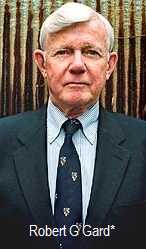
* Lt. General Robert G. Gard, Jr. is Chairman of the Center for Arms Control and Non-Proliferation where his policy work focuses on nuclear nonproliferation, missile defense, Iraq, Iran, military policy, nuclear terrorism, and other national security issues.

During his military career, Gard saw combat in both the Korea and Vietnam wars, and served a three year tour in Germany. He also served as Executive Assistant to two secretaries of defense; the first Director of Human Resources Development for the U.S. Army; Special Assistant to the Assistant Secretary of Defense for International Security Affairs; and President of National Defense University (NDU).

After retiring from the U.S. Army in 1981, after 31 years of distinguished service, Gard served for five years as director of the Johns Hopkins University School of Advanced International Studies Center in Bologna, Italy, and then as President of the Monterey Institute of International Studies from 1987 to 1998. Since 1998, he has been an active consultant in Washington, D.C., on national security issues, including the international campaign to ban anti-personnel land mines.

Facebooktwittermail

CAMPAIGN 08 EDITORIAL: The McCain-Qaeda connection

The McCain-Qaeda connection

With less than two weeks until election day, if you still haven’t decided how to vote, the McCain campaign has some advice: base your choice on al Qaeda’s choice.

If you’re convinced al Qa’eda wants McCain to win, vote Obama. If you think they want Obama, vote McCain.

That, it would seem, is the thinking that forced Randy Scheunemann, McCain’s top foreign-policy adviser, and James Woolsey to push back so vigorously against a Washington Post report that al Qaeda supports McCain.

No, no, no! Scheunemann and Woolsey protest. Muhammad Haafid (who the Post quoted) is a jihadist maverick who should not be regarded as a spokesman for al Qaeda. Indeed, if al Qaeda really wanted to see McCain elected, they would surely have the good sense to keep quiet about it. Clearly, this faux declaration of support is an attempt to undermine McCain and if al Qaeda wants to undermine McCain, it must favor Obama — except of course, as the McCain campaign points out, there’s no reason to think that Haafid speaks for al Qaeda. Is that clear? Maybe not.

The question Scheunemann and Woolsey failed to address is this: Is there any reason why American voters should be influenced by al Qaeda’s presidential preferences?

We already know that al Qaeda sees elections as opportunities for grabbing headlines, but whether we let al Qaeda steer our political judgments is up to us — unless we prefer to surrender to terrorism.

Who cares who bin Laden is rooting for? Apparently the McCain campaign cares. Otherwise they would not protest too much.

Facebooktwittermail

CAMPAIGN 08: The Great Schlep and a lame retort

Fair and balanced: Sarah Silverman vs. Jackie Mason

Just remember, if you belong to the target audience for Sarah Silverman’s video, make sure it’s the message — not the video, absolutely not the video — that you pass along to your Floridian relatives 😉

Readers should note, this video contains strong language.

Readers should note, this video contains pretty weak language.

Facebooktwittermail

CAMPAIGN 08 & EDITOR’S COMMENTS: Be careful what you wish for…

Free Sarah Palin

Maybe John McCain should fire the advisers who won’t let Sarah Palin do more interviews. The Alaska Governor has faced two major campaign challenges — her acceptance speech and last night’s debate — and each time she’s shown herself worthy of the national stage. Let Mrs. Palin be herself, and then when she makes a mistake, as every candidate does, it won’t be treated like some epic judgment on her fitness to be Vice President. [complete article]

Editor’s Comment — Sarah Palin’s performance against Joe Biden was everything the McCain campaign could have hoped for — but therein lies the campaign’s problem. Her success has nulified the argument for keeping her under wraps.

A last-minute effort by Palin supporters to paint debate-moderator Gwen Ifill as being in the tank with Obama may well have had its desired effect by making Ifill pull a few punches. Why, for instance, did Ifill not ask Palin a question that so many observers would like answered:

John McCain said this week he has turned to you for advice on foreign policy issues, and I quote: “many times in the past.” Would you tell us about a few of the foreign policy issues on which you’ve advised Mr McCain?

Since Ifill didn’t ask it, the question’s still out there.

Palin’s answer seems somewhat predictable: “We’ve talked a lot about energy policy.”

OK. Since energy policy is Palin’s silver bullet on foreign policy, national security, the economy — and who knows, maybe she can even work in an angle on health care — it’s time she gave an in-depth interview on the issue where Sarah Palin is supposedly a national expert. How about she does a segment on 60 Minutes or Face the Nation or Charlie Rose, and let’s see how she does in clearly articulating the nature of the problem and her vision of a solution when it comes to crafting an energy policy for the US.

At the end of the debate, Palin put in a request for unmediated contact with the American people:

I like being able to answer these tough questions without the filter, even, of the mainstream media kind of telling viewers what they’ve just heard. I’d rather be able to just speak to the American people like we just did.

Sorry, but that was the one and only vice-presidential debate. So, she’ll either have to rely on stump speeches, handshakes, and John McCain’s bald-faced lies about how he relies on her advice, or, she’ll need to find the courage to face the media.

A candidate who isn’t ready to deal with the press, isn’t ready to campaign — let alone hold office.

Hail Mary vs. Cool Barry

Krauthammer’s Hail Mary Rule: You get only two per game. John McCain, unfortunately, has already thrown three. The first was his bet on the surge, a deep pass to David Petraeus who miraculously ran it all the way into the end zone.

Then, seeking a game-changer after the Democratic convention, McCain threw blind into the end zone to a waiting Sarah Palin. She caught the ball. Her subsequent fumbles have taken the sheen off of that play, but she nonetheless invaluably solidifies his Republican base.

When the financial crisis hit, McCain went razzle-dazzle again, suspending his campaign and declaring that he’d stay away from the first presidential debate until the financial crisis was solved.

He tempted fate one time too many. After climbing up on his high horse, McCain had to climb down. The crisis unresolved, he showed up at the debate regardless, rather abjectly conceding Obama’s mocking retort that presidential candidates should be able to do “more than one thing at once.” (Although McCain might have pointed out that while he was trying to do two things, Obama was sitting on the sidelines doing one thing only: campaigning.)

You can’t blame McCain. In an election in which all the fundamentals are working for the opposition, he feels he has to keep throwing long in order to keep hope alive. Nonetheless, his frenetic improvisation has perversely (for him) framed the rookie challenger favorably as calm, steady and cool.

In the primary campaign, Obama was cool as in hip. Now Obama is cool as in collected. He has the discipline to let slow and steady carry him to victory. He has not at all distinguished himself in this economic crisis — nor, one might add, in any other during his national career — but detachment has served him well. He understands that this election, like the election of 1980, demands only one thing of the challenger: Make yourself acceptable. Once Ronald Reagan convinced America that he was not menacing, he won in a landslide. If Obama convinces the electorate that he is not too exotic or green or unprepared, he wins as well. [complete article]

Editor’s Comment — Charles Krauthammer can be credited as a neocon who isn’t willing to even pretend he’s started drinking the Kool-Aid. And the McCain campaign’s belief that hitching their candidates to the slogan “Maverick” is a pathway to victory, merely underlines the degree to which the word “Republican” has become toxic.

In a time of crisis, will most Americans decide they want to place a bet on Mr Unpredictable? I don’t think so. Indeed, the more McCain slides in the polls, the more unpredictable he’s likely to become. He won’t be able to persuade others to see him differently than the way he sees himself.

The voters are looking for a leader, not a loner.

Facebooktwittermail

CAMPAIGN 08: The McCain smirk

The smirk: Could McCain’s facial gestures define debate?

As the spin of Friday night’s debate settled in and both sides staked a claim to victory, one media narrative began to take hold: while Obama may have been over-complimentary of McCain, the GOP nominee was grumpy, mean, and downright contemptuous of Obama, much to his detriment.

A clip circulated by Democrats showed the McCain demonstrating all of those traits: smirking when Obama gave his answers, eyes blinking, unwilling to even look at his opponent.

It was a small visual, but one that seemed to be getting traction among the punditry. Charlie Gibson on ABC and David Brooks on PBS both noted that McCain didn’t look at Obama once. The Atlantic’s Marc Ambinder wrote that McCain sounded “angry and passionate”; MSNBC’s Chris Matthews described the GOP nominee as “troll-like” and “grouchy.”

[continued…]

Editor’s Comment — As George Bush has demonstrated, in and of itself, a smirk does not necessarily result in a political handicap. But with McCain what the smirk reveals — in combination with his unwillingness to make eye-contact with his adversary — is his fear of Obama.

The indispensable knack of “looking presidential” absolutely requires that you do not appear to fear your opponent. While some voters are weighing up the issues and making a purely personal judgment about the candidates, many more are engaged in a form of group behavior that hinges on being able to successfully predict who the winner will be – it’s all about the gravitational pull of power and the fear of social isolation.

Obama passed the looking-presidential test; McCain did not. Little else matters… Until Thursday that is, when — barring some dreadful gaffe by Biden — Sarah Palin will merely reinforce the impression that this is not a team that truly believes in its capacity to govern.

Facebooktwittermail

CAMPAIGN 08: Reforming the regulatory system for America’s financial markets

Regulation vs. deregulation

John (“I am a deregulator“) McCain can’t completely turn his back on the bedrock of his faith (“I believe in deregulation”) so instead of denouncing deregulation, he’s opting to blame the regulators — hence his silver bullet for dealing with the financial crisis would be to fire Bush-appointee Christopher Cox from his position as SEC chairman.

The financial crisis has forced the economy into the center of the presidential campaign. But as the candidates currently joust through the simplistic and emotive language of TV ads, there’s no better way of contrasting where McCain and Obama actually stand than to look back to March this year and see how they responded to the collapse of Bear Stearns.

This is what McCain had to say on the issue of regulating the financial markets:

Our financial market approach should include encouraging increased capital in financial institutions by removing regulatory, accounting and tax impediments to raising capital.

That comes from a speech McCain gave on March 25 addressing the housing crisis. In that speech he made no other reference to regulation or deregulation.

Two days later at Cooper Union in New York, Obama spoke on “Renewing the American economy.” Much of the speech was on reforming the regulatory system, but the following is a key passage:

…the American experiment has worked in large part because we guided the market’s invisible hand with a higher principle. A free market was never meant to be a free license to take whatever you can get, however you can get it. That’s why we’ve put in place rules of the road: to make competition fair and open, and honest. We’ve done this not to stifle but rather to advance prosperity and liberty. As I said at Nasdaq last September, the core of our economic success is the fundamental truth that each American does better when all Americans do better; that the well-being of American business, its capital markets and its American people are aligned. I think that all of us here today would acknowledge that we’ve lost some of that sense of shared prosperity. Now, this loss has not happened by accident. It’s because of decisions made in board rooms, on trading floors and in Washington. Under Republican and Democratic administrations, we’ve failed to guard against practices that all too often rewarded financial manipulation instead of productivity and sound business practice. We let the special interests put their thumbs on the economic scales. The result has been a distorted market that creates bubbles instead of steady, sustainable growth; a market that favors Wall Street over Main Street, but ends up hurting both. Nor is this trend new. The concentrations of economic power and the failures of our political system to protect the American economy and American consumers from its worst excesses have been a staple of our past: most famously in the 1920s, when such excesses ultimately plunged the country into the Great Depression. That is when government stepped in to create a series of regulatory structures, from FDIC to the Glass-Steagall Act, to serve as a corrective, to protect the American people and American business.

Ironically, it was in reaction to the high taxes and some of the outmoded structures of the New Deal that both individuals and institutions in the ’80s and ’90s began pushing for changes to this regulatory structure. But instead of sensible reform that rewarded success and freed the creative forces of the market, too often we’ve excused and even embraced an ethic of greed, corner cutting, insider dealing, things that have always threatened the long-term stability of our economic system. Too often we’ve lost that common stake in each other’s prosperity. Now, let me be clear. The American economy does not stand still and neither should the rules that govern it. The evolution of industries often warrants regulatory reform to foster competition, lower prices or replace outdated oversight structures. Old institutions cannot adequately oversee new practices. Old rules may not fit the roads where our economy is leading. So there were good arguments for changing the rules of the road in the 1990s. Our economy was undergoing a fundamental shift, carried along by the swift currents of technological change and globalization. For the sake of our common prosperity, we needed to adapt to keep markets competitive and fair. Unfortunately, instead of establishing a 21st century regulatory framework, we simply dismantled the old one, aided by a legal but corrupt bargain in which campaign money all too often shaped policy and watered down oversight. In doing so we encouraged a winner take all, anything goes environment that helped foster devastating dislocations in our economy. Deregulation of the telecommunications sector, for example, fostered competition, but also contributed to massive over-investment.

Partial deregulation of the electricity sector enabled (inaudible). Companies like Enron and WorldCom took advantage of the new regulatory environment to push the envelope, pump up earnings, disguise losses and otherwise engage in accounting fraud to make their profits look better, a practice that led investors to question the balance sheets of all companies and severely damaged public trust in capital markets. This was not the invisible hand at work. Instead, it was the hand of industry lobbyists tilting the playing field in Washington as well as an accounting industry that had developed powerful conflicts of interest and a financial sector that had fueled over-investment. A decade later we have deregulated the financial sector and we face another crisis. A regulatory structure set up for banks in the 1930s needed to change, because the nature of business had changed. But by the time the Glass-Steagall Act was repealed in 1999, the $300 million lobbying effort that drove deregulation was more about facilitating mergers than creating an efficient regulatory framework. And since then we’ve overseen 21st century innovation, including the aggressive introduction of new and complex financial instruments like hedge funds and non-bank financial companies, with outdated 20th century regulatory tools. New conflicts of interest recalled the worst excesses of the past, like the outrageous news that we learned just yesterday of KPMG allowing a lender to report profits instead of losses so that both parties could make a quick buck. Not surprisingly, the regulatory environment failed to keep pace. When subprime mortgage lending took a reckless and unsustainable turn, a patchwork of regulators were unable or unwilling to protect the American people. Now, the policies of the Bush administration threw the economy further out of balance. Tax cuts without end for the wealthiest Americans. A trillion dollar war in Iraq that didn’t need to be fought, paid for with deficit spending and borrowing from foreign creditors like China. A complete…

(APPLAUSE)

A complete disdain for pay-as-you-go budgeting, coupled with a generally scornful attitude toward oversight and enforcement, allowed far too many to put short-term gain ahead of long-term consequences. The American economy was bound to suffer a painful correction, and policy-makers found themselves with fewer resources to deal with the consequences. Today those consequences are clear. I see them in every corner of our great country as families face foreclosure and rising costs. I see them in towns across America, where a credit crisis threatens the ability of students to get loans and states can’t finance infrastructure projects. I see them here in Manhattan, where one of our biggest investment banks had to be bailed out and the Fed opened its discount window to a host of new institutions with unprecedented implications that we have yet to appreciate. When all is said and done, losses will be in the many hundreds of billions. What was bad for Main Street turned out to be bad for Wall Street. Pain trickled up. And that…

(APPLAUSE)

… and that’s why — that’s why the principle that I spoke about at NASDAQ last September is even more urgently true today. In our 21st century economy, there is no dividing line between Main Street and Wall Street.

The decisions made in New York’s high rises have consequences for Americans across the country. And whether those Americans can make their house payments, whether they keep their jobs or spend confidentially without falling into debt, that has consequences for the entire market. The future cannot be shaped by the best-connected lobbyists with the best record of raising money for campaigns. This…

(APPLAUSE)

This thinking is wrong for the financial sector and it’s wrong for our country. I do not believe the government should stand in the way of innovation or turn back the clock on an older era of regulation. But I do believe that government has a role to play in advancing our common prosperity, by providing stable macroeconomic and financial conditions for sustained growth, by demanding transparency and by ensuring fair competition in the marketplace. Our history should give us confidence that we don’t have to choose between an oppressive government-run economy and a chaotic, unforgiving capitalism. It tells us we can emerge from great economic upheavals stronger, not weaker. But we can only do so if we restore confidence in our markets, only if we rebuild trust between investors and lenders, and only if we renew that common interest between Wall Street and Main street that is the key to our long-term success. Now, as most experts agree, our economy is in a recession. To renew our economy and to ensure that we are not doomed to repeat a cycle of bubble and bust again and again and again, we need to address not only the immediate crisis in the housing market, we also need to create a 21st-century regulatory framework and we need to pursue a bold opportunity agenda for the American people.

Facebooktwittermail

GUEST CONTRIBUTOR – John Robertson: Is the US headed for a third war?

Is the US headed for a third war?
By John Robertson, War in Context, September 13, 2008

Don’t look now, but the US is perhaps heading for a third war – this one, with an ally (or so Mr. Bush has told us, and them, for the last eight years): Pakistan. The head of Pakistan’s army has reiterated his earlier warning to the US, that Pakistan cannot tolerate US ground and air forces (which killed another 12 people yesterday – some of them “bad guys,” but some of them reportedly women and children) repeatedly encroaching on Pakistan’s national sovereignty with such impunity.

Are al-Qaida and Taliban elements (including, most probably, Osama Bin Laden and Ayman al-Zawahiri) sheltering in Pakistan’s Northwest Frontier states and launching operations from there? Yes. Do most Pakistanis therefore believe that the US has the right to send in Navy Seal teams (that happened just a few days ago) and dispatch unmanned Predator planes to bomb people in Pakistani territory to smithereens? No.

Across Pakistan (to borrow the memorable line exclaimed by the actor Peter Finch in the movie Network more than 30 years ago), people are getting mad as hell, and are not going to take it anymore. The vast majority of Pakistanis never bought into Bush’s “war on Terror” as being their own fight (they see it as America’s war, not Pakistan’s), they resented how Bush continued to support Pakistan’s president Pervez Musharraf as his “guy” even while Musharraf undermined Pakistan’s democratic institutions (wasn’t the US committed to promoting democracy?) – and now they see the US killing people, fellow Muslims all, wantonly inside their country, after oh-so-many years of watching the US kill fellow Muslims in Iraq and Afghanistan, support Israel’s killing of them in the West Bank, Gaza, and Lebanon (and, for that matter, support its old ally Saddam Hussein’s killing of them in Iran between 1980 and 1988), and threaten the killing of them in Iran and Syria.

And at the same time, the US has been burnishing its relationship with the country that Pakistanis have seen as their most mortal enemy and most serious existential threat for 60 years. I mean India, of course – the same India that developed and tested a nuclear weapon completely under the radar of the US intelligence community, to be followed down that road by Pakistan, which felt compelled to develop its own nuclear deterrent against its larger, wealthier, more powerful neighbor. After a several-years-long fit of pique against India, the US in recent years has rushed to embrace India as an economic and strategic partner, even to the extent of pursuing an agreement that (in direct violation of internationally recognized nuclear-proliferation agreements) will provide India with advanced nuclear technology, and that more or less signals the nuclear-weapon wannabes of the world that (as Newsweek‘s Michael Hirsch has put it) “You too can rejoin the international community if you wait long enough! So keep at it.”

On the eve of his 2001 invasion of Afghanistan, most observers with any depth of awareness of that country’s historical and ethnic complexities warned Mr. Bush that he would be opening a Pandora’s box, and that US forces (like so many other invaders, from the phalanxes of Alexander the Great to the troopers sent there to maintain the British Raj in India) might be sucked into a black hole. We’ll never know if the US forces that were sent to Afghanistan might have broken that string. Mr. Bush’s poorly conceived and ill-fated digression, the hubristically and tragically misnamed “Operation Iraqi Freedom,” torched any momentum that the US had built up along any projected pathway to stability in Afghanistan.

The Bush administration may have once believed that by 2003 it had more or less closed Pandora’s box in Afghanistan. According to the ancient Greek myth, when Pandora opened her box (which was, actually, a large jar), she loosed all manner of evils into the world. But we tend to forget that she was able to clamp the lid back on quickly enough to keep one thing inside: hope. The chaos now brewing in Pakistan is surely one of the box’s escapees of 2001, nurtured to deadly maturity by its fellow escapees, the evils that have befallen the region over the past seven years. Mr. Bush (or more likely, his successor) must now find a way to get the lid back on – finally, firmly, and quickly – if he is to prevent full-blown civil war (or worse – remember, Pakistan is a state with nuclear capability). Otherwise, hope – for a stable Afghanistan, or even South Asia – may already have escaped that box as well.

John Robertson is a professor of Middle East history at Central Michigan University and has his own blog, Chippshots.

Facebooktwittermail

CAMPAIGN 08 & EDITOR’S COMMENT: Popularity breeds popularity

In Iraq, mixed feelings about Obama and his troop proposal

A tough Iraqi general, a former special operations officer with a baritone voice and a barrel chest, melted into smiles when asked about Senator Barack Obama.

“Everyone in Iraq likes him,” said the general, Nassir al-Hiti. “I like him. He’s young. Very active. We would be very happy if he was elected president.”

But mention Mr. Obama’s plan for withdrawing American soldiers, and the general stiffens.

“Very difficult,” he said, shaking his head. “Any army would love to work without any help, but let me be honest: for now, we don’t have that ability.”

Thus in a few brisk sentences, the general summed up the conflicting emotions about Mr. Obama in Iraq, the place outside America with perhaps the most riding on its relationship with him.

There was, as Mr. Obama prepared to visit here, excitement over a man who is the anti-Bush in almost every way: a Democrat who opposed a war that many Iraqis feel devastated their nation. And many in the political elite recognize that Mr. Obama shares their hope for a more rapid withdrawal of American forces from Iraq.

But his support for troop withdrawal cuts both ways, reflecting a deep internal quandary in Iraq: for many middle-class Iraqis, affection for Mr. Obama is tempered by worry that his proposal could lead to chaos in a nation already devastated by war. Many Iraqis also acknowledge that security gains in recent months were achieved partly by the buildup of American troops, which Mr. Obama opposed and his presumptive Republican opponent, Senator John McCain, supported. [complete article]

Obama faces his overseas audition

Even though the details remain sketchy, it’s clear that Barack Obama’s upcoming trip to the Middle East and Europe is an audition on the world stage. But the most important critics will not be the foreign leaders who will be sizing him up as a potential member of their ranks, or the cheering throngs that are likely to greet him at every stop. The audience that matters most will be the voters back home, where many Americans have yet to be convinced that this young man of relatively little experience is the right person to fill the role of their commander-in-chief. “This,” says Ken Duberstein, who was Ronald Reagan’s White House Chief of Staff, “is an absolute opportunity to get over the acceptability threshold.”

Polling suggests that Obama still has a way to go in that regard. In the latest Washington Post/ABC News survey, only 48% of registered voters said Obama would make a good commander in chief, with an equal percentage saying he wouldn’t. By comparison, 72% said John McCain would be a good one.

The campaign has thus far provided only the barest outline of his itinerary. On Monday, Obama will be in Amman, Jordan; on Tuesday and Wednesday, Israel and the Palestinian territory of the West Bank. Thursday, Friday and Saturday will be a sprint across Europe, with stops planned for Berlin, Paris and London. And somewhere in all this, Obama plans to make a much-anticipated visit to Iraq and Afghanistan with two Senate colleagues, Democrat Jack Reed of Rhode Island and Republican Chuck Hagel of Nebraska. [complete article]

Editor’s Comment — It might sound like the most obvious of truisms, but victory in the presidential election will go to the most popular candidate. Which is to say — and let’s assume it’s Obama — the more popular he appears, the more popular he will become.

Many people who read (as opposed to simply watching) the news, probably already know that Obama is hugely popular outside America, but that’s not something that most Americans know yet. It’s conceivable that nightly news images of Obama receiving effusive greetings and being hailed by cheering crowds of foreigners might fuel the Machuria-candidate suspicions of a few Americans, but I think the more likely deduction that most people will make is that if the rest of the world likes America’s next president, that affection will also extend towards the whole nation.

Barely concealed behind America’s need to elevate itself and be seen as a “shining beacon on the hill”, America has a much simpler and more deeply-rooted need — a need that amounts to a form of national insecurity: the need to be liked.

If Obama is able to channel his own popularity into a broader image of American revival, the effect may snowball in such a way that McCain simply has no way of competing.

Facebooktwittermail

NEWS, ANALYSIS & EDITOR’S COMMENT: A structure for dealing with Iran

Why John Bolton is right on Iran

As usual, John Bolton is absolutely right. His policy prescriptions may be reckless to the point of foolishness (”When in doubt, bomb!”), but his understanding of what is happening in Washington policy (as outlined in his op-ed in the Wall Street Journal yesterday) is unerringly accurate.

While much of the world was hyper-ventilating over the possibility that the United States (and maybe Israel) were getting ready to launch a new war against Iran, Bolton was looking at the realities and concluding that far from bombing the US was preparing to do a deal with Iran. He had noticed that over the past two years the US had completely reversed its position that originally opposed European talks with Iran. [complete article]

A test of US flexibility toward Iran

Last week, when a member of the Senate foreign relations committee repeatedly asked US undersecretary of state for political affairs William Burns if Washington was considering sending a representative to international negotiations with Iran on its nuclear programme this month, the veteran diplomat and newly anointed number-three US state department official took pains to equivocate in his response and not say anything beyond what his cabinet-level superiors had previously stated publicly.

“My question is, has there been any discussion within the administration about having an American representative at the next meeting?” Senator Chuck Hagel, a moderate Republican, asked Burns at the July 9 hearing.

“Senator, as I said, our position remains that secretary [of state Condoleezza] Rice herself is prepared to sit down in negotiations along with the [permanent members of the UN security council plus Germany] along the basis of the ‘suspension for suspension’ proposal,” Burns responded, referring to an international proposal under which if Iran would agree to suspend its uranium enrichment activities, the international community would agree to suspend international sanctions against it. [complete article]

US plans to station diplomats in Iran for first time since 1979

The US plans to establish a diplomatic presence in Tehran for the first time in 30 years as part of a remarkable turnaround in policy by President George Bush.

The Guardian has learned that an announcement will be made in the next month to establish a US interests section – a halfway house to setting up a full embassy. The move will see US diplomats stationed in the country. [complete article]

See also, US will talk to Iran (Paul Woodward, The National).

Editor’s Comment — Back in early May, during his visit to Israel, Bush told the Jerusalem Post that “before leaving office he wants a structure in place for dealing with Iran.” It was one of the clearest indications he had given that in spite of all the pro forma declarations that military action was still on the table, it was not only an option that was firmly bolted down, but Bush had a tangible alternative in mind.

Expressions of his “commitment to a diplomatic solution” have always sounded a bit flimsy — especially coming out of the mouth of a president who seems to find the diplomatic process threatening. But let’s suppose that back in May, Bush had already started toying with an idea that would be as shocking to his critics as it would be to his supporters: that the structure he had in mind to put in place for dealing with Iran was a foundation stone for diplomatic relations.

As Bush contemplated his hopes to salvage some sort of legacy, maybe he took a lesson from Nixon and concluded that his predecessor’s mistake was that he didn’t save his trip to China until close to the end of his presidency. It’s not that I anticipate seeing George Bush shaking Supreme Leader Ayatollah Ali Khamenei’s hand some time in the next few months, but I do think it’s possible that Bush is angling to pull a non-explosive surprise out of his sleeve before he leaves office.

Facebooktwittermail

REVIEW: The Dark Side

Answering terror with terror

We can’t say we weren’t warned.

The very first Sunday after the 9/11 attacks, Vice President Dick Cheney descended like a cloud on “Meet the Press” to outline the Bush administration’s response. “We’ll have to work sort of the dark side, if you will. We’ve got to spend time in the shadows in the intelligence world. A lot of what needs to be done here will have to be done quietly, without any discussion, using sources and methods that are available to our intelligence agencies — if we are going to be successful. That’s the world these folks operate in. And, uh, so it’s going to be vital for us to use any means at our disposal basically, to achieve our objectives.”

Around the nation, one presumes, numbed heads were nodding in approval. Whatever it takes to get those bastards. The true nature of our Faustian bargain would not become clear until later, and maybe it needed a journalist as steely and tenacious as Jane Mayer to give us the full picture. “The Dark Side” is about how the war on terror became “a war on American ideals,” and Mayer gives this story all the weight and sorrow it deserves. Many books get tagged with the word “essential”; hers actually is.

Above all, it underscores one of the least remarked aspects of our nation’s counterterrorist policy: the degree to which it has been driven not by spies or generals but by pasty men in ties. “The first thing we do,” goes that crowd-pleasing line from Shakespeare’s “Henry VI,” “let’s kill all the lawyers.” Readers of “The Dark Side” might be moved to add: “Before they kill you.” Almost from the moment America was attacked, Mayer writes, Cheney “saw to it that some of the sharpest and best-trained lawyers in the country, working in secret in the White House and the United States Department of Justice, came up with legal justifications for a vast expansion of the government’s power in waging war on terror. As part of that process, for the first time in history, the United States sanctioned government officials to physically and psychologically torment U.S.-held captives, making torture the official law of the land in all but name.” This “extralegal counterterrorism program,” contends Mayer, “presented the most dramatic, sustained, and radical challenge to the rule of law in American history.” [complete article]

Facebooktwittermail

CAMPAIGN 08 & EDITOR’S COMMENT: The New Yorker has its head stuck up its umlaut

‘Scare tactic’ — Obama slams Muslim portrayal

The Obama campaign is condemning as “tasteless and offensive” a New Yorker magazine cover that depicts Sen. Barack Obama (D-Ill.) in a turban, fist-bumping his gun-slinging wife.

An American flag burns in their fireplace.

The New Yorker says it’s satire. It certainly will be candy for cable news. [complete article]

Editor’s Comment — No doubt the editors of a magazine that requires the word “cooperative” to have an umlaut (¨) over the second “o”, have a hard time understanding the everyday truth that a picture is worth a thousand words. The words in The New Yorker are far too precious to be applied to that equation. And when the magazine’s smug editors think about the liberal intelligentsia that populates their intended audience, they choose to ignore that most of the New Yorker‘s readers don’t buy the magazine — they read it with a mix of boredom and anxiety that accompanies the wait in a doctors’ office. There — and across the Internet of course — the message that has much more insidious power is subliminal rather than satirical. It’s conveyed to the person who sees the image and doesn’t even pay attention to the title of the magazine. And it reinforces rather than challenges the misconceptions that it intended to mock.

The mistake was not the artist’s — it was the editors’. What could have been smart on the inside pages was totally dumb for a cover. What the editors of The New Yorker don’t seem to get, but have perfectly demonstrated, is that it’s very easy to be clever and stupid at the same time.

In addition, whether it’s at The New Yorker or NPR or PBS, any time satire has to be labeled (inside the cover of this issue, the magazine explains that the cover is satire), it has failed. The sad truth is that we live in an irony-challenged country and there’s no point pretending otherwise.

Facebooktwittermail

NEWS & ANALYSIS & EDITOR’S COMMENT: Let’s push up the price of oil

Pentagon official warns of Israeli attack on Iran

Senior Pentagon officials are concerned that Israel could carry out an attack on Iran’s nuclear facilities before the end of the year, an action that would have enormous security and economic repercussions for the United States and the rest of the world.

A senior defense official told ABC News there is an “increasing likelihood” that Israel will carry out such an attack, a move that likely would prompt Iranian retaliation against, not just Israel, but against the United States as well. [complete article]

Israel-Iran: Attack or feint

An Israeli strike is fraught with potential pitfalls and by no means guaranteed of striking a major blow to the Iranian nuclear program, which would likely require multiple raids and risk a major military escalation. (See US, Iran: Empty threats, by Kamal Nazer Yasin for ISN Security Watch.).

Any attack would also impact deleteriously on Israel’s improved position vis-à-vis western nations, the University of Haifa’s Dr Soli Shahvar told ISN Security Watch.

Referring to Iran, Kam said, “They have better air defenses than they had before, though the more sophisticated system [S-300] is probably not operational. […] Russia did supply Iran with a new, much better system [29 Tor M-1 systems].”

Russian officials relate that the S-300 surface-to-air missile is capable of intercepting aircraft at up to 27,000m and at an operating distance of 145km and believe it is superior to the Israeli-deployed US Patriot. Israeli defense analysts have confirmed that Iranian receipt of the system would make it far more difficult for the Israeli air force to attack Iranian targets. Russian supply of the system is far from assured. [complete article]

Tehran puts on a show of strength

Psychological warfare is on the rise. This weekend, a senior Iranian general, Mir-Faisal Bagherzadeh, said his country was digging 320,000 graves for American soldiers scheduled to fight in Iran. “In implementation of the Geneva Conventions, the necessary measures are being taken to provide for the burial of enemy soldiers. We have plans to dig 15,000 to 20,000 graves for each of the border provinces, or a total of 320,000,” he said, pointing out that some of them would be mass graves, if necessary. This was “to reduce the suffering of the families of the fallen in any attack against, and prevent the repetition of the long and bitter experience of the Vietnam War”.

These may sound like big words – similar to those barked by Saddam Hussein and his information minister Mohammad Said al-Sahhaf in 2003 – but they carry real impact on the psychology of American troops. Iraq – with its weak army and corrupted regime – was impossible to chew for the Americans. Nobody can imagine how difficult a war would be against 65 million Iranians, with a well-trained, well-armed military indoctrinated with Shi’ite Islam and a strong sense of purpose against the “great Satan”.

In addition to building the graves – which has actually started – the Iranians have several actions they could resort to if war were declared between now and the end of President George W Bush’s tenure at the White House in January.

They can incite the Shi’ites of nations where there are US military bases; Saudi Arabia (33%), Kuwait (36%), Bahrain (80%). They can incite the Kurds of Turkey and create problems with the Shi’ites of Yemen. They can unleash hell in Iraq through proxies like the Mahdi Army of Muqtada al-Sadr and the Supreme Iraqi Islamic Council. The Shi’ites of these countries have strong bonds to Iran and would listen and respond, if duty calls, and if the Americans or Israel went to war against Tehran. [complete article]

Editor’s Comment

The US will not allow Iran to hamper oil shipments through the Strait of Hormuz, said the US Navy’s Fifth Fleet commander, responding to earlier threats by the leader of Iran’s Revolutionary Guards.

They will not close it. They will not be allowed to close it,” said Vice-Adm. Kevin J. Cosgriff of the strait, one of the world’s most vital waterways for the shipping of hydrocarbons.

Vice Admiral Cosgriff said what a naval commander gets paid for saying. But even as he spoke, many in the oil markets, rather than being reassured, must have been remembering “Millennium Challenge 2002.” As that exercise demonstrated, protecting the Strait of Hormuz is easier said than done.

As for red lines, I suspect the one that vexes Israel more than any other, is one that is treated as unspeakable, lest by being spoken the idea acquires wider currency: that the world (including Israel) could learn to live with a nuclear Iran.

If and when the debate turns in that direction, then the game will have been lost and a new balance of power will eventually emerge — one within which Israel will be required to make accommodations rather than continuing to assume the position of being exceptional.

Facebooktwittermail

FEATURES & EDITOR’S COMMENT: America needs a better Qaeda narrative

Amid policy disputes, Qaeda grows in Pakistan

Administration lawyers and State Department officials are concerned about any new authorities that would allow military missions to be launched without the approval of the American ambassador in Islamabad. With Qaeda operatives now described in intelligence reports as deeply entrenched in the tribal areas and immersed in the civilian population, there is also a view among some military and C.I.A. officials that the opportunity for decisive American action against the militants may have been lost.

Pakistani military officials, meanwhile, express growing frustration with the American pressure, and point out that Pakistan has lost more than 1,000 members of its security forces in the tribal areas since 2001, nearly double the number of Americans killed in Afghanistan.

Some architects of America’s efforts in Pakistan defend the Bush administration’s record in the tribal areas, and vigorously deny that Washington took its eye off the terrorist threat as it focused on Iraq policy. Some also question whether Mr. bin Laden and Mr. Zawahri, Al Qaeda’s top two leaders, are really still able to orchestrate large-scale attacks.

“I do wonder if it’s in fact the case that Al Qaeda has really reconstituted itself to a pre-9/11 capability, and in fact I would say I seriously doubt that,” said Mr. Crocker, the American ambassador to Pakistan between 2004 and 2006 and currently the ambassador to Iraq.

“Their top-level leadership is still out there, but they’re not communicating and they’re not moving around. I think they’re symbolic more than operationally effective,” Mr. Crocker said.

But while Mr. Bush vowed early on that Mr. bin Laden would be captured “dead or alive,” the moment in late 2001 when Mr. bin Laden and his followers escaped at Tora Bora was almost certainly the last time the Qaeda leader was in American sights, current and former intelligence officials say. Leading terrorism experts have warned that it is only a matter of time before a major terrorist attack planned in the mountains of Pakistan is carried out on American soil. [complete article]

Editor’s Comment — Why would the branch of al Qaeda based in Pakistan be wasting its resources plotting another major attack on the US? To my mind it seems more likely that they’re now operating under the principle: No need to attack them over there when we can fight them right here.

These are strategic thinkers and I doubt that they have as strong an interest in the abstract goal of destroying Western civilization as they do in the practical goal of driving the US and its allies out of Afghanistan. 9/11 was the bait intended to draw the enemy into a fight on the home turf. We swallowed the bait.

And at the same time, let’s not lose sight of the fact that even a so-called reconstituted al Qaeda with — as the NYT claims — 2,000 local and foreign fighters, is a relatively minor player in this war.

As Graham Usher makes clear in the article below, the geographically-rooted social force here is an ethnic Pashtun movement that ultimately aspires to turn its homeland into a state. “The closest analogy,” according to Khalid Aziz, a former first secretary in the Federally Administered Tribal Areas (FATA), “is the Maoists in Nepal.”

When Obama and the Democratic chorus use the line, “finish the job” in Afghanistan and Pakistan’s tribal areas, do they have the slightest clue what this means? It’s comic-book-talk — no more sophisticated than Bush’s original “smoke ’em out of their caves” line. Anyone serious about trying to dismantle al Qaeda has to reconcile themselves to the ugly fact that this will require dealing with, rather than attempting to destroy, the Taliban. That effort could have started in September 2001. The fact that it didn’t, resulted from a failure in imagination that has haunted us ever since.

Pakistan amidst the storms

Pakistan’s insurgents are not one group, but at least four, loosely allied. There is the Pakistan Taliban and the Afghan Taliban. There are the “Kashmiri mujahideen,” native jihadist groups once nurtured by Pakistan’s intelligence agencies to fight a proxy war with India in the disputed Kashmir province but which have now cut loose from their handlers. And there is al-Qaeda and its affiliates: between 150 and 500 Arab, Uzbek and other foreign fighters who have found refuge in the FATA and use the remote tribal enclave for planning, training, rearmament and recruitment.

There are differences between the factions. The Pakistan and Afghan Taliban are still overwhelmingly ethnic Pashtun movements with a focus on Afghanistan. Al-Qaeda and the jihadists have a more global reach, including targets within Pakistan, such as the bombing on June 2 of the Danish Embassy in Islamabad. But all are united in the war against the US and NATO in Afghanistan. And all are committed to extending the Taliban’s territorial reach beyond the FATA to the NWFP as a whole, including Peshawar, the provincial capital. Such Talibanization “gives the Taliban more security, territory, recruits and bargaining power,” says a source. “It allows them to talk peace in Swat while waging war in Waziristan.”

The government’s response to Talibanization has been to temporize. In 2007, before her return, Bhutto spoke of devolving democratic power to the tribes while integrating the FATA into Pakistan proper, in effect doing away with its special “tribal” status. The focus of the Pashtun nationalist Awami National Party, which heads the NWFP Provincial Government, is economic: It has drawn up plans for a crash program of schools, colleges, rehabilitation centers and jobs to wean young tribesmen from an emerging Taliban polity that is well “on the way to primitive state formation with its own tax system, paid bureaucracy and dispute resolution,” says Aziz. For him — and many in the NWFP government — the Taliban represents less an Islamist movement than a “class revolt expressed in a religious idiom. The closest analogy is the Maoists in Nepal,” he says. It can only be addressed by the “transformation and integration” of a derelict tribal system.

Such a project “will take years,” says Aziz. It is also understood that no peace will hold in the NWFP without a resolution of the conflict with the Taliban in the FATA, which is under the remit of the federal government. And the PPP and Awami Nationalist Party have passed that buck to the army: an abdication frankly admitted by the government’s decision on June 25 to entrust the use of force in FATA entirely to Kayani. The army’s strategy for now is to secure localized peace deals that will keep the territorial advantage it obtained in February while playing divide-and-rule with the Taliban’s different tribal leaderships. It is “the policy of the breathing space,” says Afghanistan expert Ahmad Rashid.

In South Waziristan, this means extracting a pledge from the Taliban to end attacks on the army and government-sponsored development projects. In return, the army will release prisoners and “reposition” its units outside the cities. In Swat in the NWFP, the tradeoff is that the Taliban end attacks on government institutions, including girls’ schools, in return for implementation of Islamic law, seen principally as a means to coopt hundreds of jobless seminary students who may otherwise join the militants. “It’s an agreement,” says Aziz, “but not in the Western sense. In the FATA an agreement is an arrangement to coexist. It means shutting your eyes to many things.”

The Taliban have closed their eyes to the army camps that now nestle permanently in the mountains above them. And the army is looking away from a steady flow of guerrillas across the border, or at least is not acting overtly to intercept them. Peace in Pakistan, in other words, may translate into intensified warfare in Afghanistan. [complete article]

Facebooktwittermail

NEWS & EDITOR’S COMMENT: Peshawar “could fall” to the Taliban

The Taliban’s advance threatens Pakistan

“The security situation in Peshawar is grim. Officials in the home department, who evaluate the situation on an almost daily basis, believe declaring a state of red alert is now only a matter of time,” Pakistan’s Dawn newspaper reported on Tuesday.

“With militants knocking at the gates of the capital of the North-West Frontier Province (NWFP), even the more circumspect government and police officials now grudgingly concede that Peshawar, too, could fall in a few months.

“‘Peshawar is in a state of siege and if Peshawar falls, the rest of the districts in the NWFP would fall like ninepins’, a worried senior government official told Dawn.”

Pakistan’s Daily Times noted: “These days Taliban fighters do not sneak in to Peshawar. They arrive in broad daylight on the back of pick-up trucks, brandishing automatic weapons, and threatening owners of music stores to close down. ‘They had long hair and flowing beards, and were carrying Kalashnikovs. They told me to close down the shop or face the consequences,’ said Abdul Latif, a clean-shaven 20-year-old, whose video store received a visit from the vigilantes last week. ‘I asked police for help but they said they are helpless,’ he said.” [complete article]

Editor’s Comment — The Democratic Party national security posture has for several years been to claim that a clear-eyed Democratic president would “finish the job” that George Bush started in Afghanistan and from which he got distracted by Iraq.

In 2009, assuming Obama wins the election, the Democrats and the rest of America will be in for a rude awakening. A war in Afghanistan — originally dreamed up by Zbigniew Brzezinski as the Soviet Union’s Vietnam — is destined to become for the US more like Vietnam than even Iraq has been. But whereas Vietnam had the natural containment of Vietnamese nationalism, Afghanistan has no such boundaries.

The fantasy of a border between Afghanistan and Pakistan — the Durand Line — is the reason the war in Afghanistan is so difficult to prevent becoming a deeper regional conflict. With the Pakistani side of the “border” defended largely by the Frontier Corps, it’s not hard to understand why the NWFP and FATA provides the Taliban with a comfortable refuge. Created by the British, the FC retains a colonial structure: 80,000 soldiers drawn from the local population, commanded by officers from outside the region who apparently often “disdain the assignment.” FC soldiers are naturally ambivalent about fighting fellow Pashtuns, but the more heavy-handed the Pakistani Army becomes, the more the concept of Pakistan comes under threat.

American pressure on the Pakistan government to crackdown on the militants, risks provoking a civil war. In that event, the chances for NATO finishing the job in Afghanistan will be reduced to precisely zero.

A useful question to pose both presidential candidates might be this: Where do you anticipate American troops fighting for the longest? Iraq or Afghanistan?

Facebooktwittermail

CAMPAIGN 08 EDITORIAL: Obama pays his AIPAC dues — again

Obama pays his AIPAC dues — again

Barak Obama gave a little pep talk to George Bush this week. The Washington press corps either never heard about it or possibly thought it was too thin on substance to bother reporting. My guess is they never heard. Even so, when a presidential candidate feels driven to write a letter to the president, it’s curious that his campaign would not have done a conference call (again, it’s my assumption that they didn’t) or posted his letter to the president on the campaign web site or at least issued a press release. Maybe this is another case of the Obama campaign having what they have elsewhere referred to as “a very tightly wrapped message.”

The message this time seemed to have had two target audiences: The American Israel Public Affairs Committee, and the Israeli press.

Obama’s letter to Bush was reported in Yedioth Ahronoth yesterday and the Jerusalem Post today. The letter itself has been posted on the AIPAC web site.

The Democratic candidate says:

I am deeply concerned that Israel’s security has been put at greater risk, both because of renewed threats from implacable enemies like Iran, Hizbollah, and Hamas, and because of policy choices by the United States.

Obama doesn’t spell out which particular policy choices he’s referring to and he rounds off his appeal to Bush by saying:

I close by urging you to redouble your efforts to help Israelis and Palestinians achieve success in their peace efforts; to stand up for Israel’s right of self-defense; to press the Arab states to do more to advance the peace process; and to support the Israeli-Syrian talks. All of these steps will advance the interests of the United States and the security of our ally, Israel.

Most of what he says is the kind of boilerplate that might have come straight out of Condoleezza Rice’s mouth or from Bush himself. The Bush team might have refrained from chastising friendly Middle Eastern autocratic leaders, but when Obama says, “the Arab states should support the Palestinians and prepare their own people for peace by making gestures of normalization toward Israel,” he sounds pretty disingenuous. He ignores the 2002 Arab Peace Initiative and he ignores the fact that Israel continues its relentless expansion of settlements in the West Bank. He doesn’t even echo the administration’s timid rebuke in saying that settlement expansion is “unhelpful.”

The subtext here — at least I assume this was what camp Obama thought AIPAC would want to hear — was that the ceasefire with Hamas constitutes a greater threat to Israel than the threat from Qassam rockets.

If the ceasefire takes hold and gets past its bumpy start, there is a real risk that Hamas could acquire some hard sought political legitimacy. The dam that’s been holding back all those unreliable European governments who’ve never had the balls to defy Bush, might finally break. So, the message to reassure AIPAC was that just because there’s going to be a new administration in a few months, everyone can be confident that it will be just as intransigent (“Israel-friendly”) as the present one.

The one small glimmer of hope comes from Obama’s nod of approval towards the Israel-Syria negotiations. Does it count for much? Not if Obama insists on continuing to make himself a tool of AIPAC.

Facebooktwittermail

CAMPAIGN 08 & EDITOR’S COMMENT: Rising above the politics of fear

Muslim voters detect a snub from Obama

As Senator Barack Obama courted voters in Iowa last December, Representative Keith Ellison, the country’s first Muslim congressman, stepped forward eagerly to help.

Mr. Ellison believed that Mr. Obama’s message of unity resonated deeply with American Muslims. He volunteered to speak on Mr. Obama’s behalf at a mosque in Cedar Rapids, one of the nation’s oldest Muslim enclaves. But before the rally could take place, aides to Mr. Obama asked Mr. Ellison to cancel the trip because it might stir controversy. Another aide appeared at Mr. Ellison’s Washington office to explain.

“I will never forget the quote,” Mr. Ellison said, leaning forward in his chair as he recalled the aide’s words. “He said, ‘We have a very tightly wrapped message.’ ” [complete article]

Editor’s Comment — I’ve never been a fan of the word “hope” as a campaign slogan. Hope’s easy to come by — most people are able to carry at least a morsel of it all the way to their deathbed. A resource that’s in much shorter supply, yet the one that is really the only antidote to fear — especially when for so many years fear has become the political air that we’ve been compelled to breathe — is courage.

Political courage requires a certain amount of recklessness. It means reaching beyond the dictates of political tactics. If Obama really wants to end the mindset that led us to war, he needs to challenge an element that’s right at the heart of that mindset: America’s fear of Islam. So far, all he’s done is bow down to that fear.

Facebooktwittermail

ANALYSIS & EDITOR’S COMMENT: Inbedded reporting

Israel is a long way from attacking Iran

Israeli leaders and officials have recently intensified their campaign against nuclearIran. The messages from Prime Minister Ehud Olmert to Ambassador to Washington Salai Meridor and Transportation Minister Shaul Mofaz is clear: Israel will not tolerate a nuclear Iran. Indeed Israel is very concerned by the likelihood that Iran, whose leadership has called for the Jewish state’s destruction, will be able to produce nuclear weapons.

These public statements, as well as closed talks between Israel’s leadership and leaders around the world, can be interpreted as “preparing the ground” for the possibility that Israel will attack Iran. It is also correct that all the bodies dealing with the “Iran case,” including the Mossad, Military Intelligence, Operations Directorate of the Israel Defense Forces, Israel Air Force and the Israeli Atomic Energy Commission, are planning for the worst-case scenario. This is their professional duty. But one cannot conclude, as many have following a report in The New York Times (June 19) that an Israeli attack is certainly around the corner. Not only has such a decision not been made in any relevant forum in Israel – the question has not even been discussed. [complete article]

Editor’s Comment — When an “inbedded” reporter like Michael Gordon not only performs a service for his government, but is internationally seen to be acting as a stooge, I wonder how he feels?

Last Friday, no-questions-asked, he got the Israeli-attack-on-Iran-rehearsal story out and it provoked lots of reaction. A bump in oil prices (yet another little windfall for Iran), a rebuke from the Iranian government, a threat that Mohamed ElBaradei would resign as director of the IAEA in such an event, and a carefully studied no-comment from the Israeli government. Even if this was an Israeli Air Force exercse, the consensus among Israeli commentators was that the story — courtesy of Pentagon-mouthpiece Michael Gordon — was an expression of American pressure.

The fact is, a military exercise of this nature is not really newsworthy. As Amos Harel noted in Haaretz: “There is little new in the fact that the IAF is preparing for the Iranian challenge. About six months ago, Channel 2 reported a similar exercise covering a radius that an operation against Iran would require. At the time the report received little attention.” Indeed, assuming that the IAF as an active and well-trained air force will periodically engage in major exercises, what would we expect them to be training to do? Attack France?

So why did the Pentagon/New York Times need to get the story out? The Iranians know that the Bush administration is a spent force and the antics of attention-seeking neocons are becoming increasingly easy to ignore, but mad-dog Israel — that’s always the wild card. Less than a year ago it burnished its image of unpredictability by bombing Syria. The idea that Israel is unpredictable is at this point the only thing that has any chance of keeping the Iranians on their toes.

Facebooktwittermail