Category Archives: Issues

OBAMA’S “NEW” APPROACH TO THE MIDDLE EAST: Bring in a “dead-hand on the wheel peacemaker”

Obama picks Ross as Mideast envoy

Dennis Ross, a former top diplomat for the George H W Bush and Clinton administrations, will become the Obama administration’s top envoy on the Middle East, an internal email from Mr Ross’s current employer has revealed.

Mr Ross, who previously served as the US envoy for the Israeli-Palestinian conflict, is set to take a wider role as Hillary Clinton’s top adviser for the Middle East as a whole. Ms Clinton herself is due to appear before the Senate Foreign Relations Committee for her confirmation hearing for Secretary of State next Tuesday. [continued…]

Editor’s Comment — As Augustus Norton said: “Dennis Ross who was a dead-hand on the wheel as peacemaker in the Clinton [and Bush senior administrations]. His chief accomplishment the Hebron agreement –enough said.”

Can Obama change the Middle East? No, he can’t

Many Americans who voted for Barack Hussein Obama are hoping that his administration will at last break with America’s traditional, and invariably harmful, behaviour in the Middle East.

That would mean letting American oil companies fend for themselves in the free-for-all to control Mideast oil, leaving Israel’s colonists on the West Bank to pay their own way and abandoning the dictatorships in Egypt and Saudi Arabia to face the wrath of their populations without protection from American weapons and spies. And that is as likely as President Obama naming Ralph Nader to head the Securities and Exchange Commission and Patrick Fitzgerald, the US Attorney now prosecuting Obama’s Democratic Party comrades in Illinois, to be Attorney General.

Obama has improved the rhetoric, but no one who asked Hillary (“annihilate Iran”) Clinton to preside over the State Department or the failed Clinton-era hatchet man Dennis Ross to advise on Palestine has any intention of making the Middle East safe for democracy. [continued…]

Facebooktwittermail

MUST READ: Avi Shlaim puts the Gaza catastrophe in its historical context

How Israel brought Gaza to the brink of humanitarian catastrophe

The only way to make sense of Israel’s senseless war in Gaza is through understanding the historical context. Establishing the state of Israel in May 1948 involved a monumental injustice to the Palestinians. British officials bitterly resented American partisanship on behalf of the infant state. On 2 June 1948, Sir John Troutbeck wrote to the foreign secretary, Ernest Bevin, that the Americans were responsible for the creation of a gangster state headed by “an utterly unscrupulous set of leaders”. I used to think that this judgment was too harsh but Israel’s vicious assault on the people of Gaza, and the Bush administration’s complicity in this assault, have reopened the question.

I write as someone who served loyally in the Israeli army in the mid-1960s and who has never questioned the legitimacy of the state of Israel within its pre-1967 borders. What I utterly reject is the Zionist colonial project beyond the Green Line. The Israeli occupation of the West Bank and the Gaza Strip in the aftermath of the June 1967 war had very little to do with security and everything to do with territorial expansionism. The aim was to establish Greater Israel through permanent political, economic and military control over the Palestinian territories. And the result has been one of the most prolonged and brutal military occupations of modern times.

Four decades of Israeli control did incalculable damage to the economy of the Gaza Strip. With a large population of 1948 refugees crammed into a tiny strip of land, with no infrastructure or natural resources, Gaza’s prospects were never bright. Gaza, however, is not simply a case of economic under-development but a uniquely cruel case of deliberate de-development. To use the Biblical phrase, Israel turned the people of Gaza into the hewers of wood and the drawers of water, into a source of cheap labour and a captive market for Israeli goods. The development of local industry was actively impeded so as to make it impossible for the Palestinians to end their subordination to Israel and to establish the economic underpinnings essential for real political independence.

Gaza is a classic case of colonial exploitation in the post-colonial era. Jewish settlements in occupied territories are immoral, illegal and an insurmountable obstacle to peace. They are at once the instrument of exploitation and the symbol of the hated occupation. In Gaza, the Jewish settlers numbered only 8,000 in 2005 compared with 1.4 million local residents. Yet the settlers controlled 25% of the territory, 40% of the arable land and the lion’s share of the scarce water resources. Cheek by jowl with these foreign intruders, the majority of the local population lived in abject poverty and unimaginable misery. Eighty per cent of them still subsist on less than $2 a day. The living conditions in the strip remain an affront to civilised values, a powerful precipitant to resistance and a fertile breeding ground for political extremism.

In August 2005 a Likud government headed by Ariel Sharon staged a unilateral Israeli pullout from Gaza, withdrawing all 8,000 settlers and destroying the houses and farms they had left behind. Hamas, the Islamic resistance movement, conducted an effective campaign to drive the Israelis out of Gaza. The withdrawal was a humiliation for the Israeli Defence Forces. To the world, Sharon presented the withdrawal from Gaza as a contribution to peace based on a two-state solution. But in the year after, another 12,000 Israelis settled on the West Bank, further reducing the scope for an independent Palestinian state. Land-grabbing and peace-making are simply incompatible. Israel had a choice and it chose land over peace. [continued…]

Facebooktwittermail

MONOGRAPH: Hamas and Israel: Conflicting strategies of group-based politics

Hamas and Israel: Conflicting strategies of group-based politics

Summary

The conflict between Palestinians and Israelis has heightened since 2001, even as any perceived threat to Israel from Egypt, Jordan, Iraq, or even Syria, has declined. Israel, according to Chaim Herzog, Israel’s sixth President, had been “born in battle” and would be “obliged to live by the sword.” Yet, the Israeli government’s conquest and occupation of the West Bank and Gaza brought about a very difficult challenge, although armed resistance on a mass basis was only taken up years later in the Intifadha. Israel could not tolerate Palestinian Arabs’ resistance of their authority on the legal basis of denial of self-determination, and eventually preferred to grant some measures of self-determination while continuing to consolidate control of the Occupied Territories, the West Bank, East Jerusalem, and Gaza. However, a comprehensive peace, shimmering in the distance, has eluded all, even as inter-Israeli and inter-Palestinian divisions deepened as peace danced closer before retreating.

Israel’s stance towards the democratically-elected Palestinian government headed by Hamas in 2006, and towards Palestinian national coherence–legal, territorial, political, and economic–has been a major obstacle to substantive peacemaking. The reasons for recalcitrant Israeli and Hamas stances illustrate both continuities and changes in the dynamics of conflict since the Oslo period (roughly 1994 to the al-Aqsa Intifadha of 2000). Now, more than ever, a long-term truce and negotiations are necessary. These could lead in stages to that mirage-like peace, and a new type of security regime.

The rise in popularity and strength of the Hamas (Harakat al-Muqawama al-Islamiyya, or Movement of the Islamic Resistance) Organization and its interaction with Israel is important to an understanding of Israel’s “Arab” policies and its approach to counterterrorism and counterinsurgency. The crisis brought about by the electoral success of Hamas in 2006 also challenged Western powers’ commitment to democratic change in the Middle East because Palestinians had supported the organization in the polls. Thus, the viability of a two-state solution rested on an Israeli acknowledgement of the Islamist movement, Hamas, and on Fatah’s ceding power to it.

Shifts in Israel’s stated national security objectives (and dissent over them) reveal Hamas’ placement at the nexus of Israel’s domestic, Israeli-Palestinian, and regional objectives. Israel has treated certain enemies differently than others: Iran, Hizbullah, and Islamist Palestinians (whether Hamas, supporters of Islamic Jihad, or the Islamic Movement inside Israel) all fall into a particular rubric in which Islamism–the most salient and enduring socio-religious movement in the Middle East in the wake of Arab nationalism–is identified with terrorism and insurgency rather than with group politics and identity. The antipathy to religious fervor was somewhat ironic in light of Israel’s own expanding “religious” (haredim) groups. In Israel’s earlier decades, Islamic identity politics were understood and successfully repressed, as Israelis did not want to allow any repetition of the Palestinian Mufti’s nationalism or the Qassamiyya (the armed brigades in the 1936-39 rebellion).

Yet at the same time, identity politics and religious attitudes were not eradicated, but were inside of Israel, bringing about great inequality as well as physical and psychological separation of the Jewish and non-Jewish populations. This represented efforts to control politically and physically the now 20 percent Arab minority, and dealt with the demographic threat constantly spoken of in Israel by warding off intermarriage, limiting property control and rights, and physical access. Still today, some Israeli politicians call for an exodus by Palestinian-Israelis (so-called Arab-Israelis) in some areas, who they wish would resettle in the West Bank, in the permitted areas of course.

For decades, Muslim religious properties and institutions were managed under Jewish supervision–substantial inter-Israeli conflict over that supervision notwithstanding–and this allowed for a continuing stereotype of the recalcitrant, anti-modern Muslims and Arabs who were punished for any expression of Palestinian (or Arab) nationalism by replacing them–imams or qadis, for instance–with more quiescent Israeli Muslims, and by retaining Jewish control over endowment (waqf) properties and income.

Contemporary Islamism took hold in Palestinian society, as it has throughout the Middle East and has, to a great degree, supplanted secular nationalism. This is problematic in terms of the conflict between Israel and the Palestinians because the official Israeli position towards key Islamists–Iran, Hizbullah, and the Palestinian groups like Hamas, Islamic Jihad, or Hizb al-Tahrir–characterizes them as Israel-haters and terrorists. They have become the existential threat to Israel (along with Iran) since the demise of Saddam Hussein in Iraq.

Israel steadfastly rejected diplomacy and truce offers by Hamas for 8 months in 2008, despite an earlier truce that held for several years. By the spring of 2008, continued rejection of a truce was politically risky as Prime Minister Ehud Olmert teetered on the edge of indictment by his own party and finally had to announce his resignation in the summer. In fact, on his way out the door, Olmert announced a peace plan that ignores Hamas and many demands of the Palestinian Authority as a whole ever since Oslo. If the plan was merely to create a sense of Olmert’s legacy, it is not altogether clear why it offered so little compromise.

On the other hand, Israelis have for over a year been discussing the wisdom of reconquering the Gaza strip (a prospect that would aid the Fatah side of the Palestinian Authority) and also engage in “preemptive deterrence” or attacks on other states in the region. This could happen at any time if the truce between Israel and Hamas breaks down, although the risks of any of these enterprises would be high. A deal with Syria was also announced by Olmert, similarly, perhaps, to stave off his own resignation, and Syria made a counteroffer. Turkish-mediated indirect talks were to continue at the time of this writing, though they might be rescheduled. Support for an Israeli attack on Iran continues to play well in the Israeli media, despite the fact that Israelis argue fiercely about the wisdom of such a course. All of this shows flux in the region, with Israel in its customary strong, but concerned position.

Hamas emerged as the chief rival to the secularist-nationalist framework of Fatah, the dominant member of the Palestine Liberation Organization (PLO). This occurred as Palestinians rebelled against the worsening conditions they experienced following the Oslo Peace Accords. Hamas’ political and strategic development has been both ignored and misreported in Israeli and Western sources which villainizes the group, much as the PLO was once characterized as an anti-Semitic terrorist group. Relatively few detailed treatments in English counter the media blitz that reduces Hamas to its early, now defunct, 1988 charter.

Disagreements within the Israeli military and political establishments over the national security objectives of that country reveal Hamas’ placement at the nexus of Israel’s domestic, Palestinian, and regional objectives. This process can be traced back to Ariel Sharon’s formation of the KADIMA Party and decision to withdraw unilaterally from Gaza without engaging in a peace process with Palestinians. This reflected a new understanding that Arab armies were unlikely to launch any successful attack against Israel, but Israel should focus instead on protecting its Jewish citizens via barrier methods.

This new thinking coexists alongside the long-standing policies described by Yitzhak Shamir as aggressive defense; in other words, offensives aimed at increasing Israel’s strategic depth, or attacking potential threats in neighboring countries-as in the raid on the nearly completed nuclear power facility at Osirak, Iraq, in 1981, or the mysterious Operation ORCHARD carried out on a weapons cache in Syria in September 2007, or in the invasions and ground wars (1978, 1982, 2006) in Lebanon.

Israelis considered occupied Palestinian territories valuable in land-for-peace negotiations. During the Oslo process, according to Israelis, Israel was ready to withdraw entirely to obtain peace. Actually, the value of land to trade for peace and costs of maintaining security for the settlers there, as well as containing the uprisings, were complicated equations. Palestinians and others argue that, in fact, Israel offered no more in the various proposed exchanges than the less valuable portion of the western West Bank and Gaza, and refused to deal with outstanding issues such as the fate of Palestinian refugees (4,913,993 Palestinians live outside of Israel and the occupied territories; 1,337,388 UNRWA–registered refugees–live in camps, and 3,166,781 live outside of camps), prisoners, water, and the claim of Jerusalem as a capital.

Many Arabs believe that Israel never intended the formation of a Palestinian state, and that its land-settlement policies during the Oslo period provide proof of its true intentions. Either way, the “Oslo optimism” faded away between Israelis and Palestinians with the al-Aqsa (Second) Intifadha in October 2000.

The Israeli Right, and part of its Left, claimed that the diplomatic collapse, plus Arafat’s government’s corruption, showed there was no “partner to peace.” Another segment of the Israeli Left has continued until this day to argue for land-for-peace and complete withdrawal from the territories.

According to Barry Rubin, the Israeli military felt the Palestinian threat would not increase, and that if settlers could be evacuated and a stronger line of defense erected, they might better defend their citizenry. That defense could not be achieved with suicide attacks ongoing in Israeli population centers. When earlier Israeli strategies had not achieved an end to Palestinian Islamist violence, Israelis had pushed this task onto the Fatah-dominated Palestinian Authority in the 1990s. Pointing to the failures of the Palestinian Authority, the new Israeli “securitist” (bitchonist, in Hebrew, or security-focused) strategy moved away from negotiations, and called for further separation and segregation of the Israeli population from Palestinians. Neither a full-blown physical resistance by Palestinians, including suicide attacks, or the missiles launched from Gaza could be dealt with in this manner. The first depended on granting Palestinians rights to partial self-government, and the missile attacks were negotiated in Israel’s June 2008 truce.

Israel claimed significant victories in its war against Palestinians by the use of targeted killings of leadership, boycotts, power cuts, preemptive attacks and detentions, and punishments to militant’s families, relatives, and neighborhoods etc., because its counterterrorism logic is to reduce insurgents’ organizational capability. This particular Israeli analysis rejects the idea that counterterrorist violence can spark more resistance and violence, but also admitted that Israel had not “defeated the will to resistance” [of Palestinians]. This admission suggests that the tactics employed might not be indefinitely manageable, and that Palestinians, despite every possible effort made to weaken or incriminate them, to discourage or prevent their Arab non-Palestinian supporters from defending their interests, and to buy the services of collaborators, could edge Israelis back toward comprehensive negotiations, or rise up again against them. Moshe Sharett, Israel’s second Prime Minister, once asked: “Do people consider that when military reactions outstrip in their severity the events that caused them, grave processes are set in motion which widen the gulf and thrust our neighbors into the extremist camp? How can this deterioration be halted?”

Hamas and its new wave of political thought, which had supported armed resistance along with the aim to create an Islamic society, had overtaken Fatah in popularity. Fatah, with substantial U.S. support edged closer to Israeli positions over 2006-07, promising to diminish Palestinian resistance, although President Mahmud Abbas had no means to do so, and could not even ensure Fatah’s survival in the West Bank without Hamas assent, and had been routed from Gaza.

Negotiating solely with the weaker Palestinian party–Fatah–cannot deliver the security Israel requires. This may lead Israel to reconquer the Gaza strip and continue engaging in “preemptive deterrence” or attacks on other states in the region in the longer term.

The underlying strategies of Israel and Hamas appear mutually exclusive and did not, prior to the summer of 2008, offer much hope of a solution to the Israeli-Palestinian-Arab conflict. Yet each side is still capable of revising its desired endstate and of necessary concessions to establish and preserve a long-term truce, or even a longer-term peace. [See the complete 107-page monograph [PDF]]

Facebooktwittermail

EDITORIAL: Israeli propaganda campaign downplays the success of the truce – UPDATED

Israeli propaganda campaign downplays the success of the truce

(UPDATE: Since the graphs appearing below have been removed from the Israeli Ministry of Foreign Affairs (MFA) website, some readers might have doubts about there authenticity. However, Jeffrey Goldberg who blogs at the Atlantic, has kindly alerted me to the source that the MFA continues to cite for its statistics on rocket fire from Gaza in 2008. The graphs I reproduced can be found in that document.

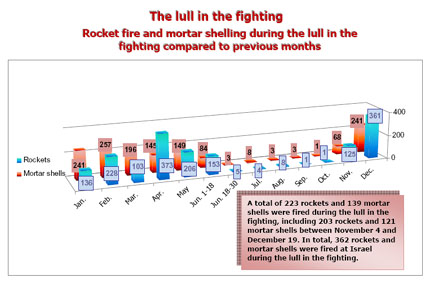
Goldberg writes: “Israel’s Ministry of Foreign Affairs cites this report [PDF] that claims that 362 rockets and mortars were fired into Israel from Gaza into Israel during what the report calls the ‘lull’ in the fighting. I think it’s fair to say that, though the numbers of rocket and mortar attacks dropped off dramatically during the ceasefire, there were, indeed, attacks.”

What Goldberg fails to point out is that of these 362 rockets and mortars fired, 324 were launched after Israel broke the ceasefire on November 4, 2008. During the period in which the ceasefire was being maintained by both Hamas and Israel from June 18 until November 4, there were a total of 38 fired. This averages 8.5 rocket and mortar attacks per month. As far as I am aware, none of these were conducted by Hamas and the level of attacks can be seen as a measure of the effectiveness (not absolute) with which Hamas was able to reign in other militant groups such as Islamic Jihad.)
_____

For four months, from Summer into Fall, the truce between Israel and Hamas was a stunning success. Indeed, if Israel doubted Hamas’ ability or willingness to engage in a truce, the Jewish state would have had no reason to request that the truce be extended as its expiration approached and passed in late December.

But now is a time of war and not only is talk of a truce being ruled out by the authors of this war but history is being re-written in order to degrade the value of a ceasefire. The memory of a period of recent calm that was the most durable peace that the residents of southern Israel have experienced in recent years must now be erased.

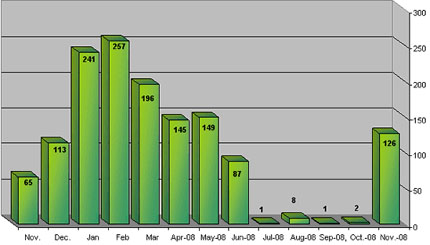
The Israeli government’s own graphical representation of the calm told the story in terms that even a child could understand. This is the graph that the Israel Ministry of Foreign Affairs displayed on its web site demonstrating that from July to October, rocket fire, if not reduced to a perfect zero, came stunningly close. From an average of 179 rockets per month in the preceding period of 2008, the number fell to just three per month:

Now that the Israeli propaganda machine is revved up to full throttle, the image of an effective truce no longer suits the Israeli government’s purposes. Instead it has become more convenient to try and hide the numbers — with numbers! The foreign ministry has thus removed the simple graph shown above and replaced it with this:

In the earlier image, graph blocks dramatically portrayed the rise and fall in rocket fire rates. In the revised image, blocks of equal size (containing numbers) are used to obscure the graph. The effect, clearly intended, is to try and portray the lull as really nothing more than a minor undulation in a period of unremitting attacks.

The message Israel now wants to sell is that the truce never really worked. Instead of acknowledging that the truce effectively collapsed when Israel launched Operation “Double Challenge” on November 5, the rocket fire that followed that Israeli raid is being used to obscure the fact that rocket fire had effectively been curtailed up to that point.*

On the IDF Spokesman web site, a post on rocket statistics simply omits the part of the record that Israel now finds inconvenient to acknowledge:

  • Between Hamas’ takeover and the start of the Tahadiya (State of Calm), (June 14, 2007 – June 16, 2008), there was an average of over 361 attacks per month—an increase of an additional 350%.
  • On Nov. 4 – 5, Israel launched Operation “Double Challenge”, targeting a tunnel Hamas was building as part of a plan to kidnap Israeli soldiers.
  • From the end of Operation “Double Challenge” until the end of the Tahadiya, (Nov. 4 – Dec. 19, 2008) a period of only a month and a half, there were 170 mortars, 255 Qassams, and 5 Grads fired upon Israel’s civilian population centers.
  • Since the end of the Tahadiya (Dec. 19, 2009) until the beginning of Operation “Cast Lead,” (Dec. 27, 2008) a period of little more than a week, there were approximately 300 mortars and rockets fired onto Israel.
  • Since the begining of Operation “Cast Lead”, there have been an additional 500 launches, 284 of which have been verified as rockets (both Qassams and Grads), and 113 as mortars.

Was four months of calm really worthless? Given that it became the precursor to war, the answer now apparently is yes.

But it didn’t have to turn out this way. The effectiveness with which Hamas enforced a truce should have provided the impetus for Israel to lift its economic siege of Gaza.

Instead, we are once again witness to Israel’s seemingly insatiable appetite for war, even while it never tires of professing its love of peace.

* Should anyone doubt that the Israeli raid (official declarations about Israel’s commitment to the truce notwithstanding) constituted a unilateral breach of the truce, consider what Israel and the world’s response would have been in the event that the raid had been launched from Gaza. Hamas gunmen conducted a raid inside Israeli territory, killing six Israeli soldiers.

That wouldn’t have been described as a breakdown in the truce; it would have been regarded as an act of war.

Facebooktwittermail

OPINION & EDITOR’S COMMENT: Time for engagement in a new political process

Israel can’t bomb its way to peace

Israel has no viable political endgame here: There’s just no clear route from bombardment to a sustainable peace. But the damage caused by this new conflagration won’t be limited to the Israelis and Palestinians. Israel’s military offensive already has sparked outrage and protests throughout the Arab world. The current crisis also may destabilize some of the more moderate Arab governments in the region — in Egypt, for instance — where leaders now face popular backlash if they don’t repudiate Israel.

And if you think that none of this really matters for us here in the U.S., you’re kidding yourself. Arab and Islamic anger over Palestine continues to fuel anti-Western and anti-U.S. terrorism around the globe.

It’s time for the United States to wake up from its long slumber and reengage — forcefully — with the Middle East peace process. Only the U.S. — Israel’s primary supporter and main financial sponsor — can push it to make the hard choices necessary for its own long-term security, as well as the region’s. In January 2001, the Taba talks between Israel and the Palestinian Authority came achingly close to a final settlement, but talks broke down after Likud’s Ariel Sharon was elected prime minister on Feb. 6, 2001. Sharon refused to meet with Yasser Arafat, and newly inaugurated President George W. Bush had no interest in pushing Israel toward peace.

Eight years later, Israel faces another election, and we’re about to swear in a new president. When he takes office, Obama needs to push both Israelis and Palestinians to sit back down, with the abandoned Taba agreements as the starting point. Here’s to a less bloody 2009. [continued…]

Editor’s Comment — It’s good that there’s at least one American columnist willing to speak about what’s happening in Gaza without being an apologist for Israel. Yet in terms of the broader political perspective, calls for renewed US engagement in the Middle East peace process beg the most important question: engagement with whom?

When the dust finally settles in Gaza, Hamas will re-emerge politically strengthened while Fatah and the Palestinian Authority will be seen by most Palestinians as having been at best, ineffectual, and at worst, quislings serving the Israeli government.

What Israel’s latest war is doing is further unmasking the chasm between Arab leaders and the people they claim to represent.

The code word “moderate” means nothing more than an Arab leader with whom a Western leader is willing to be seen shaking hands. But what these hand shakes are capable of accomplishing politically has been vastly overestimated for the simple reason that the will of the people continues being left out of the equation.

If the Obama administration wants to make a radical break with the past, it might consider not a re-engagement with what has become a hollow “peace process.” It might in fact disengage from an issue that Israel has to solve for itself. Instead, it should look across the political landscape, become better acquainted with the real locuses of emerging political power and then deliver a message of bitter political realism to its regional allies: Look hard and fast for ways to accommodate your political foes, because if you don’t they will destroy you and in the chaos that ensues the whole world will suffer.

Facebooktwittermail

EDITORIAL: Trust is not a birthright

Trust is not a birthright

There is a conceit that has so thoroughly poisoned the minds of most Israelis that it is regarded as an unquestionable truth: we occupy the moral high ground.

This poison distorts every question, not least the most pressing issue of this moment: can a ceasefire between Israel and Hamas be restored?

Implicit in that question as it is being considered by Israel is the assumption that Israel’s willingness and ability to abide by a ceasefire is beyond question and that the only real question is whether Hamas can be trusted to do the same. But even that is not really treated as a question. The heart of the issue, Israel would have us believe, is: can Hamas be forced into a truce?

When, after ignoring the subject for several days, the New York Times finally got around to making an editorial pronouncement on the war on Gaza, it trotted out what is among most inattentive observers the conventional wisdom:

Hamas never fully observed the cease-fire that went into effect on June 19 and Israel never really lived up to its commitment to ease its punishing embargo on Gaza.

In fact, Hamas’ compliance with the ceasefire was stunningly disciplined. Don’t take my word for it. The proof comes from the Israeli government.

Look at this graph provided by the Israeli Foreign Ministry showing rocket attacks from Gaza per month during 2008. From January through June there were an average of 179 rocket attacks per month. From July through October there were an average of 3 rocket attacks per month.

For the residents of Sderot, those months were indeed a period of calm. But the calm ended when Israel unilaterally broke the ceasefire right after the US elections and just before Hamas and Fatah sat down for crucial reconciliation talks in Cairo.

If Israel, as it would currently have the world believe, was so strongly in favor of extending the six-month ceasefire, why did it attach so little value to what had already been accomplished? Why did it not acknowledge the effectiveness with which Hamas was holding up its side of the bargain? Why did it not demonstrate that it valued the calm by lifting or at least easing the economic embargo on Gaza in a significant way?

All Israel accomplished was to confirm Hamas’ suspicions – suspicions shared by most Palestinians – that Israel cannot be trusted.

Facebooktwittermail

EDITORIAL: Silence has become complicity

Silence has become complicity

Is the incoming president, world-renowned for his eloquence, about to become better known for his silence?

Barack Obama may not have assumed office yet but a war is already being conducted in his name.

Israel’s defense minister, Ehud Barak, now says that Israel is engaged in a “war to the bitter end” against Hamas in Gaza. And in justifying this war to Israel’s state assembly, the Knesset, Barak said: “Obama said that if rockets were being fired at his home while his two daughters were sleeping, he would do everything he could to prevent it.”

Barak’s war has become Barack’s war — unless he breaks his silence.

Obama chooses his words carefully. He did so when speaking to the press in Sderot in southern Israel, during the presidential election campaign this summer. While he was clearly and shamelessly pandering to American Jewish voters, his statement expressed sympathy for the Israelis being targeted by Qassam rocket fire, but it also underlined that an effective response would focus on preventing further attacks — not merely the retaliatory and bellicose response with which Israelis are so familiar, that is, a military operation whose purpose is “to teach the Palestinians a lesson.”

If Obama continues to remain silent he will implicitly be sending a message to Israelis, Palestinians, and everyone else across the Arab world. His silence will be seen and will have the operational effect of providing an endorsement for Israel’s war on Gaza. His silence will set the tone for his whole approach to the Middle East. If his plan to give a major speech in a Muslim capital has not already been put on hold, it might as well now be scrapped.

But there is an alternative. This is what Obama can and should say:

I support the Israeli government in its goal of providing security for its citizens. However, I believe that the current operation in Gaza is unlikely to serve that goal and in the long run may further undermine Israel’s security.

What can Israel do now? Pull back its troops, offer to renew the truce and lift the siege.

The truce actually worked, as this graph from the Israeli Foreign Ministry clearly shows.

Rocket fire did not resume until Israel broke the truce on November 5.

What we now know, is that Israel did not view the truce as a means to bring calm to southern Israel but instead used it as an aid for gathering intelligence in preparation for war.

Had the Olmert government regarded the cessation of rocket fire as a foundation upon which it could build, it would have taken clear steps to lift the siege. (But to have pursued such a course would not however have provided the Palestinian body count upon which Israel’s next prime minister hopes to ride into office.)

Instead, what we now witness is a brutal spectacle in which, using the Orwellian language of war, Israel claims that it’s target is Hamas, not the residents of Gaza.

Obama is still in a position to exert influence, but the longer he waits, the less power he will have; the more likely he will be seen as the perpetuator of George Bush’s failed approach to the Middle East.

Facebooktwittermail

NEWS, VIEWS & EDITOR’S COMMENT: Treating the Hamas-denial complex

Livni: I will topple Hamas regime in Gaza if elected PM

Foreign Minister Tzipi Livni vowed on Sunday to end Hamas’s rule in the Gaza Strip if she is elected prime minister in a February election.

“The state of Israel, and a government under me, will make it a strategic objective to topple the Hamas regime in Gaza,” Livni told members of her centrist Kadima party. “The means for doing this should be military, economic and diplomatic.” [continued…]

Editor’s Comment — Did Tzipi Livni make this announcement in front of a crowd of 200,000 supporters (the size of the crowd in Gaza City that came to celebrate Hamas’ 21st anniversary)? Will her Kadima party even be around for 21 years?

The fact that Hamas is still in power is not due to a lack of effort on the part of Israel and its allies to apply a massive amount of pressure to bring the group down. Indeed, not only has Hamas demonstrated its resilience but it has also benefited politically from the pressure.

Having won parliamentary elections in 2006, had Hamas been allowed to govern, its merits and failings as a political organization and governing entity would subsequently have been judged by the Palestinian electorate. But neither Fatah, the Israelis or The Quartet were interested in finding out whether Hamas could pass this democratic test.

But let’s entertain some of Livni’s wishful thinking and suppose that a couple more years of siege and periodic bombardment might do the trick and lead to the collapse of the Hamas government. What then? Is liberal democracy going to rise from the ashes? Probably not. A much more probable course would be something parallel to what’s happened in Somalia. With the ousting of the Islamic Courts Union, taking its place as a political force has been the strengthening and expansion of the more radical Shabaab.

Those who dream of the end of Hamas should fear what the fulfillment of their dreams might bring.

Tony Blair, the dolt with a part-time job as envoy for The Quartet (a job to which he devotes just one week a month) told Haaretz: “I can’t see any basis for an agreement between the international community and Hamas. How do you negotiate the two-state solution with people if they don’t accept your right to exist? That’s the problem. Some people tell me, ‘You spoke with the IRA,’ and I tell them we only did that once they accepted that the solution will only be through peaceful means.”

Is Blair telling a pure, unadulterated lie, or has his political seasoning left incapable of discriminating between deceit and truthfulness?

The British government — as Blair surely knows — started talking to the IRA long before it renounced violence. The Good Friday Agreement enshrined that commitment. The end of violence, as everyone understood, would be among the fruits of successful negotiations — not a pre-condition for entering into talks.

If all sides were willing to simultaneously renounce violence, that would be a fine thing. Language after all is a far more constructive tool than explosives. But of course neither side believes it would benefit from unilateral disarmament. Instead, we can only have a much more ugly process that involves a mix of words and violence. The most practical and immediate goal should be for both sides to explore ways of adjusting the proportions of that mix. Right now, they’re both heading in the wrong direction.

Talk to Hamas

Politicians, generals and the public all know that any substantial incursion into the Gaza Strip will be a catastrophe. Still, no one dares ask why, for heaven’s sake, not try to talk directly with Hamas?

Gaza has an established authority that seized power democratically and then forcibly, and proved it has the power to control the territory. That, in itself, isn’t bad news after a period of anarchy. But Israel and the world don’t like Hamas. They want to overthrow it, but their diabolical scheme isn’t working out. The two-year siege and boycott that included starvation, blackouts and bombardments have produced no sign that Hamas is weaker. On the contrary: The ceasefire was violated first by Israel with its unnecessary operation of blowing up a tunnel.

What everybody already knew to be false – that the political choice of a people could be changed through violence, that the Gazans could be made into Zionists by being abused – was tried anyway. Now we have to finally change direction, to do what nobody has tried before, if only because we have no other choice.

Any excuse against such an attempt does not hold water. Hamas doesn’t recognize Israel; what does it matter? Hamas is a fundamentalist movement? That’s irrelevant. Hamas will decline holding talks? Let’s challenge it. Direct talks with Hamas will weaken Palestinian Authority President Mahmoud Abbas? He’s weak anyway.

What does Israel have to lose besides its much-anticipated wide-scale operation that it can carry out anytime? Why not try the diplomatic option before the military one, and not the other way around like we’re used to? [continued…]

Facebooktwittermail

NEWS & EDITOR’S COMMENT: Muntader al-Zaidi

When the shoe fits

In a war that has been punctuated by iconic moments, the shoe will be the symbol that most likely endures longest in connecting George Bush to Iraq. In 2003, the sight of a statue of Saddam Hussein being assaulted with footwear highlighted the moment in which, at Mr Bush’s instigation Saddam’s regime had visibly lost power. In 2008, the sight of the US president ducking to avoid flying shoes conveyed the eagerness among many Iraqis to witness Mr Bush’s exit from power.

While Muntader al-Zaidi may have been simply been venting a spontaneous outburst of anger as he hurled both his shoes at the president of the United States of America, his act of defiance struck a chord with many Iraqis along with fellow Arabs across the region.

As Hazim Edress, a resident of Mosul, told The New York Times: “He has done what the whole world could not.” [continued…]


(via Firedoglake)

Editor’s CommentMarc Lynch is concerned that the Muntader al-Zaidi story might distract attention from Human Rights Watch’s new report, The Quality of Justice: Failings of Iraq’s Central Criminal Court. But reports, however worthy of attention, rarely garner much public interest. Indeed, if reports and rumors about Zaidi’s mistreatment in detention turn out to be true, his case may well serve to draw attention towards Iraq’s failed justice system.

This is a case where one would have thought that out of pure self-interest and political expediency, the White House would be pushing for Zaidi’s prompt release simply to serve its own public relations interests. The longer that takes to happen, the more potent a symbol Zaidi will become.

Facebooktwittermail

The assault of Mumbai

Last gunmen killed in India, ending siege

Security forces brought a three-day assault on India’s financial and cultural capital to an end Saturday morning, killing the last remaining gunmen holed up in one of the city’s luxury hotels after freeing hostages and recovering bodies from two hotels and a Jewish center Friday.

Pakistani officials, responding to charges by Indian leaders that the attack was carried out by an organization with ties to Pakistan, said a senior intelligence officer would travel to India, in an apparent attempt to ease tensions between the two nuclear-armed states.

Indian officials said they now believe that at least 15 gunmen carried out the operation after reaching Mumbai by sea. After an interrogation of one of the attackers, Indian intelligence officials said they suspected that a Pakistani Islamist group, Lashkar-i-Taiba, was responsible. An Indian intelligence document from 2006 obtained by The Washington Post said members of the group had been trained in maritime assault. [continued…]

‘I saw them land on the jetty’

“In the darkness, I saw eight young men stepping out of the raft, two at a time. They jumped into the waters, and picked up a haversack. They bent down again, and came up carrying two more haversacks, one in each hand,” said Tamore. The bags, he thought, looked very heavy.

They were in their 20s, fair-skinned and tall, clad in jeans and jackets. “The man who was lying down shouted at them, asking what they were doing there. So one of them shouted back ‘Tussle mut le ‘. When they approached me, I also asked them who they were, and what were they doing there. One of them said ‘student hai’.”

Tamore said he found their presence unusual, but as they said they were students, and were carrying haversacks, he didn’t think much about it. He thought they were youngsters returning from a picnic. [continued…]

Mumbai police declare Taj Mahal hotel siege over

The militants may have reconnoitred the hotels by checking in as guests, Indian newspaper reports said today. They appeared to be well trained and “very, very familiar” with the layout of the hotel, an army general said.

“At times we found them matching us in combat and movement. They were either army regulars or have done a long stint of commando training,” a commando told the Hindustan Times.

A bag found in the Taj Mahal hotel contained 400 rounds of ammunition, grenades, identity cards, rations, $1,000 (£650) in cash and international credit cards, indicating a meticulously planned operation. [continued…]

U.S. intelligence focuses on Pakistani group

American intelligence and counterterrorism officials said Friday that there was mounting evidence that a Pakistani militant group based in Kashmir, most likely Lashkar-e-Taiba, was responsible for this week’s deadly attacks in Mumbai.

The officials cautioned that they had reached no firm conclusions about who was responsible for the attacks, or how they were planned and carried out. Nevertheless, they said that evidence gathered in the past two days pointed to a role for Lashkar-e-Taiba or possibly another group based in Kashmir, Jaish-e-Muhammad, which also has a track record of attacks against India.

The officials requested anonymity in describing their current thinking and declined to discuss specifics of the intelligence that they said pointed to Kashmiri militants. In the past, the American and Indian intelligence services have used communications intercepts to tie Kashmiri militants to terrorist strikes. Indian officials may also be gleaning information from at least one captured gunman who participated in the Mumbai attacks.

According to one Indian intelligence official, during the siege the militants have been using non-Indian cellphones and receiving calls from outside the country, evidence that in part led Indian officials to speak publicly about the militants’ external ties. [continued…]

Pakistani militants at center of probe

Evidence collected by police in Mumbai, along with intelligence gathered by U.S. and British officials, has led investigators to concentrate their focus on Islamist militants in Pakistan who have long sought to spark a war over the disputed province of Kashmir. India and Pakistan have already fought two wars over Kashmir, the battleground between Hindu-majority India and Muslim-majority Pakistan that each country claimed soon after India’s partition in 1947.

A U.S. counterterrorism official said additional evidence has emerged in the past 24 hours that points toward a Kashmiri connection. “Some of what has been learned so far does fall in that direction,” the official said, declining to offer specifics.

“We have to be careful here,” said the official, speaking on the condition of anonymity. “When you posit a Kashmiri connection, that puts Pakistan on the table. That is huge, enormous, but what does it mean? It can be anything from people who were [initially] in Pakistan, to maybe people who used to be associated with someone in the Pakistani government, to any gradation you could find.” [continued…]

Britons are among those detained, official claims

Britons were among the militants arrested for the Bombay attacks, a senior Indian official said yesterday.

Vilasrao Deshmukh, the chief minister of Maharashtra state, in which Bombay lies, made the claim on an Indian television station.

Patrick Mercer, MP, a former Conservative security spokesman, told The Times that he had been given information that at least two of the terrorists had credit cards and other identifying documents that linked them to Dewsbury, West Yorkshire. Other reports last night claimed that men from Leeds and Bradford were among the terrorists. [continued…]

Facebooktwittermail

EDITORIAL: Who comes first?

Who comes first?

The tribal areas of western Pakistan along with the least developed parts of southern and eastern Afghanistan have become the epicenter of international handwringing.

On one level, “the problem” revolves around government military forces being constrained by an international boundary, while their opponents can use that constraint to their advantage. On another level, there’s a struggle to find a suitable balance between bullying and helping as Nato pursues its bomb and build strategy.

The one constant is that no one seems to think that the indigenous population has the preeminent right to determine its own future.

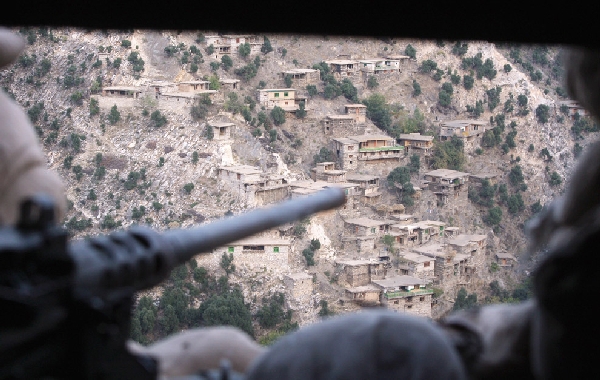
Consider the Korengal Valley in eastern Afghanistan and the people who inhabit this rugged terrain. A fascinating photographic essay in the Boston Globe last week sheds light on some of the inherent contradictions in western efforts to impose a military solution on a topographical reality.

Look at the human craft in the physical structure of this mountainside settlement — something that might not be immediately apparent when viewing this hamlet down the barrel of a gun:

Note, there are no roads. To the western eye, this is a development problem.

At the same time it is also an extraordinary indigenous accomplishment. Men and women and donkeys alone did all the heavy lifting. But instead of admiring the ability of people to master the art of survival in a challenging environment, we regard them as living in a state of deprivation. With a road, life would be better — or so we think.

But do they want a road? Apparently not. The report says: “U.S. and Afghan officers tried to convince the [Korengal Valley] elders to accept a new paved road through the Korengal Valley as part of a large American development project. The elders refused the road, however, saying that they would prohibit anyone in their valley from working on the project.”

What would a road provide for the people of Korengal? Most predictably, the means for Americans to establish larger and more heavily equipped military bases. Beyond that, a road would provide the means to tame a harsh environment. It would diminish the value of the resilience of those who for centuries have survived without a road.

Where a people invest their pride, we see their backwardness and then are perplexed when they spurn our goodwill. We suffer from the burden that dogs every evangelist: how can you insult someone and help them at the same time?

Meanwhile, the narrative that drives out all others is that Afghanistan is now in a downward spiral with the Talilban having established control over a substantial portion of the country.

Counterinsurgency expert, David Kilcullen, tells The New Yorker:

We have built the Afghan police into a less well-armed, less well-trained version of the Army and launched them into operations against the insurgents. Meanwhile, nobody is doing the job of actual policing—rule of law, keeping the population safe from all comers (including friendly fire and coalition operations), providing justice and dispute resolution, and civil and criminal law enforcement. As a consequence, the Taliban have stepped into this gap; they currently run thirteen law courts across the south, and ninety-five per cent of the work of these courts is civil law, property disputes, criminal matters, water and grazing disputes, inheritances etc.—basic governance things that the police and judiciary ought to be doing, but instead they’re out in the countryside chasing bad guys. Where governance does exist, it is seen as corrupt or exploitative, in many cases, whereas the people remember the Taliban as cruel but not as corrupt. They remember they felt safer back then. The Taliban are doing the things we ought to be doing because we are off chasing them instead of keeping our eye on the prize—securing and governing the people in a way that meets their needs.

Kilcullen could have said, “The Taliban have established law and order across much of southern Afghanistan. What can we learn from their success?”

Most importantly, in a war that was originally billed as being driven by a moral imperative, how has it come to pass that in this “good war” our allies are corrupt while our opponents are able to establish some system of justice?

To ask such a question is not to excuse the brutality of the Taliban, but merely underline how utterly lost we have become in a country and a region we insist on trying to reshape even while it still eludes our understanding.

Facebooktwittermail

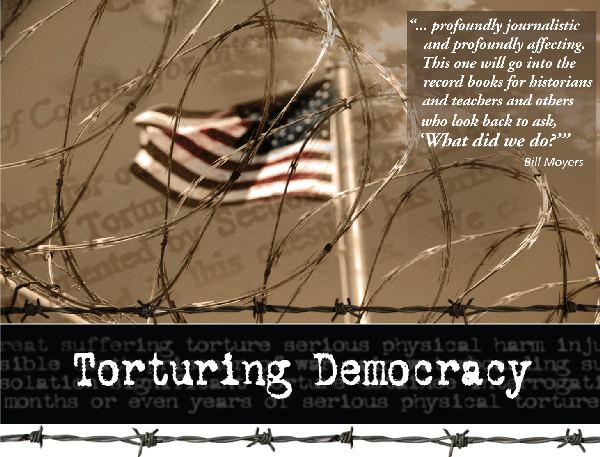
Torturing Democracy


Torturing Democracy, a major documentary film more than 18 months in the making, has been airing on individual public television stations around the US since October — although PBS has been reluctant to air it nationally.

The 90-minute film, from Emmy and DuPont awarding-winning producer Sherry Jones, relies on the documentary record to connect the dots in an investigation of interrogations of prisoners in U.S. custody that became “at a minimum, cruel and inhuman treatment and, at worst, torture,” in the words of the former general counsel of the United States Navy.

Up to date with the latest revelations, Torturing Democracy details how the government set aside the rule of law in its pursuit of harsh interrogations of suspected terrorists. It features in-depth interviews with numerous senior military and government officials.

Former Deputy Secretary of State Richard Armitage describes – for the first time on-camera – being waterboarded during military training before he was sent to Vietnam. When producer Jones asked Mr. Armitage if he considered waterboarding to be torture, he answered, “Absolutely. No question.” He added: “There is no question in my mind – there’s no question in any reasonable human being, that this is torture. I’m ashamed that we’re even having this discussion.”

Torturing Democracy can be viewed in three parts (part one, part two, part three).

Facebooktwittermail

America’s historic choice


Barack Obama’s victory speech

If there is anyone out there who still doubts that America is a place where all things are possible; who still wonders if the dream of our founders is alive in our time; who still questions the power of our democracy, tonight is your answer.

It’s the answer told by lines that stretched around schools and churches in numbers this nation has never seen; by people who waited three hours and four hours, many for the very first time in their lives, because they believed that this time must be different; that their voice could be that difference.

It’s the answer spoken by young and old, rich and poor, Democrat and Republican, black, white, Latino, Asian, Native American, gay, straight, disabled and not disabled. Americans who sent a message to the world that we have never been a collection of Red States and Blue States: we are, and always will be, the United States of America. [continued…]

The 44th President

This is one of those moments in history when it is worth pausing and reflecting on the basic facts:

An American with the name Barack Hussein Obama, the son of a white woman and a black man he barely knew, raised by his grandparents far outside the stream of American power and wealth, has been elected the 44th president of the United States.

Showing extraordinary focus and quiet certainty, Mr. Obama defeated first Hillary Clinton, who wanted to be president so badly that she lost her bearings, and then John McCain, who forsook his principles for a campaign built on anger and fear.

Mr. Obama won the election because he saw what is wrong with this country: the utter failure of government to protect its citizens. He promised to lead a government that does not try to solve every problem but will do those things beyond the power of individual citizens: to regulate the economy fairly, keep the air clean and the food safe, ensure that the sick have access to health care, and educate children to compete in a globalized world.

Mr. Obama spoke candidly of the failure of Republican economic policies that promised to lift all Americans but left so many millions far behind. He committed himself to ending a bloody and pointless war. He promised to restore Americans’ civil liberties and this country’s tattered reputation around the world. With a message of hope and competence he drew in legions of voters who had been disengaged and voiceless. [continued…]

President Obama

They did it. They really did it. So often crudely caricatured by others, the American people yesterday stood in the eye of history and made an emphatic choice for change for themselves and the world. Though bombarded by a blizzard of last-minute negative advertising that should shame the Republican party, American voters held their nerve and elected Barack Obama as their new president to succeed George Bush. Elected him, what is more, by a clearer majority than one of those bitter narrow margins that marked the last two elections. [continued…]

Facebooktwittermail

Election Day – November 4, 2008

Live election coverage on MSNBC:


Turning the page

In a world where a person like Barack Hussein Obama can appear from nowhere and advance within a few years to the highest levels of world politics, nothing is predictable, and therefore everything is possible.

Today, it seems at the moment, the incredible will happen: the most important “white” country in the world will elect a black president.

One hundred forty-three years after the assassination of Abe Lincoln, the man who freed the slaves, and 40 years after the assassination of Martin Luther King, the dreamer of the Dream, a black family will occupy the White House.

This will have huge implications in many directions. One of them is an electrifying message to a worldwide order to which I belong: the Order of the Optimists.

How does an optimist differ from a realist? My definition is: a realist sees reality as it is. An optimist sees reality as it could be. [continued…]

Facebooktwittermail

NEWS & VIEWS ROUNDUP & EDITOR’S COMMENT: November 3

Marathon man: for McCain, a final burst of enthusiasm

It seems fitting that John McCain woke up Sunday morning in a hotel populated with lanky runners getting ready to run the city’s marathon. This weekend was the very last mile of the presidential marathon, a race we’ve all been running so long we can’t remember what it feels like to walk.

To hear the senator’s campaign tell it, McCain is precisely where he wants to be in the final stretch. Never mind that Barack Obama is up ahead and sprinting.

“We think we can catch this guy,” said McCain adviser Mark Salter, sipping coffee during a smallish rally Saturday in Perkasie, Pa. He described his boss as upbeat.

“At the very end of the marathon, you get your second wind,” said McCain’s running mate, Sarah Palin, in one of the campaign’s two comedic appearances this weekend — the unplanned one. (McCain appeared on “Saturday Night Live,” while Palin was punk’d by a Canadian comedian pretending in a phone call to be French President Nicolas Sarkozy.) [continued…]

Editor’s Comment — John McCain’s willingness to fight a dirty campaign has been taken as indicative of his ruthless determination to win, but to my eye that determination has never been clearly evident. The tactics he has employed seem to say less about his core drives than they do about the lack of imagination in those around him.

When McCain says he’s exactly where he wants to be — fighting from behind — I take him at his word. He is far more comfortable as the underdog and the maverick than he is in coming out on top. When it came to being the scrappy fighter, McCain played the role while Hillary Clinton was the real thing.

Look at McCain on Saturday Night Live. He is more at ease standing next to Tina Fey than he is with his actual running mate.

Is this a man fighting for his political life? Far from it. It seems much more like a man who is quietly comfortable about returning to the Senate. Having given up on the sprint, his attention rests on the possibility of his post-defeat political resurrection.

Obamacon Jeffrey Hart

TDR: Is the Obamacon movement a product of the perceived failures of the Republican Party among certain conservatives?

JH: Yes.

TDR: Then Obama is in the right place at the right time?

JH: Yes. I had a discussion with Milton Friedman once. Milton always liked to start up arguments, and he almost never won them. We got to the pure food and drug act: too much regulation was his take, if you put out a bad product people won’t buy it, but what about if someone sells ketchup that has botulism in it? Milton says you can sue. But not if you’re dead of course. So that’s an argument he didn’t win. This is the position the Republican Party finds itself in.

TDR: When did you start supporting Senator Obama?

JH: He first attracted my attention, and everybody’s attention, at the 2004 Democratic National Convention, where he made a speech that was really stirring. Then I began to pay attention to him; this guy was a comer. The way Harold Ford of Tennessee is a comer too; he was beaten by the Republican slime machine in Tennessee. They used a racist ad about him, but he is as smart as Obama is.

As the race for president developed, I saw Obama down in Lebanon; he has both a charismatic personality and high intelligence. We face complicated problems particularly with the economy and foreign policy. The Israeli-Palestinian conflict is very complicated, relations everywhere are complicated: you have to be smart to figure this stuff out, and he’s smart. He’s much smarter than McCain, and McCain also has the Bush ideology. So it was no contest for me between Obama and McCain…

TDR: Do you think that Iraq is the most important issue in this election?

JH: Well, all the assumptions that inform the Iraq invasion are typical of misunderstood social realities, I think. Look at Iraq, at National Review or The Weekly Standard or all those papers that promoted the invasion—I never heard the word Sunni, Shiite, or Kurd in their editorials. It is tough to reconcile these factions in Iraq, if not impossible. I don’t think you have to be as vicious as Saddam, he was running a Sunni government, but to represent a minority in a country is difficult. You probably need a strong leader to rule Iraq, but until they have a looser federation, real problems will continue to plague the country.

TDR: So considering the importance of Iraq, how would you respond to those who suggest that Barack Obama lacks the military credentials that McCain possesses?

JH: You don’t need a military background. Lincoln had only sketchy experience of military action, in a war against the Crow Indians. But he was a great war leader, he was a very bright and very eloquent man, highly intelligent. McCain’s war experience is not a foreign policy credential: he bombed North Vietnam, and the only North Vietnamese he saw was when he was in prison. I don’t see that, as you know, war experience. It’s parachuting into a lake and flying a plane. [continued…]

The opening Obama saw

A good politician triumphs by adapting to the times and taking advantage of opportunities as they come. A great politician anticipates openings others don’t see and creates possibilities that were not there before.

John McCain might have been the second kind of politician, tried to be the first and enters Election Day at a steep disadvantage. Barack Obama certainly seized the opportunities created by President Bush’s failures and the country’s profound discontent, which only deepened after the economic crash. But by creating a new social movement, new forms of political organization, and a sense of excitement and possibility not felt in politics for three decades, he is bidding to become one of the country’s most consequential leaders. [continued…]

The test

In 1934, President Franklin Roosevelt asked Frances Perkins, his Secretary of Labor, to draft a plan that might help Americans escape poverty in old age. “Keep it simple,” he told her. “So simple that everybody will understand it.” On August 14, 1935, after bargaining in Congress, Roosevelt signed the Social Security Act at a White House ceremony. The law “represents a cornerstone in a structure which is being built but is by no means complete,” the President said. He continued:

    It is a structure intended to lessen the force of possible future depressions. . . . It is, in short, a law that will take care of human needs and at the same time provide the United States an economic structure of vastly greater soundness.

Roosevelt hoped that the elderly would also receive health insurance; Congress balked. It took thirty years—until July 30, 1965, when Lyndon Johnson signed the Medicare bill—to protect older Americans from the ravages of sickness as well as poverty. These were Democratic initiatives, but they gradually became national compacts: Ronald Reagan defended Social Security, and George W. Bush expanded Medicare. They, too, came to recognize that a sound system of social insurance enabled by government makes capitalism and its splendid innovations (the iPhone, the Cartoon Network, the Ultimate Fishing Tool, etc.) more balanced and sustainable.

Last week, the Department of Commerce reported that the economy is shrinking. Almost certainly, the United States has entered its twelfth official recession since Roosevelt’s death. Most of the past eleven recessions have been short and mild, in part because of the “automatic stabilizers,” as economists call them, created by New Deal-inspired insurance and regulatory regimes. The current financial crisis, however, has already proved so severe and so volatile that it has smashed or bypassed a number of important shock absorbers. Some economists fear that this downturn may therefore be atypically long and painful.

The country is fortunate in one respect: the sudden buckling of financial safeguards has put just about everyone in touch with his inner New Dealer. [continued…]

America’s outcast Muslims

American Muslims have been called the “outcasts” of this presidential election. Muslims themselves have told the media that Islam is being treated as “political leprosy”, a “scarlet letter”, or the “kiss of death”. In Pittsburgh, a city with a large Muslim population, the Guardian team heard sentiments like these when we attended a lecture by the writer and political analyst Raeed Tayeh titled Are Americans Obsessed with Islam?, followed by a panel discussion involving local community leaders and advocates.

One of the few comprehensive surveys (pdf) of Muslim voters in the United States was produced two years ago by the Council on American-Islamic Relations (CAIR). While they are a diverse community, American Muslims overall tend to be young, well educated, professional, middle-class, and family-oriented, and differ in their degree of religious observance. Muslims are also somewhat more likely than Americans in general to vote regularly, fly the US flag and do volunteer work.

Most importantly for this election, CAIR’s demographic research found that American Muslims were concentrated in 12 states, including the battleground states of Pennsylvania, Ohio, Florida, Virginia, and Michigan, where they ran from about 3 to 7% of the population. In the survey, 42% of respondents said they were Democrats and just 17% identified themselves as Republicans, while 28% said they did not belong to a political party. This reflects a dramatic turnaround in the past decade: in 2000, George Bush won an astonishing 72% of the Muslim vote, based on some combination of his social and fiscal conservatism, perceived openness on the Israeli-Palestinian conflict and deliberate outreach to the Muslim community. By 2004, with the “war on terror” and the war in Iraq under way and civil liberties in a shambles, the numbers were more than reversed, with some 90% of Muslim voters choosing Kerry. [continued…]

Why we need to call a pig a pig (with or without lipstick)

In 1944, a young British writer named Eric Blair sent the publisher Jonathan Cape a manuscript for a novel-length parable about the rise of Stalin. The book had already been rejected by one editor for its inflammatory content. Cape also declined. While he personally enjoyed the manuscript, he wrote, he believed it was “highly ill-advised to publish at the present time.” Perhaps Blair might have better luck were he to change the identity of the main characters? “It would be less offensive if the predominate caste in the fable were not pigs,” he wrote. Blair finally found a publisher, and the book, “Animal Farm,” released under Blair’s pseudonym, George Orwell, became a bestseller. But the experience proved instructive. The next year, in the essay “Politics and the English Language,” he wrote that degraded, unclear language was both symptom and cause of the decline of contemporary culture and political thought. “One ought to recognize that the present political chaos is connected with the decay of language, and that one can probably bring about some improvement by starting at the verbal end,” he wrote. In other words, it’s important to call a pig a pig.

Since its publication in 1945, “Animal Farm” has sold more than 10 million copies worldwide, and become a standard text for schoolchildren, along with Orwell’s other dystopian vision of the future, “1984.” But it is the writer’s essays on the importance of clear language and independent thought that make him relevant. Consider this, from “Politics and the English Language”: “The word Fascism has now no meaning except insofar as it signifies ‘something not desirable.’ The words democracy, socialism, freedom, patriotic, realistic, justice, have each of them several different meanings which cannot be reconciled with one another … Words of this kind are often used in a consciously dishonest way.” Substitute “anti-American” for “Fascism,” and you’ve summarized the tenor of much of the public conversation regarding the current election and the war in Iraq. “We’re so saturated in media today that anyone who is following it is bound to think, ‘This is terrible language; what are the effects of these clichés on my mind?’ ” says George Packer, a staff writer at The New Yorker who has edited two new collections of Orwell’s essays, “Facing Unpleasant Facts: Narrative Essays” and “All Art Is Propaganda: Critical Essays.” “God knows, I’ve wanted to use that essay as a purgative. Orwell tells you how to cut through the vapor and get the truth and write about it in a way that is vigorous and clear. Those skills are particularly necessary right now.” [continued…]

Facebooktwittermail

NEWS & VIEWS ROUNDUP & EDITORIAL: October 31

Moving beyond opposition

In any presidential contest between two candidates there are essentially six ways in which each ballot can be cast. In the current election, this means you can vote in one of the following ways.

  • Vote for Obama because of who he is and what you hope he will do.
  • Vote for McCain because of who he is and what you hope he will do.
  • Vote for Obama because of who he is and what you hope he will do and because of who McCain is and what you fear he will do.
  • Vote for McCain because of who he is and what you hope he will do and because of who Obama is and what you fear he will do.
  • Vote for Obama for the simple reason that you do not want McCain to become president.
  • Vote for McCain for the simple reason that you do not want Obama to become president.

Just suppose that having received their party’s nomination, each candidate had declared: “If you genuinely want me to become president, I want your vote, but if you have any other reason for voting for me, don’t vote.”

Under such terms, John McCain might as well have withdrawn from the race in early September.

On the other side, the idea that support for Obama has been driven above all by antipathy for George Bush has been greatly overstated. Dennis Kucinich and Ron Paul each made as strong a claim as did Obama for having opposed Bush, yet neither won a fraction of the support.

When 100,000 people have showed up for an Obama rally, they have been drawn by attraction, not reaction. This is what distinguishes the strength of Obama’s candidacy in 2008 from the weakness of John Kerry’s in 2004.

Whereas a McCain victory hinges on the McCain-Palin campaign’s ability to fuel and harness fear of and opposition to Obama, an Obama victory will reflect the depth of his support more than the breadth of opposition to John McCain or Sarah Palin.

This then is what will mark the end of the Bush era: the end of the notion that victory depends on destroying ones opponents; that we can move beyond defining who we are in terms of what we oppose.

The next president and the Global War on Terror

A week ago, I had a long conversation with a four-star U.S. military officer who, until his recent retirement, had played a central role in directing the global war on terror. I asked him: what exactly is the strategy that guides the Bush administration’s conduct of this war? His dismaying, if not exactly surprising, answer: there is none.

President Bush will bequeath to his successor the ultimate self-licking ice cream cone. To defense contractors, lobbyists, think-tankers, ambitious military officers, the hosts of Sunday morning talk shows, and the Douglas Feith-like creatures who maneuver to become players in the ultimate power game, the Global War on Terror is a boon, an enterprise redolent with opportunity and promising to extend decades into the future.

Yet, to a considerable extent, that very enterprise has become a fiction, a gimmicky phrase employed to lend an appearance of cohesion to a panoply of activities that, in reality, are contradictory, counterproductive, or at the very least beside the point. In this sense, the global war on terror relates to terrorism precisely as the war on drugs relates to drug abuse and dependence: declaring a state of permanent “war” sustains the pretense of actually dealing with a serious problem, even as policymakers pay lip-service to the problem’s actual sources. The war on drugs is a very expensive fraud. So, too, is the Global War on Terror. [continued…]

Petraeus wants to go to Syria; Bush administration says no

A pparently Gen. David Petraeus does not agree with the Bush administration that the road to Damascus is a dead end.

ABC News has learned, Petraeus proposed visiting Syria shortly after taking over as the top U.S. commander for the Middle East.

The idea was swiftly rejected by Bush administration officials at the White House, State Department and the Pentagon.

Petraeus, who becomes the commander of U.S. Central Command (Centcom) Friday, had hoped to meet in Damascus with Syrian President Bashar al-Assad. Petraeus proposed the trip, and senior officials objected, before the covert U.S. strike earlier this week on a target inside Syria’s border with Iraq.

Officials familiar with Petraeus’ thinking on the subject say he wants to engage Syria in part because he believes that U.S. diplomacy can be used to drive a wedge between Syria and Iran. He plans to continue pushing the idea. [continued…]

High risk, limited payoff

The Oct. 26 air raid in which U.S. special-operations pilots flew two dozen Black Hawk helicopters across Iraq’s border and killed eight people on Syrian territory marks a new phase in the Bush administration’s war on terror—a phase rife with limited payoffs and astonishingly high risks.

U.S. officials say the cross-border attack was aimed at, and killed, a high-level al-Qaida agent known as Abu Ghadiyah, who has long been smuggling jihadists and arms into western Iraq.

However, Syrian officials say the strikes killed civilians, including a woman and children. They filed a complaint with the U. N. Security Council, closed down the American School in Damascus, and canceled their participation in the upcoming regional conference on Iraqi security.

Even the Iraqi government has joined the Syrians in condemning the airstrikes and is now insisting that a new Status of Forces Agreement—the treaty that permits U.S. troops to remain in Iraq—must include a clause forbidding those troops from using Iraq as a base for attacking other countries. [continued…]

A last push to deregulate

The White House is working to enact a wide array of federal regulations, many of which would weaken government rules aimed at protecting consumers and the environment, before President Bush leaves office in January.

The new rules would be among the most controversial deregulatory steps of the Bush era and could be difficult for his successor to undo. Some would ease or lift constraints on private industry, including power plants, mines and farms.

Those and other regulations would help clear obstacles to some commercial ocean-fishing activities, ease controls on emissions of pollutants that contribute to global warming, relax drinking-water standards and lift a key restriction on mountaintop coal mining. [continued…]

Scandal of six held in Guantanamo even after Bush plot claim is dropped

In the dying days of the Bush administration, yet another presidential claim in the “war on terror” has been proved false by the withdrawal of the main charge against six Algerians held without trial for nearly seven years at Guantanamo prison camp.

George Bush’s assertion in his 2002 State of the Union address – the same speech in which he wrongly claimed that Saddam Hussein had tried to import aluminium tubes from Niger – was that “our soldiers, working with the Bosnian government, seized terrorists who were plotting to bomb our embassy [in Sarajevo].” Not only has the US government withdrawn that charge against the six Algerians, all of whom had taken citizenship or residence in Bosnia, but lawyers defending the Arabs – who had already been acquitted of such a plot in a Sarajevo court – have found that the US threatened to pull its troops out of the Nato peacekeeping force in Bosnia if the men were not handed over. According to testimony presented by the Bosnian Prime Minister, Alija Behman, the deputy US ambassador to Bosnia in 2001, Christopher Hoh, told him that if he did not hand the men to the Americans, “then let God protect Bosnia and Herzegovina”.

That such a threat should be made – and the international High Representative to Bosnia at the time, Wolfgang Petritsch, has also told lawyers it was – shows for the first time just how ruthless and unprincipled US foreign policy had become in Mr Bush’s “war on terror”. By withdrawing their military and diplomatic support for the Bosnian peace process, the Americans would have backed out of the Dayton accord which they themselves had negotiated. Then the Bosnian government would have lost its legitimacy and the country might have collapsed back into a civil war which claimed the lives of tens of thousands of civilians and involved mass rape as well as massacre. The people of Bosnia might then have endured “terror” on a scale far greater than the attacks of al-Qa’ida against the United States. [continued…]

The co-president at work

When George W. Bush testified before the 9/11 Commission, Dick Cheney was with him in the Oval Office. What was said there remains a secret, but throughout the double session, it appears, Cheney deferred to Bush. Aides to the President afterward explained that the two men had to sit together for people to see how fully Bush was in control. A likelier motive was the obvious one: they had long exercised joint command but neither knew exactly how much the other knew, or what the other would say in response to particular questions. Bush also brought Cheney for the reason that a witness under oath before a congressional committee may bring along his lawyer. He could not risk an answer that his adviser might prefer to correct. Yet Bush would scarcely have changed the public understanding of their relationship had he sent in Cheney alone. “When you’re talking to Dick Cheney,” the President said in 2003, “you’re talking to me.”

The shallowest charge against Cheney is that he somehow inserted himself into the vice-presidency by heading the team that examined other candidates for the job. He used the position deviously, so the story goes, to sell himself to the susceptible younger Bush. The truth is both simpler and more strange. Since 1999, Cheney had been one of a group of political tutors of Bush, including Condoleezza Rice and Paul Wolfowitz; in this company, Bush found Cheney especially congenial—not least his way of asserting his influence without ever stealing a scene. Bush, too, resembled Cheney in preferring to let others speak, but he lacked the mind and patience for discussions: virtues that Cheney possessed in abundance.
New York Review Books Children

As early as March 2000, Bush asked him whether he would consider taking the second slot. Cheney at first said no. Later, he agreed to serve as Bush’s inspector of the qualifications of others; his lieutenants were David Addington and his daughter Liz. Some way into that work, Bush asked Cheney again, and this time he said yes. The understanding was concluded before any of the lesser candidates were interviewed. It was perhaps the first public deception that they worked at together: a lie of omission—and a trespass against probity—to give an air of legitimacy to the search for a nominee. But their concurrence in the stratagem, and the way each saw the other hold to its terms, signaled an equality in manipulation as no formal contract could have done. It is hardly likely that an exchange of words was necessary. [continued…]

Facebooktwittermail

NEWS & VIEWS ROUNDUP & EDITORIAL: October 30

A change of tone

Barack Obama’s interview with ABC News’ Charlie Gibson last night can be viewed as standard fare in what we’ve come to know of the Obama candidacy. But what might now seem familiar is something that should neither be taken for granted nor simply labeled as the well-polished performance of a seasoned candidate.

Obama is pitch-perfect and knows how to set exactly the right tone. This level of poise is no small feat when for months and months, your opponents have been flinging the wildest accusations in your direction.

More importantly, it sets the Obama presidency on a clear trajectory upon which if we might not now know many of the policy details or the circumstances in which they will get fleshed out, we do at least know the style with which Obama will handle executive power.

His will be measured, respectful, open and pragmatic. That’s an all-important contrast from a presidency that has been forceful, condescending, secretive and ideological.

This is a change in tone that truly matters.

In an era during which style has come to be regarded as a form of deceit — we invariably expect not to get what we see — Obama’s performance is viewed by skeptics as simply that: performance.

Well, if the polls are any indication, the performance worked. The postulation of an Obama presidency is likely to soon become the practice of President Obama.

We all get to find out: Did the majority of voters get hoodwinked by a slick performance? Or, was a secret fear behind the opposition one that none dare speak: that if Obama turned out to be the real deal, then his ability to function as an agent of change might be impossible to thwart?

From Great Game to Grand Bargain

U.S. diplomacy has been paralyzed by the rhetoric of “the war on terror” — a struggle against “evil,” in which other actors are “with us or with the terrorists.” Such rhetoric thwarts sound strategic thinking by assimilating opponents into a homogenous “terrorist” enemy. Only a political and diplomatic initiative that distinguishes political opponents of the United States — including violent ones — from global terrorists such as al Qaeda can reduce the threat faced by the Afghan and Pakistani states and secure the rest of the international community from the international terrorist groups based there. Such an initiative would have two elements. It would seek a political solution with as much of the Afghan and Pakistani insurgencies as possible, offering political inclusion, the integration of Pakistan’s indirectly ruled Federally Administered Tribal Areas (FATA) into the mainstream political and administrative institutions of Pakistan, and an end to hostile action by international troops in return for cooperation against al Qaeda. And it would include a major diplomatic and development initiative addressing the vast array of regional and global issues that have become intertwined with the crisis — and that serve to stimulate, intensify, and prolong conflict in both Afghanistan and Pakistan.

Afghanistan has been at war for three decades — a period longer than the one that started with World War I and ended with the Normandy landings on D-day in World War II — and now that war is spreading to Pakistan and beyond. This war and the attendant terrorism could well continue and spread, even to other continents — as on 9/11 — or lead to the collapse of a nuclear-armed state. The regional crisis is of that magnitude, and yet so far there is no international framework to address it other than the underresourced and poorly coordinated operations in Afghanistan and some attacks in the FATA. The next U.S. administration should launch an effort, initially based on a contact group authorized by the UN Security Council, to put an end to the increasingly destructive dynamics of the Great Game in the region. The game has become too deadly and has attracted too many players; it now resembles less a chess match than the Afghan game of buzkashi, with Afghanistan playing the role of the goat carcass fought over by innumerable teams. Washington must seize the opportunity now to replace this Great Game with a new grand bargain for the region. [continued…]

World is facing a natural resources crisis worse than financial crunch

The world is heading for an “ecological credit crunch” far worse than the current financial crisis because humans are over-using the natural resources of the planet, an international study warns today.

The Living Planet report calculates that humans are using 30% more resources than the Earth can replenish each year, which is leading to deforestation, degraded soils, polluted air and water, and dramatic declines in numbers of fish and other species. As a result, we are running up an ecological debt of $4tr (£2.5tr) to $4.5tr every year – double the estimated losses made by the world’s financial institutions as a result of the credit crisis – say the report’s authors, led by the conservation group WWF, formerly the World Wildlife Fund. The figure is based on a UN report which calculated the economic value of services provided by ecosystems destroyed annually, such as diminished rainfall for crops or reduced flood protection.

The problem is also getting worse as populations and consumption keep growing faster than technology finds new ways of expanding what can be produced from the natural world. This had led the report to predict that by 2030, if nothing changes, mankind would need two planets to sustain its lifestyle. “The recent downturn in the global economy is a stark reminder of the consequences of living beyond our means,” says James Leape, WWF International’s director general. “But the possibility of financial recession pales in comparison to the looming ecological credit crunch.” [continued…]

Get ready for ‘stag-deflation’

Back in January, I argued that four major forces would lead to a risk of deflation– or “stag-deflation,” where a recession would be associated with deflationary forces–rather than the inflation that mainstream analysts have worried about.

They were: (1) a slack in goods markets, (2) a re-coupling of the rest of the world with the U.S. recession, (3) a slack in labor markets, and (4) a sharp fall in commodity prices following such U.S. and global contraction, which would reduce inflationary forces and lead to deflationary forces in the global economy.

How has such argument fared over time? And will the U.S. and global economies soon face sharp deflationary pressures? The answer: Deflation and stag-deflation will, in six months, become the main concern of policy authorities. [continued…]

America must lead a rescue of emerging economies

The global financial system as it is currently constituted is characterised by a pernicious asymmetry. The financial authorities of the developed countries are in charge and they will do whatever it takes to prevent the system from collapsing. They are, however, less concerned with the fate of countries at the periphery. As a result, the system provides less stability and protection for those countries than for the countries at the centre. This asymmetry – which is enshrined in the veto rights the US enjoys in the International Monetary Fund, explains why the US has been able to run up an ever-increasing current account deficit over the past quarter of a century. The so-called Washington consensus imposed strict market discipline on other countries but the US was exempt from it. [continued…]

Preventing a global slump must be the priority

The view is widely held, particularly in the US, that the world needs a big purge of past excesses. Recessions, on this line of argument, are good. People who hold this view also argue that governments caused all the mistakes. The market would, they insist, be incapable of the errors we have seen. To them, Alan Greenspan’s confession last week that “I made a mistake in presuming that the self-interest of organisations, specifically banks and others, was such that they were best capable of protecting their own shareholders” was about as welcome as Brutus’s knife was to Caesar.

Intriguingly, the Bank’s Financial Stability Report provides some support for this view: back in 1900, US banks had four times as much capital, relative to assets, as they do today. Similarly, the liquidity of the assets held by UK banks has collapsed over the past half-century. Implicit and explicit guarantees from governments have indeed made the financial system more dangerous than before. The combination of such guarantees with deregulation has proved lethal. Moral hazard is far from meaningless.

Yet the idea that a quick recession would purge the world of past excesses is ludicrous. The danger is, instead, of a slump, as a mountain of private debt – in the US, equal to three times GDP – topples over into mass bankruptcy. The downward spiral would begin with further decay of financial systems and proceed via pervasive mistrust, the vanishing of credit, closure of vast numbers of businesses, soaring unemployment, tumbling commodity prices, cascading declines in asset prices and soaring repossessions. Globalisation would spread the catastrophe everywhere.

Many of the victims would be innocent of past excesses, while many of the most guilty would retain their ill-gotten gains. This would be a recipe not for a revival of 19th-century laisser faire, but for xenophobia, nationalism and revolution. As it is, such outcomes are conceivable. Choosing to risk such an outcome would be like deciding to let a city burn in order to punish someone who smoked in bed. Risking huge damage now in the hope of lowering moral hazard later is mad. [continued…]

McCain camp trying to scapegoat Palin

John McCain’s campaign is looking for a scapegoat. It is looking for someone to blame if McCain loses on Tuesday.

And it has decided on Sarah Palin.

In recent days, a McCain “adviser” told Dana Bash of CNN: “She is a diva. She takes no advice from anyone.”

Imagine not taking advice from the geniuses at the McCain campaign. What could Palin be thinking?

Also, a “top McCain adviser” told Mike Allen of Politico that Palin is “a whack job.”

Maybe she is. But who chose to put this “whack job” on the ticket? Wasn’t it John McCain? And wasn’t it his first presidential-level decision? [continued…]

Facebooktwittermail