Category Archives: Issues

OPINION: Pakistan’s history is suffering

Pakistan kicked me out. Others were less lucky

The police came for me on a cold, rainy Tuesday night last month. They stood in front of my home in Islamabad, four men with hoods pulled over their heads in the driving rain. The senior officer, a tall, clean-shaven man, and I recognized one another from recent protests and demonstrations. Awkwardly, almost apologetically, he handed me a notice ordering my immediate expulsion from Pakistan. Rain spilled off a nearby awning and fell loudly into puddles.

I asked, somewhat obtusely, what this meant. “I am here to take you to the airport,” the officer shrugged. “Tonight.”

The document he’d given me provided no explanation for my expulsion, but I immediately felt that there was some connection to the travels and reporting I had done for a story published two days earlier in the New York Times Magazine, about a dangerous new generation of Taliban in Pakistan. I had spent several months traveling throughout the troubled areas along the border with Afghanistan, including Quetta (in Baluchistan province) and Dera Ismail Khan, Peshawar and Swat (all in the North-West Frontier Province). My visa listed no travel restrictions, and less than a week earlier, President Pervez Musharraf had sat before a roomful of foreign journalists in Islamabad and told them that they could go anywhere they wanted in Pakistan.

The truth, however, is that foreign journalists are barred from almost half the country; in most cases, their visas are restricted to three cities — Islamabad, Lahore and Karachi. In Baluchistan province, which covers 44 percent of Pakistan and where ethnic nationalists are fighting a low-level insurgency, the government requires prior notification and approval if you want to travel anywhere outside the capital of Quetta. Such permission is rarely given. And the Federally Administered Tribal Areas (FATA), where the pro-Taliban militants are strong, are completely off-limits. Musharraf’s government says that journalists are kept out for their own security. But meanwhile, two conflicts go unreported in one of the world’s most vital — and misunderstood — countries. [complete article]

Facebooktwittermail

NEWS, CAMPAIGN 08 & OPINION: The bankruptcy of American military power

Pentagon seeks record level in 2009 budget

As Congress and the public focus on more than $600 billion already approved in supplemental budgets to pay for the wars in Iraq and Afghanistan and for counterterrorism operations, the Bush administration has with little notice reached a landmark in military spending.

When the Pentagon on Monday unveils its proposed 2009 budget of $515.4 billion, annual military spending, when adjusted for inflation, will have reached its highest level since World War II.

That new Defense Department budget proposal, which is to pay for the standard operations of the Pentagon and the military but does not include supplemental spending on the war efforts or on nuclear weapons, is an increase in real terms of about 5 percent over last year.

Since coming to office, the administration has increased baseline military spending by 30 percent over all, a figure sure to be noted in the coming budget battles as the American economy seems headed downward and government social spending is strained, especially by health-care costs. [complete article]

Downsizing our dominance

It should be no surprise that the presidential campaigns have barely touched on foreign policy. One reason is that no candidate of either party has a solution to the nation’s most pressing foreign problem, the war in Iraq (perhaps because there are no good solutions).

A larger reason, however, may be that no ambitious politician is willing to mention the discomfiting reality about America’s place in the world — that we are weaker today than we were a decade or two ago, and that we need a new foreign policy that acknowledges and builds on that fact.

President Bush’s follies have accelerated the decline of U.S. influence, but he can’t be blamed for its onset. It started, ironically, at the moment of our late-century triumph, when the Soviet Union imploded and the Cold War victory was ours. Some proclaimed that the United States was now “the sole superpower.” But, in fact, the end of the Cold War left the very concept of a “superpower” in tatters. [complete article]

Facebooktwittermail

CAMPAIGN 08: Who can get America moving again?

Clinton’s “35 years of change” omits most of her career

To hear Hillary Clinton talk, she’s spent her entire career putting her Yale Law School degree to work for the common good.

She routinely tells voters that she’s “been working to bring positive change to people’s lives for 35 years.” She told a voter in New Hampshire: “I’ve spent so much of my life in the nonprofit sector.” Speaking in South Carolina, Bill Clinton said his wife “could have taken a job with a firm . . . . Instead she went to work with Marian Wright Edelman at the Children’s Defense Fund.”

The overall portrait is of a lifelong, selfless do-gooder. The whole story is more complicated — and less flattering.

Clinton worked at the Children’s Defense Fund for less than a year, and that’s the only full-time job in the nonprofit sector she’s ever had. She also worked briefly as a law professor.

Clinton spent the bulk of her career — 15 of those 35 years — at one of Arkansas’ most prestigious corporate law firms, where she represented big companies and served on corporate boards. [complete article]

Ask not what J.F.K. can do for Obama

Kennedy bet his campaign on, as he put it, “the single assumption that the American people are uneasy at the present drift in our national course” and “that they have the will and strength to start the United States moving again.”

For all the Barack Obama-J. F. K. comparisons, whether legitimate or over-the-top, what has often been forgotten is that Mr. Obama’s weaknesses resemble Kennedy’s at least as much as his strengths. But to compensate for those shortcomings, he gets an extra benefit that J. F. K. lacked in 1960. There’s nothing vague about the public’s desire for national renewal in 2008, with a reviled incumbent in the White House and only 19 percent of the population finding the country on the right track, according to the last Wall Street Journal-NBC News poll. America is screaming for change.

Either of the two Democratic contenders will swing the pendulum. Their marginal policy differences notwithstanding, they are both orthodox liberals. As the party’s voters in 22 states step forward on Tuesday, the overriding question they face, as defined by both contenders, is this: Which brand of change is more likely, in Kennedy’s phrase, to get America moving again? [complete article]

See also, Maria Shriver backs Obama (NYT).

Facebooktwittermail

NEWS: Iraq “still terrible”; British veterans desperate for help

A week in Iraq: ‘People say things are better, but it’s still terrible here’

Iraq is less violent than a year ago, but the country is still the most dangerous in the world. So it was no surprise to anyone in Baghdad, where people have long dreaded a renewal of al-Qa’ida’s savage bombing campaign directed at Shia civilians, that there should be suicide attacks on two bird markets, killing 92 people on Friday.

For all President George Bush’s claims of progress, cited in his final State of the Union address last week, Baghdad looks like a city out of the Middle Ages, divided into hostile townships. Districts have been turned into fortresses, encircled by walls made out of concrete slabs. Police and soldiers check all identities at the entrances and exits.

“People say things are better than they were,” says Zainab Jafar, a well-educated Shia woman, “but what they mean is that they are better than the bloodbath of 2006. The situation is still terrible.” [complete article]

They’re back from the front line – so why are these ex-soldiers still fighting their own wars?

Last year, the Royal British Legion took 1,485 calls from homeless ex-service personnel desperate for help. By law, former forces personnel should be offered accommodation as a priority, yet councils fail to honour their obligations, largely because of long waiting lists. Others are denied a chance to own a home because the heightened risk of suicide among those returning from Iraq and Afghanistan means they can’t get life insurance to guarantee a mortgage.

The stories of Brown, Hayley Murdoch, Dave Hart and Andy Julien, told here for the first time, lend weight to the consensus that the military covenant – the guarantee of a duty of care between the government and the armed forces – has faltered. Collectively, they present a tale of broken marriages, thwarted careers, psychological breakdown and isolation. Next month marks the fifth anniversary of the opening salvos of an Iraqi conflict steeped in controversy and confusion. Now it is the war in Afghanistan that is muddied in a quagmire of uncertainty. The intractability of fighting in Helmand province promises British casualties for years to come. [complete article]

See also, Iraq’s Sunni VP won’t block Baath Party law (LAT) and Former Hussein supporters live in fear in Iraq (LAT).

Facebooktwittermail

NEWS & ANALYSIS: Trusting Hamas

All power to Hamas …

During the years 2000-2006, Hamas obtained all the war medals it needed by steering what has become called the al-Aqsa Intifada. There was no higher reward for the leaders of Hamas than an esteemed reputation in the Islamic world, the ability to inflict pain on Israel, discredit Yasser Arafat, and achieve martyrdom; the ultimate goal of jihadis worldwide. By 2006, it was clear that something was still missing for Hamas. It was the opportunity to rule; the chance to dictate policy and be recognized not only by Arabs and Muslims but by the international community as well.

That, of course, in addition to their conviction that they could run a state, combat corruption and find jobs for the Palestinians. They sincerely believed – and still do – that they can deliver if given the chance. This is actually why they were voted into office in 2006. Palestinians did not vote for them because they promised to annihilate the state of Israel. They actually did not use that during their parliamentary race but rather, campaigned on a social agenda, banking on the bankruptcy of Fatah and the numerous shortcomings that surfaced after the death of Arafat in November 2004. It was a pragmatic victory rather than an ideological one. The Palestinians voted for Hamas because they promised better schools, more security, less bureaucracy and no corruption. Voters included seculars and Christians.

Giving them the full burden of government would have sidelined them from the resistance – the way it did to Fatah after 1993. They would have been too busy cleaning up house in the civil service, inspecting schools, and building roads, to lead a proper resistance. They made several important gestures towards Israel and the Americans, however, crying “Uncle” without actually saying it, because they wanted recognition as statesmen rather than guerilla warriors. Decision-makers in Washington, however, refused to listen, seeing Hamas as no different from al-Qaeda, because of its Islamic program. Instead of taking advantage of the situation, Israel brought Hamas back to the fold of the resistance (what they know how to do best). [complete article]

Egypt: Hamas, Fatah should control Gaza border together

Cairo wants Hamas and Fatah to jointly operate the border crossing between Gaza and Egypt, a spokesman for Egyptian President Hosni Mubarak said yesterday.

Meanwhile, the border was closed yesterday by mutual agreement of Egypt and Hamas, 12 days after the Islamic organization blew up the wall that sealed it.

Speaking after a meeting between Mubarak and European Union foreign policy chief Javier Solana, presidential spokesman Suleiman Awad said that Egypt would not allow the border to reopen. “Egypt is a respectable country,” he said. “You can’t break open its borders and throw stones at its soldiers.”

What Egypt would prefer, he said, is for the Rafah crossing to reopen under the same arrangements that were in place before Hamas took over Gaza last June – namely, under Palestinian control alongside EU monitors. The monitors left after the Hamas takeover, causing the crossing to be shut. Now, said Awad, “the ball is in the Europeans’ court.” [complete article]

Facebooktwittermail

INTERVIEW: Graham Fuller

Foreign Policy interview Graham Fuller

Mr. Fuller, I agree with your statement that “[s]truggles over power, territory, and trade existed long before Islam arrived.” They also existed long before the arrival of the world’s most powerful country. So my question is, What would a world without America look like?

Great question, worthy of a long essay. All I can say is that I think the United States—partly due to World War II and the Cold War—has come to believe it is indispensable to the world order. I’m skeptical about that belief. That is not to condemn America’s past role in international politics, but nothing is truly indispensable, with perhaps rare exceptions. Believing in this self-serving myth of indispensability provides grist for self-imposed global adventures and an urge toward single-superpower global hegemony—a condition that is as unhealthy for the world as it is for the superpower. Without the United States, more countries would have to assume greater burdens and take greater global responsibilities. I think the United States produced some superb political and cultural values in its day (its latter-day imperial ventures aside), but it is not “indispensable.” [complete article]

Facebooktwittermail

CAMPAIGN 08: Obama’s appeal and his Jewish problem

Why I’m backing Obama

Forty-seven years ago, my grandfather Dwight D. Eisenhower bid farewell to a nation he had served for more than five decades. In his televised address, Ike famously coined the term “military-industrial complex,” and he offered advice that is still relevant today. “As we peer into society’s future,” he said, we “must avoid the impulse to live only for today, plundering, for our own ease and convenience, the precious resources of tomorrow. We cannot mortgage the material assets of our grandchildren without risking the loss also of their political and spiritual heritage. We want democracy to survive for all generations to come, not to become the insolvent phantom of tomorrow.”

Today we are engaged in a debate about these very issues. Deep in America’s heart, I believe, is the nagging fear that our best years as a nation may be over. We are disliked overseas and feel insecure at home. We watch as our federal budget hemorrhages red ink and our civil liberties are eroded. Crises in energy, health care and education threaten our way of life and our ability to compete internationally. There are also the issues of a costly, unpopular war; a long-neglected infrastructure; and an aging and increasingly needy population.

I am not alone in worrying that my generation will fail to do what my grandfather’s did so well: Leave America a better, stronger place than the one it found. [complete article]

Why Republicans like Obama

Barack Obama is not only popular among Democrats, he’s also an appealing figure to many Republicans. Former GOP House member Joe Scarborough, now a host on MSNBC, reports that after every important Obama speech, he is inundated with e-mails praising the speech — with most of them coming from Republicans. William Bennett, an influential conservative intellectual, has said favorable things about Obama. So have Rich Lowry of National Review and Peggy Noonan. And so have I.

A number of prominent Republicans I know, who would wage a pitched battle against Hillary Clinton, like Obama and would find it hard to generate much enthusiasm in opposing him.

What is at the core of Obama’s appeal?

Part of it is the eloquence and uplift of his speeches, combined with his personal grace and dignity. He seems to be a well-grounded, decent, thoughtful man. He comes across, in his person and manner, as nonpartisan. He has an unsurpassed ability to (seemingly) transcend politics. Even when he disagrees with people, he doesn’t seem disagreeable. “You know what charm is,” Albert Camus wrote in “The Fall,” “a way of getting the answer yes without having asked any clear question.” Obama has such charm, and its appeal is not restricted to Democrats. [complete article]

Obama’s Jewish problem

In the days leading up to the Super Tuesday presidential primary sweepstakes, the Obama campaign has been making a special effort to reach out to Jewish voters. Representatives of the campaign have been visiting Jewish retirement homes, synagogues, and wherever else they can find a willing audience. Faced with Clinton campaigners making charges that he is not sufficiently pro-Israel, Obama himself wrote a letter to U.S. Ambassador to the U.N. Khalizad last week urging that the U.S. reject any resolution critiquing Israel’s cut off of fuel and food to a million residents of Gaza “that does not fully condemn the rocket assaults Hamas has been conducting on civilians in southern Israel.”

It’s a problem that won’t go away. Jewish voters are only 2% of the U.S. population, but they are mostly concentrated in the states with the highest number of delegate and electoral votes (New York, California, Florida, Pennsylvania, Ohio and Illinois), they contribute financially to politicians disproportionately to their percentage of the voters, and they are often in key roles as opinion shapers in the communities in which they work or live.

Democratic Party appeals to the Jewish vote are not much different than the appeals that happens to other constituencies like the labor movement, the women’s movement, Latino voters, African Americans, farmers, seniors or children, or Republican pandering to the anti-immigrants, Southern whites, or Catholic and Evangelical anti-abortion voters. They are as American as apple pie, even at the times when “appealing” slides into “pandering.”

What puts Obama into difficulty is that his actual beliefs make this attempt to appeal to Jews difficult when it comes to Israel.

Obama is a spiritual progressive. He believes that human beings are equally valuable whether they are white or black, American or Asian or African or European. Apply that to the Middle East and you get policy inclinations very different from those which have been insisted upon by the Israel Lobby, supported by most of the establishment Jewish institutions, and through the power of their organized pressure, have become the dominant policy supported by both parties in rare unanimity.

So while spiritual progressives like us at Tikkun and the Network of Spiritual Progressives have been insisting that the best path to Israeli security is a peace treaty with the Palestinian people and an approach that seeks mutual open-hearted repentance for the way each side has treated each other, the creation of a Palestinian state in the West Bank and Gaza that is both politically and economically viable, reparations for Palestinians refugees, and a South-Africa model of “truth and reconciliation” in both Israel and Palestine, the Democratic Party and Republican Party have traditionally vied during the election period for which could appear more militant in its support for Israeli power and less sympathetic to the Palestinian people. While spiritual progressives support a Middle Path that is both pro-Israel and pro-Palestine, the extreme partisans on both sides see us as abandoning their interests and covertly siding with the other.

Underlying this is a deeper ideological conflict. After the Vietnam war, there was a terrible fear among conservatives and the military-industrial complex that the peace movement might use the moral outrage at that war to mobilize for disarmament. Jewish neo-cons,fearful that a disarmed U.S. would be unable to play a central role in protecting Israel, took the leadership in warning against a “Vietnam syndrome.” Security for the U.S. and Israel , they argued, comes from military strength, and those who seek peace, disarmament, and reconciliation with antagonists are naïve, utopian, dangerous and de facto anti-American or anti-Israel.

We spiritual progressives, on the other hand, believe that the strategy of dominating the other does not lead to homeland security either for the U.S. or for Israel, whose interests would better be served by a strategy of generosity, caring for the well-being of the other, and reaching out with open-heartedness to acknowledge the unintentional pain that we have caused others and seeking forgiveness for that. We have seen that the path of “toughness” doesn’t work, doesn’t yield security, but only intensifies the losses on both sides. Concretely, the Network of Spiritual Progressives is beginning a campaign for a Global Marshall Plan that would allocate 1-2% of the GDP of the U.S. every year for the next twenty to once and for all end domestic and global hunger, poverty, homelessness, inadequate education, inadequate health care, and repair the global environment. This is far more likely to dry up the cesspools of hatred against the U.S. from which terrorists are able to recruit their suicide bombers. The fact is that the strategy of domination has been tried for thousands of years, and it has never brought anyone security, so it’s time to try the strategy of generosity.

In recent days, we at Tikkun magazine have had hundreds of emails from young Jews distraught at the television images of tens of thousands of Palestinians breaking out of the prison camp that Gaza has become, desperate for food, fuel and other goods that have been denied entry into Gaza by the Israeli army. A new generation of young Jews no longer blindly adopts the strategy of domination or salutes to the policies of the current government of Israel. It is these Jews who are the future, but they do not yet control the institutions of Jewish life. They understand that Israel will be far more secure if it adopts a strategy of generosity, and stops trying to show how “tough” it really is, but they also despair about Israel ever “getting it” in time to save itself from policies that further inflame hatred against it by human-rights respecting people around the world. No matter how much these young Jews may agree that Palestinian acts of terror or Hamas shelling of Sderot are also ugly and morally inexcusable acts, they understand that the overwhelming power of the Israeli military gives Israel the obligation to take the first definitive steps toward peace by embracing the kind of Progressive Middle Path that we articulate at Tikkun.

Obams’s problem is that his spiritual progressive worldview is in conflict with the demands of the older generation of Jews who control the Jewish institutions and define what it is to be pro-Jewish, while his base consists of many young Jews who support him precisely because he is willing to publicly stand for the values that they hold. We can expect that this tension will be central should Obama win the nomination. But once in office, whether Obama actually pursues policies that are in accord with his highest beliefs as a spiritual progressive, or whether he finds it “too unrealistic” to try to buck the spineless Democrats who will bow to the Israel Lobby automatically, depends on whether we can build a powerful enough movement of ordinary citizens to push for a peace that provides security for Israel and justice for the Palestinian people. Obama has made it clear he would want to do that.

Facebooktwittermail

NEWS: The war toll

Iraq conflict has killed a million Iraqis: survey

More than one million Iraqis have died as a result of the conflict in their country since the U.S.-led invasion in 2003, according to research conducted by one of Britain’s leading polling groups.

The survey, conducted by Opinion Research Business (ORB) with 2,414 adults in face-to-face interviews, found that 20 percent of people had had at least one death in their household as a result of the conflict, rather than natural causes. [complete article]

Soldier suicides at record level

Lt. Elizabeth Whiteside, a psychiatric outpatient at Walter Reed Army Medical Center who was waiting for the Army to decide whether to court-martial her for endangering another soldier and turning a gun on herself last year in Iraq, attempted to kill herself Monday evening. In so doing, the 25-year-old Army reservist joined a record number of soldiers who have committed or tried to commit suicide after serving in Iraq or Afghanistan. [complete article]

Battle concussions tied to stress disorder

About one in six combat troops returning from Iraq have suffered at least one concussion in the war, injuries that, while temporary, could heighten their risk of developing post-traumatic stress disorder, researchers are reporting. [complete article]

U.S. commanders in Iraq favor pause in troop cuts

Senior U.S. military commanders here say they want to freeze troop reductions starting this summer for at least a month, making it more likely that the next administration will inherit as many troops in Iraq as there were before President Bush announced a “surge” of forces a year ago.

There are about 155,000 U.S. troops in Iraq now, with about 5,000 leaving every month; the proposed freeze would go into effect in July, when troops levels reach around 130,000. Although violence is dropping in Iraq, commanders say they want to halt withdrawals to assess whether they can control the situation with fewer troops. [complete article]

Bomb takes death toll of journalists in Iraq war to 126

IIraq confirmed its reputation as the most dangerous country in the world for journalists this week when a roadside bomb killed an Iraqi television cameraman, Alaa Abdul-Karim al-Fartoosi, the first journalist to be killed in Iraq this year and the 126th since the start of the war. [complete article]

Facebooktwittermail

CAMPAIGN 08: Judgment trumps experience

Obama, Clinton and the war

It should mean a great deal to progressives that in the race for the Democratic presidential nomination Sen. Ted Kennedy favors Sen. Barack Obama over two other colleagues he has worked with in the Senate. No one in the history of that institution has been a more consistent and effective fighter than Kennedy for an enlightened agenda, be it civil rights and liberty, gender equality, labor and immigrant justice, environmental protection, educational opportunity or opposing military adventures.

Kennedy was a rare sane voice among the Democrats in strongly opposing the Iraq war, and it is no small tribute when he states: “We know the record of Barack Obama. There is the courage he showed when so many others were silent or simply went along. From the beginning, he opposed the war in Iraq. And let no one deny that truth.”

But that is precisely the truth that Sen. Hillary Clinton has shamelessly sought to obscure. Her supporters have accepted Clinton’s refusal to repudiate her vote to authorize the war, an ignominious moment she shares with other Democrats, including presidential candidate John Edwards, who at least has made a point of regretting it. It was a vote that has led to the deaths of hundreds of thousands of Iraqis, 3,940 U.S. service members—five more on Monday—and a debt in the trillions of dollars that will prevent the funding of needed domestic programs that Clinton claims to support. And it doesn’t end with Iraq. Clinton has been equally hawkish toward Iran and, in a Margaret Thatcher-like moment, even attacked Obama for ruling out the use of nuclear weapons against Osama bin Laden. [complete article]

After mining deal, financier donated to Clinton

LLate on Sept. 6, 2005, a private plane carrying the Canadian mining financier Frank Giustra touched down in Almaty, a ruggedly picturesque city in southeast Kazakhstan. Several hundred miles to the west a fortune awaited: highly coveted deposits of uranium that could fuel nuclear reactors around the world. And Mr. Giustra was in hot pursuit of an exclusive deal to tap them.

Unlike more established competitors, Mr. Giustra was a newcomer to uranium mining in Kazakhstan, a former Soviet republic. But what his fledgling company lacked in experience, it made up for in connections. Accompanying Mr. Giustra on his luxuriously appointed MD-87 jet that day was a former president of the United States, Bill Clinton.

Upon landing on the first stop of a three-country philanthropic tour, the two men were whisked off to share a sumptuous midnight banquet with Kazakhstan’s president, Nursultan A. Nazarbayev, whose 19-year stranglehold on the country has all but quashed political dissent.

Mr. Nazarbayev walked away from the table with a propaganda coup, after Mr. Clinton expressed enthusiastic support for the Kazakh leader’s bid to head an international organization that monitors elections and supports democracy. Mr. Clinton’s public declaration undercut both American foreign policy and sharp criticism of Kazakhstan’s poor human rights record by, among others, Mr. Clinton’s wife, Senator Hillary Rodham Clinton of New York. [complete article]

Clinton remained silent as Wal-Mart fought unions

In six years as a member of the Wal-Mart board of directors, between 1986 and 1992, Hillary Clinton remained silent as the world’s largest retailer waged a major campaign against labor unions seeking to represent store workers.

Clinton has been endorsed for president by more than a dozen unions, according to her campaign Web site, which omits any reference to her role at Wal-Mart in its detailed biography of her.

Wal-Mart’s anti-union efforts were headed by one of Clinton’s fellow board members, John Tate, a Wal-Mart executive vice president who also served on the board with Clinton for four of her six years.

Tate was fond of repeating, as he did at a managers meeting in 2004 after his retirement, what he said was his favorite phrase, “Labor unions are nothing but blood-sucking parasites living off the productive labor of people who work for a living.” [complete article]

Obamania in action

Is endorsing Barack Obama the new cool? Not long ago, Hillary Rodham Clinton was the seemingly inevitable front-runner for the Democratic Party’s presidential nomination. Obama was the insurgent. He was pulling in young voters, independents and new voters, but he lacked the blessing of the party’s heavyweights.

That’s changed. Obama’s success in moving beyond the traditional party base — combined with serious Clinton fatigue — is leading many seasoned Democratic leaders to rethink their earlier assumptions. John Kerry, Patrick Leahy, Claire McCaskill and Tom Daschle, among others, have lined up behind Obama, and the last few days brought Obama a surge of new, high-profile endorsements from such luminaries as Ted Kennedy and Nobel laureate Toni Morrison.

His endorsers are right to see Obama as their party’s best hope for 2008. Though skeptics contend that Obama lacks “experience,” this concern makes sense only if you think you have to be a Washington insider to be qualified to run for president. Obama began his career as a community organizer and civil rights attorney in Chicago — relevant background for someone who will have to deal with tough economic and social justice issues as president. He was elected to the Illinois Senate in 1996 and the U.S. Senate in 2004; in all, he’s spent 11 years being directly accountable to voters (that’s four more than Clinton). [complete article]

Volcker joins list of Obama backers

Former Federal Reserve Chairman Paul Volcker, the latest big name to endorse Sen. Barack Obama, could give the Illinois Democrat a boost by lending his gravitas in the financial world to a presidential candidate whose biggest hurdle is to convince voters he is experienced enough.

“After 30 years in government, serving under five Presidents of both parties and chairing two non-partisan commissions on the Public Service, I have been reluctant to engage in political campaigns. The time has come to overcome that reluctance,” Volcker, a Democrat, said in a statement today. “However, it is not the current turmoil in markets or the economic uncertainties that have impelled my decision. Rather, it is the breadth and depth of challenges that face our nation at home and abroad. Those challenges demand a new leadership and a fresh approach.” [complete article]

Obama’s $32 million haul

A $32 million month.

That’s how much Senator Barack Obama has raised so far in January, according to his campaign manager, David Plouffe, who announced the first fund-raising tally of 2008. The campaign attracted 170,000 new contributors during the month, he said.

“Obviously this contest could go on for some time in the primary.’’ Mr. Plouffe said, speaking to reporters on a conference call earlier this morning. “We think the strength of our financial position and the number of donors does speak to financial sustainability.” [complete article]

Facebooktwittermail

FEATURE: Barreling into recession

How oil burst the American bubble

The economic bubble that lifted the stock market to dizzying heights was sustained as much by cheap oil as by cheap (often fraudulent) mortgages. Likewise, the collapse of the bubble was caused as much by costly (often imported) oil as by record defaults on those improvident mortgages. Oil, in fact, has played a critical, if little commented upon, role in America’s current economic enfeeblement — and it will continue to drain the economy of wealth and vigor for years to come. [complete article]

Facebooktwittermail

NEWS & OPINION: Winograd; Jerusalem; Palestinian talks

Olmert: His own shlemiel, or Bush’s?

While Israel’s Winograd Commission has certainly pulled no punches in excoriating the Israeli military and political leadership for their botched war in Lebanon last summer, there appears to be a massive lacuna in its conclusions. (I’m not even going to get into the question of cluster bombs and other military actions by Israel in that conflict that contravene international law.) Israel clearly went to war in haste without a considered plan, without weighing alternatives, without establishing clear objectives and without an exit strategy. That much Winograd was prepared to say bluntly. But what he doesn’t explain is why things played out in this way.

And here, I think, he’s avoiding the elephant in the room: the very clear sense, throughout the Lebanon misadventure, that Israel was coordinating its actions with Washington to an extent that the Bush Administration’s own decisions had a decisive impact on how Israel waged its campaign. Once Israel had launche its initial air raids, the U.S. quickly moved to define the objectives of the war in terms far more expansive than Israel had ever intended, using its diplomatic veto to block a ceasefire that the Israeli leadership had, in fact, been counting on when they began. I had previously written about how in order to truly understand the brutal botchup of Lebanon, the commission would have to probe the U.S. role in Israel’s decision making — the war was one in which I believe Israeli leaders ceded an unprecedented level of control over Israeli decisions to the United States. [complete article]

See also, Opposition leader Netanyahu: Olmert is incompetent, unfit to lead (Haaretz).

Jewish group to build 200 new housing units in East Jerusalem

The Yemin Yehuda non-profit association has begun building 200 housing units in the Shimon Hatzaddik compound, in the heart of East Jerusalem’s Sheikh Jarra neighborhood. In the process, the organization intends to demolish the homes of dozens of Palestinian families who live there.

This neighborhood is in a strategic location: If Yemin Yehuda completes its plan, it will cut the Old City off from the Palestinian neighborhoods in northern Jerusalem.

MK Benny Elon (National Union-National Religious Party), who supports building the new neighborhood, says it is designed to create a Jewish continuum surrounding the Old City, where there currently is a massive Palestinian majority. [complete article]

Islamic Jihad urges Hamas, Fatah to start dialogue

Islamic Jihad movement on Thursday urged Hamas and Fatah movement benefit from both being in Cairo and start a reconciliation dialogue.

“We must get out from the internal infighting and its results,” said Naffez Azzam, an Islamic Jihad leader, during a demonstration in front of the sealed-off Rafah crossing point in southern Gaza Strip. [complete article]

Facebooktwittermail

NEWS: “NATO is not winning in Afghanistan”

Calls grow for shift in Afghan policy

The Bush administration faces increasing pressure to make a major policy course correction on Afghanistan, shifting the focus from Iraq to fight a resurgent terrorist threat and build up the faltering government in Kabul.

A Senate Foreign Relations Committee hearing today is set to take up a string of new reports warning that the political and economic situations in Afghanistan are deteriorating amid growing strains between the United States and its NATO allies over the military mission there. [complete article]

Demise of al-Qaida’s ‘number three’

If Abu Laith al-Libi is indeed dead, then there is a certain inevitability to his sudden demise.

The Libyan militant has lived dangerously for nearly two decades, starting his career in militant groups in his homeland before turning to operations in Saudi Arabia in the mid-90s.

In 1999 or thereabouts Libi, believed to be aged in his 40s, surfaced in Afghanistan, operating as both a field commander and later a spokesman for al-Qaida. His most recent post was his most dangerous to date. [complete article]

Suicide bomber kills Afghan official

The deputy governor of Helmand Province and five others were killed by a suicide bomber during afternoon prayers in a mosque in the provincial capital, Afghan officials said. The Taliban claimed responsibility.

The deputy, Hajji Pir Mohammad, was dead on arrival at a hospital in the capital, Lashkar Gah, the duty doctor there said, and at least 21 injured people, including a 5-year-old boy, were treated.

The bomb went off just after 1 p.m. in a mosque near the governor’s office, the provincial police chief, Muhammad Hussain Andiwal, said. He confirmed that six people, including the deputy governor, were killed as they were praying. [complete article]

Sentenced to death: Afghan who dared to read about women’s rights

A young man, a student of journalism, is sentenced to death by an Islamic court for downloading a report from the internet. The sentence is then upheld by the country’s rulers. This is Afghanistan – not in Taliban times but six years after “liberation” and under the democratic rule of the West’s ally Hamid Karzai.

The fate of Sayed Pervez Kambaksh has led to domestic and international protests, and deepening concern about erosion of civil liberties in Afghanistan. He was accused of blasphemy after he downloaded a report from a Farsi website which stated that Muslim fundamentalists who claimed the Koran justified the oppression of women had misrepresented the views of the prophet Mohamed. [complete article]

Facebooktwittermail

OPINION & FEATURE: The looming threats

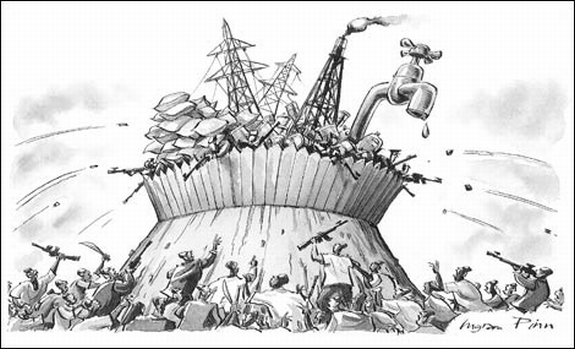
The global battle for food, oil and water

comingconflicts.jpg
Soccer crowds in England like to abuse match referees by chanting: “You don’t know what you’re doing.” If protesters had been able to get near the World Economic Forum in Davos last week, they could justifiably have aimed the same chant at the world leaders who assembled in the Alps.

These people are meant to be the “masters of the universe”: presidents, prime ministers, bankers, billionaires. If anybody can make sense of world events, it should be them. But the air of confusion in Davos was both palpable and alarming.

The meeting took place against a background of crashing stock markets, panicky interest-rate cuts and a massive bank fraud. The global financial system is now so complicated that nobody really knows how deep its problems run. This central “known unknown” means that all the subsequent big questions are much harder to answer. Will America face a serious recession? It all depends. How bad will the knock-on effects be for the rest of world? Search me. How should politicians and regulators react? Difficult to say. [complete article]

Population growth is a threat. But it pales against the greed of the rich

…if we accept the UN’s projection, the global population will grow by roughly 50% and then stop. This means it will become 50% harder to stop runaway climate change, 50% harder to feed the world, 50% harder to prevent the overuse of resources. But compare this rate of increase with the rate of economic growth.

Many economists predict that, occasional recessions notwithstanding, the global economy will grow by about 3% a year this century. Governments will do all they can to prove them right. A steady growth rate of 3% means a doubling of economic activity every 23 years. By 2100, in other words, global consumption will increase by about 1,600%. As the equations produced by Professor Roderick Smith of Imperial College have shown, this means that in the 21st century we will have used 16 times as many economic resources as human beings have consumed since we came down from the trees.

So economic growth this century could be 32 times as big an environmental issue as population growth. And if governments, banks and businesses have their way, it never stops. By 2115, the cumulative total rises to 3,200%, by 2138 to 6,400%. As resources are finite, this is of course impossible, but it is not hard to see that rising economic activity – not human numbers – is the immediate and overwhelming threat. [complete article]

The black box economy

The past year has been a harrowing one for the world’s financial markets, shaken by subprime crises, credit crunches, and other ills. Things have only gotten stranger in the past week, with stock prices swinging wildly in every major market – drastically down, then back up.
more stories like this

Last week the Federal Reserve announced the biggest cut in overnight lending rates in more than two decades. Congress, not to be outdone, is slapping together a massive deficit spending package aimed at giving the economy an emergency booster shot.

Despite the anxiety, nobody is stockpiling canned goods just yet. The prevailing assumption in today’s economy is that recessions and bear markets come and go, and that things will work out in the end, much as they have since the Great Depression. That’s because there’s a collective confidence that the market is strong enough to correct itself, and that experts in charge of the financial system will understand how to mount a vigorous defense.

Should we be so confident this time? A handful of financial theorists and thinkers are now saying we shouldn’t. The drumbeat of bad news over the past year, they say, is only a symptom of something new and unsettling – a deeper change in the financial system that may leave regulators, and even Congress, powerless when they try to wield their usual tools. [complete article]

Facebooktwittermail

OPINION: Terrorism, Iraq, and the facts on the ground

Normalizing air war from Guernica to Arab Jabour

For those who know something about the history of air power, which, since World War II, has been lodged at the heart of the American Way of War, that 100,000 figure [– the quantity of explosives dropped on Arab Jabour south of Baghdad last week –] might have rung a small bell.

On April 27, 1937, in the midst of the Spanish Civil War (a prelude to World War II), the planes of the German Condor Legion attacked the ancient Basque town of Guernica. They came in waves, first carpet bombing, then dropping thermite incendiaries. It was a market day and there may have been as many as 7,000-10,000 people, including refugees, in the town which was largely destroyed in the ensuing fire storm. More than 1,600 people may have died there (though some estimates are lower). The Germans reputedly dropped about 50 tons or 100,000 pounds of explosives on the town. In the seven decades between those two 100,000 figures lies a sad history of our age. [complete article]

The state of the (Iraqi) union

The George W Bush-sponsored Iraqi “surge” is now one year old. The US$11 billion-a-month (and counting) Iraqi/Afghan joint quagmire keeps adding to the US government’s staggering over $9 trillion debt (it was “only” $5.6 trillion when Bush took power in early 2001).

On the ground in Iraq, the state of the union – Bush’s legacy – translates into a completely shattered nation with up to 70% unemployment, a 70% inflation rate, less than six hours of electricity a day and virtually no reconstruction, although White House-connected multinationals have bagged more than $50 billion in competition-free contracts so far. The gleaming reconstruction success stories of course are the Vatican-sized US Embassy in Baghdad – the largest in the world – and the scores of US military bases.

Facts on the ground also attest the “surge” achieved no “political reconciliation” whatsoever in Iraq – regardless of a relentless US corporate media propaganda drive, fed by the Pentagon, to proclaim it a success. The new law to reverse de-Ba’athification – approved by a half-empty Parliament and immediately condemned by Sunni and secular parties as well as former Ba’athists themselves – will only exacerbate sectarian hatred. [complete article]

Al Qaeda loves Bush: Thanks for the free advertising

It shouldn’t come as a surprise at this point that the president uses al Qaeda as code. Last night, in his State of the Union address, he mentioned al Qaeda 10 times, terrorism 23, extremism eight, Osama bin Laden once. Sure we are fighting a war against terrorism, and al Qaeda is always a ready reminder of Sept. 11. But the president uses this code as much to describe our wars in Iraq and Afghanistan, and, in that, he purveys a brand of confusion and surrender.

First, confusion: Al Qaeda in Iraq, whatever it is, is just one of many organized groups fighting the United States and its military coalition, fighting the Iraqi government, and seeking to create enough chaos and insecurity to defeat both. Since the very beginning of the Iraq war, when Donald Rumsfeld dismissed those attacking U.S. troops as “dead enders” and Baathists, the American description of the enemy in Iraq has contained an element of self-deception: if the enemy were just Saddam recalcitrants, then we could convince ourselves that everyone else welcomed us and was on our side.

Since Iraq started going downhill, we have described those fighting against U.S. forces as Shia and Sunni extremists, Iranian-backed militias, foreign fighters, even criminals and opportunists. By the time Abu Musab al-Zarqawi emerged as an identifiable leader, al Qaeda had stuck as the most useful label. It didn’t always apply, and it unfortunately connoted command and control of the Iraqi insurgency against U.S. occupation from some mountain headquarters in Afghanistan or Pakistan, but U.S. spokesmen have become extremely careful never to say Iraqis attacked U.S. forces. [complete article]

Facebooktwittermail

OPINION & INTERVIEW: Hamas takes the lead

Finally, a popular uprising

The fall of the Rafah wall was a fitting combination of planning and the precise reading of the social and political map by the Hamas government, mixed with a mass response to the dictates of the overlord, Israel.

Quite a few people in Rafah knew that “anonymous figures” had secretly been destablizing the foundations of the wall for several months, so that it would be possible to knock it down easily when the time came – but the secret didn’t leak. The hundreds of people who began leaving Palestinian Rafah right after the wall was breached did so despite the risk, and the precedent of the Egyptians shooting at those who infiltrate through the border.

The leadership and public of Gaza, as two elements of the occupied people, were partners in the courageous and necessary step of breaking the Israeli rules of the game. The breach of the wall is a clear manifestation of the conception and temperament of a popular resistance among the Palestinian people, which for various reasons, were dormant in recent years. [complete article]

The world according to Hamas

Foreign Policy: What is your opinion of the Annapolis peace process?

Khaled Meshaal: We were hoping there would be American seriousness in achieving peace in the region. But I regret to say that the behavior of the American administration does not reflect that there is seriousness. Even right after Annapolis, [Israeli Prime Minister Ehud] Olmert expanded the settlements in the occupied West Bank and East Jerusalem. The American reaction to that was very weak. Olmert is taking the same path that [former Prime Minister Ariel] Sharon took previously, which was defined by the “Four Nos”: no to Jerusalem; no to the right of return; no to the borders of 1967; and no to dismantling the settlements. This path will lead to neither peace nor security in the region, nor to a Palestinian state. [complete article]

Facebooktwittermail

NEWS & ANALYSIS: The geopolitical turbulence centered in Pakistan

U.S. plays matchmaker to Pakistan, Israel

[A] geopolitical turbulence … is steadily enveloping the South Asian region. Much of the turbulence is being commonly attributed to the concerns of the international community over radical Islam and terrorism in the region or over the safety of Pakistan’s nuclear weapons or of the specter of the Pakistani state withering away into anarchy under the sheer weight of its current political difficulties. But the factors underlying the volatility go deeper than that.

What is becoming apparent is that a series of maneuvers by regional powers is gradually building up in the coming period. Arguably, the heightened tensions around Pakistan are as much a symptom of these geopolitical maneuvers as of an intrinsic nature. Democracy deficit, political assassination, ruling elites, misgovernance, corruption, popular alienation, poverty and economic disparity, religious fanaticism – these are common to almost all countries of the South Asian region. Pakistan is certainly not an exception.

At the epicenter of the geopolitical turbulence in the region lies the rapidly expanding strategic partnership between the United States and India. The developing US-India strategic axis is triggering a large-scale realignment among regional powers, especially involving Pakistan.

As a leading commentator of the official Russian news agency put it recently, “Not without help from the great powers, India has gone so far ahead in the sphere of arms that it is pursuing its national interests from the Persian Gulf to the Malacca archipelago. Islamabad justifiably believes that the United States is ready to support India’s claims to the status of a world power in exchange for its efforts to deter China and Iran … [while] Pakistan still remains the main partner of the United States and Western Europe in the region’s anti-terrorist coalition.” [complete article]

U.S. homes in on militants in Pakistan

Another piece of the United States’ regional jigsaw is in place with the completion of a military base in Afghanistan’s Kunar province, just three kilometers from Bajaur Agency in Pakistan’s Federally Administered Tribal Areas.

Pakistani intelligence quarters have confirmed to Asia Times Online that the base, on a mountain top in Ghakhi Pass overlooking Pakistan, is now operational. (This correspondent visited the area last July and could clearly see construction underway. See A fight to the death on Pakistan’s border Asia Times Online, July 17, 2007.)

The new US base is expected to serve as the center of clandestine special forces’ operations in the border region. The George W Bush administration is itching to take more positive action – including inside Pakistan – against Pakistani Taliban and al-Qaeda militants increasingly active in the area and bolstering the insurgency in Afghanistan. [complete article]

Pakistani Taliban grows bolder, taking fight to doorstep of frontier city

Islamic militants known as the Pakistani Taliban have extended their reach across all seven of Pakistan’s frontier tribal regions and have infiltrated Peshawar, the provincial capital, heightening U.S. concerns that an insurrection may be broadening in the nuclear-armed nation.

Fighting over the weekend spilled into previously peaceful parts of the tribal belt that borders Afghanistan and intensified in South Waziristan, Bajour and Mohmand. In Bannu, southwest of Peshawar, gunmen fleeing police took dozens of schoolchildren hostage for several hours Monday before tribal elders brokered a deal offering them safe passage, state-run television reported.

“It’s worsening day by day,” said Safraz Khan, a political scientist at the University of Peshawar. “People feel vulnerable. People feel scared.” [complete article]

See also, 12 die in missile attack in Pakistan (WP), Shootout echoes across Pakistan (Asia Times), and Ashdown withdrawal leaves hole in Afghan effort (Reuters).

Facebooktwittermail

FEATURE: Blackwater

Showdown in Blackwater’s backyard

Marshall Adame is a Democrat running for Congress in North Carolina’s 3rd District, a jurisdiction along the Tar Heel state’s low-lying eastern coast that is home to the U.S. Marine Corps’ Camp Lejeune, Air Station Cherry Point, and Seymour Johnson Air Force Base, as well as Blackwater Worldwide’s 7,000-acre corporate headquarters and training facility. Adame is an underdog in the congressional race, where he will likely face seven-term Republican incumbent Walter B. Jones—who brought the term “freedom fries” to Congress—in the general election. Jones has since become an opponent of the Iraq war, atoning for his vote to authorize the war by writing letters of condolence to the families of dead soldiers—a “mea culpa to my Lord,” he says. But the incumbent and his Republican party are not the only obstacles Adame will have to overcome if he hopes to take over the 3rd District’s congressional seat. He also faces tough opposition from Blackwater. [complete article]

Pioneering Blackwater protesters given secret trial and criminal conviction

Last week in Currituck County, N.C., Superior Court Judge Russell Duke presided over the final step in securing the first criminal conviction stemming from the deadly actions of Blackwater Worldwide, the Bush administration’s favorite mercenary company. Lest you think you missed some earth-shifting, breaking news, hold on a moment. The “criminals” in question were not the armed thugs who gunned down 17 Iraqi civilians and wounded more than 20 others in Baghdad’s Nisour Square last September. They were seven nonviolent activists who had the audacity to stage a demonstration at the gates of Blackwater’s 7,000-acre private military base in North Carolina to protest the actions of mercenaries acting with impunity — and apparent immunity — in their names and those of every American. [complete article]

Facebooktwittermail

OPINION: The false dichotomy of security versus privacy

What our top spy doesn’t get: Security and privacy aren’t opposites

We’ve been told we have to trade off security and privacy so often — in debates on security versus privacy, writing contests, polls, reasoned essays and political rhetoric — that most of us don’t even question the fundamental dichotomy.

But it’s a false one.

Security and privacy are not opposite ends of a seesaw; you don’t have to accept less of one to get more of the other. Think of a door lock, a burglar alarm and a tall fence. Think of guns, anti-counterfeiting measures on currency and that dumb liquid ban at airports. Security affects privacy only when it’s based on identity, and there are limitations to that sort of approach.

Since 9/11, two — or maybe three — things have potentially improved airline security: reinforcing the cockpit doors, passengers realizing they have to fight back and — possibly — sky marshals. Everything else — all the security measures that affect privacy — is just security theater and a waste of effort. [complete article]

Facebooktwittermail